Everyone standing in that garage believed the man in the oil stained jacket would snatch up the check without a second thought. Half a million dollars sat on the workbench in front of him. Folded once, pressed flat by a woman who had never in her life been told no. Celeste Winthrop pushed the check forward and said only one thing. "Save my father's car, whatever it costs."
The mechanic did not smile, did not reach for the paper, did not even glance at the number written across it. He picked up a pen instead. And on a torn service ticket, he wrote a figure so small that the room seemed to lose its breath. fifteen dollars. Nobody in that garage understood how a man living paycheck to paycheck could turn away a fortune that might change his life forever. Not until the secret her father had buried for thirty years finally turned over with the first cough of the engine.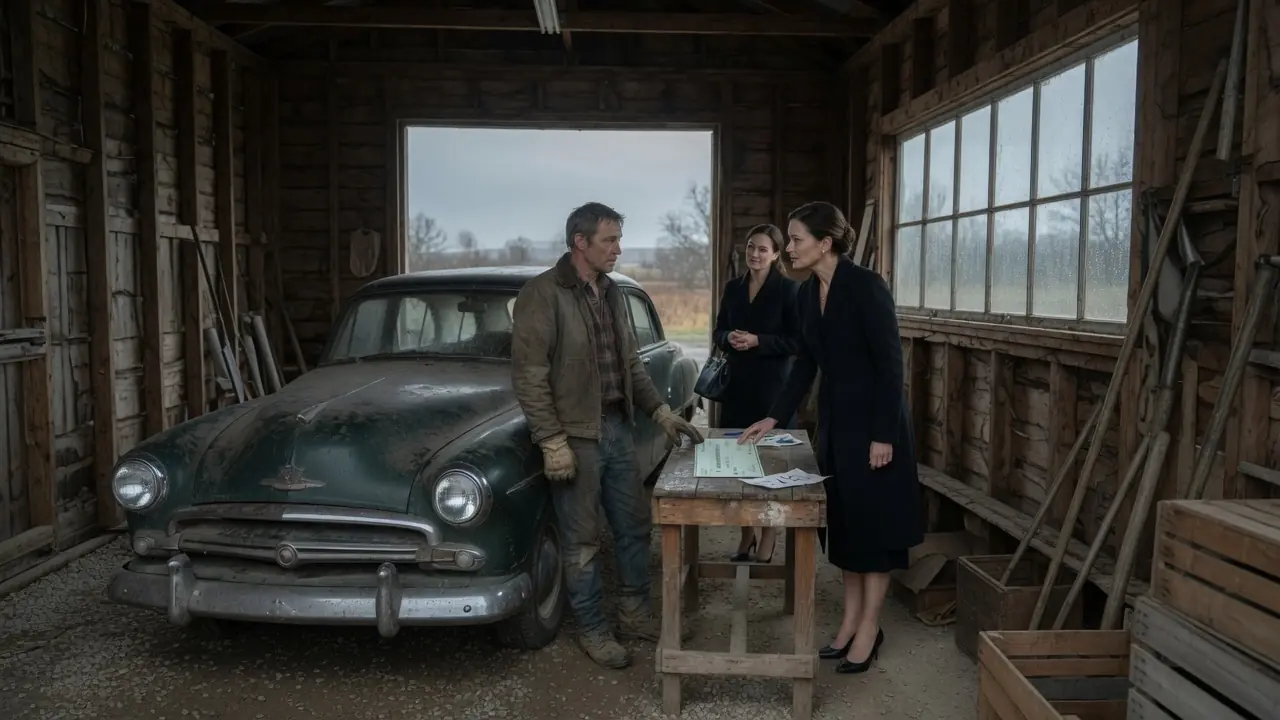
Dorian Ashcraft never learned to raise his prices. And by 41 years old, he had stopped trying. He opened the garage every morning before the sun cleared the ridge line. Alone, boots crunching over gravel, still stiff with frost, breath fogging in the cold Montana air. Late autumn had settled over the valley the way it always did, gray and patient, rain falling in thin threads that never quite committed to becoming a storm.
There was no sign out front worth reading, no website, no listing in any directory a stranger might stumble across. The only customers who ever found him were the ones who already knew. Men and women who drove old trucks and older sedans, machines with dents and stories and something worth keeping alive. He never took in anything new. New cars, he used to say, still had their whole lives ahead of them, and they did not need him.
It was the tired ones, the forgotten ones, the cars that still had a little breath left in their lungs that pulled him out of bed at five in the morning. He worked the way other men prayed methodically without needing to explain himself to anyone. His hands moved over bolts and belts with a familiarity that looked almost tender. And the collectors who occasionally tracked him down through whispered recommendations spoke of him afterward in a hushed, careful way, as though describing something they were not entirely sure they had been permitted to witness. He kept no advertisements, no business cards, no glossy folder of before and after photographs to impress prospective clients.
His reputation traveled the way good things sometimes still traveled mouth to mouth, garage to garage. One satisfied owner mentioning his name to another who happened to need him most. A regular customer leaned against the door frame. One gray Tuesday watching Dorian tighten a bolt with the same worn leather gloves he had used for a decade. "You should raise your rates," the man said, half joking, half serious.
"Everybody in three counties knows you're the only one who can bring these old engines back from the dead." Dorian only laughed, low and quiet. "The kind of laugh that ended before it really began. "If the car still wants to run," he said, "it'll tell me. If it doesn't, no amount of money is going to change its mind."
The customer shook his head and left it there because that was always how conversations about money ended with Dorian Ashcraft. Somewhere between confusion and grudging respect, he lived alone above the garage in two small rooms that held almost nothing beyond a bed, a stove, and a shelf of manuals so worn their spines had cracked and softened like leather. His wife had passed years earlier, and in the time since he had folded whatever grief remained into the rhythm of his work, letting engines and gaskets and timing belts absorb the hours that might otherwise have sat too heavy and too empty. He never spoke of her to strangers, and the few who knew enough to ask learned quickly enough not to. Some losses, he seemed to believe, were meant to be carried quietly rather than displayed, the way he carried everything else that mattered to him.
And that more than any skill with a wrench, was the reason his name traveled quietly from one garage to another across three states, Three hundred miles away, in a funeral home built of dark wood and colder silence. Celeste Winthrop stood over her father's casket in a black coat that cost more than most people's monthly wages, feeling nothing but the strange hollowness of a woman who had spent her whole life being certain and was for the first time completely lost. The service ended the way these things always end, with strangers offering condolences they did not mean and family members counting the minutes until they could leave. Board members shook her hand and murmured about legacies and continuity, already circling the question of who would steer the company forward, as though her father's body had not even finished settling into the earth. Afterward, the family lawyer handed her a single set of keys, old and worn smooth by decades of use.
That, he said, was the whole of what her father had specifically requested she receive. Not a share of the company, not a wing of the estate, just the keys to an old car parked for years in a garage none of them ever visited. Celeste turned the keys over in her palm, cold metal against cold skin, and felt something close to insult rise up beneath her grief. A woman who managed billions in assets, who negotiated with senators and steel magnates without blinking, had just been handed a set of car keys as though they were meant to answer every question she carried. There was no letter of explanation folded beside the keys, no accounting of assets, nothing that made sense to a woman who ran a real estate empire worth billions and understood every clause of every contract that crossed her desk.
There was only a small note handwritten in her father's shaking, late-life script tucked into the glove box where the lawyer said he'd found it. Her father had written, "If the car still starts, you'll understand." Celeste read those seven words three times in the parking lot before she allowed herself to cry quietly. The way people cry when nobody taught them how to do it properly. She did not know what the car had to do with understanding anything.
She only knew that for the first time in years, her father had left her a question instead of an answer, and something in her refused to let it go unanswered. By the time she climbed into the back of her car that evening, her decision was already made. She would find whoever could bring that engine back to life, no matter what it cost her, because some stubborn part of her believed the note was not really about the machine at all. She spent the drive home scrolling through old memories rather than messages, trying to recall the last time she had actually sat inside that car and realized with some quiet horror that she could not remember a single occasion. It had simply always been there, parked and waiting. a fixture of her father's life she had never once thought to question while he was alive to answer for it.
That night she sat alone in an apartment far too large for one person. The note from the glove box propped against a glass of untouched wine, reading those seven words again and again until they stopped resembling English and became simply shapes on a page. Her assistants had already begun compiling lists of the finest restoration specialists on the coast. men with polished showrooms and international reputations. Certain that money alone would settle the matter within the week. Celeste found herself unconvinced.
Her father had never once in his life done anything without a precise and deliberate reason. And a man who built an empire on details was unlikely to have chosen a nameless country garage by accident. The old sedan arrived on a flatbed two days later, and the men who unloaded it into Dorian's gravel lot did their best not to laugh at the building around them with its sagging tin roof and its single bare bulb swinging from a wire. One of Celeste's assistants, a sharply dressed young man, who clearly felt the whole errand was beneath him, made the first offer without even waiting for Celeste's instruction, tossing out one hundred thousand dollars as if it were pocket change tossed to a street performer. Dorian did not answer.
The number rose to 200,000, then 300. Each offer delivered with the same brisk business-like confidence, as though enough zeros could force any door open. Dorian kept his eyes on the car the entire time, running a bare hand along the fender, feeling for something none of them could see. The assistant grew visibly irritated at the silence, muttering something about small town men who did not understand real money and suggested to Celeste quietly, but not quietly enough that they simply find someone in the city who would be grateful for the business. Celeste ignored him.
She had built her entire career reading rooms, sensing the exact moment when a negotiation shifted its weight, and something in Dorian's stillness told her this was not a man withholding a price out of strategy. It was only when she herself walked into the garage, her heels sinking slightly into the gravel, that the room fell quiet. She placed the check on the workbench herself this time, five hundred thousand dollars, and repeated the only instruction that mattered to her. "Just make it run." Dorian looked at the car far longer than he looked at the check, his eyes moving over the hood, the tires, the faint rust blooming along one wheel well before he finally spoke.
"I don't sell time," he said, simple and unhurried. "And for a moment, everyone in the garage assumed he was negotiating, angling for more, playing some game that men like him were not supposed to know how to play. Instead, he reached for a ticket pad and wrote a single line. fifteen dollars. The number sat there on the paper. Absurd and impossible.
And the silence that followed had weight to it. The kind of silence that makes grown men shift their feet and look away. Celeste stared at the ticket, then at him, searching his face for the trick. She was certain a trick must be hiding somewhere underneath it. fifteen dollars did not repair anything. Not in her experience, not in a world where every favor eventually came with an invoice attached.
She had spent her career surrounded by men who inflated every estimate the moment they sensed real money in the room, contractors and consultants and advisers who could smell wealth the way some animals smell rain. And none of them had ever once undercharged her by a single cent. The number on that ticket did not fit into any framework she had ever operated inside. And for a woman who prided herself on understanding every angle of every deal, that alone was more unsettling than any refusal could have been. ""You knew my father," she finally said. "Not quite a question, though it came out sounding like one, because something in the way Dorian looked at that car told her this was not the first time he had ever seen it."
He did not confirm or deny it. He only turned back toward the vehicle, already rolling up his sleeves, already somewhere else entirely in his mind. And Celeste found herself standing in the doorway of a stranger's garage, feeling more unsettled than she had felt at any point since the funeral. Dorian did not answer her question. Not yet.
Instead, he rolled the car into the bay and began the only way he knew how to begin, by listening rather than assuming. He did not touch the engine first. He did not check the transmission, the wiring, the fuel lines, all the obvious places where a machine might have quietly given up. He crouched beside each wheel. Instead, running his fingers along bolts that had clearly been tightened by careful hands, not by a mechanic rushing through a job, but by someone who loved the machine enough to check it again and again, year after year, long after most owners would have grown bored of the ritual.
Every screw was exactly where it should be. Every hose had been replaced before it had the chance to crack. Somebody had cared for this car with a devotion that went far beyond ordinary maintenance. The kind of devotion usually reserved for something alive. Dorian worked in silence for the better part of an hour.
And Celeste, against every instinct that had built her career, found herself simply watching him rather than pushing for updates or timelines the way she pushed everyone else in her life. She sat on an overturned crate near the door, still in her funeral coat, watching a stranger's hands move over her father's car with more patience than she had ever seen her father spend on anything, including her. The assistant eventually gave up pacing and simply stood near the entrance with his arms folded, and even he grew quiet after a while, sensing that something was unfolding in that garage that had nothing to do with quarterly earnings or client relations. Outside, the rain thickened slightly against the windows, and the whole world seemed to narrow down to the small circle of light above the workbench, where Dorian knelt beside the car. Then, deep inside the engine bay, half hidden beneath a layer of grime, Dorian found a small mark stamped into the metal, a symbol he recognized instantly because there were only a handful of people alive who had ever learned to leave it.
It was the private signature of a restoration craftsman who had vanished from the trade decades earlier. A man whose work collectors still spoke about in hushed, reverent tones, though almost nobody had ever met him. Dorian straightened up slowly, staring at the mark. And for the first time that day, something like genuine surprise crossed his face. He wiped his thumb across the stamp again, as if the grime might have tricked him and found the shape unchanged beneath the grease.
Celeste noticed the shift immediately. The way his shoulders tightened, the way his eyes lingered on that one small stamp far longer than they had lingered on anything else. She realized in that moment with a discomfort she was not used to feeling, that she had spent her entire adult life certain she understood her father completely, his business instincts, his ruthlessness, his silences at the dinner table. And yet here was proof that an entire private world had existed inside him that she had never once been allowed to see. She rose from the crate without meaning to.
Drawn closer to the engine bay, the way a person is drawn toward a door they suspect has been locked for a very good reason. Dorian finally spoke quiet and careful. "This car has secrets in it," he said, and then he reached beneath the dashboard toward a panel that to anyone else would have looked like nothing more than ordinary trim. His fingers found a seam that should not have existed, and with a gentle push, a small compartment clicked open, hidden so cleverly that even the most thorough inspection would have missed it entirely. Celeste leaned forward without meaning to, her breath catching, because whatever her father had built into this car, he had built it to be found only by someone who truly knew what they were looking for.
There was no money hidden inside that compartment. There was no jewelry, no stack of bonds, nothing that matched the picture of a man who had built one of the largest fortunes in the country. Instead, there was an old key, small and unremarkable, the kind that might open nothing more dramatic than a shed door. Beside it lay a folded, hand-drawn map, its creases worn soft from being opened and closed a thousand times, and beneath both of those sat a thick leather notebook. Its cover cracked with age, clearly carried on a hundred long drives across a hundred forgotten roads.
Celeste opened the notebook with trembling hands, expecting maintenance records, oil changes, tire rotations, the dry language of managing a machine. What she found instead were entries written like a private journal dated across more than three decades. each one describing not the car itself but the places it had taken him, the towns he had passed through, the thoughts he had allowed himself only when he was alone behind that wheel. There were nights, she read, when her father had driven thousands of miles without telling a single person where he had gone, slipping away from meetings and dinners and the endless demands of his empire to disappear into highways that led nowhere in particular. Some entries were only a sentence long. A place name and a feeling.
A diner outside Missoula where the coffee reminded him of something he refused to name. A stretch of empty highway in Wyoming where he said out loud to no one that he missed his daughter. Other entries ran for pages. Small confessions about mistakes made in boardrooms. Apologies he had rehearsed but never delivered. plans for conversations with Celeste that he clearly kept postponing year after year until postponement itself became the only plan he had left.
She found a passage describing a diner waitress in a small Idaho town who had once refused to let him pay for a slice of pie, insisting he looked like a man who needed kindness more than change, and how he had sat in his car afterward for nearly an hour, unable to explain to himself why such a small gesture had undone him so completely. There were sketches, too, rough and untrained, of mountain ranges and grain silos, and a single covered bridge he had apparently returned to visit every autumn for eleven consecutive years without ever once mentioning the place to anyone in his family. None of it matched the man she thought she had buried 2 days earlier. The father she knew canceled family vacations for board meetings, missed birthdays for closing deals, and measured his worth entirely in numbers on a balance sheet. This notebook belonged to someone else entirely.
Someone who found in the hum of an old engine and the blur of open road the only peace he seemed able to locate anywhere in his overbuilt, overscheduled life. Celeste turned page after page, searching for some clue as to why he had never once mentioned any of this to her. Why an entire secret decade of his life had unfolded in silence while she assumed she knew every part of him worth knowing. She reached the final entry almost without meaning to. her thumb catching the last written page before the notebook ran empty. The handwriting there was shakier than the rest, written closer to the end, the letters trembling slightly, the way a hand does when the body carrying it has begun to fail.
And there at the bottom of that final page was a name she had never expected to find anywhere near her father's private world, Dorian Ashcraft. Celeste looked up from the notebook slowly, her eyes finding the mechanic across the garage and understood that whatever connected these two men went back far further than either of them had led on. The story that unfolded from there reached back thirty years to a version of her father who had not yet become the hardened businessman she grew up, fearing and admiring in equal measure. He had been younger then, still climbing, still learning the cost of every ambitious decision he made. And on one particular winter drive through the Montana mountains, his car had simply died beneath him, stranded on an empty stretch of road where no help seemed likely to arrive before dark.
The snow had begun falling sideways by the time he accepted that no passing driver was coming, and he stood beside the hood with his hands in his coat pockets. A man of considerable means, suddenly reduced to nothing more than someone very cold and very stuck. It was there, half frozen and fully humbled, that he met a young man, barely out of his teens, poor by any measure, who happened to be walking that same road with nothing but a toolbox and a willingness to help a stranger. That young man was Dorian, and he fixed the engine that night without asking for a dime, working by flashlight in the freezing cold, because it never occurred to him that kindness should come with a price tag. He had simply seen a stranded car and a shivering man, and done what anyone with the right tools ought to do, without weighing what it might mean or what it might one day be worth.
Her father, shaken by the gesture and unused to receiving anything for free, insisted on paying him something, anything, for the trouble. Dorian refused every time the offer was made, waving it off the way he waved off every offer of payment that felt disproportionate to the work itself. frustrated and moved in equal measure. Her father finally said the only thing that felt true in that moment. "If we ever meet again," he told him, "I'll pay you back properly." Dorian, being the kind of man who fixed things and moved on without keeping score, forgot the encounter almost entirely within a few years.
One stranded traveler among many, he had quietly helped over a long career of roadside kindness. Her father, however, never forgot a single detail of that freezing night. carrying the memory with him through every merger, every deal, every year of building an empire that made him rich beyond imagination. But somehow never quite as whole as he had felt standing beside that broken down car in the dark. He had gone back to that stretch of road more than once over the years. Celeste would later learn, searching quietly for the young mechanic, who had vanished into the mountains as quickly as he had appeared, never quite finding him until Fortune, or something like it, finally arranged the meeting on its own terms.
Twice he had hired investigators to trace the name of a mechanic who had worked that region decades earlier. and twice the trail had gone cold in towns too small to keep proper records until at last he simply resigned himself to carrying the debt privately. The way some men carry a stone in their pocket long after the reason for picking it up has faded. Celeste, hearing the story now secondhand through a notebook and a stranger's careful retelling, finally began to understand why her father had clung so fiercely to this one old car for thirty years, refusing every offer to sell it, refusing even to let it be photographed for the family archives. It was not a possession to him. It was a debt he had never been allowed to repay, and a version of himself he had never quite managed to become again.
Dorian returned to the engine with new eyes after that, moving slower now, more deliberate, because he understood he was no longer simply repairing a machine, but uncovering something a dying man had spent his final years carefully constructing. As he worked deeper into the engine bay, he began to notice something that unsettled him more than any ordinary mechanical failure ever could. The engine had not actually broken down the way everyone assumed. Certain components had been deliberately disconnected, not damaged through neglect or age, but removed with the precision of someone who understood engines intimately and wanted this exact failure to happen at this exact moment. This was not sabotage in any cruel sense.
It was closer to a puzzle engineered by a man who knew that only someone with real skill and real patience would ever bother looking past the surface explanation to find what lay beneath it. Whoever eventually opened this engine with enough care to notice the deliberate gaps was meant to keep looking, meant to push further than a simple repair required. It struck Dorian, as he traced the pattern of the disconnections, that this had been built the way a good lock is built, not to keep everyone out, but to open only for the one person patient enough to turn every tumbler in the right order. Dorian, guided by decades of instinct rather than instruction, reached toward a section of the firewall that had no obvious reason to be loose. And there, tucked into a space no factory blueprint would ever account for, he found an envelope sealed and yellowed slightly with age.
Celeste's name was written across the front of it in her father's unmistakable hand. The same shaking script from the notebook's final page, and she took the envelope from Dorian with fingers that had gone suddenly cold. She did not open it immediately. She simply held it for a long moment, staring at her own name written by a man who had spent her entire childhood too busy to write her so much as a birthday card. And something inside her chest tightened painfully at the strangeness of it all.
When she finally broke the seal and unfolded the letter, her father's confession began plainly without the polish or careful phrasing he used in every boardroom she had ever watched him command. He admitted in words far simpler than she expected from a man who negotiated billion-dollar deals for a living that he had spent so many years chasing money that he had lost the family he was supposedly building all that wealth to protect. He wrote that the hours behind the wheel of that old car were the only place in his adult life where he felt like himself again unburdened by boardrooms and shareholders and the endless performance of being someone important. he described in a passage Celeste would read again and again in the weeks that followed. The particular quiet of an empty highway at dawn, the way the engine's steady rhythm let his mind finally rest instead of calculate. The way a stretch of open road never once asked him to be anyone other than exactly who he was.
He apologized to her plainly without excuses. For every missed dinner and every canceled trip and every conversation he had postponed until it was simply too late to have it, he wrote that pride had kept him from calling her more than once, certain that time would eventually offer a better moment than the one currently in front of him, never once suspecting how quickly time would run out entirely. And then in the final paragraphs, he explained the real reason he had asked Dorian through this elaborate arrangement to bring the car back to life. It was never meant to be sold, restored, only to sit gleaming and untouched in some private collection. It was meant to run again so that Celeste herself could finish the roads he had never gotten the chance to finish. to drive the journey he had started but never completed.
Carrying forward whatever unfinished part of him still lived inside that engine. Celeste read the letter twice through tears she made no effort to hide. Standing in a garage that smelled of oil and cold metal surrounded by strangers who suddenly felt less like strangers and more like witnesses to something private finally being set right. And yet, even with the letter fully read and the truth fully understood, the car itself still sat silent in the bay, its engine dark, waiting for one final piece before it would ever agree to run again. Dorian worked through the last hour of daylight with the quiet focus of a man closing a circle three decades wide.
Rain had begun again outside, tapping softly against the tin roof, and the single bulb overhead swung just slightly with the draft. Throwing shadows that stretched and shrank across the concrete floor, he traced the wiring back to its source, confirmed what the deliberate disconnections had been protecting, and settled finally on the one component that had been worn down by genuine time rather than deliberate design. It was nothing dramatic, nothing that required rare parts or specialized machinery. A single rubber gasket aged and cracked from thirty years of quiet service was the only thing standing between this engine and the sound it was built to make. Somewhere behind him, the assistant, who had offered three hundred thousand dollars only hours earlier, stood watching with his mouth slightly open, unable to reconcile the size of the moment with the size of the part now resting in Dorian's palm.
He priced the part honestly, the way he priced everything without inflating a single cent to match the moment's emotional weight, fifteen dollars. He was not performing modesty for an audience, and he was not making some grand statement about the meaninglessness of money. He simply believed, the way he had always believed, that a repair should cost exactly what the repair required. Nothing borrowed from the size of someone's wallet or the size of someone's grief. He installed the gasket carefully, checked every connection one final time, wiped his hands on a rag gone gray from years of use, and then reached for the key that had waited patiently in that hidden compartment for longer than most people wait for anything.
He turned it slowly, giving the engine every chance to remember itself. For one long suspended second, nothing happened at all, and the whole garage seemed to hold its breath along with Celeste. The assistant who had spent the afternoon scoffing at the offer, stood frozen by the door, check forgotten in his jacket pocket, watching the same as everyone else. Then, low and rough at first before settling into something warm and steady, the engine caught, and the sound that filled the room was unmistakably alive. The deep, familiar hum of a machine that had waited thirty years to speak again.
Celeste closed her eyes the moment she heard it, because that particular sound reached backward through decades into a childhood memory she had almost forgotten she had, riding beside her father on some ordinary Sunday afternoon before ambition had fully claimed him. She could not have said in that moment whether the tears came from grief or relief or some third feeling with no proper name at all, only that they came freely and without any of the composure she had spent her entire career perfecting. She wept without embarrassment, standing in a stranger's garage in her expensive black coat, listening to a fifteen dollars repair undo thirty years of silence between herself and a man she would never get to speak to again. When she finally opened her eyes, her hand was already reaching for her phone, ready to transfer the full five hundred thousand dollars, regardless of what number had been written on that ticket, because gratitude this large did not feel like something a torn service slip could contain. Her thumb hovered over the screen.
The transfer was half-typed when Dorian stopped her before she could finish it, his voice quiet but absolutely certain he would not accept it. He told her and this time there was no ambiguity left for anyone in the room to misread as negotiation. Celeste stared at him genuinely bewildered the way she stared at very few people in her professional life and asked him plainly why a man with so little would refuse so much when it was being offered freely and without condition. "Your father already paid," Dorian told her, and reached into a drawer behind the workbench that looked as though it had not been opened in years. Producing an old photograph with edges gone soft and curling from age.
In the picture stood a man Celeste recognized instantly, despite the passage of time. Younger, quieter, standing beside this very garage with a hammer in his hand and a roof half repaired above him. ""Her father had come back," Dorian explained, sometime after that frozen night on the mountain road and had quietly fixed the leaking roof that once let rain pour straight into this workshop. He had replaced broken equipment, too, Dorian continued. Entire tools and machines that Dorian could never have afforded to buy himself. All of it delivered anonymously over the years that followed, credited to no name, explained to no one.
Dorian had only recently pieced together. through careful and quiet investigation of his own, exactly who his mysterious benefactor had been all along, cross-referencing invoices and delivery dates until the pattern finally settled into a single name he had never dared to expect. The man who once refused a stranger's roadside gratitude had spent decades secretly repaying it anyway. in the only language he seemed to trust completely. It was the language of fixing things without asking for credit. The two of them stood together in silence. After that, looking at the car now idling steadily in the bay, its engine finally at peace after thirty years of waiting.
Neither one needed to say anything further for a long moment, because the truth sitting between them was already louder than any conversation could have been. Outside, the rain had softened into something closer to mist, and the single bulb overhead kept swinging its small, patient rhythm above them both, as if the garage itself understood that something had finally been settled. It was Celeste who eventually broke that silence. Her voice steadier now, carrying the particular calm of someone who has just decided something important. She was not going to let this end with a check refused, and a car simply driven away.
She did not try to buy the garage. She understood by now that ownership was never the thing that mattered to a man like Dorian, and offering it would have insulted everything she had just learned about him. Instead, she proposed something different entirely. A foundation built in her father's name, dedicated to preserving old cars, the way her father himself had quietly loved doing. cars with history, cars with stories, cars that deserved more than a scrapyard ending. She described it plainly without the polished language she usually reserved for boardrooms because she sensed that Dorian would trust plain words far more than persuasive ones.
She had learned in the space of a single afternoon that every ounce of persuasion she normally relied upon meant nothing to a man who measured people by the same standard he measured engines by whether they were honest all the way through or only on the surface. She asked Dorian directly and without pressure to serve as the technical heart of that foundation. The one who would decide which machines deserved saving and how. Dorian considered the offer the way he considered everything. slowly turning it over in silence while the engine hummed on beside them and agreed to it on exactly one condition that mattered more to him than any salary or title ever could. Every car repaired under that foundation's name would be repaired with total honesty, priced according to what it actually needed rather than what its owner could afford to pay.
No customer, rich or struggling, would ever be charged a cent more than the truth of the repair demanded. Celeste agreed without hesitation, understanding now that this single principle was the closest thing to a life philosophy the man had ever put into words. Within a few months, the foundation had already taken in a handful of forgotten cars from families who could never have afforded a proper restoration on their own. Each one repaired at exactly the price its repair required, no more and no less, exactly as Dorian had insisted from the very first conversation. Word of the arrangement spread slowly at first, then steadily until people began arriving from towns Celeste had never heard of, drawn less by the promise of expert craftsmanship, than by the simple, almost old-fashioned idea that honesty could still be found behind a garage door.
The following autumn, on a cool afternoon, much like the one that had started this entire story, her father's car rolled slowly down a quiet country road, its engine humming exactly the way it had thirty years earlier, carrying Celeste toward wherever that unfinished journey was meant to lead her next. The mountains rose gray and steady on either side of the road. The same mountains that had once stranded her father in the snow and handed him without warning the one honest friendship he had carried quietly for the rest of his life. She had brought the leather notebook along on the seat beside her. Its cover still cracked with age, and she planned to keep writing in it herself, one small entry at a time, so that whatever conversation she and her father had never finished could continue in some fashion, mile after mile.
She smiled for the first time since the funeral, a small and genuine thing that surprised even her, the wind through the open window carrying away some portion of the grief she had been holding since the day the lawyer handed her those keys. Behind her, Dorian pulled the garage door shut for the evening. The same faded sign creaking gently above the entrance, unchanged and uninterested in ever becoming anything grander than what it already was. A new customer's truck rolled up the gravel drive just as he turned to leave.
Headlights cutting through the early dusk, engine ticking with some trouble the owner probably could not name. Dorian did not sigh, did not check a clock, did not think for even a moment about turning the truck away. He only looked at it the way he looked at every car that found its way to him, with quiet curiosity rather than calculation. Because to him, no machine ever arrived by accident. "Let's see," he said softly, almost to himself, "what story your car has to tell."