The voice came through the loudspeaker mounted on the side of the cruiser. Flat. Practiced. The kind of voice that had never once been questioned in this county and knew it.
“Step away from the vehicle. Right now. Or I will drag you away.”
Tamara DeLoy Wynn did not step away from the vehicle. She kept her hand on the fuel nozzle. She kept her eyes on the side mirror. In the mirror she watched Sheriff Cord Beaumont climb down from his cruiser with the slow, deliberate weight of a man who had made this exact walk before. Many times. Many women. Many mirrors.
He had chosen the wrong woman this time. He just didn’t know it yet.
The afternoon heat at Taggart Fuel and Mart sat on the skin like a wet compress. Highway 41 outside Delwood, Georgia, ran straight and flat in both directions. No shade, no cover. Just the shimmer of asphalt baking under a November sun that hadn’t gotten the message that summer was supposed to be over.
Tamara had pulled off the interstate at twelve minutes past three. She had been on the road since seven that morning, Atlanta behind her. The kind of drive that empties the mind if you let it. She hadn’t let it. She never did.
Before she opened the door of the black Ford Explorer, she did what she always did. She opened the small notebook on the center console—spiral-bound, black cover, the kind sold three for a dollar at any drugstore—and wrote:
*Taggart Fuel and Mart, Highway 41, Delwood, Caldwell County, Georgia. 3:12 p.m. Odometer 47,204.*
She capped the pen. She got out.
The gas station was the kind of place that had probably looked tired in 1987 and had simply continued in that direction. Two pump islands under a canopy that sagged at one corner. A hand-painted sign on the door: *No loitering. Management reserves the right.* The cameras—one facing the road, one facing the register—were newer than everything else on the property. Recently installed. Someone had spent money on those specifically. Tamara noticed. She always noticed.
She slid her card, selected regular, and lifted the nozzle.
Inside the station, through the smudged plate glass, a man sat behind the counter—fifties, sunburned neck, reading glasses pushed up on his forehead. He wasn’t reading anything. He was watching her. She had been watching him watch her since she pulled in. His name was on the sign above the door: Clement J. Taggart. Taggart Fuel and Mart, established 1991. The kind of establishment where the owner’s name was a declaration of ownership in both directions—the property and the county.
He came outside two minutes after she started pumping.
“You need help with something?”
The question floated across the concrete apron like it meant something friendly. It did not.
“I’m fine. Thank you.”
She didn’t look at him.
He stopped at the edge of the canopy shadow, eight feet away, thumbs in the waistband of his jeans. His eyes moved from her face to the Explorer, lingered on the rental company decal on the bumper, then moved back up.
“Rental car,” he said. Not a question.
“Yes.”
“Where’d you pick it up?”
Tamara pumped her gas. The counter ticked forward. She said nothing.
Taggart stood there another moment, as though waiting for the silence to become an answer. Then he turned and went back inside. She watched him in the window. Watched him pick up his phone. Watched his mouth move. Watched him turn his back toward her. The call lasted under thirty seconds.
She wrote the time in her notebook: *3:17 p.m. Taggart, phone call, turned away. Under 30.*
Four minutes later, a county cruiser rolled past the pump island at a speed that was not quite a stop and not quite a pass-through. Deputy Ray Edson, badge number visible at fifty feet, looked at her through the passenger window. The cruiser continued. Did not stop.
She wrote: *3:21 p.m. Unit 14, Caldwell County, passed east to west. Did not stop. Driver observed subject.*
At the corner of the intersection, a second vehicle was already there. And it had been there, she realized, since before she pulled in. A white-and-brown Caldwell County Sheriff’s cruiser, engine idling, parked against the far curb. The driver had not moved. She wrote the plate number. She capped the pen. She kept pumping.
The cruiser at the corner had not moved in nine minutes.
Tamara replaced the nozzle, replaced the gas cap, folded her receipt, and put it in her jacket pocket. She was about to open the driver’s side door when the loudspeaker crackled.
“Attention, operator of Georgia plate Tango Hotel Kilo 441. Remain at your vehicle. This is the Caldwell County Sheriff’s Office. Remain at your vehicle.”
She did not move toward the door.
“Move, Tamara.”
She stood at the side of the Explorer and put both hands where they were visible. Right hand on the roof of the car, left hand at her side, fingers open.
The white-and-brown cruiser pulled forward. Cord Beaumont stepped out.
He was a large man, not tall so much as wide. The kind of bulk that had been muscle at some point and was now simply mass. He wore his uniform tight across the chest and his hat low. He walked toward her with the measured patience of someone who had learned long ago that pace communicated power.
He carried a folder, a thin manila folder, and he did not look at it. He looked at her.
“You the operator of this vehicle?”
He stopped six feet away.
“I am.”
“License and registration.”
“I’ll need to know the basis for the stop first, Sheriff.”
Her voice was even. Not hostile. Not deferential. Even in the way a floor is even—deliberately, structurally level.
Something moved across Beaumont’s face. Not surprise, exactly. More like recalibration.
“I’m asking the questions here.”
“You are. And I’m asking a procedural question.” She let one beat of silence fall. “I’d like to understand the procedure here, Sheriff.”
He stared at her.
“This vehicle was reported to this office as possibly missing. Georgia Crime Information Center. I have a duty to verify.”
“Who reported it?”
He opened the folder and read from a printout. “Georgia plate Tango Hotel Kilo 441. Vehicle status flagged for inquiry as of 0900 this morning.”
“Flagged as missing or flagged for inquiry?”
The distinction was not something he had expected her to make. The folder lowered an inch.
“Flagged for inquiry.”
“I have the rental agreement in the vehicle. Enterprise, Atlanta. Contract number EA-2024-887341. Would that resolve the inquiry?”
“I’ll determine what resolves the inquiry.” He closed the folder. “License.”
“Stay here.”
He turned back toward his cruiser.
She reached into the car, door still open, and took the rental agreement from the console. Folded it once. Held it.
Beaumont was at his cruiser for four minutes. She could see the glow of his dash-mounted computer screen through the windshield. She watched the screen. He typed. He read. He typed again. He picked up the radio handset and spoke into it. A pause. A response she couldn’t hear. And he set the handset down.
He came back.
“Dispatch ran the plate. No active flag.”
He said it the way people say things they don’t want to be true.
“But I’m receiving information that this vehicle may have been taken from the rental lot under irregular circumstances.”
“From whom?”
“That’s an active inquiry.”
“The rental agreement is dated this morning.” She held it out. “Enterprise Atlanta, 6:00 a.m. Pickup location is on the contract.”
He did not take the agreement.
“I’ll need to verify that independently.”
Tamara looked at him for three full seconds. Not performing patience. Not suppressing anger. Just looking. Cataloging. The way she always did. The way she’d done for seventeen years. The way she had done in rooms that made this parking lot feel like a quiet afternoon.
“Well,” she said, “how would you like to proceed?”
He stepped to his left. The move wasn’t toward her. But it was deliberate. Territorial. The kind of repositioning that told you a man was about to expand the radius of what he considered his space.
“I’m going to ask you to step away from the vehicle while I conduct a visual inspection.”
“Do you have a warrant?”
“I don’t need one for a visual inspection of the exterior.”
“The exterior. Not the interior.”
He stopped. The word *interior* had landed somewhere specific.
“Do you have something in the interior you’re concerned about?”
“I have personal property in the interior. I’m clarifying the scope.”
“Step away from the vehicle, ma’am.”
She stepped back two paces. Her hands remained visible.
Clement Taggart had materialized at the edge of the canopy. She registered him in her peripheral vision without turning her head. He stood there with his arms crossed. Not hostile. Just present. A witness who had already chosen a side.
Deputy Edson’s cruiser appeared from the south, parking on the far side of the pump island. Edson stepped out and came to stand behind and to the right of Beaumont—a position that was calculated to put her between the two of them.
Three to one.
She noted the geometry.
Beaumont walked the perimeter of the Explorer. He looked at the plates, front and back. He looked at the windows. He came back around the driver’s side and stopped in front of her.
“I’m going to need you to sign a voluntary statement confirming your cooperation with this inquiry.”
He nodded to Edson. Edson produced a single printed form from the inside of his jacket and placed it on the hood of the car. He put a pen on top of it.
She looked at the form without touching it.
“What is this document?”
“Standard cooperation form,” Edson’s voice was younger than his posture. Mid-twenties. Practiced at sounding bored. “Just confirms you’re cooperating voluntarily.”
She leaned forward slightly and read the form. Line one. Line two. Line three. Her eyes moved steadily down. She did not rush. On line five, she stopped.
“Line five states that I acknowledge the vehicle’s documentation may be incomplete and that I consent to this statement being used in any subsequent legal proceeding.”
She straightened.
“I won’t be signing that.”
“It’s a voluntary form.”
“Then I voluntarily decline.”
Edson glanced at Beaumont and something passed between them. Not words. Beaumont nodded—a single, almost imperceptible drop of the chin. Edson picked up the form and put it back inside his jacket. Then he produced a small notebook of his own and began writing.
She watched the angle of his pen. She had already memorized what she saw.
“Ma’am.” Beaumont’s voice changed register. Lower. Slower. The register he used when he’d finished asking and started telling. “I’m going to ask you one more time to produce the rental documentation and confirm your right to operate this vehicle. If you can’t do that to my satisfaction, I have the authority to detain this vehicle and conduct a more thorough investigation.”
“I offered you the rental documentation fifteen minutes ago.” She held up the Enterprise agreement, still folded in her hand. “And yet you declined to take it.”
Beaumont looked at the paper. He looked at her. Something in his face went the color of new brick. Not fury, exactly. But the cousin of it. The kind that comes when someone has maneuvered you without raising their voice.
He took the agreement. He read it. He handed it to Edson. Edson read it. He folded it. He put it in his shirt pocket.
She watched the pocket.
“That agreement will need to be held as part of the inquiry documentation,” Edson said.
“That’s my document.”
“It’ll be returned.”
“I’d like a receipt for it.”
Edson blinked. “A receipt?”
She held his gaze. “Documenting the item, the time of transfer, and the name of the receiving officer.”
Edson looked at Beaumont.
Beaumont said, “We don’t issue receipts at a roadside stop.”
“Then I’d like it back.”
Edson said nothing. The agreement stayed in his pocket and the pause that followed lasted eight seconds. She counted them.
Then Taggart came off the canopy and walked toward them. Unhurried. Proprietary. A man entering a room that he owned.
He stopped beside Beaumont and addressed him as though Tamara was not standing three feet away.
“Cord, I’m telling you something’s not right here. This car pulled in, no signal, came off the interstate wrong. I’ve been running this station twenty-three years. I know what a regular customer looks like.”
Beaumont said, without inflection, “You’re saying she didn’t signal?”
“Coming off the interstate. She was on private property before she came off the road. I witnessed nothing irregular.”
Tamara looked at the Bi-State pump island. She looked at the sign mounted on the concrete pillar. White background. Red lettering. Weathered at the edges, but legible.
She walked the four steps to the pillar. She read the sign aloud.
“Removal of persons from these premises requires prior notification and refusal to vacate pursuant to OCGA section 16-7-21.”
She turned back. Three men watching her.
“You haven’t asked me to leave,” she said to Taggart. “And you haven’t waited for me to refuse. Both steps are required by the statute you posted on your own sign.”
Taggart stared at her. He looked at the sign. He looked at Beaumont. He looked back at the sign. He unfolded the paper in his hand—wrinkled, handwritten, something he’d apparently carried out here for authority—and looked at it. Then he folded it again. He said nothing.
Beaumont stepped forward.
“Ma’am, I’m placing you under investigative detention while I—”
“Under what authority, specifically?”
“Theft by receiving. You’re in possession of a vehicle that was flagged.”
“The dispatch flag was cleared.” Her voice was the same register it had been the entire time. “Your own dispatch ran the plate and returned no hold and no flag. That response came through at approximately 3:15. You received it on your in-car terminal. That would be in your dispatch log.”
Beaumont went very still.
“I’d like to know,” she said, “what information you received between your dispatch response, which said no hold, no flag, and your decision to invoke section 16-8-7.”
He did not answer.
“Was it a phone call?”
Still nothing.
“From this property?”
Beaumont moved in the same moment that she stopped speaking. Not toward her face. Not a strike. But a grab. His right hand closing on the strap of the bag at her left side and pulling. Hard. The bag jerked. She turned her body with the pull—not resisting, not running, simply rotating so that her right hip came between his hand and the bag’s contents. And the bag settled back against her side without him having it.
“Don’t resist,” he said. The words came out sharp. Too fast.
“I’m not resisting.” Her voice had not changed. She was looking at the camera on the pump island pillar—the one that faced outward, the one that had been recording since she pulled in. “I’m standing still. My feet have not moved.”
Edson stepped around from behind and came in fast from her left, his forearm catching her shoulder from the side with enough force to rock her sideways. Her knee hit the running board of the Explorer. She did not fall. She put her hand on the side of the car and steadied herself. Turned back to face them.
“And that contact will also be visible on the station camera,” she said. “Timestamp approximately 3:43.”
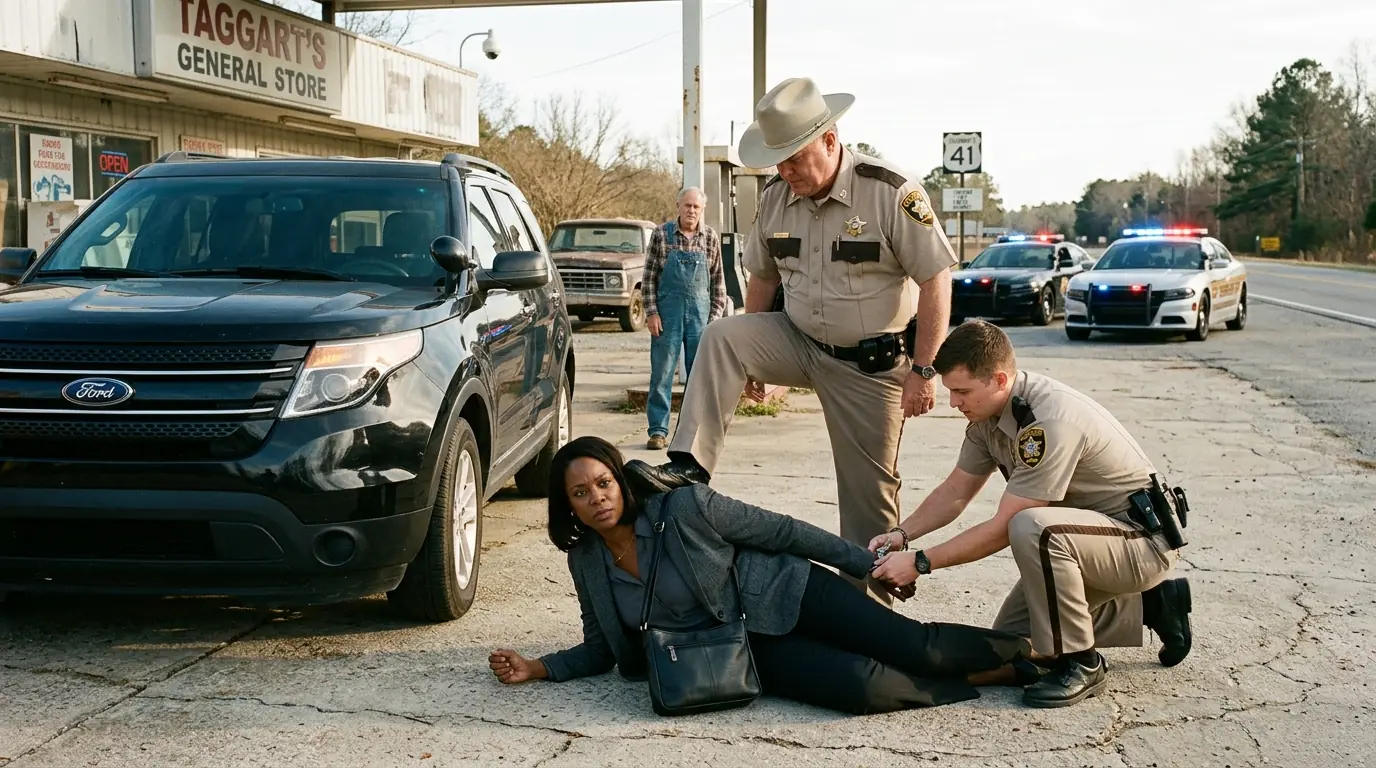
Edson grabbed her left arm. Beaumont grabbed her right. They walked her forward toward the front of the cruiser.
“Hands on the hood.”
Beaumont pressed her forward and she went. Compliance, deliberate. Hands flat on the warm metal.
He leaned in from behind. She felt his weight shift, going for the bag again, reaching around her without announcement. She pivoted on her right foot, stepped left, put eighteen inches between his hand and the bag.
“I will need to document any search of personal property,” she said, “and I’ll need to know whether you have a warrant for that search.”
Beaumont’s hand closed on her shoulder from behind. Not a grab—a shove on the flat of his palm between her shoulder blades, hard enough that her chin nearly touched the hood of the cruiser. Her palms caught the metal. She raised her eyes. She looked straight into the station camera. She held that position—hands visible, body still, eyes forward.
That was all she did.
Beaumont’s voice came from somewhere above and behind her.
“Raymond. Cuffs.”
“I want to note for the record,” she said, her voice steady against the hood of the cruiser, “that I haven’t resisted at any point. I am complying with all lawful commands. The time is—” She cut her eyes to her watch. “3:48 p.m.”
The cuffs went on. Not roughly, not gently. Procedurally.
Beaumont straightened and stepped back. He looked at Edson.
“Theft by receiving, section 16-8-7. I’m booking her at the county building. You’ll want to log that rental agreement as evidence,” she said. “The one in Deputy Edson’s shirt pocket. Chain of custody starts when it was taken from my hand at approximately 3:29. That’s on the station camera, too.”
Nobody answered.
Edson put his hand on her arm and walked her toward his cruiser. As he opened the rear door, she turned her head and looked at the station camera one last time.
She had counted two. One facing the road, one on the pump pillar. She had not yet looked for a third. There was a third. She had confirmed it when Taggart walked out and his shadow fell at a particular angle—a hemisphere dome unit mounted under the canopy overhang on the south-facing side. She had not looked directly at it. She didn’t need to.
Three cameras. Every approach to the pump island covered.
Edson closed the door.
The drive to the Caldwell County building was eleven minutes. She counted every intersection. She noted every road sign. She held her hands behind her—the cuffs positioned carefully against the bar on the rear seat—and she looked out the window without turning her head and memorized the route.
Edson drove without speaking. The radio was on low, the county dispatch frequency, the occasional burst of numbers and codes that meant nothing to most people in the back seat of a county cruiser. She was not most people. She listened.
At 3:52, dispatch called unit 14. Edson keyed his radio. The dispatcher said, “14, be advised. Follow up on that Enterprise plate THK441. Atlanta confirmed rental active, no issues. All clear status.”
Edson pressed his key and said, “Copy.”
He did not relay this to anyone. He did not turn around.
She filed it.
The Caldwell County administrative building was a low-slung two-story structure on the main road through Delwood. The kind of building that tried to suggest civic authority through its sign rather than its architecture. The sign was large and gold-lettered. The building was 1970s brick gone gray at the seams.
They took her in through the side entrance. Not the public door—the service entrance, which had a keypad and a camera above it and no windows.
She was processed by a woman at a desk who did not look at her once.
“Name.”
“Date of birth.”
“Address.”
Her phone was placed in a clear plastic bag, her jacket, her belt. Her notebook was placed in the bag last. She watched it go. The officer at the desk labeled the bag with a marker and set it on a shelf.
She was taken to a holding room—not a cell, a room with a table and two chairs and a window that faced a parking lot. The door had a lock but no bars. They had not charged her yet. Charging required paperwork. Paperwork took time. Time was Beaumont’s buffer.
She sat in the chair facing the door. She did not pace. She did not speak to the empty room. She sat with her hands folded on the table and she reconstructed from memory every piece of paper she had seen.
The rental agreement—contract number EA-2024-887341. Pickup Enterprise Rent-A-Car, Hartsfield-Jackson Airport location, 6:00 a.m. November 6th. Return date November 8th. Vehicle 2024 Ford Explorer, black, plate THK441. Driver Tamara D. Wynn.
The voluntary cooperation form, line five. She could recite it word by word.
Edson’s notebook. She had read the angle of the pen. He was writing a version of events in which the timeline began with her refusal to cooperate rather than with Beaumont’s departure from his cruiser.
Beaumont’s dispatch log. No hold, no flag. Clear. Received at approximately 3:15. Beaumont arrived on scene at 3:22. Seven minutes between a clean dispatch response and his decision to approach her. Something had filled those seven minutes. A phone call.
She knew what phone the call had come from. She knew the timestamp on the station camera would show Taggart walking back inside at 3:17. She knew what a thirty-second call could arrange. She had recorded thirty-second calls before from offices much quieter than a rural gas station—and that had collapsed careers held together for a decade.
She sat with her hands folded and she waited.
Outside the holding room, the shift changed at 5:00 p.m. She heard the voices in the hallway change. New ones, unfamiliar. The particular register of people arriving versus people leaving. Footsteps. A door. The distant sound of a phone ringing twice and stopping.
At 5:40, the door to her room opened. A young deputy, training patch still on the left shoulder, not yet replaced by his permanent unit designation, came in with a paper cup of water. He set it on the table without meeting her eyes. He was starting to turn back toward the door when he stopped. He turned around.
“Ms. Wynn.”
His voice was pitched low. Not a whisper, but a voice that was not intended to carry past the door.
“Your attorney called the desk. He’s on his way.”
Not *ma’am*. Not *miss*. Not the subject or *she* or the quiet nothing of pretending she was furniture. *Ms. Wynn*.
She looked at him for a moment. He was young—twenty-two, maybe twenty-three. He had the particular expression of a man who had recently understood something he wished he hadn’t.
“Thank you,” she said.
He left. The lock engaged.
She did not allow herself to wonder what he had seen or heard. She picked up the paper cup of water and drank half of it and set it back down. She looked at the door.
*Ms. Wynn.* Like he knew what her name carried. Like he was afraid of what was attached to it.
Jerome Spates arrived at 6:15. She heard him before she saw him—the specific cadence of a lawyer’s argument, not raised but layered. The kind of voice that built its case in the register of absolute certainty about procedure. He was talking to someone at the desk. She couldn’t hear the words. She heard the effect of the words. Two beats of silence, a drawer opening, a different door.
When the holding room door opened, Spates stepped in. Sixty, silver at the temples. The kind of compact stillness that came from spending three decades in rooms where stillness was power. He was carrying a case that was thicker than she expected. He set the case on the table. He looked at her. He looked at the table—empty, no notebook, no phone, no paper.
“They took your notebook,” he said.
“It was in my personal property bag.”
“I’ll have it back within the hour.” He sat down across from her. “Are you injured?”
“No.”
“Edson’s forearm contact. Your knee hit the running board.”
She looked at him.
“How do you know that?”
“Because I know Edson.” He opened the case. “Tell me what you have.”
She told him. All of it, in sequence, without pause. The time she pulled in, the notebook entries, Taggart’s thirty-second call, the camera positions, the dispatch response at 3:15, Edson’s pocket, the voluntary form, the timestamp on the cuffs, the dispatch call at 3:52. She recited it the way she recited everything—in order, without editorial, with every detail that bore weight and none that didn’t.
When she finished, Spates hadn’t written a single thing. He’d been watching her face.
“You said the dispatch logged a clear response at 3:15,” he said.
“Yes.”
“Beaumont was on scene at 3:22.”
“Yes.”
“Seven-minute gap.”
“Yes.”
Spates nodded. But he reached into the case and produced a folder. He laid it on the table and turned it so she could read the cover. The folder had a stamp on it—not recent, dated from six weeks prior. The content was a summary document. She scanned the first page.
Seventeen incidents. Caldwell County. A five-year span.
The pattern was specific. Single female drivers, rental vehicles or newer-model personal vehicles, stopped at or near Taggart Fuel and Mart on Highway 41. In nine of the seventeen cases, the initial contact was made by Sheriff Beaumont. In eleven cases, Deputy Edson or Deputy Voss was present for the detention. In four cases, criminal charges were filed. All four charges were dismissed within sixty days—not for innocence, for insufficient evidence. Because in four cases, the paperwork had problems. Timeline inconsistencies and documents that didn’t match dispatch logs.
She looked up. Spates was watching her.
“You knew,” she said. It was not an accusation. It was a confirmation.
“We’ve been building this for eight months.” He paused. “You were not supposed to be the subject of an incident. You were supposed to be driving through.”
“Taggart called Beaumont before I could leave.” She said it without heat. “The window was three minutes. I was almost out.”
“Almost.” He said the word with the particular weight of a man who had seen too many *almosts*. “The question is whether today gives us what we need to move the second part.”
She said, “I have the dispatch log. I have three camera angles. I have Edson’s physical possession of my rental agreement—no receipt, no documentation, no chain of custody. I have a phone contact between Taggart and Beaumont that preceded the stop by four minutes.” She looked at him. “What I don’t have is what was said in that call.”
Spates reached into the case a second time. He produced a second folder—thinner, newer paper, the ink still sharp. He placed it on the table.
“We might,” he said, “have that covered.”
She looked at the folder. She looked at him.
“The call to Beaumont’s cell at 3:17,” he said. “The carrier log shows a two-minute forty-three-second call from the Taggart station landline. That’s on record.” He paused. “But the store has a second line—a back office line that Taggart uses for administrative purposes. And that line has a voicemail system that auto-records outgoing messages when the recipient’s phone goes to voicemail.” He let one beat fall. “And Beaumont’s phone went to voicemail first. Taggart left a message. Then Beaumont called back.”
She was quiet.
“The voicemail,” she said.
“Preserved. Carrier records timestamped. Fourteen seconds.” He opened the folder. “This is the transcript.”
She read it. She read it twice. She set the paper flat on the table.
“That,” she said, “changes everything.”
Spates did not smile. Lawyers who’d done this long enough didn’t smile at moments like this. They nodded—one measured degree of acknowledgment, the way a level finds its mark.
“We have a filing to make,” he said.
She spent the night in a county facility that was technically a waiting room and technically not a cell because they had not completed the charging paperwork. And without charging paperwork, there was no booking. And without booking, there was no cell assignment. It was a procedural gap that worked, slightly, in her favor.
She had a cot and a blanket and a window that faced the parking lot. She did not sleep much.
At seven the next morning, a different officer—not Edson, not anyone from the prior shift—came in with a form and told her she was being released pending investigation. The investigation was internal. The charges were not filed.
Her notebook was on the table outside the room. Her phone, her jacket, her belt. The rental agreement was not there.
She asked. The officer at the desk checked a list. Checked another list. Made a call. Came back.
“Deputy Edson noted it as held for evidentiary purposes.” The officer’s voice had the careful inflection of a man choosing his words with awareness. “There’s a log entry.”
“What’s the log entry number?”
The officer checked. “Well, there isn’t one listed.”
She looked at the officer. He was young—younger than the trainee from last night, newer to the particular reality of what that sentence meant.
“I’d like a copy of the intake property log,” she said. “Everything listed as taken from my person at booking.”
He made her wait seventeen minutes. He came back with a single sheet. She read it. The rental agreement was not on the intake property log. It had not been logged as evidence. It had not been logged as personal property. It had simply, between Edson’s shirt pocket and this list, ceased to exist in the department’s official record.
She folded the intake property sheet twice and put it in her jacket pocket. She picked up her notebook. She walked out.
Outside, the morning was still gray—the first genuinely cool morning she’d felt since summer. Her car was in the facility lot, returned, apparently, at some point after the plate came back clean a second time, which a duty sergeant had apparently insisted upon sometime around midnight, with enough persistence that someone had driven it over from the gas station.
She sat in the driver’s seat. She did not start the engine immediately. She opened the notebook. She turned to a fresh page. She wrote the date and the time: *November 7th, 7:41 a.m.* She wrote, *Rental agreement not logged. Not in personal property, not in evidence. In Edson’s pocket as of 15:31 November 6th. Not present in department record.* She wrote, *Taggart voicemail, 14 seconds. Transcript confirmed by Spates.* She wrote, *Three cameras. Station footage not yet requested by department.* She wrote one more line, just one: *They don’t know what I have.*
She capped the pen. Then she started the engine. She put the Explorer in drive and pulled out of the Caldwell County administrative building parking lot and turned south on Highway 41 toward the gas station.
She did not stop when she passed it. She drove past at the speed limit, hands at ten and two, and she looked at the pump island from the road. She looked at the camera on the pillar—the one facing outward, the one with a clear angle on the approaching lane, the one that had been recording since before she pulled in. She looked at it. Drove past.
She picked up her phone and dialed. It rang twice.
“It’s done,” she said when Spates picked up. “File the complaint—IA, Caldwell County Sheriff’s Office, formal—today.”
A pause, then: “The second part?”
“Still running.” She kept her eyes on the road ahead. “But today gave us enough for the first part. File it.”
“Understood.” Another pause. “Tamara?”
“Yes.”
“The voicemail.” His voice was careful. “Beaumont doesn’t know Taggart left one. Taggart doesn’t know we have the carrier record. When we use it, they’ll coordinate their story before they know what we’ve got.”
She had already worked through this.
“That’s why we don’t show it at the complaint stage. We show it at the hearing.”
Silence.
“How long have you been doing this?” Spates asked.
She looked at the flat Georgia road running straight ahead of her—two lanes, no shoulder, the same road that ran through every county like this one, all the way back to Atlanta and beyond.
“Long enough,” she said, “to know how to wait.”
She ended the call.
The highway stretched out ahead of her—long, straight, and for the moment empty. But somewhere behind her, and in a county building with gold-lettered signs and gray-seamed brick, a duty sergeant was writing a shift report. And in that report, there would be a name. And attached to that name, there would be a complaint number. And attached to that complaint number—filed within the hour through Jerome Spates with the Internal Affairs Division of the Caldwell County Sheriff’s Office—there would be a list of items: a dispatch log showing a clear plate response at 3:15; a carrier record of a fourteen-second voicemail from Clement J. Taggart to Cord Beaumont’s personal cell; body cam unit BW Flex 3, badge 1147, Deputy Raymond Edson, timestamped, chain of custody authenticated, showing a rental agreement going into a shirt pocket, never coming out; three camera angles from Taggart Fuel and Mart; and an intake property log with a conspicuous absence. And one line written in a spiral notebook—three for a dollar at any drugstore, unremarkable, forgettable, the kind of thing a man like Cord Beaumont would never think to take seriously: *3:21 p.m. Unit 14 Caldwell County passed east to west, did not stop. Driver observed subject.*
One line written before anything went wrong. Written before anything had even started. Because Tamara DeLoy Wynn had learned—in rooms and corridors in county buildings that Cord Beaumont had never set foot in—that the only way to document what happened was to start before it happened. And she had started writing the moment she pulled in.
The official Internal Affairs complaint IA-2024-0312 was received at the Caldwell County Sheriff’s Office at 11:47 a.m. on November 7th. Then Beaumont’s attorney called Spates at 12:19. The union rep for Deputy Edson called at 12:41. Taggart didn’t call anyone. He didn’t have to. Someone called him. The call lasted two minutes and six seconds from a number registered to Councilman Marcus Ola’s office. That call would appear in a phone log six weeks later. The subject line of the email Ola sent afterward, addressed to a recipient whose name was blacked out in the FOIA response, read: *Re: The situation at Taggart’s.* The body of the email had four lines redacted. The fifth line, the only one visible, read: *Make sure Ray files before end of shift.*
Edson filed his incident report at 5:47 p.m.—twenty-three minutes before his shift ended.
Six weeks passed the way weeks pass in small counties—slowly at the surface, with considerable movement underneath.
Tamara had driven back to Atlanta the morning of November 7th. She had returned the Explorer to the Enterprise lot at Hartsfield-Jackson, noted the odometer in her notebook, signed the return paperwork, and taken a cab to a parking garage on Peachtree Center Avenue, where her own vehicle had been waiting since before dawn on November 6th. She had not told anyone at the garage where she was going. She had not told anyone at the office, either—not in those terms.
What the office knew was contained in a single memorandum—classified, dated October 1st, seven weeks before she pulled off Interstate 75 at the Delwood exit—an authorization to conduct a preliminary field assessment of reported civil rights pattern violations in Caldwell County, Georgia, under 18 USC Section 242, and in coordination with the Civil Rights Division of the Department of Justice.
The memo did not say she would stop at Taggart Fuel and Mart. It did not need to. The only gas station between the interstate and the county seat of Delwood was Taggart Fuel and Mart. It had been that way for eleven years, since the BP on the north end of town burned down and was never rebuilt—a fact that Clement J. Taggart had apparently taken some interest in at the time.
She knew this because the preliminary file was thorough. Eight months of work—not hers alone, but assembled by a team that included a data analyst in Atlanta, an investigator in Macon, and a retired civil rights attorney in Savannah who had been watching Caldwell County since 2019 for reasons of his own.
Seventeen incidents. Seventeen people stopped or detained or searched or charged near Taggart Fuel and Mart in a five-year window. The demographics of those seventeen people were not random. The involvement of Cord Beaumont was not occasional. It was structural.
What the file had lacked until November 6th was a witness who had been inside the incident—someone who had felt the weight of Beaumont’s hand on their shoulder, and the particular wrongness of watching their own document disappear into someone’s shirt pocket—and who had simultaneously been writing down every second of it.
Now the file had that.
The IA complaint number 0312, filed November 7th, was assigned to Captain Denise Okafor of the Caldwell County Sheriff’s Office Internal Affairs Division. Okafor had been in the role for four years, transferred from DeKalb County after a restructuring that was officially called a reorganization and unofficially called the result of one too many use-of-force settlements. She was thorough, careful, and deeply aware of the political architecture of a rural county where the Sheriff’s Office budget was approved annually by a council on which two of five members had known Cord Beaumont since high school.
She called Spates on November 9th.
“I’ve received your complaint,” she said. “I want you to know it’s being treated as a formal matter. We’re opening an investigative file.”
“I appreciate that,” Spates said. “We’ll cooperate fully.”
“I’ll need access to your client.”
“You’ll have it. On the record with counsel present.”
A pause.
“Of course.” Another pause. “Mr. Spates, the complaint references body cam footage from Deputy Edson’s unit.”
“It does.”
“I’m pulling that footage today. You’ll want the download timestamp and the chain of custody documentation from your IT specialist.”
Spates was making notes. “COC number 2024-1147-A, authenticated by Darren Ogle, your department’s IT specialist, downloaded November 6th at 18:30.”
A longer pause.
“How do you have that information?” Okafor asked.
“My client is thorough,” Spates said.
The IA interview with Tamara took place on December 2nd at the Caldwell County Administrative Building in a conference room that was slightly larger than the holding room and had a window that faced the street instead of the parking lot. Okafor was accompanied by a second investigator, a man named Harris, who took notes and asked no questions. Tamara was accompanied by Spates.
Okafor asked questions in the careful, methodical way of someone who understood that the purpose of this interview was not to resolve the matter, but to build the record. She asked about the sequence of events on November 6th. She asked about the dispatch response. She asked about the voluntary cooperation form. She asked about the rental agreement. Tamara answered in the same order, with the same specificity, that she had used in the holding room with Spates three weeks prior. Nothing had shifted. Nothing had been added or subtracted. She did not editorialize. She did not perform distress. She gave Okafor what Okafor needed—a clean, verifiable account that could be checked against every piece of documentary evidence, line by line.
When the interview concluded, Okafor set down her pen.
“Ms. Wynn.” She looked at her notes, then up. “The rental agreement. You’re certain it was placed in Deputy Edson’s shirt pocket at approximately 15:31 on November 6th?”
“It’s on the body cam footage,” Tamara said. “Timestamp 15:31, eleven seconds. The agreement is visible in his left hand. He folds it once and places it in the left breast pocket of his uniform shirt. He does not remove it in any frame of the available footage.”
Okafor wrote something.
“And it’s not on the intake property log.”
“No.”
“Or the evidence log.”
“No.”
Okafor set her pen down again. She looked at Harris. Harris looked at his notes.
“We’ll be requesting Deputy Edson’s full shift report for November 6th,” Okafor said. “And we’ll be comparing it to the dispatch log timeline.”
Spates said, “You’ll find a discrepancy in the sequencing of events, specifically in the time of first contact and the characterization of Ms. Wynn’s cooperation.”
Okafor looked at him. “You’ve already reviewed the shift report?”
“We’ve reviewed the dispatch log,” Spates said. “The shift report will be your document to compare.”
She held his gaze for a moment. Then she gathered her papers.
“We’ll be in touch,” she said.
The second person Tamara saw in that building on the way out was not someone she had expected. Deputy Charlene Voss was in the hallway—not waiting, not positioned, just there—walking in the opposite direction with a coffee cup and a lanyard and the particular composure of someone who had decided how this corridor made her feel and had arranged her face accordingly.
She saw Tamara. She saw Spates. Something moved behind her eyes. Not fear. Calculation. She smiled.
“Ms. Wynn.” The voice was warm, southern, practiced. “I hope everything’s getting sorted out all right.”
Tamara looked at her. “I’m sure the investigation will be thorough.”
“Oh, I’m sure.” Voss’s smile did not move. “Cord just—you know how he gets with the vehicles. He’s meticulous. Sometimes meticulous comes across a certain way.” She tilted her head. “No hard feelings, I hope.”
Tamara said nothing for two full seconds. Then: “Is that what happened? Meticulous?”
Voss’s smile held. “I wasn’t there for most of it, so I couldn’t say.”
“You were there at 3:37,” Tamara said. “You approached me near the south pump island. You said—and I’m quoting from memory—‘Cord’s just doing his job, hon. You cooperate a little, we’re done here.’ That was at 3:37.”
She paused. “You were there?”
Voss’s coffee cup lowered two inches.
“I’ll be available if the investigation needs a statement,” Tamara said. She walked past her.
Behind her, she heard nothing. No footsteps. Voss had stopped walking entirely.
January was cold in Delwood. The gray that had settled over Caldwell County in December hadn’t lifted. The investigation, officially, was open. Beaumont was on administrative leave with pay, pending the IA findings. Effective December 19th, there was a development that had been announced in a two-paragraph statement from the county manager’s office that used the phrase “precautionary measure” twice and the word “misconduct” zero times. Edson was on administrative leave without pay, effective December 20th. His union had filed a grievance within forty-eight hours. Councilman Marcus Ola had not commented publicly. His office had issued a statement saying he had full confidence in the county’s investigative process. He had not returned three calls from a reporter at the Macon Telegraph who was working on a story about Caldwell County’s civil rights complaint rate over the past five years.
That reporter’s name was Della Purvis. She had been working the story since October, independently, without knowing about Tamara, without knowing about the federal file. She had arrived at Caldwell County through a different door—a public records request she’d filed in August after a source in the state AG’s office mentioned, offhandedly, that Caldwell County had an unusual ratio of dismissals on vehicle-related theft charges. Four charges filed in two years, all four dismissed, all four defendants Black women between the ages of thirty-two and fifty-one. All four stops within two miles of Taggart Fuel and Mart.
Purvis had pulled the court records herself. She’d driven to Delwood in September and sat in the parking lot of the county building for an hour drinking coffee from a gas station—not Taggart’s, a Shell station on the north end—and taking notes.
She and Tamara had not met. They did not know about each other. But they were building toward the same wall from opposite sides.
The internal affairs hearing—formal designation, disciplinary hearing, IA-2024-0312, Caldwell County Sheriff’s Office—was scheduled for March 4th. The notification letter went out on February 14th, which Spates noted was either an oversight or a sense of humor. The hearing would be chaired by Captain Denise Okafor. The panel would include two additional IA officers, both from outside Caldwell County—a procedural requirement triggered when the subject of the complaint held the rank of sheriff. A county attorney would be present. Beaumont’s union attorney, Pete Dalrymple, had already filed two pre-hearing motions. The first motion sought to exclude the carrier log of the Taggart voicemail on the grounds that it had not been produced through proper discovery channels. Okafor denied it. The log was a matter of public carrier record, not privileged communication, and Spates had obtained it through a lawful request. The second motion sought to limit testimony to events directly witnessed by the complainant. Okafor denied it. The hearing was an administrative proceeding, not a criminal trial, and the panel had broad latitude to review documentary evidence. Dalrymple filed a third motion on February 28th. It sought a continuance of sixty days on the basis that Beaumont needed additional time to prepare his response. Okafor denied it. She scheduled the hearing for March 4th.
Tamara drove back to Delwood on March 3rd. She stayed at a motel in Macon. There was no motel in Delwood. She drove the forty minutes on the morning of the 4th with the heat on low and the radio off. She wore a charcoal blazer, dark slacks, flat shoes, no jewelry except a watch. She carried a single case, rectangular, professional—the same kind of case she had carried into rooms in four other states over the past nine years.
Spates met her in the parking lot of the county building at 8:45.
“The AG’s office sent someone,” he said by way of greeting.
“Who?”
“Patricia Devane, Civil Rights Unit.” He fell into step beside her. “She’s not participating, just observing.”
Tamara absorbed this. “Good.”
“It also means whatever happens in that room today goes directly back to the AG.”
“I know.” She kept walking. “That’s why it matters what happens in that room today.”
The hearing room was not large. A rectangular table, seven chairs on the panel side—Okafor in the center, the two external IA officers flanking her, and the county attorney at the far end. On the respondent side, Beaumont, Edson, and Dalrymple. A separate table for witnesses. Tamara and Spates sat at a table to the left. Patricia Devane, the AG representative, sat in a chair against the wall behind and to the right of Tamara. She had a yellow legal pad and a pen. She had not yet used the pen. The gallery—three chairs—held Della Purvis. The reporter had obtained the hearing notice through a public records request and had apparently driven from Macon the night before. She was writing in a narrow reporter’s notebook—the kind with the wire spiral at the top.
Okafor called the hearing to order at 9:02 a.m.
“This is a formal disciplinary hearing in the matter of internal affairs complaint number IA-2024-0312,” she said. “Complainant, Tamara DeLoy Wynn. Respondents, Sheriff Cordell Beaumont and Deputy Raymond Edson, Caldwell County Sheriff’s Office. This hearing is being conducted pursuant to the department’s administrative code, section seven, subsection C. It is recorded. All parties should be aware that this record may be used in subsequent proceedings.”
Dalrymple opened his mouth.
Okafor looked at him. “Mr. Dalrymple, you’ll have time.”
He closed his mouth.
“We’ll begin with the complainant’s presentation,” Okafor said.
Spates stood. He spoke for eleven minutes—not long, not short. The precise length of time required to lay a foundation without editorializing. He outlined the November 6th incident in sequence. He identified the documents they would introduce. He named the statutes at issue: OCGA section 16-8-7, cited by Beaumont as the basis for arrest; OCGA section 16-7-21, on the trespass statute on Taggart’s own sign; 18 USC section 242, deprivation of rights under color of law, federal. When he cited the federal statute, Devane’s pen moved for the first time. Then he sat down.
Okafor said, “Miss Wynn, you’ve been sworn. Please present the documentation relevant to your complaint.”
Tamara stood. She opened the case. She removed a set of documents—each in a labeled sleeve, each with a chain of custody notation on the cover page—and set them on the table in front of her. She began.
“Enterprise Rent-A-Car contract number EA-2024-887341. Pickup, Hartsfield-Jackson Airport, Atlanta, Georgia, 6:00 a.m., November 6th. Return date, November 8th. Vehicle, 2024 Ford Explorer. Plate THK441. Driver, Tamara D. Wynn.”
She set the document down.
“This agreement was in my possession at 3:29 p.m. on November 6th at Taggart Fuel and Mart, Highway 41, Delwood. I produced it voluntarily in response to Sheriff Beaumont’s request for documentation. Deputy Edson took possession of it at 3:31. He did not provide a receipt. He did not log it as personal property. He did not log it as evidence. The agreement does not appear on the intake property log for my processing at this facility on November 6th.”
She set the intake property log on the table—her copy, the one she had obtained before leaving the building on the morning of November 7th.
“This is the intake property log for my booking, timestamped November 6th, 19:04. The rental agreement is not listed.”
Dalrymple said, “Objection. The chain of custody for that log—”
Okafor said, “Overruled. And the document was produced by this department’s own administrative staff. Continue.”
“Dispatch log, Caldwell County Sheriff’s Office, November 6th.” She set down the second document. “CAL-2024-110851, timestamp 15:09. Query, plate THK441. Response, no hold, no flag. Registered to Enterprise Rent-A-Car, Atlanta, Georgia. This response was transmitted to Sheriff Beaumont’s in-car terminal.”
She looked up at the panel.
“Sheriff Beaumont arrived at my location at 3:22. The dispatch response showing no hold and no flag was received at 15:09, 3:09 p.m.—thirteen minutes before his first contact with me. His incident report states that the vehicle status was, quote, ‘unclear at time of contact.’”
She set the incident report beside the dispatch log. Two documents, side by side. And the panel read both.
“Carrier record, November 6th.” Third document. “Call from Taggart Fuel and Mart landline, registered to Clement J. Taggart, Highway 41, Delwood, to personal cell phone registered to Cordell T. Beaumont, 14:07. Duration, two minutes, forty-three seconds.”
She paused.
“Four minutes before that call, at 14:03, Mr. Taggart placed a call to Caldwell County dispatch. Dispatch log CAL-2024-110847. The dispatcher asked Mr. Taggart if he could articulate probable cause. The dispatch log records his response as, ‘Just—it don’t look right. You know what I mean.’ Dispatcher note: ‘Caller unable to articulate probable cause.’”
She set the dispatch log beside the carrier record.
“Beaumont arrived on scene at 3:22—forty-two minutes after the personal call. The stop was not initiated through dispatch.”
Dalrymple said, “Objection. The personal call has no established content. Counsel is speculating about its purpose.”
Okafor said, “Noted. Panel will weigh the circumstantial nature of the carrier record. Objection overruled. Continue.”
“Body cam footage, Deputy Raymond Edson.” Fourth document package. “Unit BW Flex 3, badge number 1147, downloaded from department server November 6th at 18:30 by IT specialist Darren Ogle. Chain of custody number COC-2024-1147-A, authenticated by Ogle’s digital signature in the department’s evidence.com system.”
She set the authentication document down.
“At timestamp 15:31, eleven seconds, the rental agreement—contract EA-2024-887341—is visible in Deputy Edson’s left hand. He folds it once and places it in the left breast pocket of his uniform shirt. In no subsequent frame of the available footage does the agreement exit that pocket or enter a department evidence bag or property log.”
She placed the screenshot—printed, labeled, timestamped—on the table.
The room was quiet. Beaumont was looking at the table in front of him. His hands were flat on the surface. His attorney was writing something on a legal pad. Edson was looking at the wall to his left—the specific direction of a man who had decided that a fixed point on the wall required his attention.
She reached for the fifth document. This was the one she had held back. The one Spates had found. The one that had sat in its folder for six weeks while two union attorneys filed motions and a county manager wrote statements and a councilman stopped returning phone calls.
“Fourteen seconds.” Carrier voicemail record, November 6th.
She set the document down with the same steady movement she had used for every other document. No performance, no pause for effect—just placement.
“At 14:03, Mr. Taggart called Sheriff Beaumont’s personal cell. Beaumont’s phone went to voicemail. Mr. Taggart left a message. The message was fourteen seconds in duration and was preserved in the carrier system as an undeleted voicemail on Sheriff Beaumont’s account, subsequently obtained through a lawful carrier records request. The transcript reads as follows.”
She picked up the document and read it aloud.
“Cord, it’s Clem. Got a situation over here. Black woman, nice SUV, rental plates, been here about five minutes. Don’t look like she’s from around here. Come take a look before she gets back on the road. Don’t send nobody else.”
She set the paper down. She looked at Okafor.
“‘Don’t send nobody else.’”
She repeated without inflection.
“Beaumont was not dispatched. He was personally requested by Mr. Taggart four minutes before Taggart called dispatch—in a message that described the only articulable characteristic of the situation as a Black woman in an unfamiliar vehicle.” She paused one beat. “That message is what filled the forty-two-minute gap between dispatch clearing my plate and Beaumont arriving on scene.”
The room did not move. Devane’s pen had been moving steadily for the past four minutes. Okafor looked at the transcript. She looked at the carrier record authentication. She looked at the chain of custody.
“Mr. Dalrymple,” she said.
Dalrymple had gone a particular color.
“Objection. The authenticity of this transcript—”
“Is established by the carrier record, the authentication chain, and the timestamp,” Okafor’s voice had not changed register. It remained the register of a woman working through a procedure. “The objection is overruled.”
She made a note. She looked at the two external IA officers. Both were writing.
Tamara sat down.
Dalrymple went for twenty minutes. He argued that the dispatch gap was procedurally unremarkable—sheriffs routinely responded to informal reports from community members. He argued that Beaumont’s description of the vehicle status as “unclear” was a reasonable characterization given active inquiry. And he argued that Edson’s possession of the rental agreement was a documentation error, not deliberate concealment. He did not address the voicemail. He returned to his seat.
Okafor said, “Mr. Dalrymple, the voicemail transcript.”
Dalrymple looked up. “Captain—”
“You haven’t addressed it.”
A pause. “The authenticity is in question.”
“I overruled that objection.” Okafor’s voice was patient in the way that patience becomes its own form of pressure. “Do you have a substantive response to the content?”
Dalrymple looked at Beaumont. Beaumont was looking at the table.
“Sheriff Beaumont exercised his professional judgment in response to a community member’s concern,” Dalrymple said.
“The community member’s concern was, by his own words in a recorded voicemail, that a Black woman in a rental vehicle had been at his gas station for five minutes,” Okafor said. “Is that the professional judgment you’re describing?”
Dalrymple said, “That’s a characterization.”
“It’s a transcript.”
Beaumont spoke once during the hearing, unprompted, during the recess. Tamara was in the hallway when he came out through a side door—not the main exit, the door to the stairwell. He had clearly expected the hallway to be empty. It was not. He stopped when he saw her. Six feet between them—the same distance as at the gas station. He was larger without the hat, shorter somehow without the visual authority of the brim. He looked at her with the expression of a man who had, in the past four months, begun to understand the geometry of what was happening to him and had not yet found a way to make peace with it.
“So I was doing my job,” he said. Not to start a conversation—to say it into existence, to have it witnessed.
She looked at him. “I know you believe that,” she said.
She walked back into the hearing room. He stayed in the hallway.
The hearing resumed at 1:15 after a lunch break during which Edson and his attorney left the building and did not return for eleven minutes—a fact that Okafor noted in the record without comment. The afternoon session was primarily documentation review. Okafor and the panel went through each item. They asked Tamara two clarifying questions, both about timestamps, and she answered both without reference to notes—which caused one of the external IA officers to stop writing and look at her for a moment with an expression she had seen before. The recalibration. Then Okafor called Edson.
He sat at the witness table in his civilian clothes. He was on administrative leave—no uniform—and he looked like a man who had been preparing for this conversation for months and had arrived at the conclusion that preparation was insufficient.
Okafor said, “Deputy Edson, the rental agreement for Enterprise contract EA-2024-887341—where is that document?”
Edson said, “I logged it with the incident report.”
“What is the report number?”
A pause. “I submitted it with the incident documentation.”
“Deputy Edson, the incident report for November 6th is in this packet.” Okafor held up the folder. “The rental agreement is not attached to it, referenced in it, or listed in its evidence log. What is the document number under which it was separately filed?”
Edson looked at his attorney—a younger man from the union, not Dalrymple, who had taken the civil side while Dalrymple handled Beaumont. The attorney looked at his notes.
“We may need to request additional time to locate the specific—”
“The document was placed in your shirt pocket at 3:31 p.m. on November 6th,” Okafor said. “It is on your body cam footage. Where is it now?”
Edson said, “I don’t specifically recall the exact disposition of every document from that day.”
The room was quiet. Tamara was looking at her own hands folded on the table. Okafor wrote something. She wrote it for a long time. Then she said, “We’ll take a brief recess.”
The brief recess lasted forty minutes. When Okafor came back, she had a different quality of stillness—the kind that preceded specific language.
“The panel has reviewed all submitted documentation,” she said. “We have several findings to share for the record—with the understanding that these are preliminary and that the formal written determination will follow within fourteen days.”
She looked at her notes.
“Regarding Deputy Edson, the panel finds credible evidence of a failure to properly document and preserve a piece of evidentiary material—specifically, the rental agreement for Enterprise contract EA-2024-887341—in violation of department evidence handling protocol section 4.2 of the Caldwell County Sheriff’s Office Administrative Manual. The panel also notes a discrepancy between the incident report timeline and the dispatch log that requires further examination. Deputy Edson is to remain on administrative leave without pay pending the formal written determination and any subsequent proceedings.”
Edson’s attorney wrote furiously.
“Regarding Sheriff Beaumont,” Okafor’s voice had not changed. It stayed level, procedural—the voice of someone reading from a document even when they were not reading from a document. “The panel finds credible evidence that Sheriff Beaumont responded to a community member’s informal personal request rather than a dispatched call, and that the articulated basis for that request, as evidenced by the carrier voicemail transcript, did not include any specific lawful basis for contact beyond the race of the person observed.” She paused. “The panel further finds that Sheriff Beaumont’s characterization of the vehicle status as unclear in his incident report is inconsistent with the dispatch log showing a clear no-hold, no-flag response received prior to contact.” She set the page down. “Sheriff Beaumont will remain on administrative leave with pay pending the formal written determination. The panel is referring this matter to the Caldwell County Board of Supervisors for independent review and to the Civil Rights Unit of the Georgia Attorney General’s Office for their consideration.”
Devane wrote. She did not look up.
“This hearing is adjourned.”
The hallway outside the hearing room was not designed for the number of people who occupied it in the following ten minutes. Dalrymple was on his phone. Edson’s attorney was on his phone. The county attorney was talking to Okafor in a voice pitched too low to hear from eight feet away. Della Purvis was writing in her notebook with the focused speed of someone trying to get down the exact sequence before memory rearranged it. Patricia Devane walked past all of it toward the building’s main exit. She passed Tamara on the way. She did not stop. She did not make eye contact. But as she passed, she said quietly, without turning her head, in a voice sized precisely for one person: “The AG will have a response within the week.”
She walked out.
Spates appeared at Tamara’s elbow. “You heard that?”
“I heard it.”
“That’s faster than I expected.”
“They’ve been watching this county for longer than we have,” she said. “We just gave them the piece they needed.”
He was quiet for a moment. Around them, the hallway moved—attorneys, officials, a county employee carrying a stack of folders who had to navigate around three separate phone calls.
“The voicemail,” Spates said. “Yes.”
“Fourteen seconds.”
She looked at him. “Tamara, it’s always the small things.”
The AG’s response came on March 11th—a week to the day after the hearing. It was a letter addressed to the Caldwell County Board of Supervisors and simultaneously to Captain Okafor’s IA division and to the presiding officer of the Caldwell County Civil Court. It was four paragraphs. The first paragraph identified the matter—the IA complaint, the hearing findings, the referral. The second paragraph stated that the Civil Rights Unit of the Georgia Attorney General’s Office was opening a preliminary inquiry into the operational patterns of the Caldwell County Sheriff’s Office with particular attention to vehicle stops, detentions, and property handling procedures during the period January 2019 through November 2024. The third paragraph stated that a representative of the AG’s office would be contacting the county manager’s office to arrange for access to departmental records and that full cooperation was expected under Georgia Code Section 45-15-17. The fourth paragraph, the last, stated: “This inquiry does not constitute a formal finding of wrongdoing. It represents the initiation of a preliminary fact-finding process. All parties are advised that the scope and duration of this inquiry will be determined by the evidence.”
The letter was signed by the First Deputy AAG. Patricia Devane’s name was not on it. That was standard. What was not standard was the speed—a week from referral to formal inquiry opening was, in Spates’s experience, approximately eight weeks faster than normal.
He mentioned this to Tamara. She said, “Oh, they had a file already.”
“On Caldwell County?”
“On the pattern.”
“We gave them a documented incident with a witness.”
She was in her car, phone on speaker, driving north on 75. “The file needed an event with complete documentation. Now it has one.”
Spates was quiet for a moment. “The second part,” he said. “The broader investigation.”
“Still running.”
“That’s not your case anymore. That’s—”
“I know what it is,” she said. “I know whose hands it’s in.”
Outside the window, the Georgia landscape moved—winter flat, bare-limbed, the particular grayness of early March in the South. She kept her hands at ten and two.
“The voicemail,” Spates said. “Beaumont doesn’t know whether Taggart knows we have it.”
“Taggart knows,” she said. “He’s known since the hearing. But the question is what he does with that knowledge.”
“What do you think he does?”
She considered the road ahead. “He calls someone,” she said. “He always calls someone.”
Taggart called Marcus Ola on March 12th. This was established later, much later, through a second FOIA request that took eleven weeks to fulfill and arrived with portions blacked out in a manner that was, Spates noted, somewhat too precise to be random. But the call log showed the connection. Taggart Fuel and Mart landline to Ola’s personal cell, March 12th at 9:17 a.m. Duration, four minutes, eight seconds.
Ola announced he would not be seeking re-election on March 14th. His statement cited personal reasons and a desire to spend more time with family. He had served three terms. He was fifty-four. He did not appear at any subsequent county council meeting, citing scheduling conflicts. His chief of staff, a woman named Bev Huard, sent a brief email to the county manager’s office the following Monday: “Councilman Ola’s office will be fully cooperative with any AG inquiries related to county operations.” The email was forwarded, eventually, to Spates through a source he did not identify to Tamara. She did not ask.
Three months after the hearing, the IA division issued its formal written determination—IA-2024-0312. The determination was seventeen pages. Tamara read all seventeen. She read them the way she read everything—in sequence, with attention to what was present and what was absent.
What was present: A formal finding that Deputy Edson had violated evidence handling protocol section 4.2 by failing to document, log, or return a piece of evidentiary material—specifically, the rental agreement for Enterprise contract EA-2024-887341. The finding noted that the material had never been recovered and that its absence from the department’s records constituted a significant procedural failure. Edson’s administrative leave without pay was extended. The determination recommended termination proceedings, noting that a formal hearing on termination would be scheduled separately with full union representation.
A formal finding that Sheriff Beaumont had conducted a vehicle stop and detention without adequate documented probable cause in a manner consistent with a pattern of behavior identified in the AG’s preliminary inquiry. The determination recommended that Beaumont’s suspension status be continued and that the question of termination be referred to the Board of Supervisors—and given that Beaumont was an elected official, a procedural distinction that meant the IA division did not have direct authority to recommend termination in the same way it did for a deputy.
What was absent: Any formal criminal finding. The IA determination was administrative, not criminal. Beaumont had not been charged. Neither had Edson. Neither had Taggart. The IA division had no authority to file charges. That was the DA’s office—and the DA’s office had received the referral and acknowledged it and was, as of the determination date, reviewing the matter. *Reviewing.* The word that meant *not yet*. *Maybe*. *Probably not in the way you want.*
Tamara read the word and sat with it. She did not expect anything different. She had learned—in rooms and corridors in county buildings in four other states—that the word *reviewing* was not a wall. It was a door. And doors required patience and pressure in combination. And she had learned to apply both with the same steady hand she applied to everything else.
She turned to the last page. At the bottom, in the formal determination’s closing language, there was one sentence that had not been in the draft she’d been informally shown by Spates the day before. It read: “The panel notes that the complainant’s documentation in this matter—including contemporaneous written records, body cam footage, carrier records, and dispatch logs—represents an unusually comprehensive evidentiary foundation and that the integrity of this documentation was a material factor in the panel’s ability to reach its findings.”
She read it twice. Then she closed the folder.
The Department of Justice Civil Rights Division notified Caldwell County on May 15th. The notification was formal—a letter on DOJ letterhead addressed to the county manager with copies to the Board of Supervisors, the county attorney, and Captain Okafor. It informed the county that the Department of Justice was opening a pattern-or-practice investigation pursuant to 34 USC Section 12601 into the Caldwell County Sheriff’s Office with particular focus on racially discriminatory enforcement practices related to vehicle stops and detentions on and near Highway 41 in Delwood, Georgia. The letter stated that a federal monitor would be appointed within sixty days. The investigation was expected to take twelve to eighteen months. Full cooperation was required. Records access would be coordinated through the county attorney’s office.
Spates called Tamara when the letter was made public. “DOJ,” he said.
“I saw.”
“Twelve to eighteen months.”
“I know.”
“That’s the long game.”
“It was always the long game.” She was in her office, Atlanta, back at her desk, with the window that faced the parking garage. She had been back at the desk since December. The field assessment had been filed. The documentation had been transmitted. The case had moved into its next phase—which was other people’s hands. That was how it worked. You did your part. You handed it off. You went back to the desk. She said, “Did they appoint a monitor?”
“Not yet. They said sixty days.”
“When? Sixty days?”
“July 15th.”
She wrote it in her notebook. *July 15th. Monitor appointment.*
“Tamara?” Spates’ voice shifted—the slight register change of a man moving from professional to something adjacent. “This is real.”
“What happened in March? The hearing?”
“That was real.”
“I know.”
“Beaumont is off the street.”
“For now.” She said it without pessimism. Just accuracy. “The Board of Supervisors meets in June. They’ll decide whether to move toward removing him. That’s a political process. Political processes move at political speeds.”
“You don’t think they’ll remove him?”
“I think they might. I think they might not.”
“I think the DOJ investigation makes it more likely.”
“And the AG inquiry makes it more likely.”
“And the IA determination makes it more likely.”
“But I’ve seen three counties in four years where more likely still wasn’t enough.” She paused. “What I know is that the documentation is real. The voicemail is real. The body cam is real. Whatever happens with Beaumont—those things exist in the record. They don’t go away.”
Spates was quiet for a long moment. “The rental agreement,” he said. “Edson’s pocket.”
“Still missing.”
“Seventeen people before you.”
“Seventeen that we documented. More that we didn’t.”
Another silence. “What are you going to do?” he asked.
She looked out the window at the parking garage. The gray concrete, the levels rising. The particular anonymity of a structure whose only purpose was to hold things in place temporarily until they moved on.
“Go back to work,” she said.
Five months after the gas station, Taggart Fuel and Mart was open. The pumps ran. The sign above the door still said *Clement J. Taggart, established 1991*. The hand-painted notice on the door—No loitering. Management reserves the right—was still there. The cameras were new. Both of them—the one on the pump pillar and the one above the register—had been replaced in February. Upgraded to a digital system with cloud backup that could not be disabled from the register. The upgrade was one of the conditions in a preliminary civil settlement agreement, unsigned as of May, still in negotiation between Spates and the county attorney’s office. The county was not admitting liability. The county was never admitting liability. But the cameras were in.
The camera under the canopy overhang—the hemisphere dome unit on the south-facing side, the one Tamara had identified by the angle of Taggart’s shadow—had also been upgraded. No one had mentioned that camera in any official document. No one had tried to take its footage. The footage from November 6th was in a secure location. It had been since November 7th.
Taggart had not been charged. He was not, as of May, the subject of any formal criminal referral. The DA’s office review was ongoing. His name appeared in the IA determination three times—twice as the person who made the dispatch call and once as the source of the voicemail to Beaumont. The determination noted, carefully, that his involvement in the events of November 6th warrants separate examination. *Separate examination.* Another door.
In the drawer of a desk at the Atlanta field office, in a file that had grown considerably since October, there was a photograph. Not a surveillance photo. An ordinary photograph taken from a public road of a gas station on Highway 41 in Delwood, Georgia. The photograph showed the pump island, the canopy, the sign, the door. The photograph had been taken in September—during the preliminary assessment phase, before the field component began. It was the kind of photograph taken so that later, when you needed to remember what a place looked like before anything happened, you had something to look at. Tamara had taken it herself on a reconnaissance drive she hadn’t put in any report. It sat in the drawer. She hadn’t looked at it since November.
She thought about it sometimes. Not often. But sometimes, in the particular quality of quiet that came in the late afternoon, when the office sounds had settled and the parking garage outside the window held the last of the day’s light. She thought about that photograph. The pump island. The cameras. The Bi-State decal on the rental car bumper. How close she had come to not stopping. She had nearly continued past the exit. And the tank had been at a quarter. Not empty. A quarter. She could have made it to the next exit, twenty miles north. She had looked at the gauge, and she had looked at the exit sign, and she had made the decision the way she made all decisions—one variable at a time.
*Variable: fuel level. Adequate but declining.*
*Variable: next service exit. 20 miles. Uncertain.*
*Variable: current exit. Certain. One gas station.*
She had taken the exit.
She thought sometimes about the seventeen people who had come before her—women who had stopped at the same exit, the same pump island, the same station with the newer cameras and the hand-painted sign. Women who had not been writing things down. Women who had been afraid or had not been afraid, but had been alone in a way that meant afraid didn’t matter. The outcome was the same. Women whose rental agreements had gone into pockets and whose documents had not appeared on intake logs and whose charges had been dismissed sixty days later, quietly, without explanation, in a county courthouse forty minutes from the nearest interstate. None of them had been able to build what she built. Not because they weren’t smart enough. Not because they weren’t paying attention. Because they hadn’t known when they pulled off the interstate that they needed to start writing before anything happened.
She had known because it was her job to know.
The Board of Supervisors met on June 3rd. The agenda item regarding Sheriff Beaumont’s status was listed as item seven of twelve. It was the only item that drew a crowd—forty-three people in a room designed for thirty, standing along the walls. One journalist from the Telegraph and one from the Atlanta Journal-Constitution in the front row. A camera from the Macon television affiliate in the back.
The meeting was chaired by the county manager, a careful man named Ted Briscoe, who had been in the role for nine years and had developed over those nine years the particular institutional talent for threading between competing pressures without visibly choosing a side.
He chose a side on June 3rd.
Item seven lasted forty minutes. Dalrymple spoke for Beaumont. Beaumont himself was not present on the advice of counsel. The county attorney presented the IA findings. A representative from the Board of Supervisors asked three questions. A second representative asked one. At the end of forty minutes, the board voted. Four to one. Beaumont’s suspension was extended pending a formal removal hearing, which would be scheduled within ninety days. The one dissenting vote was a supervisor named Glenn Marsh, who had known Beaumont since high school and who issued a statement afterward saying the process had been rushed.
Spates called Tamara with the vote count. She was in her car.
“Four to one,” she said.
“Four to one.” She drove for a moment without speaking. “Ninety days,” she said. “Ninety days for the hearing. Then however long the hearing takes.”
“And the DA?”
“Still reviewing?”
A pause. “Tamara, four to one is not nothing.”
“No,” she said. “It’s not nothing.”
It was not nothing. She held onto that. Four supervisors in a county where two of them had known Beaumont since high school. Four votes against the comfortable weight of twenty years of the same man in the same chair. That was something. That was something earned, not given. Earned by body cam footage and dispatch logs and a fourteen-second voicemail and a notebook bought three for a dollar.
“The board vote is the beginning of the process,” Spates said eventually. “Actual removal takes months. I know. Maybe longer if Dalrymple keeps filing.”
“He’ll keep filing.”
“And the DA is moving but slowly.”
“And I know that, too.”
“And the DOJ is eighteen months minimum, probably.”
Spates. She stopped him. “I know all of it. I know what it is.” She picked up the cup again—cold, the tea long finished—just to have something to hold. “It’s enough for today.”
A pause. “Is it?” he asked.
She thought about the five-to-zero vote. Glenn Marsh’s hand in the air. The dispatch log with the clear plate response that Beaumont had driven past. The body cam footage with the agreement going into the pocket. The trainee who had transferred counties and kept a phone number and eventually used it. The reporter who had pulled court records in August and driven to Delwood and sat in a parking lot drinking coffee. The seventeen women in the preliminary file. The record that didn’t disappear.
“Yes,” she said. “It’s enough for today.”
Two things happened in November. The first: Edson resigned. His attorney submitted the paperwork on November 2nd—exactly one year to the day after Tamara had pulled off Interstate 75. The resignation letter, which became public through a records request, cited personal reasons and a desire to pursue opportunities outside law enforcement. He retained a portion of his pension. The rental agreement remained missing. The second: Marcus Prieto called Spates and said he was willing to give a statement to the DA—not the AG, not the IA, the DA. That meant criminal referral territory. That meant Prieto had moved from watching to testifying. That meant the empty evidence bag—labeled and filled with nothing—was now part of a record that a district attorney’s office was actively building.
Spates told Tamara and she said, “Schedule it before the end of the year. Don’t let it sit.”
“Already done,” Spates said.
“Good.”
“There’s one more thing.” She waited. “The email,” he said. “The one from the FOIA request. The one addressed to the blacked-out recipient. Re: the situation at Taggart’s.”
“What about it?”
“The AG’s inquiry subpoenaed the full unredacted version from Ola’s office. He’s no longer a councilman, so the executive privilege argument doesn’t hold.”
She was very still. “Did they get it?”
“They got it.”
“And?”
Spates’ voice was careful. “The recipient is an attorney. Name is being withheld pending potential privilege review. But the content of the email—the four redacted lines—talks about a prior incident. 2021. A woman who was stopped at Taggart’s, who was charged, whose charge was dismissed.” He paused. “The one whose attorney received a call from this office suggesting that pursuing the matter further would be, quote, ‘complicated.’”
Tamara was quiet for a long time. “That’s a 2021 incident. Before your file started. Before the documented pattern. Before anyone was counting,” Spates said.
She opened the notebook. She turned to a fresh page. She wrote a name—the name of the woman from 2021, which Spates gave her from the court record. She underlined it.
“Find her,” she said.
“She may not want to.”
“Find her first. Then we ask.” She set the pen down. “She deserves to know she’s in the record.”
The body camera policy for Caldwell County Sheriff’s Office—mandatory activation requirements, cloud backup, monthly audits—was announced in a county manager’s press release on November 19th. The press release included a budget line for implementation. The budget line was flagged for review. In December, the county council—three remaining members, two vacancies not yet filled—voted on the budget. The body camera line item was reduced by sixty percent. The remainder was allocated to a study committee. The study committee was scheduled to meet in the spring. *The spring.*
Tamara read the press release and the budget vote and the study committee announcement on the same evening—in sequence, in the same apartment, in the same chair. She read all three. She opened the notebook. She wrote: *Policy announced. Funding cut. Study committee, spring.* She drew a single horizontal line under the entry. She turned the page.
On the fresh page, she wrote the date, the time, the odometer reading from the morning’s drive, two names from a different county’s roster, a different highway, a different gas station with newer cameras than everything else on the property. She capped the pen. She looked at the window. Outside, November had gone dark early the way November does, and the city moved through its lit evening without knowing what was written in the notebook on the table, or what the notebook meant, or what the woman holding it was preparing to do next.
But somewhere in a county building in Delwood, Georgia—on a shelf in a digital archive authenticated by a chain of custody that Darren Ogle had signed before he went on his extended leave of absence, leave that no one had yet explained—there was a file. The file had a number: IA-2024-0312. Inside the file was a dispatch log and a carrier record and body cam footage and an intake property log with an absence where a rental agreement should have been and a fourteen-second voicemail from a man who thought voice messages were temporary. And at the beginning of the file—the first item in the chain of custody, the document that started everything—was a copy of a rental agreement, Enterprise Rent-A-Car, contract EA-2024-887341, Tamara’s copy, the one she had kept, the one she had folded twice and held in her hand while Edson put the original in his pocket. And she had watched the pocket and decided right then that the copy mattered.
The copy was in the file. The file was in the record. The record did not disappear.
She closed the notebook. She picked up her phone. She dialed. It rang once.
“I’m ready,” she said when the line connected. “Send me the next file.”