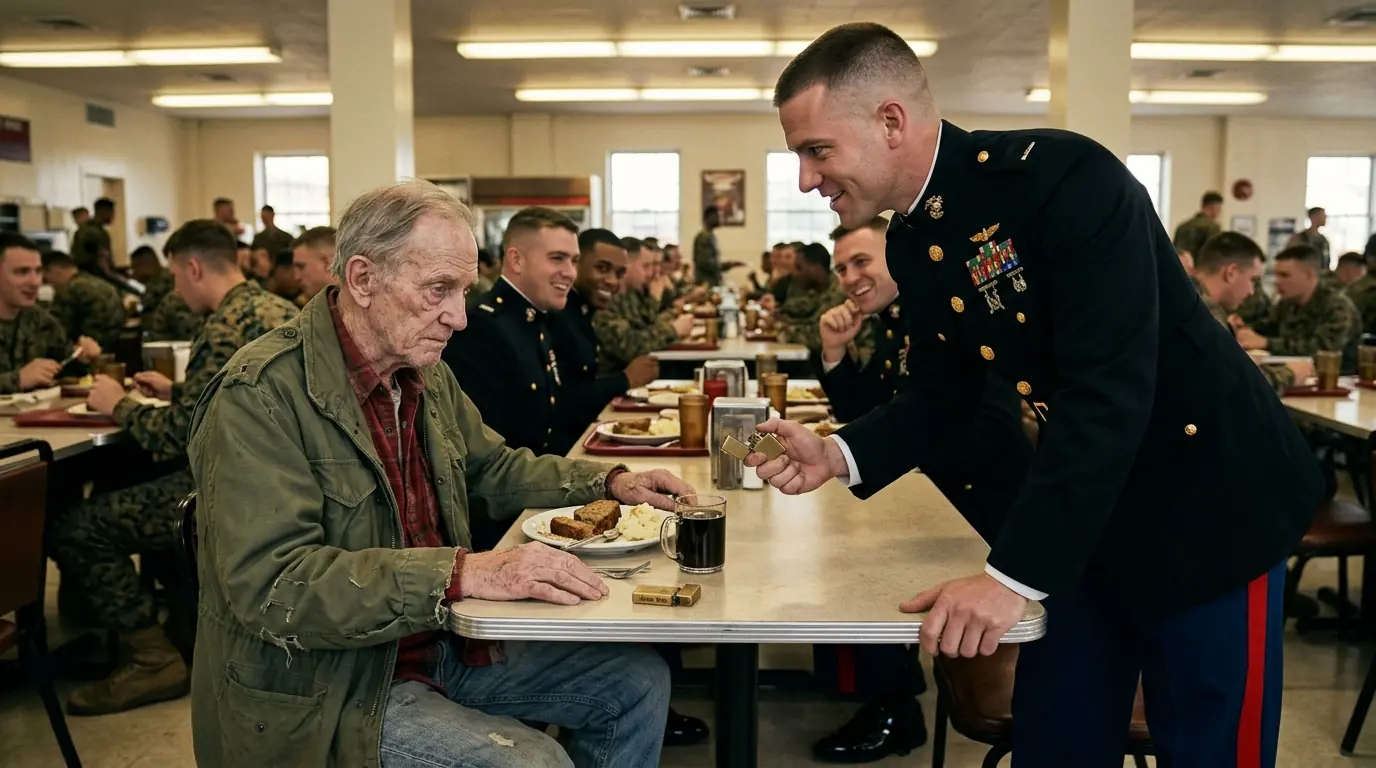
The question hung in the air like a challenge. Captain Brown stood tall in his perfect Marine uniform, the dark blue coat gleaming with shiny gold buttons. In his hand he held an old brass lighter he had taken from the table. He flipped it over to read the words engraved on the back: *Juice Box*.
Around the table, his fellow officers laughed. They were all dressed for the evening’s formal gathering, their haircuts crisp, their confidence radiating like a shield. Across from them sat an old man named Sam. He was eighty-two years old, worn by time and weather. He wore a faded red shirt under a torn green army jacket with frayed edges. Hunched over a plastic tray holding half-eaten meatloaf and a cup of cold black coffee, Sam rested his big, spotted, scarred hands on the table. His right hand trembled slightly.
Sam did not reach for the lighter. He did not look at the captain. He simply stared into his coffee.
“I asked you a question, old man,” Captain Brown said, his smile thin and mean. He tossed the lighter up and caught it. “You walk into a Marine dining hall looking like you slept in a ditch. You’re taking up a table meant for real soldiers, and you have a lighter that says ‘Juice Box.’ What did you do—drive the supply truck? Hand out juice boxes in the back?”
One of the young officers leaned in. “Maybe he was the water boy, sir. Very important job—keeping the boys hydrated.”
The table erupted in laughter again. The dining hall buzzed with noise and conversation, but the area around their table fell into an uneasy quiet. Other Marines watched. Some looked uncomfortable. Others observed with the detached interest of spectators at a schoolyard fight.
Sam finally lifted his head. His eyes were watery blue, framed by deep wrinkles. He did not look angry. He looked tired.
“I would like my lighter back, please,” Sam said. His voice was rough and scratchy, but clear.
Captain Brown closed his fist around the brass lighter. “You’ll get it back when I decide you’re allowed to be here. I’ve seen a lot of fake veterans lately—people buying old jackets at thrift stores, coming onto base for free food, pretending they served. You have no ID. You’re not in uniform. And honestly, you smell like you haven’t bathed in a week for a place where officers are eating.”
“I have permission,” Sam said simply.
“From who? The gate guard you paid twenty dollars?” Captain Brown scoffed. He leaned down, placing both hands on the table, getting in Sam’s face. The smell of expensive cologne washed over the old man. “This base is for Marines. Real Marines. Men who follow the rules. Look at me. Look at my men. Then look at yourself. Do you think you belong at this table?”
Sam slowly reached into his breast pocket. The mood at the table shifted instantly. The laughing stopped. Captain Brown’s hand dropped to his waist in reflex. Even without a weapon, his friends tensed, ready to move. Sam moved deliberately because of his stiff joints. He pulled out not a weapon, but a folded, grease-stained napkin. He wiped the corner of his mouth, folded the napkin again, and placed it beside his tray.
“I belong where I sit, Captain,” Sam said quietly. “And I earned this seat before you were born.”
Captain Brown’s face flushed red. The quiet insult landed hard. He straightened, aware that every Marine in the room was watching. He could not let an old man in civilian clothes talk back to him in front of his men.
“Get up,” Captain Brown ordered, pointing toward the door. “You’re leaving now, or I’m having the military police drag you out and throw you off the base. And I’m keeping the lighter as proof of stolen valor. Juice Box? What a joke.”
Sam did not move. He looked at the lighter in Captain Brown’s hand. For a split second the bright overhead lights seemed to flicker. The smell of floor cleaner and meatloaf vanished, replaced by the hot stench of machine oil and blood.
In that instant, Sam was no longer in the dining hall. He was strapped into a shaking, screaming helicopter. The aircraft bucked like a wounded animal. The front windshield was gone, shot out by enemy fire. Red warning lights flashed across the control panel, but he ignored them—he didn’t need lights to know they were falling from the sky. The control stick fought him, vibrating so violently it felt like it would shatter the bones in his left arm. Through the headset, static mixed with the scream of the tail rotor struggling to keep them upright.
He looked down at his flight suit. It was soaked—not with sweat, but with pinkish-red hydraulic fluid spraying from a ruptured overhead line. The fluid covered him, blinded him, made the controls slippery. He was swimming in the dying machine’s blood.
“Juice Box!” the radio operator had screamed, voice cracking with terror. “You’re leaking everywhere! You’re pouring fluid!”
The memory snapped shut as quickly as it had opened. Sam blinked. The dining hall returned. The trembling in his right hand had stopped. His knuckles were white.
“I’m not leaving until I finish my coffee,” Sam said.
Captain Brown let out a sharp breath. He turned to the largest Marine in his group, a massive sergeant built like stone. “Sergeant, take this civilian off the base. Use force if he resists. He’s not supposed to be here.”
As the sergeant stepped forward, cracking his knuckles, the air in the hall grew heavy. Three tables away, a young Marine named Billy froze with food halfway to his mouth. Billy was not part of the officers’ group. He was simply grabbing a quick meal before his shift. But Billy loved history. He had been watching the old man since he sat down.
When Sam reached for the napkin, his jacket flap had fallen open for a split second. Billy had seen something the captain missed: a faded silk map sewn into the lining and, pinned inside the inner pocket, a small, old metal device—not a modern ribbon, but a pair of heavy, theater-made wings. The unofficial insignia of the Ridge Runners, a legendary transport group that flew missions so secret they rarely appeared on official rosters.
Billy looked at the lighter in Captain Brown’s hand. *Juice Box*. The nickname triggered a memory from a half-forgotten history class. Panic shot through his chest. He dropped his fork. The metal clanged loudly against his tray. Ignoring the angry glance from his squad leader, Billy jumped up and sprinted for the exit, boots sliding on the polished floor as he raced toward the administrative offices.
He needed a phone. He needed someone with stars on their collar.
Billy burst into the hallway and grabbed the wall phone. His fingers shook as he dialed the direct line to the base commander’s aide.
“Command desk, Sergeant Martin speaking.”
“Sergeant, this is Marine Billy from Echo Company. I need to speak to General Harris immediately. It’s an emergency in the dining hall.”
“Emergency? Billy, if this is a joke—”
“It’s not a joke,” Billy said, glancing back toward the dining hall doors. “There’s a captain harassing an old veteran. He’s about to physically remove him. The captain took his lighter. It says ‘Juice Box’ on it.”
Silence on the other end. A silence so deep it felt as though the line had gone dead. Then Sergeant Martin’s voice returned, sharp and breathless.
“Did you say the lighter says ‘Juice Box’?”
“Yes, Sergeant. The old man is—he’s old. Red shirt. Old jacket.”
“Don’t let them touch him,” the sergeant ordered, voice rising to a shout. “Do not let them lay a hand on him. I’m connecting you to the general’s personal phone. Stay on the line.”
Inside the general’s office a mile away, General Harris was adjusting his tie in the mirror. The three-star general had seen combat across multiple wars, but he carried deep respect for the generation that came before him. His phone buzzed on the desk. He ignored it. It buzzed again. Then his office door flew open. His aide, a major, looked pale.
“Sir, it’s the dining hall. Someone has Sam Douglas.”
General Harris froze. “Sam? He’s here? I thought he wasn’t arriving until the ceremony tonight.”
“He came early to eat, sir. A captain—Captain Brown—is trying to arrest him for being a fake veteran. He took his lighter. The Juice Box lighter.”
General Harris’s face went from calm to pure fury in a heartbeat. He didn’t ask questions. He didn’t grab his hat. He stormed out of the office, moving faster than anyone had seen him move in years.
“Get the car,” he barked. “No—forget the car. We run. It’s faster. And get the military police on the radio. Tell them if anyone touches Mr. Douglas, I will have their rank stripped before they hit the floor.”
Back in the dining hall, the situation had deteriorated. The sergeant had a hand on Sam’s shoulder. Sam sat perfectly still, body rigid, eyes locked on Captain Brown.
“I’m asking you one last time, Captain,” Sam said, voice low. “Give me my property and let me eat in peace. You don’t know what you’re doing.”
“Oh, I know exactly what I’m doing,” Captain Brown sneered. “I’m taking out the trash. Sergeant, pick him up.”
The sergeant tightened his grip. “Let’s go, old man. Don’t make me hurt you.”
“You’re hurting yourself, son,” Sam whispered.
Captain Brown laughed—a harsh, ugly sound. “You threaten me? You threaten an officer? That’s assault. Add it to the list. I want this man in handcuffs. I want him arrested. And I want a mental evaluation because clearly he’s crazy if he thinks he has any right to be here.”
Captain Brown turned to the crowd, playing to his audience. “This is what happens when we let our standards slip. We tolerate fakes. Not on my watch.” He held up the lighter again. “This is a mockery. A nickname is earned in blood, not bought at a pawn shop. Juice Box. It’s pathetic.”
The doors to the dining hall did not simply open—they exploded inward with a sound like thunder. The room fell instantly silent. Every head turned.
Standing in the doorway was not a squad of military police, but a group of high-ranking officers. At the center was General Harris, breathing hard from running, his face purple with rage. Behind him stood two colonels and the base sergeant major.
The entire room snapped to attention. Chairs scraped as Marines leaped to their feet. Captain Brown, caught off guard, spun around. His face shifted from cocky to confused to smug satisfaction. He thought the cavalry had arrived to back him up.
“General,” Captain Brown called, stepping forward and saluting sharply. “Sir, I have the situation under control. I caught a civilian trespasser pretending to be a veteran. He was refusing to leave.”
General Harris did not return the salute. He did not even look at Captain Brown. He walked straight through him, his shoulder striking the captain hard enough to knock him off balance. Captain Brown stumbled, mouth opening to protest, but the words died as he watched the three-star general drop to one knee beside the old man in the torn jacket.
The entire dining hall went silent. You could hear the hum of the refrigerators.
“Sam,” General Harris said, voice gentle and filled with profound respect that stunned everyone watching. “I am so sorry. We were waiting for you at headquarters. I didn’t know you came in here.”
Sam looked at the general, then at the sergeant who had yanked his hand away as if the old man were on fire.
“I just wanted some meatloaf, Tom,” Sam said, a small, tired smile touching his lips. “It used to be better in ’68.”
“I’ll fire the cook myself,” General Harris joked weakly, though his eyes burned with anger. He stood and turned slowly to face Captain Brown.
Captain Brown had gone pale. He was beginning to understand he had made a catastrophic mistake.
“Sir, I—he had no ID. He was out of uniform. He has that lighter—”
General Harris held out his hand. “Give it to me.”
Captain Brown placed the lighter in the general’s palm with shaking fingers. General Harris looked at the engraving. His thumb brushed the words *Juice Box*. He looked up, voice carrying to every corner of the hall.
“Do you know who this man is?”
Captain Brown stammered. “No, sir. He refused to identify himself.”
“His name is Major Sam Douglas, USMC, retired,” General Harris interrupted, voice rising. “Navy Cross. Silver Star with two clusters. Purple Hearts—I lost count. And you mocked his nickname.”
Captain Brown swallowed hard. “Sir—Juice Box—it sounded—”
General Harris stepped closer until they were nose to nose. “You thought it was funny? You thought it was soft?”
He held up the lighter. “In 1968, during the siege at Khe Sanh, Hill 881 was cut off, surrounded by two enemy battalions. They were out of ammo, out of water, and out of blood plasma. The weather was terrible. No helicopters were flying—command had grounded the entire fleet.”
General Harris pointed to Sam, who had returned to sipping his cold coffee. “Major Douglas stole a helicopter. He loaded it with crates of plasma and ammunition. He flew alone into a storm under heavy gunfire. By the time he reached the hill, his bird had been hit forty times. The hydraulic lines were severed. The fuel lines were ruptured. He was spraying hydraulic fluid and fuel into the cockpit. He was soaked in it. It was burning his eyes and skin. He was flying a bomb.”
The general’s voice cracked with emotion. “When he talked on the radio to the Marines on the ground, he didn’t ask for directions. He told them he was leaking juice everywhere, but he was bringing the supplies. He hovered over that hill for twenty minutes, taking fire the entire time, kicking crates out the door himself because he had no crew. The Marines on the ground said the helicopter looked like a squeezed juice box, dripping fluids from every hole. He didn’t leave until every crate was on the ground. He crashed two miles out, broke his back, and crawled three miles back to friendly lines carrying the radio.”
General Harris turned his gaze back to Captain Brown. “He saved two hundred Marines that day. He is the reason my father came home to have me. He is the reason half the sergeants in this room have families. He is the Juice Box—and you tried to throw him out.”
Captain Brown looked as though he might vomit. All color had drained from his face. The officers behind him stared at the floor, praying to disappear. The sergeant who had touched Sam looked ready to cut off his own hand.
General Harris was not finished. “You are a disgrace to that uniform, Captain. You mistook shine for discipline and pride for arrogance. You saw an old man and saw a target. You didn’t see the history. You didn’t see the sacrifice.”
General Harris turned to the sergeant major. “Take this captain’s name. Suspend his command until we have a formal investigation. And get his friends out of my sight before I strip the rank off their uniforms right here.”
“Yes, sir,” the sergeant major barked, stepping forward.
Captain Brown opened his mouth—perhaps to apologize, perhaps to beg—but Sam spoke first.
“Tom,” Sam said.
General Harris turned immediately, face softening. “Yes, Sam?”
“Don’t end him,” Sam said. He pointed to the empty chair across from him. “Just make him sit.”
General Harris looked confused. “Sam, he needs to learn.”
“Not burn,” Sam said, voice steady. “He’s young. He’s dumb. He thinks the uniform makes the Marine. Let him sit. Let him drink a cup of coffee with me.”
General Harris stared at Sam for a long moment, then nodded slowly. He looked at Captain Brown. “You heard the major. Sit down.”
Captain Brown looked terrified. This was worse than being yelled at. He had to sit across from the man he had just humiliated—the living legend. He sank into the plastic chair. His perfect uniform suddenly felt heavy and ridiculous.
General Harris placed the lighter gently back on the table in front of Sam. Then the general stood at attention and gave a slow, perfect salute. One by one, the colonels, the sergeant major, and then the entire dining hall—cooks, regular Marines, officers—rose and saluted.
Sam did not salute back. He simply nodded, embarrassed by the attention. He flicked the lighter open. The flame flared strong and steady. He touched it to the rim of his coffee cup for a second, staring into the fire.
For a brief moment the flash took him back—not to the crash, but to the moment before: the stick in his hand, the smell of leaking fluid, the absolute certainty that he was going to die, and the absolute refusal to let that stop him. He remembered the voice of the young Marine on the radio at Hill 881: “God bless you, Juice Box. You’re raining life down here.”
Sam snapped the lighter shut. The sound was sharp, final. The room relaxed, but the atmosphere had changed. It felt like sacred ground now.
General Harris squeezed Sam’s shoulder and stepped back. Sam looked at Captain Brown. The captain was shaking, unable to meet the old man’s eyes.
“Drink your coffee, son,” Sam said gently.
“I—I’m sorry, sir,” Captain Brown whispered, voice breaking.
“You weren’t supposed to know,” Sam said. “You were supposed to look.”
Sam took a sip of his cold coffee. It tasted terrible, but it tasted like life.
“You see this lighter?” Sam pushed it toward the center of the table. “I didn’t get this because I was a hero. I got it because I was leaking. I was broken, but I kept flying. That’s the job. It ain’t about how shiny your buttons are, Captain. It’s about what you carry inside when the tank is empty.”
Captain Brown nodded, tears forming in his eyes. He removed his hat and set it on the table. He unbuttoned his dress coat, loosening the perfect collar. He looked human again.
“Tell me, sir,” Captain Brown asked softly. “Tell me about the hill.”
Sam smiled, and for the first time the years seemed to melt from his face. He leaned in.
“Well, it started with a broken fuel line and a lot of bad decisions…”
The dining hall returned to its normal rhythm, but the noise was lower, more respectful. At table twelve, a young captain sat listening to an old man in a red shirt, learning the lesson every Marine eventually learns: the most dangerous thing on any battlefield isn’t the weapon you can see, but the spirit you refuse to break.
The next morning, General Harris issued a base-wide memo requiring a new training module on unit history and veteran interactions. Quietly, the troops called it the Juice Box Protocol. It required every officer to spend time at the local veterans’ center—listening, not talking.
Captain Brown was not fired, thanks to Sam’s intervention, but he was reassigned to a training unit. For the next two years he taught young supply officers the importance of getting supplies to the front lines no matter the cost. He was never seen mocking a veteran again. Years later, he became known as one of the fiercest supporters of old veterans on the entire base.
Two weeks after the incident, Sam sat on his front porch watching the sun go down. A car pulled into the driveway. Captain Brown stepped out wearing civilian clothes, carrying a small wrapped box. He walked up the path without saying much and handed the box to Sam.
Inside was a custom display case. It held no medal. Instead, it contained a small sealed bottle of red hydraulic fluid and a piece of twisted metal from a recovered helicopter wreckage. The engraved plaque read: *To Juice Box—who poured it all out so we could come home.*
Sam looked at the young man and nodded. They sat together on the porch in silence, watching the day fade—two Marines sharing the quiet that only those who understand the true cost of service can truly appreciate.
**The Juice Box Legacy**
Two weeks after the dining hall incident, the sun dipped low over the quiet Florida neighborhood where Sam Douglas lived. The air smelled of salt from the nearby Gulf and the sweet decay of fallen bougainvillea petals. Sam sat in his favorite wooden rocking chair on the porch, the new display case resting on the small table beside him. Inside the glass, the sealed vial of red hydraulic fluid caught the light like a drop of old blood, and the twisted piece of helicopter wreckage gleamed dully beside it. The plaque’s words were simple and true: *To Juice Box—who poured it all out so we could come home.*
Captain Brown—no, just Brown now, since he had shed the uniform for the evening—sat on the porch steps, elbows on his knees, staring at the grass. He had driven over without calling first, the wrapped box already delivered, the silence between them comfortable in a way neither had expected.
“You didn’t have to do that,” Sam said finally, his voice the same gravelly rumble that had once carried over radio static above the jungle. He nodded toward the display case. “It’s a fine gesture, but I don’t need reminders. The scars do that job well enough.”
Brown looked up. The arrogance that had once hardened his face was gone, replaced by something raw and uncertain. “I needed to do it, sir. For me. That lighter… I almost threw away the most important story I’ve ever heard. I figured the least I could do was give you something that actually means what it says.”
Sam rocked slowly, the chair creaking like old bones. “Tell me about yourself, Captain. Not the uniform version. The real one.”
Brown hesitated, then spoke. The words came halting at first, then faster, like water through a broken dam. He told Sam about growing up in a military family where his father, a retired colonel, had measured worth by ribbons and rank. How Brown had joined the Marines because it was expected, not because he felt the call. How he had risen fast on charm and connections, but lately had started waking up at night wondering if any of it mattered. The dining hall confrontation had been the breaking point—not because he had been wrong about protocol, but because he had been so certain he was right.
“I saw an old man in a torn jacket and decided he was less than me,” Brown said, voice thick. “My father would have been proud of that moment. That’s what scares me the most.”
Sam listened without interrupting, the way he had listened to terrified young Marines on Hill 881 when they whispered their fears into the dark. When Brown finished, Sam was quiet for a long minute.
“Your father taught you the wrong lesson,” Sam said at last. “The uniform doesn’t make you better than anyone. It just gives you more ways to fail the people counting on you. I learned that the hard way in ’68. You want the full story of the hill? Not the one the general told. The one that still wakes me up some nights.”
Brown nodded, leaning forward.
Sam’s eyes went distant, seeing not the porch but the red dust of Khe Sanh. “We were the Ridge Runners. Unofficial. We flew when command said the weather was too bad and the risk too high. That day on Hill 881, the Marines were down to their last rounds. Plasma was gone. Men were dying from blood loss while the NVA poured fire from three sides. Command said no air support. Too dangerous. I stole a bird anyway—signed the forms myself, forged the maintenance logs. Loaded it with every crate I could beg, borrow, or steal from the supply depot. Took off in a storm that should have grounded angels.”
He paused, rubbing the faded scar on his forearm where hydraulic fluid had burned him decades earlier.
“Halfway there the first hits came. Tail rotor took a round. Then the hydraulics. Fluid everywhere. I couldn’t see the instruments. Couldn’t feel the stick. The radio man—kid named Ramirez, barely nineteen—kept screaming about the leak. I told him to shut up and keep shooting back. We hit the LZ in a controlled crash that wasn’t controlled at all. I kicked crates out while bullets chewed the bird apart. Twenty minutes of pure hell. When the last crate hit the ground, I tried to lift off. The engine seized. We went down two miles out. Ramirez didn’t make it. I broke my back in three places, crawled through elephant grass with a radio and a pistol, calling in fire missions until the relief column found me three days later.”
Sam’s voice had gone soft, almost reverent. “Those Marines on the hill lived because I was willing to die leaking fluid like a damn juice box. That’s why they gave me the name. Not because it was funny. Because it was true. I poured everything out so they could come home.”
Brown sat very still, tears tracking silently down his cheeks. “I don’t know how you carried that all these years.”
“You don’t carry it,” Sam said. “You let it carry you. Every time you think about quitting, every time the job feels too heavy, you remember the ones who didn’t make it home. That’s the real weight of the uniform. Not the shine. The ghosts.”
They talked until the stars came out. Brown told Sam about his wife, who had left him two years earlier because the Corps always came first. About his daughter in college who barely spoke to him anymore. Sam shared stories of his own Margaret—how she had waited through three tours, raised their two sons alone, and passed quietly in her sleep five years ago, leaving Sam with a house full of memories and a porch that felt too big for one man.
When Brown finally stood to leave, the night air cool against his skin, Sam stopped him with a hand on his arm.
“Come back next week,” Sam said. “Bring that daughter of yours if she’ll come. I’ve got stories about young officers who thought they knew everything. Might do her some good to hear how the old ones learned the hard way.”
Brown nodded, unable to speak. He drove home with the windows down, the wind carrying the scent of the Gulf and the faint echo of Sam’s voice.
The Juice Box Protocol spread faster than anyone expected. Within a month it was mandatory across every Marine Corps installation on the East Coast. Officers spent one afternoon a week at local VA hospitals and veterans’ centers—not lecturing, just listening. Brown led the first sessions at his own base, standing in front of rows of skeptical young Marines and telling them, without embellishment, how he had almost thrown a living legend out of the dining hall because the man’s jacket didn’t shine.
Some laughed at first. Then they saw the video General Harris had authorized—grainy footage from 1968 of a helicopter hovering over Hill 881, fluid streaming like blood, Sam’s voice crackling over the radio: “I’m leaking juice everywhere, but I’m bringing the supplies.” The laughter died. The questions began. Brown answered every one.
He started visiting Sam every Thursday evening after the sessions. Sometimes they sat in silence on the porch. Sometimes Sam told stories that made Brown’s hair stand on end—night insertions into Laos, evading MiGs in stolen Russian jets, the time he and three other Ridge Runners had airlifted an entire Marine company out of a valley while the NVA closed in from all sides. Brown brought his daughter, Emily, on the third visit. She was twenty, studying history at the University of Florida, and had inherited her father’s stubborn chin.
Sam took one look at her and smiled. “You’ve got your mother’s eyes and your father’s temper. Dangerous combination.”
Emily laughed, the sound bright against the quiet porch. Over sweet tea and store-bought cookies, she asked Sam about the war—not the battles, but the people. What it felt like to come home to a country that didn’t want to hear the stories. How he had raised two sons while carrying the ghosts of Hill 881.
Sam’s voice grew quiet. “I told them the truth. That courage isn’t loud. It’s showing up when every part of you wants to run. My oldest boy became a teacher. The youngest joined the Corps. Both of them understood before they were grown that the uniform is a promise, not a prize.”
Emily visited alone after that. She recorded Sam’s stories for a class project that turned into a thesis and then a book proposal. Sam pretended to grumble about “kids these days with their phones,” but he never refused an interview.
Three months after the dining hall incident, Brown received orders transferring him to a training command at Quantico. He drove to Sam’s house the night before he left, a bottle of good bourbon in hand.
“I don’t know how to thank you,” Brown said, sitting on the steps while Sam rocked in his chair.
“You already did,” Sam replied. “You listened. Most men your age don’t. They think they’ve got it all figured out until the first real test comes. Then they find out the only thing that matters is who’s standing next to you when the fluid starts leaking.”
They drank in silence, the bourbon burning warm and clean. Before Brown drove away, Sam handed him a small envelope.
“Open it when you get there,” Sam said. “And remember—the ghosts don’t go away. You just learn to fly with them.”
Brown opened the envelope on the plane to Virginia. Inside was a faded photograph: a young Sam Douglas in a flight suit, standing beside a battered helicopter, one arm around a smiling Marine with “Ramirez” stenciled on his helmet. On the back, in Sam’s shaky handwriting: *The ones we carry. Never fly alone.*
At Quantico, Brown threw himself into the work. He rewrote the officer candidate curriculum to include mandatory veteran mentorship hours. He invited Sam to speak at the first graduating class. Sam flew up on a commercial flight, wearing his old green jacket with the silk map still sewn inside. When he stepped onto the stage in front of three hundred new lieutenants, the room rose in a standing ovation before he said a word.
Sam told them the story of Hill 881. He didn’t glorify it. He described the fear, the pain, the moment he knew Ramirez was gone and still kept flying. When he finished, he held up the brass lighter.
“This isn’t a trophy,” he said. “It’s a reminder. When everything is leaking—fuel, blood, hope—you keep going. That’s what makes you a Marine. Not the bars on your collar. The fire in your gut.”
The lieutenants stood again. Brown, watching from the side of the stage, felt something shift inside him. The weight he had carried since childhood—the need to prove himself—lifted. He wasn’t his father’s son anymore. He was Sam’s student.
Six months later, Sam suffered a mild heart attack. Brown flew down the same day, arriving at the hospital in Pensacola just as Sam was being wheeled out of surgery. Margaret’s old chair sat empty beside the bed. Brown took it without asking.
“You’re not getting rid of me that easy,” Brown said when Sam opened his eyes.
Sam managed a weak smile. “Told you the ghosts don’t leave. Guess they sent a new one.”
Brown stayed three days. He read Sam’s mail, fielded calls from old Ridge Runners who had heard the news, and listened when the painkillers loosened Sam’s tongue and the stories poured out—funny ones this time, about the time they stole a case of beer from a Navy supply depot and nearly started an inter-service war.
On the third morning, Sam was stronger. He sat up, the heart monitor beeping steadily.
“I’ve been thinking,” Sam said. “About that protocol of yours. It’s good. But it needs to go further. Bring the old ones into the training pipeline. Not just to talk—let them fly the simulators with the new kids. Let them feel the stick again. Remind the young ones that the machine bleeds too.”
Brown nodded. “I’ll make it happen.”
“You already did,” Sam said. “Now go home to your daughter. Tell her the old man says she’s got the right fire. And Brown?”
“Yeah?”
“Stop calling me sir. I’m just Sam.”
Brown smiled, the first real smile in years. “Yes, Sam.”
The protocol evolved. Within a year it had a new name across the Corps: *The Juice Box Standard*. Every new officer spent time in a simulator with a retired pilot or crew chief at the controls, feeling the vibrations, hearing the old stories while the hydraulics “failed” on purpose. The young Marines stopped seeing veterans as relics. They saw them as the ones who had kept the machine flying when it should have fallen from the sky.
Brown’s career accelerated. He made major, then lieutenant colonel. He called Sam every Thursday without fail. Sometimes they talked about the war. Sometimes about Emily’s growing career as a journalist covering veterans’ issues. Sometimes they just sat on the phone in comfortable silence, two men who understood that the real battles were the ones fought in the quiet hours after the guns stopped.
Sam turned eighty-five the year Brown pinned on his first star. The ceremony was small, held at the base where it had all begun. General Harris—now retired but still sharp—presided. Sam sat in the front row, wearing his old jacket, the Juice Box lighter in his pocket. When Brown stepped forward to receive the star, he looked straight at Sam and gave a slow, perfect salute.
The crowd rose. Sam stood with them, back straight despite the years, and returned the salute with tears in his eyes.
That night, at the small reception, Brown found Sam on the balcony overlooking the parade field.
“I never said thank you,” Brown said. “Not properly.”
Sam waved it away. “You did. Every time you chose to listen instead of command. Every time you saw the person instead of the jacket. That’s the thanks that matters.”
They stood together as the sun set, the same sun that had set over Hill 881 fifty-seven years earlier. Brown thought about the young lieutenant he had been—the one who had mocked an old man for a nickname. He thought about the man he had become because that old man had refused to leave until he finished his coffee.
“I’m not done yet,” Brown said quietly. “There’s more work.”
Sam nodded. “There always is. The fluid never stops leaking. You just get better at patching the holes.”
Three years later, Sam Douglas passed away in his sleep on a warm spring night. Brown received the call at 0300. He was a brigadier general by then, stationed at the Pentagon. He flew to Pensacola that morning, arriving in time to stand beside the casket as it was carried into the small chapel.
The service was simple. Old Ridge Runners told stories. Emily read a passage from the book she had written about her “adopted grandfather.” Brown spoke last.
“Sam Douglas taught me that the strongest leaders don’t shout,” he said, voice steady. “They steady the ship when everyone else is panicking. He poured himself out so others could live. I will spend the rest of my career trying to be worthy of that example. The Juice Box Standard isn’t a program anymore. It’s who we are.”
After the burial, Brown walked alone to the grave. He placed the brass lighter on the headstone, the one Sam had carried through fire and blood and time.
“Rest easy, Sam,” Brown said. “The house is still protected. And the line is still flying.”
In the years that followed, Brown rose to lieutenant general. He made the Juice Box Standard mandatory across every service branch that would listen. He established a foundation in Sam’s name that funded scholarships for children of fallen Ridge Runners and built a museum wing at the National Museum of the Marine Corps dedicated to the unsung transport crews who had kept the war moving when command said it couldn’t be done.
Emily became a Pulitzer-winning journalist whose work on aging veterans changed national policy. She visited Brown often, calling him “Uncle” with the same easy affection she had once reserved for Sam.
On the tenth anniversary of Sam’s passing, Brown stood on the same porch where it had all begun. The house was empty now—Sam’s sons had sold it—but Brown had bought it back, restoring the rocking chair and the porch swing. He sat there with Emily and her young son, telling them the story of the old man who had changed everything with a single sentence: *I belong where I sit.*
The boy, six years old and already fascinated by uniforms, looked up at Brown with wide eyes.
“Was he really leaking juice, Grandpa?”
Brown smiled, the weight of command and memory settling comfortably on his shoulders.
“He was leaking everything, kiddo. And he kept flying anyway. That’s what heroes do.”
The sun dipped below the Gulf, painting the sky in shades of fire and blood. Somewhere in the distance, a helicopter thumped overhead—training flight, routine, safe. Brown watched it pass and raised a hand in silent salute.
The ghosts were still there. But they flew with him now.