Red and blue lights sliced through the quiet suburban morning, casting frantic, pulsing shadows across the manicured lawn. The rookie officer’s hand hovered nervously over his service weapon, but it was the veteran cop, face flushed with unwarranted authority, who barked the order: “Step off the porch and show me your ID, right now.”
The man leaning against the wooden porch railing did not flinch. He took a slow, deliberate sip of his black coffee, a cold, calculated calmness settling over his features. He knew exactly how this interaction was supposed to go. What the arrogant, red-faced officer did not know, however, was that the man he was aggressively threatening was Special Agent Curtis Vaughn, and the officer had just picked a fight with the Federal Bureau of Investigation.
Oakridge Estates was the kind of neighborhood where the loudest sound on a Saturday morning was the rhythmic, soothing hum of a high-end lawn sprinkler. Nestled in a wealthy enclave just outside the city, it was a tapestry of sprawling colonial homes, perfectly edged driveways, and aggressively green lawns. For Special Agent Curtis Vaughn, purchasing the four-bedroom property at 440 Maplewood Drive was supposed to be a milestone. It was the culmination of years of grueling work in the FBI’s Violent Crimes Task Force. He had spent a decade and a half kicking down doors in the worst parts of the state, tracking fugitives and dismantling organized syndicates. This house was his reward, a quiet, safe sanctuary for him and his daughter Riley, who was finishing her sophomore year at a state university.
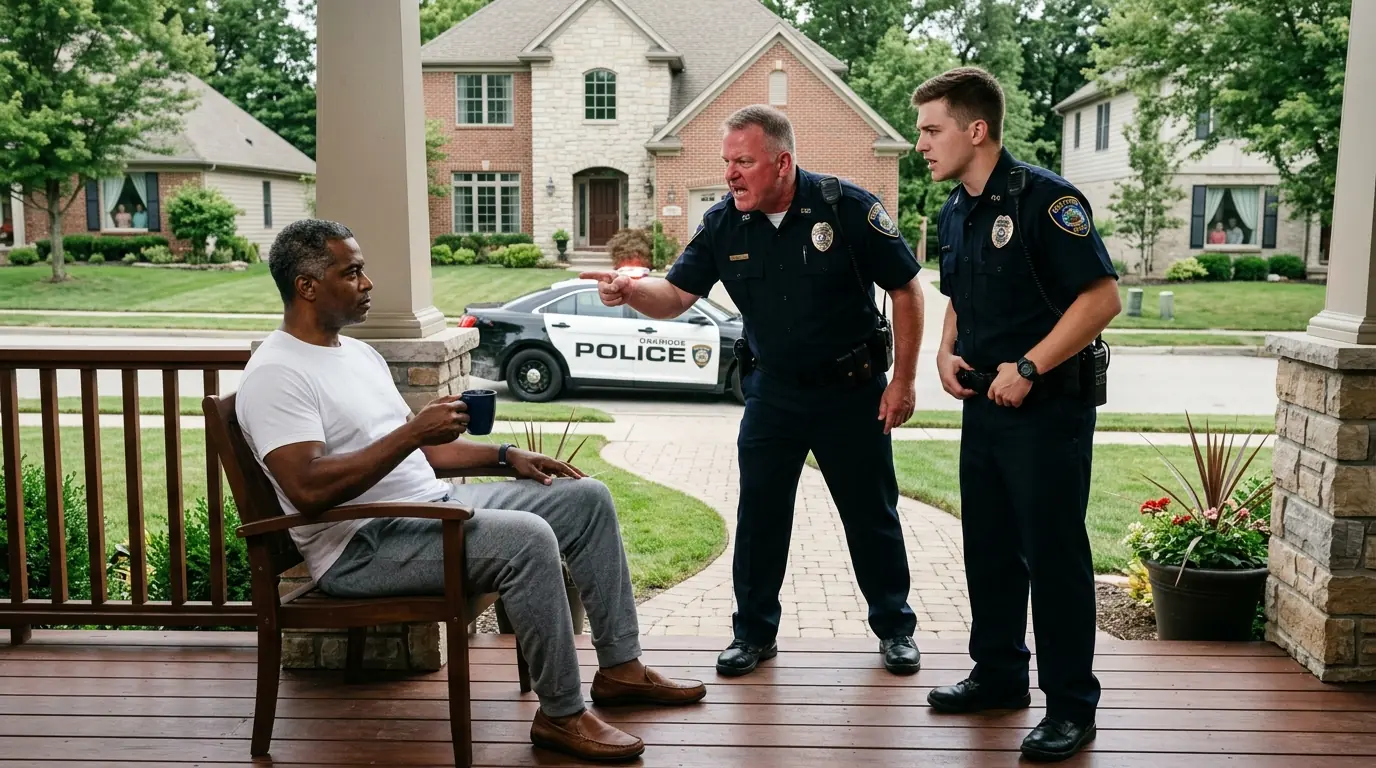
Curtis was a tall, broad-shouldered Black man with salt-and-pepper hair cut close to his scalp and eyes that missed absolutely nothing. His posture was naturally commanding, a byproduct of years in a high-stress, high-stakes profession. But on this particular Saturday morning, he was not Agent Vaughn. He was just Curtis. He was wearing faded gray sweatpants, a plain white, well-worn T-shirt, and slip-on loafers. The autumn air was crisp, carrying the faint scent of fallen leaves and distant pine.
He stepped out onto his expansive mahogany front porch, a steaming mug of black coffee in his hand. He had not even unpacked all the boxes yet. They had officially moved in recently, and the interior of the house was still a labyrinth of cardboard, but the porch was perfect. He leaned against the railing, taking a deep breath of the suburban air, letting the residual stress of his latest field assignment bleed out of his muscles.
Directly across the street, behind the tightly drawn Venetian blinds of 442 Maplewood Drive, Vivian Hargrove was already awake. Vivian was the self-appointed guardian of Oakridge Estates, a woman who treated the Homeowners Association rulebook with the reverence of a sacred text. She had lived in the neighborhood for years and had a notorious reputation for weaponizing the local police department over trivial matters. An unfamiliar car parked slightly over a property line. A landscaping crew starting too early. Vivian stood in her living room, her eyes narrowed as she stared through a narrow slit in her blinds. She had seen the moving trucks recently, but she had not managed to get a good look at the new owners. Now, seeing Curtis standing on the porch, a spike of prejudiced alarm shot through her. To Vivian, Curtis did not look like an Oakridge resident. In her narrowly constructed worldview, a tall Black man in casual sweats pacing around an upscale property did not compute as homeowner. It computed as threat.
She did not walk over to introduce herself. She did not wave. She did not even pause to consider the moving boxes still visible through the large front window of Curtis’s house. Instead, Vivian picked up her phone and dialed the local police dispatch.
“Yes, dispatch. My name is Vivian Hargrove, 442 Maplewood Drive,” she whispered, her voice trembling with manufactured panic. “I need an officer out here immediately. There is a suspicious man loitering on the porch of the house across the street. The house just sold and the owners are not home yet. I think he might be casing the property.”
The dispatcher asked for a description. “He’s a large African-American male wearing sloppy clothes,” Vivian replied, her tone dripping with disdain. “He’s just standing there looking around. He clearly does not belong here. Please send someone before he tries to break in.”
Oblivious to the phone call that had just labeled him a criminal in his own home, Curtis finished his coffee. He set the mug down on a small wicker side table and began inspecting the woodwork on the porch railing, making a mental note that it might need a fresh coat of sealant before the winter snow arrived. He was completely at peace. It was a rare, beautiful moment of absolute tranquility. It lasted only a short while longer.
The distinct sound of heavy tires crushing fallen leaves broke the silence. Curtis looked up, his trained eyes instantly locking onto the black-and-white cruiser turning the corner onto Maplewood Drive. The vehicle did not just drive down the street; it prowled. It slowed to a crawl as it approached his property. The officers inside visually scanned the house. Curtis’s instincts, honed by years of undercover work and street-level operations, flared instantly. He did not move. He did not retreat into the house. He simply stood up straight, resting his hands casually on the railing, and watched as the cruiser came to a hard, abrupt stop directly in front of his driveway, the front tires violently bumping up against the pristine curb.
The doors of the police cruiser popped open almost simultaneously. From the passenger side emerged Officer Bryce Langford, a fresh-faced rookie just out of the academy. He looked nervous, his hands instantly adjusting his duty belt as if seeking comfort in the weight of his equipment. But Curtis’s focus was entirely on the driver, Officer Trent Harlan. Harlan stepped out of the cruiser and slammed the door with unnecessary force.
Harlan was a veteran of the local force, a man whose career had stagnated due to a documented history of citizen complaints and a severe lack of interpersonal skills. He was stocky, his uniform stretched tight over a growing gut, with a flushed face and a tightly cropped haircut. Harlan walked with a deliberate, heavy strut, the walk of a man desperate to project authority he had not truly earned. He had a reputation in the precinct as a bully with a badge, a guy who used his uniform to intimidate those he felt were beneath him.
Harlan did not approach the house with the cautious, polite demeanor of an officer doing a routine welfare check. He marched up the paved walkway, bypassing the driveway completely, and stopped at the bottom of the porch steps. He rested his right hand on his holstered weapon. It was a classic intimidation tactic designed to immediately establish dominance. Curtis recognized the posturing immediately. He had trained cadets on how to de-escalate situations, and Harlan was doing the exact opposite. He was coming in hot.
“Morning,” Curtis said, his voice calm, deep, and resonant. He did not take his hands off the railing. He did not offer a subservient smile. He simply acknowledged their presence.
“Step down off the porch,” Harlan commanded, bypassing any form of greeting. His tone was sharp, aggressive, and completely devoid of professional courtesy.
“You heard me,” Harlan barked, taking a step up onto the first wooden stair. Officer Langford hovered a few feet behind him, looking increasingly uncomfortable with his partner’s aggressive opening move. “Step down here right now.”
“I think I am perfectly fine right where I am, officer,” Curtis replied smoothly, his voice never raised a fraction of a decibel. “Is there something I can help you with?”
Harlan’s face darkened, a dull red flush creeping up his thick neck. He was not used to being told no, especially not in this neighborhood, and certainly not by a man who looked like Curtis.
“We received a call about a suspicious individual loitering on this property. Now, I’m not going to ask you again. Step down off the porch and produce some identification.”
Curtis felt a cold, hard knot of anger form in his chest, but his exterior remained entirely unreadable. He knew the law backward and forward. He knew *Terry v. Ohio*. He knew the parameters of a lawful stop and the definition of reasonable articulable suspicion. Standing on a porch drinking coffee did not meet that threshold.
“Suspicious individual,” Curtis echoed, allowing a faint dry chuckle to escape his lips. “I am drinking coffee on a Saturday morning.”
“You do not live here,” Harlan stated, phrasing it as a hard fact rather than a question. “This property just sold. The owners are not home.”
“Is that what dispatch told you?” Curtis asked, his eyes locking onto Harlan’s. The intensity in Curtis’s gaze was piercing, the kind of look that had made cartel enforcers break out in a cold sweat in interrogation rooms.
“Do not get smart with me, pal,” Harlan snapped, taking another step up. He was now only a few feet away from Curtis. “I need your ID and I need you to explain exactly what you are doing on this property before I put you in cuffs for trespassing.”
“Officer,” Curtis said, leaning forward slightly, his voice dropping into a register that commanded absolute attention. “I am under no legal obligation to provide you with identification. You have no reasonable suspicion that I have committed, am committing, or am about to commit a crime. Furthermore, you are currently standing on private property without a warrant or probable cause.”
Harlan blinked, visibly taken aback by the precise legal terminology rolling effortlessly off Curtis’s tongue. For a split second, doubt flickered in the veteran cop’s eyes, but his ego, massive and fragile, quickly overrode his common sense. He could not back down now, not in front of his rookie partner and not in front of this man who was defying him.
“Oh, we got a roadside lawyer here,” Harlan sneered, his hand moving to unclip the retention strap on his holster. The loud snap echoed in the quiet suburban street. It was an explicit physical threat. “Last warning. ID now or you are going face down on this wood.”
Behind Harlan, Officer Langford finally spoke up, his voice cracking slightly. “Hey, man. Just give him your ID. It will make this easier.”
Curtis looked at the young rookie, seeing the fear and the blind compliance to a toxic superior. Then he looked back at Harlan. The unclipped holster was a major escalation. Harlan was entirely out of bounds, operating entirely on bruised ego and deep-seated bias.
Curtis had his wallet in his back pocket. Inside that wallet was a gold shield that commanded the respect of every law enforcement agency in the country. He could pull it out, flash his credentials, and end this in seconds. Harlan would turn pale, stammer an apology, and slink back to his cruiser. But Curtis did not reach for his wallet. If he flashed his badge now, Harlan would learn nothing. Harlan would just assume he had made a mistake against a VIP. He would not realize the inherent flaw in his aggressive, unconstitutional policing. He would go out tomorrow and do the exact same thing to an innocent teenager or a father coming home from a night shift—someone who did not have a gold shield to protect them.
No. Curtis decided Harlan needed to hang himself with his own rope. He needed to commit to his actions fully on the record so the consequences would be inescapable.
“I am not giving you my ID,” Curtis said, his voice ringing with absolute immovable authority. “And if you intend to arrest me, you had better be absolutely certain you understand the laws you’re about to violate.”
Harlan’s eyes narrowed into slits of pure fury. “Hands behind your back,” he growled, lunging forward, reaching aggressively for Curtis’s wrist. The trap was sprung. The dominoes had begun to fall. And Officer Trent Harlan was entirely blind to the catastrophic career suicide he was currently committing.
Officer Trent Harlan moved with the heavy, uncoordinated aggression of a man fueled entirely by adrenaline and wounded pride. As his thick hand shot out to grab Curtis’s wrist, the air on the porch seemed to freeze. Curtis Vaughn was a man who had survived armed standoffs in drug dens and close-quarters combat with desperate fugitives. He could have dismantled Harlan in seconds. He knew five different ways to break the officer’s grip, drop him to the mahogany deck, and render him unconscious before the rookie Langford could even clear his weapon from its holster. But Curtis did nothing of the sort.
Decades of federal law enforcement training, coupled with a deep, sobering understanding of how these situations historically escalated for Black men in America, overrode his natural fight-or-flight response. He went entirely limp, offering zero physical resistance, denying Harlan the one thing he desperately wanted: an excuse to escalate to violence.
“I am not resisting,” Curtis stated clearly, his voice carrying across the meticulously manicured lawn, ensuring that the nervous rookie and any observing neighbors heard it. “I am complying under duress. This is an unlawful arrest.”
“Shut your mouth,” Harlan spat, violently jerking Curtis’s right arm behind his back. The sheer force of the movement tweaked Curtis’s shoulder socket, a sharp sting of pain shooting down his bicep. Harlan kicked Curtis’s feet apart with the heavy toe of his boot, pressing his full body weight against Curtis’s back, pinning him awkwardly against the porch railing.
Click, clack, ratchet. The cold steel of the Smith & Wesson handcuffs bit aggressively into Curtis’s wrists. Harlan purposely squeezed the cuffs a notch too tight, a petty, vindictive tactic known among bad cops as “giving them the bracelets.” The metal immediately began to restrict the blood flow to Curtis’s hands.
“Check his pockets, Langford,” Harlan barked, breathing heavily, sweat beading on his forehead despite the crisp autumn morning.
Officer Langford stepped forward, his hands trembling slightly as he patted down Curtis’s sweatpants. He found the rectangular bulge in Curtis’s back right pocket. Langford pulled out the worn, dark brown leather wallet.
“Got his wallet, Trent,” Langford said, holding it out.
“Toss it in the cruiser,” Harlan commanded, not even looking at it. His focus was entirely on physically dominating the man who had dared to speak to him with authority. “We will figure out who this John Doe is when we get him to booking. Let’s walk.”
Harlan grabbed Curtis by the center chain of the handcuffs, yanking upward, another painful compliance hold designed to force a prisoner onto their toes. Curtis gritted his teeth, absorbing the pain, his face a mask of absolute terrifying composure. He allowed Harlan to march him down his own front steps, down the paved walkway he had paid for, and toward the idling police cruiser.
Across the street, behind the Venetian blinds of 442 Maplewood Drive, Vivian Hargrove watched the scene unfold with a mixture of vindication and sudden creeping unease. She had wanted the suspicious man removed, yes, but seeing the sheer aggression of the arrest, the way the officer yanked the man, the way the man remained so eerily calm and unbothered made a cold knot form in her stomach. The man did not look like a caught burglar. He looked like a king being momentarily inconvenienced by peasants. Vivian let the blinds snap shut, suddenly wishing she had not made the call.
Harlan shoved Curtis forcefully into the back of the cruiser, pushing his head down roughly to clear the door frame. The molded plastic seat of the squad car was hard and smelled faintly of industrial disinfectant and old sweat. The heavy door slammed shut, sealing Curtis inside the claustrophobic reinforced cage. Through the plexiglass divider, Curtis watched Harlan and Langford climb into the front seats.
“Fired up this morning, huh?” Harlan chuckled to his partner, a sickening sound of self-satisfaction. He slapped the steering wheel. “Thought he was a tough guy. Thought he knew the law. Let’s see how much he likes the holding cell.”
Langford did not laugh. He looked pale, his eyes darting to the rearview mirror, making brief, uncomfortable contact with Curtis’s unwavering gaze. “Hey, Trent,” he said. “He said he owned the place. What if he actually just bought it?”
“Give me a break, Bryce,” Harlan scoffed, throwing the cruiser into drive and pulling away from the curb with a screech of tires. “Look at him. Look at the way he is dressed. He does not live in Oakridge Estates. Probably casing the joint, waiting for the moving trucks to leave so he could strip the copper wiring. I’ve seen it a hundred times.”
Curtis sat in the back, silent and stoic. He did not argue. He did not hurl insults. He was busy working. In his mind, he was logging every detail: Officer Trent Harlan, badge number 4482; Officer Bryce Langford, badge number 519; cruiser designated Adam 12. He felt the tight pinch of the cuffs cutting off his circulation, a physical reminder of the gross violation of his civil rights.
Harlan thought he had won. Harlan thought he was taking a nobody to the local lockup to teach him a lesson about respecting authority. Curtis leaned his head back against the hard plastic partition and closed his eyes. A grim, humorless smile played at the corners of his mouth. The ride to the precinct was short, but the fallout from this arrest was going to last Trent Harlan the rest of his life.
The Oak Ridge Township Police Department was housed in a squat, brutalist brick building that had seen better days. Inside, the air was thick with the scent of stale percolator coffee, cheap floor wax, and the low, persistent hum of fluorescent lights. It was a quiet Saturday morning shift. The overnight drunks had already been processed, and the day-shift officers were mostly out on patrol.
Harlan hauled Curtis out of the cruiser by the handcuff chain, dragging him through the heavy metal back doors and into the booking area. The precinct was a familiar environment to Curtis, though usually he was the one walking through the front doors in a tailored suit, flashing a gold badge to take over a federal case. Being marched in through the perp entrance in sweatpants and handcuffs was a novel, albeit infuriating, experience.
Behind the elevated booking desk sat Sergeant Harlan Brooks. Brooks was a veteran, a man with a graying mustache and tired eyes who spent his days drowning in administrative paperwork. He looked up from a stack of arrest reports as Harlan shoved Curtis toward the metal bench bolted to the floor.
“Sit,” Harlan commanded, forcing Curtis down onto the bench. Curtis sat, his posture perfectly straight, his face an unreadable stone.
“Morning, Smitty,” Harlan called out, using Brooks’s precinct nickname. He swaggered up to the booking desk, leaning against the high counter with an air of casual arrogance. “Got a live one for you. Trespassing, failure to identify, resisting arrest, the whole nine yards.”
Sergeant Brooks sighed, rubbing the bridge of his nose. He grabbed a blank booking sheet and clicked his pen. “Resisting? Really, Trent? He does not look like he put up much of a fight.”
“He was giving me lip,” Harlan defended, his tone instantly defensive. “Refused lawful orders. Was prowling around that new property over on Maplewood. I had to put him in the dirt to get the cuffs on.”
From the bench, Curtis spoke. His voice was calm, conversational, and completely devoid of the panic or anger usually heard in the booking room. “For the record, Sergeant, none of that is true. There is dashcam and bodycam footage that will verify I was drinking coffee on my own porch.”
Harlan whipped around, pointing a thick, accusatory finger at Curtis. “Hey! You speak when spoken to. You understand me?”
Brooks frowned, looking past Harlan to study the man on the bench. Something was off. The prisoner was not acting like a petty criminal, and he certainly was not acting like a man who had just been taken down by force. His vocabulary was precise. His demeanor was chillingly calm.
“Name?” Brooks asked, looking directly at Curtis.
“He would not give it,” Harlan interjected, reaching into his cargo pocket. He pulled out Curtis’s dark leather wallet and tossed it onto the booking counter. “Here. Ransack his pockets. Let us see who this clown actually is.”
The wallet landed with a heavy, muted thud on the scarred wooden counter.
“Process him, Smitty,” Harlan said, turning his back to the desk to pour himself a cup of the stale precinct coffee from the nearby station. “I’m going to go write up the arrest report. Make sure you get his prints. I want to see if he has got warrants.”
Sergeant Brooks picked up the wallet. It was heavier than a standard billfold. He flipped it open to find the driver’s license, but it did not open to a driver’s license. It opened to a custom-cut leather interior. On the bottom half was a solid gold shield, intricately detailed, topped with a striking eagle. Surrounding the center seal were heavy, unmistakable blue enamel letters: Federal Bureau of Investigation. On the top half of the fold was a laminated high-security credential card. It featured a stern photograph of the man currently handcuffed to the bench. Next to the photo, printed in bold, undeniable lettering, it read: Curtis Vaughn, Special Agent in Charge, Violent Crimes Task Force, Division 4.
The air in Sergeant Brooks’s lungs vanished. All the color instantly drained from his face, leaving him looking like a man who had just been diagnosed with a terminal illness. His hand began to shake so violently that the heavy leather wallet rattled against the wooden counter. He stared at the gold shield. Then he slowly, painfully lifted his eyes to look at the Black man sitting in faded sweatpants on his booking bench.
Curtis met Brooks’s horrified gaze. Curtis did not smile. He just gave a single, slow nod.
“T-Trent,” Brooks stammered. His voice was barely a whisper, choked with sudden, overwhelming terror.
Harlan, oblivious, was stirring powdered creamer into his coffee. “Yeah, what is the name? John Doe got a rap sheet?”
“Trent,” Brooks said again, his voice cracking. He swallowed hard, feeling physically ill. “Get back over here right now.”
The sheer panic in the sergeant’s voice finally made Harlan turn around. He frowned, putting the coffee cup down. “What is the matter with you? You look like you saw a ghost.” Harlan walked back to the desk. Brooks did not say a word. He just slowly turned the wallet around and slid it across the counter so it was facing Harlan.
Harlan looked down. Time seemed to fracture and slow to an absolute crawl. Harlan’s eyes tracked over the gold metal. He read the words “Federal Bureau of Investigation.” His brain, sluggish and clouded by arrogance, took a full moment to process the visual information. He looked at the photo credential. He read the title, Special Agent in Charge. When the reality of the situation finally breached Harlan’s consciousness, the physical reaction was catastrophic. His knees literally buckled, dropping him an inch before he caught himself against the counter. A cold sweat erupted across his forehead instantly. The arrogant flush in his cheeks vanished, replaced by an ashen, sickly gray. He had just aggressively assaulted, unlawfully detained, and kidnapped a high-ranking federal agent on his own property.
“Oh. Oh my god,” Harlan whispered, the words slipping out of his mouth without his permission. He backed away from the counter as if the wallet were a live hand grenade about to detonate. His eyes, wide with sheer, unadulterated terror, darted to Curtis.
Officer Langford, who had just walked into the booking area carrying Curtis’s coffee mug from the porch, stopped dead in his tracks. He looked at Brooks’s pale face, then at Harlan’s trembling hands. “What? What is it?” Nobody answered him.
The silence in the booking room was deafening, broken only by the hum of the fluorescent lights and the ragged, panicked breathing of Officer Trent Harlan. From the bench, the metallic rattle of the handcuff chain cut through the tension. Curtis Vaughn shifted his weight, his posture commanding despite the restraints.
“Sergeant Brooks,” Curtis said, his voice echoing like a judge’s gavel in the silent room. Brooks snapped to attention, his posture rigid. “Yes, sir. Yes, Agent Vaughn.”
Curtis instructed, his tone ice-cold and utterly uncompromising: “You will come around this desk, and you will remove these handcuffs. Officer Harlan is not to come within ten feet of me. Do you understand?”
“Yes, sir.” Brooks practically tripped over his own chair as he scrambled around the counter, a set of handcuff keys already clutched in his trembling hand. “Right away, sir.”
The power dynamic in the room had not just shifted. It had violently inverted. The local police station no longer belonged to Trent Harlan. It belonged to Special Agent Curtis Vaughn, and the reckoning had only just begun.
The metallic click of the handcuff key turning in the lock was the loudest sound in the Oak Ridge Township Police Precinct. Sergeant Harlan Brooks’s hand shook so badly that it took him three agonizing attempts to seat the small key into the mechanism. When the heavy steel finally sprang open, Special Agent Vaughn did not rub his wrists. He did not wince. Even though deep, angry, red welts had already formed into bruised grooves on his skin, he simply stood up from the metal bench. The physical transformation was immediate. In his faded gray sweatpants and plain white T-shirt, Curtis suddenly seemed to take up the entire room. The quiet, compliant man on the porch was gone. In his place stood a furious, highly trained federal commander who had just had his constitutional rights violently trampled.
“My wallet, Sergeant,” Curtis said, holding out his left hand. Brooks practically lunged across the desk to hand it back, his eyes firmly fixed on the linoleum floor. “Yes, sir. Agent Vaughn, I—I apologize, sir.”
Curtis flipped the wallet shut and slid it into his pocket. He turned his attention to Officer Trent Harlan. Harlan was still backed against the far wall of the booking area, looking as though all the air had been vacuumed from his lungs. His flushed, arrogant complexion had completely vanished, replaced by a sickly, translucent pallor. He opened his mouth to speak, but only a dry, raspy wheeze came out. Next to him, the rookie Bryce Langford stood frozen, the half-empty coffee mug he had brought from Curtis’s porch trembling in his grasp.
“Officer Harlan,” Curtis said, his voice dropping an octave, carrying the terrifying calm of a brewing hurricane. “Under Title 18, United States Code, Section 242, it is a federal crime for anyone acting under color of law to willfully deprive any person of a right or privilege protected by the Constitution or laws of the United States. Do you know what the penalty is for kidnapping under color of law?”
Harlan swallowed hard, his Adam’s apple bobbing erratically. “Agent Vaughn, listen. This—this was a misunderstanding. The call came in. The dispatcher said—”
“Do not insult my intelligence,” Curtis snapped, the sudden volume cutting through the air like a whip. Harlan flinched physically. “I did not resist. I informed you that you lacked reasonable, articulable suspicion. I informed you that you were on private property. You proceeded to trespass, commit aggravated battery, and unlawfully detain me because your fragile ego could not handle a Black man in a wealthy neighborhood telling you no.”
“What the hell is all this yelling about?” a gruff voice demanded. The heavy wooden door leading to the administrative offices swung open, and Captain Warren Fletcher stormed into the booking area. Fletcher was a stern, no-nonsense commander with years on the force, a man fiercely protective of his department’s reputation. He took one look at the scene—Sergeant Brooks looking terrified, Harlan pressed against the wall looking violently ill, and a man in sweatpants standing in the center of the room radiating pure authority.
“Smitty,” Fletcher barked at Brooks. “Who is this and why is he not in a holding cell?”
“Captain,” Brooks squeaked, his voice failing him. He pointed a trembling finger at Curtis. “That is—that is Special Agent in Charge Curtis Vaughn, FBI Violent Crimes Task Force.”
Captain Fletcher stopped dead in his tracks. His eyes darted from Brooks to Curtis, dropping to the angry red handcuff marks still highly visible on Curtis’s wrists, and then finally landing on Harlan. Fletcher did not need to hear the whole story to know that his department was standing on the edge of a massive legal and public relations cliff.
“Agent Vaughn,” Fletcher said, his tone instantly shifting from authoritative to extremely cautious. “Captain Warren Fletcher. I—I assume there has been a colossal failure of protocol here.”
“That is the understatement of the decade, Captain,” Curtis replied, turning to face the commanding officer. “Your officer here bypassed a lawful *Terry* stop, ignored my invocation of my rights, physically assaulted me on my own front porch, and illegally transported me to this facility. He did this without a shred of probable cause, based entirely on a fabricated phone call, and his own blatant racial bias.”
“He was prowling,” Harlan blurted out, a desperate, pathetic attempt to save his burning career. “Captain, the house was empty. I had a duty to investigate.”
“Shut your mouth, Harlan,” Fletcher roared, his face turning a dangerous shade of purple. He looked back at Curtis. “Agent Vaughn, I will handle this internally. I assure you he will be severely disciplined.”
“No, Captain, you will not handle this internally,” Curtis corrected him, his tone leaving absolutely zero room for negotiation. “This is no longer a local administrative issue. This is a federal civil rights violation. I want the body camera footage from both of these officers secured immediately. I want the dashcam footage from Cruiser Adam 12 downloaded, and I want the unedited audio of the dispatch call from my neighbor.”
Fletcher hesitated for a fraction of a second. The instinct to protect his own warred with the terrifying reality of crossing a federal task force commander.
“Agent Vaughn,” Fletcher said, “I understand you are angry, but if we can just step into my office—”
“Captain Fletcher, if you do not secure that evidence right now, my next phone call will be to the United States Attorney’s Office to secure a federal warrant for this entire precinct,” Curtis stated, pulling a sleek, encrypted government smartphone from his pocket. “Are we going to have a jurisdictional war this morning, or are you going to arrest your rogue officer?”
The precinct fell deathly silent. Fletcher looked at Harlan, seeing the sweat pouring down the veteran officer’s face, seeing the guilt completely written across his posture. The captain knew a lost cause when he saw one.
“Sergeant Brooks,” Fletcher ordered, his voice heavy with resignation. “Secure the body cams from Harlan and Langford. Lock the files in the digital evidence vault. Give the encryption key directly to me.”
“Yes, Captain.” Brooks practically ran to comply.
Fletcher turned his furious gaze upon Harlan. “Trent, give me your badge and your service weapon right now.”
“Cap, please,” Harlan begged, tears of pure panic finally welling in his eyes. He had a mortgage. He had a pension on the line. He had spent years bullying people, and in minutes it was all being burned to the ground. “Do not do this. I’ve got years on the job, and you just threw every single one of them away.”
“Weapon and badge now, or I will have you physically stripped of them,” Fletcher snarled.
With shaking hands, Officer Trent Harlan unclipped his duty belt. The heavy thud of the loaded holster hitting the booking desk sounded like a death knell. He slowly unpinned the silver shield from his chest and placed it next to the gun.
“You are suspended without pay, effective immediately, pending a full federal inquiry,” Fletcher said, disgusted. He pointed to the very holding cell Harlan had intended to throw Curtis into. “Get in the cell, Trent.”
Harlan looked up, horrified. “What? Cap, you cannot put me in there. Not in my own house.”
“You are currently a suspect in a felony civil rights investigation,” Curtis interjected, his voice devoid of any sympathy. “Get in the cell.”
Defeated, humiliated, and entirely broken, Trent Harlan slowly walked toward the steel bars. The heavy door clanged shut behind him with a resonant, inescapable finality.
Within minutes, the quiet, mundane atmosphere of the Oak Ridge Township Police Precinct was entirely shattered. Three black, unmarked SUVs with heavily tinted windows tore into the precinct’s parking lot, boxing in the local cruisers. Five federal agents dressed in tactical khakis and dark windbreakers, bearing the bold yellow FBI letters across the backs, strode through the front doors. They did not stop at the front desk. They bypassed the security gate and marched straight into the booking area, their presence sucking whatever remaining oxygen was left in the room.
Leading the pack was Supervisory Special Agent Michael Briggs, Curtis’s second in command. Briggs was a fire hydrant of a man built like a linebacker with a perpetually unamused expression. When he saw Curtis standing by the desk rubbing the faint red lines on his wrists, Briggs’s eyes darkened with a lethal, protective fury.
“Boss,” Briggs said, his voice a low rumble. He looked past Curtis to where Captain Fletcher stood looking incredibly uncomfortable, and then to the holding cell where Trent Harlan sat with his head in his hands. “Tell me we are shutting this place down.”
“Not the whole place, Mike,” Curtis said calmly. “Just securing the scene. I need you to take full custody of the digital evidence—body cams, dash cams, and the dispatch logs from this morning.”
“Done,” Briggs said, gesturing to two of the agents who immediately flanked Sergeant Brooks at the computer terminal.
“What about the officers involved?”
“Officer Harlan is in the cell. The rookie Langford is in the break room writing a statement,” Curtis explained. He turned back to Captain Fletcher, who was watching the federal takeover of his station with a mixture of awe and dread. “Captain, your rookie has a choice to make today. He can write exactly what happened, or he can try to cover for his training officer and catch a federal conspiracy charge. I suggest you go advise him to write the truth. I will make sure his memory is perfectly clear.”
“Agent Vaughn,” Fletcher said tightly, turning on his heel to head for the break room.
“One more thing, Captain,” Curtis called out, stopping Fletcher in his tracks. Curtis walked over to the booking desk, leaning against it casually—a stark contrast to the way he had been forcefully shoved under the bench just moments earlier. “We have addressed the officers who violated my rights. Now, I want to address the citizen who initiated this entire cascade of events by weaponizing your dispatch center.”
Fletcher sighed, rubbing his temples.
“The 911 caller. Vivian Hargrove,” Curtis said, having already mentally logged the address from the dispatch audio Brooks had just played for him. “442 Maplewood Drive. She explicitly stated to your dispatcher that she believed I was a criminal casing a house despite watching moving trucks unload my belongings for days. She fabricated a threat to prompt an armed police response against a Black man in her neighborhood.”
“Swatting?” Agent Briggs muttered from the computer terminal, his tone dripping with disgust.
“Exactly,” Curtis nodded. “Captain, filing a false police report and misusing the 911 emergency system are misdemeanors in this state, are they not?”
“They are,” Fletcher admitted, looking distinctly uncomfortable. “But usually in these neighborhood disputes, we just issue a warning.”
“Captain Fletcher,” Curtis interrupted, his voice returning to that icy, unyielding register, “if a teenager called in a fake bomb threat to a high school, you would not issue a warning. You would arrest them for the chaos and danger they caused. Vivian Hargrove artificially manufactured a high-risk police encounter that resulted in a federal agent being assaulted and unlawfully detained. She created a scenario where I or your officers could have been killed.” Curtis stepped closer to the captain. “I want a cruiser sent to 442 Maplewood Drive. I want her cited on the record for misuse of the emergency system. If she argues, I want her arrested. The era of people using the police department as their personal weaponized concierge service to enforce their racial prejudices ends today.”
Captain Fletcher looked into Curtis’s eyes and saw absolutely zero bluff. The FBI was not going to let this slide. If the local police did not handle it, the federal government would likely find a way to make it much worse for the township.
“Smitty,” Fletcher called out to the desk sergeant. “Radio unit seven. Send them to 442 Maplewood. Tell them to issue a criminal citation for filing a false report to one Vivian Hargrove. If she gives them an ounce of grief, tell them to put her in cuffs and bring her down here.”
Back in the pristine, quiet confines of Oakridge Estates, Vivian Hargrove was currently repotting a fern in her front window. She felt a profound sense of satisfaction. The suspicious man had been taken away in the back of a police car. Order had been restored to her perfect, unblemished neighborhood. She had done her civic duty. She was so engrossed in patting down the potting soil that she did not hear the police cruiser pull up until the heavy car door slammed shut.
Vivian looked up, a bright, welcoming smile spreading across her face. She wiped her hands on her floral apron and hurried to the front door, eager to thank the officers for their prompt and decisive action. She pulled the door open just as two uniformed officers, different from the ones who had arrived earlier, stepped onto her porch.
“Good morning, officers,” Vivian chimed, beaming at them. “I am so glad you are back. I assume you took care of that horrible man across the street. I just could not believe he was brazen enough to stand right there on the porch.”
The older of the two officers, a seasoned patrolman named Jenkins, did not smile back. He looked at her with a mixture of exhaustion and profound irritation. He held a thick yellow citation pad in his left hand. “Ma’am, are you Vivian Hargrove?” Officer Jenkins asked formally.
“Yes, of course,” Vivian replied, her smile faltering slightly at his stern tone. “Is there a problem? Did he have accomplices?”
“Ma’am, the man you called the police on is the legal owner of the property at 440 Maplewood Drive,” Jenkins stated flatly. “He is also a Special Agent in Charge with the Federal Bureau of Investigation.”
Vivian’s mouth dropped open. The color rapidly drained from her face, leaving her looking as pale as the expensive lilies in her garden. “I—I am sorry. What? No. That cannot be right. He—he was wearing sweatpants. He looked like a thug. He was drinking coffee on his own property.”
“Mrs. Hargrove,” the second officer chimed in, his voice laced with zero sympathy, “because of your phone call, our officers engaged in an unlawful arrest of a federal agent. You completely fabricated a threat, which is a drain on our resources and highly dangerous.”
“I did not fabricate anything,” Vivian shrieked, panic finally setting in as she saw the officer start writing on the yellow pad. “I saw a suspicious person. It is my right to call the police.”
“It is your right to report a crime, ma’am,” Jenkins corrected her. “It is illegal to use the 911 system to harass a neighbor because you do not like how they look. I’m issuing you a criminal citation for filing a false police report and misusing the emergency dispatch system.” He ripped the yellow carbon copy from the pad and held it out to her.
Vivian stared at the piece of paper as if it were coated in poison. “A criminal citation? You are giving me a ticket? Do you know how long I have lived in this neighborhood? I know the mayor.”
Jenkins’s expression hardened. He moved his hand toward the handcuffs resting on his belt. “Mrs. Hargrove, you can sign the citation and appear in court next month to pay the fine, or you can refuse to sign it and I will place you under arrest right now and take you down to holding. Given the mood at the precinct today, I highly suggest you sign the paper.”
Vivian looked at the officer’s hand hovering near his cuffs. She looked across the street at the empty porch where the man had been standing. The reality of her actions, the sheer, catastrophic magnitude of her mistake, finally crashed down upon her. With trembling, soil-stained hands, she took the pen and signed her name, sealing her own public humiliation. Her sanctuary was gone. She would forever be known as the woman who called the cops on the FBI.
The wheels of federal justice turned slowly, but when they finally locked onto a target, they ground with absolute, merciless precision. The incident at 440 Maplewood Drive did not quietly fade away into the bureaucratic ether of internal affairs. It became a flagship case for the Department of Justice’s Civil Rights Division.
Months after that crisp autumn morning, the inside of the United States District Court was suffocatingly quiet. Trent Harlan, completely stripped of the uniform he had used as a weapon for over a decade, sat at the defense table. He wore an ill-fitting gray suit, his posture stooped, his face visibly aged by the unrelenting stress of the federal indictment. He looked nothing like the arrogant, flushed veteran cop who had stormed up Curtis Vaughn’s driveway. He looked broken.
The federal prosecutor had systematically dismantled Harlan’s defense. The body camera footage from Officer Langford, which Captain Fletcher had wisely secured and handed over to the FBI, was damning. It showed Curtis’s absolute compliance, his calm recitation of his rights, and Harlan’s immediate, violent escalation. It showed the unclipped holster, the forceful pinning against the railing, and the maliciously tightened handcuffs. Faced with a mountain of irrefutable evidence and the total abandonment of the police union, which rapidly distanced itself from the catastrophic PR nightmare, Harlan had no choice but to take a plea deal.
Judge Arthur Pendleton, a no-nonsense federal judge with zero tolerance for police misconduct, stared down at Harlan from the bench. “Mr. Harlan,” Judge Pendleton’s voice boomed through the mahogany-paneled courtroom. “Law enforcement officers are entrusted with an immense amount of power. You weaponized that power. You allowed your own deeply rooted prejudices to override your training, the law, and basic human decency. You assaulted and kidnapped a man on his own property simply because he did not fit your narrow, biased view of what a homeowner in that neighborhood should look like. The fact that your victim happened to be a highly decorated federal agent was your undoing. But it begs the terrifying question: how many times have you done this to citizens who lack the shield to fight back?”
Harlan kept his eyes glued to the defense table, his hands trembling. “For the federal charge of deprivation of rights under color of law, I sentence you to forty-two months in a federal penitentiary,” Judge Pendleton declared, striking his gavel with a resounding crack. “Upon release, you will be subject to three years of supervised probation. You are permanently barred from holding any position in law enforcement, security, or public office. You forfeit your municipal pension in its entirety.”
Harlan let out a choked, desperate sob. The hard karma had fully arrived. He was going to federal prison. His financial future was entirely eradicated, and his wife, unable to bear the public disgrace and the loss of their primary income, had filed for divorce months prior. The house he had worked his whole life to pay off was already entering foreclosure. He had lost everything. All for minutes of unchecked ego.
Officer Bryce Langford fared better, but his career was permanently scarred. He had testified fully against Harlan, providing a complete and honest account of his training officer’s aggressive behavior. He kept his badge, but he was bumped back to probationary status, reassigned to a different precinct, and mandated to undergo intensive de-escalation and bias training. Every officer in the department suddenly knew exactly where the line was drawn.
But the reckoning extended far beyond the police department. Back in Oakridge Estates, Vivian Hargrove’s meticulously curated life had unraveled with spectacular speed. The criminal citation for misusing the 911 system was just the beginning. The story of her calling the police on a Black FBI agent moving into the neighborhood leaked to the local press. The headline “Local Woman SWATs New Neighbor, Arrests FBI Commander” became a viral sensation. Vivian’s phone stopped ringing. The neighbors who used to join her for afternoon tea suddenly crossed the street when they saw her walking her dog. The homeowners association, desperate to scrub the stain of racism from their prestigious community’s reputation, held an emergency meeting. Vivian was unanimously stripped of her position on the board. When she tried to attend the neighborhood block party in the spring, she was politely but firmly asked to leave. Unable to withstand the icy isolation and the constant suffocating humiliation, Vivian quietly listed 442 Maplewood Drive for sale. She packed her bags in the dead of night, moving away to a smaller, cheaper town where nobody knew her name, forever haunted by the colossal, life-ruining mistake she had made while peering through her Venetian blinds.
As for Special Agent Curtis Vaughn, his life settled into the peaceful rhythm he had originally sought. It was a warm Saturday morning in late spring. The mahogany porch of 440 Maplewood Drive was gleaming, having received that fresh coat of sealant Curtis had promised it. The moving boxes were long gone, replaced by comfortable wicker furniture and vibrant hanging ferns. Curtis walked out the front door wearing a pair of comfortable athletic shorts and a plain T-shirt. He carried two steaming mugs of black coffee. He handed one to his daughter, Riley, who was home for the summer and sitting on the porch swing reading a textbook.
“Thanks, Dad,” Riley smiled, taking the mug. She looked out over the quiet, manicured street. “It is so peaceful out here. You really picked a great spot.”
“It has its moments,” Curtis replied, a knowing, quiet smile touching the corners of his mouth. He leaned against the wooden railing, taking a slow sip of his coffee. The morning air was perfect. As he stood there, a local Oakridge Township police cruiser slowly turned the corner and rolled down Maplewood Drive. It was not prowling. It was just doing a routine neighborhood patrol. As the cruiser passed Curtis’s house, the officer in the driver’s seat, a young, sharp-looking patrolman, caught Curtis’s eye. The officer did not stop. He did not demand identification. He simply raised a hand, offering a crisp, respectful wave of acknowledgement.
Curtis nodded back, his posture relaxed, his eyes reflecting the deep, hard-won peace of a man who had stood his ground. He turned back to his daughter, the morning sun warming the porch, knowing that his sanctuary was finally, unconditionally, his own.