“What kind of game are you playing, old man?”
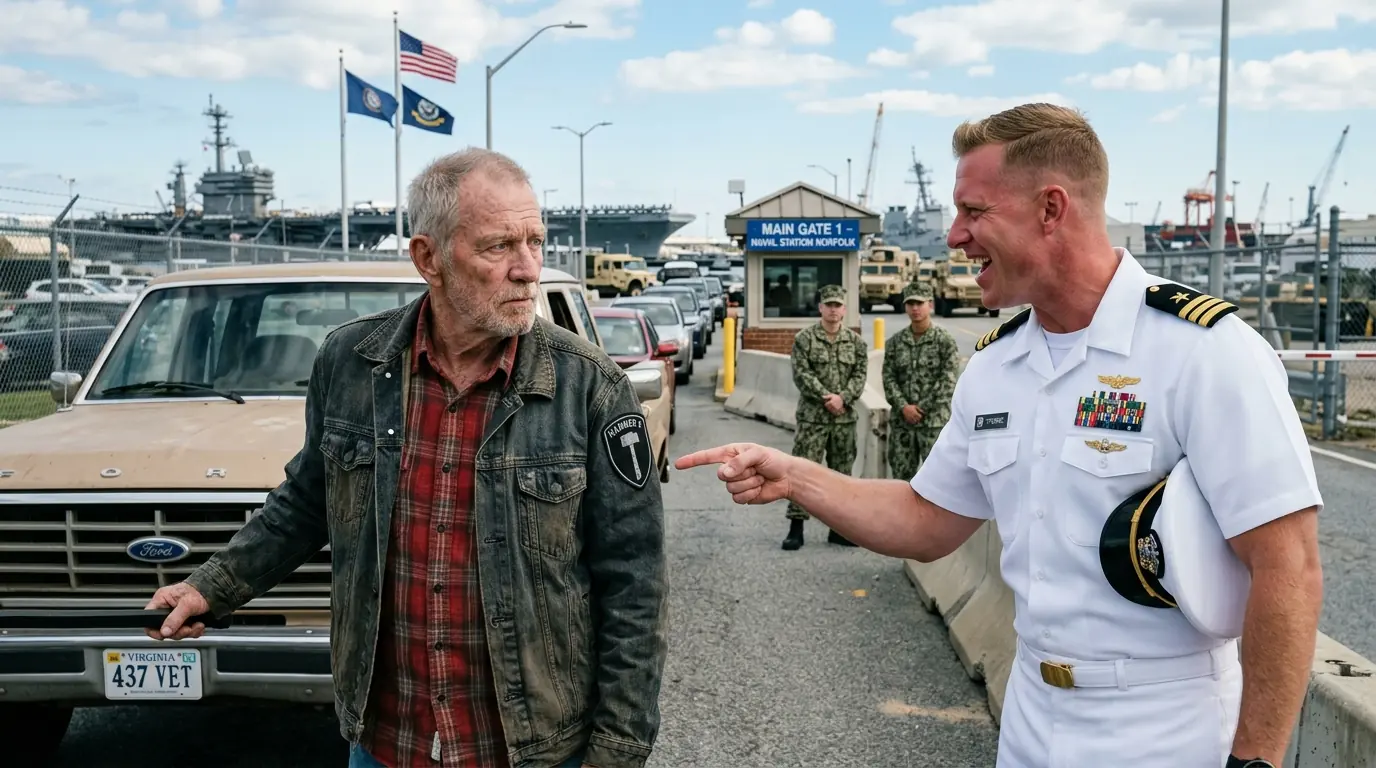
The voice was sharp, cutting through the humid morning air with the clean, arrogant edge of newfound authority. Captain Thorne, commander of base security, stepped closer to the old, dusty pickup truck, his polished boots crunching on the gravel shoulder just outside the main gate of Naval Station Norfolk.
The truck, a relic from a bygone decade, idled with a low, patient rumble. Behind the wheel, Randall Stone, a man whose face was a road map of 83 years, did not turn to meet the captain’s glare. His gnarled hands rested on the worn steering wheel, his gaze fixed on the distant gray hulls of destroyers and carriers shimmering in the harbor.
He seemed less a man being interrogated and more a mountain enduring a breeze.
Thorne exchanged a look with the two junior security personnel flanking him. They were tense, unsure. The captain, however, was a portrait of crisp, righteous indignation.
“Driver’s license. Base credentials. Now.”
His tone brooked no argument. One hand rested casually, almost theatrically, on the butt of his sidearm. The line of cars waiting to get on base was growing longer, a captive audience to the unfolding drama. The morning sun glinted off the starched collar and silver eagle insignia on Captain Thorne’s uniform.
He was the very picture of modern naval command, fit, sharp, and utterly certain of his place in the universe.
Everything about Randall Stone was an affront to that certainty. The faded flannel shirt, the dusty Ford truck that looked like it had been pulled from a barn, the quiet, unyielding stillness of the old man himself. It was all out of place, a disruption to the orderly, hierarchical world Thorne commanded.
“Sir, I am asking you for the last time,” Thorne said, his voice dropping into a low, menacing register. “Provide your identification and state your business at this naval station, or I will have you physically removed from this vehicle and this entire area.”
The line of cars had now backed up past the main intersection, a long, shimmering snake of metal and glass. People were starting to get out of their cars, their cell phones held up to record the confrontation. The murmur of the crowd grew, a mix of curiosity and irritation. Junior sailors, civilian contractors, and visiting family members all watched as the young, powerful captain bore down on the silent elderly man.
Thorne felt the eyes on him, and it only hardened his resolve. He would make an example of this man. He would demonstrate that rules, protocol, and authority were absolute.
“Do you not understand me?”
Thorne leaned down, his face close to the open window of the truck. He could smell the faint scent of old leather and motor oil.
“This is a restricted federal installation. This isn’t a public park. Your presence here without authorization is a security risk.”
He gestured dismissively at the truck.
“This vehicle is unregistered in our system. You have no visitor pass. You have no active duty or retired military ID on file. So, I’ll ask again. Who are you?”
He slowly, deliberately reached into the glove compartment and pulled out an old, cracked leather wallet. It was held together by a thick rubber band. The sight of it seemed to offend Thorne on a personal level. It was another piece of evidence in his case against this man. Disorganized. Ancient. Irrelevant.
With methodical slowness, Randall extracted a single card from the wallet.
It was a military identification card, but of a type Thorne had never seen before. It was laminated. The photo was a faded black and white image of a young man with Randall’s eyes, but a face unlined by time. The card was worn smooth at the edges, the text barely legible.
Thorne snatched it from Randall’s hand.
“What is this? This thing expired 40 years ago.”
He scoffed, holding it up for his subordinates to see, a prop in his public lesson.
“This is a joke.”
He then noticed a small, faded patch sewn onto the sleeve of the old leather jacket Randall had draped over the passenger seat. It was a simple design, a black shield with a single downward pointing hammer embroidered in silver thread. There were no unit numbers, no slogans, no other identifiers. It was stark and anonymous.
Thorne pointed at it with the expired ID card.
“And what’s this supposed to be? Some kind of motorcycle club? You and your buddies go on long rides on the weekend?” he asked, his voice dripping with condescension.
The small crowd of onlookers rippled with a few nervous chuckles. The disrespect was palpable, a physical thing hanging in the air.
The two junior guards shifted their weight, their expressions now betraying a flicker of unease. This was escalating beyond a simple security check. It was becoming a humiliation.
Randall’s eyes drifted to the patch on his jacket. His expression didn’t change, but his focus seemed to turn inward, as if listening to an echo from a place very far away.
The air wasn’t humid and thick with the salt of the Atlantic. It was thin and cold, screaming with the high-pitched whine of turbine engines. The world wasn’t bright morning sun, but the strobing, disorienting green of a night vision display.
He wasn’t sitting in a truck. He was strapped into the jump seat of a Black Hawk, the percussive thud of the rotor blades vibrating through his entire skeleton. The hammer patch on his sleeve was crisp and new. Below him, the dark, jagged mountains of a forgotten country rushed past.
A voice crackled in his headset, calm amid the chaos.
“Thirty seconds out, Hammer 6. Ground team is pinned down. They need a miracle.”
Randall’s hand, young and strong, tightened its grip on the cold steel of an M240 machine gun.
The only miracle they were getting today was him.
“Sir.”
The voice of one of the younger guards pulled him back. Randall blinked, the ghost of rotor wash fading, replaced by the impatient tapping of Captain Thorne’s finger on the truck’s roof.
Thorne had seen the old man’s eyes go distant and had mistaken it for senility, for confusion. It was the final piece of confirmation he needed.
“That’s it. I’m done with this,” Thorne announced to the crowd as much as to Randall. “This man is clearly disoriented, a danger to himself and to my base.”
Among the onlookers, however, not everyone was laughing.
Petty Officer Second Class Miller, a young man with a passion for naval history, stood by his car, his stomach twisting into a knot. He had been raised on stories from his grandfather, a master chief who had served in Vietnam, stories of quiet men who did impossible things.
There was something in the old man’s posture, a core of stillness that reminded him of those stories. And the patch, that strange, simple hammer. He felt a primal sense of wrongness, like watching someone desecrate a hidden monument.
Captain Thorne was young. He saw regulations and protocol. Miller, through the lens of his grandfather’s tales, saw something else.
He saw a sleeping giant being prodded with a stick.
Thorne turned to his guards.
“Get him out of the vehicle. Cuffs. We’ll take him to base medical for a full evaluation.”
That was the breaking point for Petty Officer Miller.
He couldn’t intervene directly. That would be career suicide. But he couldn’t do nothing.
He slipped back into his car, his hands trembling slightly as he pulled out his phone. He didn’t call 911. He scrolled through his contacts to a number he used only for true emergencies, a direct line to his grandfather’s old friend and colleague, now the command master chief of the entire Atlantic Fleet, a man who had the admiral’s ear.
He thumbed the call button, his heart pounding against his ribs.
The phone rang once, twice.
A gruff, impatient voice answered.
“Master Chief Peterson.”
“Master Chief, it’s Petty Officer Miller. Dale Miller’s grandson.”
“Miller, what is it, son? I’m in a briefing.”
Miller stammered, trying to get the words out quickly and clearly.
“You need to get down to the main gate now. Captain Thorne is about to arrest some old man. Sir, the guy is giving him nothing. Just sitting there, but there’s something about him. Thorne is making a scene, and it feels wrong. The old man’s name, he gave him an old ID card. The name on it was Randall Stone.”
Miller took a breath.
“And he has this patch, sir. A black shield with a silver hammer.”
He relayed the scene, the captain’s escalating aggression, the old man’s impossible calm. He spoke of the expired ID and the mockery. He described the moment Thorne ordered the man to be cuffed and taken for a psych evaluation.
On the other end of the line, the impatient gruffness in Master Chief Peterson’s voice evaporated, replaced by a sudden, sharp silence that was more alarming than any shout. Miller could hear the sound of a chair scraping back violently, of muffled urgent voices in the background.
The master chief had left his briefing.
Inside the command building a half mile away, Command Master Chief Peterson stood ramrod straight in the doorway of the admiral’s personal office, his phone still held to his ear. He had barged in. Protocol be damned.
Admiral Vance, a man who commanded carrier strike groups and oversaw the operations of half the United States Navy, looked up from his desk, his eyes narrowed with annoyance at the interruption.
“Master Chief, this had better be a matter of national security,” Vance said, his voice a low rumble of authority.
“Admiral,” Peterson said, his own voice tight, controlled, but laced with an urgency Vance had not heard in years. “I apologize for the intrusion. Petty Officer Miller just called from the main gate. Captain Thorne is detaining a civilian, an elderly gentleman.”
Vance’s expression hardened.
“And this requires my personal attention? Let Thorne handle his security checkpoint.”
“Sir,” Peterson continued, taking a step into the room. “The man’s name is Randall Stone.”
The name hung in the air for a moment. It meant nothing to the admiral. He gave a slight, dismissive shrug.
Peterson pressed on, his gaze locked on his superior.
“The man has a patch on his jacket, sir. A black shield. A silver hammer pointing down.”
Admiral Vance froze. The pen in his hand stopped moving. He slowly raised his head, his eyes boring into the master chief’s.
The entire atmosphere in the opulent, flag draped office shifted. The air grew heavy, charged with the weight of something old and dangerous. The admiral’s face, usually a mask of calm, confident command, went pale.
He knew the history. He knew the legends, the ghost stories that were whispered in the classified briefing rooms, in the private halls of the Pentagon. There were a handful of designations so secret they were never written down. Names that existed only in memory and in the most highly classified oral histories of the special warfare community.
“Say that again, Master Chief,” Vance said, his voice barely a whisper.
“Silver Hammer, sir. Miller reports Captain Thorne is about to place him in restraints. He says Thorne is calling him delusional.”
Vance stood up so quickly his chair shot backward and hit the credenza with a loud thud.
“Get me a car. Get me the Marine honor guard. Now. Tell them to meet me at the main gate. Move,” he roared, his voice shaking the windows.
He grabbed his cover from its stand.
“Master Chief, you get on the horn to Thorne. You tell him to stand down. You tell him if he so much as lays a finger on that man, I will personally strip him of his command and have him court martialed before lunch. Do you understand me?”
“Aye, Admiral,” Peterson said, already dialing, a cold dread washing over him as he prayed they were not already too late.
Back at the gate, Captain Thorne was basking in the final moments of his victory. He had successfully neutralized a threat, enforced protocol, and demonstrated his unwavering authority to a crowd of hundreds.
The two guards were now opening their cuff pouches, approaching Randall’s truck door with a grim sense of duty.
“All right, sir. Let’s make this easy,” one of them said, his voice apologetic. “Just step out of the truck.”
Thorne crossed his arms, a smirk playing on his lips.
“It’s for your own good. We need to get you checked out. And you still haven’t answered my question. In my Navy, everyone has a designation. Everyone has a call sign. What was yours? Or did you just peel potatoes in a mess hall?”
For the first time, a flicker of something, not anger, but a deep, profound weariness, crossed Randall Stone’s face.
He let out a long, slow sigh, the sound of a man who had been pushed just one inch too far. He looked past the guards, past the smug captain, and fixed his gaze on the American flag fluttering from the top of the main gate flagpole.
He spoke, his voice not loud, but carrying an impossible weight, a resonance that seemed to cut through all the other noise.
“Hammer 6.”
The name meant nothing to Thorne. It sounded made up, childish.
He let out a short, derisive laugh.
“Hammer 6. Is that from a comic book?”
He turned to the guards.
“Get him out now.”
But before the guards could touch the door handle, a sound pierced the air. A sound utterly alien to the routine of a morning checkpoint.
It was the high-pitched shriek of tires, not from one car, but from several. Every head swiveled toward the base. Three black sedans, lights flashing, were screaming toward them, ignoring all traffic lanes. They skidded to a halt just yards from the scene, blocking the road completely.
Doors flew open, and a full squad of Marine Corps security forces in dress blues poured out, their movements sharp, precise, and menacing. They formed a cordon, their white gloved hands holding ceremonial rifles, effectively creating a barrier between the crowd and Randall’s truck.
From the lead car, Admiral Vance emerged, his face a thundercloud of controlled fury. He strode through the line of Marines, his eyes burning with an intensity that made Captain Thorne’s earlier anger look like a petulant tantrum, fixed not on Thorne, but on the man in the truck.
Master Chief Peterson was two steps behind him, his face grim.
The entire scene at the gate went dead silent. The crowd, the guards, even the birds in the nearby trees seemed to hold their breath.
Captain Thorne’s smirk dissolved, replaced by a slack jawed expression of pure shock and confusion. He snapped to attention, his mind racing, unable to process what was happening.
Why was the fleet admiral here? Why was there an honor guard?
Admiral Vance completely ignored his base security commander. He walked directly to the driver’s side door of the old Ford pickup. He stood there for a moment, composing himself.
Then, in a move that sent a wave of disbelief through the assembled crowd, the two star admiral, commander of the entire naval station and its associated strike groups, drew himself up to his full height and executed the sharpest, most respectful salute of his life.
“Mr. Stone,” Admiral Vance said, his voice clear and ringing with a profound deference that bordered on reverence. “On behalf of the United States Navy, I want to offer my deepest, most sincere apology for the unacceptable welcome you have received today. I am Admiral Vance, the base commander. It is an honor, sir. A true and humbling honor.”
Randall Stone simply nodded, accepting the salute and the apology with the same quiet grace he had shown all morning.
The crowd erupted in a wave of confused murmurs.
Captain Thorne looked as if he had been struck by lightning. He took a hesitant step forward.
“Admiral, I don’t understand. This man is a civilian. He has no valid credentials. He…”
Vance turned his head slowly, and the look in his eyes silenced Thorne instantly. It was a look of pure, unadulterated ice.
“Captain, your understanding is not required. What is required is your silence.”
The admiral turned back to the crowd, his voice now booming, taking on the tone of a man used to addressing thousands.
“Everyone here seems to be confused,” he began, his gaze sweeping over the sailors and civilians. “You see this man, and you see an old timer in a beat up truck. You see a faded patch on a worn out jacket. Your captain here saw a security risk, a nuisance.”
He paused, letting the words sink in.
“Let me tell you what I see.”
He gestured toward Randall.
“I see the man the history books can never write about. I see the sole survivor of Operation Nightingale, a mission so deep, so classified that all seven other members of his team were listed as training accidents. I see the man who held the North Ridge at Ana Pass for 72 hours alone against an entire enemy battalion, armed with little more than a radio and the weapons of the fallen. The reinforcements who finally reached him didn’t find a man. They found a fortress built of mud, rock, and sheer will.”
The murmurs in the crowd died, replaced by a stunned, reverent silence. Cell phones were no longer just recording. They were documenting a moment of living history.
“This man,” Vance continued, his voice thick with emotion, “wears no medals on his chest because the actions that earned them are too secret to ever be acknowledged. He asks for no special treatment. He seeks no recognition. He is a ghost, a whisper, a legend to men who are themselves legends. The unit he served with was the precursor to the teams that now hunt our nation’s worst enemies in the dead of night. They didn’t have a name. They had a mission commander. His call sign…”
Vance’s voice cracked slightly.
“Was Hammer 6.”
He turned his furious gaze back to Captain Thorne, who now looked physically ill.
“You demanded his call sign. Captain, you do not have the clearance, the rank, or the honor to even speak that designation aloud. You stood here and you mocked the patch on his jacket. Men have received the Medal of Honor for actions performed just trying to keep up with the man wearing that patch.”
The public shaming was absolute, brutal, and complete. Thorne’s authority had not just been undermined. It had been vaporized in a blast of historical truth. He stood stripped bare in front of his subordinates and the entire base community, his arrogance revealed as nothing more than profound ignorance.
Admiral Vance now lowered his voice, speaking directly to Thorne, who flinched as if expecting a physical blow.
“You mistake age for weakness. You see humility, and you call it confusion. You are in charge of the security of this base, Captain, which means you are responsible for protecting the people on it. But you are also responsible for honoring the legacy it represents. You have failed in that duty in a way I have never witnessed in my 30 years of service. You are hereby relieved of your command, effective immediately. Master Chief Peterson will escort you to my office. Your career is pending a full review.”
As the master chief stepped forward to lead the utterly broken captain away, Randall Stone opened his truck door and slowly got out. He moved with the stiffness of age, but his posture was still erect.
He walked over to the admiral and placed a gentle hand on his arm.
“Admiral,” Randall said, his voice calm and steady. “He’s a young captain, full of fire, eager to do his job right. We were all like that once.”
He looked over at the pale, trembling Thorne.
“He just needs to learn to see the person, not just the uniform, or in my case, the lack of one. Don’t ruin the boy’s career over this. Teach him. That’s what leaders do.”
The wisdom in his words was simple, direct, and more powerful than any official reprimand. It was a lesson in grace from a man who had every right to demand vengeance.
Admiral Vance looked from Randall to Thorne, his anger slowly receding, replaced by a deep sense of shame and introspection. He had been ready to end a man’s career to defend an icon. But the icon himself was asking for mercy and mentorship.
As Randall spoke, his hand rested near the old leather jacket, still on the passenger seat. For a fleeting moment, the scene dissolved.
He was 25 again, crouched in a muddy foxhole. The sun was setting, casting long shadows across a landscape of devastation. Next to him, a young Marine, his leg bandaged with a bloody field dressing, was pressing a small hand stitched patch into his hand.
It was a black shield with a silver hammer.
“We were all dead,” the Marine whispered, his voice. “They call us ghosts, but you, you’re different. You’re the hammer that falls when everyone else has run. You’re Hammer 6.”
It wasn’t a name assigned to him. It was a name he had earned in blood and sacrifice, given to him by the men he had saved.
The fallout from the incident at the main gate was swift and decisive. Captain Thorne was not court martialed, but he was formally reprimanded and reassigned to a remote desk job in logistics, a public fall from grace that served as a stark lesson.
At Randall Stone’s quiet suggestion, Admiral Vance instituted a new mandatory training program for all security and command personnel on the base. It was called the Hammer 6 Initiative, and it focused on veteran interaction, deescalation, and most importantly, the oral histories of the Navy’s quiet professionals. The goal was to teach the new generation to recognize the unassuming heroes who walked among them.
The base issued a formal public apology to Randall Stone, though he never asked for one and never came to the ceremony. The video of the confrontation, however, went viral within the military community, a cautionary tale passed from one junior officer to another.
Several weeks later, a much humbled Lieutenant Thorne, his captain’s eagles now gone, was sitting alone at the counter of a small off-base diner, stirring a cup of black coffee.
The door opened, and Randall Stone walked in. He saw Thorne, and for a moment the younger man looked like he wanted to disappear into the floor.
But Randall just walked over and took the stool next to him. He ordered a coffee. They sat in silence for a few minutes, the only sound the clinking of spoons and the low murmur of the other patrons.
Finally, Thorne cleared his throat.
“Sir,” he said, not looking at Randall. “I… I never properly apologized to you. What I did was inexcusable. There’s no excuse for my arrogance. I am truly sorry.”
Randall took a slow sip of his coffee.
“You were doing your job, son. You were just looking at the world through a very small window.”
He turned and offered a small, forgiving smile.
“The trick is to make that window bigger every day you’re alive.”
He flagged down the waitress.
“I’ll take his check, too,” he said, placing a few worn dollar bills on the counter.
Then he stood up, gave Thorne a gentle pat on the shoulder, and walked out of the diner, leaving the young officer alone with his thoughts and a fresh hot cup of coffee he hadn’t paid for.
It was a small gesture, a quiet act of grace that taught a more profound lesson than any official punishment ever could.