He didn't think twice. He just jumped. Thirty-six years old, work boots still on, phone still in his pocket. Owen Mercer hit that black harbor water like a man who had nothing to lose. Because honestly, he thought he didn't.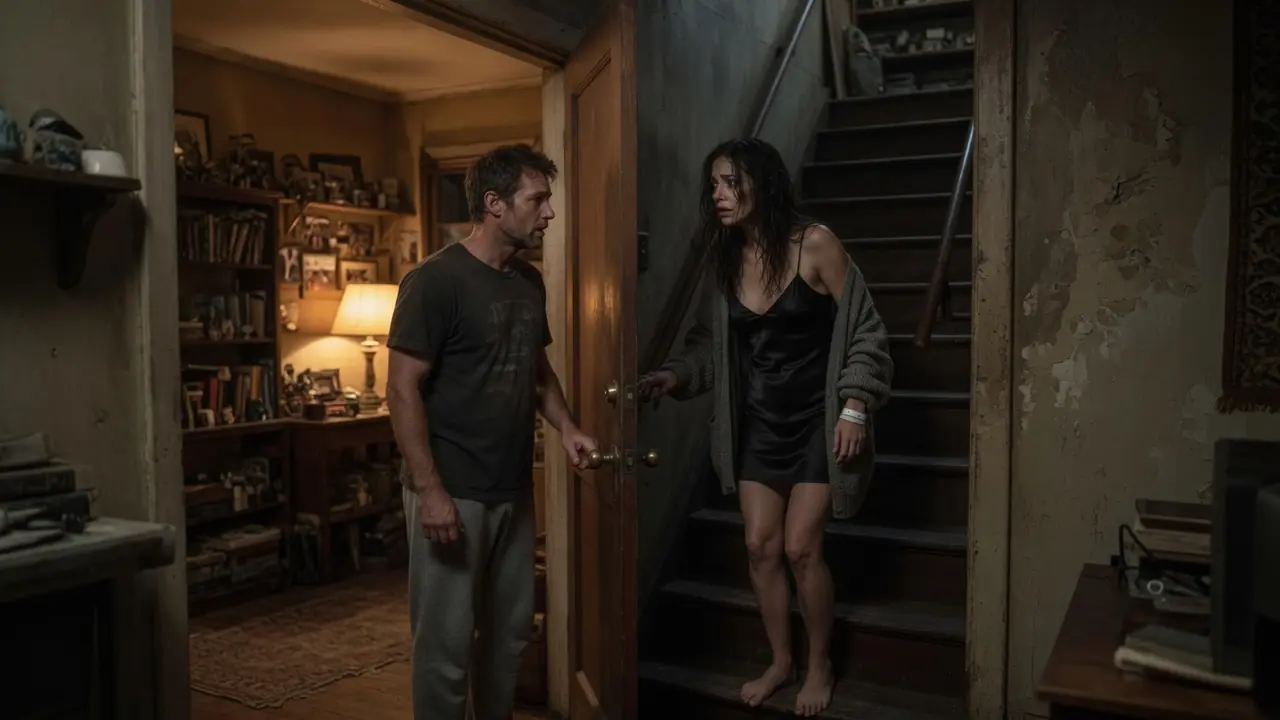
He pulled her out. She was breathing. He thought it was over. Then at one seventeen in the morning, someone knocked on his door. And when he opened it barefoot, shaking, eyes full of something she couldn't say out loud, everything he thought he understood about that night fell apart.
Owen Mercer had a rule he lived by, and he'd lived by it long enough that it didn't feel like a rule anymore. It just felt like the truth. Machines don't lie to you. A diesel engine either runs or it doesn't.
A bilge pump either holds pressure or it fails. A hull either has integrity or it takes on water. There's no in between with machines. No hidden agenda, no smile that means something different than what's on the surface.
People were another matter entirely. He'd learned that the hard way. Once with a business partner who walked off with eighteen months of contracts. Once with a woman he'd married young and loved completely and lost anyway.
And once most painfully in a courthouse in Providence where a judge read out a custody schedule that felt less like justice and more like a sentence. Every other weekend. That was what he got. Every other weekend with his son Caleb who was nine now.
And still asked Owen on the phone sometimes in that quiet way kids have, "Dad, are you okay?" Because even at nine Caleb could hear something in his father's voice that Owen didn't know was there. So Owen kept to himself.
He kept his hands busy. He took contracts nobody else wanted. The rusted out commercial fishing boats, the neglected sport fishers sitting dead in their slips, the restoration jobs that required more patience than profit.
He rented a small apartment above his workshop on the east edge of the Newport Marina, where the smell of salt and diesel was so constant he'd stopped noticing it years ago. He worked, he slept. On his weekends with Caleb he came alive in a way that made the other twelve days feel like waiting.
That was his life. And he had made a kind of peace with it. The night it all changed was a Thursday in late September, and it had already been a long one. Owen had spent eleven hours replacing the raw water impeller and exhaust manifold on a forty-two foot Hatteras.
That belonged to a real developer who called twice a day with questions. He clearly didn't understand the answers, the kind of client who wanted to feel involved without doing any of the actual work. And Owen had learned to answer politely, keep his voice even, and hang up the phone before saying what he actually thought.
By seven thirty, he was washing grease off his hands at the utility sink, his back aching in that specific way it did when he'd been bent over an engine bay too long. The radio in the corner of the workshop was playing something low and forgettable. The marina outside was quiet, just the sound of water moving against hulls, the occasional creak of a dock line.
He was thinking about dinner, specifically about whether there was anything in his refrigerator besides a six-pack of beer and what he suspected was aging takeout. He was also thinking about Caleb because he always was. His son was supposed to call at eight. And Owen was already watching the clock.
That was when he heard it. At first, he thought it was a gull. There were always gulls near the marina at dusk. And they made sounds that could startle you if you weren't paying attention. But this wasn't a gull.
A gull doesn't make a sound that lands somewhere in your chest and makes your hands go still. He turned off the water, listened. There it was again, high and broken and absolutely human. A woman's voice coming from the south end of the marina where the channel opened up toward the main harbor.
Owen stood there for exactly three seconds. Three seconds of thinking someone else will handle it. Someone from that event. There are a hundred people over there. And then something older than thought took over.
He moved. He came around the corner of the last dock building at a run. And the first thing he saw was the lights. Strings of white lights hung between masts. The kind of setup that said money and charity in equal measure.
There was a yacht, a big one, maybe sixty feet, moored at the guest pier with people in evening clothes clustered along its rail and on the dock beside it. They were all looking at the water. Some were pointing. Two men at the edge of the dock were shouting down into the darkness below.
A woman in a red dress had both hands pressed over her mouth. A man in a tuxedo was on his phone, turned away from the scene, talking fast. Owen didn't slow down. He pushed through the cluster of people at the dock's edge, looked down, and saw her.
She was maybe fifteen feet out from the dock in that black harbor water that in late September has already gone cold enough to matter. Cold enough to make your muscles stop cooperating with your brain. Cold enough to rob you of the ability to think clearly about what your arms are supposed to be doing.
She wasn't screaming anymore. That was what hit him hardest. The screaming had stopped, which meant she was past screaming, which meant she was past the stage where panic has energy behind it and into the stage where the body just starts to give.
Her head was barely above the surface. Her hands were moving, but weakly. That terrible motion flailing that looks like swimming but isn't. That looks like fighting but is actually the beginning of something else.
Owen pulled off his jacket. He was over the rail before anyone on that dock had time to process what was happening. The water hit him like a door slamming. Cold. Not just cold, but the specific cold of the North Atlantic in autumn.
The kind that makes your lungs seize for a moment and your brain send out a white flash of pure animal panic before training and will override it. He'd grown up around this water. He knew this cold. He kicked hard, found his rhythm, and covered the distance in under a minute.
"I've got you," he said. And he wasn't sure if he said it out loud or just thought it. "Stop fighting. I've got you." She didn't stop fighting right away. They never do, not immediately.
But she heard him. He could feel the shift in her body. The way the desperate grabbing eased slightly into something that was still fear, but was at least working with him instead of against him. He got her to the dock ladder.
Hands came down from above, a dock worker, a marina employee, someone who knew what they were doing. And they got her up first and then Owen pulled himself up after, his work boots hitting the planks of the dock with a sound like wet wood on wet wood.
He was on his hands and knees for a moment, water pouring off him, lungs burning. Then he got up. She was sitting on the dock wrapped in someone's jacket already. Someone kneeling beside her and she was coughing that deep body-shaking cough that means the water got in, but she was upright and her eyes were open.
And she was, by every measure that mattered, alive. That was when he got his first real look at her. She was somewhere in her early to mid-thirties. Dark hair plastered against her face. Evening clothes, the kind that didn't come off a rack, even waterlogged and shaking, sitting on a dock in the dark.
There was something about the way she held herself that suggested this was a woman who, under normal circumstances, was in control of most rooms she walked into. Except right now she wasn't in control of anything. And she knew it. And that gap between who she normally was and what she looked like right now, Owen could see it in her face.
The humiliation of it layered under the fear. "Ma'am," he said, crouching down. "You with me?" She turned and looked at him. Her eyes were dark brown or green. He couldn't tell in the dock lighting.
And they were the most alert eyes he'd ever seen on someone who'd just come out of the water. Most people, when they've nearly drowned, look inward. They go somewhere else for a while. She was entirely present, looking straight at him, taking him in with an expression he couldn't read.
"I'm with you," she said. Her voice was rough from the coughing, but clear. "Good. EMTs are coming. Don't try to stand yet." "I'm fine." "You're not fine. You just—" "I'm fine," she said again.
Quieter. And there was something in the way she said it that was different from the reflexive denial people make when they've been frightened. This was deliberate. This was a message she was sending. And Owen had the strange sense that it wasn't aimed at him, but at something behind him.
He turned. The man walking down the dock toward them was maybe forty, tall, well-dressed in the particular way that says the money is old enough that the clothing choices are effortless. Dark suit, no tie, the kind of face that belonged in a boardroom or a profile photo attached to a large donation.
He was moving quickly but not running, the careful measured stride of someone who understood that how you arrive matters. "Clare." His voice was controlled, almost soothing. "My god, Clare, are you all right?" The woman, Clare, apparently, looked up at him.
And Owen, who was still crouching right beside her, saw something happen in her face that he would not forget. It wasn't relief. He'd expected relief. The person you love arriving when you're frightened, that specific unwinding. And this wasn't it.
There was something tighter, something guarded. "I'm okay, Graham," she said. Graham crouched down on her other side, put a hand on her arm, looked at her with an expression of deep concern. Then he looked at Owen.
"Thank you," he said. His voice was warm. His eyes were not. "It's nothing," Owen said. "It's everything," Graham said. "We'll make sure you're compensated."
"That's not necessary." "Of course it is." Graham was already looking away, already looking back at Clare. And this was the part Owen's brain filed away without quite knowing why. Already positioning himself so that his body was slightly between Clare and Owen.
A move so casual it almost didn't register. Almost. The EMTs arrived four minutes later. Efficient, professional. They got Clare onto a stretcher with the practiced ease of people who'd done it many times.
Checked her vitals, started asking the standard questions. Graham walked beside the stretcher, still talking to Clare, to the EMTs, into his phone, organizing, managing, controlling the situation the way someone controls a situation when they are very, very good at it.
Owen stood back. His clothes were soaked through, and the September night was cold enough now that he was starting to feel it in a serious way. Someone had brought him a blanket from somewhere, the yacht probably, and he'd taken it without really thinking about it.
He watched them load Clare into the ambulance. And right before the doors closed, she turned her head and found him in the crowd, in the chaos, across the distance of the dock. She found him the way fuel finds a fixed point when everything else is moving.
And she mouthed something. He read it clearly. He'd spent enough years watching Caleb talk through a window on supervised visits to have gotten very good at reading lips. "Don't tell."
Don't tell what. He didn't know. He still doesn't fully know even now what she meant in that exact moment. But he nodded anyway, a small, barely perceptible nod because something in her eyes made it impossible to do anything else.
And then the doors closed. Owen walked back to his workshop. He peeled off his soaked clothes, stood under the hottest shower his water heater could manage, and stood there until the shaking stopped. Then he dried off, pulled on clean jeans and a flannel shirt, and heated up whatever was in the back of the refrigerator without looking at it too closely.
He called Caleb. "Dad, you sound weird." "Long day, bud." "Did something happen?" "Nothing bad." He thought about that actually. Something kind of happened. "I helped somebody tonight."
"What kind of somebody?" "A woman. She fell in the harbor." There was a pause. Caleb processed things carefully. Always had, even as a small kid. "Is she okay?"
"Yeah, she's okay." "Good." Another pause. "Were you scared?" Owen thought about the water, the cold, her hand when he grabbed it. "A little. Yeah, but you still did it."
"Yeah." "Okay," Caleb said with the simple complete satisfaction of a nine-year-old who has received all the information he needs. "Okay, Dad." They talked for another twenty minutes about school, about a project involving volcanoes, about whether it would be okay if they went fishing on his weekend.
Owen made coffee he didn't need and sat in the single chair in his apartment and let his son's voice fill the room. He didn't tell Caleb about "don't tell." He didn't tell anyone. He went to bed at ten thirty, slept badly, and woke up several times thinking he'd heard something.
He hadn't. The night was quiet. The harbor was quiet. The city outside his window was dark and still and made the sounds cities make when the people in them are finally, temporarily at rest.
And then at one seventeen in the morning, someone knocked on his door. Not the building door, not the workshop door below, the apartment door, the one at the top of the narrow interior stairs that nobody who didn't already know this building would think to look for, let alone climb in the dark.
Owen sat up, listened. Another knock, not hard, not the frantic knock of emergency, the careful knock of someone who needs to be heard but is terrified of being heard by the wrong person. He got up. He went to the door.
He didn't turn on the light because some instinct told him not to. He opened it. She was standing at the top of his stairs in bare feet. The hospital bracelet was still on her wrist.
Her hair had dried in the way hair dries when there's no effort put into it, and she was in clothes that weren't hers. A sweatshirt too big in the shoulders. Jeans that didn't quite fit right. The kind of borrowed things you throw on when you leave somewhere quickly.
She was shaking, not from cold. She was looking at him with eyes that had been holding something for a long time, and were very close to not being able to hold it anymore. And Owen Mercer, a man who trusted machines and kept to himself, and had made a careful peace with a quiet life, stood in his doorway and looked at this woman he had pulled out of the water six hours ago.
"How did you find me?" he asked. "The dock workers know you," she said. "Everyone around this marina knows you." She stopped. Her jaw worked for a moment. "I didn't know where else to go."
He stood aside. He let her in. And just like that, his quiet life was over. Owen stepped back from the door and she walked in. And for a moment, neither of them said anything.
That kind of silence has weight to it. It's not comfortable and it's not awkward. It's the silence of two people who both understand that whatever gets said next is going to matter and neither one of them is ready to be the first one to say it.
He pulled a chair from the small table by the wall and set it in the center of the room. She sat down without being asked, which told him something. She wasn't so far gone that she'd lost her instincts. She knew when something was being offered and she knew how to take it without making it complicated.
"Are you hurt?" "No." "Did they check you out at the hospital?" "Yes." "And they released you?" "I released myself."
He looked at her. The hospital bracelet on her wrist caught the low light from the single lamp he turned on. That cheap plastic band with her name and a barcode printed on it, and it looked wrong on her wrist. The way anything institutional looks wrong on someone who is used to being in charge of their own life.
"You signed yourself out AMA," he said. She looked up. "How do you know what that means?" "I've spent enough time in emergency rooms with boat injuries to know what AMA means." She almost smiled. Not quite.
But the corners of her mouth moved in a way that suggested under different circumstances she might be capable of it. "Yes," she said. "I signed out AMA." "Why?"
And there it was. The question she'd clearly been asking herself since the moment she climbed out of whatever situation she'd climbed out of to end up at the top of his stairs at one seventeen in the morning. "Why here? Why him? Why now?"
"Because I needed to think," she said carefully. "And I couldn't think in that room." "Why not?" She didn't answer that one. She looked down at her hands instead, bare hands, no rings, which he noticed and filed away without knowing why.
And she was quiet for long enough that he went to the small kitchen and put the kettle on. Not because he thought tea was going to fix anything, but because it gave his hands something to do and it gave her something to look at that wasn't him.
"Graham was there," she finally said, "at the hospital. He never left." She said it without inflection, like she was describing weather. "From the moment they brought me in, he was there in the room talking to the doctors, answering questions that they were asking me."
She paused. "Like I wasn't capable of answering them myself." Owen didn't say anything. He poured hot water into two mugs and brought them to the table and sat down across from her. "He's your fiancé," he said.
She looked at him sharply. "How do you know that?" "Someone on the dock said it when he showed up." She wrapped both hands around the mug and stared at it. "Yes, he is."
"He seemed worried about you." "He's always worried about me," she said. And there was something in the way she said it. Not bitter exactly, but worn. The way a stone gets worn smooth when water runs over it long enough that made Owen go still in the particular way he went still when an engine made a sound he didn't recognize and needed to locate.
"That's not a good thing," he asked. She looked up at him. "Would you like it?" she said quietly. "If the person who was supposed to love you treated every room you walked into like a problem they needed to manage?"
He didn't have an answer for that. Or rather he had one, but it required more personal disclosure than he was prepared to offer a woman he'd known for approximately six hours, two of which she'd been unconscious. "No," he said. "I wouldn't."
She nodded. Like he'd confirmed something she'd been telling herself for a long time and had needed for reasons she couldn't fully articulate to hear from someone else. The clock on the microwave read one twenty-four. The harbor was silent outside the window. The whole city felt like it was holding its breath.
"What did you mean?" he said. "On the dock. When you said don't tell." She went very still. The kind of still that isn't peace, but is the opposite of it. The stillness of someone who has been waiting for a specific question and is now deciding whether or not to answer it.
"I wasn't sure you saw that," she said. "I saw it." She set down the mug. She looked at the table for a long moment and then she looked at him with eyes that had made a decision. "We were arguing," she said.
"Graham and I before I went in the water. We weren't in the main group. We'd stepped away from the event because he wanted to talk. He always wants to talk when there are enough people around that I can't make a scene."
"What were you arguing about?" "My inheritance," she said it simply. Like those two words explained everything and in a way they did. "My father's estate. There's a trust. The Bowmont Harbor Trust. It controls a significant amount of capital and there's a board."
"And for the last two years, Graham has been positioning himself, getting close to the board members, making himself indispensable to the management structure." She paused. "He asked me three months ago to sign a document that would give him joint fiduciary authority."
"Did you sign it?" "No." "Why not?" "Because my father's attorney, Diana Marsh, told me not to. She said she'd seen language like that before, and it was designed to—" She stopped. Chose her words carefully.
"It was designed to look like partnership and function like control." Owen leaned back in his chair. He dealt with enough contracts in his business. Enough people who smiled when they handed you paperwork to understand exactly what she was describing.
"And tonight?" he said. "On the dock." She was quiet again. This quiet was different. This was the quiet of someone approaching something they haven't said out loud yet. And when you say something out loud for the first time, you make it real. And sometimes making it real is the most frightening part.
"We were at the edge of the dock," she said, "away from the lights. He was—he was very calm. He's always calm when he's serious. And he said he needed an answer about the document. He'd been patient long enough and he needed to know that I was with him."
She swallowed. "I told him I wasn't going to sign it. I told him Diana had advised against it and that I agreed with her. And he—" She stopped. "He what?" Owen said.
"He grabbed my wrist." She said it without drama, without performance, just the fact of it. Sat down on the table between them. "He grabbed my wrist and he walked me very close to the edge and he said, he said, 'Clare, you need to understand what you're choosing.'"
She paused and then, "He let go." The kitchen was very quiet. "He let go," Owen repeated. "Yes. Of your wrist." "Yes," she met his eyes. "Right at the edge."
Owen sat with that for a moment. The picture it painted was clear enough. A man with his hand on a woman's wrist at the edge of a dock in the dark. At a party where everyone was drinking and looking the other way. The thin line between a grip and a release. The thin line between a threat and an accident.
"Clare," he said carefully. "Are you saying he pushed you?" "I'm saying he let go," she said, "and that I lost my balance." She looked at him steadily. "And that I don't know if that's the same thing. Do you think it is?"
She looked down at her hands again, at the hospital bracelet, at her bare fingers where a ring presumably usually lived. "I don't know what I think," she said. And for the first time, her voice cracked slightly at the edges. "I know what I felt."
"I know that when I was going into that water, I looked at him and he was just standing there watching." She pressed her lips together and then someone screamed and he started shouting for help. Owen said nothing.
He was thinking about the man on the dock, the measured walk, the controlled voice, the hand positioned just so on Clare's arm, the way his eyes had been warm and cold at the same time in that specific combination that Owen recognized from a certain kind of person. The kind of person who understood that presentation was everything.
"Why don't you want me to tell anyone?" he said. "Because I have no proof," she said. "Because he's Graham Ellison. Because his family has been sitting on the boards of half the institutions in the city for thirty years."
"Because the moment I say what I think happened, I become the unstable woman making accusations against her fiancé. And every decision I've ever made, every position I've ever taken about the trust gets reframed as the behavior of someone who can't be trusted with her own affairs."
She said it fast like it was something she'd rehearsed. Not because it wasn't true, but because it was true enough that she'd had to think it through very carefully before she could say it. "And you came here," Owen said. "I told you. I didn't know where else to go."
"You have friends, family." "My family is the trust," she said flatly. "And my friends are people Graham introduced me to over the last four years very gradually in a way that seemed like generosity at the time." She looked at him. "I have one friend who's actually mine. Elise. She's in Boston right now. I've been trying to reach her."
Owen nodded. He stood up and went to the window and looked out at the harbor for a long moment. Not because there was anything to see, but because he needed to think, and he thought better on his feet. Here was what he knew.
A woman he'd pulled out of the harbor six hours ago was sitting in his kitchen at one in the morning. She was telling him something that could be nothing or could be everything. She had a hospital bracelet and borrowed clothes on her back and bare feet on his floor.
She was clearly intelligent, clearly frightened, and clearly in the habit of holding herself together through situations that would have unraveled most people. She was also, by her own telling, in the middle of something that involved significant money, and a man who had not liked the look he'd given Owen on that dock.
And that knock on his door, that careful, terrified knock at one seventeen in the morning, had already involved him, whether he'd chosen it or not. He turned back from the window. "There's a pullout couch," he said. "It's not comfortable, but it's dry and it's warm. You can stay tonight."
She looked at him. "You don't know me." "No," he agreed. "But I know what somebody looks like when they have nowhere to go. My kid looked at me like that once in a parking lot when things were very bad between me and his mother. And I told him the same thing I'm telling you. Tonight you're safe. That's all you need to figure out right now."
Something shifted in her face. Not the crack he'd seen before. Something quieter than that. The specific look of someone who has been holding on very tightly for a very long time and has just been given permission, briefly, to stop. "Thank you," she said. Just that.
"Do you want more tea?" "Yes," she said. "Please." He put the kettle back on, and for a short while they sat in the small apartment above the workshop, while the harbor moved quietly outside, and the clock moved from one something to two something, and they talked not about the dock, not about Graham, not about the trust, but about smaller things.
The kind of smaller things that people talk about when they need to let the bigger things settle without getting crushed by them. She asked about his work. He told her about the Hatteras, about the client who called twice a day. She laughed a little at that. A real laugh, brief and surprised, like it came out before she could decide whether to let it.
He asked where she grew up. "Newport," she said, "but the kind of Newport that's very different from the kind most people imagine." Private, contained, a childhood that looked like privilege from the outside and felt like a set of expectations from the inside.
"Your father," he said, "was he—" "He was good," she said. And the present tense slipped to past tense, landed in the room quietly. "He was a good person. He built the trust because he actually believed in what it was supposed to do. Support the harbor. Support the waterfront community."
"He didn't build it to be—" She stopped. "He didn't build it to be what it's becoming." "What is it becoming?" "A vehicle," she said, "for someone who understands how to use one out of anything."
Owen thought about that. He thought about the way Graham had walked onto that dock like he owned it. The way he'd looked at Owen, warm, dismissive, final. The way he'd positioned his body between Clare and everyone else so naturally that you had to be paying attention to notice it. Owen had been paying attention.
"My phone is dead," she said suddenly. She looked at the hospital bracelet again. "I left the hospital so fast I didn't—" "There's a charger on the counter. Blue cable." She found it, plugged her phone in, and sat back down. They waited while it powered up.
When it did, the notifications came in a cascade. Fifteen texts, seven missed calls, a voicemail that she looked at and immediately closed without listening to. Owen watched her face while she looked at her phone. She was careful about her expression, but not careful enough for someone who was trained to read machinery by the way it moved.
She was afraid, not in the way she'd been afraid in the water, which was the honest physical fear of the body. This was the quieter, more persistent kind, the kind that lives in the stomach rather than the lungs. "Graham," he said.
She turned the phone so he could see the screen without answering. There were eleven texts from Graham. He read the visible previews without touching the phone. "Where are you, Clare? I know you left AMA. I need you to tell me where you are. I spoke to the hospital staff. This is not safe. You need to please. I'm worried. I love you. Just tell me you're okay."
Owen looked at the last one. "I love you. Just tell me you're okay." The words that in another context would be the words of someone frightened for the person they love. In this context, in this sequence, at this hour they were something else. They were a hand on a wrist. A very different kind of hand.
"Don't answer him," Owen said. She looked at him. Something behind her eyes shifted slightly. Surprise. Maybe that he'd said it so directly. But she nodded. "Not tonight," he added. "Not when you're tired and alone, and he has all the advantages."
She stared at the phone for another moment. Then she turned the screen face down on the table and pulled her hands back. "Okay," she said. "Not tonight." It was approaching two thirty when she finally stopped fighting the exhaustion and accepted the pullout couch.
Owen found sheets in the closet, clean thankfully because he'd done laundry the previous weekend in preparation for Caleb's visit, and a blanket that had seen better days but was warm enough. He set them on the couch and told her where the bathroom was and went to bed himself.
He lay in the dark for a long time, listening to the harbor. The sound of water on hulls, the distant bell of a channel marker, the thousand small sounds of a marina at rest that he'd stopped hearing years ago and could suddenly hear again now with unusual clarity.
He thought about "don't tell." He thought about "he let go." He thought about the way Graham Ellison had said, "We'll make sure you're compensated," smooth and immediate and aimed perfectly at the place where a working man from the marina might be expected to have his price.
He thought about Caleb asking, "But you still did it." He fell asleep somewhere past three and woke at five forty-five to the sound of his phone. Not a call, a text, unknown number, but the area code was Newport.
He sat up and read it. It said, "Mr. Mercer, my name is Graham Ellison. I believe you helped my fiancée last night and I'm grateful. I understand she may have been in contact with you after the hospital. Appreciate a call at your earliest convenience. This is a personal matter and I'd like to handle it discreetly."
Owen read it twice. Then he put his phone face down on the nightstand exactly the way Clare had put her phone face down on his table. Four hours before he got up. He put coffee on and then he went quietly to check that the door at the top of the stairs was locked. It was.
He stood there with his hand on the deadbolt for a moment, listening to the sound of his own breathing, the sound of the coffee maker beginning its cycle, the sound of water lapping somewhere below against the hull of a boat that needed fixing. Machines, he thought. Machines are predictable.
Then he went to start the coffee and figure out what exactly he had stepped into. At six fifteen, the floorboards in the main room shifted in the way they shifted when someone was up. He heard soft footsteps, careful, trying not to wake him, and then the sound of the kitchen tap.
He came to the doorway. She was standing at the kitchen counter with a glass of water, already dressed, her hair pulled back. The hospital bracelet gone from her wrist. He'd find it later on the edge of the bathroom sink, discarded like something she had decided she was done with.
"Well," she looked at him when he appeared in the doorway. For a second, early morning. No pretense available. They just looked at each other. "I was going to leave before you woke up," she said. "I noticed."
She looked at the water in her hand. "I didn't want to make this more complicated for you." "It's already complicated," he said. Not unkind, just true. She set down the glass. "He texted you, didn't he?" It wasn't a question.
Owen crossed the room and got two mugs from the cabinet and poured coffee into both of them without asking if she wanted any. "Yes," he said. "At five forty-five." She took the mug he offered. "What did he say?"
"He wants to handle it discreetly." She made a sound that was almost a laugh. Almost. "Of course he does." "Clare." He waited until she looked at him. "You need to call your attorney today. Not tomorrow. Not after you've had time to think about whether you're making a bigger deal out of this than it is, which is what I suspect you're currently talking yourself into."
He held her gaze. "Today." She was quiet. Outside, the early morning light was beginning to give the quality of things in the way it does in a harbor town. The water going from black to gray to something almost silver and the sounds of the marina beginning their slow transition from night sounds to day sounds.
"Diana is going to ask me what happened." "Good," Owen said. "Tell her." "She's going to ask what I can prove." "Tell her that, too." She looked at him. This was the part he understood where she decided not just whether to call Diana Marsh, but something larger than that.
Whether she was going to keep doing what she'd apparently been doing for some time, which was absorbing what was happening to her and managing it quietly and telling herself she could handle it alone. Or whether she was going to stop, just stop and let someone else stand in the room with her for once.
Her phone lit up on the table. She looked at it. Graham again, not a text this time. A call. The screen lit and buzzed and sat there between them like something with its own agenda. Owen didn't say anything. He held his coffee and he waited.
She looked at the call. She looked at Owen. She looked back at the call. And then she reached out and turned the phone face down. "Okay," she said. Her voice was quiet, but it was steady. Steadier than he would have expected. Steadier he suspected than she felt. "I'll call Diana."
The phone stopped buzzing. The kitchen was quiet. And somewhere below them in the workshop, a boat engine ticked as the metal cooled in the early morning air. The sound of something at rest that would eventually need to run again. Owen drank his coffee. Clare held hers.
And the morning came in off the harbor the way mornings do in that part of Rhode Island in late September. Gray and cold and clean without apology, without ceremony, just the light arriving and doing what light does. Fifteen minutes later, she had Diana Marsh's number on the screen.
Twenty seconds after that, she pressed call. And Owen, who trusted machines because machines were predictable, stood quietly in the kitchen of his small apartment up above the workshop and listened to Clare Bowmont do the single bravest thing he would ever see anyone do, which wasn't jumping into cold water. And it wasn't surviving something dangerous. It was picking up the phone and telling the truth out loud.
Diana Marsh picked up on the second ring. That alone told Owen something. It was six forty in the morning. Attorneys who pick up on the second ring at six forty in the morning are either light sleepers or they've been waiting for a call they knew was coming. Clare walked to the far end of the small apartment while she talked, which Owen respected.
He refilled his coffee and went to the workshop downstairs, giving her what privacy his square footage allowed. He could hear her voice through the floor, not the words, just the tone. And the tone was controlled, careful, deliberate, the voice of someone who had decided to tell the truth and was doing it the hard way, one sentence at a time.
He was halfway through checking the oil on the Hatteras when she appeared at the top of the workshop stairs twenty minutes later. "She wants me to come in," Clare said. "Today. This morning. As soon as possible." "Good," Owen straightened up and wiped his hands on a shop rag. "Do you need a ride?"
She hesitated just slightly. The hesitation of someone who is used to handling their own transportation and finds it unexpectedly difficult to accept help without reading something into it. "I can call a car." "I'll drive you," he said. Not an offer, just a statement. The way he'd have said it to Caleb.
She looked at him for a moment. Then she nodded. It was seven ten when they left the marina. Owen's truck was old enough that the passenger window had to be held up with a folded piece of cardboard he'd wedged into the frame three months ago and kept meaning to fix.
He noticed Clare notice it and say nothing. He appreciated that more than he could have explained. They didn't talk much on the way to Diana's office on Thames Street. The city was just waking up, coffee shops pulling their gates. A delivery truck double-parked outside a restaurant. The first joggers of the morning moving along the waterfront.
Newport in early morning had a different quality than Newport at any other hour. Quieter, more honest, less concerned with what it looked like. "She believed me," Clare said about halfway there. Owen glanced at her. "Diana." "Yes." She was looking out the window. "I wasn't sure she would. I wasn't sure anyone would."
He thought about that, about what it does to a person when they've been in a situation long enough that they can no longer predict whether the people who are supposed to be on their side actually are. When the uncertainty becomes so chronic that even receiving belief feels surprising. "You were sure enough," he said. "You called her."
She turned and looked at him. "You made me." "No. I told you to. You did it." She was quiet after that, but it was a different kind of quiet than the ones before. This one had something in it that the others hadn't. Something that wasn't quite relief, but was adjacent to it. The way dawn is adjacent to morning without being the same thing.
Diana Marsh's office was on the second floor of a building that had been a sail loft in a previous century and still had the bones of one. High ceilings, wide plank floors, windows that looked out over the water. The kind of space that says the person who chose it has enough confidence not to need glass and marble to prove it.
Diana herself was sixty-two, gray-haired, and had the kind of face that had started out beautiful and turned into something better. Authoritative, precise, with eyes that processed information the way a good diagnostic computer processes engine data. Fast, completely, without sentiment interfering with accuracy.
She was standing when they came in. She looked at Clare first, the full look top to bottom, taking inventory, the way a doctor does when they're assessing something they can't yet name. Then she looked at Owen. "You're the man who pulled her out," she said. Not a question.
"Owen Mercer," he said. "Diana Marsh." She didn't extend her hand. She turned back to Clare. "Sit down, both of you. I've been on the phone with the hospital this morning. Tell me what happened. Start from the dock and don't leave anything out."
Clare sat. Owen sat across from her at the long table and Clare talked. She talked for forty minutes. Diana asked questions, sharp specific questions. The kind that cut through narrative to the structural fact underneath. What time exactly? What words exactly? Which hand? Which wrist? How long? Who was nearby? Who could have seen? What did he say after? What did you say?
Owen sat quietly and listened and discovered piece by piece the full shape of a thing that he'd only seen the outline of before. The control had started gradually, not with cruelty, nothing so identifiable. It had started with devotion. Graham had been in the beginning the most attentive person Clare had ever been with.
Anticipating needs before she expressed them, managing details so she didn't have to. Being, as he described himself, protective. It had taken almost eighteen months for the edges of that protection to become visible. The way a suggestion became a preference, became a quiet pressure, became something you'd adjusted your behavior to accommodate without entirely remembering when you decided to do that.
The friends who were gradually replaced by his friends. The professional decisions that he'd gently steered. The way her therapist, her previous therapist, the one she'd been seeing for four years before she met Graham, had somehow become through a series of small conversational moments, someone who doesn't really understand your situation. She'd stopped seeing her.
She hadn't noticed she'd stopped until Diana two years ago had asked who she was talking to and Clare had heard the answer come out of her own mouth. "Nobody." "The document," Diana said, "the one he wanted you to sign. When did the pressure escalate?"
"Six months ago," Clare said, "after my father's estate review, after the auditors confirmed the full value of the trust assets." She looked at the table. "The number got into the newspaper. Not the full number, but enough." Diana nodded slowly.
"And after that, he became more urgent about everything. About the wedding date, which kept getting pushed back. About my relationship with the board members. About where I was spending time, who I was spending it with." She paused. "He started asking about you."
Diana's expression didn't change. "What did he ask?" "Whether I trusted your advice. Whether I thought your relationship with my father might be affecting your perspective." She looked up. "He said you'd never liked him."
"I've never trusted him," Diana said precisely. "That's different." Clare almost smiled. "How long before the incident on the dock did you tell him you wouldn't sign?" "Three days," Clare said. "I told him on Monday. The event was Thursday."
"And in those three days, what was his behavior?" Clare was quiet for a moment. "Calm," she said. "Very calm, which was more frightening than angry would have been. He was methodical. He started talking about the wedding again. He suggested we take a trip. He was affectionate."
She paused. "He was the version of himself that I'd fallen in love with, and I knew—I knew it was deliberate, and I still almost fell for it." Owen heard something in that sentence that hit him somewhere specific. The particular cruelty of being used against yourself. Of someone weaponizing your own feelings back at you.
Diana wrote something on the notepad in front of her. Then she looked at Owen. "You recorded nothing that night." "No," Owen said. "I had no reason to. But you witnessed his behavior on the dock, his physical positioning, his manner." "Yes." "And this morning's text."
"He texted me at five forty-five." Diana's eyes sharpened. "Do you still have it?" "Yes." "Don't delete it." She looked between them. "Either of you, don't delete anything. Don't alter anything. Don't respond to anything he sends without running it past me first."
She set down her pen. "Clare, I need to talk to you about the trust board meeting." Clare went still. "What meeting?" "There's an emergency board session requested for Monday. Graham filed the request Wednesday. Two days before the incident on the dock."
The room got very quiet. Owen did the math. Graham had filed for an emergency board meeting two days before the event. The event where he'd grabbed Clare's wrist at the edge of a dock in the dark. Two days before he'd let go. He looked at Clare. She was looking at Diana.
Her face was composed in that controlled way she had, but her hands on the table, her hands gave her away. Both of them pressed flat against the wood surface, fingers straight, the posture of someone bracing against something. "He knew," she said. "He filed it before he knew whether I'd sign."
"He filed it in anticipation of an outcome," Diana said carefully. "The agenda item is a competency review." The words sat there. Owen knew enough about estate law from his own custody situation, from years of contracting work involving corporate clients, to understand what a competency review in a trust context meant.
It meant someone was building an argument that the beneficiary couldn't be trusted to make decisions about her own estate. "He's going to say I'm unstable," Clare said. Her voice was flat. "After last night." "He doesn't know what you've told me," Diana said. "He knows I left the hospital AMA. He knows I—" She stopped.
Her eyes moved briefly to Owen. "He knows I didn't go home." "Where does he think you are?" "I don't know." She picked up her phone. Fifteen texts overnight. Three missed calls since six a.m. He's been reaching out. "Don't respond," Diana said.
Then to Owen, "I need to ask you something directly." "All right," he said. "Are you prepared to provide a written account of what you observed on the dock last night and to preserve that text communication?" "Yes," he said without hesitation, the way he'd answered when Caleb asked if he was scared. Just yes.
Diana looked at him for a moment with those precise assessing eyes. "Why?" She said it. It was a blunt question, the kind that deserved a straight answer. "Because what she described," Owen said, "doesn't happen once. And I've seen enough things that were supposed to be accidents to know the difference between one and something that had a decision in it."
Diana held his gaze for a moment. Then she nodded once and wrote something else on her notepad. They were walking out of Diana's office at eight fifty when Clare's phone rang. Not Graham this time. She looked at the screen and her entire expression changed for the first time since the dock.
She looked like herself, the version of herself that existed before all of this, Owen imagined. The relief was so complete and so immediate that it was almost painful to see. The way seeing something go right after a long time of everything going wrong can be almost painful. "Elise," she said, answering.
And then immediately, "No, I'm okay. I'm— Yes, I'm okay. I need to see you." She walked a few steps away. Owen waited by his truck. He could hear the rhythm of the call without the words, the back and forth, the escalation in Elise's voice when she presumably heard more, the steadiness in Clare's as she explained.
When Clare came back to the truck, she looked different. Lighter somehow. The specific lightness of someone who has stopped carrying something alone. "She's driving down from Boston," Clare said. "Good," Owen said. "She wants to know who you are. What did you tell her?" "The truth."
She got in the truck. "I told her a man pulled me out of the water and then refused to look away." Owen got in the truck and started it and didn't say anything because there was nothing to say to that. And because the cardboard wedged in the window immediately fell out and he had to reach over and put it back, which effectively ended the moment in the most workmanlike way possible.
Clare laughed. A real one this time. Surprised. Genuine. The kind that comes from somewhere that isn't performing anything. "Does that window always do that?" she asked. "Every single time," he said. They drove back to the marina.
It was nine forty when they got back. Owen had three calls from clients, two of which he returned from the parking lot while Clare sat on the dock outside his workshop with her phone, texting what he assumed was Elise. He was on his second call when he saw the car.
It was a black sedan, expensive, parked at the marina entrance in a spot that wasn't a parking spot. Just pulled over, engine running, positioned to see the entire lot. Owen ended his call. He stood in the lot for a moment and looked at the car. The windows were tinted enough that he couldn't see the driver clearly, but the car didn't move.
It just sat there, engine idling, watching. He walked to the workshop entrance and kept moving like he hadn't noticed. Inside, he went immediately upstairs and looked out the apartment window from an angle where he couldn't be seen from the lot. The car was still there.
He went back down and walked along the dock to where Clare was sitting. He sat beside her on the dock without preamble. "There's a car at the marina entrance," he said quietly. "Black sedan parked where it shouldn't be. It's been sitting there since we got back."
Clare didn't look up immediately. She finished the text she was sending, which Owen thought was either impressive discipline or the autopilot of someone who'd learned to function through a constant low level of threat. Then she looked up. She didn't look at the car. She looked at the water. "Black BMW," she said. "I couldn't tell the make."
"Graham has a black BMW and a black Range Rover." She said he also has two people who work for him. Not security. Exactly. Men who handle things. Owen processed that. Men who handle things. The phrasing was precise in the way that evasive phrasing usually is. "How long has he had them?" he asked.
"I thought they were drivers," she said. "For the first year. And then I realized they were also watching." She paused. "Where I went. Who I talked to." Owen looked at the far end of the dock, at the boats in their slips, at the water moving in the morning light.
He was a man who fixed things. He understood systems. He understood how components work together to produce an outcome. And he understood that the outcome Graham Ellison was working toward had been in planning for some time with more infrastructure than someone having a bad night at a charity event.
This wasn't a man who'd lost his temper on a dock. This was a man who had been building something. "We need to go inside," Owen said. "Now. And you need to call Diana back." They got up from the dock.
Walking back along the pier, Owen casually checked his peripheral vision. The sedan was still there. As they reached the workshop door, Owen's phone rang. Unknown number. Same area code as Graham's previous text. He answered it. "Mr. Mercer." The voice was smooth, warm, the voice from the dock.
"I appreciate you picking up." "Mr. Ellison," Owen said. He kept his voice level. The way he stayed calm when he was reading a situation before deciding how to respond to it. Not warm, not hostile. Neutral. The way a machine is neutral before you tell it what to do.
"I'll be direct," Graham said. "I understand Clare came to you last night. I understand she was upset and frightened and possibly not thinking clearly after a traumatic experience. That's completely understandable." A pause. "She has a tendency to process things in ways that can seem alarming to people who don't know her history."
Owen said nothing. "I'm not asking you to do anything," Graham continued. "I just want to come by and talk man to man. I think if you understood the full picture, you'd see this differently." "What full picture?" Owen said.
"Clare's been under a significant amount of pressure. Medical documentation. Actually, her physician has been concerned. I don't say that to be unkind. I love her. But there are reasons why the people in her life have been carefully managing her environment."
Owen heard it. Medical documentation dropped carefully, casually, like it was incidental. The first building block of unstable woman making accusations. "I appreciate the call," Owen said. "I don't think a meeting is necessary." "Owen." And the warmth dialed up precisely one notch. The warmth of a man adjusting a control.
"You seem like a reasonable person. You did a good thing last night. Don't let it become something complicated." "I'm a simple man," Owen said. "I fix boats. Have a good morning." He hung up.
Clare was standing behind him in the workshop doorway. She'd heard. From the look on her face, she'd heard enough. "Medical documentation," she said. "Yes." "There is no medical documentation." Her voice was steady, but the steadiness cost her something. He could hear the cost. "I haven't had a physician's visit in eight months. The last time I saw a doctor was a routine physical."
"I know," Owen said. "How do you know?" "Because if there were legitimate medical documentation of instability, his attorney would have led with it, not him. He's testing what I'll believe." He looked at her. "He's seeing how much he can establish before you can contradict it."
Clare was quiet. "Then you think like an attorney." "I think like someone who's been on the wrong side of a narrative," he said. "It teaches you how they're built." She looked at him carefully. There was a question in her eyes that she hadn't asked yet about his own history, his own version of this specific education.
And he could see her decide consciously not to ask it. Not now. Later, maybe. Right now, there were more immediate things. "The car is still there," she said. "I assume so." "Then he knows I'm here." "Yes."
She picked up her phone and called Diana. While she was on the phone, Owen walked to the small office in the corner of the workshop and pulled out the notebook he used for client invoices and job notes. He opened it to a blank page. He wrote the date, the time.
He wrote down what Graham had said on the phone, word for word, as close to verbatim as he could manage, with timestamps. He'd spent fifteen years documenting marine jobs, every part replaced, every hour logged, every conversation with a client recorded in case of dispute. He knew the value of contemporaneous notes.
He knew that documentation written down the moment after something happened was the closest thing to proof that memory could generate. He wrote it all down. Diana's instructions relayed through Clare ten minutes later were clear. Don't leave the marina. Don't engage with Graham directly.
Elise would arrive by noon. Diana was filing an emergency to postpone the board meeting and had two calls to make before ten a.m. And then Diana said something else which Clare relayed with a particular kind of quiet. "She says, 'There's something you should know about the board meeting request.'"
"What?" Owen said. "Graham filed with a supporting document." Clare said. "A psychological evaluation dated six weeks ago." She looked at him. "From a psychologist I've never seen who apparently saw me four times." The workshop was silent for a moment. "Fabricated," Owen said.
"Diana believes so. But it takes time to prove fabrication. And in that time—" She stopped. "In that time the board reads it. And even if they don't fully believe it, it puts something in the room that's hard to take back out." Owen put his pen down.
This was the shape of it. This was the full machine. The one that had been assembling itself in the dark for two years or four years or however long Graham Ellison had understood that the Bowmont Harbor Trust was worth the investment of time and care and the slow patient construction of a reality that served him.
The fabricated evaluation wasn't a reaction to last night. It had been in place for weeks, which meant the escalation on the dock had been planned for, which meant that whatever happened at the board meeting Monday was supposed to happen. Whether Clare signed the document or not, the document was just the cleaner version of the outcome. The dock had been the messy version.
"He was going to do this regardless," Owen said. "Yes," Clare said. She'd already worked it out. He could see it in her face. The awful clarity of finally seeing the shape of something you'd been inside of for too long to see from outside. "Then the timing actually helps," Owen said.
She looked at him. "Because you came forward before the board meeting, before he had the room. If you'd found out about the evaluation at the meeting, you'd have been reacting. Now Diana can move first." Clare was quiet. Then she said, "Why are you doing this?"
He didn't answer right away. He picked up his pen. He wrote down the name Graham had mentioned. The psychologist. So it was in his notes. "I told you," he said. "I know what it looks like when someone has nowhere to go." "That's not a full answer," she said.
He looked up. "No," he agreed. "It's not." She waited. "I have a son," he said. "Caleb. He's nine. And for about eighteen months, when things were very bad between me and his mother, someone kept telling people who mattered that I was unstable, unreliable, not to be trusted with him."
He held her gaze. "None of it was true. All of it was believed, at least partially, for at least a while. Because the person saying it was calm and articulate and had more access to the systems that make decisions about people's lives than I did." He looked back at his notes. "Nobody helped me," he said simply. "I just want that to mean something."
The workshop was very quiet. Outside, the harbor moved. A boat somewhere out on the water ran its engine up and then back down. The sound of someone testing something, checking whether it still worked. At eleven fifty, a car pulled into the marina lot, not the black sedan that had gone sometime in the past hour, without Owen noticing exactly when.
This was a small blue car that parked properly in an actual space. And the woman who got out of it was moving fast from the moment her feet hit the pavement. Owen saw her from the workshop window, tall, natural hair, wearing the expression of someone who has driven two hours in under ninety minutes and is fully prepared to do whatever comes next.
He went to the workshop door and opened it. The woman, Elise, walked straight past him with a brief assessing look that lasted exactly long enough to determine he was not a threat. And then she was through the workshop and up the stairs and the sound of the reunion between her and Clare. The words, the tears, the particular kind of noise that people make when they've been frightened and the person who knows them best finally arrives came down through the ceiling of the workshop.
And Owen stood in the doorway and listened to it and breathed. He went back to his notebook. He kept writing. At twelve thirty, Elise came downstairs alone. She stood in the workshop doorway and looked at him across the space for a moment. "She told me everything," she said. "Okay," Owen said.
"She said you let her stay. That you didn't ask for anything." "She needed somewhere to be." Elise studied him. "She also said you have a son." "Yes." "Where is he?" "His mother's. He comes to me every other weekend."
Something moved across Elise's face. Recognition? Maybe. The kind of recognition that comes from knowing what that sentence actually costs to say casually. "Do you have any idea?" she said carefully. "What you've gotten yourself into?" Owen looked at his notebook, at the pages of notes, times, words, observations. A record of the last eighteen hours built one line at a time out of the habit of documentation. "Getting a clearer picture," he said.
Elise looked at him for another moment. Then she walked over to the once-empty stool in the workshop and sat down on it and looked at him with a direct unflinching look of someone who loves someone else with their whole chest and will do anything to protect them. "Then let me fill you in," she said, "on the parts Clare doesn't know how to tell yet." And the story got larger.