The first thing Rowan Mercer sold after losing his job was his wedding ring. Not because he wanted to forget his wife. He sold it because the electric company had taped a red notice to the front door, his daughter needed new shoes, and the last $23 in his checking account had to last until Friday. Three months later, with nearly everything else gone, too, Rowan did something that made no sense to anyone who knew him. He bought a dying bakery on a quiet street in western Pennsylvania.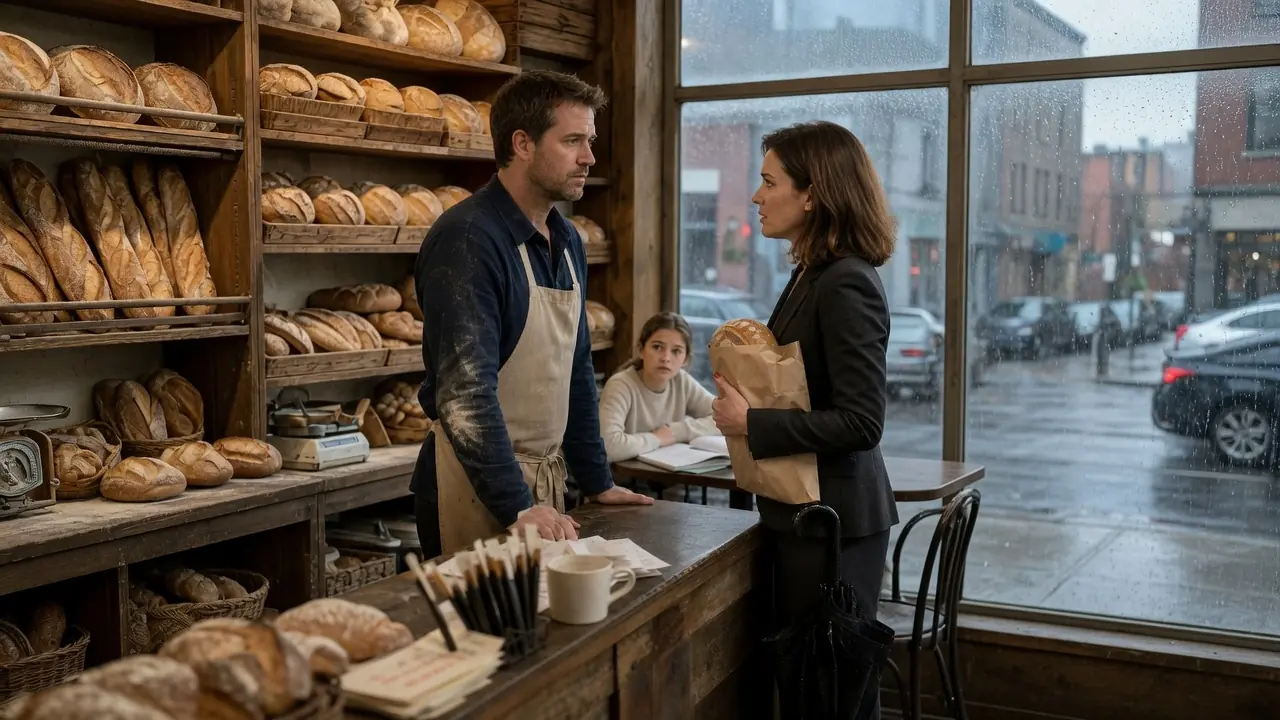
Rowan had spent eleven years working for Halden Foods, a regional company that supplied frozen pastries, bread dough, and packaged desserts to supermarkets across three states. He had started in warehouse scheduling and slowly worked his way into operations. He was good at the unglamorous things. He remembered which loading dock flooded after heavy rain. He knew which drivers had children and needed early routes. He could look at a production sheet and notice that somebody had typed 1,800 cases instead of 180.
He kept an old spiral notebook in his desk because he trusted pen and paper more than software dashboards. At thirty-nine, he was not wealthy, but he had built a stable life. A modest house outside Pittsburgh. A used Subaru that made a clicking sound on cold mornings. Health insurance. A retirement account he rarely checked. His nine-year-old daughter, Tessa, complained that he packed the same turkey sandwich for school three days in a row, but she also knew he never missed her Thursday evening swimming lessons.
Stability mattered to Rowan because six years earlier, his wife, Marin, had died after a short illness. Since then, he had learned to measure life in ordinary routines: coffee at 5:40 in the morning, Tessa's missing socks, grocery shopping on Sundays, and the small lamp left on in the hallway because his daughter still disliked waking in complete darkness. Then Halden Foods hired a new CEO. Her name was Celia Voss. She was thirty-four, sharp, impatient with long meetings, and known for turning around a struggling food distributor in Ohio. She arrived wearing plain dark suits and carrying no assistant behind her.
Rowan's department was told to cut costs by twelve percent. He submitted a plan that cut seven. The missing five percent, he explained, would require eliminating maintenance hours and reducing backup staffing on weekend shifts. He believed it would create safety problems and delayed orders. Celia disagreed. Their final meeting lasted nineteen minutes. Rowan remembered the rain tapping against the windows and a coffee stain on the printed spreadsheet between them. He remembered being tired because Tessa had been awake half the night with a fever. Mostly, he remembered Celia looking at him with an expression that was not cruel, just closed.
“You're protecting a system we can't afford anymore,” she said.
Rowan answered more sharply than he should have. “And you're cutting things you haven't had time to understand.” That sentence ended his career at Halden. Officially, his position was eliminated in a restructuring. Unofficially, Rowan knew he had made himself easy to remove. He was escorted out that afternoon with a cardboard box containing two coffee mugs, his spiral notebook, a framed photograph of Tessa, and a desk plant that died before the end of the month.
At first, he believed he would find another job quickly. He didn't. His experience was too specialized for some positions and too expensive for others. One company made him sit through four interviews before sending a two-line rejection email. Another offered him a job ninety miles away on rotating night shifts. He considered it until he calculated fuel, child care, and the number of evenings Tessa would spend with strangers. The severance money disappeared faster than he expected. The mortgage was already difficult because Marin's medical bills had eaten much of their savings years earlier.
Rowan canceled streaming services, stopped buying coffee outside the house, sold his better tools, then the Subaru. He drove an old Ford Focus with a heater that worked only when it felt like it. Tessa noticed more than he wanted her to. She stopped asking for pizza on Fridays. At the grocery store, she quietly returned a box of cereal after looking at the price. One evening, Rowan found a school field trip form in the trash because the fee was $38.
That was the night he sold his wedding ring. He sat in the parking lot outside the pawn shop afterward with his left hand on the steering wheel. The pale strip of skin around his finger bothered him so much that he kept rubbing it with his thumb. The money paid the electricity bill, the field trip, and groceries. It did not fix his life. By February, the bank had started foreclosure proceedings. Rowan and Tessa moved into a small second-floor apartment above a laundromat in Braddock, where the floor vibrated during the spin cycles.
Tessa said it felt like living on a very slow train. Rowan laughed because she wanted him to, then went into the bathroom and stayed there until his face looked normal again. The bakery appeared in his life because of a broken traffic light. One cold morning, Rowan took a different route to a job interview and saw a handwritten sign in the window of a narrow brick building. Business for sale. The faded lettering above the door read Bellweather Bakery. Half the lights were off. A metal chair held the door open despite the cold.
Inside, an elderly man named Otis Bell was trying to repair a mixer with a screwdriver that was clearly too small. The bakery had been opened by Otis's parents in 1968. His wife had run the counter until arthritis made standing painful. His son lived in Arizona and wanted nothing to do with flour, ovens, or a building with ancient plumbing. Otis had been trying to sell for almost a year. Rowan had no business buying a bakery. He told Otis that immediately.
But he came back the next day. Then again on Saturday. He had worked around industrial food production for years, but this was different. Bellweather made only six kinds of bread, cinnamon rolls on weekends, fruit hand pies, and a dense chocolate cake that Otis insisted should never be refrigerated. The place smelled of yeast, old wood, coffee, and something Rowan associated with childhood kitchens. The numbers were terrible. The roof leaked near the back stairs. The display case used too much electricity. The oven was older than Rowan.
But the bakery still had regular customers. A bus driver came at 6:15 every morning for rye toast. Two nurses from the clinic shared a cinnamon roll after night shifts. A retired teacher bought day-old bread for birds, though Rowan suspected she ate half of it herself. Otis offered a deal no bank would have approved: a small down payment from what remained of Rowan's retirement account, then monthly payments directly to him for five years.
The apartment above the bakery was empty and needed repairs, but it came with the building. Rowan stared at the contract for three days. Then he signed it. The first year was ugly. He burned eighty-four dinner rolls during his second week because he answered a phone call from Tessa's school and forgot the timer. He underestimated flour costs. A pipe burst in March. His first attempt at sourdough was so hard that Tessa tapped it against the counter and asked if they could use it as a doorstop.
He woke at 3:45 every morning. Tessa did homework at a small table behind the counter. Rowan learned to braid her hair badly.
He watched baking videos after midnight and wrote notes in the same spiral notebook he had carried out of Halden Foods. He kept Otis's recipes mostly unchanged, but slowly adjusted the business. He added online pre-orders. He started supplying sandwich rolls to a neighborhood cafe. He stopped making items that looked pretty but never sold. Most importantly, he listened. When an older customer said the bread loaves were too large for people living alone, Rowan introduced half loaves. When a construction crew began working nearby, he opened thirty minutes earlier.
When a local shelter asked whether he could donate leftovers, he said yes, then learned how to plan production better so the donation did not become an excuse for waste. By the second year, Bellweather was no longer dying. It was not a gold mine either. Rowan still worried about taxes. The freezer made a worrying noise every few weeks. He sometimes moved money from his personal account to cover payroll, but he hired two part-time workers, repaired the front windows, and finally replaced the handwritten sign with a simple painted one.
Tessa, now eleven, became unofficial quality control. She rejected anything too fancy for normal people. Then, on a rainy Tuesday in October, Celia Voss walked through the bakery door. Rowan was shaping dough behind the front counter. Flour covered one sleeve of his navy shirt. Tessa sat nearby doing math homework and eating the edge of a broken cookie. The bell above the door rang. Rowan looked up for a second. Neither of them moved.
Celia seemed different from the woman he remembered. Her hair was longer. There were tired shadows under her eyes. She carried a black handbag and a folded umbrella that dripped onto the tile. She looked around the bakery, then back at Rowan as if checking whether she had entered the wrong place.
Tessa glanced between them. “Dad.” Rowan wiped his hands on his apron. “Ms. Voss.” Celia's face tightened slightly at the formality. She had not known the bakery belonged to him. She explained that her car was being serviced two blocks away and the mechanic had recommended Bellweather for coffee. The silence that followed was uncomfortable enough that Rowan could hear the refrigerator motor switch off. He could have asked her to leave. For a brief moment, he wanted to.
Instead, he poured coffee into a thick white mug and placed it on the counter. Celia reached for her wallet. “Coffee is three dollars,” Rowan said.
Nothing dramatic happened. She paid. She sat at a small table near the window and stayed for twenty minutes. Rowan tried not to watch her, but he noticed she barely touched the coffee. She kept looking at the shelves, the customers, and the handwritten pickup orders clipped near the register. When she finally left, she gave him a small nod. The next week, she returned. This time, she ordered coffee and a half loaf of oat bread.
Then she came again. Rowan found the visits irritating. He suspected she wanted something: an apology, perhaps, or a story she could tell herself about how the employee she fired had landed on his feet, making her decision easier to remember.
On her fourth visit, Rowan finally asked, “Why do you keep coming here?”
Celia looked down at the paper bag in her hands. The answer was not what he expected. Halden Foods was closing one of its main plants. The automated production line had never worked as promised. The company had borrowed more money to fix it, lost another contract, and was now preparing to lay off more than one hundred people. Celia had spent two years trying to save the company and had failed in ways that did not fit neatly into a press release.
She told Rowan that after firing him, she had later reviewed several internal reports. Maintenance failures had increased. Weekend shipping delays had become expensive. Some of the problems were exactly the ones he had warned about.
“I thought you were resisting change,” she said quietly. “You were resisting bad cuts.” Rowan did not forgive her on the spot. He did not say it was fine, because it had not been fine. He told her about the house, the interviews, and the field trip form in the trash. He did not mention the wedding ring because that still felt too private. His voice stayed controlled, but Celia listened without interrupting. When he finished, she said she was sorry.
Just that. No speech. Rowan nodded and went back to work. For several weeks, they barely spoke beyond normal customer conversation, but Celia kept coming. Slowly, Rowan learned that she had resigned from Halden before the plant closure was announced. She had refused a retention bonus and was helping displaced employees connect with other manufacturers. She was not suddenly poor. She was not secretly buying the bakery. She was simply a woman whose career had moved faster than her judgment and who had started to understand the cost of decisions made from spreadsheets.
One afternoon, she asked Rowan whether he needed help finding wholesale customers. His first answer was no. Two days later, the bakery freezer failed. The repair estimate was $4,600. Rowan sat alone at the counter after closing, staring at the number. He had enough money for payroll or the repair deposit, but not both. Tessa was upstairs asleep. Rain pressed softly against the front windows. The next morning, Rowan called Celia. He did not ask for money. He asked whether she knew any restaurants looking for a local bread supplier.
Celia made three introductions. Only one worked. It was a small group of neighborhood cafes, not a giant contract. Their owner, Priya Anduri, tested Bellweather's rolls for a month before agreeing to a regular order. The contract gave Rowan enough predictable income to finance a replacement freezer and keep his two workers. Months later, Rowan learned Celia had not pressured Priya or exaggerated his bakery.
She had simply said, “His bread is good, and he shows up.” That mattered to him. The relationship between Rowan and Celia never became simple. Some wounds do not disappear because the person who caused them becomes kinder. There were days when Rowan saw her at the window table and remembered carrying that cardboard box through Halden's lobby. There were also days when she helped Tessa with algebra while waiting for coffee or stayed ten minutes after closing to stack chairs because one of Rowan's workers had gone home sick.
People are inconvenient that way. They can hurt you and regret it. They can be wrong without being monsters. They can apologize, and you can accept the apology slowly. Three years after Rowan bought Bellweather Bakery, Otis came in on a Saturday morning and found every table occupied. A line stretched almost to the door. The old man stood near the bread shelves with his hands in his coat pockets, pretending not to be pleased.
Rowan still was not rich. He still woke before four. The roof still leaked once during a terrible spring, and Tessa still complained about his terrible braids, even though she was old enough to do her own hair. But the bakery employed five people now. The upstairs apartment had been repaired. Rowan had even started putting a little money back into retirement. One evening, while cleaning the flour from beneath the worktable, Tessa asked him whether he was glad he got fired.
Rowan stopped sweeping. He thought about the house they had lost, his wedding ring, the months of fear, and the humiliation of asking his sister for grocery money. He thought about Otis, the broken mixer, the first burnt rolls, and the rainy afternoon when Celia had walked back into his life.
“No,” he said. “But I'm glad losing the job wasn't the end of me.” That was the closest answer he had. A few weeks later, Celia came into the bakery just before closing. She had accepted a job advising a family-owned food company in another city, this time in a role with less power and, as she put it, more listening. She placed an envelope on the counter. Inside was nothing expensive. It was Rowan's old spiral notebook.
He had left it behind during his final meeting at Halden, and somehow it had ended up in a storage cabinet. Celia had found it while clearing her office. The pages were filled with route notes, maintenance warnings, employee schedules, and small reminders in Rowan's handwriting. At the bottom of one page, written years earlier, was a note to himself. Tessa, swim lesson Thursday. Don't be late again. Rowan laughed when he saw it. For a moment, he simply held the notebook.
Celia stood on the other side of the counter, waiting. “Thank you,” he said.
It was the first time he had thanked her for anything. After Celia left, Rowan turned off the front lights and checked the ovens twice, as he always did. Upstairs, Tessa was playing music too loudly while finishing homework. The bakery smelled faintly of tomorrow's bread. Rowan placed the old notebook in a drawer beside his newer one. He had once believed a life could be ruined in a single afternoon, and for a while his had certainly felt that way.
But rebuilding had taught him something quieter. A second chance rarely arrives looking like rescue. Sometimes it looks like an old building with bad plumbing. Sometimes it is a difficult apology. Sometimes it is three phone calls made by someone trying imperfectly to repair a small part of the harm they caused. And sometimes kindness is not forgetting what happened. It is choosing what to do with what remains.