Lady Marbrey smiled at the Duke of Ravensgate and pinched her niece on the arm at the same moment, so that no one in the room saw either the smile or the pinch for what they were. The smile was for the Duke, and it was warm. It was the smile of a hostess who had arranged the season's chief event and expected to be rewarded for it in a specific and public way.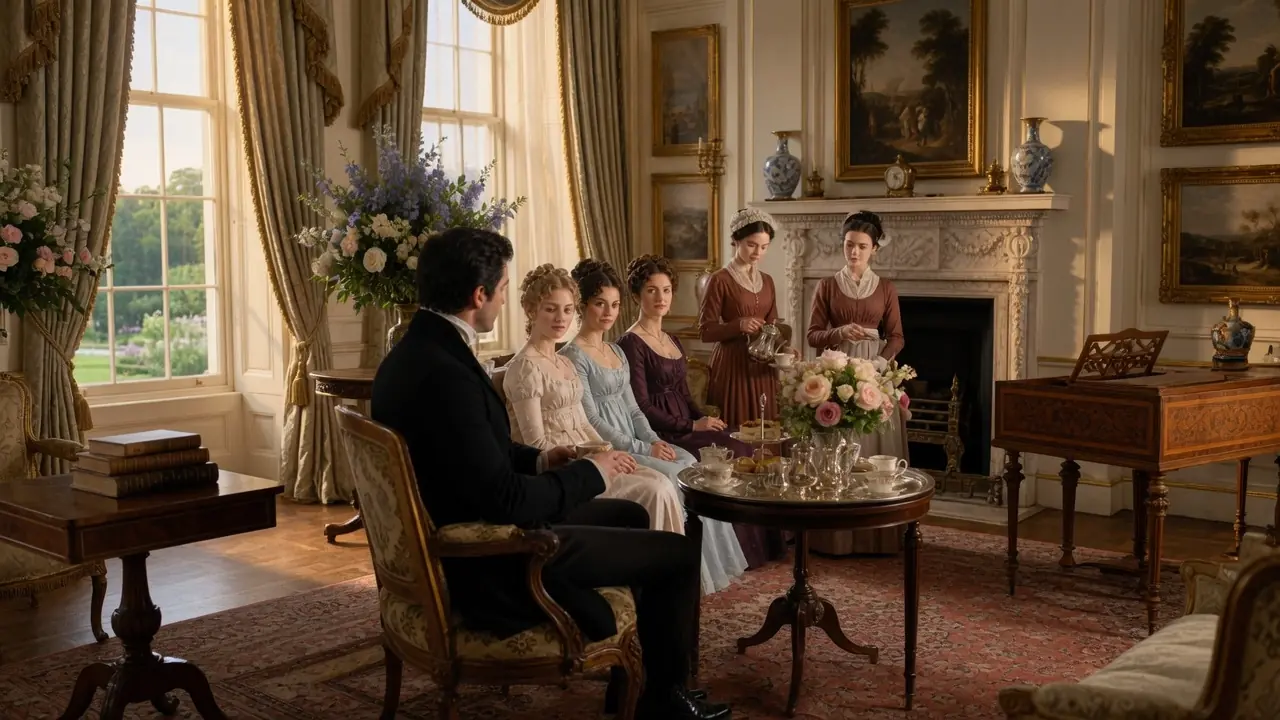
The pinch was for Diana, and it was small. It was delivered under the loose brown sleeve near the inside of the elbow, with the neat expertise of a hand that had been delivering it for seven years. It meant more hot water, and quicker about it, and not a word to anyone on her way out of the room.
Diana rose from the low tea tray without a sound and took the silver kettle. She curtsied to the general company as one curtsies to a wall, and she went. Nobody watched her go. That was, in fact, the whole design of the afternoon.
She was, at four and twenty, a slight woman in a rust-brown day gown that had been let down twice at the hem and refashioned once at the cuff. She had a pale, grave face and dark brows drawn fine over dark gray eyes. Her hair was pinned severely under a plain cap in the manner of a woman ten years older.
Her hands were the first thing anyone would have noticed, if anyone in that drawing room had noticed hands at all. They were quick and clever and steady. They were, though nobody in that room could see it, the hands of a musician.
She had not been allowed to play in seven years. Instead, she had learned to pour tea for two hundred callers a season without ever spilling a single drop.
She was Diana Cranidge, and her mother had been the elder sister of the woman who had just pinched her. Her mother was dead. Her father was dead. Her means were, by law and by the settlement no one had shown her since she was seventeen, one hundred and eighty pounds a year for her whole life.
She had not seen a shilling of it. She had instead seen the inside of Lady Marbrey's linen cupboard and the inside of Lady Marbrey's ledgers. She had seen the inside of the small back schoolroom, where the youngest Marbrey daughter had been taught her Latin by a girl who was not allowed to sit at the dinner table.
She went down the back stair for hot water. The pinch would be a small red bruise under her sleeve by supper, and nobody would ever see it. That was the design of every pinch Lady Marbrey had ever given her.
The house was in Mount Street, tall and narrow, and elegant in a way that told the exact truth about its mistress. Everything in it was correct. Everything in it was for show.
The gilt on the drawing room ceiling was fresh. The paint on the servants' stair was peeling, and Cook was paid three months late. The three Marbrey daughters were dressed each season in the third latest fashion, and it was well managed enough that nobody in Mayfair could have told the difference.
Lady Marbrey was Cosima, the widow of Sir Bertram Marbrey. Sir Bertram had died within four years of the marriage and left her three infant daughters, a moderate portion, and a name he had believed she would use gently. She had not used it gently.
She had used it entirely to prepare her daughters for a marriage market she had failed to conquer herself. She had failed for one reason only. She had been the younger of two daughters, and her elder sister had been beautiful and quiet and had married a scholar with no fortune, whom she loved.
Cosima had watched that marriage from the outside for eleven years. Then her sister had died in a bad winter, and the scholar six months after her, and Cosima had gone to the funeral in a fine black bonnet and had brought back the daughter.
Diana had been seventeen when she came into her aunt's house in the black gown of a girl still mourning both parents. She had brought with her, in a small trunk, the only three books her father had refused to sell before he died. She had brought no jewels and no music, though her mother had taught her the pianoforte, because the pianoforte in the house at Ely had gone with the rest of the sale.
She had brought, folded very small, a single piece of paper. It was a copy her father's clerk had made for her in the last week of his life, a copy of the crucial clause of her mother's marriage settlement. Her aunt had taken the paper on the first evening.
Cosima had said kindly enough that such papers should be kept safe. She had said she would keep it for Diana in her own escritoire, along with the original the executors had sent up. She had opened the escritoire, put both papers inside, turned the small brass key, and said nothing more about the matter for seven years.
Diana had understood by the end of that first evening what her aunt had done. She had been the daughter of a scholar. She was not a fool.
She had understood that the settlement provided her one hundred and eighty pounds a year, drawn on a trust her mother's uncle had set up. She had understood that if she asked her aunt for it, she would be turned out of the house within the day and left to make her way as a governess with no references. She had understood that her aunt would draw the money quietly as ward's expenses.
No one in the trust office would trouble to ask about an orphan girl in the care of a respectable widow in Mount Street. She had made her decision in the cold, in the small back bedroom she was given at seventeen. She would stay.
She would eat what she was given, and she would earn her keep in whatever way was asked of her. She would keep the copy she had because she was not sure her aunt knew it existed, folded very small inside the cover of the smallest of the three books she had brought. She would wait, though what she was waiting for she could not have said.
She had thought at first she was waiting for her aunt to die. Then she had noticed that her aunt was in vigorous health and could be expected to live another twenty years. Then she had thought she was waiting for a friend, but her aunt allowed her few.
Then she had thought she was waiting for a place, an offer of quiet employment, some small change that might turn to advantage. But her aunt intercepted every letter. In the end, she had stopped waiting for anything in particular and had simply gone on.
It is the plainest form of courage. Nobody notices it. Nobody thanks anyone for it. It is the whole way the world turns.
Now she was four and twenty. Now the youngest Marbrey daughter was nearly nineteen and had, since last spring, been considered out. Now Cosima had all three daughters unmarried and on her hands, and had begun to move.
She had moved that spring by a specific and clever route. She had written to her late husband's second cousin, a woman she had not troubled to know for twenty years, who happened to have married very well. The second cousin was the Dowager Duchess of Ravensgate.
The Dowager was elderly and gravely ill, and had one son unmarried at two and thirty whom she wished to see settled before she died. Cosima's letter had been a small model of the art. She had said nothing about her daughters.
She had asked only whether the Dowager, as a great favor, would accept a small, quiet visit in the season, and whether her son could be persuaded to come with her. The Dowager had accepted. She had accepted because she was dying.
She had accepted because she wanted, before she went, to have seen every unmarried girl of decent birth her son might possibly take, and to have formed her own opinion. She had told her son so plainly over her medicine. He had bowed to her and said, "Very well, Mother."
He had said it because his mother was dying and asked for very little, and because he was, in all things not involving his own dignity, a beautiful son.
He was Ellis, Duke of Ravensgate, at two and thirty. He had come into the title at seven and twenty on the sudden death of his father in a hunting accident. He had spent the five years since in the House of Lords and in the great moldering pile of Southcross in Kent, learning the true cost of what he had inherited.
Southcross was falling. Its roof had needed replacing for a decade. Its farms had been let go by a father who had preferred hounds. The tenants were tired. His steward was tired. His mother was dying.
He himself was tired to the marrow of the polite scheming of every woman in Mayfair with a marriageable daughter and a mother alive. He was tall. He had a face that people called cold and that his few close friends called simply tired.
His eyes were a very dark brown, so dark they read almost black at candlelight. His hair was raven black. He dressed well and always in dark colors because he had no patience for the finery of men his age.
He was, in the House, a serious young Whig of the reforming set. He was, in private, a serious young man who had gone straight from his father's funeral into responsibility and had not yet been permitted to grieve.
He had come that afternoon in Mount Street because his mother had asked him. He had brought her carriage. He had helped her up the shallow steps. He had bowed to Cosima Marbrey in the correct way. He had said the correct things.
He had sat and begun the polite and dreadful business of being shown the three Marbrey daughters. They were seated in a row. Cosima had thought carefully about this.
The eldest was placed farthest, so that her beauty would come slowly upon a viewer as a good picture does. The youngest was placed near the fire because she had a small color when warmed. The middle one was between them in a dress Cosima had had refashioned from the eldest's last winter gown.
Cosima did not think about her much because she had never been able to think of a use for Alice. Priscilla was six and twenty. She was the beauty. She had been the beauty at seventeen. She was still the beauty at six and twenty.
Six seasons had passed. No offer had come. The fact was one Cosima did not permit to be spoken in the house.
Priscilla had golden hair and a white throat and a way of turning her head that had been much admired at Almack's the season she came out. She had learned in the years since to smile without moving her mouth very much because a smile that shifted her upper lip was less becoming than a smile that did not.
She was clever in the sharp, narrow way of a woman who has decided a thing is owed her. She had decided at ten that she would be a duchess, and she was still deciding it six seasons on. There was, under the beauty, a small worn place that a careful eye could see.
She was not cruel. She was frightened. She had been raised for one purpose, and the purpose had not yet been achieved, and the fear of not achieving it had begun to eat her from the inside like a slow small mouse.
Alice was two and twenty. She was the middle one, and she was not the beauty. She had brown hair and a plain, kind face, and eyes the color of tea.
She read when she could get books. She was Diana's ally in that house, though the two of them were careful never to be seen as friends. When Diana was ill, Alice brought her a cup of broth by a back stair. When Alice was frightened, Diana held her hand under the table. It was very little. It was sometimes everything.
Jemima was nineteen, the youngest. She had been out one season and was, by all indications, going to be out for several more. She was a giggling girl, easily led, who followed Priscilla's tone in every room because it was safer than choosing her own.
She had, though nobody in the family had troubled to notice, a real gift for languages. Diana had taught her Latin because Cosima had said Latin was useless for a girl and had refused to hire a master. Jemima now read Virgil in a small, quiet way in the schoolroom in the mornings. She had never told her mother.
Into this arrangement, at three o'clock on a Tuesday in early May, the Duke of Ravensgate came. He sat opposite the row. He was offered tea and accepted it. And Cosima, who had arranged the seating with such thought, had arranged one other thing.
She had ordered Diana to pour. Diana was set at a low tray by the wall, half turned from the company. She was to pour and hand cups to the footmen and go for hot water when Cosima signaled. She was to speak to no one. She was not to be introduced.
She was, in the arrangement of the afternoon, the negative space against which the three daughters would show. She was there to be poor and plainly dressed and evidently dependent, proof of Lady Marbrey's generosity. Cosima had explained this to Diana that morning in three sentences that had left no room for reply.
Diana had understood. Diana had, in truth, been prepared to understand at seventeen, and had been paying attention ever since.
The Duke had noticed her. He had noticed her at the moment of the pinch. He had not seen the pinch itself, but he had seen Diana's shoulder move a very small fraction and had seen her face briefly become quite still.
He had watched her rise. He had watched the footman try to open the door for her and be waved off because Cosima did not want anyone opening doors for the poor relation. He had watched her go without a word.
He had noticed something else too, though he could not yet have said what. He had noticed that the three young ladies, when they spoke, spoke as if they had been coached. Priscilla answered questions with sentences arranged as neatly as flower baskets. Jemima laughed at the ends of Priscilla's sentences. Alice looked at her lap.
There was nothing wrong with any of it. There was also nothing in any of it that a serious man might build a life on. He answered the questions he was asked. He asked in return the polite ones.
He was told by Cosima at some length of Priscilla's accomplishments. He was told of a screen Priscilla had painted and a song Priscilla had learned and a shawl Priscilla had knotted for a favorite cousin. He was told that Priscilla was much admired at Almack's.
He nodded gravely. He turned to Alice and asked whether she read. Alice said softly that she did.
He turned to Jemima and asked what she had been reading lately. Jemima said, with a nervous glance at her mother, a novel of Miss Edgeworth's. She had not, in fact, been reading a novel of Miss Edgeworth's. She had been reading Virgil in a corner of the schoolroom under Diana's finger, but she had learned early not to say so.
Cosima was pleased with this. She thought it went as well as any first tea could be expected to go. She had not seen the Duke's face when Diana rose. She was, in the arrangement of her own drawing room, entirely occupied with the front row.
That was the design of the afternoon. It was also its flaw.
The Duke stayed the full civil half hour. He drank two cups and praised the tea briefly. He said nothing at all about the young ladies. He bowed to his mother and helped her to her feet.
In the hall, as he waited for his cane, Diana passed once behind him with a tray. He turned his head very slightly, but did not speak. She did not look up. Then she was gone.
In the carriage, he was silent a long moment. His mother, who was accustomed to his silences, said nothing at all. At last he said quietly, "Not Priscilla."
"No," his mother said. She said it exactly as one says no to a bolt of cloth one does not want.
"Nor the youngest."
"No. The middle one is a good girl. She is. She is not, however, the girl you need."
He did not answer for some minutes. Then he said, "There is a niece. A dependent."
His mother said nothing.
"Pouring tea," he said. "In brown."
The Dowager Duchess of Ravensgate turned her head at last and looked at her son. She was a small, worn, keen-eyed woman with the fine bones of a woman who had been beautiful a very long time ago.
"I know you saw her," she said. "I saw her when we came in, in the hall, straightening the flowers." She paused. "Her name is Cranidge."
He nodded once and did not ask his mother how she knew. His mother had made a habit in her illness of learning the names of every young woman in every house she called at, so that when her son said one at last, she would already know something about her. It was a small piece of work she had done silently for a year.
"Well," he said after a moment, "that is at least an afternoon not wasted."
"Ellis," his mother said. Her voice was very quiet. "Do not raise her and then set her down. Not that girl."
"I do not raise anyone, Mother."
"You do," said his mother. "You cannot help it. It is your title. Take care."
He inclined his head and did not answer. The carriage moved on down Mount Street in the fine afternoon light.
Inside the tall, narrow house, Cosima Marbrey was already telling her eldest daughter that the Duke had come. She said it in the small, pleased voice of a woman who has laid her groundwork well. A second call would follow, and Priscilla was to be ready.
Priscilla was pleased. Jemima was pleased for her. Alice sat with her hands in her lap and said nothing.
Upstairs in the schoolroom at the top of the house, Diana Cranidge sat down at the plain desk where she taught Jemima her Latin. She put her hand under her sleeve and pressed the small hot place near her elbow and thought about nothing at all. She had learned at seventeen not to think about the pinches.
It was the only defense she had. She had been safe at the end of every afternoon so long as she did not think about them, and she had been safe for seven years. She did not know that that afternoon she had been seen. She would not have believed it if she had been told.
The second call came three days later. It came under a small, polite pretext. The Duke had, he said, promised his mother that he would call again to ask after Lady Marbrey's health, which had been said at the last call to be a little indifferent.
Cosima had not, in fact, said her health was indifferent. She had said her nerves were sometimes troubled, but she was not the woman to refuse the frame the Duke offered her. She was in the drawing room within the quarter hour in a new cap. Priscilla was in the drawing room within the half hour in a new gown.
Jemima was in the corner. Alice was on the sofa. Diana was upstairs teaching Jemima's castoff Latin lesson to the youngest child of the housekeeper, as she had done every second afternoon for four years.
Cosima had thought this arrangement safe. The Duke had, after all, come to see her daughters and would not think to ask after a niece. She had underestimated him in the ordinary way that women who have never met a serious man underestimate serious men.
The Duke had come, in fact, to observe Diana. He would not have said so. He would not, if pressed, have permitted himself to admit it. He had come, he told himself, to learn a little more of the household.
He had come to see whether the arrangement of the drawing room was as it had been, whether the tea was again poured by a poor relation in brown, whether the young ladies were seated in the same order. He had come, he told himself, to be thorough.
He was shown up. He bowed and sat and accepted his tea, this time from Priscilla's own hand. He said the correct things about Lady Marbrey's health and allowed Priscilla to talk.
She talked well. She spoke of a lecture on antiquities she had lately attended and of a small watercolor of a Roman ruin she had lately made. She did not once ask him a question of her own.
His eye went briefly to the mantelpiece. There was a small volume there, half hidden behind a china dog.
"Are you a reader of Latin, Miss Marbrey?" he asked.
Priscilla was too well trained to falter. She said sweetly that she read a little. Very little. She could not, of course, read Virgil at sight. Nobody could.
The Duke said mildly, "One of my sisters, when I was a boy, learned it very well from our mother. It is not, I have always thought, a language reserved to men."
Priscilla smiled and said she quite agreed. But of course, she added lightly, there had not been the opportunity in her own girlhood to learn. Her governesses had been more concerned with the accomplishments. It was such a pity.
Cosima nodded gently at this. The Duke said nothing and glanced at Alice. Alice's cheeks were pink and she was looking at her hands.
He said casually, "And your other sister, ma'am? The youngest? Does she read Latin?"
Cosima laughed. It was the small laugh she used when she meant to close a subject. She said Jemima was a hopeless dawdler over any book at all. She had tried, she said, to have Jemima taught, but it had proved quite hopeless.
She said this loudly enough for Jemima to hear, and Jemima looked at the carpet.
The Duke said gently, "Miss Jemima, what is your favorite Latin author?"
There was a small silence. Jemima's ears grew hot. She looked with a quick sideways glance at her mother's face and then at the door. It was as if she were making a small calculation.
Diana was upstairs and could not save her. Priscilla could not save her. Nobody could save her. She had, for the first time in her life, been asked a question directly by a duke.
"Virgil, your grace," she said very quietly.
Cosima's face did not change. She had not been trained by any tutor. She had been trained by her own long practice, and her own long practice held.
"Ah," said the Duke. "Which book?"
"The fourth of the Aeneid, sir." Jemima caught herself. "Your grace."
He inclined his head. "That is a difficult one."
She looked at her lap and said nothing.
He turned to Cosima with an expression of polite mild surprise and said, "Ma'am, I stand corrected. Your daughter is more accomplished than you allow."
Cosima recovered quickly. She said with a small warm laugh that Jemima had done a little Latin indeed with the last governess. She had almost forgotten. The last governess had been very fond of the ancient languages.
"Poor woman," she added lightly. "She died last autumn."
Diana had, in fact, not been Jemima's governess. Cosima had never hired a Latin master, and there had been no last governess. The Duke, who had four sisters and had known several governesses well, did not press it. He nodded gravely and let the moment pass.
But he had seen the calculation Jemima had made. He had seen the quick sideways look at her mother and had seen the ears grow hot. He had noted silently that there had to be somewhere in that house a Latin book that had been read carefully, and someone patient who had guided the reading. It was not Priscilla. It was not the mother.
He waited. They talked then of the season. Priscilla was warm again and light and clever. Cosima steered the conversation around a corner or two of good news about the family. The Duke drank his tea.
He rose to leave in due course. He bowed to the ladies, and on his way to the door he glanced briefly at the sofa table, where a small household ledger lay open before being closed. He had not touched it. He had only glanced.
The hand in it was very fine. It was small and even, and it was not any of the three daughters he had spent the hour with. It looked like the hand of a woman who had kept a house's accounts for a long time.
He said his goodbyes and went.
In the carriage back to Grosvenor Square, he was quiet again. When at last he spoke to his mother, he said, "Only the middle one?"
After a moment, he said, "And the fourth?"
His mother said, "The fourth?"
"There is a fourth young woman in that house, Mother. She teaches Jemima her Latin. She keeps the accounts."
"Ah," his mother said. "So it is she."
He did not answer.
He came a third time and a fourth over the next fortnight. He came with his mother, and he came alone. He came in the mornings and in the afternoons. He asked questions about the house.
He asked once whether he might see the small garden at the back, which Cosima had mentioned in an off moment was newly planted with roses. Cosima sent Priscilla out with him. Priscilla walked with him along the paths and told him at some length what each plant was called.
She did not know one of them. She had learned the names off the plan the day before. He listened gravely. He asked in a mild voice whether the roses were Diana's work.
Priscilla's step did not check. She said with a small light laugh that Diana, dear thing, had helped a little. Yes, indeed, everyone in the house helped a little in the garden. She was very fond of Diana.
"I have not, I think, been introduced to Miss Cranidge," the Duke said.
Priscilla said sweetly that of course he had. He had met Diana at the tea three weeks ago. Diana had been pouring. She was such a dear thing, but very shy, and she preferred not to be introduced formally to visitors.
She was, poor soul, a little afraid of company. It was, Priscilla said, the awkwardness of her situation. They all felt so for her.
"I see," said the Duke.
He said it in a voice his mother would have recognized. His mother knew that voice. It was the voice her son used in the Lords when a speaker had said a plain untruth in a fine sentence and it was not yet time to say so.
He did not press it, and did not on that third visit insist on seeing Diana. He said his goodbyes to Cosima and to the sisters and left.
But that night from Grosvenor Square, he wrote a small note in his own hand and had it delivered at eight o'clock in the morning by a footman he trusted to the Mount Street house. The note was addressed to Miss Cranidge, care of Lady Marbrey, and it enclosed inside its outer paper a smaller note which was not to be given to Lady Marbrey.
The outer note said courteously that His Grace, the Duke of Ravensgate, hoped to have the pleasure of being introduced to Miss Cranidge at his next call, if her aunt could be persuaded to make the introduction. It was a polite public letter. Cosima read it, of course, over Diana's shoulder and smiled her small hostess smile.
She said without any warmth that Diana would have to be introduced. There was nothing to be done for it. But she was, of course, to say very little, and to say nothing whatever of the house or of her position.
The inner note said in a smaller hand, "If you can walk in the garden tomorrow at ten, I will be there. Come with the spaniel and a book. Say nothing of this to anyone. E. R."
Diana read it three times over the plain deal table in the schoolroom. The footman who had brought it was long gone, and nobody had seen her open the inner paper. She sat with it in her hand and understood quickly and coldly that she now had a choice she had not asked for.
She could burn it. If she burned it, nothing would change, and she would go on. In three weeks or a month, when it was plain the Duke did not intend Priscilla, Cosima would turn her rage inward on the household, and Diana would take the brunt of it for the summer. She had taken worse summers. She would take another.
Or she could go into the garden at ten in the morning with the spaniel and a book. She could speak to the Duke of Ravensgate. She could give him whatever it was he wanted from her.
When Cosima discovered it, as Cosima certainly would, she would be turned out of the house within the day with no reference and formally no money. She had, folded very small inside the book of Ovid that her father had given her, one piece of paper she had never shown anyone. But she was not sure that piece of paper would be enough. She was not sure it would even be believed.
She sat a long time in the schoolroom with the note in her hand. She thought very clearly of what she had actually been waiting for these seven years. She had been waiting for this.
She had not known she was waiting for this or for anything at all. But when she picked the note up, she had felt along the whole line of her spine the small, distinct movement of a decision she had made a long time ago and had never permitted herself to look at.
She put the outer note in the sewing basket for Cosima to find later and put the inner note into the fire and watched it go. She got up and went downstairs. She said to Cosima in her plain voice that she meant to take the spaniel into the garden in the morning for exercise.
Cosima did not look up from her writing. She said without warmth that she might.
At ten, Diana went out with the spaniel, the small volume of Ovid under her arm. She had put on the same brown gown. She had not changed anything and had not tried to be pretty. She had gone out looking exactly as she had looked at the tea.
She had done this on purpose because she had thought about it and had decided that if the Duke of Ravensgate wished to speak with her, he would speak to the person she was. He would not speak to a woman she had dressed up to be for him. She was too tired for that, and had in her way too much pride.
He was in the garden at the far end, by the small brick wall where the roses did not do well. He was in a plain dark coat and had no hat. He was standing with his hands behind his back, looking at the wall as though he were reading it.
He did not turn when she came up.
"Miss Cranidge," he said.
"Your grace."
"Will you walk?"
"I have five minutes."
"Then we will walk five minutes."
He put himself on her right at the correct polite distance. The spaniel went ahead of them, sniffing. Diana carried the Ovid.
He said very quietly, "I have asked to speak to you plainly. Is that agreeable?"
"Yes."
"I know that you keep the accounts in that house. I know that you have taught the youngest sister her Latin and that you were not, at the tea, allowed to sit."
She said nothing.
"I know also that I have no right to ask you any question I am about to ask. But if you are willing to answer, I would be grateful."
She looked at her hands on the little book. "Ask."
"Are you kept in that house against your will?"
She thought a long moment. Then she said, "No."
He nodded once.
She said, and this was the harder thing to say, "I stay because I have nowhere better to go and because my aunt has papers that belong to me, and I cannot get them out of her without a solicitor."
He did not turn his head. He kept walking at her pace.
"What sort of papers?"
"My mother's marriage settlement. There is a small annuity in it of one hundred and eighty pounds a year. That is mine. My aunt has been drawing it for seven years and has never given me a shilling. She holds the original document. I have a copy of the crucial clause, but only a copy. My father's clerk made it for me the week before he died."
He walked another dozen paces before he spoke.
"That is a serious thing to say, Miss Cranidge."
"I know it. It is why I have never said it to anyone."
"Do you say it to me because you wish me to act on it?"
She stopped walking. The spaniel came back and looked at her.
"I do not know why I say it to you. I have said it to no one for seven years. Perhaps I am tired, and perhaps you are the first person who has asked."
He was quiet a long moment. Then he said, "May I keep what you have just told me?"
"I would rather you did not tell my aunt."
"I will not tell your aunt. I will tell my mother. My mother has a very good solicitor, and I would like, with your permission, to place that man at your disposal quietly, at no cost to you. He will do nothing without your word."
Diana looked for the first time straight at him. His dark eyes were not cold. They were tired in exactly the way she was tired, and steady. He was not smiling.
She had begun, very cautiously, to trust him.
"You may," she said.
He nodded once. "Thank you."
"Your grace, may I ask you a question?"
"Please."
"Why did you come today?"
He was quiet and looked again at the wall. At last he said, "Because I have called on many houses this season, and yours is the first one in which I have seen a person I would trust to keep me sane."
She looked at him. "That is not a small thing to say."
"It is not a small thing to mean."
"You do not know me."
"No. I know a hand in a household ledger. I know a girl who taught her cousin the fourth book of the Aeneid in secret. I know a young woman who took a pinch in her aunt's drawing room and never said a word." His voice went briefly very quiet. "It is enough to know that I would like to know more."
"You have very little time before my aunt sees us from the window."
"Then let me ask my one plain question. May I call again? Not on your aunt. On you."
She was quiet a moment. She had never in her life been asked such a question, and had not, seven years ago, expected ever to be asked one.
"I have no drawing room. I have no receiving day. If you wish to see me, you must contrive it."
"I can contrive."
"Then yes."
She said the word plainly and exactly once. She turned then because the spaniel was pulling toward the house, and did not curtsy because she was walking. She went back up the path with her book, with her plain brown gown, with the dog trotting a step ahead.
The Duke of Ravensgate stood at the end of the path for a little while, looking not at her but at the small brick wall where the roses did not do well. He was not a young fool. He knew quite clearly that he had just done a thing that men of his rank were not supposed to do.
He had just committed himself silently to a plan of action that would end in marriage with a woman his mother's second cousin had been at some pains to hide from him. He knew that Cosima Marbrey would fight him for it, and he knew that he would win. He did not know how much the winning would cost the woman with the small book.
He walked back through the side gate and out into Mount Street, and did not on that afternoon call formally at Lady Marbrey's front door.
Cosima, at the drawing room window, had seen him leave the garden. She had not seen him enter. She had from the angle seen only the last of him, the tall dark coat retreating along the street.
She had thought it strange and had asked Priscilla whether the Duke had been in the garden. Priscilla, who had been at her needlework in her own room, had said she did not know. Cosima had said sharply that Diana was to come to her at once.
Diana came and said she had walked the spaniel in the garden as arranged and had seen no one. She said this in her plain voice. Cosima looked at her for a long minute. She could not quite tell whether Diana was lying.
She had not in seven years ever found Diana out in a lie. She had noticed that Diana sometimes said very little rather than lie. She said at last, coldly, that Diana was to keep out of the garden until further notice. Diana said softly that she would and curtsied and went upstairs.
That afternoon in the schoolroom, she taught Jemima her Latin as usual. She did not say a word of the garden to anyone.
For eight days after that, nothing at all appeared to happen. The Duke did not call at Mount Street. He was seen twice at Almack's, both times in the company of his mother, and both times he stood by a wall and made polite conversation and did not dance.
Cosima, at Almack's, presented Priscilla to him in a small deliberate manner. He bowed and said good evening and did not ask Priscilla to dance. He turned to speak with an older gentleman of the reforming set and did not turn back. Cosima went home in a very dry temper.
She did not, however, know what he was doing during the day. He was during those days with his mother's solicitor, Mr. Padgett, in a small, quiet office in Lincoln's Inn Fields.
Mr. Padgett was a spare, pale man of five and fifty, with a mouth like a dry seal. He had served the Ravensgate family for twenty-eight years and had never in his life smiled at a lie. He listened gravely to what the Duke told him.
He asked, when the Duke had finished, whether he might send the boy round to the trust office at Chancery Lane for a copy of the settlement. The Duke said he might. The boy went and the boy came back. By the second day of the eight, Mr. Padgett had it all in his small office.
He had a certified copy of the entire marriage settlement of Diana Cranidge's late mother. He had a schedule of the annuity payments made every quarter for the last seven years to the estate of the ward. The payments had been drawn by Lady Marbrey as trustee de facto, and not one had ever been receipted by the ward at all.
Mr. Padgett looked at the schedule for a long time. Then he said to the Duke in his dry voice that it was a very tidy piece of fraud, and one they should be able to unwind.
He said he would prepare a summons in Chancery in the ordinary form and place it before a master who would require Lady Marbrey to produce the original document. He said the ward, if she wished, should attend, and that he did not, in any case, propose to move without her word.
"You will have her word this week," the Duke said.
Mr. Padgett said dryly, "I hope so, your grace. Do not put yourself in the position of having asked a young woman to make a decision she cannot make. It is not her aunt she has to fear. It is what is done in her name without her asking."
"You are right," the Duke said. He rose. "I will bring her to you myself."
He went that evening to his mother's house in Grosvenor Square and sat by her bed. She was worse. She had been worse for a fortnight, and her breath had grown loud and thin in the small hours. She had refused that afternoon to see the doctor. She had said she wished to see her son.
"Have you spoken with her?" she asked when he came in.
"Yes. In the garden, eight days ago."
"And?"
"There is something you should know, Mother. Her aunt has been drawing her mother's annuity for seven years. She has never given her a shilling."
The Dowager Duchess of Ravensgate closed her eyes for a long moment.
"That woman," she said.
"Padgett is preparing a summons. I will bring the girl to him this week. He would like her word before he moves."
The Dowager opened her eyes again and looked at him.
He said, "You said once that I should not raise her and set her down. I do not intend to set her down. I intend to marry her."
There was in his mother's eyes a light he had not seen for a year.
"Have you asked her?"
"Not yet. She has too little just now. I will not ask her to accept me before she has her own name in her own hand. It is not my proposal she needs first. It is her paper."
His mother said very softly, "Ellis, you are a fine man."
"I am your son."
"Do not wait too long."
"I know."
After a moment she said, "Go and get her then, and bring her to Padgett, and do not let that woman keep her another quarter."
He kissed her thin, dry hand. He said he would.
The next morning, he wrote another small note. This one he sent to Alice. He had judged Alice correctly. He had noticed at each call that Alice went out every morning to a subscription library in Curzon Street alone on foot with the spaniel and stayed the better part of an hour.
He wrote to her that if she cared for her cousin and could be trusted, he would be at that library at eleven on Thursday and would like a word of ten minutes. He signed only his initials.
Alice was a plain, kind, timid young woman. She had feared her mother her whole life and had feared her sister only a little less. She had never, in her twenty-two years, done a single thing her mother had not directed.
She read the note twice and sat very still a long moment. Then she folded it small and put it inside her stocking, because she had heard once in a novel that this was the safest place to keep a letter you did not want your mother to find.
On Thursday she went to the library at eleven with the spaniel. The Duke was there and rose.
"Miss Alice, thank you," he said gravely.
She said, quite pink, "Your grace."
"I need your help. It is for your cousin's sake. She is in some difficulty about a settlement which is legally hers. My solicitor is prepared to act, but she must come to him."
"Mama will not let her out of the house."
"I know. It is why I have written to you. Can you contrive that she goes out with you tomorrow morning to this library, or to a milliner, anywhere? She need only come out of the door with you. My carriage will be at the corner."
"Where will she go?"
"To Mr. Padgett in Lincoln's Inn Fields. He is my mother's solicitor. He is entirely to be trusted. She will be back in two hours."
Alice said in a very quiet voice, "Mama will know she has been out."
"Yes. She will know."
Alice looked at her hands. "It will be very bad for Diana afterwards."
"It will for a day. Only a day. On the day after that, Diana will have a paper in her own hand that will let her walk out of that house whenever she chooses. If she wishes, she may walk out that afternoon. I will take her in my carriage to my mother's house."
Alice said, still very quietly, "Are you going to marry her?"
"Yes, if she will have me."
Alice looked up. Her eyes were shining.
"You will be very kind to her."
"I will."
"Then I will do it."
She did it. She did it the next morning before breakfast in an ordinary way that raised no suspicion. She simply said to her mother over the breakfast table that she needed a new pair of gloves and would go out to the shops with Diana at nine.
Her mother, who had begun to be tired of the daughter's company that season, said absently to go and come back promptly. She did not look at Diana. She was reading the paper.
Alice and Diana went out together at nine. The spaniel came too because it always came out with Alice. At the corner of Mount Street, Alice pressed Diana's hand once and turned back with the dog as arranged, saying loudly that she had forgotten her purse and would go home and catch Diana up.
Diana walked on alone to Grosvenor Square, where the Ravensgate carriage was waiting at the corner. She was in it and away before the clock at St. George's had struck ten.
Mr. Padgett received her in his office in Lincoln's Inn Fields. He rose and bowed and offered her a chair and tea. She refused the tea and sat very small in the chair. She kept her hands in her lap and her face still.
She had been sitting still in one house or another for seven years, and she was very good at it now.
Mr. Padgett laid out the papers on his desk with quiet care.
"Miss Cranidge, will you look at these?" he said in his dry voice.
She looked. She saw the certified copy of the settlement, the schedule of annuity payments, the receipts, seven years of them, signed by Lady Marbrey as trustee and never countersigned by Diana at all.
She sat very still. Then she took out of her reticule a small folded piece of paper, unfolded it, and laid it on the desk beside the certified copy. It was the copy her father's clerk had made her at seventeen. The two were, of course, identical.
Mr. Padgett looked at it. He said in a voice a little less dry than before, "You have carried this, Miss Cranidge, for seven years."
"Yes."
"Why did you never bring it forward?"
"I did not know whom to bring it to, and I did not know that anyone would believe me above my aunt."
Mr. Padgett bowed his head briefly.
"There is at least one person now who believes you above your aunt. Do you wish me to act?"
"Yes."
"You understand that once the summons is served, you cannot remain under her roof."
"Yes."
"Where will you go?"
"I have not yet thought."
"You may go this afternoon to the Dowager Duchess's house in Grosvenor Square. She has been apprised. A room has been prepared."
Diana was quiet. She looked at her hands.
"The Dowager is very ill."
"She is. She has, I think, been waiting to have you safe under her roof before she permits herself to be as ill as she is."
Diana did not answer for a long moment. Then she said, "I will go."
"Then that is settled."
He rose and bowed. He said he would prepare the summons that very afternoon and would place it before a master by the end of the week. He said he did not, in fact, think it would go so far.
He said Lady Marbrey, when the summons was served upon her, would very likely settle privately to avoid the notoriety and would produce the papers under some polite excuse. He said if she did not, they would go to a master and they would win. He said this in the voice of a man who had won such cases and did not enjoy the winning.
The Duke was in the carriage at the door and rose when Diana came out. He handed her in. He did not speak until they had drawn away from the curb.
Then he said, "Miss Cranidge, would you be very frightened if I asked you to come with me now to my mother's house?"
"Not frightened. Tired."
"You may sleep in the carriage. It is not five minutes."
"I did not mean the carriage."
"I know what you meant."
She sat quietly with her hands in her lap. At last she said, "I have not been in a great house since I was seventeen."
"You will not be a guest at mine. You will be my mother's guest, and she is not a woman who lets a guest be tired for long."
They came to Grosvenor Square. The house was quiet. The steps were swept. The butler received Diana at the door as though she were a member of the family who had been expected for some months.
He took her cloak and said Her Grace was in her sitting room and had asked whether Miss Cranidge would come up. Diana went up. She went up the stair like a woman walking into a room she had dreamed of once.
The Duke did not go up with her. He waited in the hall. He had judged correctly that his mother wished to see the girl alone.
The Dowager was in a great chair by the fire, wrapped in a fine woolen shawl. She was smaller and thinner than she had been at the tea. Her breath was quick, but her eyes were bright. She held out her hand and said, "Come here."
Diana went and knelt beside the chair without being asked. It was in her a movement of the body older than any thought. It was what she had learned to do in her own mother's last months, in the smaller house and the smaller room, when there were only the two of them and the world was very quiet.
The Dowager took her hand and held it.
"My dear," she said.
Diana did not answer.
"You have been in that house too long."
"Yes."
"You will not go back."
"I do not think I can."
"You will not need to."
She looked at Diana's face a long moment.
"My son has told me he means to marry you. Do you know this?"
"He has said as much."
"And what have you said?"
Diana said very softly, "That I have no drawing room in which to be asked."
The Dowager laughed once, a small dry cough of a laugh.
"You will have one soon enough. My dear, listen to me. You do not have to say yes to him this week. You do not have to say yes to him this month. He will wait. He is not a man in a hurry."
She tightened her fingers around Diana's hand.
"But I would like, before I die, to have seen my son sit down at his own dinner table with a wife who will feed him and hold his hand and tell him when he is wrong. And I would like to have known that the woman I chose was the one he chose too. Do you understand?"
"Yes."
"Go and sleep. There is a room. Betsy will bring you tea in an hour. When you are rested, you will come and read to me. I have been meaning all winter to read Cowper again, and I have quite forgotten who Cowper was."
"You have not forgotten, ma'am."
"No. But it pleases me that a young woman knows I have not forgotten. Go."
Diana kissed the thin hand and went.
The Duke in the hall did not ask her anything. He said, "Betsy will show you your room. There is a bell if you need anything. I will not trouble you today."
"Thank you," she said, and went upstairs.
Back at Mount Street at eleven, the note from Mr. Padgett was delivered to Lady Marbrey by a boy of the house of Lincoln's Inn. Cosima read it in the drawing room. She read it once and read it twice.
She rang the bell so violently the bell rope came away from the plaster. She called for Diana. There was no Diana. She called for Alice.
Alice came quite pale and said that Diana had been called away to the house of a family friend and had not, so far as Alice knew, meant to be back before evening. Alice's cheeks were bright with the lie.
Cosima looked at her once, understood immediately, and struck Alice across the face with the flat of her hand.
Alice put her hand to her cheek. She did not cry.
"You should not have done that, Mama," she said very quietly.
Cosima said low and quick, "You have helped her."
"Yes."
"You will not go out again this week."
"I do not need to go out. She is safe."
Cosima stood a long moment with the note in her hand, her chest rising and falling.
"Where has she gone?"
"I will not tell you."
"You will."
"No."
Priscilla had come in during this exchange. She had heard the last of it. She stood in the doorway with a very white face.
"Mama," she said in a small careful voice that was not quite steady. "Mama, what has happened?"
Cosima turned. She said in her drawing room voice, "It is nothing that need concern you, my dear. A small piece of family business. Go up to your room."
"Diana has gone."
"Diana has gone."
"With him?"
Cosima did not answer.
Priscilla stood in the doorway a moment longer. "I see," she said. She turned and went, not up to her own room, but along the passage to the schoolroom.
She sat down at the plain deal table where she had never in her life sat down before, and put her elegant hands flat on the top and looked at them. She thought, for the first time in her six seasons, quite clearly about the person she had become.
She thought about how long her mother had been shaping her toward this one prize. She thought about the pinches under Diana's sleeve. She had, of course, known about the pinches. Everyone in the house had known. She had never said a word.
She sat a long time in the schoolroom.
Downstairs, Cosima was writing. She was writing to her sister-in-law, the wife of a small country baronet, asking whether the family might, in an emergency, come down for a fortnight to Wiltshire. She was writing to her banker, asking for a small advance, and to her hairdresser cancelling a session.
She was, in short, moving to weather what she had begun to understand as a storm. She had not yet seen its true size. She had not yet, in her seven-year habit of underestimating Diana, understood that Diana had left her house because Diana now had, for the first time, somewhere to go.
She learned that on the second day, when Mr. Padgett called in person at three with a young clerk carrying a portfolio and a bailiff at the front door.
He said in his dry, courteous voice that he had come to serve a summons upon Lady Marbrey in the matter of the trust estate of one Diana Cranidge, spinster, of Mount Street. He said he would leave the summons with her steward if she preferred, but recommended that she read it herself and consult her own solicitor without delay.
Cosima read the summons. She read it standing by the mantelpiece with the paper in her hand. She read the schedule of payments, the affidavit of the certified copy from Chancery Lane, and the names of two witnesses to the copy her father's clerk had made her niece at seventeen.
She was very white and more angry than she had ever been in her life.
"There has been a great misunderstanding, Mr. Padgett," she said in her drawing room voice.
"That may well be, ma'am."
"I have been withdrawing that annuity as trustee for the maintenance of my niece."
"I do not doubt it, ma'am. The court will require the receipts. It will require a full accounting. It will, I think, ask why the ward, being of age these three years, has never signed a single receipt of her own."
"She has been ill."
"Ah."
"She has been of a delicate mind. I have not wished to trouble her with business."
"That is a great pity, and a great expense to spare her."
He inclined his head. He said he would leave the papers and that the hearing was set for that day fortnight. He said he did not, in fact, believe it would come to a hearing.
He said that if Lady Marbrey wished to save the family embarrassment, she had only to do three things. She had to produce the original settlement. She had to deposit the seven years' arrears in the ward's own name. She had to provide such account of her stewardship as her own solicitor advised.
He said this would, in his opinion, be an accommodation the ward's advisers would accept, and that the ward would in that case not press for costs.
Cosima said in a voice she had not used since her early widowhood, "And who advises the ward, Mr. Padgett?"
"I do, ma'am."
"And at whose expense?"
"At mine."
"That is a very handsome charity, Mr. Padgett."
"It is not charity, ma'am."
He bowed and left, and the bailiff went with him.
Cosima stood in the drawing room with the summons in her hand for a very long time. She did not cry. She had not cried in twenty years.
She thought she was clever. She was, in her narrow, terrible way, one of the cleverest women in Mayfair. She understood quickly that her position was not defensible on the merits. She understood also that her position had one remaining strength, and she held it in her hand.
The summons had told her a great deal. It had not, however, told her that Diana was already at the Dowager's house. It had left her, on that count, room to guess, and she guessed correctly.
She sent a note that afternoon by chair, hand delivered, to the Countess of Larkfield in Berkeley Square. The Countess of Larkfield was the Duke's aunt. She was Bathsheba's youngest sister. She was giving that Saturday the largest ball of the season, a ball to which every Whig of consequence and every hostess who cared to be seen would come.
The invitation to Cosima and her three daughters had gone out three months before in the ordinary run of Cosima's second-tier acquaintance. The Countess would not at this hour have retracted an invitation without cause.
Cosima's note was a small, careful piece of work. It regretted, in the gentlest terms, that Miss Cranidge, a niece of hers who had been residing with the family, had recently been the subject of a small and unhappy misunderstanding. Cosima wished, out of pure charity, to reassure the Countess that any awkwardness at the ball would be handled by the family with the greatest discretion. She hoped only that the Countess would understand.
It was a small acid sentence intended to be shown. It was Cosima at her best and at her worst.
The Countess of Larkfield read it. She was a small, brisk woman with her sister's eyes and none of her sister's illness. She had that morning received a note from the Duke Ellis, her nephew, informing her that he would be bringing Miss Cranidge to the ball as her own guest and asking her to receive Miss Cranidge in her own carriage.
She read Cosima's note twice and turned it over.
"So the woman means to make a scene," she said mildly to her secretary.
The secretary, who had been the Countess's secretary for a decade, said mildly back, "Yes, my lady."
"Well," said the Countess, "let her."
She sent no answer to the note. She sent that afternoon her own carriage to the Dowager Duchess's house in Grosvenor Square with word that on Saturday evening the carriage would call for the Dowager's guest, Miss Cranidge, at nine.
Diana received the message in the small, quiet library where she had been reading to the Dowager, and looked at it a long time.
She had been at Grosvenor Square eight days. She had slept at first twelve hours at a stretch and had eaten as she had not eaten in seven years. She had sat several times each day by the Dowager's chair and had read her Cowper, and had listened to her stories of the old queen's court, and had kept her thin cold hand warm under her own.
She had walked once in Kensington Gardens on the Duke's arm in the mornings. He had not asked her again and had not touched her hand. He had only walked with her and shown her the ducks and told her about his tenants at Southcross.
She had begun to see in his careful reticence exactly what kind of man he was. He was a man who did not want to press. He would wait for her forever if she asked him to. She would not ask him to.
She had also learned from the Countess's secretary that afternoon that Cosima had sent her acid little note, and understood at once what Cosima meant to do at the ball.
"Please tell her ladyship I will come," she said quietly to the Countess's secretary.
She went that evening to sit with the Dowager.
"Ma'am," she said, "Lady Marbrey means at the ball to name me publicly."
"Yes," the Dowager said. "She would."
"May I answer her if she does?"
"You are your own woman now, my dear. You may answer her as your own woman."
"I would rather not shame her."
"You will not need to. She will do the shaming herself. You will only need to be very plain."
"I will try."
"You will succeed. You are, my dear, a good deal better at plain speaking than my son, which is fortunate. He is going to need someone to do it for him in the House."
"Ma'am."
"Yes?"
"If, at the ball, he asks me again, I will say yes."
The Dowager was quiet. Then she said, "Good."
Diana kissed her hand.
The night of the ball came. The Countess's house in Berkeley Square blazed with candles. The rooms upstairs were opened out into one another. The band was in the gallery. The staircase was hung with early roses.
There were three hundred guests, four dukes besides the host, half the Cabinet, two royal cousins, and a poet the Countess had lately taken up. There were also, at ten minutes past ten, Lady Marbrey and her three daughters in three new gowns.
They arrived in the second carriage they had ever hired for the season. Their own coachman had been let go the week before to save the household. Cosima was very calm. She had prepared her stroke.
She had not seen Diana yet. She looked quickly along the rooms and did not see Diana. She began to think with a small sharp relief that perhaps the Duke had not brought Diana after all. Perhaps he had thought better of it and left her at Grosvenor Square. Perhaps the whole scandal could yet be closed off quietly on terms she could bear.
Then the crowd in the door of the second drawing room parted briefly, and she saw Diana on the arm of the Countess of Larkfield.
Diana was in a plain gown of very fine gray silk. It fitted her exactly. Her dark hair was dressed simply without ornament. She wore at her throat one small brooch of her mother's, a pearl set in a plain gold band.
She had carried it folded in the smallest of her three books for seven years. She had put it on for the first time that evening. She looked quite quietly like herself, and like a woman of standing.
Cosima had one moment. She took it.
She went across the room with her three daughters behind her, as one goes when one has decided that the only remaining move is to hold what ground one has. She stopped a step from the Countess and curtsied.
"Lady Larkfield," she said in her drawing room voice, pitched to carry to the six people nearest, "how kind of you to receive my niece. Diana, dear, you must not tire her ladyship."
Diana said nothing. She curtsied to the Countess briefly and did not curtsy to Cosima.
Cosima said still pleasantly, still with the small warm smile of a hostess, "It is such a kindness of you, dear ladyship, to be at the trouble. My poor niece, of course, is not used to society. She has been such a difficult charge on our house these seven years, but we have loved her." Her voice raised slightly. "We have loved her as one of our own."
The room around them was by now very quiet. A silence had opened, and everyone within twenty feet was watching.
Diana looked at Cosima without heat, without pity, without love.
"You have not loved me, ma'am," she said.
Cosima's smile did not move.
"Diana, my dear, you are overwrought."
"I am not overwrought. I am telling the truth. You have not loved me. You have drawn my mother's annuity of one hundred and eighty pounds a year for seven years, and you have never given me a shilling of it. You have held the settlement papers which are mine. You have withheld from me my own name and my own means. You may say what you like of me to the room. It is not I who will be shamed by it. It is you."
Priscilla, at her mother's shoulder, made a small movement. It was not much. It was the sort of movement a woman makes when she has heard, for the first time in a long time, a thing said plainly and has recognized it as true.
Priscilla did not step back from her mother. She stood in exactly the place she had been. But she did not touch Cosima's sleeve and did not close the ranks. She stood one small step aside, and Cosima felt it in the room like a change of temperature.
Alice was already at Diana's side.
Cosima said in a voice a little less sure, a voice with a small hard tremor in it that she could not quite keep out, "You forget yourself, Diana."
"No, ma'am. For the first time in seven years, I am remembering myself."
The Countess of Larkfield, who had heard every word, inclined her head. She said in her small cool voice, "Lady Marbrey, my rooms are open to you and to your daughters this evening, as they have been all season. I would suggest, however, that we speak no further of Miss Cranidge's private business in the passage of a ball. Diana, my dear, come."
She took Diana's arm and turned her toward the ballroom.
Cosima was left standing in the doorway of the drawing room with her three daughters behind her. She stood very still. She did not in that moment cry. She would not in that house, in that century, ever cry. But she understood quite clearly that she had lost.
The Duke came through the crowd, not quickly, but at his own quiet pace. He bowed to the Countess and bowed to Diana.
"Miss Cranidge," he said in a voice pitched so that only Diana and the Countess heard him, "may I have a word in the small blue room?"
"Yes, your grace."
He offered her his arm and she took it. She had never in her life taken a man's arm at a ball. Her hand did not tremble. She had done a harder thing in the last five minutes than she would ever be asked to do again in her life.
They went together across the ballroom in front of six hundred eyes. Nobody in the room now failed to notice her. The band was still playing. The dancing had not stopped quite, but had thinned.
There were in the doorway of the blue room one or two elderly people who had been sitting there. They rose politely as the two came in and went out, closing the door behind them without a word. Diana and the Duke were alone.
"Miss Cranidge," he said.
"Your grace."
"I asked my mother's permission a fortnight ago, and she gave it. I asked Mr. Padgett's advice yesterday, and he gave it. I am asking you now."
"Ask."
"Will you marry me?"
She was quiet a very long moment. Then she said, "Yes."
He did not move.
"Not for the estate. Not because we have said tonight that I am your ally. Not because of your aunt. If you say yes only because of any of those things, we will find that out later and it will be hard for both of us. I would rather hear no now than yes for the wrong reason."
She looked at him. Her dark gray eyes were very steady.
"I would not have said yes for any of those things. I said yes because you are a serious man, and because you asked me plainly, and because for eight days I have watched you not press me."
A small breath went out of him. "That is enough?"
"That, and one other thing."
"What?"
"You have not once asked me to be different from what I was in the garden. You have not brought me a fashionable gown. You have not asked me to sing. You have not asked me to walk with your friends. You have asked me only to sit by your mother and read to her and think. I have not been asked to think by anyone in seven years."
He said quietly, "You will have to think a great deal if you marry me."
"I would like to."
"Then it is done."
He did not take her hand. He bowed to her formally and said, "Miss Cranidge, thank you."
She curtsied. They went back into the ballroom. The Countess met them at the door and put out her hand and drew Diana in among her own people, and gave the Duke a look that said without a word that she was pleased.
Cosima and her three daughters left the ball at eleven. They did not stay for supper, and nobody remarked on their leaving. It is one of the small dreadful truths of a great ball that the arrival of some people is watched and the departure of others is not watched at all.
They drove back in silence to Mount Street. Cosima did not speak. Priscilla did not speak. Jemima looked out at the streets. Only Alice, in the corner of the carriage, said one small thing.
"She was very fine tonight," Alice said, half to herself.
"Be silent," Cosima said without turning her head.
Alice was silent.
The matter after that went quickly. Mr. Padgett called upon Lady Marbrey's solicitor at ten the following morning. The solicitor, having read the summons and the affidavit and the schedule, and having formed his own view of his client's prospects at a hearing, advised her to settle.
She settled. The settlement papers were produced entire. The annuity was accounted for. Seven years of arrears, with such interest as the master would in the end have imposed, were deposited into an account in Diana's own name at Coutts.
Costs were not pressed for, and Cosima's name did not appear in the papers. It was, as Mr. Padgett had predicted, an accommodation.
The betrothal was announced in the morning post within the fortnight. It was announced in the small formal terms which the Ravensgate family used for such things. It was read in every drawing room in Mayfair and remarked upon by everyone.
The Dowager Duchess of Ravensgate, in her sitting room in Grosvenor Square, had it read aloud to her by Diana, who was sitting at her feet on a low stool. The Dowager put out her hand and rested it on Diana's dark head.
"Well," she said.
The marriage took place at St. George's, Hanover Square, six weeks later, quietly, in the presence of the two families and a very few close friends. Diana wore a gown of white silk. It had been cut and made in three weeks by a modiste of the Countess of Larkfield's choice, and she had paid for it herself with her own money out of the account at Coutts.
She walked up the aisle on the arm of the Countess's husband, since her father was dead. She was given away formally by no one because she had at last no need of it. The service was brief. She said her vows in her plain, steady voice. The Duke said his in a voice a little rougher than his usual.
The Dowager, though very ill, insisted on coming. She sat in the front pew wrapped in three shawls and held Alice Marbrey's hand. Alice had, after some quiet negotiation, been allowed to come as the only one of the Marbreys present.
Priscilla had sent a note of decorous congratulation from Bath, where the family had gone the day after the ball. Cosima had sent nothing. Jemima had sent, folded very small inside her sister's note, a single line in her own hand.
Thank you for the Latin.
Diana put it inside the small book of Ovid, where it would live for the rest of her life.
The Dowager died in October at Grosvenor Square. Diana was with her and Ellis was with her. The Dowager knew them both at the end.
She said in her last afternoon, holding Diana's hand, "You will do very well. Go on being plain. Do not learn our manners. We have had enough of our manners in this family."
"I will not learn them, ma'am."
"Good." She turned her eyes slightly. "Ellis."
"Mother."
"Look after each other."
"We will."
She closed her eyes, and some hours later, in the small hours of a very cold night, she went quietly without pain.
Ellis did not weep at the bedside. He wept once, standing in the passage outside the door, with his forehead against the cold plaster, while Diana held his other hand. He wept for exactly the length of time he had, five years before at his father's funeral, not been able to weep. Then he was quiet and went in.
They buried her at Southcross, in the small church at the edge of the park beside her husband. Diana stood at the graveside in a plain black gown and did not cry because she had learned at seventeen that tears are what people who watched pinches wanted, and she had never gone back to them since. But her hand did not leave his the whole afternoon.
That winter they stayed at Southcross. The great house was cold, the roof leaked in three places, and the kitchen chimney smoked. Diana walked in a good pair of half boots from tenant cottage to tenant cottage with a small notebook of her own. She listened and she wrote.
She had the roofers up in April and the smiths up in May. By harvest, the great barn at the south farm had a new door. The widow at the top cottage had a warm hearth, and the herd was up by twelve on the west acres.
It was not a great transformation. It was the ordinary work of a good mistress. Nobody sang songs about it. The tenants, who had been tired for a long time, began slowly to be less tired.
Ellis was in the House three months of the year. When he was in the country, he rode out with Diana, or with his steward, or alone. He did the work of a serious young Whig of the reforming set.
In the small drawing room at Southcross on the nights he was home, Diana and he sat by the fire on either side of the hearth. She read to him what he had written for the House. She told him where he had said a thing loudly and where he had said a thing well. He was, as his mother had predicted, going to need someone to do it for him.
Alice came to live at Southcross in the spring. She had been unhappy at Mount Street and unhappier at Bath. She had written to Diana in a small, careful letter, asking whether there was any use in the country for her.
There was. Diana had begun a small school in the village for the tenants' children and needed a woman of steady hand to run it. Alice ran it. She grew in that plain necessary work into something like the person she might have been if her mother had not shaped her.
She was not seen in the drawing rooms of London again. She was seen every morning at eight opening the schoolroom door for the children of the tenants. She was very happy.
Jemima was in due course engaged to a young clergyman of good family and modest means whom she had met through Alice. She wrote to Diana at intervals in a hand improved by her Latin. She was a small, quiet, happy woman by the end, much loved by her parishioners, who never guessed that she had been raised in Mount Street.
Priscilla in Bath sat in her mother's drawing room a long time. She was still very beautiful and still very cold, but she was, after the ball, a different woman under the beauty. She had seen in the doorway of the Countess of Larkfield's ball exactly what her mother had made of her.
She could not undo it, but she could refuse to make more of it. She refused three offers in the next year from men she did not respect, whose money her mother pressed her toward. She married in the end a widower of five and forty, a Yorkshire baronet with two young children whom she had met at the Pump Room.
He was a good man. He needed a mother for his boys. He was not, she said honestly to him before she accepted him, a man she loved. He said he did not need to be loved. He needed only to be helped.
She accepted him and went north with him. She was not always kind to his boys, but she was, in the long slow way of people who have been badly raised and understand it, learning.
Diana wrote to her at Christmas each year, and Priscilla wrote back briefly. It was not friendship. But it was not nothing.
Cosima moved from Mount Street to a small house in Bath at the end of that first summer. She lived on the small annuity Diana had, at her own quiet insistence, settled upon her. She was not gracious about it and never spoke of Diana by name.
She lived in the end another eleven years in the way of women who cannot forgive themselves and cannot say so. She died in her sleep of a cold in a winter of much rain. Alice went to the funeral, and Diana did not. Neither Diana nor Alice ever regretted that arrangement.
Two years after the wedding, on a fine May morning at Southcross, Diana bore a son. She named him Thomas for her father. He had his father's dark hair and his mother's gray eyes, and from the first hour his mother's steady disposition.
He was baptized in the small church by the park where his grandmother was buried. He grew in due course into a serious quiet boy who read Latin at seven and could ride a pony at four, and who had, as the tenants said among themselves in the taproom, been born to the place. There would be in time a daughter after him and another son.
This is not their story. This is Diana's story.
It ends here in the late summer of her twenty-seventh year, in the small parlor at Southcross that she had refitted herself, at seven o'clock in the evening, with the light going soft on the west wall. She had a letter from Alice about the school and the small volume of Ovid on the table beside her. She had at the throat of her plain gray gown her mother's pearl.
She had on her arm no mark at all. She had been at Southcross long enough that when she rolled up her sleeves in the kitchen, the marks had faded and had gone away and had not come back.
She heard him in the hall coming with the baby in his arms. She heard him say to the baby in his quiet voice something she did not catch. Then she heard the baby laugh once, and then again, the small, round, unbelieving laugh of a very small person who has just discovered that laughing is a thing you can do.
She rose, but did not go to the door. She stood in the middle of her own parlor, in her own house, in her own name, and waited.
He came in and put the baby into her arms. He did not smile with his mouth. He smiled as he had learned to smile in the eight days at Grosvenor Square, with the small quiet corners of his dark eyes.
"Diana," he said.
"Ellis," she said.
There was no pinch. There would not be ever again a pinch, and there had not been since the afternoon in the garden a single smile in that great old family that meant something other than what it looked like.