Duke Ordered a Bride, She Came Determined to Be Nothing He Imagined
The carriage was late.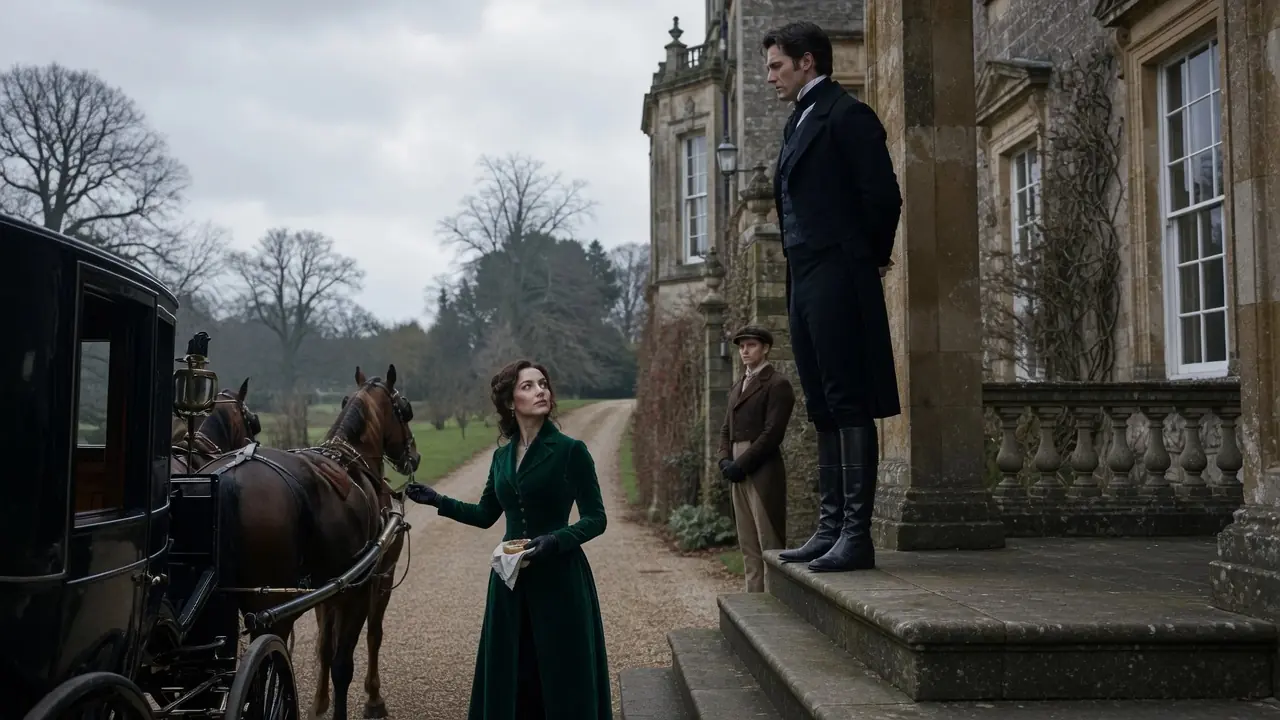
Arthur Pendleton, the Duke of Blackwood, stood at the top of the stone steps of Blackwood Manor and checked his pocket watch for the fourth time in ten minutes. It was a habit he had developed over twenty-three years of managing an estate, a title, and a name that carried more weight than most men could bear.
He was not accustomed to waiting. He did not enjoy it. And he had absolutely no patience for it.
The gray Yorkshire sky pressed down low over the grounds, and a thin October wind moved across the lawn, bending the brittle grass. Behind him, the manor rose up in dark stone and cold geometry, all sharp angles and narrow windows, built by ancestors who believed comfort was a weakness. Arthur had never seen any reason to change it.
He had not wanted a wife. That was the simple truth of the matter.
He had resisted the idea for years through every pointed suggestion from his solicitor, every anxious letter from his late mother's sisters, and every awkward dinner where some hopeful family paraded their daughter in front of him like prize livestock at a county fair. He had refused them all, quietly and completely, because Arthur Pendleton had learned long ago that people who smiled at a duke were rarely smiling at the man.
But the estate needed an heir.
His solicitor had laid out the facts without sentiment: the entailment, the cousins who would inherit if he died without children, and the slow unraveling of everything his family had built over three centuries. So Arthur had made a practical decision.
He had contacted a discreet matrimonial agency in London, the sort of establishment that handled these arrangements without gossip or ceremony, and submitted his requirements in writing. He had been very specific.
Quiet disposition. Obedient temperament. No strong opinions about the running of the household. Willing to reside primarily at Blackwood Manor and fulfill the duties of a duchess without requiring excessive companionship or conversation.
He had not asked for beauty, warmth, or wit. He had asked for simplicity, and he had been assured in writing that his requirements would be met.
The carriage appeared at the far end of the long drive, moving faster than was strictly safe on the gravel, and Arthur straightened his coat. He watched it slow to a stop at the bottom of the steps. The coachman climbed down from the box, and Arthur could already hear raised voices, one of them distinctly female and not the least bit subdued.
"I am not telling you again," the woman's voice said, crisp and carrying. "That horse has a stone in his left foreleg, and if you drive another mile without attending to it, you will lame him permanently. I do not care how far behind schedule we are. The horse matters more than your timetable."
The coachman said something low and defensive.
"That is not an answer," the voice replied. "That is an excuse dressed up as an explanation. They are not the same thing."
The carriage door opened, and Lady Georgiana Vance stepped out.
She was wearing an emerald riding habit, a shade so bright it seemed almost defiant against the gray November sky. Her dark hair had come half loose from its pins during the journey, and there was a small smudge of dust on her left cheek. She was startlingly beautiful in an unexpected way.
In her right hand, she was holding what appeared to be the remaining half of a meat pie wrapped in a cloth, as though she had been interrupted mid-meal and refused to leave it behind.
She was not what Arthur had ordered.
She looked up at him standing on the steps, took a single measured look from his polished boots to his expression, and did not appear frightened, uncertain, or even particularly impressed.
"You must be the duke," she said.
"I am," Arthur said.
"Your coachman, the one I hired from the posting house at Harrogate, not the one from the agency, has been ignoring a lame horse for the last six miles. I would like your groom to see to it before anything else happens."
Arthur looked at the coachman, who gave a small, miserable nod. Arthur gestured to the stable boy hovering near the door, and the matter was settled in silence.
"Lady Georgiana Vance," she said, though she had not been asked. "I prefer Georgiana. Lady Vance makes me feel like my grandmother, and she was an unpleasant woman."
Arthur descended two steps. "You are forty minutes late."
"The horse was lame."
"The agency informed me your journey from London would take two days."
"The agency also informed me," Georgiana said pleasantly, "that you were looking for a quiet, obedient wife. So it seems we have both received something other than what was advertised."
She looked him over again, that same steady, assessing gaze, and her eyes rested briefly on his waistcoat, a dark navy wool that his valet had pressed that morning.
"Your waistcoat," she said, almost thoughtfully, "looks as though it was tailored for a very stiff corpse."
There was a long and absolute silence.
Arthur stared at her. In thirty-four years of living, no one had ever said anything remotely like that to him. His staff did not speak to him that way. His peers did not speak to him that way.
The agency had promised him a meek country girl. This woman was looking at him as though she was genuinely unsure whether the waistcoat was the problem or the man wearing it.
"You will dine in your quarters this evening," Arthur said, his voice controlled and flat. "You will remain out of my way until I determine what is to be done with this arrangement."
Georgiana tilted her head slightly, as though considering this instruction carefully.
"I will need a map of the estate," she said. "And the housekeeper's name. And if dinner could include something warm, I would appreciate it. I have been in a carriage since dawn."
She paused.
"Oh, and the horse."
"The horse?" Arthur repeated.
"See that someone checks him properly. Not just the stone, the whole leg. He favors it on the left side."
She tucked the cloth-wrapped pie more securely under her arm.
"I will find my own room. Good afternoon, Your Grace."
She walked past him, up the steps and through the front door of Blackwood Manor, as though she had lived there her entire life.
Arthur stood on the steps for a moment, staring at the space where she had been. Then he looked down at his waistcoat.
He had never given it a single thought before in his life. He thought about it now with a feeling he could not immediately name, and found that he did not enjoy the experience at all.
He turned and went inside, and he did not look at the waistcoat again.
The rules arrived on Georgiana's breakfast tray on the second morning.
It was a single sheet of thick cream paper written in a tight, controlled hand that suggested the writer had pressed the pen down with considerable force. At the top, underlined twice, were the words: Household Conduct Requirements for the Duchess of Blackwood.
Below it were eleven numbered points.
Georgiana read the list twice. She drank her tea. She looked out the window at the frost on the grass, and then she reached for her quill.
She worked methodically through each point.
Point three, which stated that the Duchess would not rearrange any room in the manor without prior written approval, received a margin note: unreasonable. Books in the East sitting room are organized by color, which benefits no one.
Point five, which stated that the Duchess would not speak to tradesmen, estate workers, or tenant farmers directly, received two question marks and the observation: By what mechanism, then, does anything get done?
Point seven, which stated that the Duchess would not offer opinions on estate management, received the single word brave, underlined once.
By the time she had reached point eleven, her corrections occupied more space on the paper than the original text. She had given each point a letter grade in the margin, ranging from a generous C to a blunt F. She had also corrected two instances of incorrect punctuation.
She sent it back on his silver breakfast tray the same afternoon.
Arthur read it in his study with the door closed. He read it three times. He did not send a response, but later that day Georgiana noticed that the books in the East sitting room had been quietly rearranged by subject matter, and she thought that was probably as close to an apology as she was going to get from the Duke of Blackwood.
She was learning him in these small ways.
He was rigid, yes. He ran his household like a military operation, with schedules and protocols and an absolute intolerance for deviation. His staff moved around him with the careful precision of people who knew exactly where the edges were.
He inspected the tenant farms every Thursday morning, rain or shine. He answered correspondence before breakfast. He ate alone at the head of the long dining table in a silence so complete that the footman barely breathed.
But he paid his tenants fairly, Georgiana discovered after she had ignored point five of his rules and walked out to the nearest farm on her third morning.
He had repaired the cottages that previous dukes had left to rot. He remembered the names of the children. When old Mr. Hollis's barn roof had collapsed in September, Arthur had sent men and timber within the week without being asked.
He was not cruel. He was simply a man who had built walls so high and so thick that he had apparently forgotten what it felt like to have company.
Georgiana had no intention of ignoring those walls. She intended to walk straight through them.
The formal dinner arrived in the second week, and Arthur had arranged it specifically to test her.
She understood this clearly from the moment she saw the seating plan. The local baron, Sir Edmund Graves, was placed directly across from her, with his wife on his left and his eldest daughter on his right.
Sir Edmund was the sort of man who asked women questions and then talked through their answers. He had been the most prominent landowner in the county before Arthur's family had built this estate, and he had never fully forgiven history for it.
Georgiana sat through the soup course in composed silence, watching the table. Arthur sat at the head, watching her. His expression gave nothing away. She could feel the quality of his attention, focused, measuring, waiting for her to stumble.
Sir Edmund addressed her during the fish course.
"Lady Georgiana, or rather, Your Grace, I imagine Yorkshire must feel rather remote coming from London. A little raw, perhaps."
"I grew up in Dorset," Georgiana said pleasantly. "I find Yorkshire considerably less remote than my childhood."
"Mm." Sir Edmund smiled in the way that people smile when they intend to be condescending. "And I suppose a matrimonial arrangement of this nature must have seemed quite the adventure. Quite the step up."
There was a small, charged silence at the table.
Georgiana set down her fish fork with perfect precision.
"Sir Edmund," she said in the same pleasant tone, "I notice you have been speaking for approximately four minutes about my origins without once asking me a question that expects an answer. I find that fascinating. Most men do it without noticing. You, I suspect, notice perfectly well."
She tilted her head.
"You have also mispronounced the name of the wine three times. The second T is silent. It is a common error."
The table went very quiet.
Then Lady Graves, who had been pressing her lips together for the last ten minutes with the expression of a woman who had wanted to say this herself for thirty years of marriage, laughed.
It was a real laugh, sudden and bright, and the tension shattered.
The rest of the dinner moved differently after that. Georgiana let the conversation flow warmly, asked the right questions, made the right observations, and by the time the pudding arrived, even Sir Edmund was talking more freely than he had intended to.
Arthur said nothing during all of this. But when the guests departed and Georgiana was climbing the stairs, she heard him behind her in the hallway.
"You could have been kinder to Graves," he said.
"I was kind to everyone at that table except Graves," she said without turning around. "He was being deliberately unpleasant to me, and I chose not to pretend otherwise. Those are different things."
She heard him pause on the stairs below her.
"You were correct," he said after a moment, "about the pronunciation."
She smiled at the wall in front of her.
"Good night, Your Grace."
The storm arrived on a Tuesday without adequate warning.
Georgiana had been out on the estate since early afternoon, riding with the groom to inspect the western tenant farms after she had received a note third-hand from the housekeeper and the stable master that one of the cottages was losing roof tiles.
She had intended to return before dark. The sky changed in less than an hour. What had been pale and overcast became dark and moving, and the rain came in hard and sideways.
The groom turned back when lightning struck a tree near the north field, and Georgiana could not blame him. But the carriage she had taken on the narrower track was already pulling to a stop. The left rear wheel lodged in mud so deep and solid that no amount of effort from the driver or the horse was going to free it before nightfall.
She did not panic. Panic was inefficient.
The groom pointed toward a dark shape in the field to the east, an old outbuilding of stone, with a roof that still looked mostly sound. Georgiana gathered her skirts, stepped out into four inches of mud, and walked toward it.
Arthur arrived twenty minutes later.
She heard the horse before she saw the lantern. He had come out from the manor when the storm turned severe, along the same track, and found the carriage without much difficulty.
When he ducked through the low doorway of the outbuilding and held the lantern up, he found Georgiana sitting on an upturned feed bucket, her silk slippers destroyed, her riding coat soaked through, and a small but steadily burning fire crackling in the stone hearth at the far wall.
He looked at the fire. He looked at her. He looked at the complete ruin of her shoes.
"You lit that," he said.
"The kindling was dry," she said. "Someone stored it against the wall."
"Sensible habit."
Arthur crossed to the fire and crouched in front of it, holding his hands toward the heat. He was wet, too, though less comprehensively than she was, and for a moment neither of them said anything. The rain hammered on the roof in long, uneven bursts.
"The wheel is buried," Georgiana said.
"I know. We will need to wait for the worst to pass before we can bring a team from the stable."
"I estimated as much."
He looked at her sideways. There was something in his expression that she had not seen before, not the formal blankness he wore at dinner, not the controlled distance of his study. He looked, for a brief moment, like a man who had no idea what to say and was not accustomed to the feeling.
"You are not frightened," he said.
"Of the storm?"
"Of any of this."
Georgiana turned to look at him directly.
"I was frightened when I left London," she said. "I had never done anything like this before. I had never agreed to marry a man I had never met, in a county I had never visited, with no plan beyond the hope that it would be better than the alternative."
She paused.
"The alternative was marrying the Earl of Crewe, who is ninety-one years old and in very poor health, which my father felt was a point in his favor."
Arthur was quiet for a moment.
"Your father arranged that?"
"My father was running out of patience and out of money," she said simply. "I ran out of options at approximately the same time. So I took the one I could arrange myself."
She looked back at the fire.
"I am not fragile, Your Grace. I have never had the luxury."
The fire crackled between them. Outside, the storm pressed on.
"My father," Arthur said after a long silence, "believed that a duke should be beyond needing anything. Beyond showing it, certainly."
He said this quietly, to the fire rather than to her.
"He spent thirty years making sure I understood that. And then he died, and I inherited everything he built, and I discovered that the manor is very large and completely empty, and that I had absolutely no idea what to do with that fact."
Georgiana did not say anything immediately. She had learned that he filled silence badly, that he would retreat from it if she spoke too quickly. She waited.
"The woman before you," he said, and stopped.
"You do not have to," Georgiana said.
"She was engaged to me for eight months," he said. "She smiled at me the entire time. At every dinner, every outing, every conversation. A perfect, unchanging smile. And then she married a viscount with a warmer estate in the south, and I realized that she had never looked at me once. Not actually looked, during any of it."
He paused.
"I decided it was simpler not to be looked at."
Georgiana was quiet for a moment. Then she said, "I look at everything. I find it impossible not to."
He turned toward her. He was close. The outbuilding was not large, and they were both angled toward the same fire, and in the low, warm light his face looked less guarded than she had ever seen it.
"I know," he said.
His hand came up, and with one careful thumb he brushed a smudge of soot from her cheek.
It was a small gesture. It was not small at all.
His hand did not immediately move away. The warmth of his palm was just barely there, and Georgiana held absolutely still, her breath careful, the fire loud in the silence between them.
Then a crack of thunder shook the roof, and the moment broke apart.
Arthur lowered his hand. He looked at the fire. Georgiana looked at her destroyed slippers.
"The storm is easing," he said after a moment.
"Yes," she said.
Neither of them said anything more about it. But when the groom arrived with the team an hour later and they climbed into the repaired carriage in silence, the space between them on the seat felt different from the space it had been before.
Like the air after lightning, charged and changed, the way things are when something has already happened and both people know it and neither one is quite ready to say so.
The assembly ball at York was not Arthur's idea.
It had been arranged months before Georgiana's arrival by the county's social committee, which Arthur supported financially and ignored personally. His attendance had always been more of a formal obligation than a genuine event.
He would arrive, stand near the edge of the room, accept the obligatory greetings, and leave before the dancing started. He had not planned to change this pattern.
What changed it was Georgiana, in a gold silk gown with dark embroidery at the sleeves, stepping down from the carriage in front of the assembly rooms and pausing on the wet cobblestones to look up at the lit windows with an expression that was not nerves. She did not appear to do nerves. It was something alert and careful. Preparation.
"Rumor has traveled faster than we have," she said quietly, not looking at him.
"It always does in this county," Arthur said.
"They are saying the marriage is a convenience, an arrangement without feeling."
She turned to look at him.
"People will test that this evening. I want to know if you are going to let them."
He offered her his arm.
"Let us go in," he said.
The room was full, loud, and warm with candles. Arthur felt the shift in attention the moment they crossed the threshold, that particular quality of watching that moved through a crowded room like a current, visible in the way people turned, the way conversations dimmed and then resumed more quietly.
He noticed Georgiana noticing it, too. Her chin came up slightly, and she moved beside him without hesitation, meeting eyes directly, inclining her head in greeting, entirely composed.
She had an instinct for rooms that he had never seen before in anyone. She knew within minutes who held the real authority, who was genuinely interested, and who was waiting to cause trouble.
Lord Fairworth was the third category.
Arthur had known Fairworth for years, a wealthy, deeply unpleasant man who had once, briefly, attempted to court Georgiana's elder sister before that arrangement had also failed. He had a reputation for holding grudges with the dedication of a man with very little else to do. He had been watching Georgiana since they entered.
During the first interval, he moved toward her.
"Your Grace," Fairworth said, addressing Arthur and ignoring Georgiana entirely. "Quite a bold experiment, this marriage. I hope the terms of the original arrangement were satisfactory."
"I was not aware the terms were public knowledge," Arthur said.
"Oh, the broad outlines are well enough known," Fairworth said, smiling. "A man of your position using a matrimonial agency, it does suggest a certain desperation, shall we say?"
"Or efficiency," Georgiana said.
Fairworth turned toward her as though he had forgotten she could speak.
"I beg your pardon?"
"You said desperation," she said clearly. "I suggested efficiency. They produce similar results through very different means. The Duke knew what he required and secured it directly, rather than spending three seasons in ballrooms hoping for the right accident to occur."
She paused.
"Though I notice you are not married, Lord Fairworth. I hope your own method is going well."
The people nearby, and there were several, positioned with the specific casualness of people who had arranged themselves to hear this exchange, made various small sounds. One woman near the refreshment table pressed her gloved hand to her mouth.
Fairworth's smile tightened.
"You are very bold, Your Grace."
"I am honest," Georgiana said. "It can look similar from a distance."
The orchestra was beginning again. Arthur looked at Georgiana, and she looked at him, and in that look something passed between them, clear and wordless.
He held out his hand.
"Will you waltz?" he said.
He did not enjoy dancing. He was not poor at it. He had been trained from childhood, but he had never understood the social theater of it, the performance of it. He had never wanted to perform.
He wanted to now.
They moved onto the floor, and the room arranged itself around them in the way that rooms do when something worth watching is happening at the center. Arthur placed his hand at her waist.
She looked up at him with an expression he had been cataloging for weeks now and still could not fully name, direct and clear and slightly amused, but underneath it something real and unguarded that she showed him and very few other people.
"You did not have to do this," she said quietly as they moved.
"I know," he said.
They moved in a silence that was not empty. He was aware of the warmth of her hand in his, the careful distance between them that the waltz required, the way she followed his lead without surrendering anything.
"You have," he said after a moment, "completely ruined my orderly life."
She looked up at him.
"Everything I arranged to be simple," he said, quietly enough that only she could hear, "has stopped being simple. And I have spent the last three weeks trying to decide whether that is a catastrophe or the first genuinely good thing that has happened to me in years."
Georgiana's breath shifted slightly.
"And which is it?" she said.
He looked at her, actually looked, the way she had told him she looked at everything, the way he had not allowed himself to look at anyone in a very long time.
"I think," he said, "you already know."
The music moved them toward the end of the dance, the candlelight thick and warm above them, and Arthur was about to say something more, something that he had been building toward for weeks without letting himself acknowledge it, when Fairworth stepped forward from the edge of the floor.
"A lovely display," he said loudly enough to carry. "Though I wonder, Your Grace, whether the assembly is aware of exactly how Lady Georgiana came to select this particular agency, and what she told them to secure the match."
His smile was deliberate and cold.
"I have the letter she submitted. I think it would make for rather interesting reading."
The music slowed and stopped. The room went very quiet.
Georgiana's hand was still in Arthur's. He felt her fingers still, not flinch, just still, and he felt the precise weight of what Fairworth was attempting: to make her something shameful, to reduce what she had done to something small and desperate in front of everyone who mattered in this county, on the worst possible stage.
He looked at Fairworth. Then he looked at Georgiana.
She was looking back at him with an expression that was entirely steady and entirely uncertain at the same time, steady because she was who she was, and uncertain because she did not yet know what she was going to do.
He had not known either until this moment.
They did not speak on the carriage ride home.
Not because they were angry, or not only that, but because what had happened in the ballroom was still settling, the way things settle after a structural shift. Arthur needed to think clearly, and he found it difficult to think clearly when Georgiana was speaking.
He found it difficult to think clearly when she was present at all, but that was a separate matter.
The fire was already burning low in his study when they arrived back at the manor, and Arthur went there directly, pulling off his coat and standing in front of the hearth while the rest of the house grew quiet.
Georgiana appeared in the doorway a few minutes later. She had not changed, still in the gold gown, and she stood at the threshold with the same expression she had worn in the ballroom, steady and waiting.
"Come in," he said. "Sit, if you want."
She sat in the chair across from the fire, and he stayed standing because he could not sit. He had too much to say, and he had been good at finding words under pressure, and this was the highest pressure he had felt in years.
"I need to tell you what the letter contained," she said.
"You do not," Arthur said.
"Arthur."
It was the first time she had used his name without the title. She did not appear to notice she had done it.
"Fairworth will produce it, or he will describe it, and you should hear it from me first. That is simple fairness."
He turned to look at her.
"I told the agency," she said evenly, "that I was practical, capable, and direct. I told them I had no interest in a decorative marriage and no ability to pretend otherwise. I told them that if the Duke of Blackwood was looking for a quiet, obedient wife, I was not that woman. But if he was looking for a partner who would manage his household with genuine skill and tell him the truth when no one else would, I could do that."
She paused.
"I knew, reading his requirements, that I did not match them. I submitted my letter anyway because the alternative was the Earl of Crewe, and because I believed, I still believe, that what I offered was worth more than what he asked for."
The fire crackled.
Arthur crossed the room and crouched in front of the hearth. He picked up the folded matrimonial contract from the corner of the mantelpiece. He had placed it there on the first day, some practical instinct, and held it for a moment.
"You were not what I asked for," he said.
"I know."
"You are also," he said, "the only person in this house, in this county, possibly in my entire adult life, who has told me the truth when it was inconvenient."
He held the contract over the fire. The edge caught, and the flame moved slowly up through the paper. He held it until he had to let it go, and then he dropped the last burning corner into the grate and stood up.
"I am not a simple man to live with," he said.
He turned to face her.
"I have spent most of my life making myself difficult to reach because it seemed safer than the alternative. I run this estate like a campaign because I know how to run a campaign, and I have never been entirely certain what to do with stillness. I am told I am cold and formal and not warm company, and those people are not wrong."
He stopped.
"I am also aware that in the past six weeks, the only time this house has felt like anything other than a very large and very empty building is when you are in it and arguing with something."
Georgiana looked at him.
"Fairworth's letter means nothing to me," Arthur said. "What you told that agency was the truth, and the truth is that you walked into this house and improved it from the first afternoon. You corrected my rules. You defended yourself at my dinner table. You lit a fire in a barn and told me things I needed to hear in the only way I ever actually hear anything, directly, without softening."
He took one step toward her.
"I did not ask for a partner. I asked for a duchess. I am telling you now, clearly, that what I want is a partner. Everything I have, everything I am responsible for, as equal to it as you choose to be."
Georgiana had been still for a long time. Now she stood, crossed the space between them in three steps, and looked up at him with an expression that had nothing calculated in it, no wit, no careful guard, just clear, unguarded feeling.
"You are," she said, "extraordinarily dramatic for a duke."
"I have been told," he said.
"You also used my first name approximately four minutes ago without appearing to notice."
"I noticed," he said.
She laughed, a real one, sudden and bright, the same laugh she had held back at the dinner table for eleven days.
And he did something he had not done in years. He smiled. Not the controlled, formal smile that he produced for public occasions, but a real one that started somewhere he could not entirely locate and arrived on his face without his permission.
He cupped her face in his hands, carefully, like something worth being careful with.
"Stay," he said. "Not because of the contract, not because of the title. Stay because this is the first place either of us has been entirely honest, and I do not want to go back to what came before."
Georgiana reached up and took hold of his lapels firmly, with the same decisive grip she used for everything, and she pulled him down to close the remaining space between them.
The kiss was not tentative. It was not exploratory. It had the quality of something decided, the way she decided everything, completely and without apology.
His arms came around her, and for a long moment there was nothing in the study but the fire burning low, the rain beginning again on the windows, and the absolute, grounded quiet of two people who had finished pretending.
When they stepped apart, she was still holding his lapels.
"I have a list of changes I want to make to the East Wing," she said.
"I assumed," he said.
"I would like to ride the western boundary before snow comes. The fencing near the Hollis farm needs attention."
"We can go Thursday," he said.
"And I want to hire a second teacher for the tenant children. The one you have is overextended."
Arthur looked at her, at this woman who had arrived in an emerald riding habit with a meat pie and an argument, who had walked into his cold and empty house and refused to be cold in it, who had lit the fire herself and corrected his grammar and told him the truth at every possible opportunity.
She was currently standing in his study at midnight with candlewax on her hem and soot on her cuff from a fire she had lit three weeks ago in a barn during a storm.
"You are nothing I imagined," he said.
"I know," Georgiana said. "I came determined to be exactly that."
Outside, the rain settled into the steady, unhurried rhythm of Yorkshire in November, falling on the dark stone of the manor, on the tenant farms to the west, and on the long gravel drive where a carriage had arrived six weeks ago carrying a woman who was forty minutes late and entirely certain of herself.
The fire burned lower. The study was warm, and for the first time in as long as Arthur Pendleton could honestly remember, Blackwood Manor felt less like an inheritance and more like a home.