The letter came up to the great house on a Tuesday, and by Wednesday it had turned the whole of it inside out. It was carried in on a silver tray, sealed in heavy cream paper, and Lady Bramwell read it standing at the breakfast-room window with the morning light hard on her face. She read it twice. Then she sat down rather suddenly, as though her knees had been taken out from under her.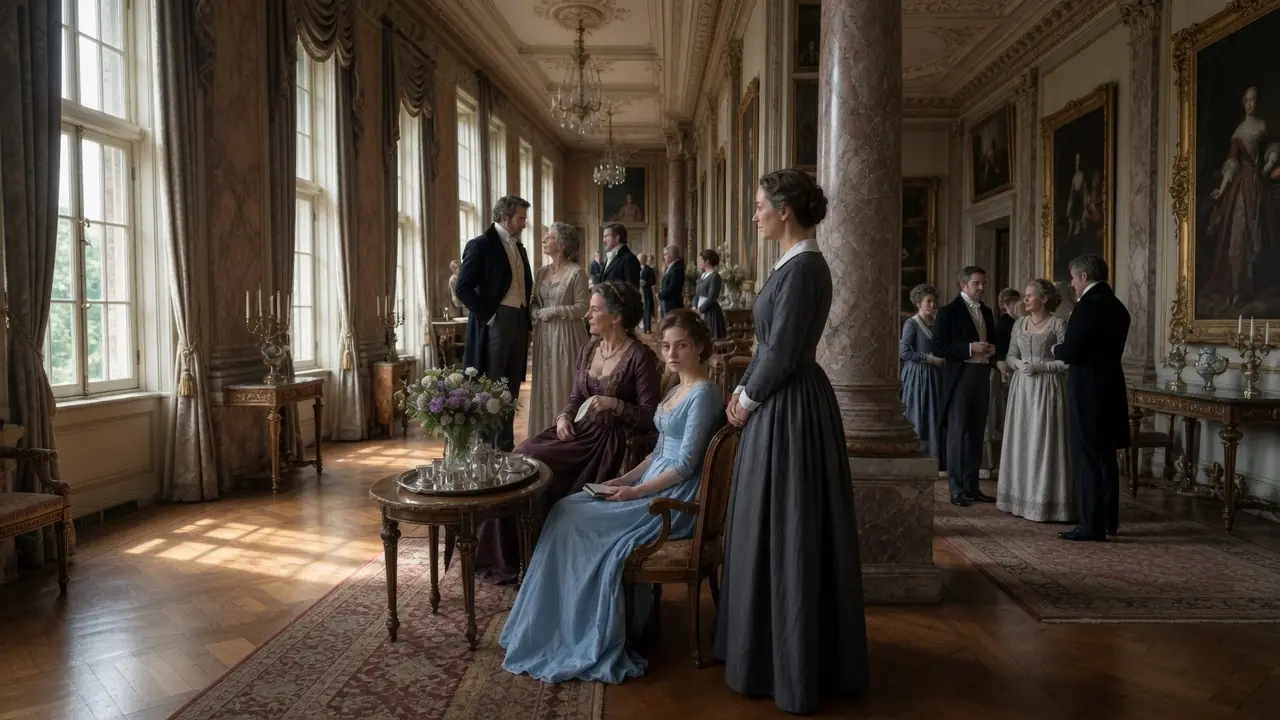
She put one hand flat on the table and said, in a voice gone strange, that the Duke of Storm Haven was giving a masquerade at Farfall, and that the Bramwells were asked.
There was a silence in the room of the kind that comes before weather. The Duke of Storm Haven did not entertain. Everyone knew it. He had not entertained in six years, not since his wife had died and the great house had gone dark.
A man who does not entertain for six years and then, all at once, gives a masquerade is a man who has been got at. His family had got at him. That was the word carried on the letter, as plain as if it had been written there.
The Duke was six-and-forty, a widower, the last of a great line except for a nephew he was said to dislike. His people had told him it was time. Time to come out of the dark. Time to look the season's daughters over behind their masks and choose one. Time to do his duty by his name.
Into that room, unseen, carrying a can of hot water for the fire that would not draw, came a woman whom no one looked at. Emiline Kelmont was three-and-forty years old. She had been in service since she was twelve, and in one-and-thirty years she had learned the whole art of not being seen.
She set the water down, knelt at the grate, and coaxed the sulky fire back to life with the patience of a woman who had coaxed a great many sulky things back to life in her time. While she did it, Lady Bramwell talked over her head as though she were a piece of the furniture, which to Lady Bramwell she was.
"The Duke of Storm Haven," said Lady Bramwell, striking the letter softly against her palm. "And Sophie not yet promised. Do you know what this is? This is the hand of Providence. This is everything. Every mother in three counties will be schooling her girl for that masquerade from this morning, and my Sophie is worth ten of them. She only wants showing."
Emiline banked the coals, rose, took up her can, and went out. No one marked her going because no one had marked her coming. She had a face that people's eyes slid off, and she had trained them to slide off it. It was safer in a great house to be a thing that eyes slid off.
She had made herself into one so thoroughly that she had half forgotten there had ever been a girl whom people looked at and smiled to see. There had been, long ago. She did not think of her often.
She went up the back stairs to lay out Miss Sophie's morning things, and she found Miss Sophie sitting on the floor by the window with her knees drawn up and her face white. Emiline knew before a word was said that there was trouble in the house that had nothing to do with any duke.
Sophie Bramwell was nineteen, pretty in the soft, unfinished way of nineteen, and under the prettiness a good deal more stubborn than her mother had ever troubled to notice. She looked up at Emiline with her chin set and her eyes wet, and she said low that she would not do it. Whatever it was, she would not do it. She would die first.
"You had best tell me," said Emiline, "before your mother comes up. She will come up. She has a duke in her hand, and she will want you dressed for him by noon."
So Sophie told her. It came out in a rush, the way such things do when they have been dammed a long while.
There was a man. Of course there was a man. There is nearly always a man at nineteen. This one was a curate with forty pounds a year and a living he might get in a decade if he was lucky and patient and someone died. His name was Mr. Adair. He was gentle, poor, and entirely unsuitable, and Sophie loved him with the whole of her undivided nineteen-year-old heart.
She had loved him since the spring. She had told no one. And now her mother meant to hang her out like a lantern before a duke, and she would not do it. She would not stand in a mask and be looked over like a mare at a fair by a cold old widower she had never met. Not when her heart was promised elsewhere. Not for anything on this earth.
Emiline sat down on the low chair by the bed. She was quiet a moment.
"You are certain," she said. "Of Mr. Adair, and of your own mind? Girls of nineteen are certain of a great many things by Michaelmas that they have forgotten by Lady Day."
"I am certain," said Sophie.
There was something in the flat, plain way she said it that made Emiline believe her. She had heard a great deal of nineteen-year-old certainty in her years, and most of it had a note in it that this had not. This was quieter. This had made up its mind.
"Then you are in a great difficulty," said Emiline. "For your mother has not the smallest intention of hearing it."
She had that right. Lady Bramwell came up within the hour, and there was a scene, and it was ugly. Emiline stood against the wall with the linen over her arm and witnessed the whole of it, being furniture, and furniture may witness anything.
Lady Bramwell did not shout. She was too clever to shout. She spoke instead in the low, reasonable voice that is worse than shouting, and she laid before her daughter one by one the facts of their situation, which were not so comfortable as the great house made them look.
The Bramwells were not so rich as they seemed. Sir Henry Bramwell had died and left his widow a fine house, a thin income, and a mountain of small debts that she had spent three years hiding behind good linen and a good cook. The house was mortgaged. The carriage was hired by the season. Sophie, pretty Sophie, was the family's whole fortune, the one coin left to spend, and her mother meant to spend her well or go down trying.
A duke had asked them to his house. Did Sophie understand what a duke was? Did she understand that a curate with forty pounds a year could not pay the interest on what this house owed, let alone keep a wife? Did she understand that to throw a duke over for a curate was not romance but ruin?
Ruin for herself, ruin for her mother, ruin for the very servants who would be turned off into the road when the creditors came.
"You would not have a roof," said Lady Bramwell. "Neither would I, and neither would any soul under it. Think on that, miss, before you speak to me again of your curate."
She went out and left her daughter weeping on the floor. She left Emiline standing against the wall with the linen over her arm, thinking of the road and of who went into it first when a great house fell.
The servants went first. She knew that. She had seen it happen once in another house long ago when she had been young, and she was not young now. A woman of three-and-forty, turned off without a character, does not find another place.
She knew that too. She had known it for years, the way one knows the edge of a cliff one has chosen to build a house beside. It was the ground she had lived on her whole life, that edge, and she had learned to walk it without looking down.
She saw the whole chain of it laid out link by link, from a girl's obstinate heart to an old woman in a ditch. The old woman in the ditch, when she looked hard, had her own face.
It was Lady Bramwell who thought of the thing first. But it was Emiline who made it possible, and she was never afterward able to decide which of them ought to bear the greater share of what came of it.
Lady Bramwell thought of it in the second week, when Sophie had not bent, when the girl had gone from weeping to a white, silent, immovable stillness that frightened even her mother a little.
"A masquerade," Lady Bramwell said, half to herself, turning her rings. "A masquerade is not like a ball. At a masquerade, the face is covered, and a lady is a domino, a mask, a gown, and a way of standing, and nothing more until midnight when the masks come off."
She looked at her daughter's stubborn silence. Then she looked, for the first time in years, directly at Emiline, who was mending a hem by the window.
"Stand up," she said.
Emiline stood. Lady Bramwell walked around her slowly, the way she might walk around a horse.
Emiline was tall. That was the first thing. She had always been tall, taller than Sophie, taller than her mistress, and she carried it well, without the stoop that service puts into most tall women. She had a straight back, a steady gray eye, and a stillness that a foolish woman might have taken for meekness. A wiser one would have known it for something else entirely.
Her hair was dark, going a little gray at the temples, and her hands, when Lady Bramwell took one up and turned it over, were a servant's hands, roughened and capable.
"But gloves cover hands," Lady Bramwell said.
"My lady?"
"You were bred up in a gentleman's house."
It was not quite a question. She knew the bones of Emiline's history, as mistresses know the bones of their upper servants' histories, without ever troubling over the flesh of them.
"I was, my lady," said Emiline. "Reared with the daughter of it. Taught with her. I sat in the schoolroom with her before the family came down in the world."
"You can read. You can speak as they speak. You have carried a lady's train and stood in a lady's drawing room a thousand times and know how it is done."
Lady Bramwell dropped the hand. Her eyes had gone bright and hard with the beginning of a plan.
"You could stand in a mask for one evening and be taken for a lady. You could be taken for my daughter."
Emiline understood her all at once, and the understanding went through her like cold water.
"No," she said. "You have not heard me."
"I have heard the whole of it, my lady, and it is madness to send a servant masked into a duke's house and show her to him as your daughter. If it were found out, it is not a scolding. It is the ruin you fear twice over. A fraud upon a peer is a thing men are transported for, and I have no wish to see New South Wales."
"It would not be found out."
Lady Bramwell had the plan whole now. Emiline could see it building behind her eyes, brick on brick.
"You would go masked. You would be Miss Bramwell for two hours. You would be pleasant, dance a set, and speak to the Duke long enough to be seen speaking to him, so that the house is seen to have come, so that we are seen to have honored his invitation, so that no slight is given and no doors are shut. You would leave before midnight, before the unmasking."
"And when the Duke wishes to call on the lady he danced with," said Emiline, "and finds a girl who is not she? When Miss Sophie cannot speak of the things the masked lady spoke of, cannot answer for an evening she never passed, cannot be the woman he remembers? What then?"
"Then that is next week's trouble, and this is this week's. Do you know a better answer? For I do not. I have a daughter who will not go, a duke who must not be slighted, and three weeks in which to square the two. If you have a better answer, give it me, and I will kiss your hand for it. If you have not, then hold your tongue and do as I bid you, for you are my servant, and I am telling you what I require."
There it was, the whole of it. You are my servant, and I am telling you what I require. Emiline had heard those words in one shape or another her whole life, and they were the wall she lived inside.
She could refuse and be turned off within the hour without a character, and go into the road she had spent thirty years fearing. Or she could obey and put on a mask and lie to a duke and risk the road by a different door.
There was no way out of the room that did not go through the road. There never was for a servant. That was what it was to be a servant. You chose your risk. You never chose whether to risk.
She thought of Sophie, white and silent on the floor, in love with her poor curate. She thought that she herself had once, at nineteen, wanted something with her whole undivided heart, and had been told it was ruin, and had given it up, and had spent the thirty years since being furniture.
Standing in the window with the mending in her hands, she found that she could not for her life advise the girl to do the same. Let the child keep her curate a little longer. Let her keep her heart whole one more month. It was worth a mask.
"If I do this," said Emiline slowly, "you will not touch Miss Sophie's curate for the length of it. You will let the matter lie until after the masquerade. You will not force her while I am buying you your time."
Lady Bramwell's eyes narrowed. She did not like to be bargained with by her own servant. But she wanted the thing, and Emiline had seen that she wanted it, and a woman who wants a thing badly enough will pay for it, even to her furniture.
"Very well," she said. "The matter shall lie until after. You have my word. Now we must see about a gown."
And so it was that Emiline Kelmont, three-and-forty, a lady's maid with a servant's roughened hands and a face that eyes slid off, was fitted in secret for a gown of silver-gray silk.
It was finer than anything she had touched in thirty years. She was taught to answer to the name of Bramwell, and she was given a mask.
The mask was the thing she remembered longest afterward. It was a domino of gray silk cut close, worked at the edges with a fine thread of silver, and it covered her from brow to lip and left only her mouth, her chin, and her steady gray eyes.
She put it on before the glass, alone, the night before the masquerade, and she looked at the woman in the glass and did not know her. That was the whole trick of it. The mask did not hide her. It freed her.
The woman in the glass was no one. She had no name that mattered, no place that mattered, and no road waiting for her because she did not exist. She was two hours of gray silk that would be folded away at midnight and never worn again.
A woman who does not exist can do anything. She can say anything. She has nothing to lose because she has nothing. She is nothing. She is a mask, and behind the mask for two hours she can be a person.
Emiline looked at the masked woman in the glass for a long time. Then she took the mask off and folded it away and went to bed and did not sleep.
Farfall on the night of the masquerade was a thing out of a dream. The Duke had done it properly, whatever he thought of it. The great house that had stood dark six years blazed now at every window. The drive was a river of carriages with their lamps swimming in the dark, and from within came music and the great soft roar of a crowd at pleasure.
Emiline came up the steps on the arm of a hired footman, masked, gowned, gloved to the elbow, with her heart going so hard she thought the whole staring hall must hear it. But no one heard it, and no one looked. She was one gray domino among a hundred dominoes, and the mask that hid her hid her.
She passed into the Duke of Storm Haven's house a nobody, exactly as she had passed everywhere her whole life. Only tonight the nobody wore silver-gray silk.
She had one task. Be seen, dance if asked, speak to the Duke long enough to matter, and leave before midnight. She set herself to it, as she set herself to any task, steadily and without fuss.
The first part came easily, for a masked woman standing quietly by a pillar is a thing every ball has a dozen of. She watched the room. She had always been a great watcher. It was the servant's art to watch a room and see everything and be seen by nothing.
She practiced it now behind her mask with a freedom she had never had. Tonight she was not the servant clearing the room. She was a guest in it, and she could watch as a guest, and no one would send her for more candles.
And so she was watching when the Duke of Storm Haven came in. She knew him at once, though she had never seen him, because the whole room knew him. The whole room bent toward him like grass in a wind, and the bending told her which he was.
He was tall, dark, and going a little iron where the candlelight caught his hair. His eyes, when the light caught them, were a cold, clear slate blue. He wore his black mask and his plain dark clothes with the air of a man attending his own execution with good manners.
He did not want to be there. Emiline saw it in an instant, in the set of his shoulders, in the exact and joyless courtesy with which he greeted the people who swam up to him. He was doing his duty. He was letting himself be shown the season's daughters, one masked girl after another steered up to him by one determined mother after another, and he was bearing it, hating it, hiding the hating under a coldness so complete that the mothers took it for hauteur and were not warned.
Emiline watched him bear it for the better part of an hour, and something in her, some old shut-away thing, unlatched a little, for she knew exactly what she was looking at. She was looking at a person being counted.
She had spent her life being not counted, which is its own hard country. But she knew the neighbirong country too, the country of the counted, of the person weighed and toted up and valued for the one thing they had that others wanted, and never once seen for the person carrying it. She had served a lady once who had been counted so, married for her money to a man who never learned the color of her eyes.
She knew the look. The Duke of Storm Haven had it now, moving through his own blazing house like a prize being auctioned, and she found, to her surprise, that she was sorry for him.
Then his slow, joyless progress around the room brought him, by no design of hers, to the quiet pillar where she stood, and stopped. He had come to the edge of the room, she understood later, for the same reason she had: because the middle of it was unbearable, because at the edge a person might stand a moment and not be swum at.
He had not come to her. He had come to the pillar, and she happened to be at it. He stood beside her, looking out at the dancers with his cold slate eyes.
For a moment, neither of them spoke. Two masked people at the edge of a room full of people who wanted things from one of them and nothing at all from the other.
Emiline, who was no one, who was two hours of gray silk, who had nothing to lose because she did not exist, opened her mouth. She said the thing she would never in her life have said with her own face on.
"You look," she said, "like a man being measured for a coat he does not want to buy."
The Duke turned his head and looked at her. It was a long look and a startled one, and she felt it go over her masked face, her gray gown, her straight tall stillness. She thought calmly, from very far off, that she had ruined everything, that no lady spoke so to a duke, that she had given herself away in a sentence.
But she found she did not much care. She was no one. Let the no one be sent home. She was going home at midnight in any case.
"I look," said the Duke after a moment, "like a man being measured for a great many coats, none of which he wants to buy, by a great many tailors who will not take no for an answer. You have the sense of it exactly."
His voice was dry and cold, and under the cold, for the first time that evening, there was something alive.
"You are the first person in this room to remark on it. Everyone else is pretending very hard that I am enjoying myself."
"You are not enjoying yourself in the least."
"I am not. Are you?"
"No," said Emiline honestly, "though for different reasons."
Something moved at the corner of the Duke's mouth under the black mask. It was not quite a smile. It stood on the near side of one.
They talked for the better part of an hour. She could not afterward have said of what, though she remembered every word of it for the rest of her life. It had the quality certain talk has once or twice in a lifetime, a feeling less like two strangers meeting than like some conversation long ago begun and long interrupted, taken up again in the middle.
She was safe behind her mask. Being safe, she was free. Being free, she was for the first time in thirty years entirely herself: the girl who had read in the schoolroom, the woman who had watched a thousand rooms and understood them, the person under the furniture.
She told him what she thought. She had never in her life told anyone in that house what she thought, and here she stood telling a duke because the Duke did not know she was furniture. The Duke thought she was a lady, and a lady may have thoughts.
They disagreed about very nearly everything and enjoyed it enormously. He thought the country dull, and she told him he had never once looked at it properly, that a man who found the country dull was a man who had brought his dullness with him. He thought books a poor substitute for living, and she told him that living was mostly waiting in her experience, and that a person did well to have a book for the waiting.
He asked her what she was reading, and she told him. He raised a brow behind his mask and said it was grave stuff for a ball. She said that a ball was exactly the place one needed grave stuff, to have something to hold to.
He was quiet a moment. Then he said that he had thought the very same thing standing in the door an hour ago, and had believed himself the only person in England to think it.
"You are not the only person in England," said Emiline, "to think anything. It is the great consolation of books that no thought you ever had is your own. Someone dead thought it first and wrote it down, and it is a comfort on a bad night to be in such company."
The Duke looked at her.
"Who are you?" he said.
Emiline's heart, which had been going quiet and glad, went cold. That was the question the whole evening turned on, the question she must not answer, and she felt the mask on her face all at once as a lie and not a freedom.
"I am a woman at a masquerade," she said. "Which is to say, tonight no one. That is rather the point of a masquerade, Your Grace. For one night, no one is anyone. You are not a duke. I am not whatever I am. We are two masks that fell to talking by a pillar. Tomorrow the masks go back in their boxes, and we are our dull selves again. And this did not happen."
She meant it lightly, but it came out with more under it than she intended, and she saw him hear the underpart, the way he seemed to hear everything.
"And if a man wished it to have happened," said the Duke, "if a man tomorrow wished to find the woman who told him he looked like a coat he did not want, where would he look?"
"He would not look," said Emiline. "That is the kindest thing I can tell you. He would not look because there is nothing to find, because the woman he liked was the mask and not the face, and the face would only disappoint him. Let her be the mask. Let this be the one clean thing. Do not spoil it by looking."
Then the great clock began to tell the three quarters before midnight, and Emiline came back to herself with a lurch. At midnight the masks came off, and at midnight she would be a servant in silver silk before the whole of the Duke's house. She rose from the little gilt chair where they had come to sit and said that she must go.
"Dance with me first," said the Duke. "One set. It is the one thing my rank is good for, that no one dares stare at what I have chosen to stand beside. Dance with me, and I will stand between you and the whole room. Then you may go and be your dull self, and I will be mine, and we will neither of us spoil it. One set. I am asking you. I do not, as a rule, ask."
She should have said no. She knew she should have said no. There was no time. Midnight was coming, and the whole plan was to be gone before this, gone clean, leaving nothing behind but a pleasant memory of a masked Miss Bramwell.
But she had wanted just once, just for an hour, to be a woman in a ballroom and not a secret in a gray gown. The wanting had got into her. She gave him her hand.
He danced well, and he did what he had said. He stood between her and the looking by the plain fact of who he was. For the length of one set, Emiline Kelmont was absurdly, impossibly at ease in a duke's arms, in a duke's blazing house, and happy with a happiness so unfamiliar it frightened her more than fear would have.
When it ended, he did not release her at once. He held her hand a moment longer than the dance required, and he looked down at her masked face with his cold eyes gone not cold at all.
Emiline heard the clock and knew midnight was on her. She did the only thing left to do. She took her hand back. She said low that she was sorry, that she had told him true, that there was nothing to find and he must not look. Then she turned and went quickly through the press of the room toward the door.
Not running, because running is how you are caught, but going. She felt his eyes on her the whole length of the room, and she did not look back. She went out through the great blazing hall into the cold dark, and the night swallowed her.
And it was over. It was not over.
She knew it was not over before she was halfway home in the hired carriage, sitting in the dark with the mask crushed in her two hands. She had done the very thing she was sent not to do. She had been sent to be forgettable, and she had made herself to the one man in England it mattered to unforgettable.
She had meant to buy time with an evening no one would remember, and instead she had given the Duke of Storm Haven the one evening in six years he would not be able to forget. She had felt it in the way he held her hand, and she had done worse than ruin the plan.
She had let herself want. Thirty years she had spent not wanting, folding the wants away small as they came, keeping the drawer of them shut. One hour behind a mask had sprung the drawer. Now she wanted, God help her, at three-and-forty, like a green girl. The thing she wanted was a duke, which was the oldest and most foolish wanting a woman in service could fall into.
She knew it, and it made not the smallest difference. The heart does not take instruction. She had learned that once before, long ago, and given up what she wanted, and been furniture ever since, and she had thought the lesson had taken. It had not taken. It had only waited.
She let herself into the great house by the servants' door and went up the back stairs in the dark. She folded the gray mask away in its box and lay down in her narrow bed in her narrow room under the eaves and did not sleep. She told herself over and over that in the morning she would be Kelmont again, that the evening would close over like water, and that no harm would come of it.
She had not reckoned on the Duke of Storm Haven.
He had watched her go the length of the room, and he had let her go because she had asked him to, and because a man does not chase a woman across his own ballroom before three hundred guests. But he had stood where she left him with the strangest sensation he had known in six years: the sensation of a door standing open in a house he had believed shut up for good.
He was six-and-forty. He had been hunted for his title since he was a young man. He had buried a wife he had been fond of without ever quite loving, and he had gone into the dark after her more from a great weariness than from grief. He had lived there so long he had forgotten there was anywhere else to live.
He did not chase women. He was chased. That was the settled shape of his life: the hunter and the hunted, and he the hunted. He had grown a shell against the hunting, so thick that no woman in six years had so much as knocked on it.
Then a masked stranger had stood by a pillar, told him he looked like a coat he did not want to buy, wanted nothing from him, told him plainly not to look for her, and walked out into the dark asking him for nothing but to be let go.
In four-and-twenty years of being wanted for the wrong thing, it was the first time he could remember being wanted, if he had been wanted at all, for the right one. Or not wanted. That was the marvel of it: not wanted, seen and talked to like a man, and then let go.
He did not have the word for what it was. He only knew that the door had opened, and that he could not for his life make himself shut it again.
He looked for her, of course. He had said he would not, and she had asked him not to, and he did it anyway in the quiet stubborn way he did everything, telling himself sensible reasons the while. He was curious. A man liked a puzzle. He had every right to know who had been a guest in his own house.
He asked his aunt, who had stood at his elbow half the evening marking the field for him, whether she had seen the tall lady in gray by the west pillar, the one he had danced with. His aunt, who missed nothing, said that the tall lady in gray had come with the Bramwells, had left before the unmasking pleading a headache, and was, she believed, the Bramwell daughter, Miss Sophie Bramwell, of whom she had heard the mother speak.
"Bramwell," said the Duke.
"Bramwell," said his aunt.
She watched him with a sharp, bright, interested eye. Lady Elanora was eighty-one years old, and she had been trying to rouse her nephew out of his dark for six years. She had seen him dance twice with a woman in gray and hold her hand at the end a beat too long. She meant to know why.
"A widow's daughter," said Lady Elanora. "Small fortune, they say, and worse debts, and the mother a pusher. But the girl herself I know nothing of. You seem to find her worth knowing."
"I found her," said the Duke slowly, "the first person in that room who was real. I should like to know her better."
Lady Elanora, who loved her nephew and wished him living again more than she wished anything on earth, said that nothing was easier. He had only to call, or to ask the Bramwells to Farfall. A duke who wished to further an acquaintance had merely to lift a finger, and the whole world came running.
Which was true, and was exactly the trouble, though none of them knew it yet.
The finger was lifted. Within the week, a letter went from Farfall to the Bramwell house, an invitation warm where the season's first had been formal, asking Lady Bramwell and her daughter to Farfall for a fortnight's stay. A small party, the near neighbors, some music, some walking. The Duke would be so glad.
Lady Bramwell read it standing at the same window, and this time her knees did not give out. This time she gave a small hard sound of triumph, for the plan had worked and worked past her wildest hoping. The Duke was caught. The Duke wished to further the acquaintance. The Duke was three parts in love with a masked lady he could not forget.
The only difficulty was that the masked lady was her lady's maid, and it was her daughter he had asked to Farfall.
There was a scene about that too, and Emiline stood against the wall through the whole of it being furniture, hearing herself discussed as furniture is discussed: a thing to be moved here or there as the plan required.
Lady Bramwell's plan was simple, and to Lady Bramwell elegant. Sophie would go to Farfall as Miss Bramwell, which she was, and Sophie would be the lady the Duke had danced with, which she was not. The difference between the two would be papered over by keeping Sophie quiet, modest, and a little unwell.
A girl who had been brilliant at a masquerade might be duller in daylight. Men, said Lady Bramwell, expected girls to be duller in daylight than in a ballroom. It was the way of the world. The Duke would find his masked lady a little quieter than he remembered and set it down to maiden shyness, and be caught anyway, for he was caught, and a caught fish does not examine the hook.
"And Kelmont comes too," said Lady Bramwell, "as your maid, which she is, and keeps out of the way, which she knows how to do better than any woman living. And if ever the Duke wants a word too clever for you to answer, Sophie, you will plead your head or your shyness, and you will come away and find Kelmont. Kelmont will tell you what to say, and you will go back and say it. Between the two of you, you will be one whole woman the Duke can love, and once he has offered, there will be time enough to be only yourself."
She smiled her hard smile.
"It has been done before. It will be done again. It is only a fortnight. Anyone can be anything for a fortnight."
Emiline said nothing. There was nothing to say. She was furniture, and furniture goes where it is carried, and she was carried to Farfall.
She should never have gone. She knew it even as the carriage turned in at the great gates, up the long drive she had come up masked three weeks before, toward the great house she had left in the dark. She should have refused. She should have taken the road rather than this.
For this was madness twice over: to walk back into the Duke's own house as a servant and to be under his roof for a fortnight while another woman was courted in her name. But there was Sophie, pale and miserable beside her in the carriage, sold to a scheme she loathed to save a family she could not save alone. There was also the plain fact that a servant who refused was a servant in the road.
Under both of those was a third thing that Emiline did not look at directly: a small, treacherous gladness at the bottom of all her fear. She would be under his roof. She would breathe the same air. She would see him again, even from behind the furniture.
She despised herself for it. It changed nothing.
Farfall by daylight, out of its masquerade blaze, was a graver and sadder place than she had known. It was beautiful with the beauty of great old houses that have grown out of their land, as though the hills had decided to make themselves a shape in stone. But it was a house in mourning.
She saw it at once with the servant's eye that reads a house the way a shepherd reads weather. There were rooms shut up. There was a wing no one went into. There was a hush over the whole of it, a held breath six years old, the hush of a house whose mistress had died and whose master had never let it wake.
Into this grave, hushed, beautiful place came the Bramwells with their scheme, and their maid with her mask folded in the bottom of her box, and the trouble that had begun at a pillar wound itself a turn tighter.
The Duke came out to greet them on the steps, and Emiline, getting down last and unregarded, saw the exact moment his cold face changed and then changed back. He had come out to meet the woman from the pillar. She saw him look for her, saw the quick involuntary search of the two Bramwell ladies getting down, the mother and the pale daughter. She saw the search find no one it knew, and the cold shell come down over the puzzlement like water over a stone.
He bowed. He said the right things. He gave his arm to Lady Bramwell and led the party in.
Emiline, three feet away, unregarded, gathering the shawls and the small cases, watched the man she had talked to for an hour look at the girl he believed she was. He did not find her, and he did not understand why.
She thought, with a grief that surprised her by its sharpness, that she had done this. She had made him a promise with her masked face that a pale, silent stranger could not keep. Now he would spend a fortnight courting the stranger and wondering in the dark where the woman had gone.
The fortnight was the strangest of Emiline's life and the most miserable, and though she would not have admitted it under torture, in its bruised way the sweetest.
It went at first as Lady Bramwell had planned, which is to say badly, but not disastrously. Sophie was presented as the masked lady grown shy, and the Duke received the presentation with a courtesy that Emiline, who watched everything, read as bafflement held very still. He tried. She gave him that, watching from the edges.
He was a man of his word, and he had asked these people to his house on the strength of an hour by a pillar. He set himself honestly to find, in the pale quiet Sophie, the woman he remembered.
He walked with her. He sat by her at dinner. He asked her once what she was reading. Sophie, who had been coached, said the name of the grave book Emiline had named to him at the ball, and Emiline, standing behind her mistress's chair, saw the Duke's face light for one instant with hope.
Then she saw him ask Sophie a question about the book, a real question, wanting to have the conversation again. She saw poor Sophie, who had never opened the book in her life, go scarlet and silent. She saw the light go out of the Duke's face, and she had to look at the wall.
It was cruel. She had not understood, planning it, how cruel it would be. It was cruel to the Duke, who was being offered a shell and told it was the pearl he remembered. It was cruel to Sophie, who was being made to counterfeit a woman she was not in service of a marriage she dreaded, away from the poor curate she loved.
And it was cruel in a way Emiline had not foreseen to Emiline herself, who had to stand behind the chair and watch the man she had let herself want turn the wrong way, always the wrong way, reaching for her through a substitute who could not hold what he reached for.
Then the thing happened that no one had planned. It happened because a duke's house is large and a fortnight is long, and a man reaching in the dark for a woman he has lost will reach in the end toward any light.
He began to talk to the maid.
It began by accident in the library on the fourth day. Emiline had gone in early before the house was up, for the library at Farfall was a wonderful thing, a great high room full of books such as she had not seen since the schoolroom of her girlhood. She had not been able to keep away from it. She had told herself she went only to dust and had taken a cloth for a pretext.
But she had a book open on the sill and the cloth forgotten in her hand. When the door opened and the Duke came in, there was no time to be furniture, no time to fold herself away. He found her there, a servant with his book in her hands and the dawn on her face.
He stopped. He looked at her. He had come down early because he did not sleep. He had thought the room empty and found instead a tall, gray-templed maidservant standing in his library with one of his books open in her rough capable hands, reading it, plainly reading it, caught in the act of a thing servants did not do.
"I beg your pardon, Your Grace," said Emiline, and shut the book, and was furniture again in an instant. Eyes down, still, apologetic, invisible. "I was dusting. I ought not to have opened it. It will not happen again."
"What were you reading?" said the Duke.
She told him. There was nothing else to do.
He crossed the room and took the book from the sill. He looked at it and looked at her. There was in his cold face the first faint stirring of something that was not about her at all, something about the strangeness of a maid reading grave philosophy in his library at dawn. A small thread of a puzzle. The Duke of Storm Haven was a man who, once he had hold of a thread, could not for his life leave it alone.
"You read this," he said, "for pleasure, at dawn, in another man's library."
"I read whatever I may reach, Your Grace, when I may reach it. It is not a common chance in my place. I ask your pardon for the liberty."
"Do not," said the Duke, "ask my pardon for reading. It is the one liberty in this house I would have every soul under it take, and none of them will."
He set the book back on the sill, open where she had left it, and looked at her a moment longer with his slate-blue eyes. Then he went away and left her there, and left the book open.
Emiline stood in the dawn with her heart going and understood that she was in very great danger indeed, of a kind that had nothing to do with New South Wales.
For he came back. That was the thing she could not have foreseen and could not now prevent. He came back to the library the next dawn, and the maid was there, and they did not speak of anything but the book. The dawn after that, he came again.
Gradually, over the still gray early hours of that strange fortnight, the Duke of Storm Haven and his guest's lady's maid fell into the habit of talking, not as duke and servant. That was the marvel and the terror of it.
He forgot, or set aside, or never quite noticed that she was a servant, because she talked to him the way no servant talked and no lady either: the way the masked woman at the pillar had talked, plainly, truly, as one mind to another, holding nothing back. A servant caught reading has already lost everything a servant can lose and may as well be honest. She had nothing to protect. She was furniture, and furniture, it turned out, could say anything.
She never told him she was the masked woman. She was not such a fool as that. She kept the two of them apart in her own mind with a discipline that cost her more than he would ever know: the masked Miss Bramwell of the ballroom and the maid Kelmont of the library. Two women, two masks.
She never let the one bleed into the other, never quoted the pillar, never let slip a word that might make him turn his head and see. But she could not stop the thing itself. She could not stop him coming to the library. She could not stop him, over those dawns, doing the very thing he had done at the pillar: reaching past the whole scheme of his life toward the one voice in the house that spoke to him true, and finding, without in the least understanding it, that the voice belonged to a servant.
And she could not stop herself. That was the bitterest part. She had sprung her own drawer of wants at the masquerade, and it would not shut, and every dawn in the library filled it fuller.
She came to know him in those gray hours as she had never thought to know any man. She learned that the coldness was a shell and not himself. Under it was a man patient and exact and a great deal kinder than he let the world see. A man who had been valued his whole life for the one thing about him that was an accident of birth. A man grown so weary of it that he had gone into the dark rather than be valued so once more.
She learned that he had not loved his wife and grieved that he had not, and carried the not-loving like a stone. She learned that he was lonely with a loneliness the size of his great house, that everyone in his life performed for him, bowed to him, wanted from him, and that no one in six years, in longer than six years, had simply talked to him until a masked stranger and then a maid.
"You are the only person in this house," he said to her once in the gray dawn, not looking at her but at the cold library grate, "who does not want something from me. Do you know how strange that is? Everyone wants something. My guests want my notice. Their mothers want my name. My own people want my happiness, which is only another thing to want and heavier than the rest, for I cannot give it them. And you want nothing. You stand there wanting nothing, and it is the most restful thing I have known in six years."
He turned his head then and looked at her, and his slate eyes were not cold at all.
"Why do you want nothing?"
Emiline, who wanted him with the whole of her sprung and aching heart, who wanted him so much that the wanting was a physical pain under her plain gray gown, looked back at the man and lied with a steadiness she was proud of.
"Because I learned not to, Your Grace," she said. "It is the first thing my place teaches. A servant who wants is a servant who suffers. So we learn not to want, and it is a hard lesson and a lonely one. But it answers. You should try it. It would rest you better than I do."
"I do not think," said the Duke slowly, looking at her, "that you have learned it half so well as you pretend."
Emiline turned the subject because her hands had begun to shake. She got herself out of the library and stood in the cold passage with her back against the wall and her eyes shut, and understood that the thing had gone past mending.
She was in love with the Duke of Storm Haven. A maid of three-and-forty in love with a duke, which was beyond foolishness and was a kind of madness.
The only thing left to do was to get through the fortnight without being found out, then go home and shut the drawer and be furniture until she died.
She had not reckoned still on how a house sees, for a house is not its master and mistress only. A house is all its people, high and low, and the low see more than the high ever dream. The low of Farfall had begun to talk.
The dovecote gave her away first, which was a thing she laughed at later, when there was laughter to be had. There was a dovecote in the Farfall gardens, an old one, and the doves of it were half wild. They would settle for no one. They would rise in a white clatter from any hand that came near.
Emiline, walking in the early garden on the one free half hour a fortnight of imposture allowed her, had fallen into the habit of feeding them from the crusts she saved. The doves, who scattered from the gardeners and the grooms, and from the Duke himself, came over the days to know her. They would settle when she came, on her shoulders, her arms, her open hands, a soft gray weight of them, gentle as anything.
It was the one sweetness of that bitter fortnight, the doves that trusted no one trusting her.
The Duke saw it. He came out one dawn and could not find her in the library, so he went into the garden. Across the wet gray lawn he saw his guest's lady's maid standing by the old dovecote. The half-wild doves he had never once been able to approach were settled all over her, on her shoulders, along her arms, in her cupped hands, and her gray-templed head was bent down to them.
There was something in her whole tall, still figure that stopped him where he stood. He did not go to her. He watched.
Lady Elanora, coming out on her stick to take the air, found her nephew standing on the wet lawn, staring across it at a maidservant covered in doves. There was a look on his cold face that she had not seen there in six years and had thought never to see again.
The old woman looked from the man to the maid and back and was silent, and understood before either of them a very great deal.
Lady Elanora had been at the masquerade, and unlike her nephew, she had a long memory for a way of standing. She had marked, three weeks past, a tall lady in gray by the west pillar, marked the straight back, the steady stillness, the tall head, and had thought her a fine figure of a woman. She had wondered a little that Miss Sophie Bramwell, who was small and soft and slight, should be spoken of afterward as that gray pillar lady.
Now here was a tall gray-templed maidservant with the very same straight back and steady stillness and tall head, standing covered in the doves that would go to no one. Her nephew was staring at her as at water in a desert.
Lady Elanora was eighty-one. She had not lived so long by being slow. She said nothing at all, but she watched from that morning with the whole force of her sharp old attention, and she saw everything there was to see, and she bided her time.
The break came in the second week, and it came, as such things do, all at once, from three directions.
The first was the Duke himself. He had reached, over that fortnight, a place he did not understand and could not stay in. He had come to Farfall's season of courtship to court Miss Sophie Bramwell, the masked lady of the pillar, and he had found Miss Sophie Bramwell a pale, silent stranger who was plainly not the woman he remembered. He had found instead, in his own library at dawn, the woman he remembered wearing a maid's gray gown.
The collision of the two had begun to tear him, for he was an honorable man. He had asked these people to his house on an understanding near an offer, and honor held him to the pale girl while his whole starved heart pulled him toward the maid. He did not know she was the masked woman. He only knew that he was falling, at six-and-forty, past all his shells and all his sense, in love with a servant.
A duke does not marry a servant, cannot marry a servant, and he was therefore a fool and a scoundrel both, in love where he had no right and courting where he had no heart. It could not hold. He knew it could not hold.
He resolved one gray dawn that he would speak to the maid plainly once and learn whether the madness was his alone. Then, whatever the answer, he would send the Bramwells home and have done, for he could not go on offering a hollow courtship to the daughter while his heart broke for the servant in the passage.
The second was Lady Bramwell, who had also seen how the wind sat and did not at all like where it was blowing. She had watched her scheme prosper and then curdle. She had brought her daughter to be courted, and the Duke was not courting her daughter. The Duke was cold to Sophie, colder by the day.
Lady Bramwell, who missed a great deal about people's hearts but very little about her own interest, had begun to mark where the Duke's cold eyes went when he thought no one watched. They went, of all impossible places, to Kelmont, to the maid, to her own lady's maid, whom she had brought to feed Sophie her lines and who had somehow, the sly deep creature, caught the Duke's eye herself and was ruining everything.
Everything. The whole scheme. The whole hope of the family. Out of what could only be the vanity and ambition of a servant who had forgotten her place.
Lady Bramwell's fear turned, as fear does in small cruel people, into rage. The rage found its object, and its object was Emiline.
The third was Sophie, who had reached the end of what she could bear and who did, on the very morning it all came apart, the one brave true thing that saved them all, though it looked at the time like the ruin of everyone.
It happened in the long gallery after breakfast, and it happened before witnesses, which was the worst of it, and as things fell out, the best.
The house party was assembled: the near neighbors, Lady Elanora, a dozen people, and the Duke among them, cold and set, having resolved on his dawn resolution and only waiting the hour to act on it. Lady Bramwell, who had lain awake in her rage, chose that gathered morning to strike at Emiline.
She meant to have her dismissed on the spot, sent packing before she could do more harm, got out of the house and out of the Duke's sight and back into the servants' nothing where she belonged.
She did it in the low, reasonable voice that was worse than shouting. She turned before the company to where Emiline stood against the wall behind Sophie's chair, being furniture, and she said pleasantly, terribly, that she must beg the Duke's pardon and the company's for a small domestic matter.
She was afraid her maid had been forgetting herself, sadly. The woman had been found reading in his library, where she had no business. She had been seen wandering the gardens at all hours. She had, in short, presumed on the freedom of a great house in a manner that could not be borne, and she, Lady Bramwell, would be sending the woman back that very day with no character, as such a woman deserved. She hoped the Duke would forgive that his hospitality had been so abused by a servant grown above herself.
There was a silence in the gallery of the kind that comes before weather. Emiline stood very still against the wall. She had known it would come to this or something like this from the first day. She had known it and come anyway. Now the bill was presented, and it was the whole bill: the road, the ruin, no character, three-and-forty and turned off in disgrace.
The ditch she had walked the edge of her whole life opened at last under her feet. She did not weep. She had done her weeping long ago over other losses and had none left to spend on a company that would only enjoy it.
She lifted her head and looked not at Lady Bramwell but across the gallery at the Duke, one long last look at the man she had let herself love. She prepared to go without a word, with the only thing she had left, which was the manner of her going.
And Sophie stood up.
Sophie stood up out of her chair, pale, shaking, nineteen years old, and said in a voice that cracked and then steadied, "No."
Her mother turned on her, but Sophie had reached the end of herself, the true end past which a person will bear no more. She stood in the long gallery before the whole company and told the truth. All of it, in a rush, the way a dam goes.
"It was not Kelmont who forgot herself," said Sophie. "It was I. It was we. Mother, I will not let her be turned off for our lie. Your Grace, the lady you danced with at your masquerade was not me. I was not there. I would not go. I am in love with another man, a poor man, and I would not be shown to you like a thing at a fair. My mother, to save the slight to you, sent Kelmont in my place, masked, to stand up in my name. It was Kelmont you talked to by the pillar. It was Kelmont you danced with. It is Kelmont you have been looking for this whole fortnight through. Only you did not know it because she is only a maid, and no one thinks to look for anything in a maid."
She was weeping now, but she did not stop.
"It was all a lie, and it was my mother's lie and my lie, not hers. She only did as she was bid, as servants must. I will not stand here and watch her ruined for the doing of what we made her do. There. Now you know. Now you all know. Ruin us if you like, but not her."
Sophie sat down and put her face in her hands. The long gallery was utterly silent.
The Duke of Storm Haven turned his head slowly across the whole gathered company and looked, for the first time understanding what he looked at, at the tall gray-templed maidservant standing against the wall.
Emiline met his eyes. There was no mask now. There was no furniture to hide behind, no place left to fold herself away. There was only the woman, seen at last, seen whole: the maid who was the masked lady, who was the voice in the library, who was the figure covered in doves. All of them one woman standing against the wall in a plain gray gown.
A duke looked at her, and the truth came down over his face like dawn over a dark country.
"It was you," he said, not loudly. The whole silent gallery heard it. "By the pillar. In the library. It was you. All of it was you."
"It was me, Your Grace," said Emiline.
Then she said the rest of it because she was ruined already and had nothing left to lose. She had spent thirty years being furniture and would be furniture no longer, not for one minute more, not now the mask was off for good.
She said it quietly, to the man and to the whole staring company, in the steady voice she was proud of.
"You have been told this morning that I forgot my place. I did not forget it. I have never for one hour of one day forgotten my place. I was sent to your masquerade to remember it, to stand in a mask and be a lady's shadow and come away leaving nothing behind. I did the whole of it, and one thing besides that I was not able to help: when a man stood beside me and spoke to me as though I were a person, I answered him as a person, because behind a mask for one hour I was let be one. That is my whole crime."
No one moved.
"I spoke to you true," she said. "I could afford to. A mask to nobody has nothing to lose, and a maid caught reading has less. So you have had from me, Your Grace, the one thing your rank has kept from you your whole life: a person who told you the truth because she had nothing to gain by a lie. That is not a thing to turn a woman off for. But turn me off you may and will, for the world is made as it is made. I am three-and-forty and a servant, and you are a duke, and there is no more to be said."
She dropped him a curtsy, a full one, grave and unhurried, a gesture of a dignity that made every soul in that gallery ashamed.
"I ask your pardon for the deceit. It was not mine to refuse. I will go and pack my box."
She turned to go.
"You will do nothing of the kind," said the Duke of Storm Haven.
She stopped.
He crossed the gallery to her. He walked the whole length of it past the company, past Lady Bramwell frozen with her ruin coming down about her, past weeping Sophie, past his sharp old aunt sitting bolt upright with a light in her eye like a woman watching a play come right in the last act.
He stopped in front of the tall gray maidservant, close enough that she had to lift her steady eyes to his, and he stood there, a duke in his own great house, in front of all his world, and he did not care who watched.
"For a fortnight," he said, low, but not so low the gallery could not hear, for he meant it to hear, "I have believed I was losing my reason. I danced one hour with a woman I could not forget, and I could not find her again. In her place I found a stranger who wore her name and not her soul. I thought myself mad or bewitched or a fool, for I could not court the one and could not stop wanting the other. And the other was a servant. I told myself a duke does not want a servant, and wanted her anyway, every dawn in that library, more than I have wanted anything since I was young enough to want."
He drew a breath, and his cold face was not cold.
"Now I am told it was one woman all along, that the lady I could not forget and the maid I could not stop wanting are one and the same. Do you know what that is to me? It is not a scandal. It is a reprieve. It is the mercy of God. For it means I am not mad and I am not a fool. The woman I have loved this fortnight and the woman I loved that hour are the same woman. She is standing in front of me, and her name is not Bramwell."
"Her name is Kelmont, Your Grace," said Emiline, and her steady voice was not quite steady now. "Emiline Kelmont. She is a lady's maid, and you are a duke, and nothing you have said this morning alters either of those things by one grain."
"No," said the Duke. "It does not. And I do not care."
But Emiline shook her head, and she stepped back from him one step. It was the hardest step she had taken in her life.
"You will care tomorrow," she said. "You will care when the county cuts you. You will care when your name is a jest from here to London. The great Duke of Storm Haven who married his guest's maid. The Duke who was gulled by a masquerade into wedding a servant of three-and-forty, with gray in her hair and roughness in her hands. You have been six years coming out of the dark, Your Grace. Do not come out of it into a thing the world will make you ashamed of. I will not be a shame to you. I would rather go back into the road than be a stone tied round the neck of the one good thing to happen to you in six years. Let me go. It is the last true thing I can do for you. Let me go and marry where the world will forgive you, and think of me kindly sometimes at dawn in the library. That is more than most servants get, to be thought of kindly by the master. It is more than enough."
She curtsied again, and this time she did turn. She walked out of the long gallery with her back straight and her head high. She did not run, because running is how you are caught, and she left the Duke of Storm Haven standing in the middle of his own house with his heart in his face before the whole of his world.
She would have gone. She meant to go. She got as far as the packing of her box up under the eaves before it was taken out of her hands.
It was Lady Elanora who took it out of her hands, the sharp old aunt, eighty-one years old and afraid of nothing on the earth or under it. She came up the servants' stairs herself on her stick, panting, where no lady of eighty-one had any business. She sat herself down on Emiline's narrow bed and told her to stop packing and listen.
"I danced at his christening," said Lady Elanora, "and I danced at his wedding. I have watched him these six years go about in a house full of ghosts, cold as a stone, doing his duty, taking no joy of anything. I had given up hope of him. An old woman gives up hope at last, even of the ones she loves. I came to that ridiculous masquerade to bury the last of it, to watch him choose some suitable frightened child and settle into a second marriage as joyless as the first."
The old woman's black eyes flashed.
"Instead, I watched him dance twice with a woman in gray and come alive under my eyes for one hour like a man raised from the dead. I have watched him this fortnight go to his library at dawn to talk to a maidservant and come away lighter than I have seen him in six years. Now you would take it from him. You would go back into the road out of nobility, out of not wishing to shame him. You would leave him to his ghosts and call it kindness."
"It is kindness," whispered Emiline.
"It is not kindness. It is cowardice dressed as kindness, which is the commonest coat cowardice wears. You are afraid, not of shaming him, but of wanting. You have wanted nothing so long that the wanting frightens you worse than the road. I know. I am old. I have seen it before. Now you listen to me, girl, for I have not climbed these stairs at eighty-one to be disobeyed."
And she told Emiline what she meant to do.
It was Lady Elanora who made the marriage possible in the end, and she did it not by softening the world, but by facing it down, which was the only way she had ever done anything. She did not pretend the county would not talk. She said the county would talk itself hoarse and then it would tire, as counties do, and the thing would be old news by Christmas and forgotten by Lady Day.
The only question worth asking, she said, was whether a man was to throw away the one happiness of his life to spare himself a season's gossip, and what kind of coward would counsel him to it.
She said that she, Lady Elanora, would stand up with the maid at the wedding and receive her afterward. She would bring the whole weight of her eighty-one years and her ancient name to bear on any door that dared to close, and she should like to see the county matron bold enough to cut a woman Lady Elanora had chosen to notice.
And she did more than that, the shrewd old woman. She saw to it that the thing was done rightly, that Emiline was not lifted up out of the road by a duke's whim, to be forever the servant he had raised, forever beholden to him for it, forever in the world's eye, and perhaps her own, the beggar at the feast.
No. Lady Elanora settled on Emiline, out of her own private fortune, a sum that made her a woman of small independent means, so that when she came to the Duke, she came not empty-handed and grateful, but standing on her own ground, however little of it, a woman who could, if she chose, refuse him and live.
It was not much, and it did not need to be much. It only needed to be enough that the choice was free. Lady Elanora had understood, as the Duke himself had begun to understand, the one thing about Emiline Kelmont that mattered above all the rest.
She would not be rescued. She would come to him as a person, or she would not come at all.
So the old woman gave her the means to come as a person, and then left the two of them to it, and went downstairs to begin with enormous relish the terrifying of the county.
The Duke came to Emiline that evening in the garden by the old dovecote, where the half-wild doves that trusted no one settled on her shoulders in the last of the light. He came alone, and he did not command, and he did not plead. He stood a little apart and let the doves be, and he said what he had come to say plainly, in the flat true voice she had come to love in the library at dawn.
"My aunt tells me," he said, "that you would have gone into the road sooner than shame me, and that she has settled money on you, so that you need not marry me for bread. So there is nothing now to make you take me, not need, not gratitude, for you owe me nothing. It is I who owe you. The world does not approve and will not for a twelvemonth at the least. There is nothing left to make you say yes, which is exactly, my aunt informs me, the only condition on which you would ever be got to say it."
Something moved at the corner of his mouth, the near side of a smile.
"She is a terrifying old woman, and she is nearly always right. So I have come to ask you with nothing in my hand. No need, no gratitude, no world. Only a man of six-and-forty who was dead for six years and whom you woke by a pillar, in a library, by a dovecote. You woke him without ever once trying, without ever once wanting a single thing from him. Marry me, Emiline, not because you must, only because you would, if you would."
Emiline Kelmont stood by the dovecote in the last light with the trusting doves upon her. She made, for the first time in thirty years, a choice that no mistress and no need and no fear had made for her, a choice wholly her own. Standing on her own small ground, wanting nothing she did not already have, choosing only because she chose.
"You never once tried to take anything from me," she said. "Every soul who ever had power over me used it my whole life, from the day I was twelve. You had all the power in the world over a masked nobody and a maid caught reading, and you spent none of it, not one grain. You let me be a person. You are the only man living who ever did."
She lifted her hands, and the doves rose from them in a soft white clatter into the evening, and she was free-handed. Then she reached out and took his hand instead, the first thing in thirty years she had reached out and taken for herself.
"Yes," she said. "Not because I must. Because I would. I have wanted to since the pillar. I only dared not until now."
They were married in the little church on the Farfall land, quietly, with Lady Elanora standing up beside the bride like a small, fierce ancient guardian, daring the county with her eye. The county, which had talked itself hoarse as the old woman foretold, came in the end. Because a duchess is a duchess however she is made, and because Lady Elanora had let it be understood with great sweetness that she would remember to her dying day precisely who had come and precisely who had stayed away.
There were empty pews. There were cold faces. There was a deal of talk that reached the bride's ears, and she bore it with the steady stillness she had worn her whole life. She had been talked over as furniture for thirty years, and to be talked over as a duchess was, she found, a good deal easier to bear.
Sophie was there at the front, glowing. Sophie's own story had come right in the wreck of the scheme, come right in the only way it could have. With the Duke lost to her, and lost so publicly, Lady Bramwell had no more use for her daughter as a coin to spend and had been forced, weeping and railing, to let the girl have her curate at last.
There was no grander match left to hold out for, and the family's credit was past mending in any case. So Sophie had her Mr. Adair and his forty pounds a year, and was happier on forty pounds a year with the man she loved than her mother had ever been on ten thousand with the man she had not.
Sophie never forgot to the end of her life that a lady's maid had bought her one more month of hope with a mask, and had taken the whole ruin on her own shoulders in a long gallery rather than see the girl forced. She named her first daughter Emiline. It seemed the least that she could do.
Lady Bramwell did not come to the wedding. She went abroad in the end, where a thin income stretched further and a soured reputation was not known, and she lived out her years in a foreign town, neither happy nor unhappy, only diminished. A woman who had gambled her daughter, her servant, and her own good name on a scheme and lost the whole stake.
She had the rest of her life to reflect that she had held at the start of it a good enough hand, if only she had been content to play it fair. She was not a monster. That was the pity of her. She was only a frightened woman who had done a cruel thing out of a small terror of the road, the very road she had been willing to send her servant down. There is no triumph clean enough to take all the sadness out of watching such a one lose the thing she wrecked herself to keep.
Emiline Kelmont, who had gone into service at twelve and been furniture for one-and-thirty years, who had trained her whole self into a thing that eyes slid off, became the Duchess of Storm Haven, and she learned slowly over the good years that followed how to be looked at.
It did not come easily. A woman does not unlearn thirty years of invisibility in a season. There were mornings she woke in the great bed in the great room and did not know herself, and reached from old habit for the plain gray gown that was not there.
There were dinners where she sat at the foot of the long table, which the Duke had lengthened again to its full grand length for the pleasure of seeing her the whole way down it, and she had to remind herself that she was not to rise and clear it.
There were the doves, which she still fed with her own hands every dawn. Some habits of the serving years she kept on purpose to remember by, and the doves did not know she was a duchess and loved her exactly the same, which she found a great comfort.
And there was the great house itself, which had stood dark six years and now blazed. Not with masquerades, for they gave no more masquerades, but with the plain warm light of a house that has woken up: a house with a mistress in it, who reads in the library at dawn without hiding the book, and a master who comes to read beside her and is not cold any longer.
He laughed sometimes, the rusty surprised sound coming easier year by year until it was not rusty at all.
The mask she kept, the gray domino of silk and silver, the mask she had worn one hour by a pillar. She kept it folded in a box, and then, at the Duke's asking, framed. It hung in the library at Farfall, where the two of them sat at dawn, a strange thing to hang among the books, a mask.
No one who did not know the story could ever say why a great house should keep framed and honored one old scrap of gray silk. But they knew why.
She had put it on once to be no one, and behind it she had found, for one hour, the person she had folded away at nineteen and thought lost for good. A man had seen that person behind the mask and then without it: in the ballroom, the library, the garden. He had seen her when the whole world had spent thirty years not seeing her, and he had never once, from the first hour to the last, been able to look at anyone else.
She had gone to that masquerade to be a shadow, to stand in another woman's place and come away leaving nothing behind, seen by no one, wanted by no one, a nobody in borrowed silk. She came out of it, by the long strange road of that autumn, the Duchess of Storm Haven, seen at last, wanted at last, and looked at every day of her life by the one man who had looked past the gray gown and the gray hair and the roughened hands.
The man who had found the person the world had thrown away, and picked her up, and brought her home.