Chapter 1: Morning Black
In the autumn of 1815, in a quiet corner of the Kentish Weald, where the hedgerows still held their autumn gold, an old man named Sir Reginald Mottram was carried to his grave. The morning of his funeral broke clear and cold. A thin frost silvered the lower lawn. Rooks called from the elms behind the churchyard.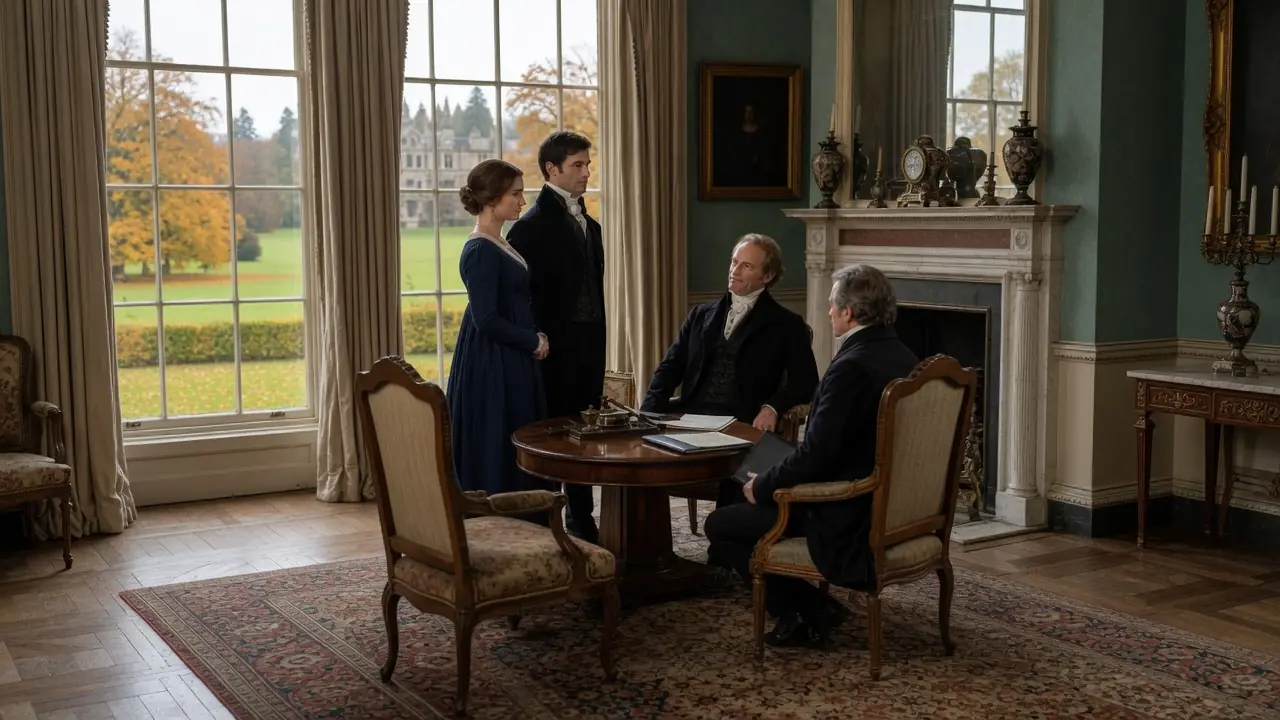
Miss Beatrice Linley stood at her bedroom window at Hartwell House and watched the carriages arrive one by one along the gravel drive. She had not slept. Not truly. Not in eleven days.
Her reflection in the dark glass confirmed it. The shadows beneath her eyes were the color of weak tea. Her chestnut hair, drawn back into a plain knot, looked duller than it ought. She wore black bombazine, plain at the cuffs, with a white linen collar and a simple jet pin at her throat.
Below, a lacquered carriage drew up at the steps. A footman in dark livery sprang down and opened the door. A gentleman descended. Beatrice did not recognize him.
He was tall, dark-haired, perhaps 30. Even at this distance, she could see that his coat was beautifully cut. He paused on the gravel and looked up at the house. Not grief, not exactly, Something more guarded than that.
Sir Reginald had been her godfather. He had been her father's oldest friend. When both her parents died within a year of one another, he brought her to Hartwell at 19 and never once spoke of her leaving. She had been his companion these ten years.
Sir Reginald had settled a respectable dowry on her and more than once encouraged her to think of her future beyond Hartwell. There had been offers, sensible men, respectable situations, the sort of marriages any prudent woman might have accepted with gratitude. Beatrice had refused them all. At first, because she did not wish to leave him.
Later, because she found she did not wish to exchange a life in which she was useful, trusted, and entirely herself for one in which she would be merely well placed. She had never yet met anyone for whom the exchange seemed worth making. She told herself it was affection for Sir Reginald that kept her. It was also, though she seldom admitted it, that Hartwell was the only place she had ever been certain of her place in the world.
Beatrice had made her peace with that long ago. The house was her home. The accounts were her work. Sir Reginald had been her family.
She had asked for no more. She had been content. "That will be Mr. Julian, miss," said Mrs. Davies behind her. Beatrice turned.
The housekeeper had entered without a sound and now held out a fresh handkerchief on a small silver tray. "The nephew, Sir Reginald's brother's boy," Mrs. Davies added. "I did not know he was coming," Beatrice said. "Mr. Pemberton wrote to him, miss, last week. As executor, he was bound to." Mrs. Davies hesitated.
"It has been a long while since he was here. Eleven years, near enough. He was a young man then, and Sir Reginald hardly above fifty." Beatrice took the handkerchief and tucked it into her sleeve. She wanted to ask why. She did not. "Mrs. Davies, where are we to put Mr. Mottram?" she asked.
"The blue chamber, miss. He brought no valet, only a portmanteau. He said he should not stay above two nights." Two nights. The funeral, the reading of the will, and then the nephew would be gone again. Back to whatever London life had kept him from his uncle's deathbed. To her surprise, she found she resented him for it.
Sir Reginald had asked for no one in his last days. He had only held her hand, patted it, called her his dear girl, and once near the end had said quite clearly, "You will be safe here, Beatrice. I have seen to it. Do not let them frighten you." She had thought he was wandering. She had not understood. When Mrs. Davies left the room, Beatrice pressed her palm against the cold glass.
Her breath clouded the pane. She drew herself upright, smoothed the front of her gown, and went down to bury the man who had stood in her father's place these ten years past. The funeral passed as such things pass. The vicar spoke of duty, of charity, of a life well used, of a master who had been generous to his tenants and faithful to his church.
Beatrice stood in the front pew with Mrs. Pelham, Sir Reginald's sister, just arrived from Bath, and behind them Mr. Hatch, the steward, a stout, gray-haired Yorkshireman who had managed the Hartwell lands for 30 years, and had wept at the churchyard gate that morning without troubling to hide it. Beatrice did not weep. She had wept herself dry in the eleven days before, wept for the man who had stood in her father's place and who had asked nothing of her in return. Across the aisle, Mr. Julian Mottram sat alone, very straight.
His gloved hands folded over the brim of his hat. Once, when the vicar paused, Beatrice glanced up. Julian was looking at her. Their eyes met.
For a moment, no more than two breaths, then he inclined his head. Not a bow, only an acknowledgement, and turned away. Beatrice felt her color rise. She was angry with herself for it.
She was eight and twenty, not a girl to be unsettled by a stranger's glance. And not today, not here. At the graveside, the vicar's voice carried thin across the frosted ground. Julian took a folded paper from his coat.
He dropped it into the grave atop the coffin. Beatrice saw it clearly. She stood directly opposite him. She did not know what it was.
A letter, perhaps, a note. Something he had not been able to send while his uncle lived and could not send now. It struck her more than she expected. She had assumed he was indifferent.
She had wanted him to be. Indifferent men did not bring folded papers to graves. They returned to the house in three carriages. Mrs. Pelham arranged matters so that she rode elsewhere.
Beatrice found herself in the second carriage with Mr. Hatch, the vicar's wife, and Mr. Julian Mottram. He handed her up with perfect correctness, perfect coolness. Once they were underway, he spoke.
"Miss Linley, I am Julian Mottram. I do not believe we have been introduced."
Beatrice met his gaze. "We have not, sir, though I have heard your name often enough," she said. A faint pause.
"I should be flattered then, were I not entirely certain what you have heard cannot have been complimentary."
Mr. Hatch coughed. The vicar's wife turned to the window. Beatrice met Julian's eyes squarely.
They were dark brown, almost black in this light. Ringed with very dark lashes, and tired in a way that was not entirely the morning's grief.
"Your uncle was a kind man. He did not speak ill of you."
A longer pause.
"That," Julian said quietly, "is more than I deserve."
He turned to the window.
They did not speak again. The will was read at 4:00 in the long drawing room. The mourners had gone. The house had fallen still.
Mr. Pemberton, the solicitor, sat behind the small writing table that had been brought in for the purpose, with his spectacles low on his nose and a leather portfolio open before him. Beatrice sat nearest the fire. Mrs. Pelham occupied the sofa, very upright. Julian stood by the window.
The light caught his face. A faint scar marked his temple. Mr. Hatch stood ready. Mrs. Davies had been called in and stood at the doorway with her hands folded over her apron.
Mr. Pemberton cleared his throat. The last will and testament of Sir Reginald Henry Mottram, Baronet, dated the 17th of June in the year of our Lord 1815, being made of his own free hand and witnessed by myself and by Dr. Arthur Linton of the village of Hartwell. He read the small bequests first. To Mrs. Davies, who had kept the house for 30 years, an annuity of 40 pounds a year for the remainder of her life, and the small cottage at the end of the lower drive.
20 pounds to each of the upper servants, 10 to each of the lower, a gold-headed cane to Mr. Hatch, a small portrait of Sir Reginald's mother to Mrs. Pelham. Mrs. Davies pressed her handkerchief to her mouth and did not weep aloud. Then Mr. Pemberton paused. He looked over the rim of his spectacles, first at Beatrice, then at Julian, and then at his page again.
As to the residue of my estate, he read, comprising Hartwell House and its grounds, the home farm, the three tenanted farms of Brindley Coles and Wickham, the woodland known as the long spinney, all furniture, plate, livestock, and the funds remaining in my account at Hoare & Company in Fleet Street, I leave the whole, jointly and indivisibly, to my goddaughter Miss Beatrice Linley and to my nephew Mr. Julian Mottram. The room seemed to tilt. Beatrice felt it. She set both hands on the arms of her chair.
Across the room, Julian went perfectly still. Mr. Pemberton continued. It is my express wish that neither of them shall sell, mortgage, lease, or take separate possession of any part of the estate without the written consent of the other. Further, it is my requirement that both shall reside at Hartwell House for the duration of the year, Miss Linley to keep the apartments she has occupied these ten years, Mr. Mottram to take the chambers in the East Wing, and that neither shall absent himself or herself from the house for more than fourteen consecutive days without the written consent of the other and of my executor.
They are to have the term of one full year, dating from the present reading, in which to come to such terms of agreement between themselves as they may judge fit. If, at the close of that year, no agreement has been signed and lodged with my solicitor, or if either party has failed to fulfill the residence required of them, the whole of the estate shall pass to my cousin once removed, Mr. Crispin Mottram of Lincoln's Inn. Mrs. Pelham gave a small, sharp sound that was not quite a laugh. There is one further condition.
Mr. Pemberton said, turning the page. My sister, Mrs. Honoria Pelham, is to take up residence at Hartwell House for the duration of the year in the capacity of companion to Miss Linley and chaperone to the household with an allowance of £200 drawn quarterly from the estate. Her presence in the house is a condition of the inheritance. Should she decline the office or be unable to fulfill it, the executors are instructed to appoint a respectable widow of suitable age in her stead.
Mrs. Pelham lifted her chin. I shall not decline. Silence followed. Mr. Pemberton lowered the page.
That is the substance of it. he said. There are clauses concerning the management of the estate during the year, the apportionment of expenses, and the duties of the steward, but those may wait. Have you any questions, Miss Linley?
Beatrice opened her mouth. She found that she had a great many questions, and not one of them in any order she could speak. I beg your pardon. Did you say jointly?
Mr. Pemberton. Julian had risen from his chair, and the easy drawing-room manner was gone. His voice was low and quite steady. Do I understand correctly that my uncle has bound Miss Linley and myself together in the matter of this house for the space of a year?
Mr. Pemberton paused and adjusted his spectacles. Mr. Mottram wrote from Lincoln's Inn upon receiving notice of Sir Reginald's death, expressing his regret that the courts of the Michaelmas term made his attendance today impossible. He sends his condolences to the family. From the sofa, Mrs. Pelham gave a small dry sound.
He sends his regrets. How very thoughtful of him. Quite so, ma'am. Julian drew a breath. He looked, for one unguarded moment, like a man who had just been struck.
Then his face smoothed again into its earlier easy lines, and he turned and gave Beatrice a bow as polished as any drawing-room in London could have asked for. Miss Linley, he said. it seems we are to be neighbors. It seems, Beatrice said, finding her voice at last.
We are to be rather more than that. And from the sofa, Mrs. Pelham permitted herself a small satisfied smile, which neither of them saw.
Chapter 2: Shared Halves
Beatrice came down to breakfast at 8:00, as she had done every morning of the last ten years, and found the breakfast room already occupied. Mrs. Pelham sat at the head of the table in a morning gown of black bombazine with long sleeves and a fine white lawn fichu folded at her throat, the day's paper opened before her. A cup of black coffee at her elbow, and her pug Pomfrey asleep on the rug at her feet. He was a fawn-colored creature of advanced opinions and short breath, who traveled everywhere his mistress did and slept wherever he pleased.
He had crossed from Bath in his own basket the previous afternoon, and had not yet forgiven any of them for the inconvenience. Julian was at the sideboard with his back to her, lifting the lid of the chafing dish, and peering inside with the air of a man inspecting evidence. He wore a black coat that fit him very well across the shoulders, black breeches, and tall boots that had been polished to a soft shine by someone, not himself, Beatrice thought, within the last hour. Good morning, Miss Linley.
He said, without turning. Mrs. Davies tells me there are kippers. I have not had a kipper for breakfast since I was 18 years old. Then you have been eating in the wrong houses, Mr. Mottram.
He turned, and she saw that he was smiling. It was a small, careful smile, the kind a man offers a stranger he is not yet sure of, but it reached his eyes. Possibly. He said.
Will you have one? I will have toast and tea, thank you. I do not eat fish before noon. A principle?
A preference. From behind the newspaper, Mrs. Pelham observed, without lowering it. A great many of Beatrice's preferences are principles, Julian. You will discover this in the course of the year.
Thank you, ma'am. I shall take notes. Do, my love. At his feet, Pomfrey exhaled audibly through his nose without troubling to open his eyes. Julian served himself a kipper and a spoonful of buttered eggs, and carried his plate to the table.
The morning room at Hartwell was a small square room with cream walls, a marble hearth, and a tall sash window that looked east over the kitchen garden. The table was laid for three with white linen, blue and white porcelain, a silver tea urn that had been polished to a mirror, and a small jug of cream beside a plate of fresh rolls. The fire in the grate had been lit early and was burning down to a steady glow. Beatrice took her usual chair, which faced the window, and began to pour her tea.
Julian sat opposite. Mrs. Pelham, between them, turned a page of her paper. For perhaps a minute, no one spoke. The clink of Julian's fork against the porcelain seemed very loud.
Miss Linley. Julian set down his fork. I think we ought to talk. Beatrice set down her cup.
I had supposed we should. It seems to me that we have been left in an awkward situation. Whatever my uncle intended by it, and I do not pretend to know, the practical fact is that we are not what either of us would have chosen for a year of close acquaintance. I have rooms in town and affairs that will not keep, and you, I imagine, have no great wish to rearrange your household around a stranger.
I should like, if you will allow it, to make you a proposal. A proposal? A simple one. The estate, by Mr. Pemberton's accounting, is worth something in the region of 24,000 pounds.
The Hoares' account holds rather more in cash than I had anticipated. I propose to take 6,000 pounds from the funds at Hoares', sign over to you my interest in everything else, house, lands, farms, woodland, all of it, and remove myself from your life by the end of the week. You should have the house clear. The year would be at an end before it had begun, and you and I should be free to forget each other's existence.
He spoke pleasantly, as though offering her a glass of wine. The newspaper very slowly came down. Julian, my love. ma'am. You will do no such thing.
I beg your pardon? You may beg it, my love, but you shall not have it. Reginald sat at this very table in August and told me what he had written into his will, and why. He had his reasons.
He had thought about them for the better part of a year. He had been a great deal less of a fool than either of you young people are about to be at this breakfast. Mrs. Pelham. Be quiet, Beatrice, my dear.
I am addressing your co-heir. She folded the paper down into her lap and turned the full force of her bright blue gaze upon Julian. At her feet, Pomfrey, sensing a change in the weather, lifted his small flat face from the rug and regarded Julian with the expression of a creature about to register a complaint. You came to this house yesterday morning in morning black, my love, and dropped a folded paper into your uncle's grave that I am quite sure you do not intend to discuss with any of us.
You came because in the end you could not stay away. You will not now sit at his breakfast table the morning after his burial and undo, for £6,000, the last act he made in this world. You will give Beatrice her year, and she will give you yours. And you will both of you do your uncle and your godfather the courtesy of finding out why he asked it.
After that, my loves, you may go to the devil or to London or to the four corners of the earth, just as you please, but you will give him his year first. There was a silence in the breakfast room. The fire shifted in the grate. Outside the window, somewhere very far away, a rook called.
Pomfrey breathed thoughtfully through his nose. Julian set down his coffee cup very carefully in its saucer. I had not realized, ma'am, that you had been listening so very particularly. You had not realized, my love, because I am a very accomplished chaperone.
Beatrice, across the table, found that she could not quite look at either of them. She had been ready to refuse Julian on her own behalf, had in fact framed the words in her mind already, and she had not had the chance. The moment had been taken out of her hands and been settled by a small gray-haired woman in a plain black shawl who was already returning placidly to her newspaper. Julian regarded his aunt for a long moment.
Then he turned back to Beatrice. Miss Linley, it seems my proposal is withdrawn. It seems so, Mr. Mottram. May I make another?
You may. It seems to me then that if we are to share this house for a year, which apparently we are, we should set down some terms for how we shall manage. Written terms between ourselves so that we may know what to expect of one another and not be forever guessing. She studied him a moment.
He met her gaze steadily. There was, she thought, something disarming in the directness of it. He had been refused on the larger matter and was settling himself with perfect grace to the smaller. Very well, Mr. Mottram.
Bring paper. From behind the newspaper, in a tone of perfect serenity, Mrs. Pelham said, An excellent notion, my loves. Do go on. I shall continue not to listen.
They moved to the small writing table beneath the window. Julian fetched a sheet of foolscap, a pen, and the inkstand from the library. Beatrice mended the pen herself for she had seen him reach for the knife and knew at once, from the way he held it, that he would ruin the nib. He noticed her noticing and surrendered the pen with a small wry bow that almost made her laugh.
You write, Miss Linley. I shall dictate. You shall not dictate. We shall agree.
Agreed. She wrote, in her clean decisive hand, at the top of the page, Memorandum of Terms between Miss Beatrice Linley and Mr. Julian Mottram. First, the breakfast room. We shall both use it.
I take breakfast at 8:00. You may take yours at any hour you choose. If we are both present, we are civil. What constitutes civil in your reckoning?
No quarrels before 9:00 in the morning. That seems generous. Write it down. She wrote it down.
Second, the library. I work there in the mornings on the household accounts and the letters of condolence which are still arriving. I should be obliged if you would not use the library between 10:00 and 1:00. After 1:00, it is yours.
I should like to use it in the evenings, as well. You may. We shall share it after dinner, provided that whoever sits there does not feel obliged to make conversation with the other. I read in the evenings.
I should like to continue to read in the evenings. My aunt will be disappointed. She seems to me a woman who likes a sociable evening. Mrs. Pelham is not to this memorandum.
From the head of the table, Mrs. Pelham observed mildly, Mrs. Pelham is the only reliable witness to it, however. Do go on. He smiled at that, a real smile, brief and warm, and Beatrice found she had to look down at the paper rather quickly. She wrote the clause out neatly, and underlined the word read.
They went on. They wrote down that the household expenses would be drawn from the estate as before, with Mr. Hatch, the steward, keeping the accounts and rendering them once a fortnight to both of them jointly. They wrote down that neither would invite a house guest without the other's knowledge. They wrote down that any letter received from Mr. Pemberton or from Mr. Crispin Mottram would be opened in the presence of the other.
They wrote down, at Julian's suggestion, that should either of them wish at any time to walk in the gardens alone, the other would not follow. Beatrice paused at that one, the pen still in her hand. That is a curious clause to ask for, Mr. Mottram. Is it?
It suggests you expect to want to walk alone. I expect that we are both going to want to walk alone, Miss Linley. This is going to be a long year. She looked at him then, properly, for what felt like the first time.
The morning light was full on his face, and she could see what she had not seen in the carriage or in the drawing room at the reading, that he was tired in a way that went deeper than a single hard journey, and that he was, in this moment entirely sincere. She bent her head and wrote the clause down. They were on the 11th clause and the morning light had shifted from gold to a clearer pale white when Mrs. Pelham folded the newspaper at last, set it aside, and rose from her chair with the assistance of her cane. I shall leave you to it.
I am required upstairs to consult with Wilkins about the trunks. Beatrice, my dear, do not let him persuade you of anything ridiculous before luncheon. Julian, my love, if you mean to make yourself agreeable in this house, you will begin by having those boots properly blacked. They are a disgrace.
They were polished this morning, ma'am. They were polished by a man who was either drunk or sentimental. It is impossible to tell which. Pomfrey rose from the rug, stretched himself once, and trotted after her with the small grave air of a creature who had also formed an opinion of Julian's boots and saw no reason to keep it to himself. At the threshold, Mrs. Pelham paused and looked back at the two of them.
The table, the foolscap, the half-drunk tea, with the smallest of satisfied smiles. Neither of them was looking. She went upstairs.
Chapter 3: Muddy Boots
By the first week of November, the rains had come and Hartwell House had settled into the strange new shape of its winter household. Mrs. Pelham occupied the rose chamber and the south side of the breakfast table. Julian had been given the chambers in the east wing, which faced the lower lawn and the long spinney beyond. Beatrice kept her own apartments at the far end of the corridor, as she had done these ten years, and went down to the library each morning at 10:00 with the steward's books under her arm.
The servants had stopped exchanging glances over their work. Beatrice had eaten almost nothing in the final days of Sir Reginald's illness or the days that followed, and Mrs. Davies had been sending her small persistent trays of beef tea and buttered toast, and would not be discouraged. It was Wednesday, and Wednesday was the day Mr. Hatch came to the library to render his accounts. Beatrice was already at the desk when Julian came in in a black riding coat.
He paused at the door. Am I early? You are punctual. Mr. Hatch will be a quarter of an hour yet.
He is never punctual on Wednesdays. Why Wednesdays in particular? Because on Wednesdays he stops at the home farm to hear how the cows have been doing, and the cows always have a great deal to say. Julian almost laughed.
He came into the room and went to stand by the fire. I take it the cows have allies. The cows have a great deal of influence in this house. I should warn you of it now rather than later.
He sat in the chair opposite the desk and watched her for a moment without speaking. The fire cracked. Outside, the rain had thinned to a fine drift of mist, and the light through the tall window was the color of milk and water. Miss Linley, I have been reading the steward's reports of the last quarter, and I should like to come with you and Mr. Hatch this morning to the tenant farms.
Beatrice looked up. When did you last ride to a tenant farm, Mr. Mottram? Never. I was raised in Berkshire and rode about my father's land as a boy, but I have not been a country gentleman in 15 years.
It will be muddy. I had assumed it would be. She studied him. He was, she noticed, in earnest.
The careful drawing-room manner was almost gone, and what stood in its place was a man who had read the reports and had questions about them, and who wished to see the farms with his own eyes before he formed an opinion. Very well. But I warn you, Mr. Hatch will speak only when spoken to and very seldom even then. He does not like new arrivals.
I shall consider myself warned. And the road to Brindley is very poor. Miss Linley, if you mean to discourage me, you are doing it badly. I am not trying to discourage you.
I am trying to be plain. They are not the same thing. Something in his face softened, and she found she had to look down at the ledger rather quickly. They rode out at 11:00, the three of them, with Mr. Hatch on his stout gray cob in the lead, and Beatrice and Julian behind on a chestnut mare and a tall bay gelding that had been Sir Reginald's favorite.
Beatrice rode side-saddle in a habit of black wool that the village seamstress had made up for her in the weeks after Sir Reginald's death. The horses knew the road. The rain had stopped for the moment, and the hedgerows along the lane were turning gold and russet against a sky of pale cloud. Mr. Hatch said nothing for the first half mile.
He was a man of few words by temperament and of fewer still in the company of a stranger. It was Julian who spoke first. I read in the last report that a cut had been made along the western edge. Mr. Hatch glanced sideways at him.
It has. And has it answered? It has, sir. The field were underwater in March of last year.
It bore wheat this autumn. Was it your suggestion or Sir Reginald's? Sir Reginald's, sir. He had been reading a pamphlet.
He read a great many pamphlets toward the end. What pamphlet do you recall? Some Scotch gentleman, sir, on the subject of land improvement. The name is gone from me.
James Anderson, perhaps? Or Sir John Sinclair? It may have been, sir. I did not read it myself.
Sir Reginald told me what was in it. And was that generally his method? It was, sir. He read, and I had it dug.
Julian laughed once. And Mr. Hatch's mouth, beneath his weathered gray side whiskers, twitched the smallest possible amount. Beatrice, riding behind them, watched this exchange with a feeling she could not quite identify. She had braced herself before they set out for Julian to be insufferable in any one of several specific ways.
To patronize Mr. Hatch, to ask foolish questions, to make some London joke at the expense of the country, or, worst of all, to be too charming and to win the steward over by manner alone. He had done none of these things. He had asked an intelligent question, helped Mr. Hatch where the steward's memory had failed him, and had not pressed when there was no more to be had. Mr. Hatch had registered this.
Mr. Hatch missed nothing. They turned in at the gate of Cole's Farm. Mrs. Cole, the farmer's wife, was at the kitchen door with a basket of eggs over her arm and a child on her hip. And she came out at once into the yard with the bright, pleased expression of a woman who has had no visitors of any consequence for a fortnight.
Miss Linley, my dear, and Mr. Hatch, and She paused and looked at Julian. You will be Mr. Mottram, sir, the new master. Mr. Mottram, yes. Julian gave her a courteous nod.
I should not, however, presume to call myself the new master. The old one is too lately gone. Mrs. Cole, who was a woman of strong opinions, considered this. Well said, sir.
Will you and your husband take a cup of tea, Miss Linley? It is no trouble. The kettle is on the hob, and I have a seed cake within. You always have a slice of the seed cake when you come.
Mrs. Cole "Mr. Mottram is not my—" "And my husband, sir, is in the upper field." Mrs. Cole continued, turning to Julian with all the force of a woman who had already settled the matter in her own mind. I shall send the boy for him. Mr. Cole will wish to pay his respects. Mrs. Cole Beatrice tried again.
It is no trouble at all, my dear. You and Mr. Mottram must come in out of the cold, and Mr. Hatch may sit in the chair by the door if he prefers, as he always does. There was a pause, perhaps two heartbeats long. Beatrice felt her color rise.
Julian, beside her, did not move at once. Mr. Hatch cleared his throat. Mr. Mottram is not Miss Linley's husband, Mrs. Cole. He is the new joint owner of Hartwell with Miss Linley, by the late master's will.
Mrs. Cole regarded the three of them in turn. Oh, I see. I beg your pardon, sir. Miss.
She wiped her hands once on her apron, which seemed to be her method of resetting the conversation. Well, you'll still have a cup of tea, won't you? The kettle is on the hob. Most welcome, Mrs. Cole.
Thank you. Julian said. It was very nearly 4:00 by the time they turned for home. Mr. Hatch had ridden ahead to call at the lodge on a separate matter, leaving Beatrice and Julian to make the last mile of the road alone.
The sky had clouded again. The lane was deep in mud where the cart tracks crossed, and Julian's tall black boots, which had been blacked that morning, were now uniformly the color of wet earth to the knee. He looked down at them, considered them bravely, and said, I shall have to compose myself for an interview with my aunt. Mrs. Pelham will not mind.
Mrs. Pelham will mind a great deal. Mrs. Pelham has views on the subject of boots. She will mind less than my coming home in a temper. Julian turned his head to look at her.
Are you in a temper, Miss Linley? I am attempting not to be. The seed cake? It was very good seed cake.
It was excellent seed cake. Julian rode on for a few paces in silence. The mare picked a way around a deep rut. A robin sang once from the hedge and was answered, faintly, from somewhere across the field.
You are quiet, Miss Linley. I am thinking. The countryside will form a great many wrong impressions before this year is out, Mr. Mottram. Mrs. Cole was the first of 50 and not all of them will be put right by Mr. Hatch.
Then we shall have to put them right ourselves. Yes, we shall. It was a small piece of agreement, the first they had reached without paper between them, and it sat for a moment in the cold afternoon air before either of them moved on. That is a remarkably sensible view, Miss Linley.
I am occasionally sensible. You are continuously sensible. It is one of the more alarming things about you. She did look at him then.
The gray afternoon light was on his face and his expression, the dark brown eyes, almost black in his dim hour, faintly tired, faintly amused, held no edge of mockery whatever. He had meant the thing as a compliment. He had not even, she thought, quite known that he was paying one. They rode the last quarter mile in companionable silence.
They left the horses with the groom in the stable yard and walked round to the side entrance of the house. The light was gone from the lower lawn and the first lamps had been lit in the back hall. Julian sat down on the bench by the boot jack and began to wrestle with his right boot. The boy, who appeared from the kitchen passage as if summoned by an instinct for muddy gentleman, knelt to assist.
Mrs. Pelham came through from the small drawing room with Pomfrey at her heels. Julian, my love, your boots. My boots, ma'am, are entirely Mr. Hatch's fault. I am quite certain they are not.
Then they are entirely the fault of the lower lane to Brindley. The lower lane to Brindley has been in that condition for 40 years. It is your boots that are new. Pomfrey, who had taken a position at a safe distance from the muddy boots, gave a small disapproving exhalation through his nose.
Beatrice, who had paused in the back hall to unpin her hat, allowed herself the smallest possible smile where no one could see it.
Chapter 4: The Assembly
The first snow of the year came on the 18th of November in fine dry flakes that settled along the gravel drive and on the iron gates and on the bare branches of the long spinney, and Hartwell House woke to a transformed landscape it had not been expecting for another fortnight at least. Beatrice sat at her dressing table that evening while Annie, the upper housemaid who had been borrowed for an hour, dressed her hair with more care than ornament, smoothing it back from her brow, coaxing the shorter curls at her temples into order, and gathering the rest into a low knot secured with a single small jet pin that had been Beatrice's mother's. The candles on the dressing table burned steadily. The fire in the grate had been built up against the cold.
Through the window, the snow that had fallen since morning lay smooth and pale across the kitchen garden, blue in the dusk. The gown laid across the bed was of black bombazine, a touch finer than the everyday morning gowns she had been wearing for five weeks, with a modest white linen collar and white linen cuffs and no other ornament. Mrs. Pelham had seen to it in late October after quietly observing that Beatrice would be expected at the village assembly in November and would need something better than her morning blacks to wear to it. Beatrice had not been certain she would attend.
She had said so quietly on three separate occasions in the last fortnight. Mrs. Pelham had not argued. She had simply continued making arrangements as though the matter was settled and now with Annie pinning the last of the chestnut hair into place, the matter was indeed settled because the carriage had been ordered and Mrs. Pelham was already in the small drawing room in her own black silk and there was nothing left to do but go. Beatrice looked at her reflection in the small oval mirror.
The shadows under her eyes were lighter than they had been five weeks ago. The black bombazine caught the candlelight in the dull light absorbing way black bombazine was supposed to and the small jet pin glinted faintly in her hair. She was not, she thought, beautiful tonight. She was not meant to be.
She was meant to be a young woman in mourning making a quiet first appearance at the village's winter assembly and she would conduct herself accordingly. A knock came at the door. Beatrice, my dear. Mrs. Pelham's voice from the corridor.
May I come in? Please. Mrs. Pelham came in with Pomfrey at her heels. She wore a gown of black silk with long sleeves and a fine white lawn fichu folded at her throat.
A black velvet ribbon at her neck with a small jet brooch and her plain black shawl across her shoulders. She brought no jewels, no ribbons, no anxious little improvements. She only stood for a moment in the candlelight, looked Beatrice over, and smiled as if nothing more were required. You look very well, my dear.
Quiet, becoming, and perfectly appropriate. Thank you, Mrs. Pelham. Julian is downstairs. He is, as men generally are at the prospect of a country assembly, suffering quietly.
We shall put him out of his misery in 5 minutes. Pomfrey will stay with Walter, who has been deputed to mind him in my absence, and who takes the duty more seriously than is strictly required. Yes, ma'am. Mrs. Pelham rested her hand briefly on Beatrice's shoulder. You will not be expected to dance, my dear.
You may be expected to be looked at, but not to dance. We shall sit together and observe the proceedings and accept condolences from the magistrate. That is all that is required of us. Yes.
And we shall come away early if you wish it. Yes, thank you. Mrs. Pelham nodded once, called Pomfrey to her side, and went out. Beatrice sat for a moment longer in the candlelight, her hands folded in her lap.
She had been Sir Reginald's companion for ten years and his nurse in the last weeks of his illness, and now she was a young woman in mourning. The category had its small consolations. One of them, she discovered, was the freedom to be looked at without being looked for. She rose, smoothed the front of her gown, and went down.
The Crown was the only inn in Hartwell of any size, and the upper room at the Crown was the room in which the village had held its assemblies for as long as anyone could remember. It was a long, low-ceilinged room with whitewashed walls, wooden beams, four good candles in each of its eight sconces, and a small platform at one end where three musicians from the village, a fiddle, a flute, and a cello, were tuning when the Hartwell party arrived. They came in together. Beatrice in her black bombazine and plain black shawl, Julian in a black coat over a black silk waistcoat.
And Mrs. Pelham, who carried her ebony cane and accepted the courtesy of the innkeeper's wife with gracious indifference. Beatrice felt the eyes of the room turn as they came in. It was, she discovered, exactly as bad as she had feared and not at all in the way she had expected. She had expected to feel exposed.
Instead, she felt observed in a way that was almost impersonal. The village had been waiting five weeks to see Miss Linley return to society, and tonight it was seeing her, and it was seeing her with Mr. Mottram, which was a separate piece of news the village had been gathering for a fortnight and was now able to assess for itself. The whispering at the edges of the room was not unkind, but it was a busy whispering, the kind of whispering that adjusts its conclusions in light of what is being currently observed. Mrs. Cole, whose seed cake had launched the matter into the village in early November, was at the side table with her husband, and she was looking at Julian and Beatrice with the particular attention of a woman who had been telling everyone they would be married by Christmas and was now considering whether she had been right.
Julian conducted them both to the fireside. Mrs. Pelham took the corner chair, accepted a glass of negus, and looked immediately in command of the room. Beatrice settled beside her, and Julian remained standing behind them for a moment to survey the assembly. Well, he said quietly, I had better make myself useful.
You had better dance, Mrs. Pelham said without lowering her voice, "You may safely consider it your patriotic duty. There are at least three young women in this room who have come specifically to be asked, and your refusing to oblige them would be ungentlemanly." "I had not intended to refuse them, ma'am." "Then go and oblige them, my love." He went. Beatrice watched as he was introduced to Miss Carstairs from Pluckley, a small and very pretty girl of 19 with dark ringlets, and led her out into the first country dance. He danced well, as she had expected he would. A man who had spent 15 years at London assemblies could scarcely do otherwise, yet there was nothing careless or festive in his manner.
He moved through the figures soberly, as one paying a debt to the room rather than seeking amusement in it. He gave Miss Carstairs his entire attention while they danced, complimented her at the end of it with the practiced grace of a man who had complimented a great many girls, led her back to her mother, and went immediately to ask the curate's daughter, who was a year younger, rather plainer, and scarlet at the prospect of being asked. Beatrice, sitting beside Mrs. Pelham at the fire, watched all of this with a feeling she could not quite identify. It was not jealousy.
She had no claim on him to be jealous of. It was something stranger, a kind of small steady ache that she did not know how to name, and that grew a little with each girl he led out. She drank her negus. Mrs. Pelham talked to the magistrate's wife.
The musicians played a second country dance and a third. Mr. Hatch, in his Sunday coat, stood beside Mrs. Hatch at the far end of the room. He caught Beatrice's eye and inclined his head. The gesture was small, dignified, and she thought worth every other welcome in the building.
She knew almost every face in the room, and almost every face knew her. That was not the same thing as having a friend among them. At the end of the third dance, there was the usual long pause while the room drifted to the long table at the side for cold ham, raised pies, syllabubs in little glasses, and ratafia. And Julian came back across the room to his aunt's chair.
Ma'am, Miss Linley. Julian. Said Mrs. Pelham. I trust you have been thoroughly useful.
I believe I have done my duty, ma'am. Then you may sit down and recover. He did not sit down. He stood instead in front of Beatrice's chair. And his expression was careful.
And his dark brown eyes were entirely level on hers. Miss Linley, will you stand up with me? The room around them did not stop. The talk and the laughter and the clink of China went on.
But Beatrice, in the chair by the fire, felt the small precise quality of the moment, as if a clock had struck somewhere inside her ribs. Mr. Mottram, you know I cannot. I do. Then why ask?
Because I should like the room to know that I asked. And I should like you to know it. That is all. She looked at him for a long moment.
Beside her, Mrs. Pelham had gone very still. Thank you, Mr. Mottram. She said. And her voice was steadier than she had expected.
I cannot stand up with you tonight, but I should be honored to do so when I may. Then I shall ask you again. Please do. He bowed very slightly and went away to fetch his aunt a glass of lemonade.
Beatrice sat for a moment with her hands folded in her lap. Her face composed, and the small steady ache inside her larger than it had been before. She did not look across the room at Julian Mottram once for the rest of the evening. She did not need to.
The room had heard him ask. So had she. It was past 10:00 when the carriage was called, earlier than was strictly fashionable, but precisely as late as Mrs. Pelham had judged correct for a household in mourning. The snow had begun to fall again in small soft flakes that caught the lantern light at the inn door.
Mrs. Pelham, who had drunk two glasses of Negus and was in excellent humor, was helped up into the carriage first. Julian handed Beatrice up next, then climbed in after her and drew the door closed. The horses moved off into the dark. For a long while no one spoke.
The lantern at the carriage corner cast a small swaying patch of warm light across the seats, and beyond the window, the snow fell white and soundless across the lane. "Well," Mrs. Pelham said at last, "that was satisfactory." "Very satisfactory, ma'am." "The Carstairs girl is a goose, Julian, and I will not have her coming to the house under any pretext whatever." "I had no intention of inviting her to the house, ma'am." "Good. I am going to sleep. Do not wake me until we are home." She closed her eyes and tilted her head against the cushion and was, in some surprisingly short space of time, asleep. Beatrice sat very still on the opposite seat and watched the snow falling past the window. Julian, beside his sleeping aunt, watched her watching it.
The lantern light was on her face. A few short curls had escaped at Beatrice's temples, softened by the heat of the assembly room and the long carriage ride home. The small jet ornament still glinted at the back of her hair, as neat and somber as when Annie had placed it there. Her black shawl had slipped a little from one shoulder, revealing the severe black bombazine beneath, white only at the collar and cuffs.
What little light there was in the carriage caught on those small pale edges and held close about her. She had not expected to be looked at tonight, he knew. She had been wrong about that. The room had looked at her first because she was Miss Linley, newly in mourning and newly altered in consequence.
But it had gone on looking because she was beautiful. He had seen more than one gentleman glance toward the chair by the fire between dances. And more than one mother notice where her son's eyes had gone. Beatrice had sat through it all with her hands folded in her lap, her face composed, and her dignity unbroken.
And Julian, in the middle of dancing with the curate's daughter, had found himself thinking that he had never seen a woman more quietly beautiful in his life. He did not think she had any idea. Miss Linley, he said quietly after a long while. May I say something while my aunt is not listening that I should not say if she were?
You may. You looked very beautiful tonight. She turned her head to look at him. The lantern light was on his face.
He had not said it lightly, and he did not look away from her. Thank you, Mr. Mottram. I have no expectation that you should reply to it. I only wanted you to know that I had thought it.
I have. She stopped. The words she had been preparing to say were not the right words. I have never been told that.
Julian did not reply. The carriage went on through the snow. Mrs. Pelham slept. The lantern swung.
After a moment, Beatrice turned her head to look out of the window because she did not yet know what her face would say if she did not. And Julian, beside his sleeping aunt, watched her watching the snow and did not say anything else for the rest of the journey. She went up to her room and sat for a long time at the dressing table without taking the small jet pin from her hair.
Chapter 5: Forgery
The letter came in the morning post on the 17th of December, bundled with three letters of condolence from distant cousins, an account from the village smith, and a printed sheet from Mr. Pemberton in London regarding the year's tithes. Beatrice was at the library desk, as she was every morning, when Mrs. Davies brought in the post. She thanked Mrs. Davies, slit the seal of the smith's account with her usual paper knife, and worked through the bundle in her usual order. Bills first, then the official correspondence, then the personal letters.
The personal letters that morning numbered four. Three were addressed to Beatrice in hand she recognized. Distant relations on the Linley side who had taken eight weeks to remember that sympathy was expected of them. The fourth was addressed in a hand she did not know, on cream laid paper of considerable quality, and it was addressed not to Beatrice, but to Mr. Julian Mottram, Esquire, Hartwell House, near Hartwell, Kent.
Beatrice held it for a moment in her hand. The clause they had written into the memorandum in October was perfectly clear. Any letter received from Mr. Pemberton or from Mr. Crispin Mottram would be opened in the presence of the other. This was not such a letter.
It was an ordinary piece of personal correspondence addressed to Julian, and the proper course was to hand it to him at luncheon, unopened, with the rest of his post. Yet the seal on the back was not a seal of business. It was a small impression of a flower, a rose, perhaps, or a poppy, pressed into red wax with a careful hand. The kind of seal a young woman of fashion might use.
Beatrice set the letter aside on the corner of the desk and went on with the rest of the post. It was 20 minutes before she picked it up again. By that time, the temptation had assembled itself in her mind with quiet inevitability. She did not, she told herself, intend to open it.
She intended only to look at the address again, to confirm that she had not been mistaken. She picked it up. She turned it over. She studied the seal more closely.
The seal had not been pressed quite cleanly. A small thin line ran along the edge of the wax where the paper had been folded too soon, and where, she realized after a moment, the wax had broken and been pressed back. The letter had been opened, whether by accident or by design, it had been opened, and the seal had been imperfectly restored, in which case, she thought, with a clarity that surprised her, the letter had already been read by someone and was no longer strictly private. She broke the seal the rest of the way and unfolded the page.
It was very short. The hand was a young woman's hand, well taught, sloping forward with the small confident loops of a girl who had been to a good London school. The paper smelled faintly of attar of roses. Albermarle Street, Wednesday.
My dear Julian, I cannot tell you how grateful I am for the bracelet. You were wrong to send it, of course, and I was wrong to accept it, but I have never been wise where you are concerned. James tells me you are still buried in Kent among wills and relations, and I confess I had hoped you would be back in town before now. The rooms are dull without you, and I begin to think you have quite forgotten how much I dislike being neglected.
Come back to us by the new year, or if you cannot, write. I am not so proud as to pretend I do not wait for it. Yours as ever, Caroline. Beatrice read the letter through twice.
The second time she read it more slowly, with her fingers flat on the desk and her breathing very even. And she found that she remembered every line of it without needing to look. She folded the page carefully along its original creases, replaced it in its envelope, and laid the envelope inside the small lap desk that had been her mother's, which she kept on a shelf above the writing table. She closed the lap desk.
She turned the small brass key in its lock, and put the key in the pocket of her morning gown. She returned to the steward's books. Mr. Hatch came in at 10:00 as he always did on Wednesdays. They went over the accounts.
Beatrice's hand remained perfectly steady on the page. Her voice, when she had reason to use it, did not shake. Mr. Hatch did not look at her any more carefully than he ever did, which was in itself the small measure she required, because Mr. Hatch missed nothing. And if he had seen something in her face, he would have given her some small indication of having seen it.
He gave her none. So, her face, she concluded, was holding. She would think about the letter later. She would not think about it now.
The kitchen at Hartwell was in the throes of Christmas. Cook stood at the long deal table with her sleeves rolled to the elbow, guiding the kitchen maid through the second mixing of the Christmas cake while Mrs. Davies presided nearby with the dinner list in one hand and the expression of a woman upon whom the order of the kingdom presently depended. The air was rich with citron peel, almonds, currants, brown sugar, and brandy. Beyond the cake bowl lay a goose, a brace of pheasant, a cone of loaf sugar, and bowls of lemons, cream, spice, and sugared peel waiting their turn.
Beatrice came in at 3:00 as she had said she would to write the dinner cards for Christmas Day. There would be 12 at table, the household, the vicar and his wife, the magistrate, the curate, and two elderly Mottram cousins who had written to invite themselves. Beatrice sat at the small writing desk in the corner and wrote each card in her clear, decisive hand with very small letters and considerable care. And when she had finished writing the first card, she had to set down the pen and press her hand flat to the surface of the desk for a moment before she could continue.
When she looked up, one of the maids was watching her from beside the dresser. Miss Linley? I am quite well, thank you. The cards are not urgent, miss.
I know. I shall finish them. She finished them. She wrote the menu on a separate sheet for Mrs. Davies' reference.
She accepted when it was offered a small piece of candied citron from the dish, but did not eat it. Instead, she closed her fingers around it, letting the hard sugared edge press into her palm until she had something specific and bright to think of besides the letter locked in her lap desk. She went out of the kitchen at 3:30 and passed Julian in the corridor on his way back from a ride with Mr. Hatch. She gave him the same small civil nod she had given him every afternoon for 2 months.
He returned it. Neither of them stopped. Neither of them spoke. Beatrice walked on toward the small drawing room, her hands folded loosely at her waist, and thought she had never in her life held her face so carefully.
Mrs. Pelham was seated within, Pomfrey on the rug, and a black-edged handkerchief half hemmed in her lap. She looked up when Beatrice came in, and her eyes followed Beatrice across the room to the chair opposite. For several moments, she said nothing. At last, she said, "What has happened, my dear?" "Nothing has happened, Mrs. Pelham." "Beatrice." "I am quite well." "You are not quite well. You came from the kitchen with a face I have not seen on you since the morning of the funeral, and I should very much like to know what has put it there." Beatrice looked at her hands in her lap.
She thought about the letter, and the broken seal, and the young woman's hand, and the smell of attar of roses on the paper. She thought about the clause in the memorandum that said any letter from Mr. Pemberton or Mr. Crispin Mottram would be opened in the presence of the other, and how the letter she had opened was not from either of them, and was therefore, by the strict terms of the memorandum, none of her business. "It is a private matter, Mrs. Pelham." "My dear." "Forgive me. I cannot speak of it." Mrs. Pelham looked at her for a long moment. Then she folded the handkerchief in her lap, set it aside, and reached across the space between them to take Beatrice's hand briefly in her own.
Her hand was small, dry, and strong. "Whenever you can speak of it, my dear, I shall listen." "Thank you." "And until you can, I shall expect you to keep your countenance. Reginald did not teach me to think you were a young woman who could be overturned by a single bad afternoon. Do you understand me? Yes. Good. She released Beatrice's hand and picked up the handkerchief again. Pomfrey, who had noticed the small disturbance in the room without troubling to open his eyes, sighed once and went back to sleep. It was nearly 9:00 when Julian found her in the library. She had told herself all afternoon that she would not stay there in the evening. She had told herself she would take her book up to her own room where he could not seek her out. And that the conversation she did not yet know how to begin would wait until tomorrow or the day after or until she had decided what to do with the letter in her lap desk. She had been in the library since 7:00. The book in her lap was open to the same page it had been open to for an hour and a quarter. He came in without speaking, closed the door behind him with great care, and stood for a moment with his back to it. Miss Linley. Mr. Mottram. I should like to understand what has happened. He came forward into the candlelight. His voice was not raised, but it had lost the easy civility of the breakfast room. I have spent 6 hours observing you not speak to me. I have respected the quiet, but I cannot respect it any longer without knowing what I have done. I should like, if you will permit me, to be told. She closed the book. She rose from the chair, went to the writing table, took the small brass key from the pocket of her gown, and unlocked the lap desk. She took out the letter, returned to her chair, and held it out to him without a word. He took it. He looked at the address. He looked at the broken seal. He looked at her briefly, and she could not read his face in the candlelight. He unfolded the page. She watched him read it. She watched the color leave his face by degrees as though it were being drawn out of him by some small invisible mechanism. He read it once, very fast. And then a second time, very slowly. His hand, which had been steady when he took the letter, began to tremble at the edge of the page. And he set it down on the small table beside his chair to keep it still. He looked down again at the signature. Caroline Welby. I knew her once. I will not insult you by pretending otherwise. But I have not seen her in more than a year. I have not written to her. I did not send her a bracelet. I did not know she was in Albemarle Street. I have had no letter from her in more than a year. And I am not yet prepared to believe this one is from her. I see. Do you? I do not know what I see, Mr. Mottram. He looked at her then, truly looked at her for the first time. There was something in his face she had not seen before. And something she was not, in that moment, equal to. It was not anger. It was hurt. Bare and unprotected. And she found she could not meet it for long. He stood. I shall leave you to decide what you believe. Good night, Miss Linley. Mr. Mottram. Good night. He left the room. She sat for a long time in the candlelight. The letter on the small table beside her chair, and the book closed in her lap. She did not know whom to believe. Worse, she did not know which possibility frightened her more. But he was lying to her. Or that he was not.
Chapter 6: The Confession
The blizzard came on the 8th of January in great soft soundless flakes that began at 3:00 in the afternoon and continued without pause until past midnight. By dawn on the 9th, the gravel drive was lost beneath a foot and a half of snow. The iron gates were no longer visible from the front steps and the lower lane to the village had drifted to the height of the hedges. Mr. Hatch had come up from the steward's house at first light to see how matters stood, reaching the main house by the kitchen path, which cook's husband had cleared before breakfast.
By half past 8:00 he had reported that the road to the village was impassable and likely to remain so for at least three days and probably longer. The household received the news with the calm of an English country house that had been confined by weather many times before. Mrs. Davies sent word to the kitchen that the larder would be stretched but not strained. Cook produced an inventory of the smoked goose, the pickled walnuts, the preserves, and the cellar and pronounced herself satisfied that no one would go hungry before Lady Day.
Mr. Hatch, having delivered his report, withdrew to the small estate office off the back hall and the accounts that had been waiting for him since 12th night. Mrs. Pelham, who had been snowbound at Hartwell more than once in her girlhood and remembered those occasions as among the more agreeable of her life, took possession of the small drawing room with a fresh length of black-edged cambric, her work basket, and Pomfrey. Beatrice spent the morning in the library over the household books. Julian spent it nowhere she could see.
He had been avoiding her for three weeks now since the night of the letter. Civil at meals, brief in the corridors, present only as required by the household's daily texture. The snow had not changed the pattern. If anything, it had made his avoidance more visible because there was now no possibility of his riding out and being absent for half a day.
They met at dinner. Cook had produced, against the limitations of the larder, a quiet and beautiful meal. A dish of pike with caper sauce, buttered parsnips and braised cabbage, and a pear tart with cream. Mrs. Pelham took her place at the head of the table and ate with appetite.
Beatrice and Julian sat opposite each other and ate as much as civility required. There was conversation about the snow, about the household, about the small piece of news that had reached Mrs. Pelham by the last post before the roads closed. But Mrs. Pelham carried the conversation almost alone, while Beatrice and Julian supplied only the brief, courteous replies civility demanded. When the cloth had been drawn and the tea brought in, Mrs. Pelham looked at the two of them and at her tea, and at the snow falling soundlessly past the dining room window.
"My loves," she said quietly, "I am going up to bed early tonight. I have a slight headache, and Pomfrey has been restless, and the snow has made the house cold. I shall take my tea in my room." "Of course, ma'am," Julian said. "Good night, my dears. Do not stay up too late." She rose, called Pomfrey to her side, and went out. Beatrice and Julian sat at opposite ends of the long dining table for perhaps half a minute after she had gone. Then Beatrice rose, said her own quiet good night, and went up to her room.
Mrs. Pelham did not, in fact, have a headache. Her duties as chaperone, like everything else about her, had its own inscrutable rhythms, and she had decided several days earlier that whatever lay between Beatrice and Julian had been allowed to remain unspoken quite long enough. It was past midnight when Beatrice gave up on sleep. She had read for an hour.
She had let the candle burn down. She had lain in the dark for a further 40 minutes listening to the wind under the eaves and the soft small sounds of an old house in deep cold. She thought finally that she would go down to the library and find another book. Something heavier.
Something that would give her mind no room to wander and that she would carry it back up to bed and read until exhaustion took her. She put on her woolen wrapper and her slippers, took up the candle in its small brass holder, and went down the corridor to the family stairs. The library door was ajar. Light fell in a narrow band across the dark floorboards of the corridor outside it.
Beatrice paused. She stood in the corridor for what she later recognized as the longest 15 seconds of that winter. She could turn back to her room. She could find another book in the small drawing room.
She could pretend she had not seen the light. Any of these would have been sensible, but Beatrice had decided three weeks ago that this conversation could wait. And three weeks, it seemed, was all the waiting she could bear. She pushed the door the rest of the way open and went in.
Julian was at the writing table by the window. A single candle burning at his elbow. A sheet of paper lay before him half covered in his neat hand. Beside it stood an inkstand and a penknife.
He had been writing. He looked up. He did not rise at once. Miss Linley.
I came down for a book. I did not know you would be here. I have been here since 11. I find I cannot sleep either.
She stood in the doorway with the candle still in her hand and her wrapper drawn close at the throat. He stood up. Will you sit down, Miss Linley? His voice was quieter than she had heard it in three weeks.
I should like, if you will permit me, to tell you the truth. She did not move at once. She thought of going back to her room, of saying courteously that the hour was late, and the conversation should wait until morning. But she had already let this silence stand for three weeks, and she found she could not carry it back upstairs with her.
She closed the door behind her, set her candle beside his on the writing table, and took the chair opposite him. Yes. He sat down. He looked at the page in front of him for a moment, then folded it carefully along the center and set it aside.
I quarreled with my uncle eleven years ago. I have never told the full story to anyone, and you may not wish to hear it, but I should like you to have it, because I should like you to know the truth of me, and because I have been a coward these past three weeks, and I find tonight that I cannot be one any longer. Tell me. He told her first about the woman, a London actress of some standing and considerable kindness, with whom at 21 he had imagined himself in love.
He had given her money, a great deal of money, and more than he possessed. When the debt came due, it had fallen to his elder brother to settle it. He told her about his elder brother, Edmund, who had been the family's pride and the man everyone expected would inherit Hartwell, and who had paid what he could of the debt without reproach, but the remainder had to be found at once. The next morning, he had ridden to Newmarket to sell his favorite hunter, a horse he had bred himself and sworn he would never part with.
On the road home, he had taken a fall, broken his neck, and died at 24. He told her about the funeral, and about his uncle taking him aside in the churchyard to say, very quietly, that he was a disgrace to the family, that his folly had put Edmund on that road, and that he was no longer welcome in any house of Sir Reginald's. And he told her about the eleven years that had followed. His commission in the cavalry, the long campaigns through Spain and Portugal, the day at Waterloo which he did not describe, but only named.
He had sold out the autumn after, and then the rented rooms at Albany, the gambling tables, the careful cultivation of a reputation who took nothing seriously because it was easier to be thought careless than to let anyone see what care had cost him. He told her all of it in a voice that was perfectly level, looking not at her but at his own folded hands on the table between them. Beatrice listened without interrupting, her hands folded tightly in her lap. The fire shifted in the grate, the candles burned, the wind under the eaves had dropped, and the house was very quiet.
When he had finished, he was silent for a moment. Then he said, My uncle wrote to me in September. He had not written to me in eleven years. What did the letter say?
I have not been able to speak it aloud. But you have read it. 11 times, Miss Linley, not once aloud. She looked at him across the table.
His face in the candlelight was very tired and very young, stripped of all the careless polish she had brought with him on the morning of the funeral. Will you let me read it? He did not answer at once. He rose, went to the small drawer in the writing table, took out a folded paper, and brought it back to her.
He did not hand it to her. He set it down on the table between them. You may read it if you wish. She took it.
The letter was very short. It had been written in a hand that was not quite steady, in a brown ink that had faded slightly along the upper lines. The date was the 11th of September. My dear Julian, I am dying.
Pemberton has the whole of my affairs. There is no need for you to come down. I have written into my will that you shall have half of Hartwell, and that you shall have it jointly with my goddaughter Beatrice Linley, who has been the only daughter I have ever known, and to whom I have said nothing of any of this. I have not been a fair man to you, Julian.
I let your brother's death stand between us as if it had been your doing when it was not. And I have been ashamed of it for longer than you know. I have not written sooner because I have not had the courage. I have it now only because I am running out of time.
Be kind to her, Julian. She is more alone than she understands and prouder than is good for her. She has been the comfort of my old age, and I have repaid her by leaving her a puzzle instead of an explanation. Your uncle, R. M. Beatrice read it through twice.
She folded the letter again, carefully, and held it for a moment in her hand. She did not know what she had been preparing to feel. Perhaps she had expected the letter to make the matter plainer, to give some shape to the 11-year quarrel, and to the man sitting across from her. She had not been prepared for a dying man asking forgiveness of the nephew he had wronged, and kindness for the girl he had loved.
She held the letter out to him across the table. His hand, when he reached for it, came toward hers. Their fingers met at the center of the table, around the fold of the paper, and she did not let go of the letter at once. She could not, in fact, have said why she did not let go of it.
She held the letter a moment longer than she needed to. With his hand on hers and the small worn paper between them, and then she released it. He took the letter back without a word. She was aware in a very distant way that the house was extremely quiet.
She said, "Mr. Mottram, I should like to apologize." For what? For judging you by it. I had no right to decide what you were without first allowing you to tell me the truth. I do not yet know who wrote that letter or why, but I am sorry for the three weeks I gave it more credit than I gave you.
You read what was in front of you. And I had done enough once to make such a letter believable. Once, she said. He looked at her.
That is not the same as now. He did not answer at once. She looked at him across the table. The candle flame between them was very steady.
The fire had burned down to its embers. The clock on the mantel had struck one sometime earlier, she thought, although she could not now remember hearing it. For three weeks I have been trying to decide whether you were the sort of man who lied to women in his own house. His face altered slightly, but he said nothing.
And I find, she said, that I should be very sorry to discover it. He was silent for so long that she thought, for one dreadful moment, that she had said too much. Then he said, very quietly, I had not known that. Nor had I.
The clock on the mantel struck the half past one. Neither of them moved. The candles burned. Pomfrey, who had decided on this particular night to sleep in the small drawing room rather than at the foot of his mistress's bed, gave a single small sound that was not quite a snore.
It is very late, Mr. Mottram. Yes. Whoever wrote the letter in December, we shall find them. Yes, we shall.
Good night. Good night, Beatrice. She closed the door behind her and went up the dark stairs to her own room with her candle burning very small in front of her. And the year ahead, which had been a countdown of 291 days remaining, suddenly not nearly so long as it had been an hour ago.
Chapter 7: Snowdrops
By the third week of February, the thaw had come. On the 23rd, the snow was gone from the lower lawn entirely, leaving the grass yellowed and the gravel drive dark with melt. And the lower lane to the village had been passable for several days. The light had changed.
The afternoons had begun, very faintly, to lengthen. The robins in the hedges had grown bold, and the rooks behind the churchyard had returned to the elms that had stood empty all winter. Beatrice and Julian had fallen into the habit of working together in the library. The arrangement had begun, almost without remark, on the morning after the confession.
Julian had come down to breakfast at his usual hour, and had said, over the coffee, that if Beatrice would not object, he should very much like to look at the home farm accounts with her, because the spring planting would soon be upon them, and there were decisions to be made about the lower fields that he wished to understand. Beatrice had prepared herself for several days of careful courtesy at breakfast, and in the corridors. She said yes, of course, and was mildly surprised by the pleasure with which she said it. By the end of the first morning, the surprise had given way to something quieter.
Julian, reading the steward's reports of the past 3 years, asked the kind of questions Mr. Hatch had long wished a Mottram would ask. Questions about drainage and rotation, about the depth of the topsoil along the home farm's eastern edge, about whether the small experiment with fodder beets in the winter of 1812 had paid for itself. Beatrice found that she had answers ready and that supplying them gave her a particular small pleasure she had not felt in a long time. Within a week, the morning library hour had stretched into two.
Within a fortnight, it had become an institution of the household. Mrs. Pelham said nothing whatever about the new habit. She merely saw that the library fire was laid early, that fresh coffee found its way there at 11, and that no one, not even Pomfrey, interrupted them without cause. It was on a Wednesday morning in late February that Beatrice, going down the South Avenue toward the home farm with a sheet of figures for Mr. Hatch in her hand, saw the first snowdrops of the year.
They had come up in a small white drift along the bank of the long spinney beneath the bare beech trunks where the snow had melted first. There were perhaps 200 of them nodding in the thin cold sun. She stopped on the path. She had seen them in this place every year for ten years.
They had marked the turn of each winter she had spent at Hartwell. Sir Reginald had walked down to see them every spring and had once told her, when she was perhaps 22, that he liked them better than any other flower because they came before there was any promise of warmth. She stood on the path with the sheet of figures in her hand and the snowdrops at her feet and found that she was, very quietly, weeping. She had not wept for him in some time.
She had not, she thought, wept for him properly since the morning of the funeral. She had been busy. She had been distracted by the will, by Julian, by the household, by the letter, by a hundred small matters that had each in turn given her something specific to think about that was not Sir Reginald himself. The snowdrops, doing what they had always done at the appointed time, had caught her without her armor.
She not hear Julian come up behind her. Beatrice. She did not turn at once. He had used her first name only rarely in the six weeks since the confession and never when anyone else was near.
It came now quietly, almost before he seemed to have thought better of it. She kept her face turned to the bank of snowdrops a moment longer, drew a breath and said, "I am quite well." He stood at her shoulder. He did not come around in front of her. He waited.
After a moment she said, "He liked them better than any other flower he knew. He said it was because they came before anyone had thought to expect them." Julian was silent for a moment. I should very much like to have known him as you did. You did know him once. Not that man.
She looked down at the snowdrops. "No, but I think at the end he wished to be that man again." She turned her head finally and looked at him. He was looking at the snowdrops, not at her. The cold thin sunlight was on the side of his face and on the bare beeches and on the small white drift along the bank.
She said in a clear, steady voice, "Mr. Mottram, will you walk with me down to the home farm? Mr. Hatch is expecting these figures by 11." I should like that. She took out her handkerchief, wiped her face once without ceremony, and they walked on together down the south avenue toward the farm. It was after dinner, when they were settled in the small drawing room, that Mrs. Pelham produced the news she had been holding for three days. She sat by the fire with Pomfrey at her feet, working a spray of snowdrops in a small embroidery hoop.
Beatrice had a book open before her. Julian, who had brought down a copy of Roderick Random and had been making slow progress through it for a fortnight, read also. They spoke when they had something to say and were quiet otherwise. At perhaps half past nine, Mrs. Pelham sat down her needle, looked at the two of them across the room, and said, "I have been thinking about how I should tell you this, my loves, and I have decided that I shall simply tell you. I have had a letter from Mr. Crispin Mottram." Julian looked up from his book.
When? On Friday. You have had it three days. I have had it three days, Julian, because I wish to consider it before I told you, and because I do not as a rule oblige Mr. Crispin Mottram by acting in haste.
He writes with great courtesy. He offers his commiserations on the severity of the winter, which it seems has been no kinder to London than to Kent. He hopes I am well, that all is well at Hartwell, and that you are bearing the difficulties of your unusual situation with the patience he is certain has always been one of your virtues. He proposes to call on me when he is next in Kent, which he believes may be in the early spring.
The room was quiet for a moment. Beatrice said, "Has he ever written to you before, Mrs. Pelham?" "My dear, in all my life I have had three letters from Crispin Mottram. The first was a note of acknowledgement when I sent him a ham at Christmas in 1803. The second, 5 years later, was to ask whether I might oblige him with a small loan. The third arrived on Friday." Julian looked up. He asked you for money? He did.
He did not receive it. He accepted my refusal with perfect civility and has not written to me since, until now. Beatrice and Julian looked at each other across the small drawing room. Pomfrey, on the rug, shifted in his sleep and did not wake.
He is trying to discover whether the letter did what it was meant to do. Julian said finally. Mrs. Pelham had been told enough of the forged letter to understand the danger. Then you believe the December letter was Crispin's work?
I believe he had reason to wish us divided. That is not proof, my love. But it is a place to begin. Beatrice said.
And this letter to you? May be no more than courtesy. Or it may be a finger laid upon the bruise to see whether it still hurts. You think he means to come?
I think he means something. Crispin Mottram has not written to me in eight years and now sends a letter too courteous by half. Men of his temperament are seldom so civil without purpose. I do not yet know what that purpose is.
But I thought you should both be told and that we should decide between us what prudence requires. She picked up her embroidery again and returned to her flowers. It was Beatrice who spoke first. Mr. Mottram, I think you should go to London.
Julian looked at her. The roads are possible now. I believe you should call on Mr. Pemberton in person and learn whether Mr. Crispin Mottram has made any inquiry about the will or about either of us. I think you should find Miss Caroline Welby, if you can, and discover whether she had any hand in the December letter.
And I think you should go now while the roads are clear and before he has the chance to come calling on us. And you would have me leave you both here while I do it. I would have you do the thing most likely to help us. Mr. Hatch is within call and the household is not so easily unsettled.
Pomfrey is also here. Mrs. Pelham said without looking up from her embroidery. Though I admit his usefulness in a crisis has not yet been tested. There, you see, we are quite offended.
He looked at her for a long moment. Then I shall do as you ask. It was very nearly the end of February when Julian rode out for London. He rode Sir Reginald's tall bay gelding with a small leather portmanteau strapped behind the saddle.
In the pocket of his greatcoat, he carried a letter of introduction from Mrs. Pelham to an old friend of hers in Cavendish Square and a list from Beatrice written in her clean, decisive hand of the precise questions he was to put to Mr. Pemberton. She walked with him to the stable yard at half past nine. He wore a many-caped traveling greatcoat over his black coat with a narrow black band still set about his hat. The gelding had been saddled and was being held by the groom.
The morning was cold and clear with a thin, pale sun coming up over the lower lawn and the first faint breath of spring in the air despite the chill. You will write. I will. Every day?
Every day, Beatrice. I shall report on London like a child sent to school for the first time. She almost smiled. Come back safely, Mr. Mottram.
I shall. He took her hand briefly, no more than courtesy allowed, but he did not release it at once. The groom was looking at the gelding. Mrs. Pelham stood at the front steps with Pomfrey at her ankles, watching from a polite distance.
Beatrice did not look at any of them. She looked instead at Julian's gloved hand over hers and found she could not, in that moment, have said anything else. He released her, mounted, and rode out of the stable yard at a steady pace. She stood watching him until he had reached the gate of the long spinney where the snowdrops along the bank were beginning to turn brown at the edges.
She did not turn back to the house at once. She stood for some little time on the gravel of the stable yard, her hands folded loosely at her waist, thinking of London, of Julian on the road, of the questions folded in his pocket. And then, quite quietly, she discovered that she was no longer thinking of the year as something to be endured. She was thinking of it as a year she did not want to be over.
Chapter 8: The Coffee Room
Hartwell House, in the absence of Mr. Julian Mottram, was discovered by Beatrice on the morning after his departure to be unbearably quiet. It was not a real quiet. The household made its usual noises. Mrs. Davies moved through the corridors with her usual brisk efficiency.
Cook produced breakfast and luncheon and tea at their usual hours. Mr. Hatch came up at 10:00 with the steward's books, conducted his Wednesday business with Beatrice in the library, and went away again at 11:00 without comment. Mrs. Pelham took her place at the head of the breakfast table, and at her chair by the small drawing-room fire, with Pomfrey at her feet, exactly as she had done every day for 4 months. The silence was not the absence of sound.
It was the absence of a particular voice in a particular chair at a particular hour of the morning. It was the absence of one set of careful questions about the home farm accounts that Beatrice had become accustomed to answering. She had not expected to feel it so directly. After Mr. Hatch had gone, she remained in the library with a book open before her, and found that she had read the same page three times without taking in a word.
The morning's business had been conducted with what she hoped was her usual competence, but the room did not settle when the steward left it. She sat at the desk for some time, looking at the place where the second chair had been pulled up to the table for the past fortnight, and decided that she would put the chair back where it belonged. The library at once became a different room, and not a better one. She went, in the afternoon, into Sir Reginald's study.
She had not been into the study since the week of the funeral. At Mrs. Davies' direction, the room had been opened to the air each week, and gently kept by one of the maids, with nothing moved beyond what care required. The papers on the desk had been gone through in October. The urgent ones forwarded to Mr. Pemberton.
The personal ones placed in the small mahogany cabinet by the window. The room had otherwise been left as Sir Reginald had last left it, with his pipes in the rack, and his slippers under the desk, and his small reading chair drawn up to the fire. The fire was not lit. The room was cold.
Beatrice walked along the bookshelves slowly, with her hand resting against the worn green leather spines. There were perhaps 2,000 volumes in the room. Sir Reginald had read most of them in the final years of his life, when print had become a labor to him. She had often read aloud to him in the evenings.
They had finished Tom Jones together only a few weeks before his death. She came to the small shelf above the writing desk where he had kept the books he had liked best. And she took down a small worn volume bound in calf, with its title rubbed almost off the spine. Poems by William Cowper.
Sir Reginald had kept this one near him in the evenings, and she had more than once passed the study door, and heard his voice within, low and absorbed, speaking a line aloud for the pleasure of its sound. She opened it. The book fell open at The Task, which had been his favorite, and at a passage in book one that had been marked with the smallest pencil tick in the margin in his own hand. Domestic happiness, thou only bliss of paradise that has survived the fall.
She looked at the small pencil tick for some little time with the cold afternoon light falling through the window across the page. Then she sat down in his reading chair with the book in her lap and wept. She did not weep for very long. She wept properly as a young woman of 28 may weep when there is no one to see her.
And then she dried her eyes and cheeks with her handkerchief and closed the book and put it back on the shelf. She had thought Sir Reginald had left her only a duty, Hartwell to guard, accounts to balance, promises to keep. Now she wondered whether he had also left her a household in which she might belong. She went out of the study and asked Mrs. Davies to have the fire lit there in the mornings from now on.
There was no good reason, she said, for the room to be cold. That night at dinner, Mrs. Pelham, who had been watching her quietly all afternoon, said, He has not been gone so very long, Beatrice. I am aware of that, Mrs. Pelham. He means to return as soon as he may.
He does. And he will write. He will. Mrs. Pelham reached across the corner of the small table, took Beatrice's hand briefly in her own, and let it go again.
Pomfrey at her feet registered the small movement with one ear, considered whether it concerned him, and returned to his supper of minced chicken, cream, and the choicest shreds of cold partridge on a China saucer, which Mrs. Pelham maintained was necessary for his nerves. The coffee room at Brooks, one of the great gentlemen's clubs of St. James's Street, was on the first floor at the front of the house with three tall windows looking down into the street and a marble fireplace on the inner wall in which a small fire was burning against the chill of an early March morning. Julian had taken a small table near the fire and ordered coffee. He had been in town two days.
He had seen Mr. Pemberton on the morning after his arrival. Had spent an hour and a quarter in his rooms in Lincoln's Inn going through the precise terms of the will and asking whether any questions had lately been put to him concerning Hartwell and had been reassured on every point that mattered. He had also called upon an old club acquaintance with private rooms in Albany, a man who knew the neighboring streets and their lodging houses better than Julian did and who could ask after a name without appearing to ask too much. The December letter had given only the vague direction of Albemarle Street.
By that evening, Julian had learned that no Miss Caroline Welby was known at any lodging house or receiving office there nor at the most likely houses in the streets adjoining it and that no one of that name had received correspondence there within the last 12 months. The forgery was confirmed. He had a third day's business still to attend to. A final visit to Mr. Pemberton, two debts to settle and a call to make upon an old school friend, now a vicar in Soho.
Then he would ride for Hartwell at first light on the morning of the fourth day. He was reading the Morning Chronicle and waiting for his coffee when one of the club servants came to his table with a card on a small salver. Mr. Crispin Mottram asks whether you will receive him, sir. Julian took the card.
Mr. Crispin Mottram. For a moment, he only looked at the name. That Crispin should have entrance to Brooks was not impossible, but Julian disliked learning it before his coffee had even arrived. I shall receive him.
The servant withdrew. A minute later, a tall, lean man of perhaps 45 crossed the coffee room with thinning sandy hair combed forward in the manner of a barrister, pale blue-gray eyes set rather close together and a thin lipped mouth arranged in a half smile that did not extend to his eyes. He wore a severely cut black tailcoat, a charcoal waistcoat and a heavy gold watch chain. A black ribbon tied portfolio of papers was held beneath one arm.
Mr. Mottram. He said. I am obliged to you for receiving me. Julian rose.
Not because he wished to. But because the room was Brooks and manners were still manners. Mr. Crispin Mottram, I take it. At your service, cousin.
We have not been introduced, sir. We have not, but this is a small enough world and Brooks's a small enough room that I had hoped you would forgive the irregularity. May I sit? Julian regarded him for a moment.
You may. Thank you. The waiter brought Julian's coffee. Crispin ordered his own.
They sat across the small mahogany table from each other while the waiter set down the cup and the saucer and the small silver creamer and went away again. Julian felt quite distinctly as if a window had been opened on a cold day. The small prickle along the back of his neck that he had once felt at faro tables in his younger years when a man across from him had made a particular kind of bid. I had hoped to make your acquaintance sooner.
Crispin said. I understood you were prevented. Unhappily. The courts are jealous masters.
I wrote of course when Sir Reginald died. I hope my letter was received. It was. I'm glad of it.
I wrote again afterward to Mrs. Pelham, a private note. She answered me very kindly some weeks ago. I had not seen her hand in some years. She writes a remarkable letter.
Julian set down his spoon. It made no sound against the saucer which pleased him. Mrs. Pelham had mentioned Crispin's letter with perfect clarity. She had not mentioned answering it.
Does she? Oh, very. In what respect? Crispin's smile did not alter.
Warmth without imprudence, courtesy without concession. It is a rare gift. Indeed, it is. For a moment, neither of them spoke.
Crispin's coffee arrived. He thanked the waiter, waited until the man had gone, and stirred in cream with the air of a gentleman performing a harmless office. I'm glad to have found you in London. He said.
Found me? A figure of speech. One hears things. Mr. Pemberton's offices are not, I gather, so remote from the world as to prevent all mention of a client's arrival.
You have been listening closely. Only with professional interest. Professional? Legal curiosity, then, if you prefer it.
Julian took up his cup. I do not know that I prefer it. Crispin accepted this with a slight inclination of his head. Naturally, the will is the will, and the year is the year.
Sir Reginald was quite determined upon that point, I understand. You and Miss Linley are to reside at Hartwell, keep the estate between you, and discover whether two persons with different interests may be made to hold one property in common. You have considered the will carefully. I am mentioned in it.
That tends to sharpen a man's attention. In the event that Miss Linley and I fail to reach an understanding? Precisely. A remote possibility, I hope.
Hope is admirable, Mr. Mottram. It is not an agreement. Julian said nothing. Crispin folded his gloves on the table beside his cup.
There is no virtue in leaving every question until the last week of the year. A division by mutual consent, in proper form, may be prepared before it is signed. By which you mean there is no need for the estate to remain intact. I mean that unsettled estates have a way of becoming known as such.
Hartwell is not unsettled. No? Crispin smiled a little. Miss Linley may not always wish to remain tied, even in matters of property, to a gentleman she did not choose.
And you are offering to relieve her of that tie. If Miss Linley were inclined to consider a division of her interest, I could make her a generous offer. For her share? For whatever interest she may lawfully dispose of when the time comes.
And me? I should be glad to discuss any arrangement you found agreeable, or to put the matter through Mr. Pemberton. How practical. Entirely.
Delicacy is best managed before it becomes rupture. There will be no rupture. Do you speak for Miss Linley? I speak for myself.
I shall not seek to divide the estate before the year is out. I shall not encourage Miss Linley to do so. We gave my uncle our word, and we shall give him his year. After that, Hartwell will be our business, not yours.
Then let us hope Miss Linley agrees. Julian stood, took up his hat, left a guinea for the coffee he had not finished, and went out of Brooks without looking back. Outside, the cold March air struck him full in the face. Crispin had not threatened him.
Not directly. He had done something worse. He had spoken as though Beatrice were already separable from him. As though her loyalty might be purchased by the acre.
Julian had come to London prepared to defend an inheritance. He understood now that Crispin meant to attack the bond first. It was past 4:00 in the afternoon when Julian rode in at the gates of Hartwell. The sun was low across the long spinney where the snowdrops were finished and the first daffodils had begun to rise along the bank.
He had ridden hard. He was tired and cold and Hartwell, when it came into view above the long curve of the drive, no longer looked like an obligation. Beatrice met him in the hall. She had been crossing from the small drawing room toward the library with a sheet of household figures in her hand when the front door opened and Julian came in wearing his traveling coat with the cold of the road on his face.
She stopped. Mr. Mottram. Beatrice. For a moment she could only look at him.
Four days had given her time to prepare a dozen sensible openings and not one of them survived the sight of him in the doorway. She stood in the hall with the paper in her hand while the scent of rain, leather, and cold air came in with him. He crossed to her and took both her hands. His gloves were cold beneath her fingers, damp at the seams from the road.
She did not let go. Tell me. She said. He found me at Brooks.
Not by accident, whatever he wished me to believe. He has been watching for a weakness in the will or between us and today he named it. What weakness? Julian looked down at their joined hands.
You. She went very still. He believes you may be persuaded to part with your share. He said he could make you a generous offer.
They stood for a moment with their hands joined and the paper crumpled between them. Behind Julian, the open door let in the cold March afternoon. At the top of the stairs there was a small sound. Beatrice did not turn.
A moment later came the faintest creak of a stair above retreating. Mrs. Pelham then had seen enough and had chosen, with admirable delicacy, to see no more. Beatrice did not let go of Julian's hands. You have been gone four days, she said carefully, and I find I have not been myself in your absence.
He was silent a moment. Nor have I. Then we shall have to be ourselves together, Mr. Mottram. There appears to be no help for it.
None at all. She released his hands at last and turned to close the front door. For an instant, the cold March light lay across the hall. Then the door shut and the house held them again.
Come into the library. I shall ring for tea. You shall tell me everything. They went together into the library.
No step sounded again upon the stairs. And Mrs. Pelham, who understood the difference between propriety and interruption, did not come down for some little time.
Chapter 9: The Whispered Scandal
May at Hartwell was a different country from the Hartwell of February. The beeches had come into pale leaf, the hawthorn was white along the home farm lane, and the evenings carried the scent of cut grass from the south lawn. Beatrice was at her letters in the small drawing room when Mrs. Davies came in to say that Mrs. Whitcomb had called. Mrs. Whitcomb was the vicar's wife, a kind, brown-haired woman of five-and-thirty who had called once or twice in the spring in a friendly way and had not been expected again so soon.
I am at home, Beatrice said. Mrs. Pelham appeared to decide, at precisely that moment, that Pomfrey required air. She set down her embroidery, gathered him up, and removed herself to the garden. Mrs. Whitcomb was shown in wearing her second-best bonnet, which Beatrice noticed at once, because a second-best bonnet on a Thursday afternoon meant the call had been decided upon at home, and not on the impulse of a passing walk.
Her color was a little high. She accepted her tea with both hands, as though it gave her something to hold. "Dear Miss Linley, I have lain awake two nights. I think I think one ought to speak in such a case." "Please do." "It concerns Mr. Mottram. There is a story going about the village. I have heard it from three different persons this week, Miss Linley, and the trail of it leads back to a single afternoon, last Tuesday, when a gentleman down from London on the stage stopped here between coaches for some 4 hours. He took refreshment at the inn, sent a letter from the post office, made some small purchase at the baker's, and was remarked everywhere for his pleasant manners and his readiness to converse. By the time his coach went on, he had told the same story in three places, that Mr. Mottram's debts in town are very considerable, much larger than is understood, and that he was in London in March, not upon estate business, but to put off his creditors for another quarter, and that you, Miss Linley, are being kept in ignorance of it deliberately by him." She set down her cup.
"I do not believe it. Let me say that plainly. A man who sees old Hannah Pike's arrears paid, and quietly, too, is not the sort of man I'm easily persuaded to think ill of. I could not be easy until you knew." Beatrice was silent a moment. She was aware of several things at once. That Mrs. Whitcomb had come at real cost. That the story had been built carefully upon Julian's London journey, which was true, and upon something that was not.
That this was Crispin's hand. She did not need to be told. And beneath it all, a small steady flame of anger burned at the man who had thought her loyalty could be loosened by village whispers. She was quiet a moment longer, then spoke.
Mrs. Whitcomb, I am more grateful to you than I can easily say. As to Mr. Mottram's affairs, I will say only this. He has had my full confidence these many months, and he has it still. The story is not true, and I shall be obliged to anyone who, hearing it, says so.
Mrs. Whitcomb's color began to settle. I had hoped it must be so, but to hear you say it is a different thing. She did not stay much longer. When her gig had gone down the drive, Beatrice stood for some moments in the hall while the afternoon sun lay in a long bright bar across the flagstones.
Mrs. Pelham came back with Pomfrey at her heels, and a sprig of rosemary in her hand. She looked at Beatrice's face, and did not ask. "He is in the library." She said. "He has been there since 3:00." Thank you.
Beatrice went to the library. Julian was at the long table by the window, the steward's books open before him. He looked up as she came in. Whatever he saw in her face brought him to his feet before she had crossed half the room.
Beatrice, what has happened? Mrs. Whitcomb has just been here. The vicar's wife? Yes.
She came to the table and stood with her hand on the back of the second chair, the chair that had its place there now. There is a story in the village that your debts in town are very large, that you went to London, not upon estate business, but to put off your creditors, and that I am being kept in ignorance of it by you. He did not flinch. He did not redden.
He stood quite still on the other side of the table, and the only thing that moved in his face was something behind the eyes. A brief, hard recognition as a man recognizes a hand he has seen before. Crispin. Yes.
And you have come to tell me before I heard it elsewhere. I told her it was not true. I tell you now because you have a right to know what is being said of you and because we shall need to decide together what to do. He was silent a moment.
She watched him and saw what passed across his face. Not the proud man's reflex this time, but something quieter and slower to arrive. He had heard, she realized, what she had told him almost in passing. You told her it was not true before you came to me.
I did. On nothing but your own knowledge of me. On that, yes. I have watched you these five months.
With Mr. Hatch. With the Cottagers. With Mrs. Pelham. With me.
I know which man you are, Julian. I did not need to ask. He stood with his hand on the back of his chair. He was a man, she thought, unaccustomed to being defended.
She had rendered him a kindness he had not known he needed until it was given. Thank you, Beatrice. There is no thanks owing. There is.
You will allow me to know what is owing and what is not. He went to the cabinet beside the desk, unlocked the lower drawer, and brought out a leather portfolio she had never seen before. He set it on the table between them and opened it. My accounts, he said.
From my majority to this morning. Every debt I have ever contracted. every debt I have paid, every receipt. I had meant by the end of the year to put these before you in any case.
You shall have them now. Julian, I do not need them. I know you do not. That is why I wish you to have them.
She sat down. He sat down opposite her. He turned the pages for her himself, slowly, and named each one as it came. There had been debts.
He did not soften them. He had served through the peninsula and at Waterloo and had sold out the autumn after when the army was being reduced and there was no longer use for a cavalry captain. There had been a year and more then when he had drunk more than he should and played higher than he could afford. The stories from that time were ugly and worse for being consistent.
Then, almost abruptly, he had stopped and from then on there was nothing but the slow, methodical labor of paying down what he owed. The last of it had been settled at Mr. Pemberton's in March on the third day of his London visit. There was a receipt for it. She remembered the day.
He had come back from London the same evening and had stood in the hall and told her about Crispin at Brooks and she had not asked him what else he had done in town. You did not tell me. No. Why? He looked at her steadily.
Because I wished you to know me first and the debts after. I did not wish to be measured by a ledger before I had the chance to be known. She was quiet a long moment. Mr. Mottram, I should have known none of this and believed you all the same, but I am glad to have seen them.
Not because I needed them, because you wished me to. He let out a breath she had not seen him take. She closed the portfolio gently and set her hand on the cover. We shall meet whatever Crispin sends next together.
If you will have it so. There is no other way I would have it. They came out into the rose garden after dinner when the long May light still lay along the south wall and the first of the early roses had begun to open. Mrs. Pelham, pleading a letter to write, had not joined them.
Pomfrey had spent the last quarter of an hour making hopeful inquiries about a walk and when Beatrice and Julian rose to leave the room, he woke fully to his opportunity, shook himself, and trotted after them as if the expedition had been arranged entirely for his benefit. They walked the gravel path slowly. Julian did not offer his arm at first. When at last he did, she took it without remark as though she had been waiting for it without knowing.
At the sundial, where the path turned, he stopped. Beatrice. Yes. I have something to ask you and I had rather ask it now than later.
If I wait until the year is out, you may never be certain of my reasons. She looked up at him. The will gave us a year and that year is not yet out. I have come to know in the time we have shared that I should wish to marry you whether there were a Hartwell to share or not.
I would rather lose the house tomorrow than have you suppose in any corner of your mind that I asked you for the sake of the acres. She said nothing. I am asking, Beatrice, not because of the inheritance, in spite of it. The light along the south wall had gone from gold to a soft rose.
Somewhere beyond the yew hedge, a thrush was singing the long evening song that thrushes sing in May. She had known since the hour in the library that afternoon that the question would come. She had thought, in the abstract, that she knew her answer. She found, standing in the rose garden with her hand under hers on his sleeve, that she did not.
Not because she doubted him, but because she had this afternoon believed him about a great matter, and she did not wish her yes to come out of the warmth of that believing. She wished it to come from a quieter place. Julian. It was the first time she had called him so.
He stood very still. I am not refusing you. But I have believed you about a great matter today, Julian. And I do not wish my yes to come out of the warmth of that.
I should like the night, if you will give it to me. Take the night. Take any number of nights you need. One will do.
They walked back to the house in silence, her hand still on his arm. Pomfrey, who had reattached himself to them somewhere along the gravel walk, trotted ahead with the air of a small dignitary leading a procession, and at the door of the house barked once briskly to announce their arrival. At the door Julian stopped. Beatrice turned to look up at him once.
She did not speak. There was nothing to say that had not been said, and nothing to promise that the morning would not answer better. She went in. Pomfrey, who knew his proper allegiance, had already crossed the hall in advance of her, and was arranging himself upon Mrs. Pelham's feet by the time Beatrice passed the open door of the small drawing room.
Mrs. Pelham looked up from her writing desk, and what she saw in Beatrice's face she did not remark upon. She said only, "Good night, my dear." And bent again to her letter. "Good night, Mrs. Pelham." Beatrice went up the stairs slowly. The house was quietening for the night around her.
A shutter being drawn somewhere in the back of the hall, the soft tread of a housemaid on the kitchen passage. The small ordinary sounds of Hartwell composing itself for sleep. In her own room, she set down the candle, closed the door, and stood for some moments at the window looking out into the May darkness, where the scent of the roses still came faintly up from the garden below. She had been given a question to answer.
She had asked for the night to answer it in. The night was now hers. Below, in the library, Julian sat down in the second chair, the one that had come to belong at the table, and settled to wait out the night as a soldier waits, without impatience, without certainty, and without any wish to be anywhere else in the world.
Chapter 10: The Year Ran Out
Beatrice did not sleep. She had not expected to. She had asked for the night in order to find a quieter place to answer from, and she found, when she had set down the candle and closed her bedroom door, that the quiet was already in her. It had been there perhaps for some time.
She had only not allowed herself to look directly at it. She sat for some hours by the window with her shawl about her shoulders, while the May darkness lay along the gravel walk below, and the scent of the roses came up from the garden where Julian had asked her. She thought about the man she had defended that afternoon to Mrs. Whitcomb on no evidence but her own knowledge of him. She thought about the man who had opened his account books to her, not because he had needed to, but because he had wished her to have them.
She thought about the way he had stood very still in the rose garden when she had called him by his Christian name for the first time. And in the small hours, she thought about how quietly he had made a place for himself in her life, and how quietly she had allowed it. By 4:00, the answer was settled. By 5:00, it had been settled long enough that she could begin to feel something like peace.
She watched the sky turn from black to the pearl gray of a May dawn, and heard a thrush begin to sing in the spinney, and thought how strange it was that the world should be so unchanged when she herself could not return to yesterday. She came down to the breakfast room a little after 8:00. Julian was already there, standing at the window with the look of a man who had been there since first light. He turned when she came in.
For one moment, he did not move. Then his face changed so slightly that anyone else might have missed it, and he came to her without a word. He did not ask. He did not need to.
She gave him her hands. "Yes, Julian. Yes, of course I will." He did not speak at once. There are some things a man cannot receive quickly and do them justice, and Beatrice's yes was one of them. He only stood holding her hands, looking down at her with the morning light coming in through the breakfast room window and lying along the side of his face.
Mrs. Pelham came in a moment later, upright, composed, and carrying a china pattern book against her chest as though it were a state document. She stopped just inside the door. Beatrice and Julian were still standing by the window, hand in hand. Mrs. Pelham's eyes filled at once.
"Well, I see I was right to bring it down." Julian looked at the book, then at Mrs. Pelham. "Mrs. Pelham," he said with helpless affection. "Wedding china," she said with great composure. "I have had it 6 months. I did not presume. I merely prepared." Pomfrey followed her in and settled himself upon Beatrice's foot.
The breakfast grew cold, unnoticed by everyone but Pomfrey, who found consolation in buttered toast, ham, and a small quantity of deviled kidney, and bore the happiness of the household with admirable fortitude. The blow came late in October. It had been a strange summer and a stranger autumn. Hartwell had gone about its ordinary business with an air of suppressed celebration since the May morning of Beatrice's yes.
Since nothing could be formally announced, no bands called until the year of the will had run out. The household knew. The village did not. Beatrice and Mrs. Pelham had already chosen the China, though Mrs. Pelham continued to keep the book of patterns close at hand, making small private notes in the margins about menus.
The year was due to run out on the 26th of October. By the third week of the month, the wedding was so near a thing that Mrs. Pelham had taken to humming over her embroidery. The special license, which Julian had quietly procured through Mr. Pemberton in September, lay folded in the writing desk in the library. Beside it was the certified copy of the joint agreement Julian had lodged with Mr. Pemberton at the beginning of October.
Julian had foreseen, even in May, that they would not wish to invite the village into their happiness before prudence allowed it. Beatrice had read both papers once with great gravity and then set them aside. One belonged to the law. The other, very shortly, would belong to them.
Beatrice was in the library with Julian when the front bell rang. It was a little before 11:00 on the 20th of October. They were going through the morning's post together. They had begun, in the months of their engagement, to do many things together that they had previously done apart.
Julian had just opened a letter from his cousin in Yorkshire when Mrs. Davies appeared in the doorway with a card on a salver and a face that suggested she did not approve of what was upon it. "Mr. Crispin Mottram, sir, with another gentleman." Julian read the card without expression. He set it down upon the table. "Show them into the drawing room. We shall come down." Mrs. Davies withdrew.
Julian and Beatrice looked at each other across the table for a long moment. Neither of them looked afraid. What passed between them was closer to satisfaction. The quiet recognition of a long-expected storm broken at last and ready to be weathered.
"He has come a week too early." Julian said quietly. "For himself." Beatrice said. "The year is not out for another six days." "Then he shall find us in possession of every one of them." They went down. Crispin stood at the drawing room window with his back to the door.
His heavy gold watch chain catching the morning light. The London attorney, a small gray-faced man with spectacles, sat upon the sofa with a black portfolio across his knees. When Beatrice and Julian entered, Crispin turned at once, and Mr. Holloway rose. The introductions were brief.
Mr. Holloway was of Lincoln's Inn. He had come, he said with the smallest of bows, to attend to a matter concerning the late Sir Reginald Mottram's estate. "Sit down, gentlemen." Beatrice said. Crispin and Mr. Holloway obeyed.
Beatrice did not sit. Julian stood beside her. Crispin produced his papers. He spoke with great courtesy and with the same thin half-smile Julian remembered from Brooks.
His case, as he presented it, was simple. The year should be reckoned from Sir Reginald's death, not from the reading of the will. By that calculation, the term had already expired. "No agreement," Crispin said, "had been signed and lodged with the solicitor. The estate had therefore passed to the next named beneficiary, to him." Julian took the figures from Mr. Holloway's hand, looked at them for some moments, and set them down.
"The will was read on the 26th of October." he said. "The year dates from that reading. It ends on the 26th. It is the 20th today." Mr. Holloway adjusted his spectacles. "My reckoning is based upon the date of Sir Reginald's death." "Then your reckoning begins from the wrong day. The will does not date the year from my uncle's death. It dates it from the day Mr. Pemberton read it to us." Crispin's smile did not alter. If he had expected the objection, he had also prepared for it.
He produced a second paper. "Whatever the date from which the year is reckoned," Crispin said, "the will requires more than residence. It requires an agreement, signed and lodged with the solicitor, setting out the terms upon which you and Miss Linley intend to hold the estate." "We are aware of the clause." Julian said. Beatrice looked at him. "If no such agreement has been lodged," "Precisely." "Then your assumption is false, Mr. Mottram." For the first time since he had entered the room, Crispin's smile faltered.
"There is such an agreement. It was lodged with Mr. Pemberton at the beginning of the month. Mr. Pemberton has the original. We have a certified copy in this house. Should you like to see it?" "I should be obliged, for the sake of form." Julian went to the library and returned a moment later with a folded paper sealed with red wax. He gave it to Mr. Holloway. The attorney broke the seal, unfolded the paper, and began to read. His expression did not change, but his second reading was slower than his first."
When he had finished, he removed his spectacles and polished them carefully. It is in order. He said. Naturally.
Julian said. Crispin had gone very still by the window. The morning light was full upon his face, and Beatrice watching him saw what passed across it. Not anger, which she had expected, but something colder and smaller.
The recognition of a man who had staked a great deal upon a single throw of the dice, and had just been shown that the dice were never his. I see. He said at last. I think you do.
Julian said. Crispin gathered his gloves. Mr. Holloway gathered his portfolio. There is one further matter.
Crispin paused. Mr. Pemberton will be here on the 26th. He is to see the year properly concluded. Very prudent.
Crispin said. And afterward, Mr. Pemberton is to see us married by special license. Crispin's smile attempted to return and failed. For a moment, he looked merely astonished.
Then he bowed. Mr. Holloway closed his portfolio with care. Miss Linley, Mr. Mottram. He said, bowing to each in turn.
I regret the intrusion. Crispin gave him a sharp glance, but said nothing. They were shown to the door by Mrs. Davies, who had been waiting in the hall with the particular composure of a housekeeper who had decided it would be a pleasure to see certain persons off the premises herself. The carriage went down the drive.
The dust settled on the gravel. The morning went on. In the library, Julian and Beatrice stood for some moments in silence. Then Julian reached for her, and Beatrice stepped into his arms as if the answer had been waiting in both of them.
He held her with his cheek against her hair while the carriage faded down the avenue, and the house around them returned, by degrees, to its ordinary October quiet. Six days. Six days. And then Hartwell is beyond him.
Yes. The year is not out for us, but it is over for him. At luncheon, Julian had asked whether she would walk down to the church with him. There was something there he wished to show her, he said, and he gave no explanation beyond that.
Beatrice had learned not to press him for what he was not yet ready to give. She said only that she would be glad to. The afternoon was warm for late October and very still. The beeches in the avenue had gone to their last gold, and the light lay in long bars across the gravel as Beatrice and Julian came down from the house.
They went first to the church. It stood at the foot of the lower park, behind a low flint wall, and a wooden gate that creaked when Julian opened it for her. The churchyard was quiet. A robin moved somewhere in the hedge, and the grass had been newly scythed for autumn.
Sir Reginald's grave was in the southeast corner, beneath the yew tree he had planted as a young man. The stone was plain. Reginald Henry Mottram, baronet, born 1748, died 1817. Requiescat in pace.
He had wanted nothing more. Beatrice had not been there often. In the early months, grief had seemed better done indoors and at her own hour. Julian, she suspected, had come more frequently than she knew.
He stood now at the foot of the stone with his hat in his hand and was silent for some little time. When he spoke, he did not look at her. I left a note here. On the day of the funeral, I put it into the grave before the earth went on.
I know, Beatrice said quietly. I saw you do it. After a moment, he drew from his coat a folded sheet, worn at the creases. I made a copy before I went to the church.
I have kept it since. I should like you to read it, if you will. He gave it to her. She unfolded it beneath the yew, with the autumn light moving faintly through the branches above them, and read, To my uncle, on the day of his burial.
I am sorry I did not come sooner. You wrote in September that there was no need, and I obeyed you, though I had not obeyed you in eleven years. I should have come. Whatever you wrote, I should have come.
I did not answer because I told myself there would be time, and because your forgiveness shamed me more than your anger ever had. I have read your letter more times than I can count. I know that you forgave me before I asked, though I do not know that I shall forgive myself so easily. But I will say to you what you would not say.
My brother's death was no man's doing. You bore it as well as you could, and so did I, and we bore it apart when we should have borne it together. You asked me to be kind to her. I shall be.
I shall meet her with an open mind and an honest heart. Julian. Beatrice read it twice. When she had finished, she folded the paper with the same care she had once used to fold his uncle's letter, and gave it back to him.
"You wrote this before the funeral."
"I did."
"You had not yet seen me."
"No."
The robin in the hedge had stopped singing.
They did not stay long at the grave. There was nothing more to say there. Julian put the copied note back into his coat, and they went out through the wooden gate, across the lower lawn, and toward the spinney. At the old stone bench, Beatrice sat.
Julian sat beside her. He did not at once take her hand. He looked instead across the lower park toward the house with its long gray roof against the autumn sky. And she had time to consider the quietness of him, the reserve she had once mistaken for coldness, the face she had now seen at breakfast for nearly a year.
She turned to look at him. He kissed her then. He had, she understood afterwards, been waiting almost a year to do it. He kissed her without haste and without apology, one hand against her cheek, the other resting on the stone bench between them.
She let him. She had been waiting almost a year, too. When Julian drew back at last, he did not let her go.
"The year runs out on Friday."
"It does."
"I have the license already. Pemberton sent it down a fortnight ago."
"I know you do. You have been very prepared."
"I have been very patient."
She looked at him then.
"Julian, I have been ready since February. I only did not know I had been." He smiled then, fully, not the small private smile she had come to know, but one that reached his eyes and changed him briefly into the man he might have been before his brother's death, and before eleven years of estrangement had taught him to hold himself apart. She could not bear, after that, to let him be solemn again. She lifted her hand to his face and kissed him.
He went very still for the first instant, as though even now he had not expected her to come to him so freely. Then his hand closed over hers, and the astonishment in his face gave way to happiness. When she drew back, he was smiling. They sat upon the bench a little longer.
The light along the spinney path went from gold to the soft amber of late October. Somewhere beyond the hedge, a wood pigeon began to call. Above them, the beech leaves lifted and settled, and the afternoon was still.
Epilogue
They were married on the first Friday in November in the parish church at Hartwell. The bride wore a gown of pale blue silk, and in her hair a small garland of myrtle and seed pearls, arranged by Mrs. Pelham with unsteady hands and great determination, while crying intermittently into a handkerchief embroidered for the purpose some weeks earlier. The bridegroom wore his best blue coat, and a look the vicar afterwards described to his wife as that of a man who had not, until that morning, entirely believed his good fortune. Mrs. Whitcomb sat in the third pew and was observed to weep gently throughout the service.
Mr. Pemberton came down from London and gave the bride away on the grounds that Sir Reginald had appointed him executor of her happiness, as well as of her late guardian's estate, and he meant to discharge both offices to the letter. Pomfrey, who had been bathed against his will and wore a small ribbon of his mistress's choosing, conducted himself with credible dignity until the wedding breakfast, at which point he discovered the partridge and was lost to all further ceremony. The first year of the marriage at Hartwell was, by all accounts, a happy one. The poorer tenants' arrears, which Julian had already begun quietly to settle, were now dealt with openly, and the rents adjusted in places where Sir Reginald's last years had let them grow heavier than was just.
Mr. Hatch, who had survived two generations of Mottram stewardship and considered himself a fair judge of these things, remarked privately to his wife that the new master was a man one could work for. The home farm was put into better order. The library was reorganized. The small drawing room was redecorated to Mrs. Pelham's specifications, which were modest in everything except the matter of the curtains, where she held strong opinions and was indulged.
Mrs. Pelham herself remained at Hartwell on the understanding that no one had asked her to leave. And she did not propose to give them the chance. A second basket was placed in the corner of Beatrice's morning room, which Pomfrey considered a promotion and accepted as his due. Of Crispin Mottram, little need be said.
He returned to London after the morning of the 20th of October and was not heard from at Hartwell again. His scheme had cost him the better part of his savings and most of what remained of his reputation. Within 2 years, he had married a widow of some property in Bath on the assumption that the property was greater than it proved to be. The marriage settled, in time, into mutual disappointment.
When news of his death reached Hartwell years later, Beatrice and Julian felt only the small, uncomplicated relief of a household from which a long shadow had at last gone. By the fifth year of the marriage, there were two children at Hartwell. A daughter, Margaret, who was grave and observant from the cradle and was generally thought to take after her mother, and a son, Reginald, who was named for his great uncle and who did not. A second daughter, Cecily, came in the seventh year and was the household's particular delight, being the kind of child whom even Pomfrey's elderly successor, a dignified spaniel called Mr. Dudley, acquired the year after Pomfrey's peaceful death by the small drawing room fire at the great age of 14, was prepared to tolerate upon the rug.
The children were taught to ride upon the home farm ponies. They were taken, as soon as they could walk, to lay flowers upon the grave of the great uncle who had brought their parents together, and who, in the family's private mythology, had quite deliberately done so, knowing what he was about all along. Whether this was true, Sir Reginald himself was no longer in a position to say. But the children believed it, and the household let them.
Mrs. Pelham lived to see the youngest of the three children safely past her seventh birthday. She died in her sleep at Hartwell in her seventy-ninth year, in the bedroom that had been hers for very nearly two decades, with Mr. Dudley curled against her feet, and was mourned not only as Julian's aunt, but as the beloved tyrant of the household. Mr. Pemberton, who had become a frequent guest at Hartwell over the years, and a particular favorite with the children, lived to dance at Margaret's wedding, but not at Cecily's. Mrs. Whitcomb was godmother to Reginald, and remained the Mottrams' nearest friend in the village until her own quiet death in old age.
Hartwell stayed in their hands. 15 years after the November of the wedding, on an afternoon in late October that was very like another such afternoon they both remembered, Beatrice and Julian walked down through the lower park to the spinney. The beeches above the bench had grown a little fuller, but the bench itself had not changed. They sat upon it.
Beatrice's hair had begun to silver at the temples. Julian's face had changed less than hers, perhaps, though time had set a few lines about his eyes and softened something in the gravity of him. He took her hand without ceremony, in the way of a man who had been taking the same hand without ceremony for 15 years, and they sat in companionable silence and watched the late autumn light come down through the leaves. The house stood behind them, full of children's voices and old loyalties, of rooms restored, letters kept, griefs forgiven, and happiness made ordinary by long use.
Before them, the lower park fell away into gold and shadow. They had kept the house. They had kept their word, and in the long quiet of that October afternoon, hand in hand beneath the beeches, they knew themselves kept in return. The end.