The fork was cold in her hand, a solid, unforgiving weight of silver, ornate with the Blackwood crest of a stooping hawk. Eleanor felt the chill of it seep into her fingers, a precise and anchoring sensation in a room that had suddenly grown airless. She did not flinch. She did not raise her eyes from the intricate pattern of the damask tablecloth.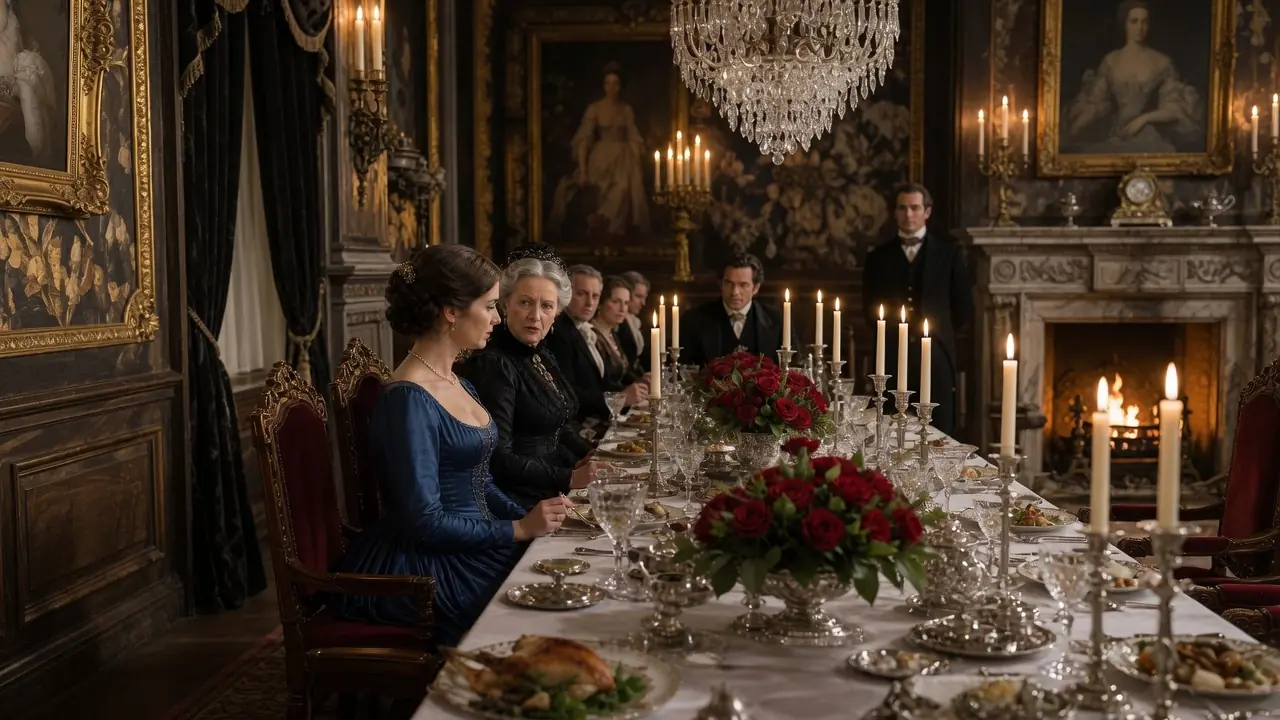
To look up would be to confirm what she already knew: that every eye at the long, candlelit table was now upon her. Not on her husband, the Duke, at the head of the table, nor on his aunt, the Dowager Duchess Augusta, at his right, but on her, the Duchess, the woman who did not belong.
The silence that followed the Dowager's pronouncement was not a comfortable one. It was the silence of a held breath, of social calculation, of a dozen minds weighing the cost of speaking against the cost of remaining quiet. Eleanor cataloged it. It was a specific and textured thing.
The air, thick with the scent of beeswax and roasted pheasant, seemed to press in on her. The light from the three great chandeliers overhead caught the facets of the crystal glasses, splintering into a thousand sharp, accusatory points. She had been Duchess of Blackwood for precisely two years, three months, and eleven days. In that time, she had learned that silence was a language, and she had become fluent in all its dialects.
This was the silence of judgment.
Her marriage had been a matter of contract, not of passion. Alistair, the ninth Duke of Blackwood, had needed an heir and a manager for the chaos his first wife, the celebrated and beautiful Isabella, had left in her wake. He was a man hollowed out by a grief that had curdled into a kind of weary indifference.
He had chosen Eleanor, the daughter of a respected but untitled country doctor, for the qualities he believed he saw in her: quietness, tractability, and a lack of complication. He had mistaken her composure for simplicity. It was a common error.
He had been polite, meticulously so. He had given her his name, his houses, and his seat beside him at tables like this one. He had not, however, given her his attention.
He looked at her, but he did not see her. He saw only the absence of the woman who had come before.
The Dowager Duchess Augusta, a woman constructed of iron certainties and rigid corsetry, had seen Eleanor from the very beginning. She saw a usurper, a nobody, a creature of common stock polluting a noble line. Her campaign against Eleanor had been one of subtle cruelties, of quiet dismissals, and remarks like this one, dropped like poison into the wine.
"One can hardly expect a woman of such common stock to understand the nuances of managing a household of this rank," Augusta had said, her voice carrying with perfect clarity down the length of the table. "It requires breeding, an instinct for the proper order of things."
Eleanor kept her eyes on her plate, on the swirl of sauce beside a slice of pheasant. She would not eat. She could feel the heat rising in her cheeks, a traitorous blush she refused to dignify with acknowledgement.
She had arrived at Blackwood to find an estate hemorrhaging money, a jewel box whose contents had been sold off or mortgaged to pay for Isabella's whims. The tenants were disgruntled, the fields neglected, the staff demoralized and leaderless. The ledgers, when she had finally requested them from the wary estate steward, Mr. Davies, were a testament to beautiful, ruinous chaos.
They were filled with Isabella's looping, impatient script, detailing expenditures for Parisian gowns, Venetian glass, and entire shipments of exotic birds for a garden that was never built. Debts were recorded in the margins, if they were recorded at all. It was a disaster written in violet ink.
For the first six months, Eleanor had done nothing but read. She sat in the cold estate office, a room Alistair never entered, and she read. She read the account books, the tenant rolls, the letters from creditors. She read reports on crop yields from twenty years prior. She read until her eyes burned and the numbers swam before her.
Then she began to work.
Her handwriting, a stark contrast to Isabella's flamboyant loops, was small, neat, and precise. She filled new ledgers, page after page of black ink, of carefully balanced columns and expenses tracked to the last farthing. She met with Mr. Davies every Tuesday morning.
At first, the steward, a man who had served the Blackwood dukes for forty years, had been polite but distant. His loyalty belonged to the memory of the old family. He answered her questions with curt formality. She did not press. She simply continued.
She asked about drainage in the north fields. She asked about the cost of seed grain versus the market price of wheat. She asked about the leaking roof on the home farm. She never raised her voice. She never gave an order without first understanding the entirety of the problem.
One Tuesday, three months into her tenure, she had pointed to a line in the old ledger.
"This contract for the wool," she said, her voice quiet in the dusty room. "We are selling it for twenty percent below the price offered at the Halifax market."
Mr. Davies had looked at her, truly looked at her, for the first time.
"The previous duchess preferred the merchant, your grace. A Mr. Abernathy. He was a charming man."
Eleanor had tapped the page with a single finger.
"His charm has cost this estate four hundred pounds a year for the last five years. That is two thousand pounds. It is the cost of a new roof for the tenants at Mill Farm. Please make inquiries with the merchants at Halifax."
He had simply nodded, a new light of respect in his aging eyes.
From that day, he became her quiet ally. He saw the work. He saw the slow, painstaking repair of a great house brought to its knees by neglect. He saw the mind that was bringing it back.
Alistair saw none of it.
He saw a wife who was always appropriately dressed, who managed his social calendar with quiet efficiency, who never troubled him with domestic concerns. He moved through the beautifully run house as if it were a natural phenomenon, like the rising of the sun, requiring no effort to sustain.
He did not see the hours she spent with the housekeeper, reviewing menus and linens. He did not see her correspondence with solicitors, patiently renegotiating the terms of Isabella's many debts. He did not see the woman who walked the fields with Mr. Davies, her boots muddy, discussing the merits of a new breed of sheep.
He saw only a quiet shadow in the shape of a duchess.
Now, at this table, that shadow was being illuminated by the cruelest of lights. The Dowager's words hung in the air, an indictment not just of Eleanor, but of Alistair's choice, of his judgment. Eleanor could feel the vicarious embarrassment of the guests, their discomfort, a palpable wave.
She did not look to her husband for rescue. She had not in two years ever looked to him for rescue. To do so would be to admit she was in need of it.
She was not.
She was the Duchess of Blackwood. She had earned the title not through birth, but through labor, an invisible, unacknowledged labor that was at this moment the only armor she possessed. She drew it around herself, this knowledge of her own competence, and sat perfectly, unshakably still.
The silence stretched. Five seconds. Ten. It became a presence in the room, a guest in its own right.
Eleanor finally allowed herself to lift her gaze, but not to her husband or his aunt. She looked at the centerpiece, a magnificent arrangement of hothouse roses from the Blackwood gardens. She had overseen their cultivation. She knew the work it took to make a fragile thing bloom in a cold climate.
She held her composure with the ferocity of a gardener shielding a prized flower from a killing frost. It was all she had. It would have to be enough.
Alistair felt the silence as a physical pressure. It was as if the air had solidified, trapping him in his chair at the head of the table. He had heard his aunt's words, of course. He had heard the casual, confident cruelty in them, the dismissive flick of the wrist that relegated his wife to a lower order of being, and he had done nothing.
He sat frozen, caught between the ingrained habit of deference to his formidable aunt and a nascent, unfamiliar stirring of something else. Something protective.
He looked down the table at Eleanor. She was not looking at him. Her profile was turned slightly, her attention seemingly fixed on the floral arrangement. He saw the clean, elegant line of her jaw, the smooth sweep of her dark hair coiled at the nape of her neck.
She wore a simple gown of deep blue silk, and at her throat, the pearls he had given her as a wedding gift. He had chosen them himself, a task he had performed with the same detached efficiency with which he had chosen her.
They were fine pearls, perfectly matched, but they were not spectacular. They were suitable, like her, or so he had thought. Now, in the hostile glare of the chandeliers, they seemed to glow with a soft internal luminescence. They looked right. They looked as if they belonged to her.
The stillness of her posture was absolute. It was not the frozen stillness of fear, he realized. It was the centered stillness of profound self-possession. The stillness of a woman who knew her own worth, even if no one else in the room did.
And in that moment, for the first time, a crack appeared in the smooth, polished surface of his indifference. He had assumed her quietness was emptiness. He was beginning to suspect it was depth.
His mind flashed back, unbidden, to a night three weeks prior. He had been in his study late, unable to sleep, wrestling with a speech for the House of Lords. A draft from the window had sent a stack of papers skittering across his desk, and one had fallen to the floor.
As he bent to retrieve it, his hand brushed against another book left on the floor by a careless footman. It was one of the estate ledgers. He had never looked at them. That was Davies's domain. It had been Isabella's before that, and the memory of her chaotic finances was a headache he had no desire to revisit.
Curiosity, or perhaps boredom, made him pick it up. He opened it on his desk.
He was met not with Isabella's frantic, ink-blotted scrawl, but with page after page of the most exquisitely neat and orderly script he had ever seen. Every entry was perfect, every column aligned.
He recognized the hand. It was Eleanor's. He had seen it on the household menus, on the guest lists she prepared for him, on the brief formal notes she sometimes left on his side of the breakfast table.
He spent the next two hours reading. He did not read only the words. He read the story they told. A story of quiet, relentless competence.
He saw debts, vast and terrifying, methodically reduced, renegotiated, and paid. He saw wasteful expenditures curtailed, new sources of income cultivated. He saw the sale of the wool with a note in the margin: "Per Halifax market rate."
He saw the cost of the new roof at Mill Farm paid in full. He saw hundreds of small, intelligent decisions that, taken together, amounted to the salvation of his estate.
He had sat back in his chair, the heavy book open before him, and felt a profound sense of dislocation. This was not the work of a simple, tractable woman. This was the work of a keen, analytical mind. A mind that saw structure, that understood consequence.
A mind that had been silently, diligently shoring up the foundations of his world while he had been mourning the woman who had very nearly brought it all down.
He had felt a confusing mixture of gratitude and shame. He had married her to manage his house, and she had done it. She had done it so well, so quietly, that he had not even noticed.
The next day, he had walked the estate, not with the eyes of a duke making his rounds, but with the eyes of a man trying to see what he had missed. He saw the new slates on the cottage roofs. He spoke to a tenant farmer who praised the duchess for her fairness in a dispute over grazing rights.
"She listened, your grace," the man had said, his face open with surprise and respect. "Properly listened."
He had found his way to the old orangery. It had been Isabella's pet project, a grand glass house she had ordered built at ruinous expense and then abandoned when the novelty wore off. For years, it had been a place of decay, of broken panes and withered, frostbitten plants.
As he approached, he saw that the glass had been replaced. The ironwork was freshly painted. He pushed open the door and stepped into a world of impossible warmth and greenness.
Eleanor was there. She was at the far end, her back to him, wearing a simple day dress and gardening gloves. She was tending to an orchid, its delicate, speckled petals a small miracle in the English autumn.
She was completely absorbed in her task, her movements economical and precise. She misted the leaves, her touch gentle, her focus absolute. The air was fragrant with damp earth and jasmine. The place was no longer a monument to failure. It was a sanctuary of quiet, determined life.
He watched her for a full five minutes, unseen. He saw not a duchess, not a wife, but a creator, a restorer, a woman of substance and quiet strength. And he felt the last of his grief for Isabella fall away, replaced by a sharp, piercing regret for two years of profound blindness.
Now, at the dinner table, the image of her in the orangery superimposed itself over the woman sitting in perfect, dignified silence. The two Eleanors merged into one: the quiet wife and the brilliant manager, the unassuming presence and the powerful force of order.
He saw the pearls at her throat not as a symbol of her suitability, but of her essence. Understated, luminous, and deeply valuable.
His aunt was still speaking, her voice regaining its momentum as she mistook the Duke's silence for assent.
"It is a matter of blood, after all. One cannot make a silk purse from a sow's ear, as they say. The girl tries, I am sure, but she simply lacks the—"
Alistair moved.
The action was small, almost imperceptible, but in the taut silence of the room, it was seismic. He deliberately, slowly set down his crystal wine glass. He did not slam it. He did not drop it. He placed it on the damask tablecloth with such measured precision that the single soft clink of crystal on wood was as loud as a cannon shot.
The sound cut off his aunt's words mid-sentence. Every head that had been studiously avoiding Eleanor's gaze now snapped to him.
The room held its breath once more.
He did not look at the stunned faces of his guests. He did not look at the fork that had fallen from his aunt's suddenly nerveless fingers. He looked at his wife. He looked at her until she finally lifted her eyes from the centerpiece and met his gaze.
In her eyes, he saw no plea, no fear, no expectation. He saw only a calm, waiting stillness.
He was the Duke of Blackwood. This was his house. She was his wife. And he finally, finally saw her.
He turned his head slowly, deliberately, to face his aunt. The Dowager Duchess Augusta stared back at him, her mouth slightly agape, her perfect social armor pierced by a simple sound.
Alistair looked directly into her eyes. His own face was a mask of cold ducal authority. When he spoke, his voice was not loud. It was quiet. It was measured. It was absolute.
"Enough."
The word was a wall. It was a verdict. It was the end of a conversation and the beginning of a new reality. It did not invite argument. It did not permit response. It simply was.
In that single word, Alistair dismantled his aunt's authority, defended his wife's honor, and declared his allegiance with irrefutable finality. He had not raised his voice. He had not made a scene. He had simply spoken the truth, and the truth was enough.
The silence that followed was of a different quality altogether. It was not the silence of judgment. It was the silence of shock, of realignment, of a power structure shifting on its foundations.
The Dowager Duchess Augusta, for the first time in her seventy years, looked utterly defeated. The color drained from her face, leaving behind a mask of powdered disbelief. She had been publicly, quietly, and completely rebuked by the nephew she had always believed she could control. Her certainty, the bedrock of her existence, had shattered.
Eleanor felt the tension in her own body release. A slow, deep unwinding she had not realized was there. She had not asked for this. She had not expected it. But as she watched her husband, his gaze still fixed on his aunt, she felt a warmth spread through her chest, a feeling so unfamiliar she could not at first name it.
It was recognition. It was the feeling of being seen.
The dinner party dissolved. It did not end. It simply disintegrated. The guests, sensing a moment of profound family crisis, murmured their excuses with an awkward haste that bordered on panic. Within fifteen minutes, the great dining room was empty, save for the three of them.
The Dowager sat frozen in her chair, a monument to her own obsolescence. Alistair remained standing at the head of the table, and Eleanor, who had been the catalyst for it all, simply waited.
Finally, Alistair moved. He walked around the table, his footsteps echoing in the cavernous room. He did not go to his aunt. He came to Eleanor's side. He held out his hand.
She looked at it for a moment, at his long, strong fingers and the signet ring of his office, and then placed her own in his. His grip was firm, warm, and steady. He drew her to her feet.
He did not speak. He simply led her from the room, leaving his aunt to the company of the guttering candles and the wreckage of her own making.
He led her through the silent, portrait-lined corridors, their footsteps the only sound. He did not lead her toward their separate bedchambers, the geography of their polite, distant marriage. He led her down a smaller hallway toward the west wing, toward the gardens.
He stopped at the door to the orangery. The moonlight streamed through the great glass panes, silvering the leaves of the plants within. The air that drifted out was sweet with the scent of night-blooming jasmine.
He turned to face her, his hand still holding hers. His face in the pale light was stripped of its ducal mask. He looked tired and sad and profoundly earnest. It was not an apology for his aunt that he offered. It was an apology for himself.
"I have been blind," he said, his voice low and raw. "For two years, I have been living in this house with its foundations being repaired, its treasures being polished, its very soul being restored, and I have failed to see the architect of it all."
He lifted her hand, the one that was not gloved for gardening, and looked at her fingers, at the faint ink stain on her forefinger that never quite washed away.
"I looked at you, and I saw quietness. I did not see strength. I saw simplicity. I did not see clarity. Forgive me."
Eleanor looked up at him, at this man who was her husband, this stranger who was finally seeing her. There were no tears in her eyes. There was no grand swelling emotion. There was only a quiet, profound sense of rightness, of a balance finally being restored.
Her power had never resided in what others thought of her. It resided in what she knew herself to be. But to have that truth acknowledged freely and with such humility was a gift.
She did not offer him effusive forgiveness. The wound had not been one of passion, and it did not require a passionate healing. It required something truer. It required acknowledgement.
She gave him a small, slow nod.
"There is nothing to forgive, your grace," she said, her voice steady. "You were grieving."
"Alistair," he corrected her, his thumb stroking the back of her hand. "My name is Alistair."
He had never asked her to use it before. It was a greater intimacy than any they had yet shared.
"Alistair," she repeated softly.
And in the quiet of the moonlit corridor, surrounded by the scent of the life she had nurtured, a new foundation was laid. Not on contract or duty, but on a truth finally seen.
Five years later, the orangery was Eleanor's undisputed domain. It was a riot of controlled life, of vibrant greens and impossible blooms. Sunlight, thick and golden, poured through the glass panes, warming the stone floor.
Alistair sat in a worn wicker chair, a book lying open and forgotten in his lap. He was watching his wife and their son.
Thomas, who had his father's dark hair and his mother's serious, observant eyes, was four years old. He stood on a small stool, his small hands carefully tending to a pot of seedlings under Eleanor's gentle guidance.
"Gently," she murmured, her hand covering his. "They need only a little water. Just enough."
Thomas nodded, his face a mask of concentration, and tipped the tiny watering can with painstaking precision. A small, perfect droplet landed on a new green leaf and clung there, sparkling in the sun.
Alistair watched them, a feeling of deep, settled contentment filling him. The past five years had been a quiet education. He had learned the language of his wife's stillness. He had learned that her strength was not in what she said, but in what she did.
She had taught him, without ever meaning to, how to see the world not just for its surface beauty, but for its underlying structure, for the patient work that underpins all things of value. He had come to rely on her judgment not only in matters of the estate, which now flourished beyond all expectation, but in all things.
She was his anchor, his counsel, and the quiet, unshakable center of his world.
His aunt, the Dowager Duchess Augusta, never dined at Blackwood again. She removed herself to Bath the season following the disastrous dinner, where she resided, still complaining about the damp and the decline of society to a dwindling circle of companions. Her name was never mentioned between them. There was no need. Her absence was a more eloquent statement than her presence had ever been.
Mr. Davies had retired two years before, his pension generous and his departure marked by a quiet, emotional ceremony with the staff. A letter arrived from him each Christmas, addressed not to the Duke, but to Eleanor. It was filled with news of his small cottage garden and his prize-winning roses, the script of an old man finding peace. Eleanor answered every one.
Alistair reached out and took his wife's free hand. She turned, a small, genuine smile touching her lips, the same smile that had bloomed so rarely at first in the months after that fateful dinner. Now it was an easy, familiar part of the landscape of their lives.
He brought her hand to his lips, the faint scent of earth and leaves clinging to her skin.
It had not been a grand passion that had remade their lives. It was not a story of thunder and lightning. It was the story of a slow, patient turning toward the sun. It was the story of a man learning to see, and of a woman whose worth was so absolute it required no witness, but was all the more beautiful for having finally been found.
He looked from his wife's calm, beloved face to his son's dark head, bent in concentration over a new and fragile life.
Everything of value, he thought, was built this way.
Quietly.
Carefully.
And with devotion.
The sunlight caught the simple pearl necklace at Eleanor's throat, the one she still wore every day, and it shone with a soft, steady light.