The first thing Silas Boone noticed was not the girl.
It was the way the road had gone quiet.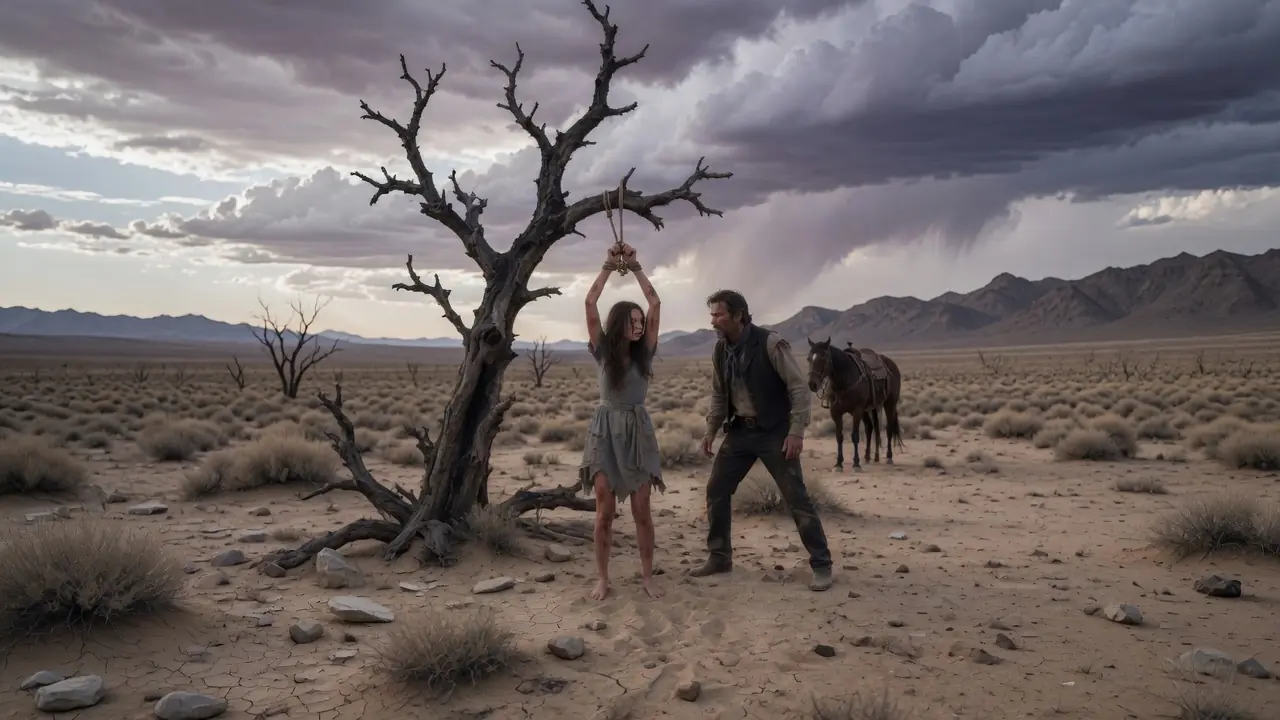
Out near Red Mesa Crossing, silence usually came with a reason. Even on the hottest afternoons, there was always something moving across that land. Dry grass whispered under the wind, hawks circled above the cliffs, and somewhere far off, a wagon wheel or a loose steer would remind a man he was not alone in the world.
But that afternoon, nothing moved.
Silas slowed his horse before he understood why.
He had been riding north since morning, following the old cattle trail that cut between the red cliffs and the shallow wash. The sun was high, hard, and white, burning the color out of everything it touched. Dust clung to his coat, his beard, and the tired animal beneath him.
Then he saw the shape beside the road.
At first, he thought it was a torn piece of canvas caught on a mesquite limb. Then the wind shifted, and the shape moved.
A woman.
She was hanging from a low branch with one arm tied above her head. Her boots barely touched the cracked earth. Her dress was ripped at the hem, covered in dirt, and her face had the dry, hollow look of someone who had been left too long under the sun.
Silas reached for his revolver before he reached for her.
Not because he wanted trouble.
Because trouble had a way of dressing itself like mercy out there.
He guided his horse forward slowly, watching the ridge, the brush, the shadows between the rocks. A careless man would have rushed straight to her. A dead man would have done it without looking around first.
The woman lifted her head.
Her lips were split.
Her eyes were wide with a terror that had not ended just because someone had arrived.
“Don’t come too close,” she whispered.
Silas stopped.
His eyes moved over the ground beneath her feet.
There were drag marks in the dust. Two sets of boot prints. Horse tracks circling once, leaving, then turning back as if whoever had done this meant to return. A torn scrap of rope lay half-buried under the sand.
Silas had seen fear before.
He had seen men beg.
He had seen women lie to stay alive.
But this was different.
This was not a robbery gone mean.
This was something organized enough to leave signs and cruel enough not to care who found them.
“What’s your name?” he asked.
The woman stared at him as if names belonged to another life.
For a moment, he thought she would not answer.
Then she swallowed.
“Clara.”
Silas took off his coat and stepped toward her.
She flinched so hard the rope cut deeper into her wrist.
He stopped again.
“Easy,” he said. “I’m not him.”
That did not calm her, but it kept her from fighting.
He moved slowly, keeping both hands where she could see them. When he reached her, he lifted the coat and laid it over her shoulders. The fabric swallowed her thin frame, but she clutched it like it was the first decent thing the world had offered her in days.
Silas pulled his knife from his belt.
The rope came apart with one clean cut.
Clara dropped.
He caught her before she hit the ground.
For half a breath, she leaned against him because her legs had forgotten their purpose. Then pride or terror pushed her away, and she wrapped the coat tighter around herself.
Silas let her have the distance.
“Who tied you there?” he asked.
Clara looked past him toward the ridge.
Her face changed.
Not because she saw someone.
Because she remembered someone.
Before she could answer, a voice came from the rocks above them.
“Well, now. That is a poor way to treat another man’s property.”
Silas turned.
A rider sat at the top of the slope, black hat low, rifle resting across his saddle. He was lean, clean-shaven, and too comfortable for a man who had just admitted what he was.
Clara made a sound behind Silas.
Small.
Broken.
“That’s Danton,” she said.
The rider smiled.
“Miss Clara has always been dramatic.”
Silas did not move.
The rider looked him over, measuring the worn coat, the dusty boots, the old Colt at his hip.
“You best ride on,” Danton said. “This is a private matter.”
Silas lifted his eyes.
“Funny thing about open roads.”
Danton’s smile thinned.
“What’s that?”
“They make private matters hard to hide.”
The rifle shifted.
Silas saw the movement before the shot came.
His hand dropped, the revolver cleared leather, and the sound cracked across the dry wash before Clara could even breathe.
Danton fell sideways out of the saddle.
The horse bolted, empty stirrups kicking dust into the air.
The echo rolled against the red cliffs and faded.
Then the silence returned.
Clara was shaking.
Silas stood still, revolver lowered, watching the ridge for another rider. When none came, he walked to Danton’s body, turned him over with his boot, and took the folded papers from inside his coat.
He expected a bill of sale.
Maybe a letter.
Maybe instructions from someone worse.
What he found made his stomach tighten.
Names.
Ages.
Descriptions.
Prices.
Routes.
Some had town names beside them. Some had only initials. Some were marked delivered. Some were marked pending.
Silas read one line twice.
Then a third time.
A girl named Elsie Ward.
Seventeen.
Taken from a ranch near his own spread two winters ago.
The story had been that she ran off with a gambler.
Her mother never believed it.
Silas had not either, but belief without proof was just a burden a man carried in silence.
Now the proof was in his hand.
Clara watched his face.
“You know one of them,” she said.
Silas folded the paper carefully and put it inside his vest.
“I know enough.”
He walked back to her and brought his horse closer.
“Can you ride?”
She looked at the saddle, then at the open land.
“I can sit.”
“That’ll do.”
He lifted her onto the horse as gently as he could and swung up behind her. She stiffened at first, but exhaustion was stronger than fear. By the time they left the road, her head had dropped forward, and her hands were locked around the horn.
Silas did not ride toward town.
Not yet.
He took the old hunter’s trail west, through a narrow cut in the hills where even the buzzards seemed to lose their way. By sundown, they reached a line cabin tucked beneath a stand of cottonwoods near a dry creek bed.
The place was small.
One room.
A table.
A stove.
A bed narrow enough to make a lonely man feel honest.
But it had water, a lock, and walls that could hold off the night.
Silas helped Clara down. This time, she did not pull away as quickly. It was a small thing, barely worth noticing to most people, but Silas noticed everything when fear was in the room.
Inside, he lit the stove and set a tin cup of water on the table.
Clara sat on the edge of the bed with his coat still around her shoulders.
She drank slowly at first, then faster, then stopped herself as if even thirst could be taken from her if she showed too much of it.
Silas turned his back and busied himself with coffee.
He did not ask her questions.
Not yet.
Men who demanded answers from broken people usually cared more about control than truth.
The first stars had come out by the time Clara spoke again.
“My last name is Whitcomb.”
Silas stayed at the stove.
“I figured you had one.”
She gave a sound that might have been a laugh if there had been more life in it.
“My father owed money.”
Silas poured coffee into a tin cup.
“Most men do.”
“Not like this.”
He set the cup near her and stepped back.
Clara stared at it for a long moment before picking it up.
“My father owed Gideon Vale.”
The name sat heavy in the cabin.
Silas knew it.
Everybody within fifty miles knew it.
Gideon Vale owned the freight office, the feed store, half the water rights, and enough men to make people pretend he owned the rest.
“He said he could help us,” Clara continued. “Said there was work for girls in the south. Good houses. Good wages. Safe arrangements.”
Her mouth twisted around the word safe.
“My mother wanted to believe him. My father wanted the debt gone. I found the ledger in Vale’s office when I went to clean after supper. It had all the names.”
Silas touched the folded paper inside his vest.
“You took it.”
“I took a page. Not the whole book.”
She looked toward the window.
“I thought if I got to the marshal in Dry Creek, maybe someone would listen.”
“And they caught you.”
“My brother did.”
That stopped him.
Clara’s eyes did not fill with tears.
They had gone past tears.
“He helped tie me to that branch. Told me if I had just behaved, none of this would have happened.”
The cabin seemed to shrink around them.
Silas had known cruel men.
He had known greedy men.
But there was a special kind of sickness in a family choosing money over blood.
Clara wrapped both hands around the coffee.
“There are more girls than the ones on that page.”
Silas sat across from her.
“How many?”
“I don’t know.”
“Guess.”
She looked at him.
“Enough that if Red Mesa says it didn’t know, Red Mesa is lying.”
Silas said nothing.
Outside, wind pushed against the cabin walls.
Inside, the paper in his vest seemed to burn through the cloth.
He could take Clara north.
Find a widow in a quiet town to hide her.
Send word to the territorial marshal and hope the right man read it before the wrong man buried it.
That would be sensible.
That would keep him alive.
He stood and walked to the window.
Down in the valley, beyond the black ridges, Red Mesa Crossing sat under the dark like an animal pretending to sleep.
A town like that did not grow blind by accident.
It learned how.
One missing girl became gossip.
Two became bad luck.
Three became the kind of thing nobody discussed near church doors.
Silas thought of Elsie Ward’s mother sitting by her window for months, waiting for a daughter the town told her had chosen to disappear.
He turned back to Clara.
“Can you walk by morning?”
She looked at him with a fear that already knew the answer.
“Back there?”
“Yes.”
Her fingers tightened on the cup.
“They’ll kill me.”
“Not if they’re too busy answering questions.”
“People don’t question Gideon Vale.”
Silas put the coffee down.
“Then they can start tomorrow.”
Dawn came cold and colorless.
Clara slept maybe an hour. Silas did not sleep at all. He cleaned his revolver, checked the horses, read the paper until every name settled somewhere behind his eyes.
When they rode into Red Mesa Crossing, the town was just beginning to stir.
A woman swept dust from a boardwalk already covered in it.
A blacksmith opened his doors.
A boy carrying milk stopped in the street and stared.
Then others noticed.
People knew Clara Whitcomb.
Or they knew the version they had accepted.
The runaway.
The ungrateful daughter.
The girl who had brought shame onto a struggling family.
Now she rode in behind Silas Boone wearing a man’s coat and the look of someone who had clawed her way back from a grave nobody wanted to admit had been dug.
Silas did not stop at the saloon.
He did not stop at the church.
He rode straight to the law office.
Deputy Elias Mercer sat inside with his boots on the desk and a cold cup of coffee near his elbow. He was in his fifties, broad through the middle, with gray hair and tired eyes. He looked like a man who had once believed in the law and had spent the years since making excuses for what replaced it.
When Clara stepped through the door, Elias stood so fast the chair hit the wall.
“Clara?”
She did not answer.
Silas placed the folded page on the desk.
“Read it.”
Elias looked at him.
“Who are you?”
“Read it.”
There was something in Silas’s voice that made the deputy reach for the paper.
He opened it.
His eyes moved down the list.
The color left his face.
Not shock.
Recognition.
Silas saw it.
So did Clara.
“You’ve seen names like that before,” Silas said.
Elias swallowed.
“I heard things.”
“That all?”
The deputy looked toward the door, as if the town itself might be listening.
“I suspected Vale was moving girls through freight wagons. I never had proof.”
Silas leaned forward.
“You had missing women.”
Elias said nothing.
“You had mothers crying in this office.”
Still nothing.
“You had enough.”
The deputy lowered his eyes.
That was the moment Clara’s face hardened.
Not with hatred.
With understanding.
People had not failed her because they knew nothing.
They had failed her because knowing would have cost them something.
The office door opened.
Gideon Vale walked in like a man entering his own dining room.
He was dressed in a dark wool coat despite the morning heat. His boots shone. His gloves were clean. Everything about him looked polished enough to hide rot.
His eyes went first to Clara.
Then to Silas.
Then to the paper.
“Well,” he said softly. “There she is.”
Clara’s body went still.
Silas stepped half a pace in front of her.
Vale smiled.
“No need for theatrics. Miss Whitcomb has caused her family a great deal of distress.”
“She was tied to a tree,” Silas said.
“By whom?”
“One of your men.”
“Dead men make poor witnesses.”
“Ledgers don’t.”
For the first time, Vale’s expression changed.
Only slightly.
Enough.
Elias saw it too.
Silas tapped the paper.
“That page came from your office.”
Vale removed his gloves one finger at a time.
“A stolen paper carried by a hysterical girl and a stranger with dust on his boots. That is your case?”
Clara stepped forward.
Her voice shook, but it did not break.
“No.”
Vale looked at her.
“My case is every girl whose name you wrote down like livestock.”
The deputy looked from Clara to Vale.
Something old moved in his face.
Shame, maybe.
Or the last piece of courage he had not yet sold.
Vale’s smile disappeared.
“You would be wise to remember who keeps this town alive.”
Silas looked through the window at the street beyond.
People were gathering outside.
A few had heard Clara’s voice.
More were coming.
“Looks to me,” Silas said, “like the town’s about to decide that for itself.”
Vale turned toward the door, but Elias moved first.
It was not much.
Just one step.
But for a man who had spent years stepping aside, it was enough to change the room.
“You’re not leaving,” Elias said.
Vale stared at him.
“Excuse me?”
The deputy’s hand trembled near his holster.
But it stayed there.
“I said you’re not leaving.”
Outside, the crowd thickened.
Mrs. Ward was there, thin as a fence rail, face pale beneath her bonnet. She had lost Elsie two winters before and never stopped wearing black. When she saw Clara standing in the office, she pushed through the doorway without asking permission.
“What is this?” she demanded.
Nobody answered.
So Silas took the paper and handed it to her.
Mrs. Ward read the names.
Her breath caught on one.
Then she made a sound that did not belong to speech.
“My Elsie.”
The crowd outside went quiet.
That was how the truth began.
Not with a sermon.
Not with a gunfight.
With a mother reading her daughter’s name on a list no decent world should have allowed to exist.
By noon, more people had come forward.
A ranch hand admitted he had loaded freight wagons after midnight and been paid not to ask what was inside.
A widow said her niece had been offered work by Vale’s men and vanished two weeks later.
A stable boy confessed he had seen young women taken through the back road toward the canyon, always guarded, always quiet.
At first, every confession came with an excuse.
I didn’t know.
I didn’t want trouble.
I had children to feed.
I thought someone else would say something.
But excuses change shape when spoken beside grief.
They stop sounding like reasons.
They start sounding like choices.
By evening, Deputy Mercer had sent riders to Dry Creek for the territorial marshal. He also locked Gideon Vale in the back cell with two armed men watching the door. It was not justice yet, but it was the first honest thing that office had done in a long time.
Clara sat on the bench outside the law office while the town moved around her in a strange, broken hurry.
Nobody knew how to look at her.
Some wanted forgiveness before they had earned it.
Some wanted her to say they could not have known.
She gave them neither.
Silas stood beside the hitching rail, letting his horse drink from a trough. When Clara finally walked over, she looked smaller than she had in the office, but not weaker.
“You could leave now,” she said.
Silas glanced at her.
“So could you.”
She looked toward the jail.
“My father will say I ruined him.”
“Did he sell you?”
Her jaw tightened.
“Yes.”
“Then he ruined himself.”
The answer landed slowly.
Clara looked down the street at the town that had raised her, judged her, abandoned her, and now watched her like she had become a mirror they hated.
“I don’t know where I belong anymore.”
Silas rested one hand on the saddle.
“That’s not always the worst thing.”
She looked at him.
“No?”
“No. Sometimes it means nobody gets to decide it for you.”
The marshal arrived the next afternoon with six men and a wagon for prisoners.
By then, Vale’s hidden office had been searched. They found the full ledger under a loose floorboard behind his freight desk. More names. More routes. More payments made to men who called themselves respectable.
Several were arrested before sundown.
Others ran.
Some were caught before they reached the river.
Red Mesa Crossing did not celebrate.
There are things too ugly for celebration.
The town simply stood under the weight of what it had allowed, while women cried in doorways and men who had once looked away now struggled to meet anyone’s eyes.
Clara testified in front of the marshal with her hands folded in her lap.
She did not speak like a victim begging to be believed.
She spoke like a witness who had survived long enough to become dangerous.
When she finished, Mrs. Ward crossed the room and held her without asking.
Clara froze at first.
Then she broke.
Not loudly.
Not like the frontier stories tell it.
Just a quiet collapse against another woman who understood what had been taken and what could never fully be returned.
Silas looked away.
Some things were not for a man to watch too closely.
Weeks passed before the territory stopped sending riders through Red Mesa.
The freight office closed.
The feed store changed hands.
The church bell rang for women whose bodies had not been found and for those whose names finally had.
Deputy Mercer resigned before anyone forced him to. Some called him coward. Some said at least he had acted in the end. Silas thought both could be true, which was often the trouble with men.
As for Clara, she did not stay in Red Mesa.
Not because she was driven out.
Because leaving was the first choice that belonged entirely to her.
Silas offered to take her north as far as the rail station.
She asked instead if the line cabin still needed fixing.
He said it always did.
So she went west with him.
At first, she slept with a chair against the door.
She woke at every night sound.
She kept a knife under her pillow and hated herself for needing it.
Silas never mentioned it.
He gave her work when she wanted work and silence when words became too heavy. She learned to mend fence, cook beans without burning the pot, and ride without holding the saddle horn like it was the only thing keeping her alive.
By winter, she could laugh once in a while.
By spring, she had planted beans behind the cabin.
By summer, she rode into town alone to buy flour and came back with a blue ribbon she claimed had no meaning at all.
Silas never tried to call that healing.
He had seen enough wounds to know better.
Some scars closed.
Some only learned to live under the skin.
But Clara was alive.
Not hidden.
Not owned.
Not erased.
And that mattered more than any pretty ending the newspapers might have wanted.
Years later, people still told the story of the girl found on the road near Red Mesa Crossing.
They liked to make it about Silas Boone.
A lone rider.
A quick draw.
A man who brought down Gideon Vale.
But Clara always hated that version.
Because it made her sound like something discovered instead of someone who endured.
The truth was harder and better.
Silas stopped because the silence felt wrong.
Clara survived because some part of her refused to disappear.
And Red Mesa changed because one piece of paper forced a whole town to look at what it had trained itself not to see.
Out on the frontier, people loved stories about courage.
They sang about men who faced guns, crossed rivers, fought storms, and carved lives from hard land.
But the kind of courage that saved Clara Whitcomb was quieter than that.
It was a man stopping his horse when he could have kept riding.
It was a woman saying the name of the man who hurt her.
It was a deputy finally taking one step when years of silence had taught him to stand still.
And it was a town learning, far too late, that looking away is not innocence.
Silas never called himself a hero.
Clara never called herself rescued.
They both knew the road had offered them a choice that day.
Keep moving.
Or stop.
Most of the world’s cruelty survives because decent people keep moving.
But every now and then, someone stops.
And sometimes, that is enough to change everything.