"If you want to keep living here after this month, then you'll have to pay more rent." The words rang out right in the middle of dinner while I was still holding my spoon not yet raised to my mouth. I looked up at my daughter, the woman I once carried in my arms every night when she had a fever, and realized the look she was giving me was no longer the look of a child. It was the look of a landlord speaking to a tenant. I stayed silent.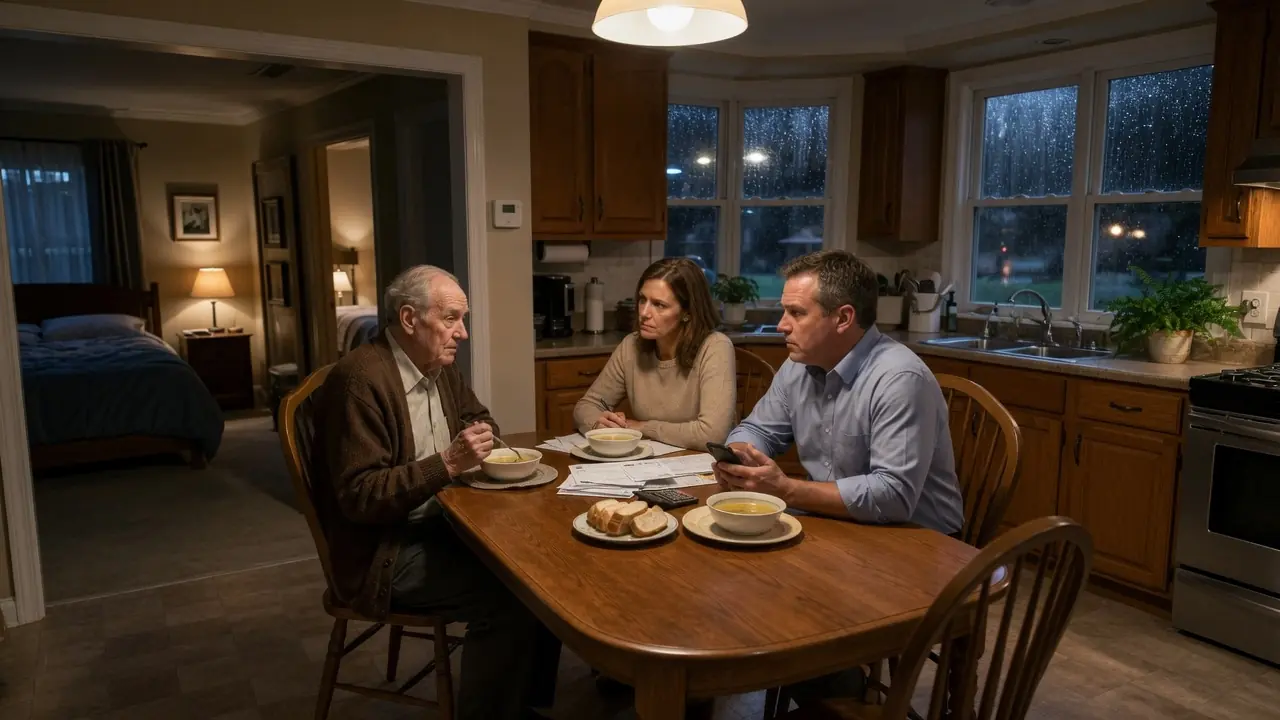
I didn't argue. I didn't beg. I simply nodded. While inside my head, a decision had already been made.
They had no idea who this house really belonged to. And in just one more week, they would know what it felt like to be forced out of the very place they believed was theirs.
My name is Harold Wittmann. I am 78 years old, an elderly American man, more than half my hair gray, my left knee aching whenever the weather turns cold. I have been a widower for 12 years. Since the day my wife Eleanor passed away from a sudden stroke, my life has felt like a house drained of all its light.
Everything's still there, but no longer warm.
Six years ago, I moved in with my youngest daughter, Melissa, and her husband, Ryan. At least that's how they described it. "Dad, moving in with us will be less lonely for you. You're getting older. Living alone isn't safe. Family is supposed to take care of each other." It all sounded very kind, but in reality, from the very first day I set my old suitcase down on the floor of that small room on the first floor, I was no longer a father living with his daughter. I became a tenant.
That room used to be Ryan's home office. After I arrived, they cleaned it out half-heartedly, put in a single bed, a cheap particle board wardrobe, and a desk lamp with a weak yellow glow. No pictures, no keepsakes, no sign that this was a place where a man who had lived a full life was truly welcome.
Every month I transferred the money on time, rent for the room, electricity, water, internet, because Dad uses it, too. The list of so-called fair shared expenses kept growing longer while the space I was allowed to occupy kept shrinking. I didn't turn on the heater unless it was absolutely necessary. I didn't dare take long hot showers.
I didn't turn on the TV during the day. Every time I accidentally forgot to turn off the hallway light, Ryan would stand there, arms crossed, glance at the switch, and say in a half joking, half serious tone, "Electricity is really expensive these days, Dad." Melissa was more subtle. She didn't mock me. She just sighed a lot.
"Dad should be a bit more mindful. We have a lot to worry about, too." If you live a little more frugally, it's easier on everyone. "If Dad could just be a little more considerate, things would be easier for all of us."
Considerate. I have lived nearly 80 years. I worked for 40 years without taking long vacations. I raised two children through school in a small house in the suburbs of Ohio.
I worked weekends to pay for their college tuition. I sat up all night in a hospital room while Eleanor lay there breathing through a machine, her hand growing colder in mine. And now I was being reminded to be considerate, just to be allowed to exist in a corner of a house. dinner that night.
The dinner when those words were spoken was nothing special. Canned chicken soup, sliced bread, a light meal for an old man, as Melissa liked to say. I sat in my usual spot at the corner of the table near the window where the light from the yard lamp was just enough for me to see my bowl of soup. Ryan was checking email on his phone.
Melissa ate while calculating something in her head. No one asked how my day had been. No one noticed my hand trembling slightly as I held the spoon. And then the sentence was dropped.
Clean, decisive, without a hint of hesitation. If you want to stay here after this month, you'll have to pay more rent.
No one looked at me after saying it, as if this had already been discussed, and I was simply the last one to be informed. I looked at Melissa for a long time, looked at the face I once shielded from rain and wind, looked at the eyes that once held absolute trust in me. Now all that remained was calculation and fatigue, as if I were an expense that needed adjusting. I could have said many things then.
I could have reminded them of the years I sacrificed. I could have asked why a father had to pay to live with his own daughter. I could have gotten angry. I could have cried.
But I did nothing. I simply nodded.
That nod made Melissa let out a quiet breath of relief. It allowed Ryan to keep eating without looking up. It made them believe I had accepted my place. A dependent old man with no other options.
They didn't know that in that moment I had not surrendered at all. I was calculating.
In my mind, it wasn't the increased rent. It wasn't the fear of being thrown out. It was a very clear, very calm thought. It's time.
Time for me to stop playing the role of a poor old father living on a modest pension. Time to stop asking permission to exist. Time for my silence to end. For 6 years, Melissa and Ryan believed I lived on a small pension.
They believed I had nothing but a few modest savings, just enough to get by. They believed that if I left this house, I wouldn't know where to go or how to live. They believed I needed them. They had no idea, and I had made sure of this for 20 years, that I was the one whose name was on this house.
Every document, every tax payment, every line in the legal records. They didn't know that the money I transferred every month, which they called rent, was simply money I moved from one account to another. They didn't know that the person they were laying down conditions for, was the true owner of the house. I didn't keep the truth to myself because I was afraid.
I did it because I was waiting for the right moment. And when I saw Melissa lower her head and continue eating her soup, as if she had just concluded a successful negotiation, I knew one thing for certain. That moment was very close.
That night, after dinner, I sat alone in the small room on the first floor, listening to the dishwasher humming steadily on the other side of the wall. The sound had become so familiar, it was part of the silence in this house. I sat on the edge of the bed, both hands resting on my knees, staring into the empty space ahead. I didn't turn on the light.
I had grown used to saving electricity a long time ago. Melissa's words echoed in my head, no longer sharp, but still clear enough to pull me back into the past. A past no one in this house knew about.
More than 20 years ago, I won the lottery. Not the kind where you win a few thousand and tell all the neighbors. It was an amount large enough to change an entire life if you let it. I still remember that afternoon vividly.
An autumn afternoon in Ohio, the air cool, leaves beginning to change color. I stood in the kitchen holding a crumpled lottery ticket, matching each number against the small television mounted in the corner. I checked it three times, then four. Then I sat down on the wooden chair by the table, my heart beating slowly but heavily as if my body hadn't yet caught up with what was happening.
I didn't shout. I didn't jump. I just sat there for a long time until the kettle whistled, pulling me back into the familiar kitchen.
Eleanor was in the living room reading. I walked out holding the ticket. I was going to tell her. I truly was.
I even opened my mouth and called her name. But then I saw her sitting there, her back slightly hunched, her glasses slipping down her nose, her hair already streaked with gray. And in that moment, a strange feeling crept in. Not fear, caution.
Eleanor had already begun having heart issues then. Nothing severe, but enough for the doctor to tell us to slow down. I told myself I would tell her later, when I fully understood what I was dealing with, when I was sure this news would bring peace, not chaos. And later became "not necessary yet."
Kept drinking coffee with Eleanor every morning as if nothing had changed. But something had changed slowly. The calls from my children.
Daniel, my eldest son, was just over 30 then, newly married, had just bought a house, had just started a small business. Every call began with proper concern and ended with a complaint about expenses, tuition, loans, car repairs. There was always a reasonable reason. Melissa was different.
She didn't go around in circles. She said outright that life was hard, that her friends were all better off, that being a child in this day and age wasn't easy. Eleanor and I helped many times. We weren't rich, but we never let our children go without.
And that, I later realized, taught my children a lesson. If they needed money, all they had to do was ask. When Eleanor died faster than I ever imagined, I understood that my silence had been the right choice.
Before the funeral was even over, Daniel began talking about how dad living alone probably doesn't need much money. Melissa discussed how it might be convenient to sell the old house. They weren't cruel, I believe that, but they were used to my money being something that could be redistributed when needed. It was during that time that I decided to buy the house in the suburbs.
The very house Melissa and Ryan are living in now. A house large enough, nice enough, valuable enough to be a long-term home. I put it in my name. All the paperwork was clear.
No power of attorney, no co-ownership. When my children asked, I simply said I had found a good rental, reasonably priced, close to the hospital, convenient for daily life. No one questioned it. No one asked to see a contract.
They were busy with their own lives. I let them believe I was still just a man living on a pension with a little savings, enough to get by, and I felt relieved that they believed that. A few years later, when my health began to decline, Melissa suggested I move in with them. It'll be easier to take care of you, she said.
I agreed, not because I needed to, but because I naively thought that living close to my children might heal something. I moved into my own house as a tenant. From the very first month, Melissa suggested I contribute a fair share. I didn't object.
I understood. But then a share became a fixed amount and that fixed amount kept increasing. I saw the change clearly in how they looked at me, not as an aging father who needed care, but as another adult in the house who had to pull his weight. And the thing was, they had no idea I was capable of saying no.
If I told the truth, I knew exactly what would happen. I had imagined it too many times. Daniel's eyes would change. Melissa would start talking about sharing.
Ryan would calculate reasonable investment options. Every decision I made would become a family discussion. I would no longer be Harold Wittmann, the father, the husband, the man who had lived nearly 80 years making his own choices. I would become a money tree.
So I kept the secret.
At first, it was just a choice. But over time, it became armor, an invisible layer of protection that allowed me to keep the final say, the right to live the way I wanted without asking permission or explaining myself. I accepted being seen as stingy, accepted being told I was too frugal, accepted the sighs, the condescending reminders, because in this family, the price of truth was always far higher than the price of silence. Sitting in the dark room that night, I leaned back against the wall and closed my eyes.
I didn't feel bitter. I didn't feel angry. Just a very clear sense of awareness. I chose this path 20 years ago, and I had walked it long enough to know that sometimes being looked down on is easier than being exploited.
Outside, Melissa's small laugh drifted in from the living room. Ryan said something about next month's bills. They were living very normally in the house they believed was theirs. They didn't know that with each passing day, the armor I had worn for two decades was slowly being removed.
Not to reveal weakness, but to prepare for the moment when I would no longer need protection.
The next morning, I woke earlier than usual, not because I couldn't sleep, but because old habits still clung to me like a shadow. 6:00 a.m. The house was still silent. I sat up slowly, slid my feet into the slippers, neatly placed by the bed, careful not to make a sound.
At this age, every movement requires a reason and patience. I poured myself a glass of water and stood by the window, looking out at the backyard, still wet with dew. The lawn Ryan kept meticulously trimmed, looked neat, but cold, like many things in this house, proper, but lacking warmth. I was thinking of Eleanor when the doorbell rang.
Three short, firm chimes, not urgent, but enough to let everyone inside know there was a visitor. Before I could turn around, Melissa stepped out of the bedroom, hurriedly pulling on a thin sweater. She glanced at the clock on the wall, frowning slightly. Who could be here at this hour?
The answer came immediately when the door opened and Daniel stood there. my eldest son. Thick coat, tie loosened, face tired, but still trying to hold on to its familiar confidence. Behind him was a black SUV parked at the curb, the kind of car I knew carried a hefty monthly payment.
"Morning, Dad," Daniel said, his voice slightly higher than usual. "I was passing by and thought I'd stop in." I nodded and stepped aside to let him in. I didn't need to look to know that passing by was rarely accidental.
Daniel sat down on the sofa, his eyes scanning the room as if reassessing an asset. Melissa made coffee, placed a cup in front of her brother, then sat beside him, hands clasped together. I took the single chair across from them, the same spot I always sat whenever there was something to discuss. "How have you been, Dad?" Daniel asked, his tone more procedural than caring.
"About the same," I said. "Still going." There was no follow-up question. No one asked if I was sleeping well, if my knees still hurt, if I needed to see a doctor. Daniel cleared his throat and adjusted his posture. "Dad," he began, "I've got a pretty good opportunity right now." I wasn't surprised.
I had heard this opening line in many forms over the past 20 years. "My company is expanding into southern regional transport. There are some big contracts, but I need a bit more upfront capital. Not much, just to keep things moving."
Melissa turned to me, her expression already prepared for this conversation. "Daniel's serious about his business, Dad," she said. "If it works out, it'll be good for the whole family." I looked at Daniel, at his hands resting on his knees, his fingers moving slightly, as if calculating.
I remembered the image of him as a boy standing in front of me, insisting on buying a more expensive bicycle than his friends, just because everyone has one. "How much do you need?" I asked. Daniel smiled, the smile I knew so well.
"Not much compared to the market. Just a few tens of thousands. I'll pay it back soon with interest." A few tens of thousands.
To him, it was just a number. To me, the man they believed was living on a pension. It should have been unthinkable. I shook my head very slowly.
"I don't have that kind of money." The air in the room changed instantly. Daniel straightened his back, his expression darkening. "Are you serious?"
"I'm serious." Melissa sighed and leaned back in her chair. "You're always like this, Dad," she said. "Always saying no." "Did I ever say no when you needed money for college?" I asked calmly.
"Did I say no when you bought your first house?" "That was before," Daniel cut in. "Now it's different. I just need a little support. We're family."
"Family?" I repeated the word silently in my head. "I can't help," I said. "I live on a pension. I still have to take care of myself."
Daniel stood up, no longer hiding his irritation. "I never thought you'd be this stingy," he said. "I'm just asking to borrow, not begging." Melissa immediately took her brother's side.
"Think about Daniel for a bit, Dad," she said. "He's carrying the whole family, two kids and all, and you live alone. You eat simply."
I looked at my daughter. "Do you know how I eat?" I asked. "Do you know when I last saw a doctor?"
Melissa fell silent. Not because she was thinking, but because she had no answer. Daniel put on his coat and headed for the door. "Fine," he said.
"I get it." The door closed, not too hard, but hard enough to leave a heavy emptiness in the living room. Melissa turned to me, her voice reproachful. "That wasn't right, Dad. Daniel needs help."
"Did you ever ask what I need?" I replied. She avoided my gaze. "You always only think about yourself." That sentence made me smile. A tired smile.
Thinking about myself. After 40 years of thinking about others, perhaps I had grown far too used to forgetting myself.
That afternoon, as I sat on the back porch, my granddaughter Emily came home from school. She set her backpack down and smiled when she saw me. "Grandpa," she said gently. "Are you okay today?" "Just one simple question, yet it touched me more than all the morning conversations combined." "I'm okay," I said.
How about you? Emily sat down beside me, took an apple out of her backpack, and took a bite. I heard mom say Uncle Daniel stopped by, she said, probably talking about money again. I didn't answer.
There was no need. Don't be sad, Grandpa. Emily continued. Everyone always thinks you're fine, so they forget to ask.
I looked at my granddaughter, 19 years old, eyes clear and direct. In this house, she was the only one who looked at me as a person, not a number. You know, I said slowly. Sometimes grandpa gets tired of playing a role.
Emily tilted her head. What role? The poor father, I replied. The one who always has to explain why he doesn't have money.
She didn't laugh, didn't joke. She just sat there listening. "You don't have to prove anything to anyone," she said. "At least not to me." Those words tightened my throat.
I turned my face away, looking out at the yard where the late afternoon sunlight stretched long across the grass.
That night, lying in bed, I thought about Daniel, about Melissa, about conversations that always ended the same way. No one asked how I was living. No one asked if I was lonely. They only asked how much money I had left, or assumed I must have more than I said.
I began to feel tired. Not tired from age, but tired of a role that had gone on too long. Tired of nodding, of staying silent, of accepting judging looks, I stared up at the dark ceiling, listening to Ryan's light footsteps upstairs. And for the first time in many years, I asked myself a question I had always avoided.
How long do I have to keep playing the role of the poor father? That question didn't have an immediate answer, but I knew one thing for certain. If I didn't change, none of them ever would. And that thought slowly but steadily began to sink into me like a decision quietly taking shape.
In the days that followed, the house began to change in a way that was hard to name. The same walls, the same doorframes, the same silent mornings and brief dinners. But the feeling was different, like a place that had once been familiar suddenly becoming distant, even though nothing concrete had changed. It all started with numbers.
One Monday morning, Melissa placed a stack of papers on the kitchen table just as I was making coffee. She didn't say anything, just gently pushed them toward me. I looked down, electric bill, water bill, internet, heating. Numbers circled carefully in red pen, neat and decisive.
"This month went up quite a bit," Melissa said evenly, like she was reading a report. "Your share is this much." I squinted at the page. The amount was nearly $100 higher than the month before. I looked up.
I didn't use anything differently. Ryan leaned against the sink, phone in hand. "Energy prices are up," he said without looking at me. It's like that everywhere.
I nodded. No objections, no arguments. I was used to everything having a reasonable explanation and always ending with me paying. From that day on, small reminders began to appear more frequently.
Dad, remember to turn off the hallway light. The TV during the day uses a lot of electricity. "Hot water isn't necessary, Dad." It's not that cold. At first they were said as reminders, then as warnings, and eventually they didn't need to be said at all.
Just a look was enough. Once I was watching an afternoon news program, not because I cared that much, but because the room had been too quiet for too long. Ryan walked by, stopped, looked at the TV, then at me. "You've been watching all day?" he asked.
"Just for a bit," I replied. He didn't say anything else, but that evening, as Melissa was calculating the bills, she slipped in a very light comment. Maybe the electricity's up because Dad's home more. No one said outright that I was a burden, but everything around me pointed in that direction.
Ryan spoke to me less and less. When he did, his voice always carried a hint of hidden irritation. A full house costs a lot, Dad. We're carrying a lot, too.
Melissa always stood in the middle, half sympathetic, half rationalizing everything. Don't take it personally, Dad. She said, this is just being realistic. Whoever lives here pays their share.
Being realistic? I heard that phrase so often it lost its original meaning. What was reality? An elderly father having to watch every step in his own home, weighing whether turning on a light was worth it, whether using the heater was too much, or living in a way that made sure no one felt shortchanged.
I didn't argue, not because I agreed, but because I understood that arguing was useless. Every explanation I gave only made them think I was justifying myself. Every objection made them believe I didn't understand. Instead, I remembered.
I remembered the way Melissa glanced at the electric meter at the end of every month. I remembered the way Ryan stood with his arms crossed whenever the bills were placed on the table. I even remembered the evenings they whispered to each other in the kitchen. Voices low enough that I couldn't hear the words, but loud enough for me to know I was the topic.
The feeling of being pushed to the margins didn't arrive in one day. It accumulated like water seeping through a small crack. I began to realize that no one in this house still saw me as part of us. I was a factor, a variable to be managed.
Sometimes I stood in the living room, looked around, and suddenly felt like a guest who had stayed too long. Everything was tidy, clean, but there was no place truly meant for me. No trace of long-term presence, no sense of belonging. One evening, as I was washing my cup, Ryan said, not loudly, but clearly enough, ""If you lived on your own, it'd probably be easier on everyone."" Melissa didn't argue.
She just sighed. That sentence followed me upstairs, followed me into sleep. I lay staring at the ceiling, street light filtering through the curtains in long streaks. I thought about earlier years when home was where I returned after a long day, where I didn't have to prove my worth.
Now every day in this house felt like a test. I had to live without disturbing, exist without costing too much, stay silent so I wouldn't become a problem. And then, for the first time, I thought of an exit. The thought came softly, like a casual question.
What if I weren't here anymore? Not dying, just leaving. Living somewhere I didn't have to look over my shoulder, a place where I could turn on the light when I needed to, turn on the TV when I wanted, and not apologize for it. The thought startled me because for so many years I had taken living with my children as a given as the final chapter of a life.
I had never considered that I could or should choose differently. But that night, remembering Ryan's words and Melissa's silent look, another thought bolder began to creep in. Not just leaving. I sat up, bracing my hands on the edge of the bed.
In my mind appeared the image of the house. Three stories, a wide backyard, a quiet neighborhood, the house I had bought with my own money, the house I had let others believe was theirs. A question formed so clear it made me hold my breath. What if I sold it?
At first the thought felt like a betrayal of myself. Selling a house once meant as a place to grow old. selling something I had kept secret for 20 years. But the more I thought about it, the more it made sense.
This house to me was no longer a home. It was a place I had to pay to live in peace. A place where I was measured by bills and expenses, a place where I was reminded that I was costly. I didn't make a decision right away.
I just let the thought sit there like a small stone in my pocket, light but always present. I began to observe more closely the way Ryan calculated the way Melissa rationalized everything and myself, a man nearly 80, still clearminded, still entitled to decide his own life. And in those days, every time I looked around the house, I felt the same thing. I was living in a place that no longer needed me.
The idea of selling the house appeared for the first time not as an act of revenge, but as a door, a door leading out of the role of the poor father I had played for far too long. I hadn't opened it yet, but I knew I had already placed my hand on the doorknob.
The argument broke out on a rainy evening when the entire house was bathed in the dull gray light of ceiling lamps turned on earlier than usual. I was sitting at the kitchen table drying my coffee cup when I heard the front door slam shut. Ryan walked in, coats still wet, muddy shoes left on the rug. Melissa followed, her face tense, nothing like her usual tired look.
"The boiler broke again," Ryan said irritably, shrugging off his coat. "The technician says the whole control unit has to be replaced. No patchwork fixes anymore."
Melissa set her bag on the table, opened her phone, and scrolled. "I just got the estimate," she said. "It's not cheap." I looked up, about to ask, but Ryan had already turned to me. "You know how much this house costs, Dad."
The sentence was spoken lightly, but it made the air in the kitchen sink. I set the cup aside and waited for them to continue. "We can't keep carrying everything," Melissa said, her voice even as if rehearsed. "Repair costs keep rising. The house is old."
"Yeah," Ryan added. "And it's not fair if only the two of us handle it." I looked at them, my daughter and her husband, standing across from me like two sides of a negotiation table. No anger, no explosion, just calculation. "What do you think?"
Melissa asked. I thought for a moment. "I don't use the boiler more than anyone," I said. "I've barely turned on the heat these past months."
Ryan smirked slightly. "But you still live here." That sentence clicked into place like a final latch. Everything became clear in a very cold way.
It wasn't about who used more or less. It was simply my presence. Melissa crossed her arms over her chest and let out a long breath. Dad, she said, her voice turning serious.
"We have to be honest." I stayed silent. "If things keep going like this," she continued, "you'll have to contribute more, increase what you pay each month to cover the costs, or..." She paused for a very brief moment, but it was enough for me to understand. "Or, you should think about finding another place."
The kitchen fell completely silent. I could clearly hear the rain tapping against the window, steady and emotionless. I looked at Melissa, searching her eyes for even a hint of hesitation, a trace of guilt. There was none.
"This isn't about feelings," she added, as if to extinguish any remaining hope. ""This is business. If we live together, everything has to be fair."" "Business?" I heard those two words echo in my head, slow and heavy. The woman standing in front of me was the daughter who had once sobbed on her first day of school when I walked her there.
Now she was speaking to me the way one speaks to a partner who no longer brings profit. I felt dizzy, not because of the money, not because of the proposal, but because of the finality in her voice. No cracks, no way back. But I didn't resist.
I didn't say that this house was mine. I didn't say that I could pay for the entire repair without a second thought. I didn't lay out any of the cards in my hand. I just nodded.
"I understand," I said. My voice was so calm that it surprised even me. Ryan exhaled as if a burden had been lifted. Melissa's shoulders lowered slightly, but her gaze remained firm.
"Think about it," she said. "We'll give you some time." I stood up, picked up my cup, and walked back to my room without another word. No one called after me. No one added anything.
The negotiation was over.
In my room, I sat down on the edge of the bed, my hands hanging loosely at my sides. Everything in my head became strangely quiet. No anger, no surge of sadness, just clarity. I thought of Eleanor.
I remembered a distant afternoon when we were young, sitting on the porch of our old house, drinking tea. I had told her about a former neighbor who had cut off all contact with his own siblings over a money dispute. I remembered Eleanor shaking her head, her voice sad but firm. "Money doesn't make people bad," she said.
"It just reveals who they really are." I had forgotten that sentence for a long time, but that night it returned clear down to every word. I lay down on the bed, staring at the ceiling. Outside the rain had softened.
In my mind, all the pieces began to fall into place. The bills, the looks, the reminders, and finally the ultimatum I had just been given. I had walked this road for far too long. the road of silence, of endurance, of pretending to be weaker, poorer, just to preserve a fragile peace.
But that so-called peace only existed as long as I was the one making the sacrifices.
That night, I didn't fall asleep right away. I sat up, opened the small drawer beside the bed, and took out a stack of documents carefully wrapped in an old plastic folder. I didn't open it. I just placed my hand on it.
I knew what I had to do. Not to get revenge, not to teach anyone a lesson, but to save what remained of my life. I didn't tell anyone. Not Melissa, not Ryan, not even Emily.
I understood that if I said a word, they would try to stop me, persuade me, or manipulate me. I didn't need that.
The next morning, I woke up as usual, made coffee, put on my jacket, greeted Melissa with a brief nod. No one noticed anything unusual. But inside me, everything had changed. Their ultimatum didn't frighten me.
It woke me up. And that clarity at my age was more valuable than anything else. I had made a decision. And from that moment on, I stopped waiting.
I began packing on a very ordinary morning while everyone else was still asleep. Not because I was afraid of being discovered, but because I didn't want to turn this into another conversation. I had spoken enough in my life. Some decisions don't need to be debated.
I opened the closet and took down each shirt. The collars faded with time. I folded them carefully and placed them into the old suitcase that had followed me through countless moves in the past. Not much stuff.
When a life is finally packed up, it takes up far less space than I once imagined. A few sets of clothes, a pair of leather shoes softened by years of wear, a few books I hadn't finished, a small photo frame of Eleanor and me from a distant summer when smiling came easily. I did everything slowly, not out of hesitation, but because I wanted to remember this feeling, the feeling of leaving a place I had once believed would be my final stop. Each item placed into the suitcase carried a fragment of memory, but I didn't let myself sink into it.
I had lived too long on memories. It was time to live in the present.
As I was folding my thick coat, the one I only wore on the coldest winter days, the door creaked open softly. Emily stood there, her backpack still on her shoulders, her eyes wide. "Grandpa," she called quietly. I stopped.
I didn't turn around right away. I knew this moment would come. Just not this soon. "What are you doing?" Emily asked, her voice dropping when she saw the open suitcase on the bed. I turned to look at her.
On that young face, I saw something I hadn't seen in anyone else in this house for years. Genuine concern. I'm moving, I said. No detours, no embellishment.
Emily stepped into the room and set her backpack down. Moving where? Somewhere else, I replied. Quieter.
She looked around the small room. My room, but never truly mine. "Why?" she asked. "Did you do something wrong?" That question pierced my heart.
"No," I said. "I didn't do anything wrong." Emily sat down on the edge of the bed, her hand gripping the suitcase handle. "Then why do you have to leave?" I sat down across from her. I didn't want to speak badly about her parents.
I didn't want to put Emily in the middle, but I also didn't want to lie. There are places, I said slowly, that make people live more carefully than they should. I don't want to live like that anymore. Emily bit her lip.
Does mom know? Not yet, I said. She was quiet for a moment, then suddenly hugged me. Not tightly, but enough for me to feel the trembling in her hands.
I don't want you to go, she said, her voice breaking. I placed my hand on her back. I'm not disappearing, I said. I'm just changing where I live.
She looked up at me. You promise you'll still see me? Of course, I said, and this time I truly could promise. Emily left the room afterward, more quietly than when she had entered.
I continued packing. No one else noticed until everything was nearly done.
Two days later, I moved out. The apartment I chose wasn't large. One bedroom, a small living room, a neat kitchen. It was in an older building, well-maintained, near a park, and just a few minutes walk from a bus stop.
Not luxurious, but clean, and most importantly, quiet. On the first day there, I set my suitcase down on the floor and stood in the empty living room. No footsteps overhead, no whispers in the kitchen, no one checking whether I had turned off the lights. I opened the window.
A cool breeze flowed in, carrying the scent of trees and the familiar smell of the street. I sat down on the wooden chair by the window, the chair I had bought quickly at a secondhand store, and listened. quiet. Not a heavy silence, but a quiet that left room to breathe.
For the first time in many years, I didn't have to listen for someone approaching.
That evening, I turned on the living room light later than usual. No one reminded me. I turned on the television and watched an entire documentary without lowering the volume. I brewed a pot of hot tea, filled my cup without worrying about the bill.
No one controlled me. No one calculated every dollar I spent. At first, the feeling was slightly disorienting, like someone accustomed to constant noise suddenly stepping into a quiet room. Your ears need time to adjust.
In the days that followed, I gradually formed a new rhythm. I woke up early and walked in the nearby park. I bought food I liked and cooked simple meals that suited my taste. I read late into the night if I wanted.
I called Emily every Tuesday and Friday evening, listening to her talk about school and friends. Melissa didn't call. Neither did Ryan. I wasn't surprised.
Sometimes I sat alone in the small apartment watching the afternoon sunlight stretch across the wooden floor and realized I was breathing more easily. Not because life had suddenly become easy, but because I no longer had to tense myself to fit into someone else's expectations. I didn't need to prove that I deserved to stay.
Still, I knew this wasn't the end. Leaving that house was only one step, a necessary one, but not enough. I hadn't yet dealt with the root of the problem. I hadn't fully reclaimed control of my life.
Some evenings I looked at the folder of documents tucked away in the drawer of my new desk. I hadn't opened it yet. I didn't need to. Just knowing it was there was enough to make me feel steadier.
I understood that this quiet was a pause before things began to move. I wasn't in a hurry. I had learned the value of waiting. Leaving that house wasn't running away.
It was how I created space to think, to prepare. And in the stillness of this small apartment, I began to see the road ahead more clearly. This was only the beginning.
I met the real estate agent on a cloudy morning when the city was still half asleep. The cafe sat on a street corner, not too crowded, quiet enough to talk without lowering one's voice. I chose a seat by the window and ordered a black coffee, no sugar. Old habits stayed with me, even though the setting had changed.
The agent arrived on time. He was in his early 40s, neatly dressed, his manner balanced, not overly slick like a salesman, but not cold either. That put me at ease. I didn't like people who talked too much before knowing who they were talking to.
We began with small talk. The weather, traffic, the recent housing market. I let him talk and listened more. After a few minutes, I slowly steered the conversation to what I truly wanted to know.
I'd like to ask about the value of a house, I said calmly. The house my daughter is living in. The agent nodded and took out his notebook. Do you have the address?
I gave him the address. He paused his pen for a very brief moment. So brief that most people wouldn't notice, but I did. That's a pretty good area, he said.
Houses like that, if they're well-maintained, don't go for a low price right now. How much do you think? I asked. Oh.
He leaned back in his chair, thinking for a few seconds. Without seeing it in person, it's hard to be exact, but based on the neighborhood, the size, and the current market, I'd say not under 1 million. I didn't show anything on my face, but inside something shifted slightly. 1 million.
The number echoed in my head, not loudly, not dramatically, just clearly, like a door opening in a dark room. I had always known the house had value, but hearing it spoken by someone with no personal stake in a professional tone made everything different. Possibly more, he added, if the interior is still in good shape. I took a sip of my coffee.
The familiar bitterness spread across my tongue. I want to know more precisely, I said, if I were to consider selling. He looked at me this time for a little longer. You are, he asked.
I'm the homeowner, I said. No raised voice, no emphasis. The air between us changed, not tense, but focused. He set his pen down and looked straight at me.
"Your daughter is living there?" he asked. Yes. And does she know you're the owner? No.
He was silent for a few seconds. I didn't need to explain further. Some stories only need half to be understood.
I want to sell, I continued. Quickly, quietly, no identity revealed, he leaned forward. That can be done, he said slowly, but it will require some arrangements. I'm ready to listen.
He began explaining the options, trusts, intermediary companies, legal procedures. I listened and memorized everything. Nothing surprised me. I had already thought about all of this while sitting alone in my small apartment, watching the late afternoon light stretch across the floor.
I don't want attention, I said. No signs, no publicity. We have private clients, he replied. Serious buyers, fast transactions.
Good. He studied me for another moment, then nodded. I'll need to see the house. You can see it while my daughter is at work, I said.
She doesn't need to know. He didn't ask anything else. He just nodded again. All right.
We agreed on the next steps. Timing, paperwork, communication. Everything was clean and efficient with nothing extra. When I stood up to leave the cafe, I felt something very strange.
Not excitement and not fear, relief. For the first time in many years, I could see a future that didn't require asking anyone's permission. A future where I didn't have to weigh every word, every action, afraid of upsetting someone else in my own home. I stepped outside.
A light breeze passed by. The city looked the same as always. people walking, cars passing, distant horns. No one knew that inside me a wheel had begun to turn.
I didn't call Melissa. I didn't tell Ryan. I didn't say anything to Daniel either. Only Emily knew that I was busy with a few personal matters.
I wasn't lying. I just wasn't saying everything yet.
That evening, back in my small apartment, I opened the desk drawer. The folder of documents was still there. I took it out, placed it on the table, and opened it for the first time in weeks. The certificate, the contracts, everything was clear, legal, and in my name.
I looked at them for a long time, not with a sense of victory, but like I was looking at a part of my life that had been neglected for far too long. I wasn't doing this to get revenge. At least not only for that reason. I was doing it because I needed to end a role.
The role of the poor aging father who had to be grateful for being allowed to exist. I closed the folder and put it back in the drawer. Tomorrow the agent would begin his work. The calls, the quiet showings, the numbers, the wheel was turning.
And this time I didn't intend to stand aside and watch it pass.
The house was listed on a morning when Melissa left for work earlier than usual. I knew this not by intuition, but because the agent had texted me the night before very briefly. Starting tomorrow. Just those two words, but I read them several times before setting my phone down.
I didn't go near the house. I didn't stand on the corner and look at it. I didn't drive past. I did exactly what I had said I would do.
Follow everything from a distance. Some things, the closer you stand, the easier it is to waver. I no longer allowed myself to waver. That morning, I brewed coffee in my small apartment and sat at the kitchen table, watching sunlight filter through the narrow window.
I imagined the agent opening the door, stepping into that familiar house, the house I had lived in, repaired piece by piece, paid every bill on for so many years. Now it was being shown to others as a product. Thinking about it, I didn't feel pain, only a necessary detachment.
Less than 3 days later, the agent called. There are people asking to see the house, he said. more than one. I didn't ask much.
I asked only one question. Are they serious? Very serious. Everything moved faster than I had expected.
The market was hot, just as he had said. The buyers appeared not out of curiosity, but ready to put money down. I was told that two families and one older couple wanted to see the house. The viewings were scheduled during hours when both Melissa and Ryan were at work.
I imagined Melissa coming home that evening, unaware that during the day strangers had walked across the living room floor, opened the balcony doors, and stood looking out at the yard she believed was hers. The thought left me quiet for a moment, not with satisfaction, but with the irony of life. I didn't take any calls during those days. All updates came through messages.
All decisions were confirmed in writing. I kept my distance, not to avoid things, but to keep my mind clear. Then the signs of something being wrong began to appear, even though I wasn't there.
Emily called me one evening, her voice lowered as if she were afraid someone might hear. "Grandpa," she said, "there were strangers at the house today." I paused for a moment. "Oh, are you sure?" "I saw an unfamiliar car parked outside at noon."
"When I got home, Mom was upset." "Did you hear her say anything?" Emily hesitated. "Mom said, 'Maybe the landlord is about to sell.'" I closed my eyes.
That day was coming sooner than I had thought. "That's okay," I said. "Don't worry." "But Mom is really worried," Emily said quickly. "She said, 'If the landlord really sells, we'll all have to move.'" "You don't need to be in the middle of this," I said gently.
"I'll take care of it." After the call ended, I sat still for a long time. I didn't feel victorious. I only felt inevitability moving closer.
2 days later, Melissa called me. I watched the phone vibrate on the table, letting it ring for a few seconds before answering. I didn't want to seem too eager. I didn't want to seem indifferent, either.
"Dad," Melissa said, her voice softer than usual. So soft that if you weren't used to it, you might mistake it for concern. "How have you been lately?" "Good," I replied. "And you?" "Fine," she said, then hesitated.
"Dad, have you heard anything from the landlord?" I stayed silent, not intentionally, but at the right moment, just long enough for the person on the other end to keep talking. "A realtor came by today," Melissa said. "They said the landlord is considering selling." I replied with just one sound.
"Hmm."
"Do you think that's really happening?" she asked.
"Why not?" I said. Melissa let out a small laugh, a strained one. "You know, we've lived here a long time. If the landlord sells, everything will be complicated."
"The landlord has the right," I said evenly. There was a brief pause. "Aren't you worried?" Melissa asked.
"Why should I be?" I replied. She exhaled as if trying to stay calm. "It's just, if we have to move, it'll be expensive. Ryan is busy with work. Emily is still in school."
"That's life," I said. "Sometimes things change."
Melissa didn't answer right away. I heard movement on the other end. Maybe her walking around the kitchen, opening or closing a cabinet. "If you're in contact with the landlord," she said slowly.
"Could you talk to them for us?" I closed my eyes. "I don't know the landlord," I said. "You know that."
"But you used to say you sent rent directly." "A long time ago," I cut in. "I don't live there anymore." She fell silent.
I could feel the shift in the air from forced concern to real anxiety. "Dad, you're not mad at us, are you?" Melissa asked, her voice trembling slightly. I opened my eyes and looked around my small apartment.
The tidy furniture, the soft light. "What? No," I said. "I'm just living my life." The call ended in uncertainty. No apology, no accusation, just a widening gap.
A few days later, the agent sent word. There was a formal offer, a good price, clean terms. The buyer wanted to close quickly. I read every line of the email carefully without rushing.
I asked a few questions. I thought it over for one afternoon, not because I was hesitating, but because I wanted to be sure I wasn't doing this in a moment of emotion. Then I replied, "Proceed." The contract was prepared. I signed my name in a small, unmarked office.
No one came with me. I signed slowly, firmly. No shaking, no rush. When the pen left the paper, I didn't feel relief right away.
I felt an ending. One chapter had closed. Melissa called again that evening, her voice stripped of all pretense. "Dad," she said, no longer circling around it.
"The landlord really sold the house." "Hmm," I replied. "Do you know when we have to move out?" "About a month," I said. "Dad, are you sure?" she asked, her voice rising. "Isn't there some kind of mistake?" "No," I said.
"There's no mistake." I could hear her breathing hard on the other end of the line. "You have to help us," Melissa said quickly. "We're family." "Family?" The word spoken at this moment sounded strange, like an old object taken out and reused. "You'll be fine," I said.
"Ryan has a good job. So do you. But Melissa," I cut in, my voice still calm. "This isn't something I decide." She went quiet.
This time the silence was heavier. I set the phone down after that call and looked at the clock on the wall. Time was still moving as it always did. But I knew that for Melissa, Ryan, and probably Daniel, too, a different clock had started counting down.
The day the truth would be exposed was getting closer.
The official notice reached Melissa on a drizzly afternoon. I knew because Emily called me as soon as she got home from school. Her voice was trembling, unable to hide it. "Grandpa, Mom got the letter."
I didn't ask what letter. I didn't need to. "Okay," I replied softly. "Are you all right?"
Emily was quiet for a few seconds. "Mom... Mom cried," she said quietly. "Then she yelled. Then she cried again." I closed my eyes. The image formed clearly in my mind, even though I wasn't there. A room that had once felt familiar, now filled with tension.
A woman who believed the world was turning against her when, in truth, reality was simply knocking at the door.
Less than 10 minutes later, my phone rang. I saw Melissa's name on the screen. This time, I didn't wait. I answered immediately.
Dad. Her voice broke completely out of control. "Did you know about this?" "Yes," I said. "The landlord sold the house," Melissa almost screamed.
"They gave us exactly 30 days to move out. 30 days. Do you hear me?" "I hear you," I replied evenly. "This can't be happening," she said rapidly, breathless.
"We've lived there for six years. Emily goes to school nearby. Ryan works around there. You have to help us."
"How do you want me to help?" I asked. "Dad, you were in contact with the landlord," Melissa said, trying to steady her voice. "You sent rent directly."
You must have a way to reach them. Call them. Ask them to give us more time or or we'll buy the house. I leaned back in my chair and looked out the window.
The sky was gray. Rain fell steadily, not heavy, but persistent enough to be impossible to ignore. Melissa, I said slowly. Who do you think I am in this situation?
You're the tenant, she answered immediately. You You lived there. They'll listen to you. I let out a long breath, not because I was tired, but because I knew this moment could no longer be postponed.
"No," I said. They don't need to listen to me. "What do you mean?" Melissa asked, her voice rising.
I'm not the tenant, I said, each word clear. "I'm the owner." On the other end of the line, silence. Not the silence of bad reception.
Not the silence of not hearing clearly. It was a complete void, as if all sound had suddenly been pulled away. "Dad, what did you just say?" Melissa asked again, her voice smaller now, uncertain.
"I said," I repeated, "I'm the one whose name is on that house." I heard sharp breathing, then the sound of something falling, maybe the phone nearly slipping from her hand. "That's impossible," Melissa said.
"You're lying." "I have no reason to lie anymore," I replied. "You always said you rented it for a good price," she shot back.
"You said you lived only on your pension." "Yes," I said. "I did say that." "So, what are you saying now?"
Melissa shouted, "What kind of game are you playing?" "I'm telling the truth," I said. "A truth I've kept for many years."
Silence fell again, but this time I could hear a stifled sob. "So, so all this time," Melissa said brokenly. "We were living in your house." "Yes."
"And the rent?" Her voice was shaking. "I transferred it to you," I said, "while the house was mine." The silence shattered, replaced by rage.
"You're crazy," Melissa screamed. "You deceived us. You let us think we were helping you. You let us..." "You let yourselves calculate every bill I had."
I cut in, my voice still not raised. You reminded me to turn off the lights. You called me a burden. "You're blaming us," Melissa yelled.
"If you had told the truth from the beginning." "If I had told the truth from the beginning," I interrupted, "what would you have done?" She went completely silent.
"I'm asking you," I continued. "What would you have done if you knew I was the owner? Would you have treated me differently? Or would you have started calculating how much you could get?"
"You're so selfish," Melissa screamed, her voice breaking with anger and panic. "You destroyed this family. Ryan was right. You only think about yourself."
"I thought about this family," I said, "for many years. And what did I get in return?" "You have no right to kick us out," she shouted. "What about Emily?"
"She's your granddaughter." "Emily isn't being thrown onto the street," I said. "You and Ryan have jobs. You have income. Thirty days is enough." "You're a cruel old man," Melissa almost sobbed. "If Mom knew."
"Don't bring your mother into this," I said, my voice hardening for the first time. She wouldn't accept the way you've spoken to me all these years. "You're punishing us," Melissa screamed. "All because of a few words." "No," I said.
"I'm ending a role." "What role?" "The role of the poor father who has to know his place," I replied. "The role of someone living off others and thanking them for being allowed to exist." "You promised you'd help us when we needed it," she shouted. "I did help," I said. "But you never once asked how I was living."
Melissa broke down completely. Then the sharp anger was gone, replaced by the panic of someone who had just lost something she believed was guaranteed. "You can't do this," she kept repeating.
"You can't." I stayed silent and let her finish. Then I spoke very slowly. "Do you remember that night?"
"What night?" Melissa asked, her voice small. "The night you looked at me and said, 'If Dad doesn't pay more money, then Dad should move out.'" She fell silent. "You called it business," I continued.
"You said it was being realistic." Melissa didn't respond. "I listened," I said. "And I did exactly what you told me to do." "Dad," her voice broke. "You're getting revenge." "No," I said.
"I'm respecting the rules you set." A long silence followed. No more screaming, no more accusations, just heavy breathing on the other end of the line. "You told me to pay or leave," I said, each word clear.
"I left." I set the phone down afterward, my hand trembling slightly, not from fear, but from the weight of what had just been said. Outside, the rain continued to fall, steady, indifferent. The shock had happened, and none of us could pretend it hadn't.
Daniel's call came the next morning, earlier than I expected. I was sitting at the kitchen table, my coffee still steaming, the newspaper folded beside me, unread. The phone rang steadily, not urgent, but insistent enough to tell me yesterday wasn't over yet. I looked at my son's name on the screen, closed my eyes for a brief moment, then answered.
"Dad," Daniel said immediately without greeting. His voice was stretched tight, like a string pulled too far. "What are you doing?" "I'm drinking coffee," I replied. "What about you?" Daniel exhaled sharply.
"I'm not joking. Melissa just called me. She said you sold the house. She said you're the owner."
"She said you kicked her whole family out onto the street." "I didn't kick anyone onto the street," I said. "I sold my property." "You're always like this," Daniel snapped.
"You always talk as if you have nothing to do with us. That was the family's house." "Family?" I repeated calmly. "When did you last call me because of family?" There was a brief pause. I heard Daniel inhale, then speak quickly, as if afraid of losing momentum.
"You don't understand. Melissa is a mess. Ryan isn't sleeping. Emily keeps crying. You do this, and who do you think pays the price?" "I've paid the price for many years," I said. "Don't you see that?"
Daniel fell silent for a moment. Then his tone shifted. Softer, familiar, the tone he used every time he needed something.
"Dad," Daniel said slowly, "I know things have gone too far, but now that you've sold the house, what are you planning to do with that money?" The question landed between us like a block of ice, not unexpected, still heavy. "Why do you ask?" I replied. Daniel hesitated. "I just want to know so we can plan for the future."
"Family, Dad." "Whose future?" I asked. "Ours?"
Daniel said, "Emily's. The whole family's. You can't take money with you."
I set my coffee cup down, the soft clink of porcelain against wood filling the space. "You're right," I said. "I can't take money with me, but I also can't take the years of being treated like a burden." Daniel exhaled sharply.
You're bringing up those things again. I don't understand why you kept everything inside. If you had said something sooner. If I had said something sooner, I cut in.
What would you have done? I would have helped, Daniel answered quickly. I would have arranged things. I would you would have asked me how much I finished just like you're asking now.
Daniel fell silent. I know you, I said, my voice not accusatory, just tired. I know how you ask after me. It always starts with concern and ends with numbers.
You're insulting me, Daniel said, his voice turning cold. I'm calling because I'm worried about you. If you were worried about me, I replied, you would have asked how I was living, not what I was doing with the money. Daniel let out a dry laugh.
So, what are you going to do? Keep it all for yourself. I'm going to live, I said. For the first time, on my own terms.
Oh, you're selfish, Daniel said flatly, no longer hiding it. You have money. You're healthy. While we're carrying debt and raising kids, you don't think about anyone else.
I did think about others, I said. And that's exactly why I'm exhausted. You're punishing us, Daniel said. Over old things.
I'm not punishing anyone, I replied. I'm stopping. Stopping what? Stopping trying to please everyone, I said.
Stopping letting other people decide how much I'm worth. Daniel was quiet longer than before. I could hear traffic on his end of the line, distant horns. His life was still moving while I was sitting still.
So, so just say it, Daniel finally said. Are you sharing the money with us or not? I'm not discussing that, I replied. Not now.
So, that's a no, Daniel said bitterly. I get it. I didn't say no, I said. I said I won't be forced.
Daniel gave a short, humorless laugh. You really have changed. I haven't changed, I said. I've just stopped pretending.
So, from now on, Daniel said slowly. Take care of yourself. Don't call us when you need something. I closed my eyes.
That sentence wasn't new. I had heard it in many forms for years. I've been taking care of myself, I said, for a long time now. The call ended with a sharp click.
No goodbye. No talk of seeing each other again. I sat there for a while, looking at the wall in front of me. The morning light slid across the floor, slow and indifferent to the fact that my family had fractured a little more.
The family was divided, not in a single moment, but layer by layer, building up over time. Today was just when the crack became visible.
I didn't speak to Melissa anymore. No messages, no further explanations. Daniel didn't call back either. Ryan had never called at all.
Only Emily would message me occasionally asking how I was, telling me about school, carefully avoiding any mention of her parents. In the evenings, when the small apartment sank into quiet, I did feel pain. I won't deny it. There were nights when I lay staring at the ceiling, remembering the days when my children were young, remembering noisy dinners, remembering how easily laughter once came.
That pain didn't disappear just because I had spoken the truth. But I didn't regret it. For the first time in my life, I had said everything that weighed on me without apologizing for its existence. I had named my feelings for what they were, being used, being dismissed, being valued only in money.
I wasn't taking revenge. Revenge requires anger. I didn't have that kind of anger left. I was simply freeing myself from a role that had drained me dry.
The truth had been spoken. It couldn't be taken back. It couldn't be treated as if it had never happened. And even though the price was distance, I knew I couldn't return to being the man who bowed his head in his own life.
Outside, the new day had fully arrived. I stood up, washed my coffee cup, folded the newspaper, and got ready to go out for a walk. Life was still moving forward. And this time I stepped into it without carrying the weight of all the things that had never been said.
I signed the papers to buy my new house on a clear morning, the sunlight so gentle it almost made you forget you were getting old. There was no ceremony, no one with me, just me, the agent, and a neat stack of documents on a light colored wooden table. The house had only one floor on the edge of a quiet residential area, far enough from the center to avoid noise, close enough that I didn't feel cut off from the world. Three small bedrooms, a living room just big enough, an open kitchen looking out onto a backyard with a few old trees, no stairs, no long hallways, no dark corners where you might stumble in the middle of the night.
I chose it for its simplicity, because it fit someone who no longer wanted to prove anything to anyone. When I put my pen down to sign my name on the final line, my hand didn't shake. I had signed many papers in my life, employment contracts, insurance forms, Eleanor's hospital documents years ago. But this time was different.
Not because of the money, but because of the feeling that I was deciding something entirely for myself without asking permission, without explaining.
On moving day, I cleaned the place myself. I didn't hire anyone. I wasn't in a hurry. I wiped down every surface, opened every window, let the air flow through.
I placed an armchair in the corner of the living room where the afternoon light slanted in. Warm but gentle. I hung the old photo of Eleanor and me on the wall, not to dwell on the past, but to remind myself that I had once lived a decent life.
I began taking care of my health in the true sense of the word, not the kind of checkups just to get them done, or take medicine just to finish it. I found a new family doctor, someone who knew nothing about my family, who didn't look at me as an old man nearing his expiration date, but as a patient worth listening to. The first appointment lasted over an hour. The doctor asked how I slept, how I ate, whether I had pain anywhere, whether I felt tired often.
Not a single question about money, not a single pitying look. When it was over, he reviewed my test results and nodded. "You're healthier than you think," the doctor said. "Your blood pressure is fine. Your heart is good. Your joints have some minor issues, but they're manageable."
I smiled softly. "So, I'm not falling apart as much as people think." The doctor smiled, too. "You still have many good years ahead of you if you take proper care of yourself."
Those words stayed with me longer than I expected. For years, I had grown used to being reminded that I was getting weaker, that I was a burden, that I needed to be managed. Now, for the first time, someone was telling me I still had time. I bought better medicine, not the cheapest kind.
I signed up for physical therapy for my knee regularly every week. I ate carefully, but not miserably. a piece of salmon, a glass of good milk, some fresh fruit each morning. I spent money without looking around to see if anyone was judging me.
At first, that feeling made me a little uncomfortable, as if I were doing something wrong. But gradually, I got used to it. I understood that taking care of myself wasn't selfish. It only becomes selfish when others have grown accustomed to living off your sacrifice.
Emily came to visit on the first weekend after I moved into the new house. She stood at the door, looked around for a long moment, then turned to me. "Grandpa," she said, her eyes lighting up. "Your house? It feels so peaceful."
I smiled. "I think so, too." We drank tea in the backyard. Emily told me about school, about an essay she was working on, about her dream of becoming a journalist. I listened, undistracted by the sound of a television or arguments from another room.
Just her voice and the wind moving through the trees. I like coming here, Emily said quietly. Here, I feel lighter. That sentence made me fall silent for a moment.
I realized that perhaps I wasn't the only one who needed a safe space.
A few weeks later, I met with a lawyer, not to sue anyone, not to retaliate, just to arrange what I had in a way that truly reflected my values. I set up a fund for Emily. Nothing flashy, nothing announced, an amount enough to cover her education and her first steps after graduation. I didn't tell Melissa.
I didn't tell Daniel, not out of revenge, but because I didn't want to turn this gift into another argument. When I told Emily, she froze. "You don't have to do this," she said, her eyes filling with tears. "I want to," I replied.
"And I trust you." She hugged me tightly. It was not a polite hug, but the kind that comes from knowing you are seen, not for money, but for who you are. That relationship between Emily and me was the only one that remained intact.
No conditions, no calculations, no demands. I guarded it the way someone guards a small flame on a cold night, keeping it from going out, but not showing it off to the world.
I heard nothing more from Melissa. Daniel would occasionally send a short, polite message, then fall silent again. I didn't reach out, not out of anger, but because I no longer had the energy to hold on to relationships that only existed when there was something to gain.
Some afternoons I sat on the porch of my new home, watching sunlight touch the steps and thought about family, not as a sacred idea, but as a complicated reality. I understood that not every family is worth holding on to at all costs. Some relationships, even when they carry the name of blood, can drain you if you try to keep them alive. I no longer felt guilty for choosing myself.
I also didn't crown myself a victim. I was simply a man who had lived long enough to understand that peace doesn't come naturally. It is the result of difficult decisions. In that small one-story house, I learned to slow down without stepping back.
I took care of my health, cared for the relationships that deserved it, and let the rest remain behind me. My new life wasn't loud or dramatic. But it was mine. And for the first time in many years, that was enough.
My life now moves more slowly, but in a very different way. Not the slow pace of old age forced to stop, but the rhythm of someone who has finally earned the right to choose his own speed. I wake up as the light first appears. Not because someone needs me present, not because I'm afraid of being reminded.
I open the door, take in a breath of cool air, and listen to the birds in the trees at the edge of the yard. Those sounds were always there, but I had never truly heard them before. I make coffee and sit down in my familiar armchair. No one asks me how much electricity I use.
No one reminds me that hot water costs money. No one sighs when I turn on the light earlier than usual. I no longer live like a long-term guest in my own life.
There are moments when I still miss my children. I miss Melissa from years ago when she ran barefoot in the yard laughing as she wrapped her arms around my neck. I miss Daniel when he was a boy, proudly showing me every detail of his new bicycle. Those memories don't disappear just because the present has changed.
They're still there, but now I don't let them bind me to something that no longer exists. I no longer play the role of the poor father. I no longer have to bend, no longer have to explain why I can't give more, no longer have to listen to words sugarcoated as just being realistic.
I realized that role had taken more from me than I ever knew. It took my voice, my self-respect, and even the feeling that I was still a whole human being. I also no longer ask permission to exist. It sounds strange, but that's what I did for many years.
Permission to stay. Permission to turn on the light. Permission to be tired. Permission to grow old.
When I think back on it, that makes me sadder than any argument ever did. No one should have to ask permission to live their own life, especially when they've already walked most of the road.
I lost my children, at least in the way people usually understand the word lost. I no longer have daily calls, shared meals, familiar check-ins. But I found myself again. I found the voice that had been suppressed.
I found the right to decide. I found a peace I once thought was a luxury. Some people would say the price I paid was too high. Maybe they're right.
Family isn't easy to let go of. But I've lived long enough to understand one thing. The truth always has a cost. Speaking the truth can shatter structures built on silence.
But living in lies is even more expensive. Paid for with every exhausted day, every sleepless night, every moment of wondering why you feel so small in your own home.
I didn't defeat anyone. I didn't stand proudly on anyone's ruins. I don't see myself as a hero. I'm simply a man who walked out of an invisible prison.
A prison of expectations, imposed roles, and the fear of disappointing others. When that door opened, there were no fireworks, no applause. There was just the ordinary light of a quiet morning. And for me, that was enough.
Emily still comes to visit. We talk about books, about the pieces she's dreaming of writing, about the wide world beyond. When I look at my granddaughter, I feel hope. Not that things will return to how they were, but that what is good can continue in a different way.
I don't know what the future holds. I only know that this present is real, and I no longer have to hide inside any role.
Some afternoons I sit alone, watching the sun set behind the trees. I think about all the people my age, those who gave their entire lives only to find themselves asking permission to stay at the end. If there's one thing I've learned from everything that happened, it's this. You can love your family, but you don't have to lose yourself to preserve an image that no longer loves you back the same way.
I don't regret choosing the truth. I only regret that I didn't choose it sooner. But even so, I chose it. And at this age, that is a gift.