"What are you doing to that man?"
Five heads turned. Five big, burly, tattooed thugs.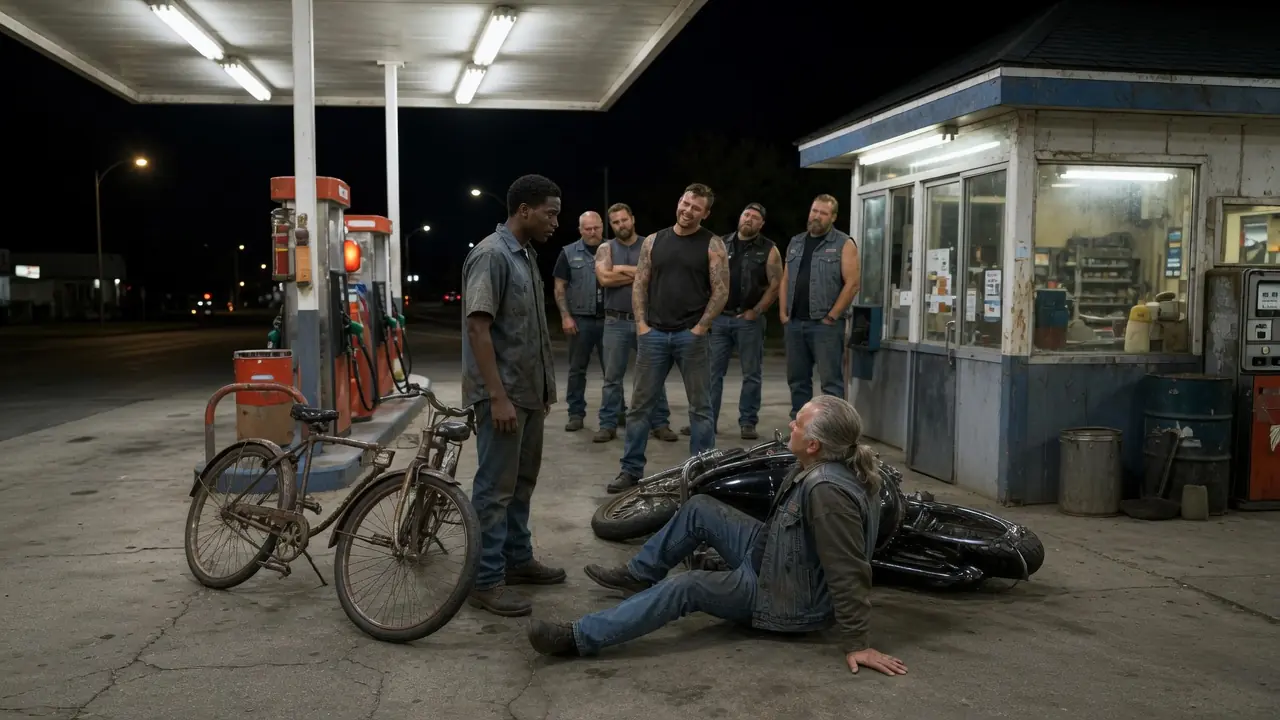
"Help me, please."
The biker lay on the ground, covering his face with his hands. His Harley tilted beside him.
"Mind your own business, one-eyed man."
Fletcher Aldridge did not move. He was 19, skinny, wearing a grease-stained shirt, with his left eye swollen shut from a mosquito bite.
"Let him go."
"What if I don't?"
"You scrawny stick."
Cody stepped forward.
"Want to be a hero?"
"Want me to make both your eyes the same size first?"
"Stop."
"Don't say that."
"Looks like you want us to teach you a lesson about sticking your swollen eye into other people's business."
Fletcher rolled his shoulders, cracked his neck, took one step forward, and what followed the next morning shook his entire town. To understand why Fletcher did what he did that night, you have to understand the life he was already fighting to hold together. Bellwood, Georgia, population 1,200. Used to be 3,000.
Used to have a paper mill that employed half the town. Three years ago, the mill shut down. No warning, no severance, just a chain on the gate and a sign that said closed until further notice. There was no further notice.
Main Street used to have a barber shop, a hardware store, a diner that made peach cobbler every Sunday. Now half the storefronts are boarded up. The diner closed last spring. The barber shop still opens three days a week, but the owner's thinking about leaving, too.
Young people don't stay in Bellwood. They graduate. They pack. They go.
Atlanta's four hours south. Augusta's two hours east. Anywhere is better than here. But Fletcher Aldridge stayed.
He stayed because of his grandmother, Nan Aldridge, 72 years old. Hands swollen at every knuckle. Knees so stiff some mornings she can't get out of bed without grabbing the headboard and pulling herself up inch by inch. Arthritis had been eating at her joints for 15 years.
The doctor told her she needed a knee replacement. Both knees, actually. $12,000. No insurance.
Might as well have said $12 million. Fletcher worked two jobs. His main job was at Jessup's Auto Repair, the last mechanic shop in Bellwood. The owner was Ruthie Jessup, 64, widow.
Tough as a railroad spike and just as thin. She paid Fletcher $11 an hour, not because she was cheap, but because that's all the shop could afford. Business was dying like everything else in town. After the shop closed at 6, Fletcher cut grass, fixed fences, patched roofs, cleaned gutters.
Whatever anybody needed, he showed up. Some weeks they paid him. Some weeks they just gave him food. He never complained.
Total income about 1,400 a month. After rent, electricity, groceries, and Nan's pain medication, he had almost nothing left. Almost nothing. But not nothing.
Under his bed, in a dented tin box that used to hold his grandfather's dog tags, Fletcher kept his savings. $2,340. Every dollar earned with his hands. Every dollar put aside for one thing.
The old community center on Pine Street. It had been shut down for five years now. The windows were cloudy with dust. The basketball hoop out back had no net.
The front door was padlocked. But if you pressed your face against the glass, you could still see the framed photo hanging on the far wall. Earl Aldridge, Fletcher's grandfather. Earl served 22 years in the United States Army.
Free. No signup sheet, no fees, just show up and learn. Fletcher was four years old the first time Earl put him on the mat.
"Hands up, chin down, breathe."
That was the first thing Earl ever taught him. Fletcher still heard it every morning. Earl didn't just teach him how to fight. He taught him how to stand, how to look someone in the eye when they were bigger than you.
How to stay calm when your body wanted to run. If you can protect somebody, Earl used to say, you don't get to choose not to. Fletcher was 14 when Earl died. Heart attack quick.
No warning. One morning he was teaching a class. That afternoon he was gone. The community center closed a month later.
Nobody else could run it. Nobody else had the time, the energy, or the heart. The kids who used to come every Saturday just stopped coming. Some of them ended up fine.
Some of them didn't. Fletcher never forgot what that building used to be. Every morning he rode his bicycle two miles to the shop. Every morning he passed the center, and every morning he slowed down just a little, looked through the dusty window, saw his grandfather's picture on the wall.
He told himself one day he'd open those doors again. That was the dream. 12,000 for Nan's knees, enough to renovate the center, a life that felt like it was always one emergency away from falling apart. But Fletcher never let it show.
He joked with Nan every evening, brought her coffee in the morning, rubbed her hands when the swelling got bad, told her everything was going to be fine. Some nights after she fell asleep, he sat on the front porch and did the math in his head. How many more months? How many more lawns?
How many more years? The numbers never worked, but he kept going because that's what Earl taught him. You don't stop. You don't quit.
You show up. Every morning before work, Fletcher stood on the front porch and stretched. Same routine Earl drilled into him since he was four. Roll the wrists, loosen the shoulders, breathe in through the nose, out through the mouth.
Nobody in Bellwood knew why he did it. They just saw a skinny kid stretching on his porch at 6:00 in the morning. They had no idea what those hands could do. That Tuesday night, Fletcher almost went home a different way.
He'd stayed late at the shop. A rush job came in around 5. A cracked radiator on a Ford F-150 that needed to be out by morning. Ruthie told him to go home.
He stayed anyway. Finished at quarter to 10. Ruthie handed him $40 cash and told him to eat something. Fletcher put the money in his front pocket and got on his bicycle.
The fastest way home was County Road 9, past the Sunoco station at the edge of town. The only gas station still open 9. One fluorescent light over the pumps. One cashier behind bulletproof glass.
The kind of place you don't stop at unless you have to. Fletcher didn't plan to stop. He was tired. 11 hours on his feet.
His left eye had been swollen shut since noon. A mosquito had gotten him good while he was under a Chevy that morning, and he'd been scratching it all day until the whole lid puffed up like a plum. He could barely see out of it now. All he wanted was to get home, make sure Nan took her pills, maybe eat whatever was left in the fridge, sleep.
But what Fletcher didn't know was that 6 minutes before he reached that gas station, a man had pulled in on a motorcycle. And that man's life was about to depend on a 19-year-old kid with one good eye and no reason to stop. His name was Garrett Hollis. 58 years old, 6'3, 220 lb, silver hair pulled back, leather jacket worn soft at the elbows, hands like a man who'd spent his whole life working with them because he had.
Garrett was a heavy equipment mechanic for 31 years before he retired. Built engines, welded steel, fixed things that most people gave up on. Every year since he turned 40, Garrett took the same trip solo. Just him and his Harley-Davidson Softail.
No destination, no schedule, just the road. It was how he reset, how he remembered who he was before the meetings and the phone calls and the responsibilities that came later. This year, he'd left Knoxville, Tennessee four days ago. Rode through the Smokies, down through North Georgia, heading for the Florida coast.
No crew, no patches on his jacket, no phone calls, just miles. By the time he pulled into the Sunoco station outside Bellwood, he'd been riding for 9 hours straight. His back was locked up. His hands were stiff on the grips.
His eyes were dry and heavy. He just needed gas, maybe some water. five minutes, then back on the road. He never got those five minutes.
Garrett was leaning against his bike, stretching his legs when the first shove came from behind. He didn't even see who hit him. One second he was standing, the next second his face was against the concrete and someone had a knee on his back. Five of them, all young, all local, led by a man named Cody Burrell.
Cody was 28. He'd worked at the paper mill since he was 19. When the mill closed, he lost everything. his job, his apartment, his girl.
He owed $11,000 in debt he couldn't pay. So Cody did what desperate men do when they run out of options. He made bad choices, worse choices every month. And he dragged four others down with him.
They'd been hitting travelers on this stretch of road for months. Bikers, truckers, anyone passing through who looked like they had something worth taking. Tonight it was the old man on the Harley. Garrett was strong.
Any other night he could have put up a fight, but nine hours on a motorcycle will drain a man. His reflexes were slow. His legs were stiff. And five against one, it doesn't matter how big you are, you're going down.
They pinned his arms, went through his pockets, took his wallet, took his watch. Cody kicked him in the ribs twice. Garrett curled up on the concrete, arms over his head, trying to protect his face. "Stay down, old man. Stay down and this will be over." But it wasn't over because Cody kept going, and the others followed. That's when Fletcher Aldridge came around the bend on his rusted bicycle. He heard it before he saw it. The sound of boots on concrete, a man groaning, the clatter of a motorcycle being knocked onto its side.
Fletcher squeezed his brakes and stopped at the edge of the lot. He saw the five men. He saw the old man on the ground.
He saw the Harley lying sideways, engine still ticking. He could have kept riding. Nobody saw him. Nobody knew he was there.
Fletcher thought about Nan, about the $40 in his pocket, about his one good eye. And then he thought about what Earl would have said. If you can protect somebody, you don't get to choose not to. Fletcher got off his bike.
What happened next? Nobody in Bellwood would have believed it if the gas station camera hadn't caught every second. Fletcher walked across that parking lot like he was walking into work. No running, no yelling, just steady steps on cracked asphalt.
Cody saw him first. Turned around, looked him up and down.
"What are you doing to that man?"
Five heads turned. Five big, burly, tattooed thugs.
"Help me, please."
The biker lay on the ground, covering his face with his hands, his Harley tilted beside him.
"Mind your own business, one-eyed man."
Fletcher didn't move.
"Let him go."
"What if I don't?"
"You scrawny stick."
Cody stepped forward.
"Want to be a hero?"
"Want me to make both your eyes the same size first?"
Cody laughed.
"Looks like you want us to teach you a lesson about sticking your swollen eye into other people's business."
Fletcher rolled his shoulders, cracked his neck, took one step forward. Cody stopped laughing. The first attacker came from the left, fast, with big arms swinging wide. Fletcher couldn't see him clearly.
The mosquito bite had his left eye nearly sealed shut. But Earl had trained him for that. Don't rely on your eyes, Earl used to say. Feel the weight shift.
Feel the air move. Fletcher dropped low, shot in under the man's arms, grabbed both legs behind the knees, drove forward. The man hit the concrete back first hard. Didn't get up.
The second attacker came right behind him. Fletcher was still on the ground. He rolled, got to his knees, and caught a fist square in the ribs. Pain shot through his side.
He gasped, but he didn't stop. He grabbed the man's wrist, pulled him forward off balance, hooked his hip under him, and flipped him over his shoulder. The man crashed into the gas pump island and stayed down. Two down, three left.
Fletcher stood up. His ribs screamed. His good eye was watering. His lip had split somewhere in the scramble.
He could taste it. The three remaining men spread out, Cody in the middle, the other two on each side. They were done laughing now. This skinny kid had just dropped two of their boys in less than 15 seconds.
"You're dead," Cody said. His voice wasn't joking anymore. They rushed him at the same time. This was the moment.
The moment that separates people who know how to fight from people who've been taught how to survive. Earl's voice, clear as mourning. When they come together, they trip together. Use their weight.
Use their speed. They'll do the work for you. Cody reached Fletcher first through a wide right hand. Fletcher ducked under it.
A wrestler's level change low and tight. He grabbed Cody's wrist with both hands, planted his feet, and used Cody's own momentum to swing him sideways straight into the two men coming from the right. All three of them went down in a heap, arms tangled, legs crossed, Cody on the bottom. The other two piled on top.
Before any of them could move, Fletcher was on Cody, knee on his back, wrist pinned behind him, arm locked at the elbow. Cody screamed, tried to twist free, but he couldn't. "Stay down," Fletcher said. He was breathing hard.
His voice was shaking.
"Stay down."
The other two scrambled to their feet, looked at Fletcher, looked at their two boys still on the ground by the pump, looked at Cody, pinned and yelling. They ran. The two by the pump got up next, limping, one holding his back. They didn't look at Fletcher.
They just followed the others into the dark. Cody was the last one left. Fletcher held the lock for another five seconds. Then he let go, stepped back.
Cody rolled over, looked up at Fletcher with something between rage and disbelief. Then he got to his feet, and walked away slowly without turning around. The whole thing took 53 seconds. The parking lot was quiet now.
Just the hum of the fluorescent light and the ticking of the Harley's engine cooling down. Fletcher stood there for a moment. His hands were trembling, not from fear, from the adrenaline draining out of his body all at once. His ribs throbbed with every breath.
His lip was swelling. His left eye, the one the mosquito had already shut, was pounding now from the strain of trying to see through it. He looked down at his knuckles, swollen, scraped raw. These were the same hands that had changed brake pads 12 hours ago.
The same hands that rubbed Nan's fingers when the swelling got bad. The same hands Earl had wrapped in tape every Saturday morning and said, "These are for protecting, not for hurting." Fletcher turned to the old man on the ground. Garrett Hollis was lying on his side, arms still over his face, his body trembling. Not from the cold, from the shock.
Nine hours on a motorcycle had drained him down to nothing. His legs hadn't worked fast enough. His arms hadn't swung hard enough. A man who'd spent 31 years bending steel with his bare hands, and he couldn't even stand up when it mattered.
He'd been riding alone for four days through open country and quiet towns. He'd felt free, untouchable, and then five strangers had put him face down on the concrete and taken everything in his pockets while he couldn't do a thing about it. He was shaking and he couldn't stop. Fletcher knelt beside him.
"Hey, it's over."
"They're gone."
Garrett lowered his arms. His face was swollen along the jaw. His eyes were wet. He looked at Fletcher, this skinny kid with one eye shut, a split lip holding his ribs.
"You're hurt," Garrett said.
"I'm fine."
"Your eye."
"That's a mosquito."
Fletcher almost smiled.
"The rest is new."
Fletcher helped him sit up, leaned him against the gas pump. Went to his bicycle and pulled a small first aid pouch from the saddle bag, the one he kept for work, full of band-aids and antiseptic wipes from the shop. He cleaned the scrape on Garrett's forehead, pressed a bandage above his brow. Garrett watched him the whole time.
This kid's hands were still shaking from the fight, but they didn't shake when they held the bandage. They were steady, patient, careful, like he'd done this a thousand times.
"You fight like you've done this before," Garrett said quietly.
"My granddad taught me a long time ago."
"He taught you well."
"He taught me everything."
Fletcher finished with the bandage, then sat down next to Garrett on the concrete. Both of them breathing hard, both of them hurting. Two strangers who hadn't known each other 15 minutes ago, sitting under a gas station light like they'd been through a war together. Garrett looked at Fletcher's hands.
Swollen knuckles, grease under the nails. A kid who worked with his hands for a living, just like Garrett had once. Something shifted in Garrett's face. not just gratitude, something deeper, recognition.
He looked down at his own hand. On his right ring finger sat a thick silver signet ring engraved with three letters IRB. Inside his leather jacket, stitched in small white thread along the inner collar were the words Iron Ridge, established 1989. Fletcher didn't notice either one.
He was too busy making sure the old man could breathe. But Fletcher didn't leave, and what he did next said more about him than the fight ever could. He pulled out his phone, cracked screen, 3% battery, and called 911. Then he sat down on the concrete next to Garrett and waited.
Neither of them talked for a while. Just two strangers sitting under a flickering fluorescent light, listening to the Harley tick and cool. Garrett was the first to speak.
"What's your name?"
"Fletcher. Fletcher Aldridge."
"How old are you, Fletcher?"
"Nineteen."
Garrett shook his head slowly.
"Nineteen."
He said it like he couldn't believe it, like the number didn't match what he just watched.
"Where'd you learn to fight like that?"
My granddad, Earl Aldridge, Army combatives instructor, 22 years. And he taught you all that since I was four. Every Saturday at the community center on Pine Street, Fletcher paused before it closed.
"What do you do now?"
"Fix cars."
"Jessup's Auto Repair."
"Only shop left in town."
Somewhere down the road, a siren started up.
"You got family?"
My grandmother, Nan, she raised me after my granddad passed.
"She know you're out here fighting five men at a gas station?"
"No, sir."
and I'd appreciate it if we kept that between us. Garrett looked at Fletcher for a long time. This kid had just taken a beating to save a man he'd never met. His ribs were bruised, his lip was swollen, his one good eye was bloodshot from the strain, and he was sitting here cracking jokes about keeping it a secret from his grandma.
Garrett reached into his back pocket. His wallet was gone. Cody's crew had taken it. But in the inside pocket of his leather jacket, zipped shut, was a fold of emergency cash he always kept when he rode.
He pulled out $500, five crisp bills, held them out.
"Take it."
Fletcher looked at the money, then back at Garrett.
"No, sir."
"Son, you just saved my life."
"I didn't do it for money."
Fletcher's voice was quiet but firm.
"My granddad would have done the same thing."
"He wouldn't have taken money either."
Garrett held the bills there for another few seconds. Fletcher didn't reach for them. Didn't look at them again. Just sat there with his hands on his knees waiting for the ambulance.
Garrett put the money back inside his jacket. The ambulance arrived. Then a patrol car. The paramedics checked Garrett's ribs, cleaned the scrape on his forehead, wrapped his wrist.
The officer took a statement. Fletcher gave his version. Short, simple.
"I saw them hurting him. I stepped in."
When the officer walked away to radio in, Fletcher stood up and picked up his bicycle.
"Where are you going?" Garrett asked from the back of the ambulance.
"Home! My grandma's waiting."
"Fletcher?"
He turned around. Garrett reached into his jacket again. This time, from a small inner pocket near his chest, he pulled out something that wasn't money. It was a silver coin, old, heavy, about the size of a half dollar.
On one side, an eagle with its wings spread wide. On the other side, two words stamped into the metal. Ride or Die. "Hold on to that for me," Garrett said.
"I'll come back for it."
Fletcher looked at the coin, turned it over in his fingers. It was warm from sitting against Garrett's chest.
"What is it?"
"Something I don't give to many people."
Fletcher didn't understand, but he put it in his pocket. "Get home safe, son," Garrett said. Fletcher nodded, got on his bicycle, pedaled into the dark. 20 minutes later, he walked through the front door.
Nan was asleep in her chair. He put a blanket over her legs, made sure her pain pills were on the nightstand. Then, he sat on the front porch, pulled the silver coin from his pocket, held it up in the moonlight. Ride or Die.
He had no idea what it meant. no idea that by this time tomorrow, the man who handed him that coin would be standing in front of his house with 300 people behind him. Fletcher went to bed that night thinking it was over. A strange night, a strange man, a strange coin in his pocket, but it was done.
He was wrong. Wednesday morning, Fletcher showed up at Jessup's auto repair at 7 like always. Ruthie was already inside wiping down the counter with the same rag she'd been using for a decade. He told her what happened.
Not all of it, just enough. Five guys, a gas station, an old biker on the ground. Ruthie put down the rag, stared at him.
"You fought five men?"
"Yes, ma'am."
"By yourself?"
"Yes, ma'am."
"Boy, you could have been killed."
Her voice cracked on the last word. Then she grabbed his face with both hands and looked at his swollen eye, his bruised lip. She didn't say anything else. She didn't have to.
Fletcher went to work. Oil changes, brake pads, a transmission that wouldn't shift out of second. Normal Wednesday. Except it wasn't.
Around 9, a black SUV pulled up at the end of Main Street, parked across from the old community center. Nobody in Bellwood drove a car like that. tinted windows, out-of-state plates. Someone inside was taking pictures of the building.
Fletcher saw it from the shop window, but didn't think much of it. Around 11, Ruthie turned on the CB radio she kept on the shelf behind the register. She liked the chatter, kept her company. But today, between the usual trucker talk, she caught something different.
Motorcycle frequencies, a voice she didn't recognize. Confirm location, Bellwood, Georgia. Pine Street. Ruthie turned the volume up.
Nothing else came through. She looked at Fletcher. He shrugged. By noon, three Harleys rolled down Main Street.
Slow. Real slow. The riders looked around at the storefronts, at the community center, at the street signs. Then they turned at the light and rode out of town without stopping.
People noticed. In a town like Bellwood, three motorcycles on Main Street is an event. Miss Adeline at the post office asked if there was a rally somewhere. Old Gerald at the barberh shop said he hadn't seen that many bikes since 1998.
Fletcher didn't connect any of it. He was thinking about Nan's doctor appointment on Friday, thinking about whether he could pick up an extra lawn job this weekend. That evening, his phone rang. It was Pastor Elden Morris from Grace Baptist.
"Fletcher, son."
"I don't know what you did, but I just got a call from somebody asking about you."
He paused.
"Somebody important."
Fletcher sat down on the porchstep. The coin in his pocket suddenly felt heavier. The next morning, Fletcher heard it before he saw it. A sound like rolling thunder, low and steady, coming from the east down County Road 9.
But the sky was perfectly clear. Fletcher was sitting on the front porch with Nan. She had her coffee in both hands, the way she always held it, palms wrapped around the mug because her fingers couldn't grip the handle anymore. Fletcher was lacing up his boots for work.
The sound got louder. Nan set her mug down.
"What is that?"
Fletcher stood up, walked to the edge of the porch, looked down the road. At first, he thought it was a convoy. Military maybe. The rumble was too deep, too constant for regular traffic.
The porch railing vibrated under his hand. Nan's coffee rippled in the mug. Then the first motorcycle came around the bend. Then the second.
Then 10 more. Then 50. Then 100. Fletcher stopped counting at 200.
They just kept coming. A river of chrome and leather and exhaust filling Main Street from one end to the other. Harleys, Indians, Triumphs, old bikes, new bikes. every color, every style, and every single rider wore the same patch on the back of their jacket.
A silver eagle with its wings spread wide over three words: Iron Ridge Brotherhood. Bellwood had never seen anything like it. Doors opened up and down the street. People stepped onto their porches.
Kids stood on the sidewalk with their mouths open. Miss Adeline came out of the post office holding a stack of envelopes she forgot to put down. Old Gerald stood in the doorway of his barber shop, scissors still in his hand. Ruthie Jessup walked out of her shop with a wrench in her fist.
She stood at the curb and didn't say a word. Nobody knew what was happening. 300 motorcycles in a town of 1,200 people. Some folks looked nervous.
A few went back inside and locked their doors, but most of them just stood there watching, trying to make sense of it. The convoy slowed, then stopped right in front of Fletcher's house. The lead bike was a Harley-Davidson Softail. Same bike Fletcher had seen lying sideways on the gas station concrete two nights ago, but tonight it was upright, polished, and the man sitting on it looked nothing like the man who'd been curled up on the ground begging for help.
Garrett Hollis. Same silver hair, same big frame, but everything else was different. His leather jacket wasn't plain anymore. On the left chest, a patch read founder in gold thread.
On the back, the same silver eagle as everyone else, but larger with a banner underneath. Established 1989. His posture was straight. His eyes were clear.
This wasn't a tired old man on a road trip. This was a man that 300 people followed. Beside him, on a matte black Indian Chief, sat a younger man, 30 years old, same jaw, same build. A patch on his chest read, "Vice president." His name was Dane Hollis, Garrett's son.
Garrett swung his leg off the bike, took off his gloves, walked toward the porch. Fletcher stood at the top of the steps. Nan was behind him, one hand on his shoulder. Garrett stopped at the bottom of the steps, looked up at Fletcher, the same kid from Tuesday night.
Same grease-stained shirt, same swollen eye now fading to yellow around the edges. "You gave me back my life Tuesday night," Garrett said. His voice carried across the quiet street. 300 engines had gone silent.
"Now I want you to know whose life you saved."
Dane stepped forward, handed Fletcher a card, heavy card stock, embossed lettering. Garrett Hollis, founder, Iron Ridge Brotherhood, established 1989. Fletcher looked at the card, then at Garrett's hand. The silver ring, IRB, the same three letters he'd seen at the gas station, but hadn't understood.
Then he looked at Garrett's jacket. The eagle, the patches, the word founder, everything connected. "Iron Ridge Brotherhood," Garrett said, "started in 1989." Six guys, one garage in Knoxville.
I was 21 years old, working as a heavy equipment mechanic making $12 an hour. He paused. Let that sit. Today, we're 3,000 strong, 12 chapters across eight states.
We build houses after hurricanes. We escort kids to school when their neighborhoods aren't safe. We raise money for families who can't bury their own. That's what this brotherhood does.
Garrett looked back at the 300 riders behind him. Then back at Fletcher. Every year I ride alone. No patches, no crew, just me and the road.
I do it to remember where I started. to make sure I never forget what it feels like to have nothing but your hands and your word. His voice dropped lower. Tuesday night, I was on that ground.
58 years old, 6'3, 220 lb, and I couldn't do a thing. I was tired. I was alone. And I thought, "This is how it ends on a gas station floor in a town I've never heard of." He looked Fletcher dead in the eyes.
And then a 19-year-old kid with one good eye and a bicycle walked into five men for me. A kid who didn't know me, didn't ask who I was, didn't want my money, just help me because I needed help. Garrett's voice cracked. Just barely, just enough.
I've built a brotherhood of 3,000 people, and I'm standing here telling you what you did Tuesday night is the reason I built it. The street was silent. 300 riders, 1,200 townspeople. Nobody moved.
Fletcher didn't say anything. He couldn't. Nan's hand tightened on his shoulder. The coin in his pocket pressed against his leg.
Ride or Die. Now he understood what it meant. But Garrett Hollis didn't ride 300 miles with 300 brothers just to say thank you. He turned to the crowd that had gathered on the street.
Townspeople and bikers standing side by side. 1,200 locals who'd never seen anything like this and 300 riders who'd driven through the night to be here. "I want to show you all something," Garrett said. He walked down Main Street toward Pine Street.
The crowd followed. Fletcher followed. Nan held his arm, walking slow, one careful step at a time. They stopped in front of the old community center.
The building looked worse in daylight than it did through the dusty windows. The roof sagged in the middle. The gutters hung loose. The paint had peeled down to bare wood in patches.
The basketball hoop out back had rusted through. The front door was still padlocked with the same lock from five years ago. Garrett stood on the sidewalk and looked at it for a long time. Then he turned to Fletcher.
"This is the place your granddad built."
"Yes, sir."
"The place you've been saving to reopen?"
Fletcher didn't answer. He hadn't told Garrett that. He'd only mentioned the center existed. He looked at Pastor Morris, who gave a small nod.
The pastor had filled in the rest. Garrett turned to the crowd. My name is Garrett Hollis. I founded the Iron Ridge Brotherhood 37 years ago because a stranger helped me when I had nothing.
I was 21, broke, working 60 hours a week welding steel for $12 an hour. A man I'd never met gave me a place to sleep, fed me for a week, and told me one thing. He paused. He said, "The world doesn't owe you anything, but if someone helps you stand up, you spend the rest of your life helping others do the same." Garrett looked at the community center.
That's what this building was, a place where a man named Earl Aldridge helped kids stand up for free every Saturday because he believed that's what you do. He let the silence hold. Then he spoke again. Iron Ridge Brotherhood has 3,000 members across eight states.
Welders, carpenters, electricians, plumbers, roofers, men and women who build things with their hands for a living. He pointed at the building. We're going to rebuild this. Every wall, every floor, every window.
Our foundation will cover $350,000 in materials. Our members will do the labor. Volunteers, no contracts, no invoices, just hands. A murmur went through the crowd.
People looked at each other. Fletcher stood perfectly still. Garrett wasn't done. When it's finished, this building will have a gym, a classroom, a basketball court, and a free community health clinic on the ground floor.
He turned to Nan and looked her straight in the eyes.
"Ma'am, your grandson told me about your knees. The clinic will be staffed by volunteer physicians from our network, and the first appointment is yours."
Nan's chin trembled. She pressed her lips together and held Fletcher's arm tighter.
Garrett continued, "We're also establishing a scholarship, $50,000 a year, for any young person in Bellwood who wants to go to college but can't afford it." He paused again. This time when he spoke, his voice was quieter. "The scholarship will be called the Earl Aldridge Memorial Scholarship."
Nan made a sound, not a word, just a sound, like the air had been pulled out of her chest.
Her hand went to her mouth. Her eyes filled. Fletcher put his arm around her and held her up. The street was silent.
300 bikers, 1,200 townspeople. Nobody spoke. Garrett turned to Fletcher. And for you.
He reached into his jacket and pulled out a folded letter. Full scholarship. Georgia State University. Room board tuition covered.
And every summer you come work with me. I'll teach you everything I know about building things that last. Fletcher took the letter. His hands were shaking.
He opened it, read the first line, closed it. He looked at Garrett, then at the 300 people behind him, then at the building on Pine Street. "I didn't save you for any of this," Fletcher said. His voice was barely above a whisper.
Garrett smiled, the first real smile Fletcher had seen from him.
"I know, son."
"That's exactly why you're getting it."
Then Garrett reached into his pocket and pulled out a second silver coin identical to the one he'd given Fletcher at the gas station. He held it up so the crowd could see it. This coin, he said, I've given to two people in my life. The first was the man who helped me when I was 21.
He passed away in 2006. The second is the woman I married. She's been wearing hers on a chain around her neck for 28 years. He looked at Fletcher.
Tuesday night, I gave the third one to a kid at a gas station who didn't even ask my name. He put the coin back in his pocket. Three coins, 37 years, three people I'd trust with my life. He nodded at Fletcher.
You're one of them now. Fletcher stood there. He didn't speak. He couldn't.
Nan was crying into his shoulder. The townspeople were crying. Even Ruthie Jessup, tough, iron-spined Ruthie, had her hand over her eyes. Dane Hollis stepped forward and put a hand on Fletcher's shoulder.
"Welcome to the family, brother."
300 engines roared to life behind him, not in anger, not in threat, in salute. Now, I wish I could tell you that Bellwood opened its arms to 300 bikers on day one, but that's not what happened. The first week was tense. 300 strangers in leather rolling into a town of 1,200 people, a town where nothing good had happened in three years.
Some folks didn't trust it. Miss Adeline told Pastor Morris she thought it was a gang. Old Gerald locked his barber shop early two days in a row. A few families kept their kids inside.
But then something shifted. It started small. A biker named Doug 53, retired electrician from Macon, noticed the street light outside the post office had been out for months. Nobody asked him to fix it.
He just climbed up there with his tools and fixed it. That same afternoon, two riders patched a pothole on Elm Street that had been swallowing tires since January. By the end of the first week, Bellwood started to understand. These people weren't here to take, they were here to build.
Month one, the roof came off the community center. 30 Iron Ridge members showed up that Saturday with ladders, crowbars, and a flatbed full of lumber. They tore the old shingles down to the rafters. Fletcher was up there with them.
Grease stained shirts swapped for a hard hat that was two sizes too big. Nan sat in a lawn chair across the street and watched every single day. Month two, the walls went up. New drywall, new insulation.
The plumbing crew, six Brotherhood members from Savannah, redid every pipe in the building. The electrical team from Atlanta, rewired the whole structure to code. No contracts, no invoices, just hands, just brothers keeping their word. Month three, the community clinic opened on the ground floor.
Two volunteer physicians from the Brotherhood's network, one from Knoxville, one from Charlotte, set up a rotation two days a week. Free checkups, free prescriptions for seniors. Nan was the first patient. The doctor examined her knees, put her on a real treatment plan, and scheduled her for surgery three months out, covered by the Brotherhood's foundation fund.
When Fletcher got the call, he sat in the shop and put his head down on the workbench. Ruthie pretended not to see. Month four. Something happened that nobody expected.
Cody Burrell walked into Jessup's auto repair. He stood in the doorway for a full minute before Fletcher looked up. Neither of them spoke. Cody's hands were shaking.
His eyes were red.
"I'm not here to start anything," Cody said.
"I came to say I'm sorry."
Fletcher put down his wrench, looked at him.
"I know you are."
"I lost my job when the mill closed. I owed money I couldn't pay. I made bad choices. Real bad choices."
His voice broke.
"That don't make it right."
"I know that."
Fletcher nodded. "There's a warehouse logistics position open with a construction supplier connected to the Brotherhood," Fletcher said. "They're hiring." Cody stared at him.
"You do that after what I did?"
"My granddad gave second chances."
"I figure I should too."
Fletcher wrote the recommendation letter that night. Garrett interviewed Cody personally over the phone. Asked him one question. If someone gave you a second chance, what would you do with it?
Cody said, "I'd make sure I never needed a third one." He got the job. Month five. The building was finished. The sign went up on a Saturday morning, hand-painted by a Brotherhood member from Nashville who'd been a sign maker for 30 years.
Gold letters on dark wood. The Earl Aldridge Community Center. Inside the main hall, Earl's old photograph, the one Fletcher used to see through the dusty window, was cleaned, reframed, and mounted on the entrance wall. Beneath it, a brass plate read, "If you can protect somebody, you don't get to choose not to." Fletcher opened his first self-defense class that afternoon.
12 kids showed up. He taught them the same thing Earl taught him first.
"Hands up, chin down, breathe."
CBS Atlanta sent a crew. The story aired on a Thursday night. By Friday morning, the #BellwoodStrong had 40,000 posts across Georgia. Small businesses started calling about the empty storefronts on Main Street.
Ruthie Jessup got a maintenance contract with three Iron Ridge chapters regular fleet service for their bikes. Her shop went from two cars a week to a full schedule. The first Earl Aldridge Memorial Scholarship was awarded to a young woman from Bellwood. Ruthie's daughter, Colleen Jessup, 18 years old, accepted into the nursing program at Augusta University.
Ruthie didn't cry at the ceremony. She just squeezed her daughter's hands so hard her knuckles turned white. Bellwood wasn't dying anymore. But the moment that stays with me, the one I can't stop thinking about, happened 6 months later on a Tuesday night.
Fletcher was locking up the community center. The last class of the day had just ended. 12 kids, same group that had been showing up every Saturday since the doors reopened. He wiped down the mats, stacked the pads, turned off the lights one by one.
He was about to lock the front door when he saw someone outside. A kid standing on the sidewalk. 18 maybe. Black, thin, shoes worn through at the toe.
hoodie too big for his frame, hands in his pockets. He was looking through the glass door at the gym inside. He looked exactly like Fletcher had looked five years ago. "Is this free?" the kid asked quietly, like he was afraid the answer would be no.
Fletcher held the door open. "Always." He turned the gym lights back on, put one mat down in the center of the floor, stood across from the kid.
"What's your name?"
"Deshawn."
"All right, Deshawn."
"First thing first."
Fletcher rolled his wrists, loosened his shoulders, breathed in through the nose, out through the mouth. The same warm-up Earl had drilled into him since he was four years old. Deshawn watched, then copied him. Clumsy, stiff, but trying.
"Hands up, chin down, breathe."
The same words, the same mat, the same building, a different generation. On the wall behind them, two photographs hung side by side. The first was Earl Aldridge, the one that had been there since the beginning, now cleaned and reframed in dark wood. The second was new, Fletcher, Garrett, Dane, and 300 Iron Ridge members standing in front of the building on opening day.
The sun was hitting the sign above them, the Earl Aldridge Community Center. Fletcher locked up an hour later, got on his bicycle, and pedaled home through the warm Georgia night. He rode past the Sunoco station, new lights, a security camera on the pole, and a small metal plaque bolted to the wall in honor of an act of courage. October 2026.
Fletcher didn't stop, just smiled as he passed. When he got home, Nan was sitting on the porch. She looked different, too. Stronger, steadier.
Three months post-surgery, she was holding her coffee mug by the handle, not with both palms like before. Her fingers could grip again. Fletcher sat down next to her. Neither of them said anything for a while, just the crickets and the night air.
In his pocket, the silver coin pressed against his leg. Ride or Die. Some people wait for the world to change. Fletcher Aldridge just showed up at a gas station with one good eye and a choice.