The year was 1818, and London had settled into the damp, persistent chill of late autumn. A fine mist, smelling of coal smoke and wet wool, clung to the gray stone of the city, blurring the edges of the townhouses and turning the cobbled streets into slick, treacherous pathways. It was a season that promised little and delivered less. A time of shortened days and long, cold nights that seemed to seep through the very walls of the less fortunate houses.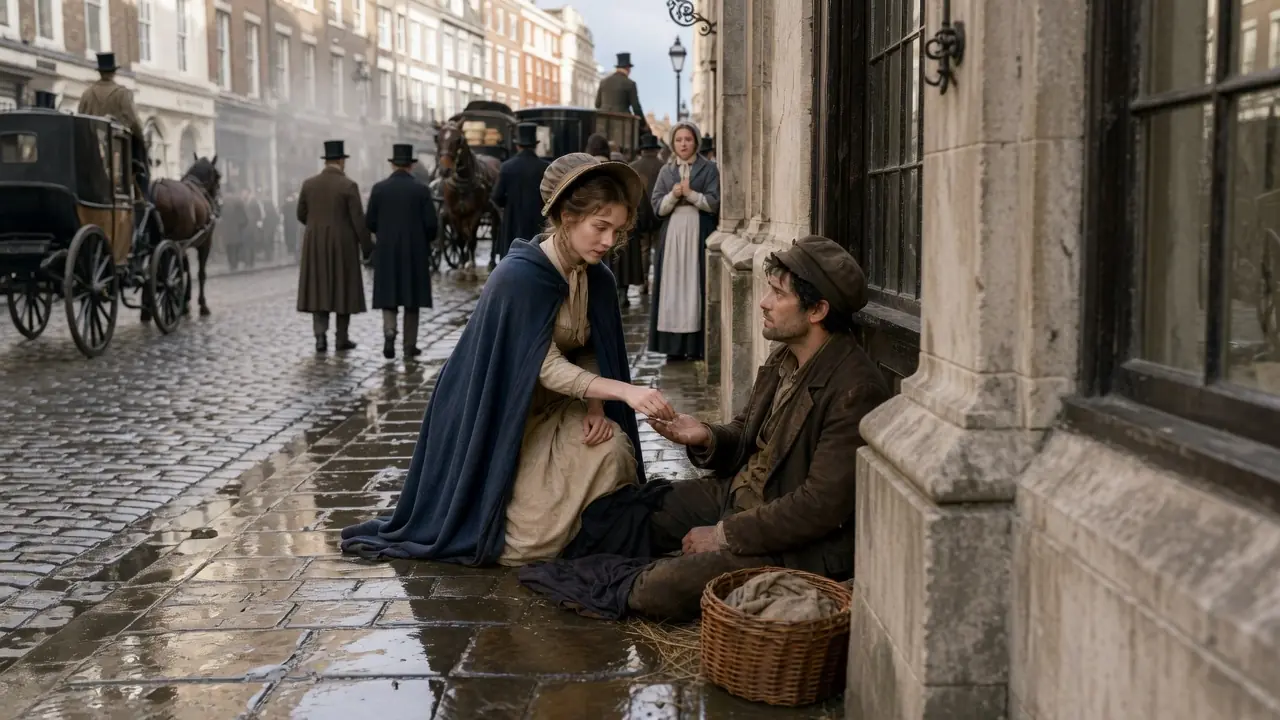
In a modest second-floor apartment on a respectable but fading street in Bloomsbury, Miss Margaret Dartmere felt the chill not as an abstract feature of the season, but as a constant, unwelcome companion. It lived in the draft that whispered under the door and in the thinness of the blanket on her bed. Today, it was a particularly keen presence, for the small box where she kept their household money held only a single, solitary shilling.
It was not a new predicament, but its familiarity did not blunt its sharpness. Since her father's death three years prior, life for Margaret and her mother had become a careful, quiet exercise in management. Captain Dartmere had been a good man, a naval officer of respectable service but little fortune, and his pension had died with him. What little remained had been stretched thin, piece by painstaking piece, until it had become this: a single coin between them and the encroaching void.
Margaret, at twenty-four, wore her beauty as she wore her gowns, with a quiet dignity that belied their lack of fashion. Her hair, the color of rich, dark soil, was coiled simply at the nape of her neck, and her eyes, a clear, thoughtful hazel, held a serenity that was hard-won. She was not given to despair. Despair, she had learned, was a luxury. It changed nothing. Action, however small, was the only remedy.
And so, pulling her plainest gray wool shawl tightly around her shoulders, she prepared to act. The shilling would buy a small loaf of bread, perhaps some cheese if the baker was feeling generous. It would be enough for today. Tomorrow remained a problem for tomorrow.
Her mother was resting, a fragile figure in the dim light of the sitting room, her breath a soft, shallow rhythm. Margaret did not wish to disturb her. She slipped out of the apartment, her footsteps making almost no sound on the worn stairs, and emerged into the mist-shrouded street.
The air was thick and heavy. The clatter of carriage wheels and the cries of street vendors were muffled, distant sounds in the enveloping fog. She kept her head down, her gaze fixed on the uneven flagstones, her mind already at the baker's shop, calculating.
It was then that she saw him.
He was huddled in a recessed doorway, a figure made of rags and shadow. So still, he might have been part of the decaying architecture. Most Londoners, even those of modest means, learned to walk past such sights without seeing. It was a necessary armor against a city filled with endless, overwhelming need.
Margaret, however, stopped. It was not a conscious decision. Something about his stillness, the abject slump of his shoulders, cut through her own anxieties. He was not calling out, not rattling a cup, not even looking up. He seemed to have surrendered entirely.
He was a man folded into himself, braced against a world that had forgotten him. She saw the tremor in his hands, tucked beneath the thin, tattered coat he wore. She saw the grime on a face that, beneath the dirt and the rough stubble of a beard, held the sharp, clean lines of good bone structure. His hair, a dark chestnut brown, was matted and unkempt. He looked utterly, hopelessly defeated.
Margaret thought of the shilling in her reticule. It was their supper. It was their only defense against the gnawing hunger that was never truly absent. Her stomach gave a faint, protesting clench. Her mother needed to eat.
But the man in the doorway looked as though he had not eaten in days. His need, in that moment, felt greater than her own. It was a raw, elemental thing, a silent testament to the city's casual cruelty. She hesitated for only a moment. One second. Two seconds. Three.
Then, her decision made, she walked toward him. She knelt, her knees protesting the cold, damp stone. He did not stir. She could see his eyes now from beneath the shadow of his brow. They were a startling color, a deep, turbulent gray, like a stormy sea, and they were utterly devoid of hope.
"Sir," she said softly.
He flinched at the address, the title a mockery of his state. His gaze flickered toward her, wary and suspicious. He expected a command to move on, a word of disgust.
Instead, she held out her hand. Resting in her palm was the shilling, the single shining coin. His storm-gray eyes fixed on it, then lifted to her face. A flicker of disbelief, of profound confusion, crossed his features. He looked from the coin to her plain, worn clothing, the threadbare shawl. He was a beggar, but she was clearly not a woman of means.
"Take it," she urged, her voice quiet but firm. "Please. You need it more."
He did not move. He simply stared at her, a long, searching look that seemed to peel back the layers of her weary composure and see the frightened, determined young woman beneath. It was an unnerving gaze, intelligent and assessing. For a moment, she felt a strange sense of being truly seen.
She pressed the coin into his cold, calloused hand, her fingers brushing his for a brief instant. His skin was like ice. She closed his fingers over the shilling.
"Get something warm to eat," she said, her voice softening with an empathy that was as real as her own hunger.
Then she stood, pulled her shawl tighter, and turned to walk away, leaving him in the shadowed doorway with their last shilling in his hand. She did not look back. There was no point. The act was done.
She expected no thanks, no reward. It was a simple, stark transaction of human kindness, offered without condition. As she walked on toward the empty promise of the baker's shop, a strange sense of peace settled over her. She had nothing, and yet she did not feel poor.
Nicholas, Duke of Whitchurch, remained in the doorway long after she had disappeared into the mist. The small, surprisingly warm shilling was a solid weight in his palm. He looked down at it, then in the direction she had gone.
He was not a beggar. He was, in fact, one of the wealthiest and most powerful men in England. The rags were a costume, the grime a carefully applied theatrical touch. The entire sordid scene was a charade, a test of his own devising.
And Miss Margaret Dartmere, his intended bride, had just passed it in a way he could never have anticipated.
The arrangement had been his solicitor's idea. Following the tragic death of his younger brother and his wife in a carriage accident, Nicholas had become the sole guardian of their only child, his eight-year-old niece, Lily. But the girl's maternal relations, the Crawfords, a grasping, ambitious family of minor gentry, were contesting the guardianship.
Their claim was that Nicholas, a notorious recluse known for his cold demeanor and solitary habits, was an unfit parent. His man of business, Mr. Hargrove, had been blunt.
"They will use your bachelorhood against you, Your Grace. The magistrate will see a cold, single man versus a wholesome, if odious, family. You need a wife, a duchess, a woman of unimpeachable character to be the mistress of Larchbridge and a mother to the child."
The suggestion was as distasteful as it was practical. Nicholas had no interest in marriage, no time for the simpering debutantes of the ton. Love, in his experience, was a transaction, a weakness, a prelude to loss. But he would do anything to protect Lily, to honor the promise he had made to his dying brother.
But Nicholas was a man who trusted nothing on paper. He had seen too much of the world's duplicity, the smiling faces that hid grasping hearts. He needed to know the true nature of the woman who would be entrusted with his brother's child. And so he had concocted this plan, this descent into the squalor of London's streets, to see her for himself, unseen.
He had expected to observe her from a distance, to note her comportment, her expression. He had not expected her to approach him. He had certainly not expected her to kneel in the filthy street and offer him her last coin.
The sheer, uncalculated generosity of the act stunned him. She had nothing. That was plain to see. Her clothes were worn. Her face held the fine lines of worry. That shilling was not a trifle to her. It was survival.
And she had given it away to a stranger. A wretch in a doorway. For no other reason than that she perceived his need to be greater. She had not done it for show. There was no audience. She had not done it with condescension, but with a quiet, shared humanity.
She had called him sir.
He closed his hand around the coin. The metal held the faint warmth of her skin. For the first time in a very long time, Nicholas felt something other than grief, duty, or cynicism. It was a strange, unsettling feeling, a crack in the icy armor he had built around his heart.
He did not have a name for it yet. But he knew with absolute certainty that he would never forget the face of the woman who had shown him such kindness when she believed he was nothing.
Two days later, a letter arrived. It was delivered not by the common post, but by a liveried footman whose presence on their humble doorstep caused a minor stir in the building. The envelope was thick, creamy parchment, sealed with a formidable crest of a wolf's head.
Margaret's mother, her hands trembling slightly, broke the seal. Her gasp was a sharp, brittle sound in the quiet room.
"Margaret," she whispered, her eyes wide with a mixture of terror and awe. "It is from the Duke of Whitchurch."
Margaret's heart gave a sudden, hard thump. The Duke of Whitchurch. A name spoken in whispers. A figure of immense wealth and legendary seclusion. What could he possibly want with them?
Her mother read the letter aloud, her voice wavering. It was penned not by the Duke himself, but by his solicitor. The language was precise, legal, and utterly devoid of sentiment. It spoke of a long-forgotten connection between her late father and the previous Duke. It spoke of the current Duke's awareness of their reduced circumstances.
Then it came to the point, a sentence so staggering it seemed to suck all the air from the room. His Grace, the Duke of Whitchurch, did them the honor of proposing a marriage of convenience with Miss Margaret Dartmere.
The letter went on to detail the terms: generous settlements, the paying of all their debts, a life of security and comfort. In exchange, Margaret would become the Duchess of Whitchurch. There was no mention of affection, no pretense of romance. It was a business contract. A lifeline.
Her mother looked at her, tears welling in her tired eyes. "Margaret," she breathed. "This is an answer to our prayers. We are saved."
Margaret felt a dizzying wave of vertigo. Saved. Yes, they would be saved from poverty, from the constant, grinding worry. Her mother would have doctors, warmth, good food.
But Margaret would be sold. A transaction, just as cold and clear as the shilling she had given away. She was to be a duchess in name, a placeholder wife for a man she had never met, a man known for his coldness and isolation.
But what choice did she have? To refuse was to condemn her mother to continued hardship and herself to a future of ever-deepening poverty. The quiet integrity she held so dear was now a luxury she could no longer afford. With a heavy heart and a steady hand, she penned the reply. She accepted His Grace's proposal.
A week later, the Duke was to call upon them. The day dawned with a sense of unreality. Margaret dressed in her best gown, a simple navy-blue muslin that had been mended more than once. There was a frantic energy in their small apartment, a mix of her mother's fluttering excitement and Margaret's own leaden dread.
At precisely two o'clock, a grand carriage, its panels bearing the same wolf's head crest, drew up outside. The entire street seemed to fall silent. The footman announced him.
"His Grace, the Duke of Whitchurch."
Margaret stood, her hands clasped tightly in front of her, her breath caught in her throat. She kept her eyes down, bracing herself for the appearance of this cold, formidable stranger to whom she had sold her life.
He entered the room. He was tall, impeccably dressed in a coat of dark blue superfine wool that fit his broad shoulders perfectly. His cravat was a masterpiece of crisp white linen. He moved with a contained, powerful grace.
Her mother gave a small, reverent curtsy. Margaret forced herself to do the same, her eyes still on the floor.
"Miss Dartmere," a deep, quiet voice said.
She lifted her head, and the world stopped.
It was not the fine clothes, nor the aristocratic bearing, nor the title. It was his face. The sharp, clean lines of his jaw and cheekbones were no longer hidden by grime. The chestnut hair was no longer matted, but clean and impeccably styled.
But the eyes were unmistakable. They were the same turbulent, storm-gray color, the same intelligent, assessing gaze that had met hers in that filthy doorway.
He was the beggar.
A gasp escaped her lips, a small, choked sound. She felt the blood drain from her face. Her mind reeled, trying to connect two impossible realities. The wretch in the doorway and the powerful duke in her drawing room were the same man.
He saw her recognition. She was certain of it. For the briefest of moments, a flicker of something unreadable passed through his gaze. It was not triumph. It was not amusement. It was something quieter, more complex. Then the mask of cool, aristocratic indifference snapped back into place.
He did not acknowledge it. He gave no sign. He simply stood there, the Duke of Whitchurch, looking at her as if they were complete strangers.
"I trust my solicitor's correspondence was clear," he said, his voice as cool and remote as a winter sky.
The lie of it, the cold denial in his expression, was more shocking than the truth itself. He knew. He had to know. He was pretending. The kindness she had offered, the moment of shared humanity, had it all been a game to him? A cruel test he had engineered?
A cold fury, something she had not felt in years, rose within her, momentarily eclipsing her shock. She had been played. Her poverty and her compassion had been put on display for his private assessment. She straightened her spine, lifting her chin.
The hurt was a sharp, physical pain, but she would not show it. She would not give him the satisfaction. If he could pretend, so could she. She would meet his coldness with her own.
"Perfectly clear, Your Grace," she said, her voice betraying none of the turmoil within her. "It was a business proposal. I have accepted the terms."
Something moved at the corner of his mouth. Not quite a smile. The almost of one. It was a fleeting acknowledgement of her steel.
He turned his attention to her mother, his manner polite but distant, discussing the arrangements for the swift, quiet wedding. Margaret stood by, a silent statue, her mind a whirlwind of confusion and betrayal.
She had pitied him. She had given him their last shilling. All the while, he had been a duke, weighing her worth like a merchant assessing livestock. The man she was to marry was not a stranger. He was the beggar from the doorway.
And she already knew, with a certainty that chilled her to the bone, that his heart was a place of ice and shadow. Her act of kindness had not been received. It had been inventoried.
The wedding was a swift, sterile affair, conducted by special license in the Duke's London residence, a vast, silent townhouse in St. James's Square. Only Margaret's mother, the solicitor Mr. Hargrove, and a formidable-looking older woman introduced as the Duke's great-aunt, Lady Hortense, were in attendance.
Margaret moved through the ceremony as if in a dream. She wore a simple gown of cream-colored silk, provided by the Duke's household, which felt as foreign on her skin as her new title. She made her vows in a clear, steady voice, her gaze fixed on a point just over her new husband's shoulder.
She would not look into those storm-gray eyes. She would not give him the chance to see the hurt she was so desperately trying to conceal.
Nicholas, for his part, was a study in cool control. He was polite, correct, and utterly remote. He spoke his vows with the same detached precision with which he might have signed a deed.
To any observer, they were two strangers embarking on a mutually beneficial arrangement. Only Margaret knew the secret that lay between them, the shared moment in a misty doorway that he refused to acknowledge and she could not forget.
Immediately after the brief wedding breakfast, they were to depart for Larchbridge, the ducal seat in Hertfordshire. Margaret's mother, now installed in a comfortable suite of rooms in the London house with a companion and medical care, wept with a mixture of joy and sorrow as she bade her daughter farewell.
"Be happy, my dear," she whispered, clinging to Margaret's hand. "He is a good man. I am sure of it. Just quiet."
Margaret managed to smile. "I will be well, Mother. You are to rest and get strong."
The carriage journey was conducted in near total silence. Margaret, now the Duchess of Whitchurch, sat opposite her husband, the chasm between them wider and colder than the few feet of carriage floor. She stared out the window, watching the gray terraces of London give way to the rain-washed greens of the countryside.
Duchess. The word felt like a costume she was wearing, ill-fitting and absurd.
Nicholas did not attempt to speak. He sat with a book open on his lap, though she never once saw him turn a page. His gaze was fixed on the landscape, his profile sharp and unyielding against the window.
What was he thinking? Was he congratulating himself on his clever ruse? Did he feel any shame? Any guilt? The questions burned in her mind, but she would not ask them. Her pride was the only thing she had left that was truly her own.
They arrived at Larchbridge as dusk was falling. The carriage swept through imposing iron gates topped with the familiar wolf's head and down a long drive lined with ancient larch trees, their branches bare against the twilight sky. The house rose before them, a vast, magnificent pile of pale stone, its mullioned windows glowing with warm yellow light.
It was not a house. It was a statement of power, of history, of immense, unbreachable wealth. It was beautiful, and it was the most intimidating place Margaret had ever seen.
The entire household staff was assembled in the cavernous marble entrance hall to greet their new Duchess. A stern, gray-haired housekeeper, Mrs. Graves, stepped forward and curtsied.
"Welcome to Larchbridge, Your Grace."
Margaret inclined her head, her voice a little small in the echoing space. "Thank you, Mrs. Graves."
Nicholas spoke for the first time since they had left London. "Mrs. Graves will show you to your rooms. I have business in my study."
With a curt nod, he was gone, disappearing down a long corridor and leaving her alone in the center of his world.
The coldness of the dismissal was a physical blow. He had brought her to his home and abandoned her on the threshold. Mrs. Graves' expression was unreadable.
"If you will follow me, Your Grace."
Margaret followed the housekeeper up a grand, sweeping staircase, her hand trailing on the cool, polished oak of the banister. The apartments were a suite of rooms larger than her entire London flat. There was a sitting room with a fireplace already crackling, a spacious bedchamber dominated by a vast canopied bed, and a dressing room lined with wardrobes.
Inside those wardrobes, she discovered dozens of gowns of every color and fabric, shoes, gloves, hats, an entire life's worth of clothing, all in her size.
He had bought her a new life, down to the last stitch. The thought was suffocating. She was not a wife. She was an acquisition.
That night, she dined alone in her sitting room, served by a silent maid. She learned from the maid that the Duke often took his meals in his study when he was working. He was, it seemed, just as reclusive here as his reputation suggested.
After the meal, exhausted by the day's emotional turmoil, Margaret decided to seek out the one place that had always offered her solace: a library. She asked a passing footman for directions, and he led her to a pair of towering oak doors. She pushed them open and stepped inside.
The room was breathtaking, two stories high, lined from floor to ceiling with thousands of leather-bound books, with a gallery running around the upper level. A fire blazed in a hearth large enough to stand in. The air smelled of old paper, leather, and wood smoke.
It was a sanctuary. And it was not empty.
In a large wingback chair by the fire, a small figure was curled up, a book open on her lap. She was a little girl, perhaps eight or nine years old, with dark, serious eyes and two long, neat braids of brown hair. She looked up as Margaret entered, her expression startled and wary.
This must be Lily, the Duke's ward, the reason for this entire charade of a marriage.
Before Margaret could speak, another voice cut through the silence, sharp and aristocratic.
"So, you have found your way to the heart of the house."
Margaret turned. Lady Hortense, the Duke's great-aunt, was seated in another chair, hidden in the shadows. She was a formidable old woman with eyes as sharp and intelligent as her grandnephew's.
"I hope I am not intruding," Margaret said quietly.
"Nonsense. You are the Duchess. The house is yours," Lady Hortense said, though her tone suggested the matter was still under debate. She gestured toward the child. "This is Lily, my great-grandniece."
The little girl gave a small, shy curtsy, her eyes fixed on the floor.
"It is a pleasure to meet you, Lily," Margaret said, her voice gentle.
Lily did not reply. She simply stared, her small face a mask of solemn grief. Margaret's heart went out to her. This child had lost her parents and been thrown into this vast, cold house with a man she barely knew.
"She does not speak much," Lady Hortense stated, not unkindly. "She has built a wall around herself, much like her uncle."
The observation was pointed. Margaret felt Lady Hortense's keen eyes on her, assessing her just as Nicholas had.
"Leave her be for now," the old woman advised. "She is like a frightened fawn. Any sudden movement will send her bolting."
Margaret nodded, understanding. She did not try to force a conversation. Instead, she walked to a nearby shelf and ran her fingers over the spines of the books. She found a slim volume of poetry and took it to a chair on the other side of the hearth, a respectable distance from the others.
She did not read. She simply sat with the book in her lap, feeling the warmth of the fire on her face. For the first time all day, a small measure of peace began to settle over her. She was in a library, surrounded by books, and in the quiet company of a grieving child and a watchful old woman, she felt, for a fleeting moment, a little less alone.
Nicholas found them there an hour later. He stopped in the doorway, and for a moment, he just watched the scene by the fire: his great-aunt, sharp and alert as a hawk; his niece, lost in her own silent world; and his new wife, a still, quiet presence, her head bent over a book, the firelight catching the rich, dark sheen of her hair.
She had not created a scene upon her arrival. She had not made demands. She had not wept or raged at his coldness. She had found the library and settled into the quiet heart of his family without a single word.
He had expected tears, recriminations, a woman who would demand the affection his title promised. He had been prepared for that. He was not prepared for this quiet, unnerving dignity.
It was the same quality she had possessed when she knelt in the street, a duchess in spirit long before she wore the title.
He stepped into the room. Three pairs of eyes turned to him. Lady Hortense's were knowing. Lily's were fearful. But Margaret's expression was perfectly, infuriatingly neutral. She looked at him as if he were a stranger she was seeing for the first time.
The duchess had erased the beggar entirely.
"Your Grace," she said, her voice calm and even.
He had wanted a wife of unimpeachable character, a woman of dignity and grace. It seemed he had gotten exactly what he had asked for. As he stood in the doorway of his own library, a stranger in his own home, Nicholas, Duke of Whitchurch, began to suspect that this quiet, dignified woman would be far more difficult to manage than any weeping debutante.
He had tested her and found her worthy. Now it seemed she was testing him.
The days at Larchbridge unfolded with a quiet, formal rhythm. Margaret learned the vast geography of the house, the names of the senior staff, and the intricate timetables that governed the lives of dozens of servants. She took her meals, more often than not, with Lady Hortense and a silent Lily in a small, sunny breakfast room.
The Duke remained a distant, remote figure, absorbed in the estate business that kept him locked in his study for most of the day. He was a ghost in his own house, a presence felt more than seen. Margaret would sometimes catch a glimpse of him crossing the hall or see him from a window, walking the grounds with his long, purposeful stride.
They exchanged polite, empty greetings when they chanced to meet.
"Your Grace."
"Your Grace."
They were like two actors in a play, reciting lines that had no meaning.
The secret of the beggar lay between them, a silent, unexploded bomb. The more he pretended it had not happened, the more it dominated Margaret's thoughts. The memory of his ravaged face, his hopeless eyes, was superimposed over the image of the cold, controlled Duke.
How could one man be both? Her anger had cooled, leaving behind a deep, aching confusion. She found herself watching him, searching for a flicker of the man in the doorway. She found nothing. There was only the Duke, armored and inaccessible.
Her focus, by necessity, shifted to the child. Lily was a small, silent ghost who haunted the grand rooms of Larchbridge. She spoke only in monosyllables to her uncle and great-aunt, and not at all to Margaret. She spent her days with her governess, a stern, humorless woman named Miss Finch, or curled in a chair in the library, her face buried in a book.
Margaret knew she could not force the child's affection. Following Lady Hortense's advice, she did not press. Instead, she simply made herself a quiet, constant presence. When Lily was in the library, Margaret would be there too, reading her own book. When Lily and Miss Finch walked in the gardens, Margaret would stroll along a parallel path, never intruding, but always visible.
She began to learn the child's habits. She knew that Lily loved the small, crumbling folly at the edge of the woods. She knew the child was afraid of thunderstorms. She knew that Lily secretly fed crumbs from her bread roll to the sparrows on the terrace. Margaret cataloged these small particulars, building a silent understanding of the grieving girl.
One afternoon, Margaret was arranging some late-blooming roses in the morning room when Lily entered with her governess. Miss Finch gave a stiff nod and steered Lily toward the table for her drawing lesson. As Lily sat, a small sketchbook and a box of charcoals were placed before her.
Margaret finished with her roses and, instead of leaving, sat in a window seat with her embroidery. She watched as Lily began to draw. The child was talented. Her sketches were precise and full of a sad, delicate beauty. Today, she was drawing a bird, a wren she must have seen in the garden.
Suddenly, the charcoal stick snapped in her small fingers. A noise of pure frustration, sharp and pained, escaped Lily's lips. It was the most emotion Margaret had ever seen her express.
Miss Finch was instantly at her side. "There is no need for such a display, Lady Lily. Control yourself. It is only a piece of charcoal."
Tears welled in Lily's eyes. Her small chin trembled.
Before the governess could say more, Margaret stood and crossed the room. She knelt beside Lily's chair, bringing herself to the child's level.
"It is very frustrating when a tool breaks," Margaret said softly, her voice calm and even. She did not look at Miss Finch. Her attention was entirely on Lily. "Especially when you are in the middle of creating something so beautiful."
She gently took the two broken pieces of charcoal from the child's hand.
"Look," she said. "Now you do not have one tool. You have two. A short one for the fine, dark lines of the eye, and a longer one for the soft shading of the feathers."
Lily's tear-filled eyes looked from the broken sticks to Margaret's face. She saw no scolding there, no impatience, only understanding. Margaret placed the pieces back in her palm.
"Sometimes," she said, her voice barely a whisper, "things that are broken can be made useful again, just in a different way."
She gave the child's shoulder a light, fleeting touch, then stood and returned to her seat without another word.
Miss Finch looked on, her mouth a thin line of disapproval at the interruption, but she said nothing. After a moment, Lily picked up the smaller piece of charcoal. With a hesitant, careful motion, she drew the perfect, tiny, dark circle of the wren's eye.
From that day on, something shifted. It was almost imperceptible. Lily's gaze would no longer slide away when Margaret entered a room. Sometimes in the library, she would hold up a book to show Margaret a picture. She did not speak, but she shared.
It was a beginning.
Nicholas observed it all from a distance. He received daily reports from Mrs. Graves and Lady Hortense.
"The new Duchess is quiet, Your Grace," the housekeeper told him. "She asks for nothing, but the house feels lighter. The staff are fond of her."
Lady Hortense was more direct. "She is winning the girl," she said one evening in his study. "Not by force, but by patience. You chose better than you knew, nephew. She has a core of steel, that one, but it is wrapped in silk."
He saw it for himself. He saw the way Lily's eyes now followed Margaret around a room. He saw the wildflowers that started appearing in a small vase on the breakfast table, picked by a small hand. He saw the Duchess teaching Lily how to press flowers in a heavy book in the library.
He saw his wife's quiet, steady kindness beginning to penetrate the wall of his niece's grief. He had married her to be a mother to the child. She was fulfilling her part of the bargain with a grace and integrity he had not expected. She was doing it all while holding him at a polite, unbreachable distance.
The irony was not lost on him. He, who had built a fortress around his heart, now found himself on the outside of the small, warm circle of trust she was building with his niece. He was the master of the house, the Duke, the authority. And yet, in the quiet moments of his own home, he was an outsider.
One evening, he was working late in his study when a fierce autumn storm broke over Larchbridge. Rain lashed against the tall windows, and the wind howled around the eaves. A boom of thunder rattled the very foundations of the house.
A few moments later, there was a frantic knocking at his study door. It was Agnes, one of the younger housemaids, her face pale.
"Your Grace, begging your pardon, it is Lady Lily. The storm. She is terrified. She has hidden herself and will not come out. Miss Finch cannot coax her."
Nicholas felt a familiar pang of helpless frustration. He was her guardian, but he had no idea how to comfort a frightened child. He was about to rise when Agnes spoke again, her voice rushed.
"The Duchess, Your Grace. She is with her now."
"What?"
"Lady Lily ran to the Duchess's rooms. We found her there, hidden in the dressing room wardrobe. Her Grace is with her."
Nicholas strode from his study, down the long corridor, and up the main staircase. The door to Margaret's suite was ajar. He pushed it open and stood, unseen, in the doorway of the sitting room.
The bedchamber beyond was lit only by the soft glow of a single lamp. There, on the floor, was his wife. She had made a small tent of blankets draped over two chairs, creating a tiny, cozy cave. Inside, by the light of a safely enclosed candle, he could see the small shape of his niece and Margaret beside her.
He could not hear what she was saying, but her voice was a low, soothing murmur, a gentle counterpoint to the raging storm outside. After a moment, he saw Margaret hand Lily a book. Even from this distance, he recognized it. It was a book of fairy tales, the same one his own mother had read to him and his brother during childhood storms.
He watched as Margaret began to read, her voice rising and falling in the gentle cadence of the story. Lily, who had been a trembling ball of fear, slowly uncurled. She leaned her head against Margaret's shoulder. He saw his wife, his Duchess, instinctively wrap an arm around the child, pulling her close.
It was not a calculated gesture. It was a pure, unconscious act of comfort and protection.
A knot in his chest, one he had not even realized was there, loosened. He had married this woman for a purpose. He had set a test to gauge her character. He had treated her with coldness and distance, expecting her to be nothing more than a functional part of his household.
But what he was witnessing was not function. It was not duty. It was kindness. The same pure, unvarnished kindness she had shown a beggar in a London doorway. It was not a performance. It was the very essence of who she was.
He backed away from the door, his movements silent. He returned to his study, but he did not work. He stood by the window, watching the storm, the reflection in the glass showing him a man he barely recognized.
The Duke of Whitchurch, who had everything, felt a profound and unsettling envy for a frightened little girl tucked away in a blanket tent, being held by a woman who knew how to chase away the dark.
The next morning, news arrived that shattered the quiet routine of Larchbridge. A letter from Mr. Hargrove. The Crawfords had formally petitioned the courts. They were demanding a hearing to have Lily's guardianship transferred to them, citing the Duke's cold and reclusive nature and his recent, hasty marriage to a penniless unknown as proof of his instability.
A magistrate would convene a hearing at the local town hall in a fortnight. The battle he had sought to avoid by marrying was now upon them. And Margaret, his quiet, dignified wife, was now at the very center of it. Her character, her suitability, her very presence at Larchbridge would be scrutinized and attacked.
He had brought her into this, and he did not know if she had the strength to withstand it.
The news of the hearing cast a pall over the house. The staff grew quieter, their movements more subdued, as if they too felt the impending threat. Nicholas became even more remote, closeted for hours with Mr. Hargrove, who had traveled down from London. Margaret would see them in the study, surrounded by papers and law books, their faces grim.
Her husband barely spoke to her about the matter. He informed her of the hearing in his study, his voice clipped and formal.
"The Crawfords have made their move," he said, not looking at her, his gaze fixed on a map of the estate. "Hargrove is confident, but they will be unpleasant. They will attack my character, and by extension, yours. I regret that you are to be subjected to this."
The apology, if it could be called that, was as cold as everything else he said. I regret that you are to be subjected to this. As if she were a piece of property that might be damaged in a skirmish.
"I am your wife, Your Grace," she replied, her voice steady. "My character will withstand their scrutiny."
He finally looked at her then, a long, searching look.
"I do not doubt that," he said.
The simple, quiet sincerity in his voice surprised her. It was the first time he had offered her anything that felt like genuine respect.
In the days leading up to the hearing, Margaret focused on Lily. The child was unaware of the legal battle swirling around her, but she was sensitive to the tension in the house. She grew more withdrawn, her brief flashes of openness disappearing behind the old, solemn mask.
Margaret knew that the best defense against the Crawfords' accusations was the truth of Lily's well-being. She redoubled her quiet efforts, spending her afternoons with Lily and the new governess Nicholas had hired at Lady Hortense's insistence, a warm, gentle woman named Mrs. Allen. They read together in the library. They practiced sketching.
One afternoon, Margaret took Lily to the kitchens and, with the cook's amused permission, they made a batch of slightly lopsided sugar biscuits. Lily, her face smudged with flour, actually laughed. A real, bubbling laugh.
The sound was so unexpected and so beautiful that it brought tears to Margaret's eyes. She did not know that Nicholas, passing the kitchen corridor, had heard it too. He stopped, listening to the sound of his niece's laughter for the first time since her parents' death and the sound of his wife's low, encouraging voice.
He stood there for a long time, hidden from view, a silent witness to the life she was breathing back into his family.
The evening before the hearing, Margaret found she could not settle. The weight of the next day was a physical pressure in her chest. She wandered into the library, seeking its familiar comfort.
Nicholas was there, standing before the fire, one arm resting on the mantelpiece. He was not reading, simply staring into the flames. He looked tired, the lines of strain visible around his eyes.
"You should not be anxious," he said without turning around. "Hargrove is an excellent solicitor. The law is on our side."
"It is not the law that concerns me," she replied, coming to stand on the other side of the vast hearth. "It is Lily."
He turned to face her. "The Crawfords will not get her." His voice was flat, absolute.
"They are her blood," Margaret said quietly. "Her mother's family. To have her name and yours dragged through a public hearing, it is a cruel thing."
"The world is a cruel thing, Duchess," he said, his voice laced with a familiar cynicism. "I am merely trying to protect her from the worst of it."
"By marrying a stranger?"
The question slipped out before she could stop it. It hung in the air between them, sharp and dangerous.
His expression hardened. The mask was back.
"I did what was necessary."
"And was the deception necessary too?" she pressed, her voice low but shaking with the force of her long-suppressed hurt. "The rags, the doorway, was it necessary to humiliate me? To test my compassion like a common tradesman testing a coin?"
He was silent for a long moment. The only sound was the crackle of the fire. He did not look guilty. That was what she noticed most sharply. He looked weary.
"Yes," he said finally. "It was necessary."
"Why?" she demanded, her control finally breaking. "Why could you not simply trust the word of your own solicitor? Why the cruel game?"
"Because my solicitor's word meant nothing."
The words were a sudden, raw outburst, his voice harsh with an emotion she could not name. He took a step toward her, his storm-gray eyes blazing.
"Paper means nothing. Reputations mean nothing. I have seen the most pious men be monsters in their own homes. I have seen women of unimpeachable character be cruel beyond measure to children not their own. I was not choosing a hostess, madam. I was choosing a mother for my dead brother's only child. I would not do so on the basis of a report. I had to see for myself."
The raw pain in his voice stunned her into silence. This was not the cold, calculating Duke. This was a man haunted by grief and driven by a desperate, protective love.
"I did not expect you," he continued, his voice dropping, becoming quieter, more intense. "I did not expect anyone to even notice a beggar in a doorway. I certainly did not expect a woman who had nothing to give everything she had."
He looked at the shilling she had given him, which he now held in his hand. He had carried it with him all this time.
"This," he said, his voice rough, "this is the only thing I have trusted in this entire damnable affair. Not your name, not your reputation. This. This act of kindness, given when you thought no one of importance was watching."
He looked up at her, and the armor was gone. For the first time, she saw the man, Nicholas, stripped of his title and his cynicism. She saw the immense burden of his grief and his duty.
"I did not acknowledge it because I was ashamed," he confessed, the words costing him dearly. "Ashamed of the necessity of the test. Ashamed that I had to trick you to find the truth. And I did not know how to bridge the distance my deception had created."
Margaret stared at him, her heart pounding. The anger that had sustained her for weeks dissolved, washed away by this sudden, shocking flood of truth. He was not cruel. He was wounded. He was a man so terrified of betrayal that he had to stage a play to find one honest person.
Before she could find the words to respond, the library doors opened. Lady Hortense stood there, her expression grave.
"Nicholas. Margaret. You should rest. Tomorrow will be a long day."
The moment was broken. Nicholas straightened, the mask of the Duke sliding back into place, though not as securely as before. He gave his great-aunt a curt nod.
"Hortense is right," he said, his voice once again controlled. He looked at Margaret, his gaze holding hers for a second too long. "We will see this through. Together."
He turned and left the library.
Margaret remained by the fire, her hand pressed to her chest, her world tilting on its axis. He had said together. In that one word, everything had changed.
The town hall was a grim, imposing stone building. The hearing was to be held in the magistrate's private chambers, a wood-paneled room that felt both formal and confining. Margaret sat beside Nicholas at a long oak table. Across from them sat Mr. and Mrs. Crawford.
Mr. Crawford was a fleshy, florid man with an air of self-importance. His wife was a thin, anxious woman who twisted a handkerchief in her hands. Mr. Hargrove sat beside Nicholas, a neat stack of papers before him. The magistrate, a stern-faced man named Mr. Davies, entered and took his seat at the head of the table.
The proceedings began. The Crawfords' solicitor, a man with a whining, sanctimonious voice, painted a damning portrait of Nicholas. He was a recluse, a man of morbid temperament, wholly unsuited to the raising of a young, sensitive girl. He spoke of Larchbridge as a cold, empty mausoleum.
Then he turned his attention to Margaret.
"And this sudden marriage, sir. To a woman of no fortune, no connections. A hasty, desperate measure to lend a veneer of respectability to an untenable situation. What does a young girl from a life of poverty know of raising the future Lady Ashworth?"
Margaret felt a flush of anger, but she kept her expression serene, her hands folded calmly in her lap. She would not let them see they had struck a nerve. Nicholas sat like a statue of ice, his face unreadable.
When it was Mr. Hargrove's turn, he was calm and methodical. He presented documents attesting to the late Captain Dartmere's good character. He produced a glowing letter from Lily's new governess, Mrs. Allen, detailing Lily's progress and happiness. He spoke of the new warmth in the house.
But it was all words. Paper and testimony. Margaret could feel the magistrate's skepticism. He was looking at Nicholas, at his cold, unmoving facade, and seeing exactly what the Crawfords wanted him to see.
Finally, the magistrate cleared his throat.
"I would like to speak to the Duchess."
All eyes turned to Margaret. Nicholas gave her a slight, almost imperceptible nod.
"Your Grace," Mr. Davies said, his tone not unkind, "you have been at Larchbridge for a little over a month. Tell me about your husband. Tell me about the child."
Margaret took a breath. She did not look at the Crawfords or their lawyer. She looked directly at the magistrate.
"My husband, sir," she began, her voice quiet but clear in the silent room, "is a man who feels his responsibilities very deeply. He is private, it is true. He does not show his heart to the world, but that is not the same as not having one."
She thought of his confession in the library, the raw pain in his eyes.
"He loves his niece. He has taken on her care not as a burden, but as a sacred trust to his late brother. I have seen him watch her when he thinks no one is looking, with an expression of such profound love and concern that it is not a thing that can be faked."
She paused, then continued.
"As for Lily, she is a child who has suffered an unimaginable loss. She is grieving. She needs patience and quiet and the security of knowing she is safe. She does not need to be forced into a new life. She needs to be given the space to heal in her own home. Larchbridge is her home."
Her words were simple, heartfelt, and true. But she knew they might not be enough. The Crawfords were whispering to their solicitor, smirking. The magistrate looked thoughtful.
"The child is waiting in the anteroom with her governess. I would like to see her."
A bailiff opened the door and brought in Lily with Mrs. Allen. The little girl stood by the door, her eyes wide with fear, a small, lost figure in the intimidating room. She looked at the strange faces, at the glowering Crawfords, at the stern magistrate.
Her gaze darted around, searching. Then she saw Margaret.
Her face, which had been tight with anxiety, softened. A look of pure relief passed over her features. Then she did something no one could have predicted.
Ignoring everyone else, Lily walked across the room. She did not run. She walked with a quiet, deliberate purpose. She went straight to Margaret's side. She slipped her small hand into Margaret's.
Then she reached out her other hand and placed it in Nicholas's.
She stood between them, a small, solid link holding both their hands. She looked up at the magistrate, her expression no longer fearful, but steady. She did not say a word.
She did not have to. Her simple, profound act of trust spoke louder than any legal argument. It was a choice. She had chosen them.
The room was utterly silent. Mrs. Crawford let out a small, defeated sob. Mr. Crawford's face was a mask of disbelief and fury.
The magistrate looked at the scene before him: the cold, remote Duke, his hand now gently enclosing his niece's; the quiet, dignified Duchess, her face soft with love; and the child, who had anchored herself between them.
He cleared his throat.
"I believe," he said, his voice firm, "that the child has made her wishes perfectly clear. The guardianship of His Grace, the Duke of Whitchurch, is affirmed. This matter is closed."
The carriage ride back to Larchbridge was as silent as the one that had first brought them there. But this was a different kind of silence. It was not born of coldness and distance, but of shared relief and unspoken emotion.
Lily, exhausted by the ordeal, had fallen asleep with her head in Margaret's lap. Nicholas sat opposite, his gaze fixed on his wife and his niece. The light was fading as they turned onto the long drive of Larchbridge. The house, lit from within, looked welcoming, a true sanctuary, a home.
After they had seen a sleeping Lily safely tucked into her bed, Nicholas turned to Margaret in the quiet of the upstairs corridor.
"Walk with me," he said.
It was not a command, but a request. He led her not to the library or his study, but out onto the stone terrace at the back of the house. The air was cool and crisp, the sky a deep, velvety blue pricked with the first stars of evening.
They stood for a long time, looking out over the dark, sleeping gardens.
"Thank you," he said finally, his voice low. "For what you said today. And for everything."
"I only spoke the truth," Margaret replied.
He turned to face her. In the dim light from the house, she could see the conflict in his eyes.
"There is one more truth that needs to be spoken," he said.
He reached into his waistcoat pocket and drew out the shilling. It gleamed dully in his palm.
"When you gave me this," he began, his voice rough with emotion, "I was at the lowest point of my life. Not because I was pretending to be a beggar, but because I had just lost my brother, and I felt the entire weight of the world on my shoulders. I was surrounded by whispers and plots and people who wanted something from me. I trusted no one."
He looked from the coin to her face.
"Then a stranger knelt in the dirt and showed me a kindness so pure, so unconditional, that it was like a light in a profound darkness. It was the only real thing I had seen in years."
He took a step closer. His gaze was so intense it felt like a physical touch.
"I married the Duchess of Whitchurch out of necessity, Margaret. But I think I began to fall in love with the woman who gave a beggar her last shilling."
Margaret's breath caught in her throat. He had used her name. Margaret.
"I was a coward," he continued, his voice raw. "I hid behind my title and my coldness because I did not know how to face the woman I had deceived. I did not feel worthy of the kindness you had shown me. Every day, I watched you. I saw your patience with Lily, your grace under pressure, your quiet strength. I saw you make this cold, empty house into a home. And I realized that the woman I met in that doorway was even more remarkable than I knew."
He reached out and gently took her hand. His was warm and strong.
"I did not offer you a marriage of love. I know that. I cannot change the beginning of our story. But I am asking if you would be willing to start a new one with me. Not as the Duke and Duchess, but as Nicholas and Margaret."
Tears she had refused to shed for weeks now welled in her eyes. Tears of relief, of joy, of a profound and overwhelming sense of being seen for who she truly was.
"I think," she said, her voice trembling slightly, "that I have been waiting for Nicholas for a very long time."
A slow smile spread across his face. It was not the ghost of a smile she had seen before. It was a real, true smile, and it transformed his severe features, chasing away the shadows and revealing a warmth she had only glimpsed.
He lifted her hand to his lips and pressed a gentle, reverent kiss to her knuckles.
"Margaret," he said again.
Her name on his lips was the most beautiful sound she had ever heard.
Standing there on the terrace under the vast, star-filled sky, the Duke and his quiet bride finally closed the distance between them. The charade was over. The truth was out. In its place, something real and lasting and infinitely more precious had begun to grow.
One year later, the late autumn sun, a softer, more golden version of its summer self, slanted through the tall windows of the Larchbridge library. The room, once a place of solemn silence, was now filled with a quiet, lived-in warmth. The fire in the hearth crackled cheerfully, and the air, still smelling of leather and old paper, now also carried the faint, sweet scent of the honey cakes they had had for tea.
Lily, now a bright-eyed nine-year-old, sat on the floor, a large book of maps spread out before her. She was tracing a route from England to India with her finger, chattering away to her uncle, who was kneeling on the floor beside her, listening with an expression of rapt attention.
"And the ship would have to go all the way around Africa, you see, Nicholas," she explained, her voice full of authority. "Because there is no canal here yet. It would take many, many months. A very long time indeed."
"A very long time indeed," Nicholas agreed, his smile easy and unforced.
The transformation in him was profound. The cold, remote Duke was gone, replaced by a man at ease in his own home, his own skin. The harsh lines of grief around his eyes had softened, replaced by the gentle crinkles of laughter.
Margaret watched them from her favorite chair by the fire, her hands resting on the gentle swell of her stomach. She was expecting their first child in the spring. A quiet joy, so deep and steady it felt like a part of her, filled her heart. The house was no longer vast and intimidating. It was home, filled with love and the sound of Lily's now constant chatter.
Lady Hortense sat opposite her, her knitting needles clicking softly. Her sharp eyes missed nothing.
"You have worked a miracle here, my dear," she said, her voice low. "You gave him back his heart, and you gave that child back her childhood."
"I did very little," Margaret said honestly. "I was just here."
"Sometimes," the old woman said with a knowing look, "just being here and being kind is the most powerful thing in the world."
Nicholas looked up then, and his eyes met Margaret's across the room. The love that passed between them was a silent, perfect thing. A language all their own. He excused himself from the geography lesson and came to her, taking her hand and drawing her to her feet.
"Walk with me," he murmured, leading her to the French doors that opened onto the terrace.
They stood in the same spot where he had confessed his love a year before. The gardens were ablaze with the gold and crimson of autumn.
"Do you remember what you said to me once?" she asked, leaning her head against his shoulder. "That things that are broken can be made useful again, just in a different way."
He smiled, wrapping his arm around her. "I believe I was quoting my very wise wife."
He reached into his pocket and brought out the shilling. He had polished it, and it shone in the afternoon sun.
"I am having this set into a locket for you," he said. "So you never forget the true foundation of this family."
She looked from the coin to his face, to the storm-gray eyes that were no longer turbulent, but calm and clear, and filled with love for her.
"I could never forget," she whispered.
He bent his head and kissed her, a slow, tender kiss filled with all the unspoken gratitude and love of the past year. It was a kiss that promised a lifetime of quiet mornings, shared laughter, and a love that had been tested and found true.
The poor noblewoman and the beggar duke had found their way home, not to a grand estate or a title, but to each other.