Two years ago, Vivian Ashcroft, CEO of one of Boston's most powerful tech companies, was left paralyzed in an accident everyone called a tragedy. But the wheelchair she sits in tonight has been tampered with. Her security credentials have been copied, and the man everyone blamed for her accident has been hiding something that could change everything. One repair man noticed what no one else did. And that small, quiet observation is about to drag them both into a conspiracy that nearly destroys everything she spent her life building.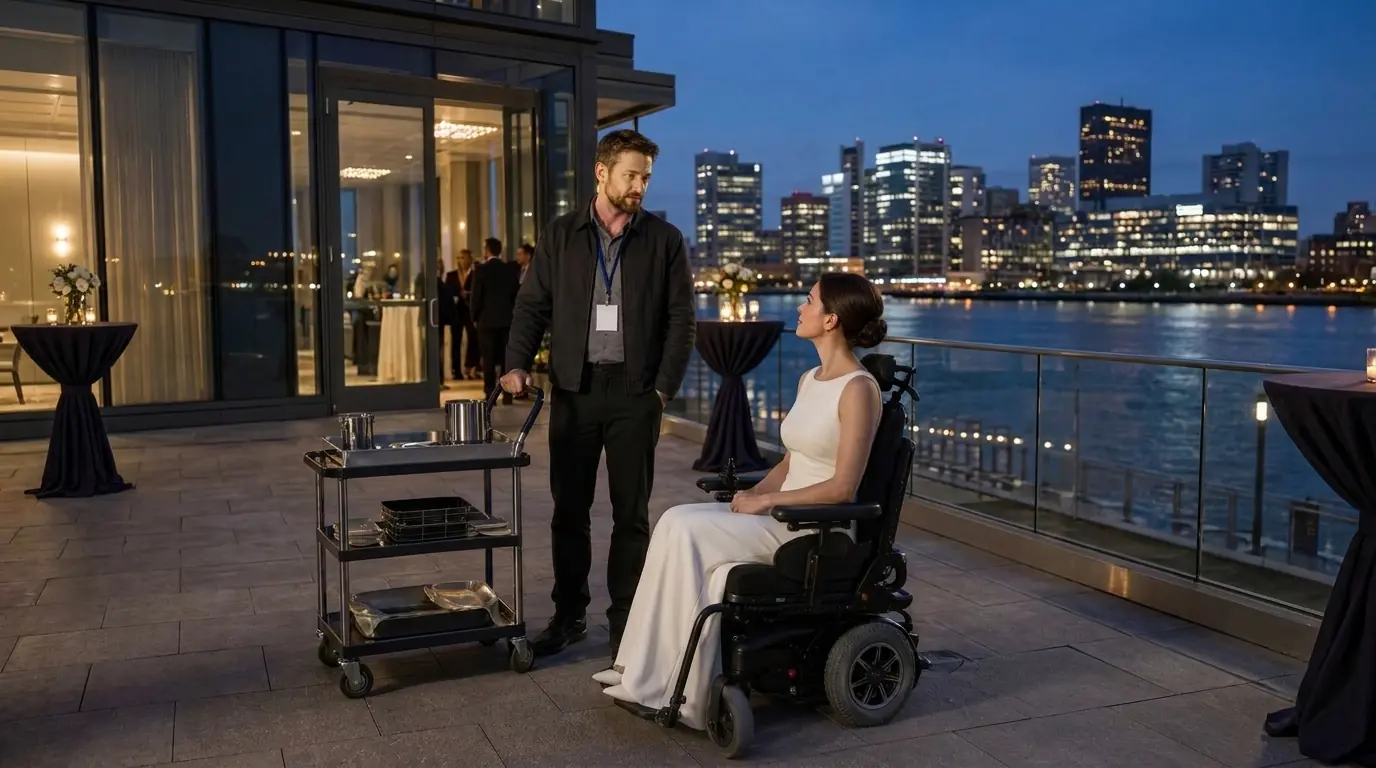
The gala had cost someone a great deal of money to make look effortless. Nathan Cole figured that out around the third hour when he found himself carrying a folding table through a service corridor at the Hargrove Center while two caterers argued in hushed, furious tones about whether the dessert station had been set up on the wrong side of the room.
He set the table down where they pointed, said nothing, and went back for the next one. That was volunteering. You showed up, you did what you were told, and you tried not to be in the way. He'd signed up through a community board posting. Event support staff needed for Meridian Children's Foundation annual gala.
No experience necessary because his neighbor, Mrs. Paulson, had offered to watch Lily for the evening, and it felt wrong to spend that time sitting in his apartment. He wasn't built for stillness. Never had been. The Hargrove Center sat at the edge of Boston Harbor, its upper floors all glass and steel. And on a clear October evening like this one, the city spread itself out beyond the windows in a way that looked almost designed.
Nathan had grown up 40 minutes outside the city and had spent years either not noticing it or being too tired to look. Tonight, working cleanup after the guests had thinned out, he noticed. He was pushing a service cart back toward the freight elevator when he saw her. She was parked. That felt like the wrong word, but he couldn't think of a better one. Near the far end of the observation terrace facing the harbor.
Most of the gala crowd had moved back inside or left entirely. She was alone, a glass of something untouched on the small table beside her wheelchair, and she was looking out at the water with the focused, contained expression of someone who has decided not to feel anything in public. Nathan almost kept walking. It wasn't his business. He had a cart to return and a corridor to clear, and Mrs. Paulson expected him back by 11:00.
But something stopped him. Not sentiment, or at least not only that, the wheelchair. He'd been repairing mobility equipment for 6 years. First as an apprentice under a man named Gerald Stokes, who'd run a small independent shop in Dorchester, and then on his own after Gerald retired and sold him the client list and the lease. Six years of chairs and scooters and lifts, and the 10,000 small mechanical ways they failed the people who depended on them.
He knew what a well-maintained chair looked like. He knew what wear patterns meant, what sounds indicated, what problems, what the difference was between a chair that had been serviced recently and one that hadn't. The chair this woman was sitting in had not been properly serviced. He could see it from 20 ft away. The left rear wheel sitting fractionally wrong.
The angle just slightly off from what it should be. It could have been nothing. It could have been a loose axle bolt or a worn bearing housing or a dozen other things that were inconvenient but not dangerous. Or it could have been something else. He told himself it was nothing and kept walking.
Then he stopped, left the cart, and walked across the terrace. "Excuse me," he said, stopping about 6 ft from her. She turned to look at him with the kind of measured patience that people develop when they're used to being approached by strangers who mean well and waste their time. She was younger than he'd expected, early 30s maybe, with dark hair pulled back and a face that was either naturally composed or had learned to be. She wore a charcoal blazer over a dark dress and carried herself in the chair with a straightness that read less like posture and more like decision.
"The event's over," she said. "If you're looking for someone from the foundation, I'm not." He gestured at his volunteer lanyard. "I'm just doing cleanup. I wasn't going to bother you. I just I wanted to say the view's nice up here and so are you.
He regretted it immediately. It came out more direct than he'd intended and the way she was looking at him made it worse. Excuse me, she said. That came out wrong. I meant you looked like you were the only person up here actually looking at it.
The view. Everyone else tonight was looking at the room. He stopped. I'll go. Beauty, she said.
And there was something in the word that had an edge on it is a complicated compliment for someone in my position. People look at me and they see the chair and the chair reminds them I can't walk. So when someone tells me I'm beautiful, what they usually mean is considering, as in beautiful considering. She picked up the glass and looked at it instead of him. I'm sure you meant well.
I didn't mean considering, Nathan said. I just meant what I said. She looked at him again, not softened exactly, but reassessing. That's either very sincere or a very good line, she said. I don't really do lines.
I'm not. He shook his head. I'm bad at this. I just thought you looked a little alone out here and I didn't want to walk past without saying something. I'll leave you alone.
He turned to go. What's your name? She asked. He turned back. Nathan.
Nathan Cole. Vivian Ashcroft. She didn't offer her hand and he didn't reach for it. You said you're doing cleanup. Volunteer.
I repair mobility equipment, chairs, scooters, that kind of thing. Saw the posting and needed something to do tonight. Something shifted in her expression at that very briefly, like a door opening a half inch and then closing again. You repair wheelchairs? She said, among other things.
Yeah. She studied him for a moment. Then, and he blinked. And what? You walked over here for a reason, Nathan Cole.
You said you were doing cleanup. You said you weren't looking for someone from the foundation. And then you gave me a compliment that you immediately called wrong. So, she tilted her head slightly. And he looked at the chair.
He looked back at her. Your left rear wheel, he said. The axle angle's off. Could be nothing. Could be a worn housing. He paused.
When was the last time it was serviced? She went very still. My chair is serviced on a schedule, she said, and her voice had changed. Not softer, not harder, more careful. By a specialist.
Okay, Nathan said. Then it's probably nothing. But you came over to mention it. I came over because you looked like you were having a rough night and I didn't want to walk past the chair thing. That's just what I noticed.
Occupational habit. I'm not trying to make it into something. She looked at him for a long moment. The harbor lights were coming off the water behind her, and the city behind him was doing its usual October thing, cold enough to remind you it was real, clear enough to look like a painting. I'll have it checked, she said finally.
Good, he said. I mean it not it's probably nothing. You keep saying that because it probably is but not definitely. He didn't answer that and she seemed to accept it. I appreciate you stopping.
She said it didn't sound like a dismissal exactly, more like a punctuation mark. Something ended. Something else may be beginning. Nathan picked up his cart. Have a good night, Ms. Ashcroft.
Vivian, she said. He was already walking. He got home a little before 11. Mrs. Paulson was half asleep in the armchair with a book open on her chest, and Lily was in bed where she was supposed to be, which was either a miracle or evidence that Mrs. Paulson had more authority over his six-year-old daughter than he did. Probably the second one.
He paid her, said good night, locked the door, and stood in his kitchen for a minute in the quiet. The apartment was the same apartment it always was. Two bedrooms in a building that had last been renovated sometime in the previous century, with a kitchen that faced a brick wall and a living room that smelled faintly of the lavender spray Lily had discovered at a craft fair, and deployed aggressively on every soft surface she could reach. Drawings on the refrigerator, a stuffed bear missing one eye on the couch, a half-finish jigsaw puzzle of the Boston skyline on the coffee table that they'd started 3 weeks ago and hadn't touched since. He poured water from the tap and drank it standing at the sink.
He thought about the chair. In 6 years, he had seen a lot of wheelchairs. He had seen chairs with bent frames and stripped bolts and cracked footrests and bearings so worn they'd ground down to metal on metal. He had seen chairs that had been badly maintained by accident, by neglect, by cost, people who couldn't afford proper servicing and stretched every adjustment as far as it would go. He had seen one chair once that had been tampered with.
It had come through the shop on a referral. An elderly man whose family had brought the chair in after a fall, wondering what had gone wrong. Gerald had found it first. A specific modification to the brake mechanism, subtle enough to look like wear, targeted enough to cause exactly the kind of failure it had caused. Gerald had called it in to the client's family and to the police, and there had been an investigation, and Nathan had never found out what came of it because Gerald didn't talk about it after that.
The thing Gerald had told him afterward when they were both back to regular work and trying to act like it hadn't happened, was this. The tricky part isn't spotting it. The tricky part is that you can always tell yourself you're wrong. Nathan rinsed the glass and set it in the rack. He was probably wrong.
He went to bed. He found the access card the next morning. He'd been in his van, a white Ford Transit that had been old when he bought it, and was now old in the way that required philosophical acceptance, doing inventory before his first call when he found it wedged between the passenger seat and the center console. A corporate key card, the kind that opened building doors and activated elevators. It had a chip and a magnetic strip and a small printed logo, Ashcroft Dynamics.
Vivian Ashcroft's name was not on it. What was on it was a position title printed in small gray letters below the logo, chief executive officer. He stared at it for a long time. At some point during the evening, either when he'd been clearing the terrace area or when she'd been near the service corridor, it must have slipped from her or from her bag. He didn't remember seeing her with a bag, but he hadn't been paying attention.
He thought about mailing it. He thought about calling the foundation to pass along the message. Then he thought about the wheel and about the specific way she'd gone still when he'd mentioned it, and he decided to go in person. Ashcroft Dynamics occupied the top six floors of a building in the Seaport District, the kind of building that had gone up in the last 10 years, and was still deciding what it wanted to be when it grew up. The lobby had the standard arrangement.
Security desk, turn styles, a receptionist behind a curved counter who looked like she spent significant energy making everything seem very under control. Nathan walked up to the desk and explained that he'd found an executive access card at the Hard Grove Center and wanted to return it to Ms. Ashcroft. "I can log it in," the receptionist said, reaching for the card. "I'd rather return it directly," Nathan said. "Is she in?" The receptionist looked at him with the very specific expression of someone who has been trained in how to be helpful while still ensuring that random people do not walk into the CEO's office.
Do you have an appointment? No, but she'll know who I am. That was optimistic. He wasn't sure she'd remember him at all. Nathan Cole.
We met last night at the gala. The receptionist's expression softened slightly. Gala implied someone who had been in rooms with people worth protecting and she picked up the phone. Nathan stood at the desk and looked at the lobby. It was a Friday morning and the building was in the middle of its workday rhythm.
Badge taps, elevator dings, people crossing from one direction to another with the focused, purposeful walk of people who wanted to look like they were going somewhere important. Nothing looked wrong. Nothing looked like anything. But there was a man near the elevator bank, mid-40s, expensive suit, the kind of haircut that communicated position, who glanced at Nathan and then looked away too quickly. Not the way people look away from strangers, the way people look away from things they've noticed and are deciding how to respond to.
Vivian's office was a corner room with two walls of floor toseeiling windows and a desk that faced the door instead of the view, which told Nathan something about how she worked. She was on the phone when Priya showed Nathan in, and she held up one finger without looking at him, just a minute and finished the call in a voice that was clipped and certain and gave nothing away. She hung up and looked at him. "Nathan Cole," she said. "You found my card wedged in my passenger seat.
He put it on the desk. Figured I'd bring it directly. That's She picked it up and turned it over. Thank you. It's the master access card.
I use it for the restricted floors. A pause. You could have just mailed it. I could have, he said. She looked at him steadily.
But you came in person. I wanted to ask if you'd had the chair looked at. There was a silence. I called this morning. She said, "My service technician is coming this afternoon.
Good, Nathan. She set the card down. What exactly did you see? He thought about how to say it. He thought about Gerald and the thing Gerald had told him and the way the man by the elevator had looked away.
I saw what I said I saw, he said. An axle angle that's off. Could be where? He met her eyes. Or it couldn't be.
She held his gaze for a long moment without blinking. Sit down," she said. He sat outside 40 floors down. Boston was doing what Boston did in October, moving, ignoring the cold, carrying on with the fixed determination of a city that had never particularly cared whether you found it charming. Nathan sat across from a woman he'd met 12 hours ago and tried to read a face that had clearly been practiced into steadiness over a long time and felt in the pit of his stomach the specific feeling he'd learned to trust in 6 years of work.
Something was wrong with that chair. And it hadn't happened by accident. Vivian didn't ask him to leave. That was the first thing Nathan noticed. He'd half expected it. The polite dismissal, the thank you for returning the card, the implication that he'd done his part and could now go back to whatever small life he'd come from.
Instead, she picked up her phone, told Priya to hold everything for 30 minutes, set the phone down, and looked at him with the specific expression of someone who has decided to do something they aren't entirely sure about. "Tell me exactly what you saw," she said. "Not the version you'd tell a stranger, the real one." Nathan leaned forward, elbows on his knees. The left rear wheel. The axle isn't just worn. The angle of deviation is too consistent.
Wear patterns are irregular. This kind of thing happens gradually over time from use. What I saw last night had a uniformity to it that doesn't come from use. He paused. It comes from adjustment.
You're saying someone modified it. I'm saying it's possible. Your technician will know more than I do. My technician, she said slowly, has been servicing this chair for 18 months. He was hired through the company's facilities management team.
She stopped, which means he was vetted by the same people who run building security and HR systems. Nathan understood what she wasn't saying. He let it sit for a moment. How many people have access to your chair when you're not in it? He asked.
Practically speaking, she considered. My personal assistant, my driver, the facilities team here. The chair travels with me almost everywhere. It stays in my office overnight when I sleep here during high demand periods. She caught the look on his face. I work long hours.
And your access card, the one I returned, is there a log of where it's been used? Something moved in her expression. Not alarm exactly, more like the particular feeling of a suspicion you've been suppressing suddenly having a name. Yes, she said. The system tracks every badge use, entry point, time, date.
She reached for her keyboard, then stopped. Why are you asking about the card in the chair in the same breath? Because I'm thinking about who would need both, Nathan said. She looked at him for a long moment, then she turned to her computer. The access log took her less than 2 minutes to pull up, and it took Nathan less than 30 seconds to see what she saw.
Her card had been used to access the R&D restricted floor, designated on the log as level 11R on three occasions in the past 6 weeks. The timestamps were all between 11 p.m. And 1:00 a.m. Vivian hadn't been in the building on any of those nights. She confirmed it by cross-referencing her own calendar, which she pulled up in a second window without saying anything. Her jaw had tightened.
That was the only visible change. "I'm never here that late," she said. "I have a medical protocol. I need to be home by 10:00 at the absolute latest on most nights because of" She stopped. "It doesn't matter.
I'm not here past 9 on a normal week." Who else has master access to level 11R? Senior executives. Myself, the CTO, the COO, the head of R&D, and the facilities director for secure areas. She was already typing. I can see their individual logs. You might not want to do that from your own account, Nathan said quietly.
She stopped typing. She turned and looked at him slowly. You think whoever did this has access to the system, she said. I think if someone went to the trouble of copying your credentials to access a restricted floor without your knowledge, they probably thought about who might notice and when. You didn't soften it.
There was no version of this that was soft. I'm not telling you what to do. It's your company and your system. I'm just saying that if I were you, I'd want whoever looks at this to be someone who isn't already inside it. The silence stretched.
A phone somewhere in the outer office rang twice and stopped. Nathan could hear the building breathing. The low mechanical hum of a place with too much square footage and too many systems running at once. I have an attorney, she said finally. Marcus Webb.
He's outside the company and he's handled sensitive matters for me before. She didn't elaborate on what that meant, and he didn't ask. He has a firm in Cambridge. That's a good start, Nathan said. She looked at him again, that same measuring look she'd given him on the terrace, only sharper now, more awake.
"Why are you still here?" she said. "It wasn't unfriendly. It was a real question. I found something I thought you should know about, and I didn't know how to leave it at the front desk," he said. That's the honest answer.
"You repair wheelchairs for a living," she said. "You volunteer at charity events. You have a daughter. You mentioned a neighbor watching her last night." She tilted her head. You are not the person I'd expect to walk into a Seaport office tower and tell me my security's been compromised.
I didn't plan to tell you that, he said. I plan to return the card and go to my 9:00 appointment. What was the 9:00? Woman in Brooklyn power chair with a joystick calibration issue. He paused.
I called and rescheduled. Vivian almost smiled. It didn't quite make it all the way. Why? Nathan thought about it honestly.
Because you went still, he said. When I mentioned the wheel, "You went very still, and that's what someone does when they're not surprised. When they've already been afraid of something and they've been trying not to think about it," he shrugged, which felt inadequate. "I didn't want to leave that alone." She looked at her hands on the desk very briefly, the way people do when they're deciding how much they're willing to show. "I had a feeling," she said.
A few weeks ago, the chair handled differently on a wet surface. I told myself it was the floor. I've been She stopped again, then started differently. I've been in this chair for 2 years. I know exactly how it moves.
I know the sound it makes on tile versus carpet. I know the resistance on an incline. I know what it feels like when the battery is running low. Two weeks ago, it felt wrong. And I told myself I was tired.
She said it flatly without drama. I've been doing a lot of that, telling myself things. Nathan didn't say anything. Sometimes the right thing was just to let a person finish. Call Marcus Webb, he said when she'd been quiet long enough.
Tell him you want everything looked at quietly. Logs, security footage, the works. He stood. And please, when your technician comes this afternoon, stand somewhere that isn't right next to the chair when he opens it up. She looked up at him.
You think it's that serious? I think until you know what you're dealing with, you should treat it like it is. Yes. He drove his second appointment of the day, a man in Charlestown with a rollator that had a collapsing brake arm with his mind about 60% in the work and 40% back in that office with the two walls of windows. It wasn't a comfortable split.
He prided himself on being present for clients, on giving the work the attention it deserved because the work mattered. A brake arm that didn't hold was not an abstract problem for the person whose arm strength and balance depended on it. But he kept coming back to the access log three times in 6 weeks. Level 11R 11 at night. Whatever was on level 11R was worth the risk of being caught.
He finished the Charlestown job, drove to his shop on the border of Roxbury and Jamaica Plain to pick up a part he needed for the following day and was locking up when his phone rang. The number wasn't in his contacts, but it had a Boston area code. And he picked up Nathan Cole. Vivian's voice, and she sounded different than she had in the office. Less controlled, not falling apart, but the edges were showing.
My technician found something. He leaned against the van door. How bad? The axle mount on the left rear wheel has been mechanically weakened. There's a stress fracture that goes through the outer housing.
It's the kind of thing that would fail progressively. Fast cornering, wet surface, any kind of sudden impact. She stopped. He said given the level of damage, the failure point was probably 2 to 3 weeks out, maybe sooner. 2 to 3 weeks.
Nathan stared at the brick wall of his shop. Where's the technician now? He asked. I asked him to wait. Marcus Webb is sending someone over.
Good, he said. Don't use the chair until it's been fully inspected and repaired. Do you have a backup? There's one at my home. I'll manage.
A pause. Nathan, this isn't a maintenance failure. No, he said. It's not. Someone tried to.
She stopped. When she came back, her voice was steadier, but it was the steadiness of someone holding something heavy with both hands. I've been afraid of this chair for 2 weeks and I told myself I was being irrational. I told myself I was still that the accident made me oversensitive to things that weren't. She stopped again.
Vivian, he said, "What? You weren't being irrational." Silence on the line. The street outside his shop was doing its afternoon thing. A bus going past, a kid on a bike, the smell of someone's dinner coming from the apartment above. I know, she said quietly.
That's the part that's hard. Marcus Webb turned out to be a small man in his late 50s with the kind of unhurried manner that Nathan associated with people who'd seen enough crises to stop being impressed by them. He had an office in Cambridge that looked exactly like you'd expect an attorney's office to look if the attorney had been practicing for 30 years and had stopped caring what visitors thought of the decor. Stacked files, degrees on the wall with fingerprints on the glass, a desk that was losing the battle against paper. He met with Nathan and Vivian together, which meant Nathan drove across the river on a Friday evening to sit in a room that smelled like old coffee and explain again what he'd observed.
Webb listened without interrupting. When Nathan finished, Webb looked at Vivian. "You said you haven't told anyone in the company yet," he said. No one, she confirmed. She was in the backup chair, which was an older model, a little stiff in the right armrest, and Nathan had noticed it immediately when she'd rolled in, though he'd said nothing.
"I don't know who I can trust inside the building." "Smart," Webb said without any praise in it. "Just an observation." "The credential use on level 11R. Tell me what's up there." Vivian took a breath. Ashcroft Dynamics has a primary R&D division on 11 and 12. The restricted section 11R is where we keep the prototyping lab for the ARIA project.
That's our intelligent mobility system, exoskeleton integration, smart chair technology, adaptive neural interface. It's been in development for 4 years. She paused. The projected value of the technology is somewhere between 800 million and a billion too depending on the licensing model. We've had acquisition interest.
From whom? Webb said three companies, two domestic, one foreign registered but with substantial overseas backing. I declined all three conversations and the board her expression shifted. There have been discussions I wasn't part of. A faction on the board believes a strategic sale would maximize shareholder value.
The way she said it, flat, careful, like reading from a legal document, told Nathan there was a great deal of emotion underneath that she was keeping behind glass. They've been pressuring me to reconsider. The pressure has increased significantly over the past 2 months. Webb wrote something on the pad in front of him. Anyone on the executive team aligned with that position?
She hesitated for just a moment. Adrian Lockhart, my COO. He's been the most vocal internally about what he calls strategic flexibility. Nathan watched Webb's pen move. What does Lockhart have access to?
Webb asked. Executive master access. Same as mine. He can access 11R. Webb looked up.
Has he been there at night recently? I don't know, she said. I didn't want to pull his access log from my own account. Good call. Webb set down the pen.
I'll put someone on that discreetly. He looked at Nathan. Mr. Cole, you said the chair modification was, in your professional judgment, deliberate. Yes. Nathan said, "I've seen accidental damage in chairs for 6 years.
This was targeted. It would have looked like a failure, but the mechanism was too specific. Someone who understood how the wheel assembly worked made that fracture. Not a layman. Someone who knew what they were doing. Webb nodded slowly, adding something else to the pad.
Vivian the accident two years ago. Walk me through what you were told. Her hands were in her lap. Very still. Nathan had noticed she did that when she was controlling something.
The prototype personal transport vehicle. So, it was part of an early ARIA integration test. I was in the vehicle with Elliot. She said the name without elaborating, and Webb didn't ask. The system malfunctioned.
The vehicle accelerated instead of stopping. I was thrown. The spinal damage was She stopped. Started again. Significant.
And Elliot left the company after the investigation. Left the city. She looked out the window at the Cambridge Street. The board concluded the accident was the result of operator error on his part. He accepted responsibility and disappeared.
She turned back. I believed them. I had no reason not to. Webb tapped the pen on the pad. The black box from that prototype.
Was it preserved? Standard procedure after an incident. It should be in secure storage. Should be, web said. Vivian looked at him steadily.
Should be, she agreed. Nathan drove home through Friday evening traffic, which in Boston meant approximately 45 minutes of movement, so incremental it gave him too much time to think. He called Mrs. Paulson, who confirmed that Lily had eaten dinner and was currently arguing that 8:30 was an unreasonable bedtime for someone who had stayed up until 9:15 the previous Tuesday, which was, in Lily's legal opinion, precedent. Tell her Tuesday was a special occasion. Nathan said I told her that Mrs. Paulson said.
She asked what special occasion. I said her dad had a thing. She said what thing? I said I didn't know. She said I'll be home in 20.
Nathan said he was home in 25. Lily was in her pajamas, not in bed. Operating on the technical loophole that she was near her bed and therefore the spirit of the instruction was being honored. Nathan sat on the edge of her mattress while she explained at significant length the events of the school day, which involved a disagreement over a basketball that had been resolved fairly and then unfairly and then fairly again, and a substitute teacher who didn't know that you were allowed to keep your water bottle at your desk, which was a rule that Lily felt strongly had been established and should not require relitigation.
He listened. He laughed where it was funny and made the appropriate sounds of outrage where it was outrageous. He tucked her in at 9:00, which was splitting the difference in a way that satisfied neither of them completely, and sat on her floor for 10 minutes after lights out because she said she wasn't tired, and he said okay. And within 7 minutes, she was asleep. He sat there in the dark for a moment after.
There were drawings taped to her walls, animals mostly, and a Boston skyline that was identifiable if you already knew what you were looking at, and one drawing labeled in her careful printing as Daddy and Lily that showed two stick figures of notably different heights holding hands. He'd been meaning to get frames for some of them. He went to the kitchen, poured water, and sat at the small table where he usually ate breakfast alone with whatever free local paper happened to have ended up in the mail slot. He thought about what Webb had said before they'd left.
The investigation 2 years ago concluded operator error. But if someone tampered with the vehicle's control system, operator error is what you'd see from the outside. You'd see exactly what they wanted you to see. He thought about what Vivian had said in a voice careful enough that he'd had to work to hear what was underneath it. I believed them.
I had no reason not to. He thought about the way she'd described knowing her chair, the sound it made on tile versus carpet, the resistance on an incline, the way it moved when the battery was low. Two years of learning a world through different contact points, different information. Two years of the chair being the thing between her and the ground, and someone had put their hands on it and weakened it deliberately, calculating how long before it gave, trying to measure out exactly how much she had left.
He should not be involved in this. He had a shop to run and a daughter to raise and clients who depended on him showing up on time with the right parts. He did not work in corporate conspiracy. He did not investigate senior executives or analyze access logs or sit in rooms with attorneys and try to figure out who'd been in a restricted floor at midnight. And yet he'd walked across a terrace because she'd looked alone.
And he'd seen something nobody else had noticed. And now he knew what he knew. You didn't unknow things. He'd learned that, too, in the years since Lily's mother had left. You couldn't choose not to see what you'd already seen.
You only chose what you did with it. Webb called him the following Monday afternoon while Nathan was replacing a power cell in a standing wheelchair for a client in Newton. He stepped outside to take it. Adrian Lockhart's access log, Webb said without preamble. My contact pulled it clean. Nothing traceable back to Vivian or her systems.
Lockhart accessed level 11R on four of the past 6 weeks. All after 10 p.m. Four times, Nathan said, "And here's what's interesting. The ARIA project files, at least the publicly visible version of them, show a series of unexplained setbacks over the past 8 months. Failed tests, equipment calibration issues, delays in the neural interface component.
The project lead filed three separate incident reports, all of which were reviewed and filed by the COO's office. A pause. Adrian Lockhart. He reviewed reports about problems he was creating. Nathan said that appears to be the shape of it.
The project delays have been used as justification in board presentations, in shareholder communications for why an acquisition offer should be reconsidered. If the technology is troubled, the argument goes, a strategic sale makes more sense than continued independent development. Nathan leaned against the side of the building, facing a strip of parking lot, a chainlink fence, and beyond it, a stretch of Newton Street that was completely indifferent to the conversation he was having. The delays aren't real. The test failures appear to have been engineered.
My contact has a background in technology IP litigation, and she's been looking at the engineering reports. The calibration failures have a pattern that doesn't match random equipment issues. They look like deliberate interference. Webb's voice stayed level. He'd probably had this conversation or some version of it many times.
There's something else. The acquisition interest we discussed, the foreign registered company. My firm has been doing some background. That company appears to have ties to a private equity group that has been attempting through various intermediaries to acquire domestic mobility technology for some time. There are import restrictions and technology transfer regulations that make a direct purchase impossible.
But if Ashcroft Dynamics collapsed into financial trouble and had to sell or if Vivian was removed as CEO and the board voted to accept an acquisition, Nathan said correct the buyer would need a friendly board and an absent or weakened CEO and they'd need the technology to appear troubled enough that the price was reduced and the urgency was real. Webb stopped. Nathan, I want to say something clearly. What I've just told you is pieced together from multiple sources and none of it is courtroom ready yet.
We have access logs, pattern analysis on engineering reports and corporate registration research. That's a picture, not evidence. What would make it evidence? The original prototype's black box. Webb said from the accident 2 years ago.
If that vehicle was tampered with, if someone modified the control system to cause that crash, the black box would have recorded the anomaly. Pre-AC system states control inputs, the works. He paused. Vivian told me it should be in secure storage on level 11R. Nathan stood up straight.
You're telling me the evidence of what happened to her, he said slowly. Is in the same restricted lab that Lockhart has been accessing at midnight. Yes, Webb said. That is what I'm telling you. For a moment, Nathan said nothing.
A delivery truck went by on the street beyond the fence, and somewhere behind him, his client's front door opened and then closed. "How long has it been since anyone verified the black box is still there?" he asked. "That's the question," Webb said. "Vivian is going to request a formal audit of secure storage, but if Lockhart knows that audit is coming, he'll move it or destroy it," Nathan said. Or he already has, Webb said. Which is why the audit needs to happen quietly and quickly and ideally before Lockhart has any reason to think we're looking.
Nathan looked at the fence at the street at the ordinary Monday afternoon going about its business. I need to think about something, he said. Take your time, Webb said, and then after a pause. Not too much time. He called Vivian that evening after Lily was in bed, sitting at the kitchen table again with the same glass of water and the same brick wall view from the window.
She picked up on the second ring. "Webb told me about the log," she said before he could speak. Her voice was tight. "And the engineering reports." "Yeah, I knew the project was having problems. I thought," She stopped.
I thought it was real, the setbacks. I thought we were having genuine technical challenges and I was pushing my team too hard and not giving them enough support. I brought in external consultants. I approved additional budget. A pause.
Every adjustment I made gave him more time. He used my own management responses to extend the delay. Nathan didn't know what to say to that. There wasn't really anything to say. The black box. She said, "You need to see if it's still there before Lockhart has any reason to think anyone's looking." I know, a long beat.
I have authorized access to that storage room. I can request the inventory log through my own clearance without it looking unusual. I review R&D storage periodically. Anyway, another pause. But I want to be there when it's opened.
I don't want to send someone else. That makes sense, he said. The storage room is on level 11 R. She said it carefully like she was measuring the weight of each word. I haven't been to that floor in 4 months.
I've been delegating the R&D oversight to She stopped to Adrian Vivian. I know. I know what that sounds like now. He thought about what to say and landed on the truth. He's good at what he does.
He positioned himself where you'd trust him and then he stayed there. That's not a failure of your judgment. That's someone working very hard to be trusted. She was quiet for a moment. You're being kind.
"I'm being accurate," he said. "There's a difference." Another silence, different from the silences earlier in the conversation. Less heavy. I'm going to level 11R tomorrow morning, she said. Early before the executive floor gets busy.
I'll pull the storage inventory myself. She paused. Would you come? He hadn't expected that. Why? Because you know what you're looking at when it comes to the chair, and I trust your judgment on what's been tampered with and what hasn't.
And because she stopped, said the next part more quietly, "Because I don't want to walk in there alone." Nathan looked at the kitchen window. The brick wall looked back. "I'll be there at 7," he said. They met in the lobby at 7:05. Nathan 3 minutes late because the parking in the Seaport at 7:00 a.m. Was its own specific category of purgatory.
Vivian was already passed the security desk and she looked at his slightly windblown arrival without comment, which he appreciated. They rode the elevator to 11 in silence. The building was quiet at this hour. A few early arrivals, the cleaning crew finishing up, that particular hush that corporate buildings have before the day fully commits to itself. Level 11R required a secondary badge at a steel door with a keypad, and Vivian used the original access card, the one he'd returned, and the door opened cleanly.
The lab beyond was large and cool and smelled faintly of metal and something chemical that Nathan couldn't identify. Equipment lined the walls, testing rigs, prototype components in various states of assembly, a workbench that had the organized chaos of actual daily use rather than showroom arrangement. At the far end, a row of secure storage cabinets, each with its own electronic lock. Vivian moved through the space with the efficiency of someone who had spent a great deal of time here and had not been back in a while. She went to the storage section directly, pulled up the inventory log on a wall terminal, and began scanning.
Nathan stood back and looked at the room. He was looking at the testing equipment. The main exoskeleton rig, the frame that held prototypes during trials, had modification marks on the control interface that didn't match the surrounding hardware. Fresh marks, newer than everything else on the bench. He leaned in.
Someone had been in here with tools recently. Vivian," he said. "I see it," she said from across the room. Her voice had gone flat. "The black box." "It's listed in the inventory log as present in cabinet 7." She was looking at cabinet 7.
"The cabinet has been accessed twice in the past 3 weeks." "By whom?" She looked at the terminal. "The log shows my credential." "Silence." "You weren't here," Nathan said. "No." She turned to look at him. Someone used my copied credential to access this cabinet twice. She looked back at the cabinet and the log shows it's still there, still present.
Open it, Nathan said quietly. She did. She used her card on the cabinet lock and it clicked open and she pulled the door wide. The cabinet held a row of labeled storage cases. In the slot marked ARIA incident record/BX-1, there was a case that was the right size and shape and had the right label.
She lifted it out and set it on the workbench. She opened the latches. The case was empty. She stood looking at the empty case for a long moment. Nathan stood beside her and said nothing because there was nothing to say that the empty case hadn't already said.
Someone had taken the evidence of what had been done to her, logged the access under her own name, and left the container perfectly in place. He's thorough, she said finally. Yes, Nathan said. So the question is whether he has it or whether he destroyed it. If he destroyed it, he'd have no reason to keep accessing the lab at night.
Nathan looked at the modification marks on the exoskeleton rig, then back at the empty case. He still has something to protect here, which means he still has something. She closed the case and set it back in the cabinet with the careful movements of someone keeping themselves together through physical action. We need it back, she said. I know.
She turned to look at him. Her jaw was set in his way he'd already started to recognize. Not anger, not exactly, but a kind of compressed force that had nowhere to go yet. You said we. He hadn't realized he'd said it.
Yeah, he said. I did. She looked at him for a long moment, and this time the measuring in her gaze had something different in it. Not warmer, exactly, but less defended. Like a window that had been shut for a long time had been opened just enough to let the air move.
You should know, she said carefully, that getting further into this is not without risk. If Adrian is doing what we think he's doing, he's not a man who responds well to interference. I figured, Nathan said, you have a daughter. I know I have a daughter, she held his gaze. Nathan, I need you to understand what you might be walking into.
He thought about Lily's drawing on the wall, the two stick figures of different heights labeled carefully in her handwriting. He thought about the empty case on the workbench and the access log with Vivian's name on entries she hadn't made and the chair that had been quietly failing for weeks while she told herself she was imagining things. I understand enough, he said. Let's figure out what he did with it. Webb did not look like a man who slept well under normal circumstances, and when Nathan and Vivian walked into his Cambridge office the following morning, he looked like a man who had not slept at all.
There were two additional chairs pulled up to his desk and a pot of coffee that was nearly empty. He waved them in without getting up. The credential copying, he said before either of them had fully sat down. I have a contact at a cyber security firm. I've used them before on IP theft cases.
They looked at the entry log data my original contact pulled. He turned a printed page on his desk so they could see it. The copies were made incrementally. Not one clean lift. Whoever did this built a ghost profile of Vivian's access signature over several months by capturing partial credential data at different entry points and assembling them.
It's not simple. It requires either significant technical knowledge or someone who paid for significant technical knowledge. Adrian has both. Vivian said more than that, it means this was planned, not opportunistic. Someone made a decision probably more than a year ago to build toward this specific outcome.
The access log, the engineering sabotage, the board pressure, the credential copying. These are not independent events. Webb picked up his pen and set it down again without writing anything. This is a coordinated campaign. Nathan looked at Vivian.
She was listening with the particular stillness she carried, processing, not shutting down. He'd started to be able to tell the difference. I need to tell you something, she said to Webb. She hadn't told him about the black box yet. She'd called him the previous night to say she'd been to 11R and needed to meet in the morning, and she'd kept the rest until now.
She laid it out cleanly. The inventory log, the cabinet, the empty case, the modification marks on the exoskeleton rig. Webb listened without moving. When she finished, he was quiet for several seconds. You took the black box, Webb said.
Yes, and logged the access under your credential so that if the cabinet was ever audited, it would show you had retrieved your own evidence, which would make it look like I had a reason to suppress it," she said. "If there's ever an investigation, the log shows I accessed the case twice. Whatever's in the box, it looks like I already know." Webb made a sound that wasn't quite a word. He stood up, which Nathan hadn't seen him do before, and walked to the window.
It faced a Cambridge side street, a coffee shop, a dry cleaner, a row of bikes locked to a rack, the kind of street that existed to be completely normal. The box itself, he said, still facing the window. If he has it, he hasn't destroyed it yet. You said the lab modifications looked recent. The marks on the control interface were newer than the surrounding equipment.
Nathan said days, not weeks. He's still using the lab, which means there's something he still needs there. Webb turned back, the ARIA project, the legitimate version of it. Vivian, how close is the actual technology to completion? Not the sabotaged version, the real one.
Closer than the board knows, she said. That's part of what Adrian's been managing. He's been presenting the board with a version of the project that's 18 months behind where we actually are. I have the real development records. My core engineering team reports directly to me on the technical milestones and I keep a separate record outside the main system.
She paused. I started doing that about a year ago. I'm not sure why. Instinct maybe. Instinct kept your real progress off Adrian's radar, Webb said.
He sat back down. The buyer, whoever is on the receiving end of this deal, they're acquiring what they think is a troubled technology that needs another 2 years of work. If they discover the technology is nearly complete and has been intentionally suppressed, that changes the transaction entirely. He looked at both of them. Adrian is managing an acquisition negotiation built on fraudulent representations of the asset.
If that falls apart, he has nothing. No leverage, no deal, no payout. Which means he needs the real engineering data before the deal closes. Vivian said, not just the black box. He needs the actual technical files to hand to the buyer so they know what they're really getting.
Files he doesn't have access to. Nathan said looking at her. He doesn't know I've been keeping separate records. She said as far as he's aware the project data exists only inside the company's main system which he has access to. But the final integration specs, the neural interface schematics, the test results from the last 6 months, those are in a format I developed outside the company architecture.
He can't get to them without me. Nathan sat with that. So, he needs to force a board vote to remove you before the real state of the technology becomes public, but he also needs your technical data to close the deal once you're gone. And the black box is his insurance evidence he's been suppressing so that if anyone investigates the accident, the record shows you retrieved it yourself. He's been building toward a moment where he has everything.
Webb said, "Control of the company, the real technology, the evidence neutralized, and a board that voted him into power cleanly." He looked at Vivian. "How soon is the board meeting?" He's been pushing for an emergency session. Given the board's current temperament, I'd estimate two weeks, maybe less. Then we have two weeks to find the black box and establish what's on it before he either destroys it or uses the access log to frame any investigation. Webb tapped the desk.
We need to know what happened in that vehicle 2 years ago. Not what was concluded, what actually happened. The investigation into the accident had produced a file and Webb had a copy of it, not because he'd worked the case originally, but because he'd represented Vivian in the subsequent civil matter around the insurance claim, and the file had been part of discovery. He spread the relevant pages on his desk. The vehicle had been a prototype personal transport unit, a small enclosed two-person mobility pod built as part of ARIA's early integration testing.
The idea was a vehicle that responded to a combination of manual control and predictive navigation, adapting to the user's movement patterns. Vivian had been in it with Elliot Marsh, her then fiance, and the project's co-lead engineer. The vehicle had been in a controlled testing environment at a facility in Waltham, a private track closed circuit, not public road. According to the investigation, the vehicle had received a manual input that overrode the navigation system and sent it into an acceleration sequence the track wasn't designed to handle.
The conclusion was operator error by Marsh. Marsh had not contested it. He didn't contest it, Nathan said, reading. No, Webb said he signed a statement accepting responsibility and resigned from the company the same week. That's fast, Nathan said.
Extremely, Webb said. The investigation took 11 days. Marsh signed within 24 hours of the conclusion. Vivian had been looking at the page with an expression Nathan couldn't read. Or maybe it was an expression he could read and was choosing to give her space around.
He'd been doing that. There was a history in this file that was hers in a way that nothing else was, and he tried to stay on the facts and not the weight of them. Elliot didn't make that input, she said. She said it quietly and without heat, as though she'd been thinking it for a long time and had only recently allowed herself to say it aloud. He was meticulous.
He'd run that vehicle configuration a 100 times. He knew that track. He wouldn't have he couldn't have. She stopped. But he signed.
People sign things for reasons that have nothing to do with guilt. Webb said not unkindly. What reasons? Webb folded his hands on the desk. Fear, pressure, the belief that signing is the only way to protect someone else. He paused.
Or a threat. Vivian sat very still. We need to find Elliot. Nathan said, "I've been trying to locate him since last week." Webb said, "He left Boston after signing. Left the state.
I have a contact running a trace. Last known address put him in Portland, Oregon about 14 months ago. After that, it gets murky." He looked at his phone on the desk as if it might suddenly produce an answer. I expect to hear today or tomorrow. Won't.
The call from Webb's contact came the next morning while Nathan was in his shop attempting to concentrate on a motor rebuild and mostly failing. Webb reached him at 10:15. Elliot Marsh, Webb said, currently in Portland. He's been working under a different professional name. He's been consulting in a completely different field, agricultural equipment mechanics, nothing adjacent to his previous work.
A pause. He agreed to speak with me. I told him I was working with Vivian. Nathan set down the tool he was holding. How did he respond?
He was quiet for about 30 seconds, Webb said. And then he said, "I've been waiting for someone to call." They did it over video, the three of them in Webb's office with a laptop open on the desk. Elliot Marsh appeared on the screen looking like a man who'd aged more than 2 years in the time since the accident. He had the face of someone who'd been carrying something and hadn't set it down once. He was in what looked like a workshop, equipment behind him, a bare bulb overhead.
He looked at Vivian for a long moment when the call connected and then looked away. Viv, he said. Elliot," she said. Another silence. Nathan sat to the side outside the camera's frame.
"It felt like the right place to be." "I need you to tell me what happened that day," Vivian said. Her voice was steady. "Not the statement. What actually happened?" Elliot rubbed the side of his face. He looked like he hadn't slept well in 2 years, either.
3 days before the test run, he said, "I found something in the vehicle's navigation code, an injected subroutine, a sequence that would override manual control under a specific set of conditions. Throttle position, speed, and a timing trigger. It was buried eight layers deep in the firmware. I almost missed it." The room was very quiet. "I didn't tell you," he said to Vivian.
"I know I should have, but I didn't know who had put it there, and I didn't know how far up it went. And I he stopped. I was going to take it to external security, someone outside the company. I had the code documented. I had a copy.
I was going to go that weekend. What happened? Webb said. Friday afternoon. I was in the vehicle bay running diagnostics, trying to understand the trigger conditions better.
I was alone. Uh I thought someone came up behind me. I don't know who. I never saw them. I went down and I woke up with my head against the floor and the bay was empty.
He paused. When I tried to access the firmware copy I'd saved, it was gone. The device I'd stored it on had been wiped and someone had moved the test run up to that same afternoon. The scheduling had been changed while I was unconscious. "You were in the vehicle," Vivian said.
"You were there when it happened. I came too and you were already getting in." He said, "I tried. I told you something was wrong. Do you remember? I said we should wait.
You said the track was clear. The team had signed off. I He pressed his hand to his mouth briefly. I should have stopped it. I should have been louder.
I didn't know if I was wrong. I'd just woken up on a concrete floor and I wasn't sure what was real." "The investigation," Webb said. "Why did you sign?" Elliot looked at a point below the camera. The night before I signed, I got a call, no name, voice modulated. The message was that if I didn't accept the finding and leave, they had documentation suggesting I'd introduce the subroutine myself, that I'd built it into the firmware as part of unauthorized independent testing, and the acceleration was the result of my own experimental code.
They had He stopped, and when he came back, his voice was thinner. They had fabricated logs, commit histories in my name, credible enough that they could present them to the investigators, and they said if I didn't sign, they'd release them, and Vivian would spend the rest of her life believing I had done it deliberately. Vivian made a sound that wasn't quite words. Nathan didn't look at her directly. I couldn't let that be the story, Elliot said.
I couldn't let you think. I know how it looks. I know what I did was. He stopped. I left because I didn't know how to stay and fight something I couldn't prove and I was terrified that fighting it would make everything worse for you.
It would have helped me to know the truth, Vivian said. Quiet, not angry, which almost made it worse. I know that now, he'd said. I've known it for a long time. Webb leaned forward.
Elliot, the code you found, the sub routine. Do you remember enough of the structure to identify who could have written it? I've thought about it a lot, Elliot said. The architecture, the way it was embedded, it had a specific style, modular, very clean. It wasn't my code, but it used elements from my own previous projects, which is why the fabricated logs were plausible.
Whoever wrote it understood my work well enough to approximate my style. He paused. There was someone on the systems integration team, a contractor Adrian Lockhart had brought in about 6 months before the accident. I never worked with him directly. His name was Renner.
Daniel Renner. Webb wrote it down. The original code, Nathan said from the side of the room. Elliot seemed slightly startled. He'd apparently not noticed Nathan was there.
If the device you saved it on was wiped, is there any chance there's another copy anywhere? Elliot was quiet for a moment. The vehicle itself, he said slowly. Whatever the subroutine executed, the execution is logged. The black box would have recorded the control inputs, the firmware state at time of incident, everything, including the injected sequence.
He looked directly at the camera. If the black box still exists, it has everything. It existed, Webb said carefully. We're currently trying to locate it. Elliot understood what that meant.
Nathan watched him understand it. "Then you need to find it before whoever took it does something permanent with it," Elliot said. "Yes," Webb said. "We do." The question of how to find the black box without alerting Adrian Lockhart was the question Nathan drove home with that afternoon and woke up with at 4 in the morning and carried to the breakfast table where Lily was eating cereal and explaining that her friend Mara had a dog that could open doors, which was either impressive or terrifying.
And did Nathan think dogs understood what doors were for, or did they just know the motion? I think they know the motion, Nathan said. But do they understand the point of the motion? Lily pressed. That's a genuinely hard question, he said.
She considered this satisfied. He drank his coffee and tried to think about the black box. Lockhart had it. That was the working assumption. He'd taken it from secure storage and logged the retrieval under Vivian's credential so that any record of its removal pointed to her.
He'd brought it somewhere he controlled, and he was still making late night visits to the R&D lab, which meant there was still work happening there. Still something that required access to the restricted space. Nathan picked up Lily at school that afternoon, fed her dinner, helped with spelling homework that was more contentious than it needed to be because she'd decided that several of the words on the list were too similar to other words, and this was the curriculum's problem, not hers. He got her to bed by 8:45, which was a minor victory. He sat at the kitchen table and opened his laptop and pulled up what he could find about Ashcroft Dynamics Waltham facility. The testing location where the accident had occurred.
It was still listed as an active secondary site on the company's public filings, used for hardware testing and equipment trials, large enough to have significant storage, remote enough from the Seaport headquarters that access would be less monitored. He called web at 9. The Waltham facility, he said, has anyone looked there? Webb was quiet for a moment. The facility is still active.
Lockhart oversees equipment testing there. It's under his operational remit. So, he has access, full access. He's the signing authority for that location. Nathan sat back.
He'd need somewhere with controlled access, storage capacity, and a reason for him to be there that wouldn't raise questions. Waltham fits all three. It does, Webb said. But, Nathan, I'm not suggesting anything that isn't completely obvious. I know what you're suggesting, Webb said.
And you're not wrong that it's the logical location. The problem is that Lockhart has the site under his oversight, which means a formal request for access or an audit would reach him immediately. So, it can't be formal. Nathan said, "It was the sigh of a man who understood the law well enough to know exactly which side of it a conversation was heading toward. What I'm going to say now is as an observation, not a legal opinion.
The Waltham facility is a company site. Vivian is the CEO of the company. Her master credential, the original one, would give her authorized access to every company location. She mentioned that her credential would work at the Waltham facility, Nathan said carefully. Main Street.
If she chose to visit a company facility she has legal authority over, that would not constitute any kind of unauthorized entry, Webb said in the tone of a man reading from an invisible legal brief. It would be a CEO visiting her own company's property. And if she brought someone along, Nathan said, who has professional expertise in hardware inspection and mechanical systems. Then she brought a technical consultant, Webb said, also not unusual. Nathan looked at the kitchen window.
The brick wall was doing its usual thing, telling him nothing and somehow still telling him something. I'll call Vivian, he said. She agreed immediately. That didn't surprise him. He was starting to understand that whatever fear Vivian Ashcroft carried, and she carried real fear.
He'd seen it in the way she'd stood at that empty cabinet and held herself very still, she did not let it make decisions for her. She made the decisions and then felt the fear, which was a specific kind of toughness that Nathan recognized because it was the only kind he had any personal experience with. They went on a Thursday early morning before the Waltham facility's regular staff arrived. Vivian had a driver, a quiet man named Carl, who clearly understood that his job sometimes involved not asking questions, and they drove out in the pre-dawn dark, the highway mostly empty, the city releasing them gradually as the buildings gave way to warehouses, and then to the low industrial landscape that rings every major city like a forgotten hem.
The Waltham facility was a converted manufacturing plant, long, low, functional security camera at the entrance, a badge reader at the main door, and then inside a long corridor that smelled of machine oil and dry air, and something Nathan associated with the particular brand of quiet that old industrial buildings develop when no one's been in them recently. Vivian's credential opened the main door and the secondary access gate without hesitation. Nathan followed her in, carrying a tool bag. He'd brought it because it was what he brought to professional appointments, and because having his hands full of something familiar helped him think.
The main floor was equipment testing, rigs and platforms, prototype frames, rolling stock in various states. Nathan looked at everything and said nothing. In the far corner, a separate door with a second access panel. Vivian opened it. Behind the door was the smaller room cooler, the kind of storage space that had been partitioned off from the main floor at some point for environmental control.
Shelving units on three walls, cases and containers labeled in the sparse shorthand of a storage system that assumed the person looking knew what they were looking at. Nathan started at the left wall and worked methodically right. He read every label. He opened nothing without saying so first. Here, Vivian said.
She was at the back wall kneeling, which was not a word he'd have used before he understood how she moved. But she'd lowered the chair and leaned forward over the armrest, and her hand was on a case on the lowest shelf. Standard black equipment case, handle on top, foam lined interior. The label had been removed, but the outline of adhesive was still visible on the plastic surface in the shape of a rectangular tag. He crossed the room and crouched beside her.
The latch wasn't locked. It opened. Inside, nested in foam that had been cut to fit the specific dimensions of the device, was a black box recorder, compact, ruggedized, the kind used in high value prototype testing. It had a data port on one end and a serial number etched into the case on the other. Vivian reached for it and then stopped.
She looked at Nathan. If I pick it up, she said, he'll know we were here. The room's logged. He already knows your credential works here, Nathan said. He can't tell you apart from the times he used your credential himself.
He paused. Pick it up. She picked it up. It was heavier than it looked. She turned it in her hands and looked at the serial number.
Nathan watched her do it. Her face had gone through something complex in the moment her hands closed around it. Not relief, not satisfaction, something harder and more personal than either of those. This was the object that held the record of the worst day of her life. Whatever was on it would either change the story or confirm the worst version of it.
He understood why she was holding it like she wasn't sure she wanted to know. Do you have a data reader that can access this? He asked, keeping his voice practical. My CTO does. He's the one person on the executive team I'm confident isn't involved.
She said it carefully in her lap. His lab is on 12. He can pull the data without it going anywhere near Adrian. Okay, Nathan said, "Let's go." They were almost to the door when Nathan stopped. He'd heard something.
Or not heard exactly, so felt maybe the way you feel a change in a room's air before you consciously process it. He put his hand out and Vivian stopped rolling and they both stood still. The sound, when it became identifiable, was footsteps, not the facility's regular staff. It was barely 6:00 a.m. Someone else moving across the main floor outside the storage room door with the purposeful, unhurried step of someone who knew exactly where they were going.
Nathan looked at Vivian. She looked at the door. The footsteps stopped. There was a silence that lasted long enough that Nathan counted it involuntarily. 4 seconds.
5. And then the secondary access panel on the other side of the door beeped. The panel here inside the storage room showed green. The door was about to open. Nathan took two steps back, pulling Vivian with him, putting them both behind the shelving unit nearest the back wall.
It wasn't cover. It was concealment barely, the kind that would last about 4 seconds if anyone looked carefully. He kept his hand on the edge of the shelving unit and tried to make his breathing quiet. The door opened. The man who walked in was not Adrian Lockhart.
Nathan didn't know him. Mid-40s, heavy build, wearing the kind of unremarkable clothes that people wear when they're trying not to be memorable. He was carrying a tablet and he moved directly to the back wall and crouched at the lowest shelf and looked at the space where the case had been. He stayed in that position for a moment that stretched well past the point of comfortable. Then he stood.
He pulled out his phone and made a call. It's not here, he said. His voice was low, flat. Someone's been in the room. A pause.
Listening. I don't know. The log will show the access. Another pause. Then you should look at the log.
He hung up. He looked around the room. Slowly, without panic, the way someone looks when they're assessing rather than searching. His gaze passed over the shelving unit where Nathan and Vivian were standing. Nathan went completely still.
He was aware of Vivian beside him, of the black box in her lap, of the absolute absence of anything useful he could do right now. The man's gaze moved on. He walked out of the room, the door closed behind him. Nathan stayed where he was for 10 seconds. Then he said quietly, "We need to leave now." "Yes," Vivian said.
She was moving before he finished the sentence. They went out through the main corridor, through the badge reader, into the parking lot where Carl was waiting with the car running and his face in the same neutral expression he always wore. They got in. Carl pulled out without being asked. Nathan looked out the back window at the facility entrance.
He called someone, Vivian said. Yes. That was Lockhart's man sent to retrieve it before she stopped. He got there the same morning we did. Which means Lockhart has been watching the facility's access log, Nathan said.
When your credential showed access to that room, he sent someone. He turned forward. He knows we have it. Vivian was looking at the black box in her lap. Outside the window, Waltham was waking up.
Lights coming on in a diner. A truck backing out of a loading dock. Two pigeons arguing over something on a curb. He's going to move fast now, she said. Yes, Nathan said.
So are we. It Webb had the data within 4 hours. Vivian's CTO, a small, precise man named Howard Chang, who wore the same style of glasses in what appeared to be every color they made, connected to the black box in his lab on 12, and extracted the data without putting any of it near the company's main system. He put it on an encrypted drive that he handed to Vivian personally and then looked at her over the top of his glasses and said, "I've been wanting to tell you for 6 months that something wasn't right with the project reports.
I didn't know how." "I know," she said. "I know." He nodded once and went back to his equipment. They drove to Webb's office. Webb had two people from his firm there, a data forensics specialist and a litigation associate who looked like she hadn't left the building in 2 days and was managing to function anyway through what appeared to be determination and cold coffee. The black box data took 3 hours to fully parse.
Nathan sat in the corner of Webb's office with a takeout container he'd picked up from a place around the corner and ate and watched the wall and listened to the occasional exchange between Webb and the forensic specialist. At 2:15 in the afternoon, the forensic specialist leaned back from the laptop and said, "There it is." The sub routine Elliot had described was embedded in the vehicle's control log exactly as he told them. Eight layers deep, triggered by a specific set of conditions that had been met in the final minute of the test run. The control inputs showed clearly the manual override that the investigation had attributed to operator error had not come from the manual controls at all. The vehicle had received a command from the injected code.
Elliot Marsh had not done anything, and the code had a signature, not a name. It was too sophisticated for that, but a structural signature, an architectural style that the forensics specialist cross-referenced against a database of software authorship patterns and came back with a match inside 40 minutes. Daniel Renner, the contractor Adrian Lockhart had brought in 6 months before the accident. Renner, who had left the company 2 weeks after the incident. Renner, who Webb's associate, found this in an hour of public records work, was currently listed as a systems engineer at a private equity subsidiary registered in the Cayman Islands, a subsidiary that was owned through three layers of intermediary companies by the same foreign registered group that had approached Vivian about acquiring ARIA.
Webb sat back in his chair and looked at the ceiling. He's been running this since before the accident, he said. The accident wasn't a pivot point. It wasn't improvisation. It was the plan from the beginning.
He lowered his gaze. Vivian, your father founded this company. Yes, she said. She was sitting across from him, very straight, the black box now in Webb's possession on the desk. He died 4 years ago.
I took over as CEO after. She paused. Adrian was one of the people who encouraged me to take the position. He said my father would have wanted it. She said this without any visible expression, which was its own kind of expression.
Webb was quiet. Nathan looked at his hands and thought about what it meant to use a person's grief as an entry point. To position yourself as a supporter while building the architecture of their destruction. He thought about it and set it aside because the feeling it created wasn't useful right now. We need to move before the board meeting.
Webb said, "We have the black box data, Renner's connection to the buyer, Elliot's testimony, the access logs, and the engineering sabotage record. That's substantial, but presenting it in pieces is weaker than presenting it all at once." He looked at Vivian. "I want to hit him with everything at the shareholder meeting, everything simultaneously in front of everyone he needs to impress. He'll try to get the meeting scheduled before you're ready," Nathan said. "He already has," Vivian said.
He sent me a board notification this morning. Emergency session. He's calling a confidence vote. She looked at Nathan, then at Webb. 5 days.
Webb didn't look rattled. Then we have 5 days. There's something else. Vivian said she hadn't mentioned this yet. She'd been holding it for the right moment.
Nathan could tell. Sh. She had a tendency to sequence information deliberately to save the hardest part for when the other person was most ready to hear it. When we were in the storage room. When that man came in and made the call, she looked at Nathan, his voice.
Then you should look at the log. The person he called already knew that the log would show the access. He was prepared for it. Nathan thought about this because he'd already been planning his next move. He assumed we'd try to retrieve it eventually, and he had a response ready.
"He's been three steps ahead the whole time," she said. "He's been managing this for years." She looked at Webb. What do we do when someone who's been managing something for years suddenly loses the thing they've been protecting? Webb considered the question. They improvise, he said.
And improvisation is where people make mistakes. Nathan thought about the empty case, the access logs in Vivian's name, the careful layered construction of two years of deception. He thought about what it meant for someone like that to discover that the black box was gone and that Vivian Ashcroft, whom he'd spent two years neutralizing, had walked into his facility in the dark and taken it. "He's going to try something before the meeting." Nathan said he won't wait. The room was quiet.
The afternoon light was coming in through Webb's windows at a low October angle, catching the dust above the filed cases and the stack of documents on the credenza and the empty takeout container on the floor near Nathan's chair. Everything was very ordinary and nothing was. I know, Vivian said. She was looking at Nathan with an expression he hadn't seen from her before. Not the measuring look, not the controlled stillness, not the compressed force with nowhere to go.
Something more unguarded, something that acknowledged, without saying it in words, that the ground they were standing on had shifted and that she knew who was standing on it with her. He held her gaze and didn't look away. Then we move faster, he said. They had four days and Adrian Lockhart used the first one to make his move. It came through official channels, which was his style. A formal notice distributed to all board members citing material concerns regarding executive judgment and fiduciary responsibility attached to a 12-page document that outlined in the careful language of corporate governance why Vivian Ashcroft should be removed from her position as CEO pending a comprehensive review.
The document was thorough. It cited the ARIA project delays, the cost overruns, the failed technical milestones. It cited her extended absence from key operational decisions, which was a version of events that described her delegating oversight to her COO as evidence of her own disengagement. It cited in a section near the end that Nathan read twice to make sure he understood what he was seeing, irregularities in the management of proprietary research documentation and questions surrounding the integrity of incident records related to the 2023 testing accident.
He was using her name on the access log. He was building it into the record before she could explain it. Webb read the document at 6:00 in the morning and called Nathan at 6:15. He's frontloading. Webb said he's put the access log narrative into the board communication so that whatever we present at the meeting looks like a response to an accusation rather than independent evidence.
He's trying to make her look defensive before she's said a word. Nathan was in his van outside his first appointment of the day. A client in Somerville. He'd rescheduled twice already and couldn't reschedule again. He was staring at the document on his phone. "What do we do?" he said.
"We don't respond to it," Webb said. "Not directly. Not yet. Responding to his framing accepts his framing. We build our own presentation and we walk into that meeting with something he can't anticipate." A pause.
I need the next 3 days to be very productive. How are you on sleep? I'll manage, Nathan said. Good. So will I.
Webb hung up. Nathan sat in the van for a moment. Then he went inside and fixed Mrs. Petraus' power chair, which had a controller fault that was causing the right drive motor to cut out on inclines. And he did it carefully and completely because she was 81 and lived alone, and the chair was not an abstract problem for her. He spent 40 minutes on it, got it right, showed her what to watch for, and left.
He had three more appointments. He went to all of them. Whatever was happening with Vivian and Lockhart in the board meeting, his client still needed their equipment, and he was still the person they called. He'd learned in the years since Lily was born, and everything had reorganized itself around the fact of her that the way to keep from being crushed by large things was to keep doing the small things correctly. It wasn't philosophy.
It was just what worked. He picked up Lily at 3:30. She had opinions about the afternoon. The next two days moved in parallel tracks that Nathan kept having to consciously separate. There was the track with Lily, homework and dinner, and the ongoing negotiation about screen time and the bedtime stories that had evolved from the books on her shelf into serialized adventures that Nathan invented on the fly. Following a protagonist named Meera, who was a mechanic on a space station and whose best friend was a robot with a bad attitude and strong opinions about proper tool storage.
There was the other track, Calls with Webb, Calls with Vivian, an evening in Webb's office with Howard Chang laying out the technical evidence in a format that a boardroom full of non-engineers could follow. He didn't tell Lily anything. She was six. She didn't need to carry anything that wasn't hers, but she noticed things, the way children notice things. Not the specific content, but the atmospheric change.
On the second evening, she climbed into his lap while he was reading and stayed there for a while without saying anything, which was unusual for her. When he asked what she was thinking, she said, "You seem like you have something in your head." "I do," he said. "Is it a bad thing?" He thought about how to answer honestly without giving her anything that would weigh her down in the night. It's a complicated thing, he said. I'm trying to help someone.
Who? A woman I met recently. She's in trouble and I'm trying to help her figure it out. Lily processed this. Does she know you're helping her?
Yeah, he said. She knows. Okay, Lily said, apparently satisfied and went back to her book. On the third day, Adrian Lockhart made his second move. This one wasn't official.
Nathan was at his shop in the early afternoon when a man he didn't recognize walked in through the front door. The shop was small, a front area with a counter and some display equipment, and behind it, the actual workspace where Nathan did repairs. The man was dressed in the way that was meant to read as casual, but wasn't. Pressed chinos, a jacket that cost more than Nathan's entire workbench setup, shoes that had never encountered a puddle. He looked at the shop with the particular expression of someone who has arrived somewhere beneath them and is managing it politely.
Mr. Cole, the man said. That's me, Nathan said. He set down the tool he was holding. He didn't come out from behind the counter. My name is Victor Harland.
I represent a group of interested parties in the current situation at Ashcroft Dynamics. He said this as if Nathan would understand what it meant and be impressed by it. What can I do for you, Mr. Harland? Nathan said. Harland looked around the shop at the equipment in various states of disassembly, the parts bins, the workbench with its organized scatter of tools and components.
He looked back at Nathan. You've become involved in something that is considerably outside your area of expertise. He said, "I understand the impulse. You met Ms. Ashcroft and you found something concerning and you wanted to help. That's admirable." He paused to let the word land with its full condescension.
But what you're participating in involves securities regulation, corporate governance, technology transfer law, and ongoing business negotiations that have taken years to develop. These are serious matters with serious consequences. Nathan looked at him steadily. Sounds like you should be talking to an attorney. I'm talking to you, Harland said.
Because you're the variable that no one planned for, and variables can choose to become non-variables. He took a breath. I'm here to offer you a very straightforward proposition. You have a daughter, a business, a relatively uncomplicated life that you've built carefully. None of that needs to change.
He let that sit for a moment. Walk away from this. Take your equipment bag and your van and your volunteer lanyards and go back to what you do well. No one will bother you. The situation will resolve itself without you and you and your daughter will have nothing to worry about.
Nathan looked at him for a long moment. You said your name was Victor Harland, he said. That's right. And you represent interested parties. Correct.
Those interested parties know my name. Nathan said they know I have a daughter. They know what kind of car I drive. He came out from behind the counter, not toward Harland, but to the side, picking up a clipboard from the hook on the wall and making a note on it, giving himself something to do with his hands. That's a lot of research into someone who's just a repair tech who stumbled into something.
Harland's expression didn't change. As I said, you're a variable, and if I don't choose to become a non-variable, a pause. Harland looked at his hands, then back at Nathan. Then the situation becomes more complicated for everyone. He said it without heat, which was the part that Nathan was meant to find frightening.
Not a threat delivered with anger, but one delivered like weather, like a fact. Nathan nodded slowly. He hung the clipboard back on the hook. I appreciate you coming by, he said. Doors over there.
Harland looked at him for another moment, assessing, recalibrating, and then he left. Nathan watched the door close. He stood in the middle of his shop and breathed steadily for a moment because his hands had started to shake very slightly, and he preferred not to act until that stopped. Then he called Webb. "Take note of the time and date," Nathan said when Webb picked up.
"A man named Victor Harland just visited my shop. He told me to walk away and implied something would happen to my life if I didn't. He kept his voice flat. I want that on record somewhere. Webb's response was immediate.
Are you okay? Yes. He didn't threaten me directly. He was very careful about that. Classic, Webb said with something in his voice that was the particular contempt of a man who has spent 30 years watching people be clever in the service of bad causes.
Harland is a fixer. He operates in the space between things that are illegal and things that are merely terrible. I've seen his name on the periphery of two other corporate matters over the years. He paused. Nathan, I need to ask you directly.
Do you want to pull back? Nathan looked at the shop. The parts bins, the workbench, the chair frame in the corner that belonged to a teenager in Dorchester who'd been without it for 2 weeks while Nathan sourced a discontinued component. "No," he said. Your daughter. I know about my daughter, he said.
I'm the one raising her. He stopped, recalibrated. If I pull back now, he wins. And Vivian's been living inside what he built for 2 years. She's been blaming herself for things that were done to her.
Her father built that company, and Lockhart has been striping it from the inside while she sat in a chair that someone deliberately sabotaged. He stopped again. I'm not pulling back. Webb was quiet for a second. Okay, I'm increasing the document security on everything we've assembled and I'm calling a contact at the FBI's financial crimes division.
I've been meaning to do that anyway, but Harland's visit moves the timeline. The board meeting is in 2 days, Nathan said. I know, Webb said. Be careful between now and then. He told Vivian about Harland's visit that evening.
She went quiet when he described it. Not the controlled stillness he'd seen in her office, but something more unguarded. When she spoke again, her voice was careful in the way that means something underneath it is not. He came to your shop, she said. Yes, he mentioned Lily.
By implication, he knew I had a daughter. A silence. Nathan, I need you to know when I asked you to come with me to level 11R, I didn't know it would escalate to this. I thought I was involving a a witness, a technical consultant. I didn't think Vivian, he said.
I'm serious. He knows who you are now. He knows where your shop is. And I'm sitting here in my apartment with a security team that Marcus arranged. And you're I'm fine.
He said Lily's at Mrs. Paulson's for the next two nights. I talked to her this afternoon without telling her why. She thinks daddy has early morning appointments. Another silence, different from the previous ones. You already moved her, Vivian said.
I figured it was the cautious thing to do. Before you told me about Harland, "I didn't want you to feel responsible," he said honestly. "She made a sound that wasn't quite a laugh." "I am responsible. You got involved because of me. I got involved because of a wheel angle on a terrace." He said, "You didn't manufacture that." Nathan, what?
A long pause. When she spoke again, it was quieter. Thank you for not running. You keep being surprised that I haven't, he said. I've had reasons to develop that expectation, she said.
He didn't press that. He knew enough of the shape of it. Two years of people managing her, accommodating her, working around her, underestimating her, and occasionally using her grief as a door to understand what she meant without requiring her to say more of it than she wanted to. Two days, he said. Two days, she agreed. The night before the board meeting, Nathan couldn't sleep. He lay in the dark and listened to the building breathe, the pipes, the ventilation, the occasional sound of a neighbor moving around somewhere above him, and thought about the shape of the following day. Webb had prepared the presentation. Chang had packaged the technical evidence in a format that was clear and sequenced and irrefutable on its own terms. Elliot Marsh was flying in from Portland.
Webb had arranged it, and Elliot had agreed without hesitation with the decisiveness of a man who'd made a decision he should have made two years ago and wasn't going to delay it further. The FBI contact had acknowledged receipt, but of Webb's preliminary filing, and had indicated that a formal inquiry was likely pending the meeting's outcome. Everything was prepared. Everything that could be anticipated had been anticipated. And yet he got up at 4:00 and made coffee and sat at the kitchen table in the dark.
He thought about lock, about the kind of person who builds something like this. Patient, layered, years in construction, every piece placed with the precision of someone who enjoys the work of it. The manipulation of Elliot, the credential copying, the engineering sabotage, the board positioning, the access log misdirection. None of it improvised. All of it maintained simultaneously for years, adjusted and refined as circumstances changed.
He thought about the moment two days ago when Harland had walked into his shop, the way lock had shifted from orchestration to direct pressure the instant the black box was gone. That was the improvisation Webb had predicted, the sign that someone had moved outside their plan. And improvisation, Nathan had learned from years of work on equipment that other people had already modified, was where you found the mistakes. At 5, he called Webb. He expected voicemail.
Webb picked up. "You're awake," Nathan said. "I've been awake since 2." Webb said, "This is the part of a case where I either sleep very well or not at all, and this one is clearly the second type." "Is there anything we're missing?" Nathan said. Webb was quiet for a moment. "The accomplices," he said.
"Lockhart didn't do this alone. The credential copying required technical expertise. That's Renner, who we've documented. The wheelchair modification required someone with mechanical knowledge and access to Vivian's chair outside normal service channels. We have the tampered chair and evidence, but we don't know who physically made the modification.
The service technician, Nathan said, the one Vivian called after the gala. He cooperated fully with Webb's team, and his examination of the chair is in the evidence package, Webb said. But the modification was made before his last service visit, which means it happened during an earlier access window. Lockhart had someone on the facilities team. We think the investigation is ongoing.
If lock's people in the building see what's happening at the meeting, Nathan said they might try to I've accounted for that. Webb said the board meeting room has its own access control. I've arranged with building security, someone I trust, not from the company's internal team, to manage access. A pause. Nathan, the meeting is at 9:00.
I want you there at 8:00. I'll be there. He picked up Lily from Mrs. Paulson's at 7 took her to school, stood at the school entrance, and watched her go through the door without looking back because she never looked back because she had inherited from somewhere the ability to leave a place fully and be completely in the next one, which he admired and found slightly heartbreaking in the way that admirable things sometimes are. He drove to the Seaport. The Ashcroft Dynamics boardroom was on the 15th floor. A large room with the kind of table that signals serious money, 12 leather chairs, and screens on three walls for presentations.
Webb was already there when Nathan arrived. Chang was there setting up equipment with the focused competence of a man who doesn't do anything carelessly. Vivian was there at the head of the table in the original chair, repaired now, fully inspected, the left rear wheel rebuilt by Nathan himself over the course of 3 hours in his shop 2 days ago. She looked at Nathan when he came in. "Ready," she said.
"As I'm going to be," he said. "Same," she said, which from her he was learning to understand as a form of honesty. The board members arrived at 9:00, filing in with the particular energy of people who have been told something consequential is happening and have arrived prepared for a version of events that is about to be significantly revised. There were nine board members. Nathan counted them and noted the ones who sat near the end of the table closest to the door and the ones who sat near Vivian and the ones who sat in the middle, which is where you sit when you haven't decided.
Adrian Lockhart arrived at 9:03. Nathan had seen photographs. Webb had compiled a dossier, thorough as everything Webb did, but photographs hadn't fully prepared him. Lockhart was taller than expected, well-built, with the kind of face that communicated reliability. He had gray at his temples that read as distinguished rather than aged.
He walked into the room with the manner of someone who has rehearsed this entrance, not by rehearsing it, but by spending years becoming the kind of person for whom this entrance was natural. His eyes found Nathan immediately. Nathan watched him register who he was, what he was doing in this room, what it meant. Lockhart's expression didn't change in any way that anyone who wasn't looking for it would notice, but Nathan was looking for it. The adjustment was tiny and instant and controlled, a micro recalibration, the briefest recognition of an unplanned variable.
Then Lockhart sat down and opened the folder in front of him and looked at the table with the complete composure of someone who has decided that composure is the position he'll hold until he can't. I appreciate everyone coming on short notice, he said. He had a good voice, measured, warm enough to seem human, authoritative enough to seem inevitable. "I know this isn't ideal timing, but the situation at the company requires us to have a frank conversation that I believe we've been deferring for too long." He glanced at Vivian.
"Vivian, I want to be clear that this isn't personal. Everything I've raised in my communications to the board is about the company's future." "Thank you, Adrian," Vivian said. She sounded like herself. Steady, not angry. I'd like to address the board as well, if you don't mind going second. A pause.
Lockhart looked at the board members. The politeness of the request and the complete absence of difference in the way she made it were two separate things happening in the same sentence, and Nathan watched two of the board members register it. Of course, Lockhart said he went first. He was good at it. Nathan gave him that.
The presentation was organized and clear, and it told a story that sounded true, which is different from being true, but produces the same initial effect in a room full of people who haven't yet been told otherwise. He covered the ARIA project delays with the authority of someone who had been managing them personally. He presented the cost overruns with the sorrowful manner of someone who had tried to contain them and been unable to. He presented the access log irregularities with careful regret, naming them not as accusations, but as questions the board deserves to have answered, which was a framing Nathan recognized as the kind of thing people say when they want to make an accusation while retaining the option to deny they did.
He was 40 minutes in when he moved toward the vote. Given these concerns, Lockhart said, I believe it's the board's responsibility to act. What I'm proposing is not a permanent removal, but a temporary suspension of executive authority pending a full independent review. During that period, operations would be managed by, "I'm sorry to interrupt," Webb said from the end of the table, where he'd been sitting in a chair that was technically outside the board seating arrangement, introduced at the meeting start as Vivian's legal counsel attending as an observer.
He said it the way a man says something when he isn't sorry at all, but is willing to perform courtesy. There's some material that needs to be introduced before the board votes on anything. Miss Ashcroft. Lockhart turned to look at Webb, then at Vivian. Something moved behind his eyes, but not panic.
Not yet. But the first recognition that the room he'd walked into was not the room he'd prepared for. "Thank you, Marcus," Vivian said. She looked around the table. "I have a presentation of my own.
I apologize that it's more technical than what you've just seen. Dr. Chang is going to walk you through the technical sections. Chang stood up. What followed was an hour that Nathan experienced in a specific and strange way, watching the faces of nine board members as information arrived and reorganized what they thought they knew. Chang presented the ARIA project's real status first, the actual engineering milestones, the real test results, the neural interface development that was 11 months ahead of what Lockhart had been reporting to the board.
He showed the difference between the reports Lockhart had presented and the data that existed in Vivian's separate records. He was precise and he did not editorialize and he was Nathan thought exactly the right person to present this particular information because he had the manner of someone who has no interest in your reaction to the truth only in the accuracy of the truth itself. Then web took over. He presented the access log, not Vivian's entries, but the pattern analysis showing that the late night accesses to level 11R predated and corresponded with each of the reported project setbacks.
He showed the engineering sabotage evidence, the pattern of deliberate interference that Chang had identified in the incident reports. He showed Lockhart's access logs. He showed the credential copying explained in terms that did not require a technical background to understand. Someone had built a duplicate of Vivian's identity in the building's security system and used it to access restricted areas and create a false record of her presence. He showed the connection between Daniel Renner and the foreign registered acquisition group.
He showed the financial trail, the preliminary work Webb's firm had done, tracing the intermediary companies back to their source. Through all of it, Lockhart sat with his folder closed in front of him and his hands flat on the table and his face in the expression of a man who is doing the work of appearing unaffected. Then Webb said, "I'd like to introduce someone who has traveled from Portland, Oregon to be here today." The door opened. Elliot Marsh walked in. He was thinner than in the video call.
Or maybe it was the room's light. Or maybe it was that Nathan was seeing him in person for the first time. And reality always adjusts for the physical presence of someone who has been carrying something heavy. He walked to the front of the room and stood beside Webb and looked at the board and then briefly at Lockhart. Lockhart looked back at him with an expression that Nathan would not have been able to describe precisely except to say that it was the expression of a man who has just seen the thing he feared most walk through a door.
Elliot told the board what he told them on the video call. He told it directly and without performance. The sub routine, the fabricated logs, the phone call the night before he signed, the threat. He described waking up on the concrete floor of the vehicle bay. He described the sound Vivian made when the vehicle lost control.
He had not been present for it consciously, but he had heard it as he was coming around, he said, and he had heard it approximately every other night for 2 years. When he finished, the room was quiet in the specific way that rooms are quiet when something true has been said in them. One of the board members, a woman named Patricia Hail, a founders era member who Nathan had been told had known Vivian's father, said to Lockhart, "Do you have a response?" Lockhart opened his mouth. Whatever he had prepared, whatever response he had mapped out for contingencies, it did not arrive.
He looked at Elliot and then at the black box data displayed on the screen at the end of the room and then at the board members and something in his composure, the thing he'd been holding as a deliberate posture since he walked in, shifted. I'd like to consult with my attorney, he said. You're welcome to do that, Webb said. The FBI's financial crimes division has already received a preliminary filing based on this evidence. I'd suggest you move quickly.
At the far end of the table, two board members were already typing on their phones. Nathan watched them type and watched the body language of the room reorganize itself the way rooms reorganize themselves when a consensus breaks and reforms around something new. He'd seen it happen in smaller rooms over smaller things. The moment when everyone in a space accepts a shared new reality. It was the same here, just higher stakes and more leather chairs.
Lockhart stood. He closed the folder that he'd never opened during the meeting. He looked at Vivian, the first time he'd looked directly at her since Elliot had walked in. She looked back. She didn't say anything.
She didn't need to. The evidence was on the screens and Elliot was in the room and the board was sitting in front of her and two years of construction were coming apart at its joints. And Vivian Ashcroft looked at the man who had done this to her father's company and to her and said nothing because sometimes nothing is the most complete response there is. Lockhart walked out. In the aftermath, and there was a great deal of aftermath, the kind that happens when a room full of serious people suddenly has to make serious decisions very quickly.
Nathan sat in a chair against the wall and stayed out of the way. This was Webb's domain now. And chunks and the boards. Votes were taken. Emergency resolutions were passed.
Patricia Hail, who had the manner of a woman who had been waiting for years to stop being polite about things she'd suspected, moved through the process with decisive efficiency. Vivian's authority was formally reaffirmed. The proposed acquisition was terminated. A resolution was passed authorizing full cooperation with the federal inquiry. A motion was made to refer the matter of the wheelchair modification and the vehicle tampering to law enforcement separately, specifically by name, and it passed unanimously.
By the time the room was clearing, it was past noon. The coffee had been replaced twice, and the untouched water bottles had formed a small, sad row in the center of the table. Nathan picked up his bag from the floor beside his chair and stood. Vivian was at the head of the table. Two board members were still with her and Webb was gathering his papers.
Elliot was near the door talking quietly to Webb's associate. The room was tired in the particular way that rooms are tired after something real has happened in them. Vivian looked over at Nathan across the table. She didn't say anything for a moment. The board members were talking and Webb was compiling his folder and the room was doing the things a room does when a crisis has resolved.
And people are starting to process what comes next. She looked at Nathan from across the table with an expression that he couldn't entirely read and that he wasn't sure she intended to be read completely. "It held," she said. "Simple, just those two words." He understood what she meant. Everything they'd built, the evidence, the case, the week of it, it had held.
He nodded. She looked tired. She looked like someone who had been carrying something very heavy for 2 years and had just been able to set it down and was still adjusting to the difference in weight. She looked, and this was the word he landed on, the one that fit like herself. Whatever version of herself existed underneath the controlled stillness and the managed composure and the two years of living inside someone else's manufactured story, that was the version in the room right now.
He picked up his bag and walked around the table toward the door. Elliot was still near the door. He looked at Nathan as he approached. Studying him in the way people study someone they've heard about but hadn't expected to meet. "You're the one who found the wheel," he said.
"Yeah," Nathan said. Elliot looked at him for a moment. "She trusted you," he said. And it wasn't a question. It was an observation that contained something complicated, a recognition of what trust meant in context for her.
That's not small. I know, Nathan said. He meant it in the simplest possible way. He knew. Outside in the corridor, the building was doing its regular Friday afternoon thing.
People coming back from lunch, the elevator bank working steadily, the particular ambient sound of a large organization that has continued operating regardless of what happened in the boardroom on 15. He stood in the corridor for a moment and breathed. His phone buzzed. Mrs. Paulson. Lily wants to know if you're picking her up or if it's a pickup day.
He read it twice before his brain fully engaged with it. A normal sentence, a normal question. The world outside the boardroom, intact and indifferent and requiring him to be in it. He texted back, "I've got her. Leaving now." He walked to the elevator.
The doors opened immediately, which rarely happened. And he took it as nothing except convenient timing. The lobby was its usual self. He walked through it and out into the October afternoon, which had turned cold and bright, the kind of day that Boston produces periodically to remind you that beauty and discomfort are not mutually exclusive. His van was in the parking structure two blocks over.
He started walking. His phone rang. Vivian. He stopped on the sidewalk and picked up. You left without saying goodbye, she said.
I didn't want to interrupt, he said. There was a lot happening. There's still a lot happening, she said, but I wanted to. She stopped. The pause had a specific texture to it.
Not uncertainty exactly, but care. The care of someone who has learned the hard way to be precise about what they say. I wanted to say thank you. That's insufficient, and I know it's insufficient, but I don't have anything better right now. You don't need anything better, he said.
A pause. I'm going to need a new service technician for the chair, she said. Someone I trust. He laughed before he could decide whether to. It came out short and genuine.
I can give you some names, he said. I was thinking I might already have one, she said. He stood on the sidewalk in the October cold, and the city moved around him the way cities always moved, without ceremony, without any particular awareness of the things people were working out on its sidewalks. Lily's getting out of school in 45 minutes, he said. Okay, she said.
After that, I'm free. Another pause. He heard what might have been the faint sound of her exhaling. After that, I'm free, too, she said. He put his phone in his pocket and kept walking.
The federal inquiry moved faster than Webb had predicted. Within 3 weeks of the board meeting, the FBI's financial crimes division had issued formal subpoenas covering Lockhart's personal accounts. The intermediary companies connected to the acquisition group and Daniel Renner who was located in the Cayman Islands and who faced with the specific weight of the evidence assembled against him made the practical decision to cooperate. Victor Harland, the man who had stood in Nathan's shop and talked about variables and nonvariables with the calm of someone who believed consequence was something that happened to other people, was named in the filing as a facilitator and retained his own attorney within 48 hours of the subpoenas going out. Adrian Lockhart was formally charged on a Tuesday morning in November.
Webb called Nathan to tell him and Nathan was in the middle of replacing a battery pack on a power chair for a client in Quincy and he said thank you and hung up and finished the job because the client needed the chair and the news about lock wasn't going to change the work in front of him. That was the thing about the weeks after the board meeting that Nathan hadn't quite anticipated. He'd expected some version of resolution to feel different, larger maybe, or more conclusive. Instead, life continued in the way life continues.
Lily needed to be picked up and fed and helped with a school project about the water cycle that required a poster board and several colored markers and a level of artistic input from Nathan that he felt was beyond his competence, but that Lily supervised with sufficient directorial authority to compensate. Clients called. Equipment needed attention. The shop needed an order placed in a shelf reorganized and a conversation with his landlord about the parking situation that had been ongoing for 8 months and would apparently continue indefinitely.
The difference was Vivian. It didn't happen in one moment. There was no single point at which the thing between them shifted from what it had been into something else. And Nathan, who was honest enough with himself to know that he wasn't good at tracking these things in real time, only understood it in retrospect. By looking back from a later point and seeing the shape of it, the coffee in Webb's office the week after the meeting, when the immediate crisis had passed, and they'd sat across from each other without the specific pressure of the previous two weeks, and simply talked about the company, about Lily, about a book she'd mentioned, and he'd actually gone and found and read, about the particular difficulty of November in Boston, when the cold arrived, but the snow hadn't yet, and the city existed in a gray provisional state that required daily acts of will the dinner in December just the two of them at a restaurant in the South End that she'd chosen and that turned out to be a place that prioritized the food over the atmosphere which Nathan appreciated more than he'd expected.
The afternoon in January when he'd brought Lily to a company event, a soft open of the newly restructured R&D floor. And Lily had spent 45 minutes asking Howard Chang extremely specific questions about how robots worked while Nathan and Vivian stood near the window and talked about nothing consequential. And he'd noticed somewhere in the middle of it that neither of them was working at the conversation anymore. Lily noticed Vivian before she formed an opinion. That was how she operated.
She watched first and decided later, which was more sophisticated than most adults Nathan knew. She watched Vivian in the way children watch adults they're not sure about yet, which is to say with a completeness of attention that adults mostly don't realize they're receiving. She watched how Vivian talked to her. Not the way some adults talk to children, which was a performance of engagement, but actually directly, as if Lily's questions were worth answering fully. She watched how Vivian moved through a room, how she handled her chair in tight spaces with the matter-of-act efficiency of someone who had stopped apologizing for the space she required.
She watched how Vivian looked at Nathan, and she was six, but she was not in any way unobservant. Her verdict arrived on a Saturday afternoon in February when Nathan was making lunch and Lily was at the kitchen table drawing. She said without looking up from her drawing, "Is Vivian your girlfriend?" Nathan sat down the spatula. What made you think about that? I'm not thinking about it.
I'm asking. He turned around and looked at her. She was still drawing a house this time with a large tree beside it that was doing structurally ambitious things. I don't know exactly what to call it, he said honestly. Lily looked up.
Is that because you're still figuring it out or because you don't want to tell me? He looked at his daughter, who had her mother's directness and his habit of making things harder than they needed to be, and who was apparently six, going on something considerably older. "Both," he said. She considered this with the gravity it apparently deserved. "I like her," she said.
"She talked to me about the exoskeleton thing for a really long time, and she didn't use a baby voice." "That's your metric?" He said, "It's a good metric," Lily said and went back to her drawing. The ARIA system launched publicly in March. Vivian had spent the four months after the board meeting doing something that Nathan watched with a specific kind of attention. She had rebuilt not dramatically, not with the energy of someone reclaiming something stolen, but methodically, practically in the way that a person rebuilds when they understand that the rebuilding is the actual work and not the performance of it.
She brought in new leadership for the teams that Lockhart had hollowed out. She reinstated the project leads he'd sidelined. She had three separate conversations with the board about governance structures that would prevent a single executive from controlling information flow the way Lockhart had. And she had those conversations without drama, as proposals rather than demands, which was its own kind of authority. Howard Chang, operating without the sabotage that had been throttling the project for 18 months, moved the Ara neural interface from near complete to complete in 11 weeks.
He did it by mostly ignoring Nathan when Nathan visited the lab on the two occasions he came by, which was the compliment of a man who was too busy doing important work to manage anyone's feelings about it. The launch was at the Hargrove Center, the same building where Nathan had first seen Vivian on the terrace, which she'd chosen deliberately and without announcing the significance of it, which was the kind of thing she did. The event was for medical professionals, rehabilitation specialists, and most importantly, the patients who had participated in the clinical trials. There were 63 people in the room who had used the ARIA system in testing, and their presence was not symbolic.
They were the point. Nathan stood near the back with Lily, who was dressed in the specific way that she dressed when she'd been allowed to make her own clothing decisions, which was with great conviction and imperfect coordination. She had opinions about the room, the ceiling, which was very tall, and the lights, which were interesting, and the chairs, which she tested by sitting in several before Nathan suggested she pick one. Vivian spoke from the front of the room. She spoke without notes and without the careful management that Nathan had watched her maintain very deliberately for the months after the accident that he hadn't been there for but could infer.
She spoke about her father who had started the company with the belief that technology should expand what people were able to do with their lives, not reduce it. She spoke about the two years in which the company had almost become something else. She didn't name lock or the case. She didn't need to. Everyone in the room with any connection to the company knew the shape of it.
What she said instead was this, that the work had continued even when it was being actively suppressed because the people doing it believed in it. And that belief was harder to damage than any single piece of technology. She looked out at the room and she said, "What we're launching today is not a product. It's an answer to the question of whether this company would become what my father intended it to be or something smaller." a pause. I'm satisfied with the answer.
Lily sitting beside Nathan whispered, "She's really good at talking." "Yeah," Nathan said quietly. "Is she nervous?" He looked at Vivian at the front of the room, the composed stillness, the controlled breath, the set of her shoulders, and underneath all of it, yes, the thing that looked like calm, but was actually the managed form of something less calm, the effort that went into the steadiness, which was real effort and not naturalness, and which most people in the room would never know about. A little, he said. She just doesn't show it the same way other people do.
Lily nodded, accepting this as information. Like you," she said. Nathan looked at his daughter. "What?" "You do that, too," she said. "You seem fine, and then later, you tell me you were nervous." He opened his mouth and closed it again. "When do I do that?" "Lots of times," she said cheerfully, and turned back toward the front of the room, ending the conversation with the efficiency of someone who had made her point and had no need to extend it.
Oh, the news about Vivian's treatment came in April, 6 weeks after the launch. She told Nathan on a Tuesday evening. They were at his kitchen table. She'd started coming to the apartment sometimes, had navigated the building's old elevator and the threshold at his front door and the tight corridor to the kitchen without comment. The way she navigated everything physical in her life, which was by solving it and moving on.
Lily was asleep. There were two cups of tea on the table that were mostly full because they'd been talking and forgetting to drink them. She told him that her neurologist working with the ARA research team had identified her as a candidate for an experimental protocol that combined the company's neural interface technology with a targeted regenerative approach. It was not a cure. The neurologist had been very clear about that and Vivian relayed the clarity in a way that told Nathan she had made the doctor say it more than once because she needed to understand precisely what she was and wasn't being offered.
There was damage that would not be repaired. There was function that was gone and would stay gone. But there were also pathways that had been assessed as potentially responsive. And the question of whether the treatment would produce meaningful improvement was genuinely unknown. He said the most realistic outcome is partial restoration of lower limb sensation and limited controlled movement.
She said he said realistic. He used the word realistic three times in the consultation, which I think means he's dealt with people who attached a different kind of meaning to this. "What kind of meaning did you attach to it?" Nathan asked. She looked at her tea. I told myself I wasn't going to attach any meaning to it until I knew more.
And then I drove home and sat in my apartment for about an hour and realized I was already attached. She looked up. I've been in this chair for 2 and 1/2 years. I've built my whole understanding of my life around it. I've stopped thinking of it as temporary or as something to be overcome.
It's just what my life is. She paused. The idea of that changing is as frightening as it is anything else. Nathan thought about what to say and landed as he usually did on the version that was true. You don't have to be uncomplicated about it, he said.
It can be frightening and still be worth doing. She looked at him with the expression he'd come to know. Not the composed stillness, not the measured assessment, but the one that was more unguarded. The one she'd started showing him gradually and apparently without fully deciding to. That's a very specific kind of useful thing to say, she said.
I have my moments, he said. She almost smiled. She was better at smiling than she'd been in October. He'd noticed this without mentioning it because it wasn't the kind of thing you mentioned. She started the treatment in May.
It was a four-month protocol, regular sessions with the neurological team, working with the ARIA interface and a clinical adaptation alongside physical therapy that her therapist described as significant and that Vivian described on the days she was being honest about it as the hardest thing she had done since learning to use the chair in the first place. She was not uniformly brave about it. There were sessions she came out of tired in a way that went past physical. And there were days when she was sharp with Nathan in ways she'd apologize for later.
And there were two occasions when she called him at an hour that was late enough to mean something and talked for a long time about things that circled the fear without fully landing on it. He picked up every time. He stayed on the line. He didn't perform patience. He just had it or he found it, which is the only version of patience that is actually useful.
You're very hard to run off, she said on one of those late calls. I've been told I'm stubborn, he said. By who? My daughter mostly. A pause.
She's right, she said. I know, he said. I'm choosing to take it as a compliment. In September, on a Thursday afternoon, Vivian stood up. It was not a cinematic moment.
Nathan had been warned by her therapist, who had called him the day before because Vivian had asked her to, that the session the following day might produce some significant results and that it would be good to have someone present. He'd rearranged three appointments and gotten misses. Paulson to cover the school pickup and driven to the rehabilitation facility on the western edge of the city where the clinical sessions had been running. The room was a therapy space. Parallel bars, a padded floor, equipment that Nathan recognized from the mobility aid world, and some he didn't.
The ARIA interface unit in the corner looking more compact than its clinical trial version. Vivian's therapist, a woman named Dr. Sorcin, who had the manner of someone who has seen enough of this work to be genuinely moved by it without losing professional accuracy, was there. Chang was there because the interface was his and he treated it like a colleague. A member of the neurological team, Nathan. Vivian positioned herself at the parallel bars and did not look at any of them, which Nathan had learned to understand as the way she concentrated.
She looked at the bars and she looked at the space in front of her, and she did what she had apparently been building toward for 4 months of work that Nathan had witnessed only in pieces. She stood, not smoothly. Her arms took most of the weight. Her legs shook with the effort of the message getting through imperfectly, incompletely. The neural signal and the muscle response negotiating in real time.
She was upright. She was standing. Her face was doing something complex that Nathan looked at briefly and then looked away from because it was hers and she hadn't decided to share it yet. She took two steps, halting both hands on the bars, Dr. Sorcin beside her and Chang monitoring the interface data and Nathan standing at the end of the bars in case she reached them. She reached them.
She looked at Nathan. She was breathing hard. Her arms were shaking. She had her hands on the bars and she was upright and she was looking at him with an expression that was not triumph. It was larger and more complicated than triumph.
It had fear in it and exhaustion and something that Nathan couldn't name cleanly but felt clearly. The way you feel something that is too specific for the available words. Well, she said her voice was slightly unsteady. Yeah, he said. Dr. Sorcin said something behind her about resting and protocol and Nathan heard it as background because he was looking at Vivian who was still looking at him and there was something happening between them that didn't require commentary and would have been diminished by it.
She sat back down eventually. Dr. Sorcin helped her through it. Chang reviewed the interface data with the contained excitement of a man for whom the data was the thing and it was enough. Nathan stood near this window and let the room settle around the event that had just occurred in it. Later outside in the parking lot that was just a parking lot in the September afternoon that was just an afternoon.
Vivian sat beside him and they were quiet for a while. It's not going to be what it was. She said I know he said the treatment has a ceiling. Sorcin's been clear. I'll have more than I have now.
I won't have everything I had before. She looked at the parking lot. I think I knew that. I think I've known for a long time that this was always going to be a partial story. That there were things that weren't coming back.
Nathan thought about what he knew about partial stories. About raising a daughter alone in a two-bedroom apartment with a brick wall view and a jigsaw puzzle they'd never finished and drawings on the refrigerator. About a business he'd built from a client list and a lease in 6 years of showing up. About all the things he'd learned to do without and all the things that had turned out to matter more than the things he'd lost. "Partial isn't small," he said. She turned and looked at him.
"The thing you built," he said. "The company, the technology, the what you did after everything that was done to you. That's not a partial version of something. That's the whole of something." He stopped, aware that he was getting close to the edge of what he was good at saying, "And Lily thinks your ceiling is very high, for what it's worth." Vivian looked at him for a moment, then something moved in her face. "Not the managed versions, not the careful or composed or compressed ones.
Something looser, more herself." "When did she say that?" she said. She didn't, but she'd agree if asked. "You can't speak for a six-year-old." She's almost seven, he said. And I've been doing it for 6 years. I'm getting better.
She laughed. It came out fully without calculation. And he felt it the way you feel something you've been waiting for without knowing you were waiting. He laughed too, which was easier. But the grand opening of the ARIA Center, a dedicated facility attached to the company's new rehabilitation partnership program was in October, a year almost to the week from the night Nathan had pushed a service cart through a corridor at the Hargrove Center and crossed a terrace because a woman looked like she was alone in the wrong kind of way.
The facility was designed for people, not for spectacle. That was Vivian's instruction to the architects, and she had held it against every suggestion that the space should communicate ambition or innovation or any of the words that corporate facilities used to communicate about themselves. What it communicated was usability, generous doorways, thoughtful transitions, a physical therapy suite that had been laid out with input from the clinical team and the patients who had tried the system, not from a design firm working from a brief. There were more than 200 people at the opening. Patients, families, medical professionals, members of the team who had built the technology.
Webb was there looking exactly like himself, rumpled, unhurried, slightly too interested in the food. Howard Chang was there talking to two bioengineers with the absorbed intensity of a man who has found his people. Elliot Marsh was there flown in from Portland, looking better than he had at the board meeting and worse than a man should look who had spent 2 years running from something. He and Vivian had talked. Nathan didn't know what was said and didn't ask.
He knew it had happened because she'd told him afterward that it had been hard and that she was glad they'd done it, which was the whole story in the version she chose to share. Lily was there. She was wearing the dress she'd chosen herself and a pair of shoes that Nathan had raised an eyebrow at and then said nothing about because the shoes made her happy and he decided that was the calculation. She had spent 20 minutes with Dr. Sorcin discussing the rehabilitation process with the focus of a child who has identified a genuine interest and Sorcin had given her a full and serious answer which had confirmed Lily's assessment of the event as worthwhile.
Nathan stood near the window, the same instinct he always had in crowded rooms, the same position that let him see the space without being the center of it. Outside the harbor was doing the October thing, the light coming off the water in the way that it did. He'd been watching it for a year from various windows in various rooms, and it still looked the way it had the night he'd crossed the terrace. Vivian came to stand beside him. She was in the chair.
The days of the parallel bars and the careful steps were real, were part of her life now. But the chair was also still part of her life, and she had stopped treating this as a contradiction a long time ago because it wasn't one. It was just what was true. Are you doing the thing where you stand near the window so you don't have to be in the middle of the room? She said.
Yes. He said, "I thought so." She said, "I was going to point out that you're the director of safety innovation for this company and probably should be accessible to the staff at these events, but then I thought about how much you'd hate that, so I decided not to. I appreciate that." "You're welcome." They stood together looking at the harbor. Across the room, Lily had moved on from Dr. Sorcin and had located Chang again and appeared to be asking him something that required a diagram, which he was providing on the back of a program.
Nathan watched this and felt the specific inarticulate feeling that came from watching your child be completely herself in a room that could hold her. My father used to stand near the window at company events, Vivian said. Yeah. He said it was the only place in the room where you could see everything and no one expected anything from you. She looked out at the harbor.
I used to think it was because he was antisocial. I think now he just needed a moment to look at what he'd built without having to perform his feelings about it. Nathan looked at the room, the people in it, the technology being demonstrated in the corner by a member of the clinical team, a young man in his 20s who had come through the trial program and who was now, per his introduction earlier in the evening, a first-year physical therapy student. The staff from the engineering team who had worked on ARIA through two years of manufactured setbacks and had kept going because the work was real.
Vivian's name on the wall by the entrance under her father's. He would have liked this, Nathan said. Yes, she said. She said it simply without drama. The way she said things she'd made her peace with.
He would have. They were quiet for a moment. The room went on around them. There was something Nathan had been thinking about. In the way that he thought about things. Not in concentrated sessions, but in the background while he was driving and during appointments and in the 15 minutes after Lily went to sleep when the apartment was quiet and he was just a person sitting with his own thoughts.
He'd been thinking about what it meant to find something unexpected and follow it through. About the specific quality of attention required to notice a wheel angle in a dark terrace and to understand that noticing it was not optional. About Lily and the way she'd said you seem like you have something in your head with the accuracy of a person who has been watching you their whole life and knows the difference between your regular self and your working self. He had spent years being careful, not in the fearful sense. He wasn't a fearful man, but in the sense of keeping his world to a manageable size. The shop, Lily, the clients, the work.
Things he could do well, things he could be accountable for. Things that didn't require him to walk into a boardroom or drive to Waltham in the dark or sit across from a woman who had two walls of windows in her office and look her in the eye and say what he actually thought. He'd done all of those things, and the world hadn't become unmanageable. It had become larger. There was a version of what had happened Nathan knew that could be told as a story about a conspiracy exposed a villain accountable a technology launched.
That version was true. It was all of those things. But it wasn't the part that had changed something in him. The part that had changed something was smaller and harder to name. The moment on the terrace when he'd stopped and turned back around.
The moment in Vivian's office when she'd said, "Sit down." and he had the empty case on the workbench and her hands lifting it and looking at it and him saying pick it up because he was already in it by then and so was she. The way she'd said we and not corrected herself. The things that happened to your life were not always the things you planned but the things you chose to do with them. The attention you paid, the instinct you trusted, the second when you could keep walking and instead you turned around, those were yours.
Lily materialized beside him, which she did with the sudden completeness of a child who has finished one thing and is ready for the next. She leaned against his arm. Chang said the exoskeleton could help people walk who haven't walked in years, she said. That's right, Nathan said. She looked at Vivian.
Is that what happened to you? She asked with the directness that Nathan had stopped trying to moderate because it came from genuine care and most people he'd found responded better to it than to the diplomatic alternatives. A version of that, Vivian said, mine is different, but yes, a version of that. Lily considered this. Is it better now? Vivian looked at Lily and then at Nathan and then back at the room.
Yes, she said. Most things are better now. Lily nodded satisfied and then said, "Can I get more of those small sandwich things?" Nathan said yes. And she disappeared into the crowd with the confidence of a child who knows exactly where she's going. Nathan looked at Vivian.
She's going to ask me hard questions for the rest of my life. Vivian said. "Yes," Nathan said. "She will. I'm going to need to be prepared." "You will be." He said, "She gives you a few days warning.
Usually she thinks things over before she asks. Vivian was quiet for a moment, then. Good. So do I. Outside the window, the harbor was doing what the harbor did.
The October light was exactly what it was. Somewhere in the room, a child who had participated in the ARIA trial was demonstrating something to her mother, and her mother's face was doing what faces do when something that seemed impossible is no longer that. Nathan saw it from across the room and felt the weight of it from that distance. Not his grief, not his joy, but the genuine human thing that happens when you witness someone else's life expanding back toward itself. This was the work.
Not the conspiracy unraveled, not the meeting won, not even the two steps at the parallel bars. The work was this, a room full of people whose lives the technology would touch and the company intact to do it. And the woman beside him who had built it out of what had been done to her and what she refused to let that make her. Vivian reached over and put her hand on the windowsill near his not touching, just near. He put his hand next to hers.
The room went on. The harbor went on. Somewhere across the floor, Lily was negotiating for a second small sandwich with the focused determination of someone who knows what she wants and is prepared to make a reasonable case for it. The city outside was its usual self, moving, cold, indifferent, demanding, possessed of a beauty that required something from you to see it. Nathan saw it.
He had learned in the past year that the things worth doing rarely announce themselves as such. They show up as a wheel angle in the dark, as a card wedged between a seat and a console, as a woman looking at a harbor alone after everyone else has left. They show up as the moment when you could keep walking and you don't. He had learned that you didn't know when you turned around what you were turning toward. You only knew that something mattered enough to stop.
That was enough. That had always been enough. The rest came from what you did once you stopped. He stood beside Vivian Ashcroft at the window of the thing she had built in the city they both lived in, and the October light came off the harbor the way it always had, and he was exactly where he had ended up.