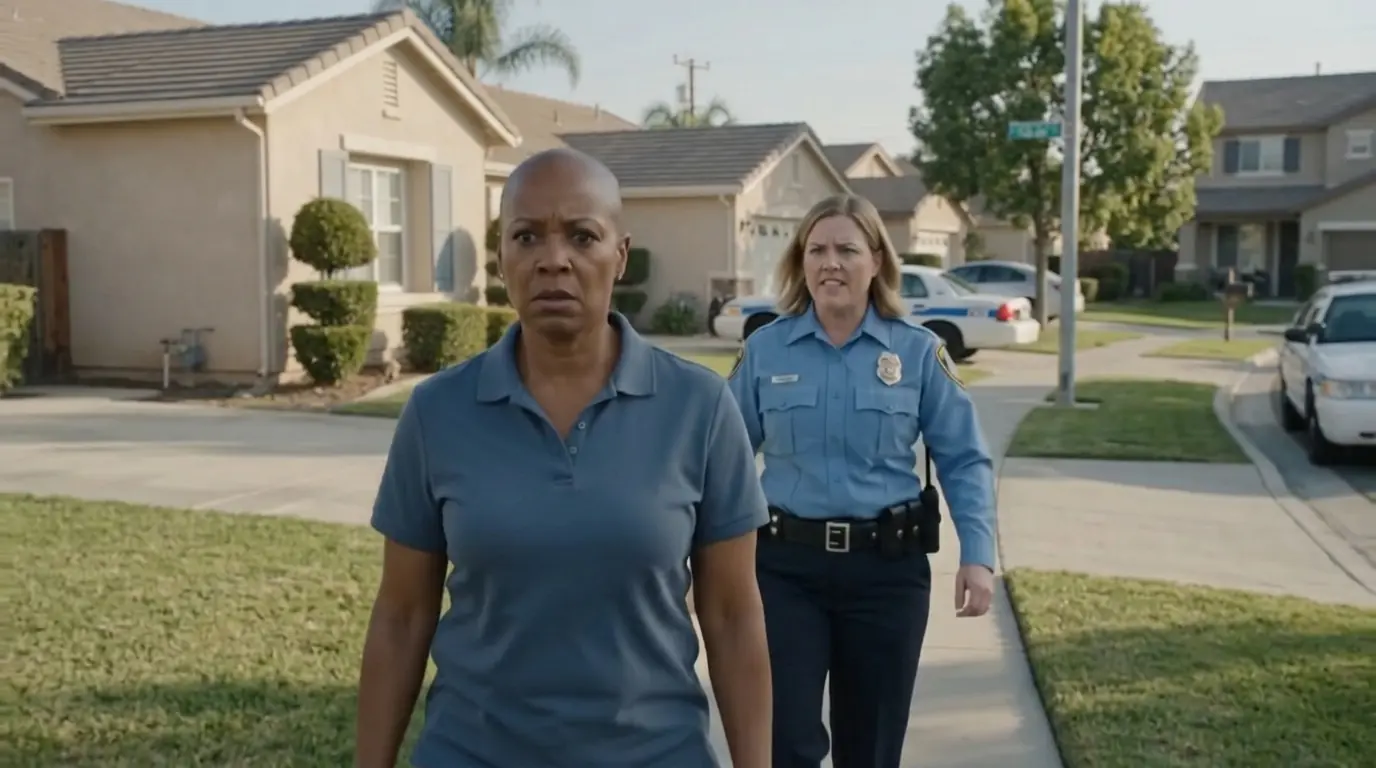
Officer Dana Whitlock was already shouting before Mayor Camille Brooks realized the words were meant for her.
“Hey! Stop right there!”
Camille kept walking for another half step, then turned on the sunlit sidewalk of Hawthorne Grove, one of the oldest neighborhoods in Bellhaven, Virginia. A white patrol cruiser sat crooked at the curb behind her, emergency lights flashing even though there was no traffic, no accident, and no visible emergency.
Dana strode toward her with one hand resting beside her duty belt. “I said stop.”
Camille looked behind herself, almost expecting another person to be standing there. She wore tan slacks, a navy polo shirt, comfortable walking shoes, and no jewelry except a small silver watch. Nothing about her appearance suggested she was on her way to a government building, and that morning she had deliberately left her security detail, city vehicle, and mayoral lapel pin behind.
“Are you talking to me?” Camille asked.
Dana stopped several feet away. “Who else would I be talking to?”
Camille studied her. The officer was perhaps forty, blond hair pulled tightly behind her head, shoulders squared with the confidence of someone who expected instructions to become obedience the moment they left her mouth. Her nameplate read WHITLOCK.
“What seems to be the problem, Officer Whitlock?”
Dana’s eyes narrowed slightly. “What are you doing in this neighborhood?”
Camille almost smiled because the question sounded so absurdly broad. “Walking.”
“I can see that.”
“Then I’m not sure what you’re asking.”
Dana stepped closer. “Where are you going?”
“Down Hawthorne Avenue.”
“To what address?”
Camille looked at her for a moment. “Why?”
That single word changed Dana’s expression.
“Because I asked.”
Across the street, an elderly man watering hydrangeas lowered the hose. A woman carrying grocery bags slowed beside a parked Volvo, and somewhere farther down the block a lawn mower went quiet.
Camille noticed all of it.
She also noticed Dana had never asked whether she needed help.
Had never said someone reported a crime.
Had never described suspicious conduct.
The officer had looked at her, chosen a conclusion, and started building questions around it.
“Am I being detained?” Camille asked.
Dana gave a short laugh. “Here we go.”
Camille’s face remained neutral. “That’s a simple question.”
“No, it’s something people say when they’ve been watching too many videos.”
“Am I free to continue walking?”
Dana moved into her path. “Not until I figure out what you’re doing here.”
Camille’s stomach tightened.
For the previous three months, residents in Bellhaven had been telling her office variations of this exact story. Black homeowners questioned while collecting mail, Latino landscapers ordered to prove they worked at houses they were standing beside, teenagers stopped for walking through developments where officers decided they “looked out of place.” The complaints were never identical, and most were dismissed individually because each officer could articulate some vague reason for concern.
Camille had spent weeks asking whether the problem was real or whether frustration was making unrelated encounters look connected.
That was why she was walking Hawthorne Grove alone.
The city had recently funded sidewalk repairs, new lighting, drainage work, and a small community center renovation in the area, and Camille liked visiting projects without cameras whenever possible. More privately, three complaints about selective police stops had come from these six blocks alone.
She wanted to see the neighborhood without everybody performing for the mayor.
Apparently, she was.
“I live in Bellhaven,” Camille said.
Dana looked her up and down. “That’s not what I asked.”
“I’m walking on a public sidewalk.”
“And I’m investigating suspicious activity.”
Camille’s voice changed slightly. “What suspicious activity?”
Dana hesitated.
It lasted less than a second, but Camille noticed.
“We received concerns about someone walking around looking at houses.”
“From whom?”
“That’s not information you need.”
“What did the caller say the person did?”
Dana’s jaw tightened. “You ask a lot of questions.”
“I’m trying to understand why you stopped me.”
“People around here have had problems.”
“What problems?”
“Break-ins. Package theft. Cars being checked.”
Camille nodded toward the row of restored Craftsman homes. “Was a crime reported today?”
Dana did not answer directly. “Identification.”
Camille remained still.
“Do you have reasonable suspicion that I committed a crime?”
Dana smiled without warmth. “You don’t get to run this stop.”
“I’m not trying to.”
“Then give me your ID.”
Camille considered complying simply to end the encounter. Her driver’s license carried her full name, and there was a good chance Dana would recognize it. But something inside her resisted the convenience.
Every resident who had complained to City Hall had faced the same choice.
Make it easy.
Answer the extra question.
Hand over identification.
Explain where you live.
Explain why you belong.
Perhaps nothing bad happens.
Perhaps the officer leaves.
Then the report says voluntary contact.
Camille looked toward Dana.
“I’m not carrying identification.”
That was technically true.
Her wallet was back in the city SUV three blocks away with her security officer, who believed she was spending twenty minutes inspecting landscaping work before meeting him at the community center.
Dana’s eyes hardened.
“You’re walking through an expensive neighborhood without ID?”
There it was.
Camille tilted her head. “Is identification required to walk through expensive neighborhoods?”
“Don’t twist my words.”
“I repeated them.”
Dana stepped closer. “Where do you live?”
“Bellhaven.”
“Where?”
“Does that determine whether I’m allowed on this sidewalk?”
Dana inhaled sharply through her nose. “You need to lose the attitude.”
Camille had been called difficult in council meetings, cold during negotiations, aggressive by opponents, and arrogant by at least three newspaper columnists. She had survived a gubernatorial campaign, two federal investigations into city contracts, one divorce, and enough political insults to make the word attitude almost charming.
Still, hearing it here felt different.
Because Dana did not know who she was.
The officer believed she was talking to an ordinary Black woman.
That made the contempt cleaner.
More useful.
And much uglier.
“I have not raised my voice,” Camille said. “I haven’t insulted you. I haven’t interfered with anything.”
“You’re refusing to cooperate.”
“With what investigation?”
Dana pointed toward a house behind Camille. “How do I know you’re not casing that property?”
Camille looked at the porch. “You don’t.”
Dana seemed pleased.
“Exactly.”
“You also don’t know that I am.”
The satisfaction disappeared.
“That’s why I’m asking questions.”
“And I’m answering.”
“No, you’re being evasive.”
Camille shook her head. “I told you what I’m doing. I’m walking.”
Dana moved even closer. “People who belong in this neighborhood don’t usually act nervous when police talk to them.”
Camille stared at her.
The elderly man across the street shut off his hose.
“People who belong here?” Camille repeated.
Dana looked briefly toward the witnesses.
“I said residents usually cooperate.”
“No.”
Camille’s voice became quieter.
“You said people who belong here.”
Dana’s face reddened. “You know what I meant.”
“I would like you to explain it.”
“Enough.”
“Explain what someone who belongs here looks like.”
Dana reached toward Camille’s arm.
“Turn around.”
Camille stepped back. “Do not touch me.”
“Hands behind your back.”
“For what?”
“Obstruction.”
“Obstruction of what?”
Dana grabbed her wrist.
Camille pulled instinctively.
The officer’s grip tightened.
“Stop resisting.”
“I am not resisting. Let go of me.”
“You pulled away.”
“Because you grabbed me without explaining why.”
Dana twisted Camille’s arm behind her.
Pain shot through Camille’s shoulder.
The woman carrying groceries dropped one bag onto the grass and took out her phone.
Camille heard herself breathe differently.
Slow.
Measured.
She had learned that rhythm decades earlier from her father.
Four counts in.
Four out.
Stay inside the facts.
“Officer Whitlock,” Camille said carefully, “you need to release my arm.”
Dana gave a bitter laugh. “You really think you’re in charge here.”
Camille looked over her shoulder.
“Yes.”
That answer seemed to infuriate the officer.
Dana pulled her toward the patrol cruiser.
“Hands behind your back.”
Camille planted neither foot.
She did not fight.
She did not make it easy either.
“You are making a serious mistake.”
“I hear that from everybody.”
“You haven’t heard it from me before.”
Dana pulled out handcuffs.
Across the street, the elderly man finally spoke.
“Officer, she wasn’t doing anything.”
Dana turned her head. “Sir, stay out of this.”
“She was walking.”
“Go back inside.”
The man did not.
Camille recognized him now.
Arthur Bell, retired high-school principal.
He had introduced her at a veterans breakfast two years earlier.
Apparently Dana did not know that either.
Arthur stared at Camille, then at the officer.
His face changed as recognition reached him.
“Officer.”
Dana ignored him.
Arthur stepped toward the curb.
“You need to look at who you’ve got.”
Dana snapped around.
“Stay back!”
Arthur raised both hands.
Camille met his eyes and shook her head slightly.
Do not tell her.
Not yet.
Arthur understood.
He remained where he was.
Dana closed one handcuff around Camille’s left wrist.
Metal tightened.
Camille looked down at it.
“Officer Whitlock.”
“What?”
“My name is Camille Brooks.”
Dana barely reacted.
“Great.”
Camille waited.
Nothing.
Interesting.
“You have heard that name before.”
Dana pulled the second wrist behind her.
“Everybody thinks they’re somebody.”
Camille almost laughed.