By the time Ethan Cross pointed at the quiet man on the bench, half the gym was already smiling.
That was the kind of room it had become whenever Ethan felt good about himself.
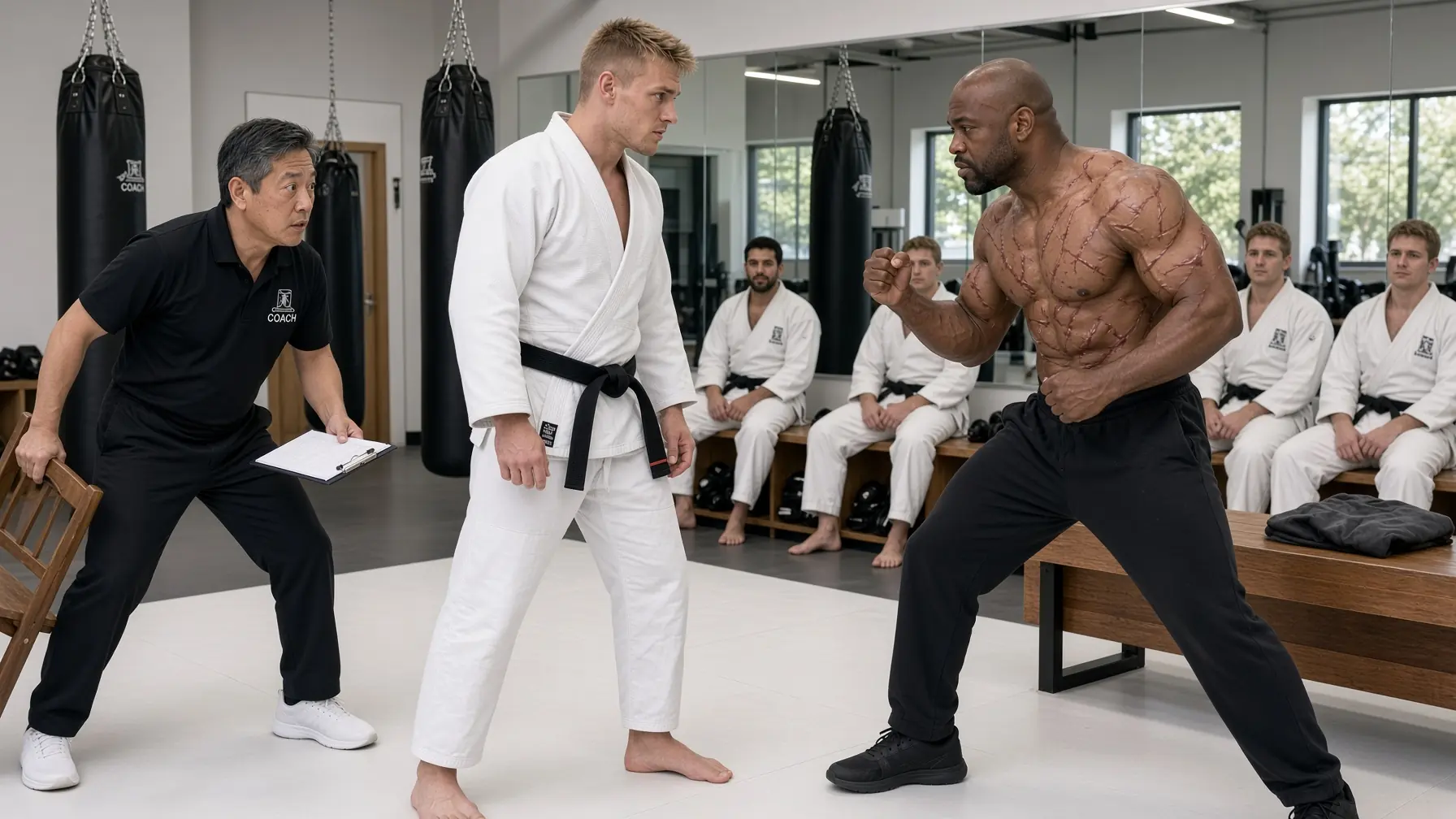
Reeves Combat Arts sat in a clean industrial strip on the edge of Franklin, Tennessee, about twenty minutes south of Nashville, in the kind of fast-growing suburb where martial arts schools shared parking lots with frozen yogurt shops and physical therapy clinics. The gym had a good reputation. Parents trusted it. Amateur fighters trained there. Office workers came in after work to sweat through beginner classes and imagine themselves harder than they felt during the day.
And on that particular Saturday afternoon, the intermediate class had swelled larger than usual because people liked watching Ethan Cross.
Ethan was twenty-seven, lean, handsome, disciplined, and just arrogant enough to mistake applause for proof of character. He wore a crisp white gi and a black belt tied with the neat confidence of someone who had practiced every movement in a mirror until it looked effortless. He had won three regional tournaments in two years, taught several evening classes, and had recently started talking like a man who believed the gym would someday belong to him, even though the name on the glass door still said REEVES COMBAT ARTS.
He was good. Nobody denied that.
But the longer Ethan stayed the best young fighter in a room full of hobbyists and teenagers, the more he confused being talented with being untouchable.
Coach Daniel Reeves had started noticing the shift weeks earlier.
At fifty-eight, Reeves no longer needed to raise his voice often. He had coached long enough to know arrogance rarely arrived loudly at first. It came in little signs. The extra second a student held a submission after the tap. The smirk after landing a clean sweep on a beginner. The casual way Ethan began volunteering smaller partners for demonstrations while explaining techniques as if he were doing everyone a favor by humiliating them efficiently.
Twice, Reeves had corrected him privately.
Three times, he had corrected him in front of the class.
Ethan always nodded. Always said, “Yes, sir.” Always behaved for a week.
Then the edge came back.
That Saturday, the edge had shown up early.
The first warning sign came during warm-ups, when Ethan laughed after dumping a forty-year-old accountant onto the mat harder than necessary. He apologized, but only after other students looked over. The second came when he corrected a brown belt woman mid-drill in a tone more suited to a lazy child than a training partner. The third came when he started talking too much between rounds about “killer instinct,” one of those phrases men loved when they had never had to use anything truly dangerous in their lives.
Reeves watched all of it from his folding chair near the edge of the mat, clipboard across his knees, expression unreadable.
He was not watching only Ethan.
He was also watching the man on the bench.
Marcus Hale had arrived almost forty minutes before class started. He had entered quietly, said hello to the front-desk girl, spoken to Reeves for less than a minute in a low voice, then taken a seat on the far wooden bench against the mirrored wall.
He wore a faded charcoal-gray T-shirt, loose black training pants, and simple black athletic shoes. He looked like a man who had spent his life carrying heavy things without feeling the need to discuss it. Broad shoulders. Thick hands. Calm eyes. Shaved head. Short trimmed beard. No gym bag beyond a small duffel at his feet.
He had not stretched dramatically. Had not made conversation. Had not looked around to see who was watching him.
Mostly, he had sat with his forearms on his thighs, retieing one shoe lace slowly and listening.
A few students had assumed he was a parent.
A few assumed he was new.
One of the younger fighters whispered that maybe he was a former student.
Nobody guessed correctly.
Reeves had invited Marcus himself.
Not to teach. Not officially. Marcus hated attention too much for that. Reeves had simply asked him to stop by, watch a class, and maybe, if the mood felt right, move around a little afterward.
The invitation had not come out of nowhere.
Reeves and Marcus went back twenty-three years.
Back when Reeves was still competing occasionally and traveling to seminars. Back when his knees hurt less and his black hair had not started giving way to gray. He had first met Marcus on a military base in North Carolina during a self-defense instruction program that Reeves had been hired to assist. Marcus had been twenty-one then. Quiet even at that age. Built like a middleweight and carrying himself like a man who understood danger so well he no longer needed to advertise it.
Over the years, they crossed paths again. Sometimes at regional grappling camps. Sometimes at charity seminars. Once in a smoky little gym outside Atlanta where Marcus had entered an open tournament under a borrowed mouthguard and dismantled three much younger men so efficiently the crowd had stopped cheering and simply stared.
He had never chased fame. That was part of why almost nobody outside certain circles remembered him.
Marcus had spent eight years in the Army, much of it in units where close-quarters fighting was not a sport. After that, he trained and competed just enough to make a name people whispered with respect, then disappeared from the scene almost entirely when his wife got sick and his priorities changed. Now, at forty-four, he worked security consulting, taught a tiny self-defense program for veterans twice a month, and stepped into gyms only when old friends asked.
He was not there to prove anything.
Reeves knew that.
What Reeves also knew was that Ethan had become too comfortable performing cruelty inside politeness, and sometimes the only cure for a man like that was a mirror he could not punch through.
Still, Reeves had not planned anything. He would never set up a student to be humiliated for sport. If the day passed quietly, fine. If Marcus simply watched and left, also fine.