Daniel Mercer, seventy-eight years old, stood outside the small fast food restaurant on Snyder Avenue in South Philadelphia while snow drifted slowly onto the sidewalks around him.
The cold had settled deep into his bones hours ago.
He pulled his thin coat tighter around his chest, though it barely helped. The fabric had become worn after years of use, and the stitching along the sleeves had started to fray. His right hand trembled as he reached for the handle of the restaurant door.
Not because he was afraid.
Because he was exhausted.
The bell above the entrance chimed softly as he stepped inside.
Warm air rushed toward him immediately. The smell of barbecue sauce, fresh bread, fried onions, and hot soup wrapped around the room like a blanket. For a brief second, Daniel closed his eyes and breathed it in.
It reminded him of years long gone.
Family dinners.
Sunday evenings.
Days before hospitals, medication, and unpaid bills had slowly consumed everything he and his wife once had.
The restaurant buzzed with noise. Teenagers laughed loudly near the windows. Construction workers in reflective jackets crowded around a television mounted above the counter. A mother sat feeding fries to her little boy while scrolling through her phone.
Nobody noticed Daniel at first.
And honestly, he preferred it that way.
He moved slowly toward the counter, his uneven limp impossible to hide. Every step forced pressure onto the old military brace hidden beneath his trousers. The injury had followed him home from Afghanistan decades earlier.
Shrapnel damage.
Three surgeries.
Permanent pain.
But Daniel never talked about it.
Complaining, in his mind, solved nothing.
“Next,” she called out without looking up.
Daniel stepped forward carefully.
His fingers reached into his pocket.
He pulled out a single folded dollar bill and smoothed it gently against the counter like it was something fragile.
“Ma’am,” he said quietly, “could you sell me some food? Just enough so my wife doesn’t go to bed hungry tonight.”
Brittany finally looked up.
At first, she blinked in confusion.
Then she laughed.
Not a nervous laugh.
A loud, mocking laugh that turned heads throughout the restaurant.
“One dollar?” she repeated.
Several customers looked over immediately.
“Sir,” she scoffed, “if you dropped that on the sidewalk outside, people would probably step over it.”
A few customers chuckled.
Daniel lowered his eyes slightly but remained polite.
“I understand,” he said softly. “I’m only asking for something small.”
A heavyset man seated nearby leaned back in his chair with a grin.
“Hey, old timer,” he called out loudly, “why don’t you pray for a hamburger? Maybe God delivers now.”
More laughter erupted.
Someone at another table muttered, “This is getting sad.”
Daniel’s hand tightened around the dollar.
His stomach burned with hunger, but the humiliation hurt far worse.
Still, he stayed calm.
Because this was not the hardest thing life had done to him.
Not even close.
He had once carried wounded soldiers through gunfire while explosions shattered the desert around them.
He had once sat beside hospital beds listening to doctors explain that young men barely out of high school would never walk again.
He had once buried friends whose families never even got to say goodbye.
Compared to those memories, public humiliation felt small.
Painful.
But small.
“I know it isn’t enough,” Daniel repeated quietly. “I just need enough for my wife.”
Brittany rolled her eyes dramatically.
“This isn’t a shelter,” she snapped. “If you can’t pay, you can’t order.”
The room grew uncomfortable after that.
Even some of the customers who had laughed now avoided looking directly at him.
Daniel nodded slowly.
For a moment, he seemed ready to leave.
Then he reached carefully into the inside pocket of his coat.
He pulled out a folded sheet of paper.
The page had been worn soft from being handled.
“I wrote this after praying this morning,” he said quietly. “I know it doesn’t have value, but I wanted to leave it here.”
Brittany stared at him in disbelief.
“Oh my God,” she muttered. “He’s trying to pay with church notes now.”
“He’s lost it,” someone whispered nearby.
Daniel gently placed the paper on the counter anyway.
His hand trembled slightly as he withdrew it.
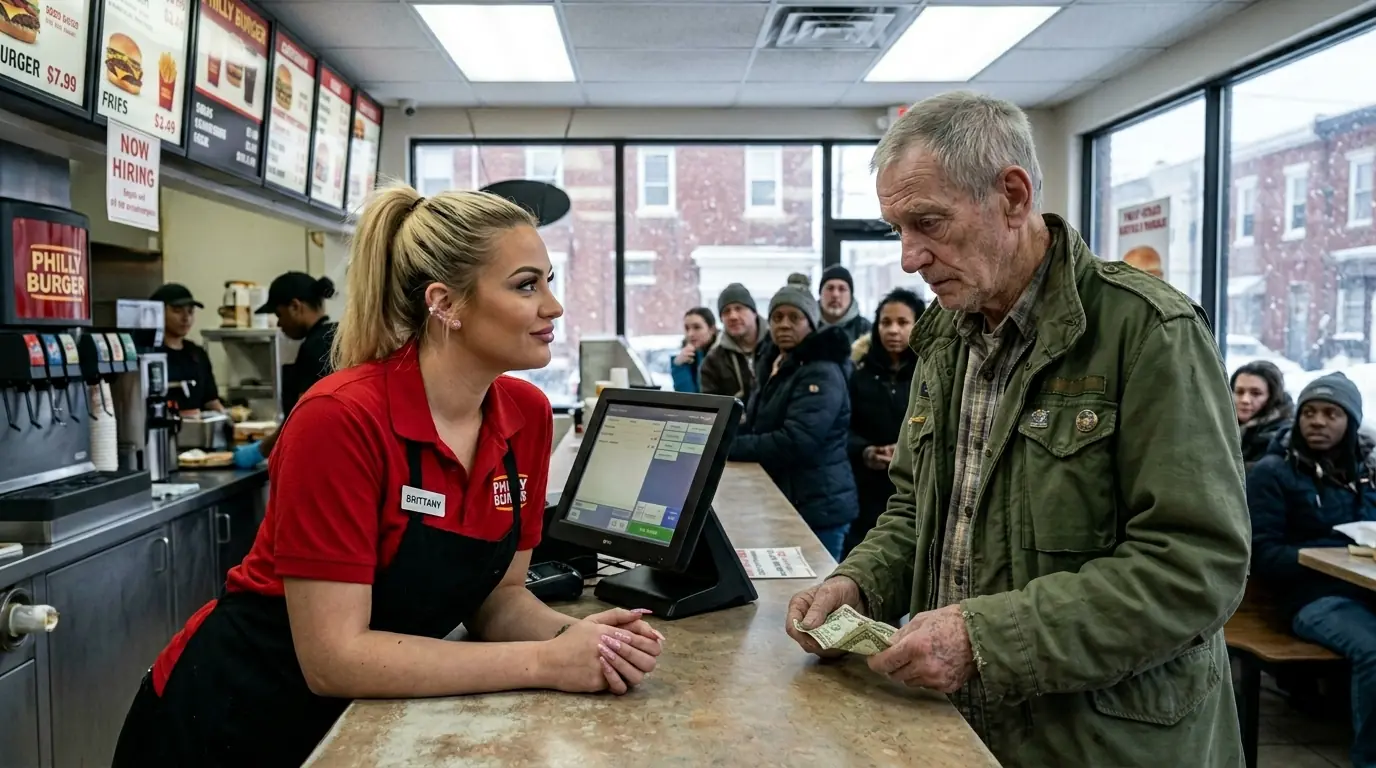
For a brief second, his posture shifted as pain shot through his injured leg. His body leaned unevenly before he steadied himself again.
The movement revealed years of damage hidden beneath quiet dignity.
But nobody asked about it.
Nobody cared.
Or at least, not yet.
Then a voice suddenly cut through the room.
“Enough.”
The single word silenced everything instantly.
The kitchen curtain pushed aside.
A tall older man stepped out slowly, wiping his hands on a white apron.
His name was Marcus Reed, owner of the restaurant for nearly thirty years.
Marcus had spent most of the evening in the kitchen preparing food orders while listening to the laughter outside.
At first, he ignored it.
Restaurants were noisy places.
But something about the old man’s voice had bothered him.
Not weakness.
Not desperation.
Dignity.
That was what stopped Marcus.
The kind of dignity people carried only after surviving things others could not imagine.
Marcus walked to the counter slowly.
Without saying another word, he picked up the folded paper.
The restaurant watched silently.
He unfolded it carefully.
Then he read the words written across the page in faded blue ink.
His expression changed immediately.
The laughter disappeared completely.
Marcus swallowed hard before reading aloud.
“I was young, and now I am old, yet I have never seen the righteous forsaken, nor their children begging bread.”
Silence spread across the room.
The verse hung heavily in the air.
Marcus looked up at Daniel.
“Your wife,” he asked softly. “Is she sick?”
Daniel nodded once.
“She can’t walk anymore,” he replied. “The treatments weakened her legs. Some nights I tell her I already ate earlier so she won’t feel guilty taking the last of the food.”
Nobody moved.
The mother near the window slowly lowered her phone.
The construction workers stopped eating.
Even Brittany’s face lost its arrogance.
Marcus stared at Daniel for several long seconds.
Then he quietly said, “Please wait here.”
Without another word, he turned and disappeared back into the kitchen.
The restaurant remained silent after he left.
Daniel stood alone near the register holding the crumpled dollar in shaking fingers.
Part of him wished he had never come inside.
Pride was a difficult thing to lose.
Especially for a man who had spent his entire life trying to protect others.
Several minutes passed.
Then Marcus returned carrying two large paper bags filled with food.
Steam drifted from the containers inside.
Fresh stew.
Roasted chicken.
Bread.
Eggs.
Soup.
Milk.
Canned vegetables.
Enough food for nearly a week.
Daniel stared at the bags in disbelief.
“Sir,” he whispered, “there must be some mistake.”
“There’s no mistake,” Marcus replied gently.
Daniel shook his head immediately.
“I can’t afford this.”
Marcus stepped closer.
“You already paid.”
Daniel looked confused.
Marcus glanced down briefly at the older man’s injured leg before speaking again.
“When someone gives their strength, their youth, and part of their body serving something bigger than themselves,” Marcus said quietly, “and still keeps their faith after all these years...”
He pressed the dollar bill back into Daniel’s trembling hand.
“That’s worth more than anything on my menu.”
Daniel’s lips trembled.
For a moment, he tried to speak, but no words came out.
His eyes filled with tears he had spent years refusing to show.
Not during war.
Not during surgeries.
Not even during the nights he and his wife sat hungry together pretending everything would somehow improve.
But kindness broke something inside him that pain never could.
“Thank you,” he whispered hoarsely.
Marcus nodded softly.
“Tonight,” he said, “your wife eats warm food.”
Daniel slowly gathered the bags into his arms.
Several customers immediately stood up to help him carry them.
The same room that had laughed at him minutes earlier now refused to meet his eyes out of shame.
The heavyset man who had mocked him earlier stared silently at his untouched burger.
Brittany wiped at her eyes discreetly behind the register.
Daniel turned toward the door.
His limp remained.
His pain remained.
His poverty remained.
But something else walked beside him now.
Dignity restored.
The bell above the door chimed softly as he stepped back into the snowy Philadelphia night.
Marcus watched through the window until the old veteran disappeared down the sidewalk beneath the streetlights.
Then he looked down at the prayer sheet still resting on the counter.
Carefully, he slid it beneath the glass display near the register where every customer would see it.
Brittany looked over quietly.
“Why are you putting it there?” she asked softly.
Marcus stared at the handwritten verse for a long moment before answering.
“Because tonight,” he said, “a hungry man walked in here asking for food...”
He paused.
“And reminded all of us what sacrifice actually looks like.”
Nobody spoke after that.
The television continued playing overhead.
Cars moved through the snowy streets outside.
But inside that little restaurant in South Philadelphia, something had changed.
Not because of money.
Not because of charity.
Because people had been forced to remember something the world often forgets.
Some heroes do not wear uniforms anymore.
Some heroes walk slowly.
Some heroes carry invisible wounds.
And some heroes still stand tall long after life has taken pieces of them away.
That night, in a tiny apartment several blocks away, Daniel Mercer sat beside his wife Eleanor while steam rose gently from bowls of hot stew placed between them.
Eleanor looked at the bags of food with tears in her eyes.
“Danny,” she whispered, “how did you manage all this?”
Daniel looked at her quietly for a moment.
Then he smiled softly.
“There are still good people left,” he said.
Outside, snow continued falling over South Philadelphia.
But inside their small apartment, for the first time in weeks, the cold no longer felt unbearable.
Because sometimes a meal is not just food.
Sometimes it is hope.
Sometimes it is dignity.
And sometimes the smallest act of kindness becomes the thing that reminds someone they have not been forgotten after all.