Burglar Uncovers Shocking Crime During Robbery, Turns Himself In and Exposes Serious Offense
Facts 16/12/2025 23:59

Many of humanity’s most important discoveries begin with a deceptively simple question: who lived here before us? The research at Takarkori, a remote rock shelter in what is now southwestern Libya, is one such moment. Long before the Sahara became the vast desert we recognize today, this region supported lakes, vegetation, and stable human communities. New genetic evidence shows that some of those people followed a completely independent path through history—one that does not directly connect to any living population today.
The recovery and analysis of two women buried at Takarkori offers a rare glimpse into a forgotten human lineage that existed for thousands of years in North Africa. Their story does not merely add a footnote to human evolution. Instead, it reshapes our understanding of early population diversity and challenges the assumption that all ancient groups contributed to modern ancestry. These women represent a branch of humanity that flourished, adapted, and eventually vanished without leaving a direct genetic legacy.
Their discovery serves as a powerful reminder that much of human history unfolded quietly, beyond the lineages we typically trace, and that entire populations may have lived rich, complex lives without appearing in the genetic maps we rely on today.
To understand the significance of Takarkori, it is essential to imagine a Sahara very different from the arid landscape we know today. During the African Humid Period, roughly between 14,500 and 5,000 years ago, North Africa experienced significantly higher rainfall. The desert was dotted with lakes, grasslands, and wildlife, creating conditions that supported long-term human settlement.
Within this greener Sahara, communities formed around reliable water sources. Takarkori was one such refuge. Archaeological evidence shows that people lived there for generations, practicing early forms of herding, pottery making, and seasonal resource management. Rather than constantly migrating, these groups often remained rooted in specific locations, shaped by the environmental stability around them.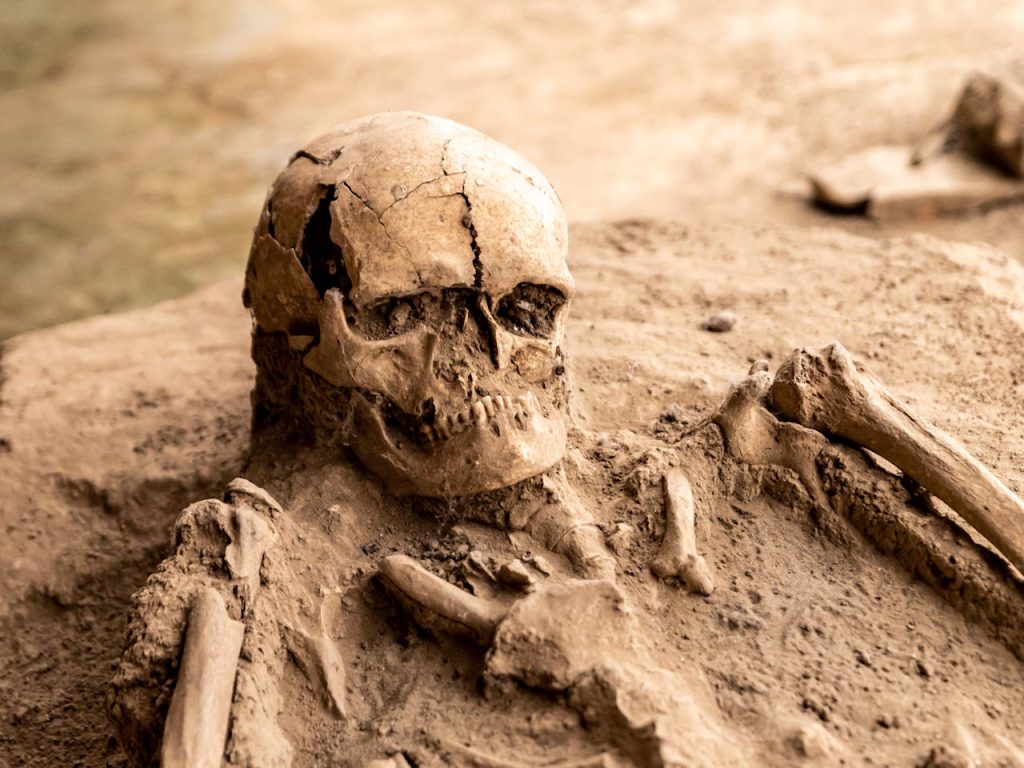
It was within this context that researchers uncovered the remains of two women whose genetic profiles revealed something extraordinary.
Genetic analysis led by archaeogeneticist Nada Salem at the Max Planck Institute for Evolutionary Anthropology revealed that the Takarkori women belonged to a previously unknown North African lineage. According to the study, reported by Popular Mechanics and supported by genomic modeling, this lineage diverged from sub-Saharan African populations nearly 50,000 years ago—around the same time modern humans began migrating out of Africa (Popular Mechanics; Max Planck Institute).
Crucially, this group remained largely isolated for tens of thousands of years. Unlike many ancient populations that mixed through migration and expansion, the Takarkori community maintained a distinct genetic identity shaped by geography, climate, and long-term settlement. Their ancestry shows minimal influence from neighboring populations, underscoring how environmental barriers can preserve genetic continuity over vast stretches of time.
This isolation explains why their lineage does not survive in an unmixed form today. It was not absorbed into later population movements that shaped modern North African or Eurasian ancestry.
One of the most intriguing findings concerns Neanderthal ancestry. The Takarkori women carried only a very small amount of Neanderthal DNA—less than modern non-African populations, but slightly more than many sub-Saharan African groups of the same era. This pattern suggests limited contact with populations outside Africa, reinforcing the idea of long-term regional stability.
Interestingly, despite their genetic isolation, the Takarkori people were not culturally isolated. Archaeological evidence shows similarities between them and later North African communities, such as those from Taforalt Cave in Morocco, dating to about 15,000 years ago. Both groups practiced herding and pottery, indicating that ideas and technologies spread across regions even when genes did not.
This distinction highlights a critical insight: cultural exchange does not require genetic blending. Communities can learn from one another while still maintaining separate identities over thousands of years.
Beyond genetics, the Takarkori discovery deepens our understanding of how humans adapt to changing environments. Rather than responding to climate shifts through constant migration, this community thrived by learning how to live sustainably within a specific ecological niche. Their success demonstrates a form of resilience rooted in adaptation rather than expansion.
Modern researchers note that this has contemporary relevance. As climate change reshapes environments today, studying how ancient populations survived dramatic ecological transitions can inform how societies think about sustainability, stability, and long-term survival.
The discovery also underscores the importance of interdisciplinary research. Archaeology, genetics, climatology, and anthropology all played essential roles in reconstructing the Takarkori story. No single field could have revealed the full picture alone, a reminder that understanding complex systems—past or present—requires collaboration.

Perhaps the most profound implication of the Takarkori findings is philosophical. They remind us that the human story is not a single, linear narrative leading inevitably to the present. Instead, it is a branching network of paths—some leading forward, others ending quietly, yet all meaningful in their time.
Many ancient populations, like the Takarkori lineage, shaped the regions they inhabited, influenced cultural practices, and contributed to humanity’s collective experience, even if they did not leave descendants alive today. Their absence from modern DNA does not diminish their importance.
As genetic technology advances and more ancient remains are studied, researchers expect to uncover additional “lost” lineages. Each discovery expands our understanding of who we are and challenges assumptions about continuity, survival, and legacy.
The women of Takarkori remind us that humanity’s past is far richer and more complex than any single ancestry chart can capture—and that much of our shared history is still waiting to be uncovered.