"I'll give $500 million cash to anyone who can crack it. Anyone."
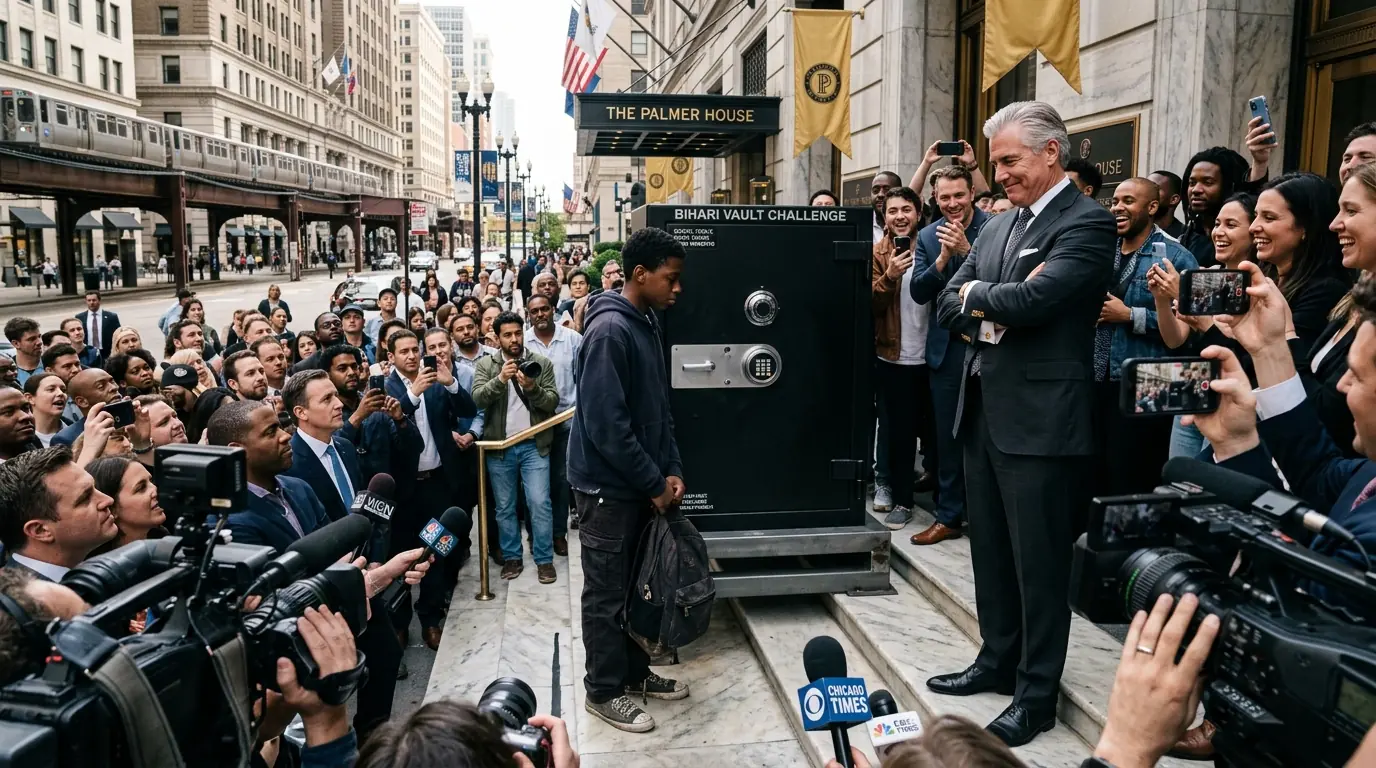 Cornelius Vance swept his arm across the crowd like a king surveying cattle. He was standing on the marble steps of the Whitmore Grand Hotel in downtown Chicago on a Tuesday afternoon that would later be replayed on every major news channel in the country.Behind him, bolted to a custom titanium platform, sat the most sophisticated vault ever built outside a government facility: matte black, six feet tall, no keypad, no dial. Just a single smooth surface and a biometric panel that, according to Vance's own engineers, responded to nothing—not sound frequencies, not magnetic fields, not laser drilling, not the most advanced safe-cracking equipment money could buy. His engineers had tried; he'd paid them to fail.The crowd that afternoon numbered somewhere around three hundred people: reporters, city officials, curious pedestrians who had stopped when they saw the cameras, and a ring of Vance's associates in tailored suits radiating smug energy like heat off a hot sidewalk."Nobody," Vance repeated, letting the word land slow and deliberate, adjusting his gold cufflinks. "And I mean nobody on this earth has the mind to touch that safe."He turned to the cameras and smiled—the kind of smile that didn't reach his eyes because it wasn't meant to. It was a billboard smile, a brand."$500 million, tax-free. You have my word. My lawyers are right there." He pointed. Three men nodded like they'd rehearsed it.The crowd laughed nervously. A few people filmed with their phones. One reporter shouted, "Mr. Vance, is this a publicity stunt?"Cornelius Vance didn't even turn his head. "Does a publicity stunt cost $500 million?" He raised an eyebrow. "I built the Vance Tower. I own three satellite companies. I funded the Meridian Bridge reconstruction. I do not do publicity stunts." He buttoned his jacket. "I make statements."More laughter. This time, it was the crowd giving in, because when you're standing in front of a man worth $42 billion, his confidence becomes gravity. You orbit it. You laugh when he implies you should.Cornelius Thaddeus Vance was sixty-one years old and had never once in his adult life been told no by anyone who mattered.He was not a large man physically—medium height, lean in the way that expensive personal trainers and Swiss health retreats produce—but he moved through space like he owned it. Not arrogantly; worse than arrogantly: naturally. As if the world had been arranged for his convenience a long time ago, and he'd simply grown comfortable with the arrangement.His hair was silver-white and swept back with the kind of precision that suggested someone else managed it. His watch, a Patek Philippe Grandmaster Chime, cost more than the median American home. His shoes were hand-stitched in Florence. He had opinions about leather; he had opinions about everything.Vance had built his first company at nineteen from a dorm room in Connecticut—a logistics algorithm that cut delivery times for major retailers by 30%. At thirty, he had sold four companies and acquired two more. At forty, he had restructured an entire sector of the defense contracting industry. At fifty, he had placed himself so far beyond ordinary consequence that news about his business dealings read less like journalism and more like mythology.