Silas Calder had buried three people he loved and never once wept until the morning a girl was shoved across the dust toward him like a debt come due. The whole town watched. Her stepmother counted the coins twice. And the crippled man they called a monster did the one thing nobody in Crooked Pine expected. He pressed the money back into that woman's hands and said low and even, "I don't buy people, ma'am."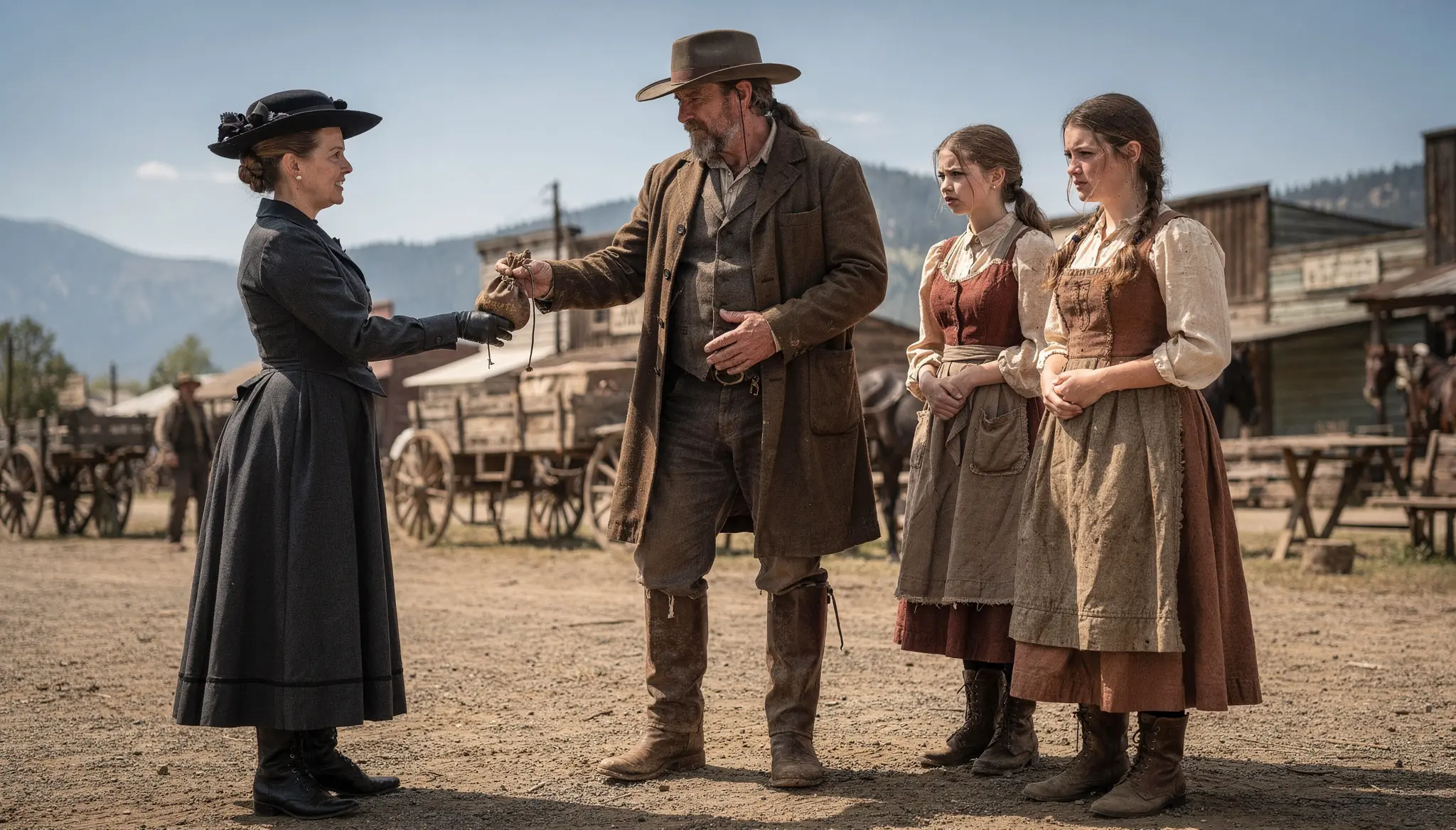
The bell over the Crooked Pine church had rung eight times when they brought Josephine Merritt out into the square and the first thing she did was reach back for her sister's hand. Priscilla. She said the name quiet the way you'd say a prayer you already knew wouldn't be answered. "Priscilla, look at me."
But Priscilla wouldn't look at her. The girl stood behind her mother's skirts, which was answer enough. Delphine Merritt turned around with her gloved hands folded at her waist calm as a Sunday. "Stop your fussing, Josephine. You'll shame the family."
"The family?" Josephine laughed and it came out cracked. "Which family would that be, ma'am? The one that raised me or the one that's selling me?"
"Nobody is selling anybody." Delphine's mouth thinned. "You are being placed. There's a difference and a girl your age ought to know it."
A crowd had gathered the way crowds always gathered in a town too small to have anything better to watch. They came out from the mercantile and the feed store and the little clapboard bank and they stood along the boardwalk with their arms crossed and their faces set and not one of them said a word to stop it. Josephine looked from face to face. She had known some of these people her whole life. Mrs. Ackley, who'd sold her mother buttons before her mother died.
Old Tom Hurley, who used to slip her peppermints when she was small. They looked at her now like she was already gone. "Where?" Josephine said.
"Where am I being placed?" Delphine didn't answer. She didn't have to. Because that was the moment the wagon came down off the North Road, slow, one wheel catching, a big dun horse in the traces, and the crowd went still, the way a room goes still when a snake comes through the door.
"Lord have mercy." Somebody breathed. "They actually got him to come down." "Didn't think that man came into town for anything but bullets and salt."
"He don't. That's how you know what she paid for." The wagon stopped at the edge of the square, and a man climbed down. He came down slow, and he came down wrong.
The left leg wouldn't take his weight clean, so he swung it and caught himself on the wheel, and stood a moment before he trusted the ground. He was tall, broad through the shoulders in a way that made the coat sit heavy on him. His face was weathered dark, and there was a scar that ran from his ear down under his jaw. And when he lifted his head and looked across that square, half the crowd took a step back, like he'd raised a hand. "That's him," a woman whispered.
"That's the Calder man, the one who killed who knows how many up on the mountain. All alone, you know what he is. Hush now." Josephine had heard the stories.
Every child in Crooked Pine had heard them. The monster of the mountain. The man with no heart. The monster up at the tree line who'd come down out of the pines one hard winter, and never told a soul where he'd come from, or what he'd done. And folks decided the way folks do, that a man that quiet, and that scarred, and that alone, must have something buried under his cabin floor.
And this was the man her stepmother had sold her to. Josephine's knees went just for a second. She caught herself. She would not fall down in front of these people. She had promised herself that much when they'd walked her out here.
You will not fall down. You will not beg. You will not give them that. And she straightened her spine and lifted her chin and made herself look at the man coming across the dust toward her. Silas Calder stopped 10 ft off.
His eyes went to Delphine first, then to the girl behind her skirts, then last to Josephine, and they stayed there a beat too long, and something moved behind them that Josephine couldn't read. "Mrs. Merritt," he said. His voice was low and rusted like a man who didn't use it much. "You sent word to the mercantile, said you had a girl needed a place before the snow.
Said she was of age and willing and strong enough for mountain work." "I did." Delphine's smile came back bright and false. "And here she is, 19 years healthy, quick with her hands.
She can cook and mend and doctor a sick animal. You'll not find better, Mr. Calder, not for the price we discussed." "The price." Josephine heard it land in her own chest like a stone dropped down a well.
Silas Calder's jaw worked. "The price." "The arrangement." Delphine produced from a fold in her skirt a small drawstring purse, and she held it up so the whole square could see it, so no one could later say she'd done a thing in shadow.
"You sent thirty dollars up front, generous. My husband, rest him, left debts. A woman alone in this world must be practical, Mr. Calder." She held the purse out toward him, palm up, as if she were doing him the kindness.
"She's yours. Take her on up. We'll speak no more of it." "She's yours.
The crowd leaned in. You could feel them lean, all of them, waiting to see the monster take the girl and drive her up the mountain, waiting for the story they'd tell over supper for a month. And Josephine stood there with her hands fisted in her apron and her whole body shaking, and she thought, this is how it ends then. This is how a life comes apart. Not with a scream, with a woman holding out a purse in the sunshine and calling it practical.
Silas Calder looked at the purse for a long moment. Then he stepped forward that swinging uneven stride, and he closed Delphine's fingers back over the coins with one big scarred hand and pushed it firm back against her chest. I don't buy people, ma'am. The square went dead quiet. Delphine blinked.
I beg your pardon? You heard me. Silas didn't raise his voice. He never once raised his voice, and that was somehow worse than shouting. I sent thirty dollars because a woman wrote to the store and said there was a soul in this town about to be put out with nowhere to go before winter.
I sent it because I've got room and I've got work, and I don't hold with letting people freeze. I didn't send it to buy a girl off her own kin like she was a heifer. He took his hand back. Keep your money and take your hands off that child. Josephine realized distantly that Delphine's grip had closed on her wrist somewhere in the last minute hard enough to bruise.
Mr. Calder? Delphine's voice had gone tight. I don't think you understand the situation. She's got nowhere else. She can't stay in my house.
There's my own daughter to think of, her prospects, her name. And this girl, well, Delphine's lip curled just slightly, and she said the next part loud enough for the whole square because she wanted them to hear it, because it was easier to send a girl away if everyone agreed she deserved it. This girl has always been difficult, willful. She's not She's not the kind that finds a husband, Mr. Calder. You'd be doing us all a Christian mercy.
Somewhere in the crowd, somebody laughed. Josephine felt it go through her like cold water. She'd braced for a lot of things that morning. She hadn't braced for the laughing. And then a strange thing happened.
Silas Calder turned his head slow and looked out at the crowd. He didn't say anything. He just looked moving from face to face, the way a man counts a herd, and one by one the laughing stopped, and folks found reasons to study their own boots. He looked until the square was silent again. Then he turned back to Delphine, and when he spoke, his voice had dropped even lower.
A Christian mercy. He let that sit. You know, ma'am, I've been called a lot of things by this town. Heard most of them through the walls of the mercantile when they thought I couldn't. Monster, devil, worse.
And I'll tell you something. He leaned in just an inch. Not one person in this square has ever done a crueler thing in front of me than what you just done to that girl. And you did it in your church clothes. Delphine's face went white, then red.
Mr. Calder, let go of her wrist. Delphine, let go. Josephine's hand came free, and she pulled it against her stomach and held it there, and she was staring at the scarred, limping stranger, this monster the whole town feared, and she could not for the life of her make her mind fit around what was happening now. Silas straightened. He tipped his hat back off his forehead with one thumb, and for the first time he addressed her directly, and his voice gentled by a degree that surprised her.
Miss, I'm sorry to meet you like this, in front of all this. He glanced at the crowd, dismissed it. My name's Silas Calder. I've got a place up on the North Ridge—a cabin, a barn, forty head of cattle, and a garden gone half to weeds because I can't kneel to it no more. It's honest work and it's hard and it's lonely and I won't lie to you about any of the three, but I'll tell you what it ain't.
He looked her dead in the eye. It ain't a sale. You're not bought and you're not owed and you're not mine. You come up that mountain, you come as a free woman taking honest wages. And the day you want to leave, you leave and no man, including me, has got the right to say different.
You understand what I'm telling you. Josephine's mouth opened. Nothing came out. “She understands, ” Delphine cut in, brisk, eager now to have it done. Go on, Josephine.
Get your things. I wasn't asking you, ma'am. Silas didn't even look at her. I was asking her. Josephine swallowed.
Her voice, when it came, was a whisper. I She stopped, tried again. I don't have things. She didn't let me bring anything. Something flickered across Silas Calder's face.
Wagon's over there when you're ready. No hurry. I'll wait. And he waited. That was the thing Josephine would remember later, long after the day itself had blurred.
Not the shame or the coins or her sister's turned away face. She'd remember that a man the whole world called a monster stood in the dust with his bad leg painting him and waited. Waited for a girl to decide on her own whether she'd come while the good Christian people of Crooked Pine had already made up their minds about her before she was old enough to have a say in it. She looked at Priscilla one last time. Prissy, she said softly.
It's all right. You didn't do this. I don't blame you. And that finally made her sister look up, eyes wet, mouth trembling, and the girl took one step forward before Delphine's hand shot out and caught her shoulder and held her fast. Josephine, Priscilla whispered.
I'm sorry. I'm so sorry I told her not to. I know. Josephine made herself smile. It cost her everything.
I know you did. Be good. Be careful of her. And then because she couldn't hold it another second, she turned away and walked spine straight, chin up, exactly as she'd promised herself across the square toward the wagon and the waiting man. The crowd parted for her.
Nobody said goodbye. She was halfway up into the wagon seat when the voice came from the boardwalk. Now hold on. Hold on just a minute. A man was pushing out through the crowd, heavy set, red faced, a gold watch chain across a straining vest.
Josephine knew him. Everybody knew him. Harlan Doss who ran the bank and held half the paper in the county and had a way of standing over people even when they were taller than him. Calder. Doss came down the two steps into the dust, hitching his thumbs in his vest, playing to the crowd.
Before you go carting off with the girl, I think there's a matter of accounts to settle. Silas had one hand on the wagon rail. He didn't turn all the way around. Doss smiled around at the square, inviting them all in on it. Late Mr. Merritt owed my bank a considerable sum.
His widow's been settling it up piecemeal. Now, the way I understand this arrangement—he nodded at Delphine, who had gone very still—the girl was to go toward that account. Labor in lieu of coin, so to speak, which makes her, in a manner of speaking, collateral. And collateral don't just walk off up a mountain because some hermits had an attack of conscience.
Josephine's stomach dropped. She turned to look at Delphine, and she saw the truth of it written all over the woman's face. The panic, the flush, the way she wouldn't meet Doss's eye, and she understood all at once exactly what had happened. There was no thirty dollars going to feed Priscilla. The money went to Doss.
The girl went to the mountain. And the debt got a little smaller, and everyone in the square had known it and let it happen and called it a mercy. You sold me to pay the bank, Josephine said. Not to Delphine, to no one, to the sky. You didn't even sell me for yourself.
You sold me for him. Silas Calder turned around all the way now. He looked at Harlan Doss for a long, long moment. And when he spoke, it was slow, and it was quiet, and every soul in that square leaned in to catch it. Let me be sure I've got this straight, Mr. Doss.
He took one step off the wagon back toward the boardwalk, that leg swinging. You're standing there in your good vest telling me, telling all these people that a living, breathing girl is collateral on a dead man's loan. That she belongs to your bank like a barn or a wagon. That she can be handed round to clear a debt she never signed for and never spent a dime of. Another step.
That about the shape of it. Doss's smile got a little less certain. The law's the law, Calder. A debt's a debt. I don't make the terms, I just hold the There's no law in this territory nor any other, Silas said, that lets one human being be posted as security on another human being's note.
Not since a war we fought over exactly that. You know it, I know it, and every man on this boardwalk with a lick of sense knows it, which is why not one of them has looked me in the eyes since I stepped down off that wagon. His voice never rose. It just got colder. So, here's the shape of it, Mr. Doss.
If Mrs. Merritt owes your bank money, that's a matter between Mrs. Merritt and your bank, and you can take it up with a judge like a civilized man. But, the girl is not part of it. The girl was never part of it. And if you try to make her part of it, I will ride to the territorial capital myself and swear out every word of what I've watched happen in this square this morning in front of every witness standing here. He turned slow and swept the crowd with that same flat look.
And there's a lot of witnesses, ain't there, folks? Nobody answered. Nobody had to. Doss's jaw flexed. He looked at the crowd gauging it, and Josephine watched him do.
She watched him do the arithmetic, watched him weigh how much of the town's fear of the Calder man was fear, and how much of it right this minute had quietly turned into something closer to respect. Watched him decide it wasn't worth the trouble, not today, not out here. This isn't finished, Doss said finally. Low meant only for Silas. You don't know what you're stepping into, Calder.
You don't know whose interests you're crossing. Reckon I'll find out. Silas tipped his hat mock polite. Mr. Doss, and he turned his back on the banker deliberately, an insult everyone understood, and limped back to the wagon. And this time when he pulled himself up into the seat beside Josephine, he was breathing hard, and she saw the pain of it tighten the corners of his eyes, and she saw him hide it.
He gathered the reins. He didn't look at her. You all right, miss? Josephine opened her mouth to say yes, the way you're supposed to, and found she couldn't. No, she said instead, small.
No, I don't believe I am. Silas nodded like that was the right answer. Like he'd have distrusted any other. That's honest. I'll take honest over all right any day of the week.
He clicked to the horse, and the wagon lurched forward, and the square began to slide away behind them. The bank, the church, the faces, her sister's small hand still lifted in a wave that Delphine hadn't managed to catch in time. You just breathe now. You don't owe me a word the whole way up. And you don't owe me one when we get there, either.
The town fell behind them. The road bent north and began to climb. And Josephine Merritt, nineteen years old, sold in the morning to settle a dead man's debt, and freed by noon by the one man everyone had taught her to fear, sat beside a stranger on a jolting wagon seat, and finally, finally, where no one from Crooked Pine could see her do it, let herself cry. He let her. That was the second thing she'd remember.
He didn't tell her to stop. He didn't tell her it would be all right, which would have been a lie. And he didn't fill the silence with talk, which would have been for his comfort, and not hers. He just drove, both hands on the reins, eyes forward, and gave her the mile it took to come apart. And the mile after it to put herself back together.
And when she finally scrubbed her face with the heel of her hand and drew a shaking breath, he waited a decent spell before he spoke. Name's Josephine, she said. Josie. It came out before she'd decided to say it. My father called me Josie.
Nobody else anymore. Josie. He tried it careful, like it was something that might break. That suit you or you want Miss Merritt? Your choice.
I'll call you whatever you tell me to. She looked at him sidelong. It was such a small thing being asked. She couldn't remember the last time anyone had asked her what she wanted to be called. Josie's fine, she said.
Josie's yes, thank you. All right then, Josie. He nodded once and that was settled. They rode a while. The horses' hooves and the wheels and the wind and the high pines were the only sounds and Josie found to her surprise that the silence wasn't the frightening kind.
It was the kind you could rest in. Can I ask you something? She said eventually. Ask. Why'd you do it?
She turned on the seat to face him. Send the money. You never met me. You never met any of us. You could have hired a hand from town, a man, somebody strong.
Why send thirty dollars up front for a girl you'd never seen sight unseen on the word of a woman you didn't know? Silas was quiet long enough that she thought he might not answer. Because the note said she'll be put out with nowhere to go before winter. He said at last. Those words, nowhere to go.
His hands tightened on the reins and eased. I know what it is, Josie, to have nowhere to go. I know what a Montana winter does to a body that's got nowhere to go. I've buried folks that had nowhere to go. A muscle worked in his jaw.
So when a note comes to the store saying there's a person about to be one of them, I don't much care whether it's a man or a woman or how strong they are or whether it's good business. I care that come January they've got a roof and a fire and enough to eat. That's the whole of it. There's no more to to than that, whatever the towns told you. Josie studied the side of his face, the scar, the weather, the leg he'd arranged carefully to one side of the boot board.
"They told me you were a monster." she said quietly. "I know they did." "They told me you killed a man, maybe more than one." Something closed over his face, not anger, something older.
"That so." "Is it true?" He was a long time answering. The wagon climbed.
When he finally spoke, his voice had gone flat and even the voice of a man reciting something he'd made peace with never being believed about. "There's a version of it they tell in Crooked Pine," he said. "And there's what happened, and they ain't the same story, Josie, though. I'll not sit here and pretend to you that my hands are clean because no man's hands are clean who's lived the life I've lived, but I'll tell you this much, and you can believe it or not as you see fit."
He looked at her, and there was no plea in it, no asking to be trusted, just a plain tired truth laid down between them. "I have never in my life raised a hand against a soul that wasn't raising one against somebody weaker first, and I never will. You're going to be alone with me on that mountain for a long while, and I'd be a coward not to say it plain so you can sleep at night. You are safer under my roof than you were in that square this morning. That's a low bar, God knows, but it's true, and it'll stay true, and if I ever give you the smallest reason to doubt it, you take that dun horse and you ride, and I won't so much as call after you."
Josie sat with that. She'd spent 19 years learning to read the difference between what people said and what they meant. Her stepmother could say, "I love you like my own," and mean, "You are a burden I am counting the days to be rid of." The whole town could say Christian mercy and mean good riddance.
She had gotten very, very good at hearing the second thing under the first, and she listened to this scarred, limping stranger say, "You are safe." And for the life of her, she could not find the second thing underneath it. There was no second thing. There was just the words.
She didn't know what to do with that. So, she looked away out over the climbing pines, and she said in a small voice, "My father used to say the same, that I'd always be safe with him." She swallowed. "He died two winters back, and it turned out safe was the only thing he had to leave me, and it died with him."
"I'm sorry," Silas said. And she believed that, too. After he passed, she Josie stopped, started again. "Delphine married him when I was 11, brought Priscilla, and for a while it was it was all right.
I thought we were a family. I loved that little girl like she was my own blood. But after Pa died, something changed overnight, near. Like a mask coming off. And I understood that to her, I'd never been a daughter at all.
I'd been the price of marrying a widower with land." Her voice hardened just slightly. And once the land was hers, and the widower was in the ground, there wasn't any more use for me. There was only her real daughter to think of. Priscilla's prospects, Priscilla's name.
She laughed short and bitter. "You heard her say it, in front of the whole town. Not the kind that finds a husband." Silas made a low sound in his throat.
"That woman," he said, "does not know the first thing about you, Josie Merritt. And she said what she said because it's easier to throw away a thing if you've told everybody it was broke to begin with." He shook his head slow. "You ain't broke.
A body doesn't sit up straight and walk across a square full of people laughing at her without falling to pieces. I watched you do it if she's broke. That's not broke. That's the opposite of broke. That's the strongest thing I've seen a person do in a good long while, and I've seen men walk into gunfire."
Josie's throat closed. She looked down at her hands twisted together in her lap and could not speak. "So." Silas cleared his throat gruff, like he'd said more than he was comfortable with and wanted the ground back.
"That's enough hard talk for one wagon ride. Here's how it's going to go up top. There's the cabin one room, but it's tight and it's warm and it's yours. I'll be out in the barn."
Josie's head came up. "The barn? There's a stove out there and I've slept rougher. You'll have the cabin and a door that bars from the inside, and I'll be a good forty yards off where you can hear me, but you don't have to see me till you're ready to. That's how it'll be till you tell me otherwise."
He said it like it was the most natural arrangement in the world, like a man giving up his own bed and his own roof to a stranger was simply what a person did. "Wages are a dollar a week, paid Sundays. Yours to keep or save or spend in town. And if the work's more than a dollar's worth, and it will be, I'll not pretend otherwise, then we'll talk about more. You cook if you've a mind to and I'll be grateful, but you're not obliged.
You're not obliged to much of anything except being honest with me about how you're faring, because I can't fix what I don't know is broke." He glanced at her. "That fair?" she heard. "He That's Josie shook her head dazed.
"Mr. Calder, that's more than fair. That's more than anyone's offered me in" She couldn't finish it. "Why are you being kind to me?" The wagon crested a rise and the land opened up ahead of them.
And somewhere below, a cabin and a barn and a stand of firs and forty head of cattle grazing the high summer grass. But Josie wasn't looking at any of it. She was looking at him. Silas Calder was quiet a moment. Then he said without looking back at her in a voice gone rough at the edges, "Because somebody was kind to me once when I had nothing and deserved less.
And I've spent every year since trying to be worth it." He drew the horses to a slow stop at the top of the rise and set the brake and finally turned to look at her, this monster the whole world feared with his scarred face and his ruined leg and his steady steady eyes. "Welcome home, Josie. For however long you want it to be one.
Nobody up here is ever going to trade you for anything. You've got my word on that. And my word's about the only thing in this world I've got left worth a damn." And Josie Merritt, who had learned to hear the second thing under the first, looked into that face and heard only the truth. For the first time in two years, she let herself believe it.
The first week, Josie learned that a mountain does not care whether you're grieving. She learned it before dawn on the second morning when Silas knocked twice on the cabin door, not hard, just enough to wake her, and called through the wood that the cows didn't milk themselves. And she was welcome to sleep, but the coffee had been gone by the time she got out. She was up and dressed and out the door in 4 minutes flat because two years in Delphine's house had trained her that a person who slept while others worked did not stay welcome long. Silas was already at the fire pit outside the barn, and he looked up at her surprised.
"Didn't mean you had to jump," he said. "That was an invitation, not a bell." "I don't lie abed while a man does chores," Josie said. "I wasn't raised to it."
"No." Something crossed his face. No, I reckon you weren't. He handed her a tin cup of coffee, black and scalding, and she wrapped both hands around it and understood from the small, careful way he passed it, turning the handle toward her, not letting his fingers touch hers, that he'd thought about how to hand a frightened girl a cup of coffee, that he'd decided in advance not to touch her. She didn't know what to do with a man who thought that far ahead about her comfort.
Her whole life men who thought ahead were the ones you had to watch closest. The cows? She said to have something to say. Cows. He nodded at the barn.
Come on, I'll show you once. You'll have it by tomorrow. He showed her once. She had it by that afternoon. That was the shape of the first day's Silas showing her a thing one time, plain, no fuss, and then stepping back and letting her fail at it and figure it out and fail again and get it and never once telling her she was slow or stupid or doing it wrong.
When she pulled too hard on the cow's teat and got kicked half off the stool, she braced for the crack of a voice, the sigh of a for God's sake, girl. It didn't come. Silas just said from where he was forking hay, "She'll do that. Gentle first, then firm. She can tell the difference, and so can you."
And went back to his hay, and Josie sat there in the dirt with her ears ringing and realized she was waiting for a punishment that was never coming. By the fourth day, she stopped bracing. By the sixth, she caught herself humming. She caught it and stopped ashamed the way you're ashamed of laughing at a funeral. Priscilla was still down in that house.
Her father was still in the ground. She had no business humming. But the mountain didn't care about that, either.
The trouble came on the eighth day, and it came the way trouble comes on a mountain fast and from a direction nobody's watching. Josie was in the garden on her knees in the ruined rows Silas couldn't kneel to anymore, pulling two years of weeds out of good soil when she heard the horses. Three of them coming up the north track at a walk, and something in the sound of them, too many, too slow, too deliberate, put her on her feet before she'd thought about it. Silas was already out of the barn. He came around the corner with a rag in his hands wiping grease off his fingers, and he stopped when he saw the riders, and Josie watched his whole body change.
It was a small change. He didn't reach for anything, didn't square up, didn't do any of the things a man does when he wants you to know he's dangerous. He just went still, went quiet in a way that was somehow louder than any noise, and she understood watching him that this was what the town had seen and called monstrous, this stillness, because it was the stillness of a man who had already decided long ago exactly how far he'd let a thing go before he ended it. Josie, he said low, not looking at her. Go on in the cabin.
Who are they? Doss's men. Go on in. She didn't go in. She came and stood a few feet behind him and to the side close enough to be with him, far enough not to crowd his bad leg, and she saw his jaw tighten, and she knew he wanted to argue, and she knew he wasn't going to because there wasn't time.
The three riders drew up in the yard. Two of them she didn't know, hard-faced men with pistols worn low and easy. The third she did. Harlen Doss's foreman, a lean man named Kurt Pardo, with a way of smiling that never reached his eyes, who'd once dumped a widow's furniture in the street personally while she wept and called it business. "Calder."
Pardo touched his hat brim, mockery in his voice. "Fine place you got up here. Real fine. Be a shame."
"State your business, Pardo."
"No business. Friendly call."
Pardo's eyes slid past Silas and found Josie, and they crawled over her slow top to bottom, and she felt it like a hand. This the girl? The one you played the gallant over in the square? He whistled low. Half the town's talking about it, you know.
The monster and the castoff. Sweet as pie. Josie felt her face go hot. Beside her, Silas hadn't moved. You've said your piece, Silas said.
Now turn those horses around. See, I would. Pardo leaned on his saddle horn. "But Mr. Doss had a legal thought." Turns out that girl standing there really does have some paper attached to her, and I don't mean the debt, I mean He grinned wider. Turns out the county's got questions about a 19-year-old girl living unwed and unchaperoned with a man like yourself.
Questions of decency. Mr. Doss being a church-going man, he'd hate to see a scandal. He thought maybe it'd be cleaner all around if the girl came back down to town. Protective custody, you might say, till things get sorted proper. Just like that, there it was.
Josie felt the ground tilt. She saw it whole in an instant how they'd twisted, how they'd take the one kind thing that had happened to her in two years and make it filth. Make it a scandal. Drag her back down the mountain in the name of her own decency and hand her right back to the woman who'd sold her. She opened her mouth, and what came out surprised her.
"No." Pardo blinked. "Beg pardon, missy?"
"I said no." Her voice shook, and she made it stop. I'm nineteen years old of legal age in this territory and I'm here of my own free will taking honest wages.
And there is nothing in the law of God or man that says I have to go anywhere with you. So you can tell Mr. Doss I decline his protection. And you can tell him I know exactly what it's worth. For a second nobody spoke. Then Silas said quiet, not taking his eyes off Pardo.
She said it. Ain't much I could add. Pardo's smile finally slipped. You're both making a mistake. Reckon we're good at those.
Silas took one step forward and it was such a small thing, one uneven step, but the two hired men shifted in their saddles and one of them dropped his hand toward his belt and Silas saw it and stopped and spread his own empty hands wide plain in the sunlight. Now hold on. Nobody up here's armed but you three and I'd like to keep it a friendly call like you said. So here's how it's going to be Pardo. You're going to ride back down and tell Doss the girl declines and you're going to tell him one more thing and you're going to tell him careful because I'll want it word for word.
His voice dropped. Tell him I know what's under his land. Something changed in Pardo's face. It was fast, a flicker gone almost before it came, but Josie saw it and so did Silas and Josie understood she'd just watched a bluff land on something real. Don't know what you mean, Pardo said.
Too quick. Sure you don't. Silas almost smiled. You tell him anyway, word for word. Calder knows what's under the land.
And then you watch his face when you say it Pardo and you'll know whether I'm bluffing a lot better than you know right now. Pardo sat his horse a long moment then he gathered his reins hard jerking the animal's head around. This ain't done. He said. "Never is."
Silas didn't move. "Ride safe." They rode. Josie stood next to Silas and watched the three of them go down the north track at a trot.
Now no swagger left in it and she waited until the sound of them had faded into the pines before her legs gave out and she sat down hard in the garden dirt. Silas was beside her in a moment as fast as that leg would let him lowering himself down with a grunt not touching her just there. "You did good." He said, "You hear me?
You did good, better than good." "I'm shaking." "Course you're shaking. That's your body telling you it just did something hard."
He looked at her and there was something new in his face, something that looked almost like wonder. "No. You said it right to his teeth. You know how many grown men in this county would say no to Kurt Pardo? I could count them on this hand."
He held up his hand, made a fist of it, then opened it. "Just you." Josie laughed wet half a sob. "It didn't feel brave.
It felt like falling." "That's what brave feels like, Josie." He said it gently. "Anybody tells you different is selling something."
She wiped her face, steadied. And then she asked the question that had been building since the yard. "What's under the land?" Silas's expression closed.
Not against her, she understood now, just closed the way a man closes a door on a room he doesn't go into. "Later." He said, "I'll tell you. You've earned the truth of it and you'll have it.
But not sitting in the dirt with my heart still going. Let me get up off this ground first, would you, before my leg locks and you have to fetch the horse to haul me." And Josie laughed again, real this time, and got to her feet and before she'd thought about whether she was allowed, reached down and offered him her hand. Silas looked at it. For a moment, she thought she'd made a mistake, crossed the careful line he'd drawn, and she started to pull it back.
But then his big scarred hand closed around hers, warm and rough and gentle, and she braced and pulled, and he came up off the ground with a grunt and a great deal of his own effort. And for one second, they were standing close, her hand still in his, both of them a little startled by it. Silas let go first, carefully. "Thank you," he said, gruff.
"You're welcome." And neither of them said anything about how it was the first time she'd touched him on purpose.
He told her that night. He told her at the fire after supper. She'd made a rabbit stew and cornbread, and he'd eaten three helpings and told her twice it was the best thing he'd put in his mouth in years, and she'd flushed and said it was just rabbit, and he'd said, "It ain't just anything if a body made it careful." And she'd had to look away.
And then the fire burned down, and the stars came out thick and cold overhead, and Silas turned his coffee cup around and around in his hands, and finally spoke. "This land was my father's," he said, "and his father's before. Calder's been on this mountain 60 years, and about four years back, a survey man came through county work mapping the creeks, and he took me aside quiet, and he told me something he wasn't supposed to." Silas stared into the coals.
"He told me there's silver in the creek rock. Not a little. A vein running right under the north pasture, under this cabin, under the whole ridge. He said in 5 years, 10, when the big money came looking, this land would be worth more than every acre in the valley put together."
He turned the cup. "And he told me one more thing. He said Harlan Doss had already been asking around, buying up quiet, getting men to sign notes they couldn't pay so he could take their land when they defaulted, building himself an empire on the back of a secret only a handful of people knew. Josie went cold. "The debts," she whispered.
"That's why he holds so much paper. He's not a banker. He's He's a man building a mine out of other people's ruin." Silas nodded.
"One farm at a time, one family at a time. Sign here, ma'am. Sorry about your husband, ma'am. Oh dear, you've defaulted, ma'am. I'll take the deed.
And nobody in that valley knows why the Doss bank is so eager to lend to folks who can't pay it back. But I know." He looked up at her. "And now you know.
But your land." Josie's mind was racing. "You're on top of the vein, the best of it. He needs He needs me gone."
Silas said it flat. "He's needed me gone for four years, and I've held on because a man can hold on to a mountain a long time if he don't owe anybody anything and don't want anything from anybody. No debt for Doss to call, no family for him to lean on, nothing he could take." A pause.
"Till eight days ago." Josie's stomach dropped for the second time that day. "Me." "You."
Silas's jaw worked. "The second I stood up in that square and put myself between you and that woman Doss had it. First thing I'd wanted in four years, first thing I'd protect, first lever he could pull." He shook his head, and there was something raw in it, something like guilt.
"I'm sorry, Josie. Truth is, by helping you, I painted a mark on your back. Pardo coming up here today, that's not about the debt. It's about you being the one thing on this mountain that Doss can use to move me off it. And I didn't see it clear till just now saying it out loud to you.
And God help me if I'd seen it that morning in the square, I'd still have done the same thing, but I'd have Don't. Josie's voice came out fierce, surprising them both. Don't you dare apologize for the only decent thing anyone's done for me in two years. Don't. Silas went quiet.
You want to know what would have happened if you'd left me in that square? Josie leaned toward the fire toward him. I'd be back in Delphine's house tonight or worse. And I'd be nothing and no one would ever have said the word no on my account as long as I lived. So don't sit there and tell me you're sorry you saved me.
You can be sorry it's hard. You can be sorry it's dangerous, but don't you be sorry you did it. Her voice cracked, because it's the first time in my whole life somebody looked at me and decided I was worth the trouble. And I won't have you take it back. The fire popped.
Somewhere off in the dark, a night bird called. Silas looked at her across the coals for a long, long moment and something moved in his weathered face that she'd never seen there before. Not the stillness, not the guarded quiet, but something opening. Something that had been shut so long it had near forgotten how. All right.
He said low and rough. All right, Josie. I won't take it back. Neither of them slept much that night.
The days that followed had a different weight to them. They both knew now knew Dos wasn't done. New Pardo would come again with something worse than words knew the mountain that had felt like a refuge was really a chessboard and the two of them were pieces on it. And it should have driven them apart that knowing. Fear does that.
Fear makes people small and selfish and quick to save themselves. It did the opposite. Josie found she couldn't stop watching Silas work the way he favored the leg, but never spared himself the way he talked low to the horses like they were people, the way he'd catch her looking and duck his head like a boy. And Silas found excuses to be near where she was working close enough to talk, and they talked more each day, and the talk got easier. And one evening, she looked up from the fence rail she was helping him mend and realized she'd been laughing for 10 straight minutes about nothing at all and that the sound of her own laugh had stopped surprising her.
That scared her more than Pardo had. "Silas," she said one evening careful, "can I ask you the thing the town says, the killing?" He was quiet a while. "Reckon you've a right."
"You don't have to." "No. You should hear it from me and not from Pardo's mouth someday dressed up ugly." He set down the harness he was oiling. "ten years back before the leg I rode for the Cattlemen's Association.
Hired gun, near enough though we called it other things. And there was a man, a land agent working for the railroad, who was running families off their claims, burning barns, poisoning wells, doing it legal on paper and murder in fact. And one night, I rode up on him and two others burning out. A family man, wife, three little ones stood in the yard in their night clothes watching everything they had go up. And the agent, he had a pistol on the father and he was going to Silas stopped.
His hands had gone still. "I killed all three of them in the yard, in front of those children, and I'd do it again tomorrow and twice on Sunday, and that's the God's truth. And it's also the truth that I have not had a whole night's sleep since because you don't do a thing like that, even a right thing, and come away whole." Josie sat very still.
"The leg," she said softly, "the leg came after. One of the three didn't die as quick as I thought." A grim half-smile. "Put a bullet through my knee before he went.
So." He spread his hands. "That's your monster, Josie. A man who killed three men to save five strangers and has limped ever since and never once told the story true because the version they tell in town, the version where I'm a mad dog killer with no cause, that version keeps folks away.
And a man who wants to be left alone learns to let them believe the worst." He looked at her. "But I find lately I don't want you believing the worst. So there it is, all of it."
Josie stood up. She came around the fire slow so he'd see her coming the way he'd taught her without ever teaching her. And she sat down beside him, close closer than she'd ever sat, so their shoulders near touched. And she looked into the fire and not at him because she thought it might be easier for him that way. "My father," she said, "would have called you a good man, not a monster.
A good man who paid too high for doing right. And my father was the finest judge of a soul I ever knew." She swallowed. "So that's what I'll believe.
And Kurt Pardo and the whole town of Crooked Pine can go hang." Silas made a sound that might have been a laugh and might have been something else. "You're a rare thing, Josie Merritt," he said hoarse. "I'm a castoff," she said.
"You heard Pardo, the castoff and the outcast." "Rare things," Silas said, "are the ones nobody knows the worth of till they're gone." And then because the moment had gotten too large to hold, he cleared his throat and stood that grunting careful rise and said something about the horses needing checking and limped off into the dark. And Josie sat by the fire alone with her heart going like a hammer and did not understand yet what was happening to it.
She understood two days later. It happened fast, the way the important things did up here. She was carrying a bucket of feed across the yard when she heard Silas shout one hard bark of pain from behind the barn, and she dropped the bucket and ran and came around the corner and stopped dead. He was down. Half under a horse, the big dun spooked by something gone up on its hind legs and come down wrong, and Silas had shoved a yearling colt clear of the hooves and taken the fall himself.
And now the dun was panicked and stamping, and Silas was on the ground in the churn of it with his bad leg twisted under him and his arms up over his head. Josie didn't think. She was between him and the horse before she knew she'd moved. Hands up, voice low and steady, the way she'd heard him gentle them a hundred times. Easy.
Easy. Now, easy. There's a girl. And the dun's ears came forward, and the wildness went out of its eyes, and it dropped back to four feet and stood trembling. And Josie got a hand on its halter and walked it off three steps and tied it fast to the rail and was back on her knees in the dirt beside Silas in the space of 10 breaths.
"Where?" she said. "Where are you hurt? Tell me where." "Leg."
He was gray with it, teeth gritted. "Old side. It's just It's just the leg. It's all right."
"It is not all right. You're the color of ash." Her hands were already moving, checking sure, this she knew, this she'd done for her father, for the horses. This was hers.
"Hold still. Let me feel. Is it the knee or above?" "Josie," Silas said.
"I have set more bones than you've shot men. Now, hold still." And he went still. And let her hands move over the ruined knee, gentle and certain, and she found it wasn't broke, only wrenched hard.
The old joint pulled out past what it could bear, and she talked him through it low and steady while she eased it back there. There, breathe. I've got you. I've got you. And Silas, Calder, monster of the mountain, killer of three men, lay in the dirt of his own yard with his head in a cast-off girl's lap and shook and let himself be held.
When it was over, when the leg was braced and he was propped against the barn wall with his color coming back and the dun standing quiet, he looked up at her and there was something in his face she'd never seen in anyone's face ever aimed at her. You ran toward it, he said, wondering. The horse. Everybody runs the other way. You ran at it.
You were under it. Everybody, he said again slow, like he was learning it runs the other way. And Josie kneeling there with dirt on her face and his blood on her hands and her heart cracked wide open with the fear of nearly losing him, understood at last exactly what had happened to her and exactly how much trouble she was in. Not from you, she said before she could stop herself. I don't run the other way from you.
They looked at each other. Neither one moved to close the last few inches. Not then. It wasn't the moment and they both knew it. Him hurt on the ground, both of them raw war coming down the north track that could take everything.
But something had been said that couldn't be unsaid, and they both heard it land. And Silas reached up with one shaking scarred hand and for the first time brushed the dirt from her cheek with his thumb, so careful, so gentle, like she was the thing that might break. No, he said quietly. I reckon you don't. And that was when the gunshot cracked across the valley far off down the mountain from the direction of town, and both their heads came up, and the tenderness in Silas's face went hard and still as stone.
He was already reaching for the barn wall to pull himself up. "That came from the Hendricks place," he said. "Down the ridge. Nearest neighbor I've got." He got a foot under him, grimly ignoring the leg. "Doss is done sending messages, Josie. He started making examples."
He looked at her and the fire was back in him, the old dangerous stillness, but there was something new alongside it now, something she'd put there. "And I'll be damned to hell before I let him make one out of you."
They took the wagon down the ridge because Silas couldn't sit a horse with the leg braced, and Josie drove, and she drove hard, and Silas didn't tell her to slow down once. "Faster if you can," was all he said, one hand gripping the seat rail, the other resting on the old carbine he'd pulled down off the cabin wall the first time she'd seen him touch a gun. Hendricks is seventy years old. His wife's near blind. If Doss's men are down there, I've got it.
She snapped the reins. "Hold on." They came down the last bend, and the Hendricks place opened up below them, and Josie's stomach dropped. There was smoke, not a house of fire, not yet, but a thin black thread rising from behind the barn, and three horses in the yard she recognized, and a figure on the ground in the dooryard that wasn't moving. Oh God, Josie breathed.
Oh God, Silas. Slow now. His voice had gone flat and cold and completely calm, and that calm frightened her more than shouting would have. Slow. Bring us up easy.
Don't spook them into doing something they can't take back. He worked the carbine's lever one-handed, practiced. And Josie, whatever happens down there, whatever you see, you stay on this wagon. You hear me? You do not get down off this wagon.
Silas, promise me. I promise. She lied. The yard resolved as they rolled in. The figure on the ground was old Amos Hendricks, and he was alive, sitting up now, holding his own arm, blood dark on his sleeve, and standing over him was Kurt Pardo with a pistol loose in his hand, and the two hired men were dragging furniture out the front door and pitching it in a heap.
And behind the barn, the smoke came from a burning pile of hay and fence rail, a warning fire meant to be seen from the ridge, meant to be seen from Silas's ridge. Pardo looked up as the wagon came in, and he smiled, and Josie understood in one sick lurch that he'd wanted them to come, that the gunshot, the smoke, the timing, all of it was bait, and they'd taken it, and now Silas was down off his own mountain with a braced leg, and a girl he'd die to protect exactly where Doss wanted him. Well, now, Pardo holstered the pistol easy, like he had all the time in the world. The monster and the castoff. And here I thought you'd hole up on that ridge and make me come get you.
Saved me a ride. Silas didn't answer him. He was looking at Amos Hendricks. Amos, you hurt bad. Winged me is all.
The old man's voice shook, but held. Silas, don't don't do nothing on my account. They're saying I signed papers. I never signed saying the bank owns my place. They got a paper says I know what they got.
Silas's eyes went back to Pardo. Forged deed. Same as the others. Doss signs the widow's name, the old man's name, the fellow that can't read signs it himself and files it, and by the time anybody thinks to fight it, it's three counties away and a year gone, and who's going to pay a lawyer to chase it? That about the shape of it, Pardo?
Pardo's smile flickered that same flicker Josie had seen on the mountain, the flicker of a lie touched on bone. You talk a lot for a man in your position, Pardo said. And what position's that? Down off your mountain, bad leg, one old rifle, no law for 40 miles, and the only law there is drinks with Mr. Doss on Thursdays. Pardo spread his hands.
You're a smart man, Calder, so I'll say it smart. Doss doesn't want you dead. Dead's messy. Dead brings questions. Doss wants you gone.
Sign the mountain over fair price, more than fair. Take the girl and ride to Oregon and start fresh and all this. He gestured at the burning pile, the old man, the wrecked house. All this stops tonight. That's the offer.
That's the only offer. Refuse it and I can't promise the next fire's just hay. And there it was. The whole thing laid bare in a dooryard with an old man bleeding in the dirt. Josie watched Silas's face and saw him weighing it.
Not the offer, she knew him well enough now he'd never take the offer, but the moment. The three guns, the braced leg, the girl he'd told to stay on the wagon. She saw him doing the arithmetic of how many people could die in the next sixty seconds and which ones, and she saw him decide something and she did not like the stillness that came over him when he decided it. Josie. He said not looking at her very quiet.
Get down and see to Amos's arm. It wasn't what he'd said before. He'd said stay on the wagon. And now he was telling her to get down and she understood cold sick, sure that he was getting her clear of the wagon seat because he was about to do something and he didn't want her in the line of it. Silas.
Her voice came out thin. Silas, what are you See to his arm. Iron under it now. Go on. She climbed down.
Because he'd asked, and because Amos was bleeding, and because there was nothing else to do, and she went to the old man and knelt and pressed her apron to the wound, and kept her body between Amos and the guns, and the whole time her heart screamed that Silas was about to get himself killed. All right, Pardo. Silas set the carbine down, deliberate. Laid it on the wagon seat and took his hand off it and lifted both hands empty into the light. I'm setting it down.
See no gun, just a crippled man in a dooryard like you said. Now I want to talk, and I want you to listen because I'm about to save your life, and you don't even know it. Pardo laughed. You're going to save my life? That's right.
Silas took one uneven step forward, hands still up. Because you're standing there thinking you've got three guns, and I've got a bad leg, and this is easy. And what you don't know, what Doss didn't tell you, because Doss doesn't tell his dogs everything, is that I already sent the proof out. Two weeks back. He took another step.
The survey. The silver. The forged deeds. I got copies. Pardo, copies of six of them.
In a man's handwriting a court could match to Harlan Doss in about four minutes. Sent it all to the federal land office in Helena with a letter laying out the whole scheme. And a US marshal reads that letter, and he doesn't ask the county sheriff who drinks with Doss on Thursdays. He rides. And when he gets here and finds an old man shot in his own dooryard Silas's voice dropped.
He's going to want a name, Pardo, and it won't be Doss's face he saw pull the trigger. It'll be yours. The dooryard went dead silent except for the crackle of the warning fire. Josie's hands had stopped moving on Amos's arm. She was staring at Silas two weeks back.
But Pardo had only come up the mountain eight days ago. Silas hadn't known about the marshal, the letter, any of it. He'd told her that night at the fire. He was just holding on with nothing to fight with. He was bluffing.
He was bluffing with his life and Amos's life and her three guns on him and no rifle in his hands and he was doing it in that same flat calm voice he used to gentle the horses. And Josie realized she was watching the most dangerous thing she'd ever seen. A man who had decided the only weapon he had left was the truth and had decided to point a version of it that didn't exist at three armed men and pulled the trigger. She saw it land on Pardo. She saw the foreman's face do the arithmetic.
Is he bluffing? Is he not? What did the survey man tell him four years ago? What does Doss actually know? How much of this could be real?
And she saw the exact moment Pardo realized he couldn't be sure. That was the thing. He couldn't be sure. And a man who can't be sure whether there's a federal marshal already riding does not put another bullet in another body in another dooryard. "You're lying."
Pardo said, but it came out a half second too slow. Maybe. Silas took the last step close now, close enough to touch hands still open and empty. "Maybe I'm lying. You want to bet Amos's life on it?
Your life. You want to explain to a federal judge why you burned out a witness the day before the marshal showed? Go on then." He tipped his head at the pistol on Pardo's hip. "Draw.
But you draw on me, you'd best not miss and even if you don't miss, you'd best hope I'm lying because if I'm not, you just hanged yourself to do Harlan Doss a favor he won't even remember your name for." Nobody breathed. One of the hired men back by the furniture pile spoke up nervous. Kurt. Kurt.
I didn't sign on for no federal Shut up. Pardo said. I ain't hanging for Dos. That ain't the deal. Shut up.
And that was the crack in it. Josie saw it split wide open. Pardo's own men wavering the certainty gone out of the yard and Pardo standing there with his hand near his gun and no good move left because Silas had done the one thing nobody does. Walked into three guns with empty hands and made the guns the problem instead of the answer. Pardo's jaw worked.
His hand hovered. And then slow it came away from the pistol. This ain't over. He said the same words as the mountain but smaller now. A man reaching for the last thing he had.
Dos hears about your marshal. He'll have his own men in Helena inside a week. You just started a clock called her. You understand that? You just started a clock and I don't think it runs the way you hope.
Reckon we'll see. Silas didn't move. Now take your dogs and your fire and get off Amos Hendricks land. They went. Josie watched them mount and pull the horses around and watched Pardo look back once and it wasn't a look of a beaten man.
It was worse. It was the look of a man already thinking three moves ahead. A man who'd been surprised once and wouldn't be twice. And then they were gone down the valley road and the only sound was Amos Hendricks weeping quietly into his good hand and the warning fire burning itself down to nothing. Silas stood in the middle of the dooryard for one more breath.
Then his leg buckled and he went down. Josie caught him. Got under his arm before he hit the dirt. Took his weight. Eased him down slow.
And he was shaking now. All the calm gone out of him at once. Gray and sweating and shaking like a man pulled out of an ice river. "You were bluffing."
She whispered. "There's no marshal. There's no letter. You made all of it up right there out of nothing."
"Every word." His voice cracked. "There's no marshal, Josie. There's no letter in Helena.
There's nothing. I just He dragged in a breath. I just needed him to not be sure. That's all a bluff is. You don't need to win.
You just need the other man to not be sure enough to bet his neck." He laughed ragged, terrible. "God. God, my hands are shaking.
Are they shaking? Don't let Amos see. Amos can't see much of anything, you old fool." But she was half laughing, too half crying, holding on to him. "You walked into three guns empty-handed with a bad leg.
I told you to stay on the You told me to stay on the wagon and then you "I know." He gripped her arm. "I know what I did. And I'd do it again because it was the only card I had and I played it.
But Josie He pulled back and looked at her urgent. Now the fear in his face, not for himself. "Listen to me. The bluff bought us a night, maybe two. Because now Doss has to find out whether there's really a marshal coming and that takes time sending a man to Helena and back.
That's the time we've got. And in that time I have to make the bluff true." Josie stared at him. "What?"
"The forged deeds. The proof. He was already trying to get his feet under him driven now burning. It doesn't exist yet, but it could. Amos here signed nothing.
That deed in Doss's safe is a forgery. And there's men all over this valley the same. Widows, old folks, folks that can't read. If I could get even one of those forged deeds in front of a real federal marshal alongside the true survey the silver the motive Doss doesn't just lose the mountain Josie. He hangs.
Land fraud, forgery, arson, assault on a federal witness once I make Amos one. His eyes were bright, fever bright. I turned the bluff into a plan the second I said it out loud. All I have to do now is make it real before Doss figures out it isn't. And Josie felt something rise in her chest that she hadn't felt in two years.
Not fear, not grief, but something with teeth in it. Purpose. Then that's what we do, she said. Josie. Don't you Josie me.
She got a shoulder under him and hauled him up and he came and they stood there swaying in the dooryard holding each other up. You keep trying to leave me on the wagon. Stay in the cabin. See to the arm. Well, I'm done being left on the wagon, Silas Calder. You made a bluff you can't back up alone and I can read and write and doctor and I've got a face nobody in that valley scared of and there's a whole county full of folks Doss robbed who'll talk to a girl before they'll talk to the mountain monster. So you're not doing this alone. Do you understand me? Whatever this is now it's ours. Silas looked at her a long moment and then he did something she'd never seen him do.
He smiled a real smile the whole ruined weathered face of him breaking open with it and it was the most beautiful thing she'd ever seen and she nearly lost her breath. Yes, ma'am. He said softly. I reckon it is. They loaded Amos Hendricks and his half-blind wife into the wagon and took them up the mountain that same night because Silas would not leave a shot old man in a wrecked house with Doss's men in the valley and by the time they got the two of them settled by the cabin fire it was past midnight and Josie's hands still smelled of blood and smoke and that was where the plan began.
Over the next three days the mountain became something else. Not a refuge now, not a chessboard, but a war room. Amos, it turned out, once he stopped shaking, was sharp as a tack and mean as a snake about Harlan Doss, who'd been trying to take his land for two years. He knew names. He knew which families had defaulted and lost everything to the Doss bank and where they'd scattered to and which of them had sworn the papers were forged and been laughed out of the sheriff's office.
Josie wrote it all down in a careful hand, a list of the robbed. A map of the crime while Silas paced the cabin on his braced leg and turned it over and over building the case a marshal would need. "It's not enough." he said third night staring at Josie's list. "It's a dozen folks saying they were cheated.
Doss says they defaulted fair. Their word against his paper. We need the paper itself. We need one forged deed in our hands to compare against a real signature and Doss keeps every one of them in the safe in the back of that bank." "Then we get into the safe."
Josie said. Silas looked at her like she'd lost her mind. "Get into the safe? Josie, that's a bank robbery. That's a hanging offense.
That's exactly what Doss would love is for me to break into his bank so he can shoot me legal. Not you." Josie's voice was very quiet. "Me."
The cabin went still. "No." Silas said. "Silas." "No." He came around the table fast as the leg would let him and took her by the shoulders the first time he'd ever gripped her like that, hard afraid.
"No, absolutely not. I will not send you down that mountain into Harlan Doss's bank. Do you understand me? I have watched that man treat human beings like fence posts. If he caught you."
His voice broke. "If he caught you, I could not live with it, Josie. I could not. Do you hear me? There is not a version of this where I let you walk into that.
And Josie, looking up into his terrified face, his hands gripping her shoulders like she was the last solid thing in a flood, understood two things at once. The first was that he loved her. She'd known it maybe since the horse, since his hand on her cheek. But she knew it now, whole and certain in the raw terror on his face at the thought of losing her.
The second was that there was a knock at the cabin door. They both froze. It was past midnight. Nobody came up the mountain at midnight. Silas's hand went to the carbine, and Josie's heart slammed, and the knock came again, soft, hurried, frightened, and then a voice, a girl's voice, thin and shaking on the other side of the wood.
Josie, Josie, please, please be here. It's me. Josie's whole body went cold. She crossed the cabin and through the bar and pulled the door open. And there, standing on the threshold in a torn traveling dress with a bruise going purple across her cheek and a small carpet bag clutched to her chest, and a horse blown and lathered behind her, was Priscilla, her step sister, fifteen years old, wet-faced and terrified, and a hundred miles from where she should have been.
Prissy? Josie could barely make the word. Prissy, what How did you I ran. Priscilla was crying, the words tumbling out. I heard them, Josie.
I heard Mama and Mr. Dawson in the parlor. They didn't know I was on the stairs, and Dawson said he said She grabbed Josie's hands. He said he's not waiting for any marshal. He said he's coming up the mountain tomorrow with 10 men, and he's going to burn the cabin with Mr. Calder in it and take you back down and make it look like Mr. Calder did something to you, so no one asks questions, and Mama Her voice shattered. Mama said fine.
She said fine, Josie. As long as it's done quiet. She said you were always going to come to a bad end anyway. The cabin was silent. Josie stood holding her little sister's cold hands in the doorway, and behind her she heard Silas set the carbine down on the table slow, and she heard Amos Hendricks whisper, "Lord God."
And she felt the whole careful plan, the bluff, the deeds, the marshal that didn't exist, collapse into a single hard point Tomorrow. Doss was coming tomorrow. "How many men?" Silas said.
His voice had gone back to the flat, cold, calm, and this time Josie didn't find it frightening at all. This time she found she loved it. 10. Priscilla wiped her face. He said 10. And the sheriff's riding with them, so there won't be any law after the sheriff will say it was all legal.
He'll say Mr. Calder, he'll say I did something to Josie, and the town will believe it because they already believe I'm a monster. Silas nodded slowly taking it in, turning it over. Course he will. That's the whole use of a reputation like mine. Been the cage they built around me for ten years, and now he's going to use it to bury me.
He looked up. And there was something in his eyes Josie had never seen. Not fear, not the cold killing calm, but something almost like relief. Almost like a man who had been waiting a long, long time, and had just heard the waiting end. "Well, all right then."
"Silas." Josie's voice shook. "There's 10 of them and the sheriff, and there's you and me and a shot old man and two girls. We can't" "No." Silas agreed.
"We can't. Not the way they're counting." He crossed to the window and looked down the dark mountain toward the valley, toward the town that had called him a monster for ten years, and when he turned back his weathered face was set like stone and burning like a forge. So, we're going to have to make it so they count wrong.
All of them. Doss, the sheriff, the whole town of Crooked Pine. He looked at Josie and at Priscilla and at Amos, and something in him had grown very large and very still. They think they know exactly what I am. ten years they've been sure of it. The monster on the mountain.
He picked up Josie's list of the robbed and held it in his scarred hand like a weapon. Tomorrow. Silas Calder said quietly. I'm going to show that whole valley what I actually am. And it is going to be the last mistake Harlan Doss ever makes.
They didn't sleep. There wasn't time to sleep and there wasn't a soul in that cabin who could have anyway. By the gray hour before dawn, Silas had it worked out and he laid it on the table like a hand of cards. "We don't fight 10 men."
He said. "We can't and we won't. A gunfight up here is exactly what Doss needs, dead bodies on the mountain, the monster's doing the sheriff there to write it up however Doss likes. If one shot gets fired, we lose even if we win."
He looked around at the four faces. "So, we don't fire a shot. We do the one thing Doss has never once had to plan against in all his years of robbing this valley." "And what's that?"
Amos said. "Witnesses." Silas set his scarred hand flat on Josie's list of the robbed. "Every family on this list got cheated in the dark alone, one at a time with nobody watching but the sheriff who's in Doss's pocket.
That's how it works. That's how it's always worked. A man like Doss can do anything he wants as long as he only does it to one frightened person at a time and nobody sees." His jaw set. "So, we're going to make sure everybody sees all at once in the daylight in the middle of town.
Josie leaned forward. How? Because he's not coming up this mountain to burn me quiet at midnight anymore. Silas almost smiled. Prissy heard him wrong.
No fault to you, girl. You did the bravest thing anybody's done in this whole business. But, think on it. Doss said 10 men and the sheriff in daylight with a story ready about what I did to Josie. That's not a murder.
That's a show. He wants the town to watch the monster get taken down. He wants an audience. Silas's eyes glittered. Well, a man who wants an audience is a man who's about to have one.
And an audience is the one thing that can hang him. That can beat him by it. Oh, J Tedion.
And so, they didn't wait on the mountain to be attacked. They went down to meet it. They loaded the wagon before full light. Amos and his blind wife Priscilla the list and Silas's carbine wrapped in a blanket and shoved under the seat not to use, but to have. And they came down off the ridge not by the north track.
Doss's men would be climbing, but the old logging trail east, the one only Silas knew. The one that came out behind the church at the top of Crooked Pine's one street. And they got there first. That was the whole gamble get to town before Doss did. Get in front of the audience before Doss could arrange it his way.
They got there first.
By the time the sun was full up over the valley, Josie was standing on the steps of the Crooked Pine church with her step sister beside her. And a shot old man leaning on her arm. And the town was gathering. The way it always gathered. The mercantile emptied out. Faces appeared at the feed store.
She knew faces that had laughed at her nine days ago in this same square when her stepmother sold her. And Josie Merritt cast off, climbed up one step higher so they could all see her. And she began to talk. Most of you know me. Her voice shook at first and then it didn't.
You watched Delphine Merritt sell me in this square nine days ago. Some of you laughed. I remember which of you laughed. She let that land, watched a few faces go down. And most of you know Amos Hendricks standing here shot through the arm because two days ago Kurt Pardo burned his place and put a bullet in him for signing papers he never signed.
She lifted Josie's list high. And I've got the names of 11 more families in this county Harlan Doss robbed the exact same way. Widow Cain, the Alvarados, old man Peety who can't read his own name. Doss forged their deeds, took their land and told every one of you they defaulted honest. Her voice rang off the storefronts.
And you believed him because it's easier to believe a poor man failed than a rich man stole. The square had gone dead silent. "Why?" she shouted. "You ever ask yourselves why Harlan Doss is so eager to lend money to folks who can't pay it back?
Why he wants their scrub land so bad? I'll tell you why. There's silver under this valley. A vein of it running from the Hendricks place up under the mountain. Doss has known for four years.
And he's been buying you out from under yourselves for pennies, robbing your neighbors one at a time in the dark and calling it banking."
That was the moment Harlan Doss came up the street. He came with his 10 men and the sheriff riding beside him exactly as Priscilla had said. But he came into a full square. A hundred faces turned toward him. A girl on the church steps holding up a list.
And Josie watched him understand in one instant that everything had gone wrong. That the quiet was gone. That there would be no witness-free mountain, no story arranged after. That he'd walked into daylight with an audience already primed. He recovered fast.
She'd give him that. Now, what's all this? Doss reined up, spread his hands, put on the warm, rich voice, playing the crowd he'd played for years. Folks, folks, this poor girl's been living up on that mountain with the Calder man for a week and a half, and I think we can all understand her mind's been turned, filled with wild tales. It's a tragedy is what it is.
He shook his head sorrowful. A young girl, no chaperone, in the clutches of a known killer. I'm right here, Doss. The whole square turned. Silas Calder came around the corner of the church, slow, that uneven swinging stride, no gun in his hands, both of them open and empty at his sides, and he came out into the middle of the square in front of God and the whole town of Crooked Pine.
The monster of the mountain walking straight toward 10 armed men with nothing in his hands at all. Silas! Josie breathed. This wasn't the plan. The plan was for him to stay back out of sight safe.
You want to talk about me, Doss? Silas called. You talk to my face. You've been talking behind it for ten years, made a right nice living off it, too. Doss's men shifted.
Hands moved toward belts. And Silas kept walking right into the middle of them, right into the guns, and he stopped in the open where every soul could see him, and he turned in a slow circle, so the whole square got a good look, and then he did the thing that broke ten years of Crooked Pine wide open. He started to talk, not loud. He never once got loud, and the square went so quiet to hear him that his low, rusted voice carried to every corner of it. You all know what I am.
He turned as he spoke, meeting eyes one after another, not letting a single person look away. The monster on the mountain, the killer. I've heard you say it through the walls of the mercantile for ten years thinking I couldn't hear, and I let you. You want to know why I let you believe it? He stopped turning.
Because it kept you away. And a man who's done what I've done wants to be left alone. So, I let a whole town be scared of me because it was easier than telling the truth. He looked at the sheriff. So, here's the truth.
Sheriff, and you write it down. ten years ago, I killed three men, land agents, burning a family out of their home, man, wife, three little children in their night clothes. I rode up on them putting a gun to that father's head, and I killed all three, and I took this leg doing it, and I have never once been sorry. His voice dropped. Because there's a difference, Sheriff, between a man who kills and a man who murders. And every one of you has spent ten years too scared to ask which one I was.
Well, ask Amos Hendricks. Ask any man here who's ever needed a hard job done and found his barn mended in the night, his firewood cut, his sick stock doctored, and never knew who. It was the monster. It was always the monster. Because a man alone on a mountain's got time to be kind if kindness is what he's got left.
Somewhere in the crowd, a woman was crying. Now, Harlan Doss. Silas turned slow and faced the banker on his horse. Doss is a different animal from me, and I want this whole town to see the difference plain because you've had us backwards for ten years. You've feared the man who kills to protect, and you've trusted the man who smiles while he robs.
He pointed one scarred finger up at Doss. I never once took a thing off a soul in this valley, and that man has taken everything off half of you and called it business. So, which of us is the monster? Go on. Look at us both and decide.
For one long, terrible moment, the square hung in the balance, and Harlan Doss made the mistake that finished him. He panicked. Josie watched it happen, watched him feel the crowd tipping, watched him see ten years of careful reputation turning to smoke in front of him, and he did the thing a cornered robber does. He reached for the gun and the story at the same time. He's lying.
Doss's voice cracked high. He's a killer. You heard him admit it. He's got that girl bewitched and he'll say anything. Sheriff, arrest that man, Kurt.
Take him. He wheeled his horse. Take him now. I don't care who's watching. I want him.
Off his horse, said a new voice. Every head turned. A stranger stood at the mouth of the street. Tall, dust-covered, a long coat, and a badge. A real badge.
A federal badge caught the morning sun, and behind him were two more mounted men with rifles across their saddles. And Josie's heart stopped in her chest because it wasn't possible. There was no marshal. Silas had made him up.
There was no letter in Helena. "United States Marshal," the stranger said, walking his horse slowly into the square. "Name's Bell, out of Helena." His flat eyes went across the whole scene, the armed men, the shot old man, the girl with the list, the banker with his hand on his gun, and settled on Doss. "And I've been sitting in the back of the mercantile for the last quarter hour, listening to every word."
"So why don't you take that hand off that pistol, Mr. Doss, real slow, before you give me a reason?" The square erupted. Josie couldn't breathe. She grabbed Priscilla's hand and stared at Silas, and Silas stared back at her across the whole width of the square, and she watched him understand at the same instant she did. He was as shocked as she was.
The marshal was real, but how?
The answer came climbing down off the marshal's second horse, a survey man. The survey man. Four years older than the night he'd taken Silas aside by the creek, but the same man, and he pushed his hat back and looked across the square at Silas Calder and said loud enough to carry, "Told you I'd come back if it ever went bad, Calder. Wrote the land office in Helena myself three weeks back soon as I heard Doss was moving on folks again. Marshall Bell here's been riding this county quiet for a week, waiting to see it with his own eyes."
He nodded at Silas, grim and glad. "Reckon he just did." And Josie understood all at once the whole shape of it. Silas's bluff hadn't been a bluff, or it had been when he made it standing empty-handed in Amos Hendricks's dooryard with three guns on him throwing out a marshal and a letter that didn't exist.
He'd invented it out of pure desperation, but the survey man, four years gone, had done the exact thing Silas invented for his own reasons at his own time, had written that letter, had brought that marshal, and it had ridden into the valley in the same hour on the same day, and turned a dying man's bluff into the God's honest truth. Silas had lied, and the world had made him honest. "The deeds," Josie shouted before Doss's men could scatter, before the moment slipped. She ran down the church steps waving her list.
"Marshall, it's all forged. The deeds in his bank safe. He signed the widows' names, the old folks' names, folks that can't read. You compare the handwriting. It's all Harlan Doss's hand, everyone, and there's silver under the land.
That's the why of it. That's the whole why." Marshall Bell looked at her a long moment, then at the survey man who nodded, then at Amos Hendricks bleeding and upright on the steps. That true old-timer, you sign any paper giving this man your land? Never.
Amos's voice shook, but rang. Never signed a thing, Marshall. He shot me for saying so. Bell's face went hard as the badge on his chest. Kurt Pardo.
He didn't raise his voice. He didn't have to. You and your men set your guns down in the dirt one at a time or every one of you hangs alongside your boss. And Mr. Doss, he turned, you're going to open that bank safe for me right now in front of all these good people and we're going to have a look at your handwriting. That was when Doss ran.
He wheeled his horse and drove it straight at the crowd trying to break through, trying to run for the county line and the money and the paper and the crowd. The whole cheated, frightened, ashamed town of Crooked Pine did not part for him. They closed. Josie watched it happen and would never forget it as long as she lived. Old Tom Hurley, who'd once given her peppermints, grabbed the bridle.
The blacksmith caught Doss's leg. Mrs. Ackley, who'd sold her mother buttons, who'd stood in this square nine days ago and said nothing, picked up a stone. And the town that had been robbed one frightened soul at a time, all at once and in the daylight, dragged Harlan Doss down off his horse and into the dust and it was over. And it had taken about the length of a held breath. Don't kill him, Marshall Bell said, wading in.
He's worth more to me alive and hanged legal than dead in the street. Let him go, folks. Let him go. The law's got him now. The real law.
They let him go. Bell's men had irons on Doss's wrists before he'd stopped spitting dirt and Kurt Pardo's hired guns were laying their pistols in the dust one after another. None of them willing to hang for a man already in chains. And it was done. It was truly done.
Josie found she was crying and hadn't noticed starting. She turned to find Silas and he was already coming toward her fast as the leg would let him faster than she'd ever seen him move and they met in the middle of the square where nine days ago she'd been sold and this time nobody laughed. This time the whole town watched the monster and the castoff and not one soul dared say a word against it. "You lied," she said, laughing and crying as she gripped the front of his coat.
In Amos's yard you made up a marshal out of nothing. I know. And then he came. He was real. Silas, he was real.
I know. Silas's own eyes were wet and he didn't hide it not anymore not in front of anybody. I've been trying to reckon it. Best I can figure God's got a sense of humor about honest men. I told the biggest lie of my life because it was the only thing standing between you and a bullet and he looked down and decided to make an honest man of me one more time.
His voice broke. Josie Josie it's over. It's really over. Doss is done. The mountain's safe.
You're safe. You're free. She said it for him wondering at the word. I'm free. You always were.
He took her face in both his scarred hands gentle the way he'd brush the dirt from her cheek that day by the barn. That's the thing I never got to say right. You were never bought Josie not for one minute not by Doss and not by that woman and not by me. You were always free. I just I just wanted more than I've wanted anything in ten years for you to choose to stay anyway.
Free of your own will not because you'd nowhere else to go but because because I want to. Josie put her hands over his. "Silas Calder, you limping, scarred, lying, best man I ever knew." I want to. I choose it.
I choose the mountain and I choose you. And I'd choose it if there was no silver and no cabin and nothing up there but you and the cold. Do you hear me? I choose it. And Silas Calder, monster of the mountain in the middle of the square that had sold her in front of the whole town of Crooked Pine and a federal marshal and God and everybody bent down and kissed her.
The square was quiet for a moment. Then the town began to clap, and Josie would remember that always. Slow at first ashamed then all at once a whole Valley trying to wash nine days of silence off its hands the only way it knew how. Priscilla was crying and cheering both. Amos Hendricks was pounding his good hand on his knee.
And somewhere near the back Delphine Merritt stood at the edge of the crowd with her face gone white and pinched and small watching the castoff she'd sold for pennies become the most beloved woman in the valley and no one not one single person moved to stand beside her. Marshall Bell found them a few minutes later notebook in hand Doss already loaded in a wagon under guard. I'll need statements he said. From all of you the old man the girl with the list you especially called her the whole thing start to finish for the territorial court. He looked at Silas and something almost like respect moved across his weathered face.
That was a fool thing you did walking into 10 guns empty-handed. Bravest fool thing I've seen in 20 years of this work. If you'd been wrong about that crowd turning you'd be dead. I wasn't wrong about the crowd Silas said. His arm was around Josie and it stayed there.
I was wrong about myself is all spent ten years believing the story this town told about me. Took a girl who wouldn't stay on a wagon to make me stop believing it. Bell almost smiled. The silver," he said, "the vein under the mountain.
That's your land." "Calder, free and clear. No paper on it, I checked. You understand what that means?
When the mining money comes, and it'll come, you'll be one of the richest men in the territory." Silas was quiet a moment. Then he looked down at Josie and back at the marshal, and he said the thing that made her love him past all reason. "Then the first thing that money does," he said, "is buy back every acre Harlan Doss stole and hand it to the folks he stole it from.
The Hendricks place. The Widow Cain. The Alvarados. Old Pete who can't read. Every name on that girl's list gets their land back deed clear, not a cent owed."
He looked out over the square, over the town that had feared him, and finally, finally seen him true. "I lived ten years wanting nothing so nobody could take nothing from me. Turns out that was just another kind of poor. I'm done being that kind of poor."
His arm tightened around Josie. "I've got everything I want right here. The rest is just money, and money's only good for one thing, making right what other men made wrong." The marshal looked at him a long moment.
"You're a strange man, Silas Calder," he said finally. "So I've been told." Silas tipped his hat. "For ten years, reckon the town's about to have to find a new story."
And it did. The story it found took a full year to tell, and it told it one deed at a time. Marshal Bell was true to his word about the territorial court, and Harlan Doss was true to what a cornered man becomes. He hired the best lawyer money could buy right up until the court froze his accounts, at which point the lawyer discovered a pressing engagement in another county. And then he sat in a Helena courtroom and watched the survey man testify, and Amos Hendricks testify, and 11 cheated families testify, and finally he watched a girl named Josie Merritt lay her careful list on the judge's bench alongside six forged deeds pulled from his own bank safe, every one of them in his own hand.
"You understand what you're doing?" Doss said to her in the courthouse hall low, when the guards let him pass to close. He'd lost weight. The rich, warm voice had gone thin.
"You understand a girl like you doesn't get to do this to a man like me. It isn't how the world works." Josie stopped, looked at him, and she wasn't afraid. That was the thing she noticed standing there.
She wasn't afraid of him at all anymore. "You're right," she said. "It isn't how the world works. The world works the way you made it work, one frightened person at a time in the dark, where nobody sees."
She stepped closer, not away. "So we did it in the daylight instead, all at once, where everybody could see. That's the only trick to beating a man like you, Mr. Doss. You just have to stop being one frightened person alone."
She smiled, and it wasn't cruel, and that was somehow worse for him. "I learned that from a man you called a monster."
They hanged Harlan Doss in the fall for the murder that came out at trial, a homesteader two years back, a man everyone had thought simply left the valley found under his own collapsed well when Bell went looking. The land fraud alone wouldn't have hanged him, but a robber who's decided people are only fence posts eventually treats one like a fence post too far, and Doss had, and the well gave up its truth, and that was the end of him. Josie didn't go to the hanging. Silas asked her once if she wanted to gentle, giving her the choice, the way he gave her every choice, and she thought about it honestly and said no. I spent 19 years being taught I was worth less than other people.
She said. I don't need to watch a man die to feel worth more. I already know it now. I don't need his neck for it. Silas looked at her a long moment, and then he pulled her against his chest and put his chin on the top of her head and said rough, I don't think I've ever in my life met a person as strong as you, Josie, and I've met a few.
You married one, she said, because they'd married by then. In the spring in the crooked pine church in front of the whole town that had once laughed at her in the square out front, and this time the square was full of people who'd come to cry instead. The Hendricks were there, Amos with his arm long healed and his land back deed clear, not a cent. Owed exactly as Silas had promised the marshal. The widow Cain was there in a new dress on land that was hers again.
The Alvarados. Old Petey who couldn't read the deed Silas handed back to him, but who held it against his chest through the whole ceremony and wept. Every name on Josie's list made whole sitting in the pews of the church where the monster married the cast off. Silas had done it, all of it, one deed at a time, the way he'd told Bell he would. The mining money had come, and it had come the way the survey man promised, enough to make Silas Calder one of the richest men in the territory, richer than Harlan Doss had ever dreamed of being off the backs of the poor.
And Silas had taken that money and bought back every stolen acre and handed it back and paid the doctor bills and rebuilt the Hendricks barn better than it had been and set up a fund at the mercantile so no family in the valley would ever again have to to a note to a bank just to eat through a hard winter. You're giving it all away. Josie had said once watching him sign another draft. Not all. Silas didn't look up from the paper.
Keeping the mountain. Keeping enough to see us old. Keeping enough that our children never learn what it is to have nowhere to go before winter. He set down the pen. The rest was never mind Josie.
It was just sitting under the ground waiting for somebody to do right by. I'm not giving it away. I'm giving it back.
Priscilla lived with them now. That had been Josie's one condition. The only thing she'd ever asked Silas for outright. And she'd asked it the night after the trial braced for him to say no, the way she'd been braced her whole life for men to say no. She ran a hundred miles in the dark to warn us, Josie had said. fifteen years old.
She stood on our doorstep with a bruise on her face and she chose us over her own mother. I won't send her back to Delphine. I can't. Silas. I know it's a lot to ask.
I know she's not yours to Josie. Silas had taken her hands. Stop. Just stop. He'd looked almost hurt.
You think I'd send that child back to the woman who said fine to burning us alive? You think that low of me still? No, no. I just That girl saved every life on this mountain. His voice had gone thick.
She's got a home here as long as she wants one. As long as she lives. She's blood to me now, same as if same as. He'd stopped unable to finish. And Josie had understood Silas Calder who'd buried his own family and lived ten years alone rather than risk loving anyone again, had just gotten a daughter and didn't have the words for it.
She stays, he'd said finally. Course she stays. What kind of question is that?
Delphine tried once to take Priscilla back. She came up the mountain in the summer a year near enough after she'd sold Josie in the square and she came in a hired buggy in her church clothes and she sat in that buggy in the cabin yard and did not get down and she called for her daughter in a voice that tried for warmth and landed on cold. Priscilla. Priscilla, come now. You've had your adventure.
It's time to come home to your mother. Priscilla came out of the cabin. She was sixteen now and taller and she stood on the porch of the home she'd chosen and looked down at the woman in the buggy for a long moment. You told him fine, she said. Delphine blinked.
What? When Mr. Doss said he'd burn the cabin with Mr. Calder inside and take Josie and make it look like something awful. You said fine. You said Josie was always going to come to a bad end anyway. Priscilla's voice didn't shake.
Josie watching from the doorway with her hand pressed to her mouth marveled at how it didn't shake. I was on the stairs. I heard you say it, Mama. So, no. I won't come home.
Because the woman who said fine to killing my sister isn't my mother. My sister's my mother now. She's the only one who ever was and Delphine Merritt sat in her buggy in the mountain sun with nothing at all to say. She'd come up expecting the girl she'd raised to be frightened, expecting the old power, the old obedience, the child who flinched and what she found instead was a young woman with a spine standing on a porch beside a sister she'd been sold from and a scarred man leaning in the doorway with his hand resting easy on his own rifle. He had no intention of raising and Delphine understood finally that she had lost.
Not the argument. Everything. She'd sold the one person who'd ever loved her stepdaughter honestly and she'd done it for pennies and there was no getting it back. You'll regret this, Delphine said. It came out small.
No, ma'am, Josie said quietly stepping out onto the porch beside her sister. I don't think we will. She wasn't cruel about it. She'd found she didn't have cruelty in her even for this. You can go now, Delphine.
Nobody up here wishes you harm. But nobody up here is going to pretend either. We know what you are. We forgive it because carrying it around is too heavy and we've got better things to carry, but we don't forget it. Now go on home and don't come back up this mountain.
Delphine went. The buggy turned in the yard and went back down the north track and none of the three of them watched it out of sight because there wasn't one of them who cared to. They went back inside to supper, to the life they were building, and they let the woman drive down the mountain alone with the thing she'd done, which was punishment enough and more than any of them would have chosen for her.
The town found its new story about Silas Calder in the end. It just wasn't the one anybody expected. They'd braced some of them for the newly rich man to lord it over the town that had feared him to buy the bank, buy the sheriff, become the new Harlan Doss with a better reason. That was how the valley understood money and power. That was the only story it knew.
Silas told a different one. He gave the money away until people begged him to stop and then he gave more. He built the valley a real doctor's house and paid a real doctor to live in it. He put a school teacher in Crooked Pine and a stove in the schoolhouse. And when old Tom Hurley, who'd once given Josie peppermints, who'd grabbed Doss's bridle in the square, got too stove-up to work his little place, it was Silas who quietly paid a hand to work it for him and never said a word and let the old man keep his pride.
And slow the way a town changes, Crooked Pine stopped telling the story of the monster on the mountain. They started telling a different one. The story of the man everyone got wrong. The story of the girl who wouldn't stay on the wagon. The story of how a whole valley let one rich man rob it in the dark for years until a castoff and a crippled man stood up in the daylight and said no, and the town found to its own shame and its own surprise that it had been waiting all along for somebody to say it first.
Mrs. Ackley, who'd thrown the stone became Josie's dear friend. She never once spoke of the day in the square when she'd said nothing, and Josie never once made her. Some debts you don't collect. Josie had learned that from Silas, too.
They had a child that second winter. A girl, healthy, loud, and Josie held her by the cabin fire in the deep cold with Silas's arm around them both and Priscilla asleep in the loft above, and she thought about the note that had started all of it. Nowhere to go before winter. Those words. The ones that had made a lonely man on a mountain send thirty dollars to a stranger because he knew what a Montana winter did to a body that had nowhere to go because he'd buried people who'd had nowhere to go.
"You know what I think about sometimes?" she said softly so as not to wake the baby. "What's that?" "How close it came to never happening." Josie watched the fire.
"If Delphine hadn't been cruel enough to sell me. If you hadn't been kind enough to send the money. If I hadn't been stubborn enough to run at that horse instead of away from it. If Prissy hadn't been brave enough to run a hundred miles in the dark. If that survey man hadn't remembered a promise from four years back."
She shook her head. "So many ways it doesn't happen. So many ways I'm still down in that house or worse, and instead I'm here. With you. With her."
She looked up at him. "It scares me sometimes how close it came." Silas was quiet a while turning it over the way he turned everything over. "I don't see it that way," he said finally.
"I used to. Used to think the whole world was just close calls and bad luck waiting to fall on you. Live ten years like that wanting nothing so nothing could be taken." He looked down at his daughter, at his wife, at the fire in the home that had been a fortress and was now just a home.
"But I think I think what I've come to believe, Josie, is that it wasn't close at all. Not really. Because at every one of those turns somebody chose kind, or somebody chose brave. You, me, that little girl up in the loft, the survey man. Even that whole sorry town when it finally came to it chose to grab a bridle instead of look away."
His voice went low and sure. "That's not luck. Luck's random. This was people choosing over and over the harder right thing. And when enough people do that enough times, it stops looking like a close call and starts looking like the way things were always going to go."
Josie leaned into him. "My father used to say," she murmured, "that a person isn't the worst thing that ever happened to them. And they're not the worst thing anybody ever said about them, either." "Your father," Silas said, "was a wise man.
Wish I'd known him." "You'd have liked him." Josie smiled against his shoulder. "He'd have liked you.
Even the leg. Even the lying." She felt Silas huff a laugh. "Especially the lying, probably.
He always did say the measure of a man wasn't whether he ever did wrong. It was what he was willing to do wrong for."
The fire settled. The baby slept. Outside the mountain kept its long quiet, and the town below kept its lamps, and somewhere down in that valley 11 families slept on land that was theirs again. Deed clear, not a cent owed because a man everyone had called a monster had turned out to be the only one among them who'd never once been anything of the kind.
Josie Merritt had come up this mountain a year before with nothing, no money, no name, no things, not even a change of clothes sold in a square while a town laughed. She'd come up braced for cruelty because cruelty was all she'd ever been given listening the whole way for the second uglier thing hiding under the kind words. And there had never been a second thing. That was the truth she'd built a life on in the end. Not that the world was safe.
It wasn't, she knew that better than most. Not that people were good. Some weren't, she knew that, too. But that here in this cabin with this man, the words and the meaning underneath them were finally blessedly the same. When Silas said, "You're safe," she was safe.
When he said, "You're free," she was free. When he said, "Welcome home," that first day on the wagon seat to a frightened girl who couldn't yet believe a word of it, he had meant exactly that and every day since had proven it true. She looked around the warm cabin at her sleeping daughter at the loft where her sister dreamed at the strong scarred hand that held hers and had never once in a whole year been raised against her or anyone who didn't deserve it. And Josie Merritt, who had been traded at 19 to a man the whole world called a monster, who had been the price of another girl's future, who had been told to her face by her own kin that she was not the kind that anyone would ever want, looked into the fire of the home she had chosen freely of her own will with the whole world open to her and this, the thing she picked and knew all the way down with a certainty no one could ever take from her again, that she had been wanted all along.
That she had always been worth the trouble. That she was and had always been exactly enough. And she was home.