A man worth $80 billion, who could buy the entire city block, walks into a greasy diner wearing a thrift store jacket with a hole in the elbow. He sits in a torn vinyl booth and orders the cheapest thing on the menu, two eggs and a black coffee. The waitress, drowning in medical debt and working a double shift, looks at him not with disgust, but with a simple, tired kindness. But when a wealthy customer tries to humiliate the poor man, her reaction sets in motion a chain of events that will change their lives and the entire city forever. This isn’t just a story about a rich man in disguise. It’s about what happens when true character is finally seen. The air in the 90th-floor boardroom of Marcus Global Holdings was so sterile it felt vacuum-sealed. Darius Marcus, a Black man whose net worth fluctuated with the global markets but always remained north of 80 billion dollars, stared out the floor-to-ceiling window. Below him, Chicago sprawled like a circuit board, a complex map of lights and lives he owned but did not understand. His dark reflection in the glass was sharp and commanding, a silhouette of power.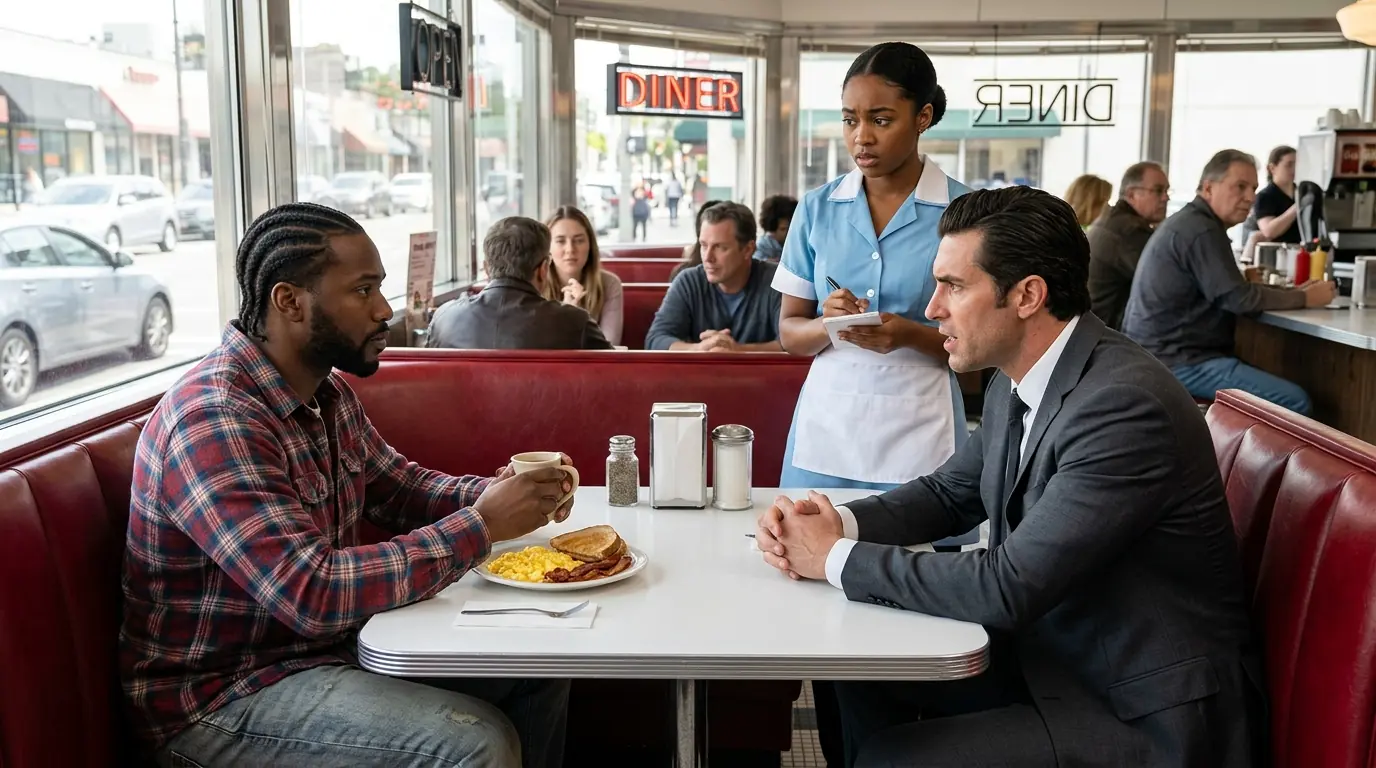
"The optics are bad, Darius," Vincent Porter, his COO and lifelong rival, said, his voice smooth and sharp. "The Tribune column this morning called you the hermit king of Chicago. They’re painting you as disconnected, a dragon sitting on a pile of gold, completely detached from the people who actually use our products and live in our buildings."
Darius didn’t turn. "The Tribune is a tabloid, Vincent. I don’t care about optics. I care about the Q4 projections."
"And the board cares about the stock price, which is tied to public perception," Vincent countered, leaning forward. "They see you in your tower, approving acquisitions and closures, but never seeing the faces of the people affected. This new urban renewal project, it’s displacing thousands. We need positive PR."
"What do you suggest? I go kiss a few babies at a shelter opening?" Darius scoffed, finally turning. His suit was a dark, severe gray, costing more than the average car, perfectly tailored to his broad shoulders.
Vincent smiled, a predator’s glint in his eye. "No, something more immersive. I make you a wager, Darius. A challenge, if you will."
"I don’t make wagers."
"Then consider it a vital piece of market research. For one week, seven days, you live like them. No access to your accounts, your cars, your name. We’ll give you a room at a hostel in the warehouse district, a burner phone, and $300 in cash. That’s it. See if the hermit king can survive among the commoners."
Darius was about to dismiss the idea as absurd, a childish stunt, but he saw the look on Vincent’s face, a smug certainty that he couldn’t do it, that he was too soft, too removed, too royal to handle reality.
"Fine," Darius said, his voice dangerously low. "One week. But when I return, Vincent, that urban renewal project’s over-budget committee, you’re leading it personally from the ground."
Vincent’s smile faltered, but he nodded. "Done."
Two days later, Darius Marcus was gone. In his place was D, a man who looked like he’d been chewed up and spit out by the city. His disguise was painfully simple, a worn flannel shirt from a thrift store, jeans faded at the knees, and a pair of scuffed work boots. He hadn’t shaved in two days, and the gray stubble across his dark brown skin made him look less like a billionaire and more like a man one step away from sleeping on the subway. His usually meticulously groomed hair was hidden under a worn baseball cap. The $300 was vanishing faster than he’d anticipated. The hostel room was a cramped, noisy box that smelled of mildew. For 48 hours, he had walked the streets, invisible. People didn’t just ignore him, they looked through him. His power, his name, his presence, it was all gone, stripped away by a cheap flannel shirt. He was just another man struggling to get by, someone the city had trained itself not to see. He was hungry, not the polite kind, but a gnawing hollow ache in his gut. He had $40 left to last him five more days. He found himself standing outside the Silver Spoon Diner, a relic wedged between a pawn shop and a laundromat. The sign flickered, the “e” in “Spoon” buzzing erratically. He smelled grease, stale coffee, and bleach. He pushed the door open. A bell tinkled. The diner was real, everything his boardroom was not. Cracked vinyl booths, worn checkerboard floors, a long counter, tired men nursing coffee mugs, sizzling sounds, clattering plates, and a static-filled radio playing an old 80s song. He slid into a booth by the window. The seat was cold. Eyes flicked toward him, assessed him, and dismissed him. He was just another piece of the worn-out scenery.
"Coffee?" the waitress asked. Her voice was flat, tired. Her name tag read "Maya."
"Please. Black," D said.
She returned instantly, poured without a word, dropped a menu, and moved on. D watched her, efficient, precise, tireless. He found the cheapest item. Two eggs. $3.50.
"I’ll just have the two eggs, sunny side up, and the coffee," he said.
"Coming right up," she replied, without judgment.
For the first time in a week, he felt something unfamiliar. Respect.
D sat nursing his coffee, waiting for his meager breakfast. The diner was filling up with the morning rush. The noise level rose, a symphony of clattering forks, gruff greetings, and the relentless sizzle from the kitchen. Maya moved through it all like a shark, fast and efficient, her face a mask of neutral politeness. The bell on the door tinkled again, followed by loud, obnoxious laughter. A man and a woman strolled in, demanding attention. The man, in his late 30s, wore a flashy suit and carried himself with the arrogance of someone who thought money made him important. The woman, Amber, was draped in labels, her perfume cutting through the grease-laced air.
"Tyler, my man," the man boomed, spotting Rick, the diner’s owner behind the register. "Table for two. Best one you got."
Rick sighed. "Morning, Tyler. Booth in the back is clean."
"No, we’ll take this one," Tyler said, sliding into the booth across from D. Amber followed. Maya arrived with water glasses.
"Hi folks, what can I get you?"
Tyler ignored her, talking to Amber. "Coffee. Lumberjack slam, extra bacon. Don’t burn it like last time. What do you want, babe?"
"Healthy start omelette, side of fruit," Amber replied.
Maya scribbled. "Two coffees, one lumberjack, one healthy start."
At that moment, Jake the cook slid a plate onto the pass. "Order up."
Maya grabbed it and placed it in front of D.
"Here you are, sir."
"Thank you," D murmured.
Tyler watched, sneering.
"Seriously?" he said loudly.
D froze mid-bite.
"I said seriously. You take up a whole booth for two eggs? What are you saving up for, toast?"
Amber giggled.
D felt heat rise in his chest. "I just wanted some eggs."
"Yeah, well some of us are here to eat a real breakfast. People like you are bad for business," Tyler sneered.
Before D could respond, Maya stepped between them.
"Sir," she said, her voice now cold and firm, "we don’t have a minimum charge. All customers are welcome here."
Tyler frowned. "I’m just saying it’s pathetic."
"No," Maya replied, her voice lower, sharper. "What’s pathetic is a grown man needing to insult a stranger to feel big in front of his date."
The diner went quiet. Tyler flushed.
"Why are you sticking up for him? He’s a bum."
"I’m sticking up for my customer," Maya said. "Now, is there anything else I can get you?"
The message was clear. Tyler backed down.
"Whatever. Just get my coffee."
"I would never do that," Maya replied calmly.
She walked away. The moment passed. But for D, it changed everything. She hadn’t defended him for a tip. Not for recognition. Just because it was right. He finished his meal slowly. When he left, he put $20 on the table and walked out before she saw it.
The next few days, he returned again and again. Always the same booth. Always the same order. He became invisible again, but now he was watching. He saw everything. Maya helping an elderly man choose his meal. Maya calming a screaming child with a small cup of cherries. Maya studying corporate finance behind the counter. Maya whispering on the phone, begging her mother to refill prescriptions she couldn’t afford. He saw her exhaustion, her strength, her quiet resilience. He saw the truth behind the tired smile. One evening, he overheard Rick speaking to her.
"The bank denied the appeal," Rick said, his voice cracking. "They’re calling the loan. We have 30 days. $50,000 or they take the place."
Maya froze. "$50,000? Rick, we can’t—"
"I know," Rick whispered. "They want the land. Marcus Global is buying everything. They’re squeezing us out."
D’s blood went cold. His company. His project.
"We fight," Maya said, her voice hardening. "Fundraiser. Media. Something. We don’t just roll over."
Rick shook his head. "We’d be lucky to raise five grand."
"We try anyway."
She left, determined. D stood there, stunned. His experiment had collided with reality. This wasn’t theory anymore. This was consequence.
The next day, a man in a $1,000 suit walked into the diner. Scott Anderson from Marcus Global.
"Richard Turner?" he asked.
"That’s me."
"We’ve acquired your debt. You have 48 hours to pay or sign this."
He slid papers forward. $5,000 payout. Surrender the diner.
Maya stepped forward.
"You can’t do this."
"I’m not speaking to you," Anderson said dismissively.
"Her name is Maya," D said quietly.
All eyes turned to him.
Anderson scoffed. "Who are you?"
"Someone asking a question," D replied.
"It’s business," Anderson said.
"It’s people’s lives," Maya shot back.
Rick looked defeated. Then finally, quietly—
"Get out."
Anderson smiled coldly. "You’ve made a mistake."
He left. The diner fell silent. Rick broke down. Maya stood shaking. And D sat there, something inside him finally snapping.
The rest of the day dragged like a slow funeral. The Silver Spoon Diner no longer felt like a place of life. It felt like a place waiting to die. The regulars still came in, but their voices were quiet, their movements subdued, as if speaking too loudly might make the inevitable happen faster. Rick moved like a ghost behind the counter, his shoulders slumped, his eyes hollow. Maya worked through the shift on pure force of will, her smile brittle, her energy flickering in and out like the broken neon sign outside. D sat in his usual booth, nursing cup after cup of coffee, no longer observing as a detached experiment, but as a man carrying the full weight of what he had created. Around 3 p.m., the diner was nearly empty. The silence was heavy, suffocating. Maya stood behind the counter, staring blankly at the worn surface, a rag hanging loosely in her hand. D finally stood and walked over.
"Maya."
She looked up, startled, her eyes red and tired. "Oh, D. Sorry. You need something?"
"I heard what that man said," D replied quietly.
She let out a bitter laugh. "Yeah, well… progress, right? The little guys always get crushed."
She slammed a salt shaker down harder than necessary, frustration spilling over. "I just… I don’t know what to do. I study that textbook every night, corporate finance, trying to understand how to build something… and they just take it with paperwork."
D leaned slightly forward. "What would you do?"
"What?"
"If you had the power, the money… what would you do?"
Maya paused. She leaned onto the counter, staring at it like she was trying to see through it. "I’d save this place. Not just for me, for Rick. He gave me a job when no one else would. When my mom got sick, he let me stay, let me study here. He’s a good man. He doesn’t deserve this."
She looked around the diner, her eyes softening. "It’s not just Rick. It’s Mr. Johnson. Jake… he’s got two kids. This isn’t just numbers. It’s people. It’s a home. You can’t put a price on that."
Then she looked at him. "What about you, D? What’s your dream?"
The question hit him harder than anything that week. He hesitated. "I… I think I’d want to build something that lasts. Something that matters more than money."
She smiled faintly. "Yeah. Sounds nice."
The bell suddenly rang again, sharp and loud. Tyler stormed in, irritation written all over his face.
"Hey, waitress! Coffee. Hurry up, I’m late."
Maya stiffened but grabbed a mug. "Coming right up, mister."
"It’s Tyler," he snapped. Then he spotted D. "You again? What are you, permanently attached to that booth?"
Maya froze. "Leave him alone, Tyler. Not today."
Tyler smirked. "What? Your bum boyfriend giving you trouble?" He looked at D with disgust. "Pathetic. Leeching off her. Why don’t you go to a shelter?"
Something in Maya broke. She walked straight to the door, flung it open, and held it wide. Cold air rushed in.
"Get out."
Tyler blinked. "What?"
"I said get out. You’re not welcome here anymore."
"You can’t do that!"
"I can," Maya said firmly. "You insult my customers, you insult me. We don’t want your money."
"Rick!" Tyler shouted.
Rick came out, exhausted. Maya didn’t look away from Tyler.
"I’m refusing service. Do you support me?"
Rick looked at Tyler. Then at Maya. Then at D. He picked up the phone.
"Yeah. I support her. You can leave or explain it to the police."
Tyler faltered. His power was gone. He stormed out, defeated. Maya slammed the door and locked it. She flipped the sign to closed.
"If we’re going down," she said, her voice shaking, "we go down with dignity."
Then the strength left her. She slid down against the door, burying her face in her hands. Rick sat beside her. The diner was silent. D watched them both. Then he moved.
"Thank you," he said quietly.
"We look out for our own," Maya whispered.
"Yes," D said. "You do."
He walked out, turned the corner, and stepped into a waiting black sedan.
"Take me home," he said. "Call Vincent."
The next morning, the diner felt like a countdown clock. Rick, Maya, and Jake waited in silence. The knock came. Anderson returned, confident.
"Time’s up. Sign the papers."
"We’re not signing," Maya said.
"You don’t have a choice."
"Are you sure about that?"
A new voice cut through the air. Everyone turned. A man stood in the doorway, dressed in a perfect navy suit, flanked by security. He was tall, composed, powerful. Maya’s breath caught.
It was D. But not D.
"Darius Marcus," Anderson whispered, turning pale.
Darius ignored him. He looked at Maya.
"My apologies for the interruption."
"You… you’re D," Maya said, stunned.
"Yes," he replied calmly. "I was."
Anderson panicked. "Sir, I can explain—"
"Scott," Darius said coldly, "you’re fired."
The room froze.
"You represented my company with thuggery. You’re done."
Security dragged Anderson out. Silence followed. Darius turned to Rick and Maya.
"I am deeply sorry for what my company has done."
He took the foreclosure papers, wrote one word across them. VOID. Signed his name.
"This is over. The diner is yours. Free and clear."
Rick collapsed onto a stool, overwhelmed. Maya stared.
"You were testing us?" she whispered.
"I was testing myself," Darius said softly. "And I found something I didn’t expect. You."
He looked at her with respect.
"You showed me what real value is."
Vincent burst in. "Darius, what are you doing? This project—"
"It’s over," Darius said. "I’m canceling it."
Vincent froze.
"We’re not destroying communities anymore. We’re building them."
He turned back to Maya.
"I’m creating a new division. Community First. I want you to run it."
Maya stared. "Me?"
"You’re the smartest person I’ve met this year. And the only one with integrity."
He paused. "We’ll pay for your degree. And your mother’s care."
Tears streamed down her face.
"Yes… yes, I’ll do it."
Darius smiled. "Good."
At that exact moment, the door opened again. Tyler walked in, angry.
"I’m suing this place—"
He stopped. Saw Darius. Realized everything.
"Tyler," Darius said calmly, "your company just lost our contract. You might want to update your resume."
Tyler turned pale and fled.
Months later, the diner was reborn. Clean, bright, alive. Rick smiled behind the counter. Jake cooked. Mr. Johnson sat in his booth. The bell rang. Darius walked in, relaxed.
"Afternoon, Darius," Rick said.
Darius nodded and sat. Maya approached, now confident, professional.
"You’re late," she smiled.
"I was reviewing the fallout. Tyler’s company collapsed."
"Good," she said.
They sat together, partners now.
"What can I get you?" she asked.
Darius smiled.
"Two eggs. Sunny side up. And a black coffee."
"Coming right up."