Every morning at exactly 6:00 a.m., before the sun had fully climbed over the quiet streets of Millbrook, before the bakery next door unlocked its front door, before most of the town had even finished dreaming, a young waitress named Clara Bennett watched the same elderly woman shuffle into Rosewood Diner. The bell above the glass door would give one soft ring, and Clara would already be reaching for the coffee pot. The woman was small and fragile, with silver hair tucked beneath a knitted blue hat in winter and pinned neatly behind her ears in summer. She wore the same faded beige coat most mornings, even when the weather was mild, and carried a brown leather purse polished smooth by age and habit. Her steps were slow, but never uncertain. She always walked to the same booth by the front window, the one with a view of the road leading into town. She never looked at the menu. She never asked for specials. She never complained. One coffee. One blueberry muffin. Always warmed for ten seconds. Always with one napkin folded beside the plate. Then she would sit for exactly thirty minutes, looking out the window, sometimes holding her coffee with both hands, sometimes touching the edge of the muffin but barely eating it. At 6:30, she would leave cash on the table, stand carefully, nod to Clara, and walk back into the morning. This happened every day. Not almost every day. Not most days. Every single day for three years.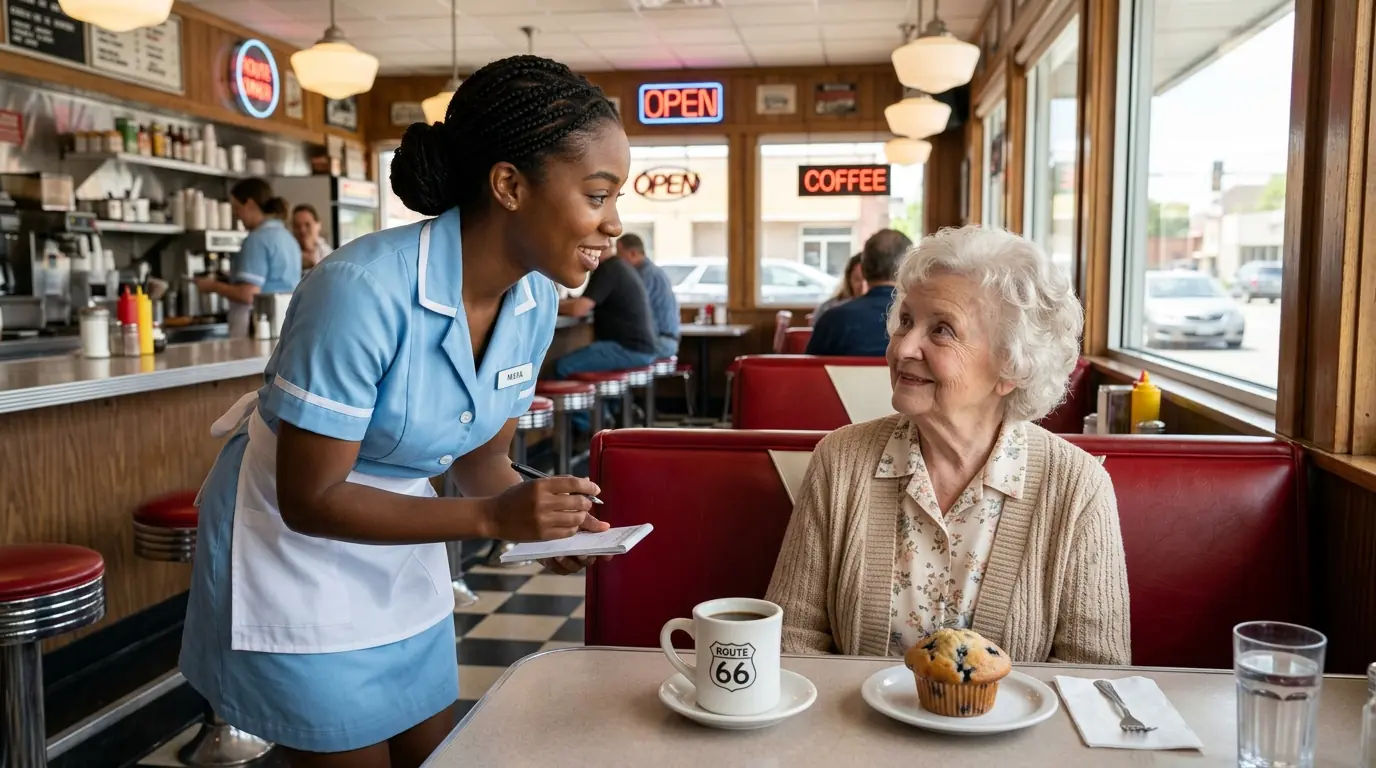
At first, Clara thought the woman was just another regular with a routine. Diners were full of people like that. Old Mr. Daniels came every Monday for eggs and black coffee because his wife used to make them that way. Two teachers came every Friday before school and split pancakes because they said it made the week survivable. A truck driver named Pete stopped in whenever his route brought him through town and always asked if anyone had beaten the jukebox record yet. People carried rituals for reasons they rarely explained. Clara had learned not to ask too much. A good waitress understood when to refill a cup and when to leave silence alone. But this elderly woman’s silence was different. It was not peaceful. It was waiting. Clara could feel it in the way she sat facing the road, in the way her eyes lifted whenever headlights passed the window, in the way her fingers tightened slightly when the doorbell rang. She was not simply eating breakfast. She was keeping an appointment.
Clara was twenty-four then, with tired eyes, quick hands, and a heart that had not yet learned how to protect itself from other people’s sadness. She worked the opening shift because it paid a little extra and gave her afternoons to care for her younger brother, Noah, who was still in high school. Their father had died when Clara was seventeen, and their mother had never fully recovered from the loss. Clara had become practical before she became an adult. She knew how to stretch groceries, fix a leaking sink with online videos, smile through rude customers, and hide fear inside a clean apron. But there was one thing she had never learned to ignore: lonely people. Maybe because grief had once sat at her own kitchen table. Maybe because she knew what it looked like when someone kept waiting for a voice that would never call again.
The elderly woman’s name was Evelyn Hart. Clara learned it from the receipts before she ever learned it from conversation. Evelyn always paid in cash, exact amount when she could, a small tip folded beneath the cup. On rainy mornings, Clara would bring extra napkins. On cold mornings, she would warm the muffin a few seconds longer. On Evelyn’s birthday, which Clara discovered from a loyalty card she once left behind, Clara placed a tiny candle in the muffin without singing because something told her music would break the woman more than cheer her. Evelyn had looked at the candle for a long time, then whispered thank you with tears in her eyes. Still, she never explained why she came. And Clara, though curious, respected the border.
Then one morning, after three years of coffee, blueberry muffins, and unanswered questions, Clara finally asked. It was late October, the kind of morning when fog rested low over the road and the diner windows glowed against the gray. Evelyn had arrived at 6:00 as always, but she looked more tired than usual. Her hands trembled when she lifted her cup. Her muffin sat untouched. Clara stood beside the booth, coffee pot in hand, pretending to check whether she needed a refill. The diner was nearly empty. The cook was in the back humming softly. A newspaper delivery truck rolled past outside. Something about the quiet gave Clara courage.
“Ma’am, forgive me for asking, but why do you come here every single day? Same time, same order, same table.”
Evelyn did not seem offended. She looked out the window for a moment, and when she turned back, her smile was so sad Clara almost wished she had never asked.
“I’m waiting for someone.”
Clara’s fingers tightened around the coffee pot.
“A friend?”
“My son.”
The words were gentle, but they changed the air between them. Clara lowered herself into the seat across from Evelyn without thinking.
“How long have you been waiting?”
Evelyn opened her purse slowly and pulled out a faded photograph protected in a clear plastic sleeve. She placed it on the table with care, as if setting down something sacred. In the picture was a young man in military uniform, no older than twenty-two, standing straight with one hand behind his back and a nervous smile on his face. He had Evelyn’s eyes.
“Seventeen years.”
Clara stared at the photograph. The young man looked impossibly alive.
“What was his name?”
“Samuel Hart. Sammy to me, though he hated when I called him that in front of his friends.”
Evelyn touched the corner of the photograph.
“He left for deployment when he was twenty-one. Before he left, he came home for one week. We had breakfast here every morning, right at this booth. Coffee for me. Blueberry muffin for him, though he always said real soldiers didn’t eat muffins. Then he’d eat two.”
Clara smiled through the ache rising in her throat.
“On his last morning, he held my hand right here and said, ‘Mom, when I come home, I’ll meet you here at 6:00 a.m. I promise.’”
Evelyn’s voice cracked, but she straightened.
“He has never broken a promise to me.”
Clara swallowed hard.
“Ma’am, I’m so sorry.”
“He is not dead,” Evelyn said firmly.
Clara froze.
“He is missing in action. They never found him. They never brought him home. No body. No grave. No final certainty. Just papers and officers at my door telling me they were sorry.”
She looked back toward the road.
“So every morning I come here. Because what if today is the day he keeps his promise?”
Clara could not speak. She looked at the photograph again, at the young soldier smiling with all the confidence of someone who believed goodbye was temporary. She imagined Evelyn sitting here as the years changed outside the window, watching seasons pass through the glass, holding on to a promise the world had tried to bury under probability and time.
“People think I’m foolish,” Evelyn said softly. “My daughter used to tell me I was hurting myself. My neighbors said I needed closure. Even my pastor once told me that sometimes faith means letting go.”
She smiled faintly.
“But they never heard him promise.”
Clara reached across the table and touched Evelyn’s hand.
“I don’t think you’re foolish.”
Evelyn looked at her with sudden tenderness.
“No. You never made me feel that way.”
From that morning on, something changed between them. Evelyn no longer felt like just a customer, and Clara no longer felt like just a waitress. They still kept the same routine, but now words entered the space between coffee and silence. Evelyn told Clara stories about Samuel as a boy: how he once brought home a stray dog and hid it in the laundry room for three days; how he built model airplanes and hung them from the ceiling; how he cried at his father’s funeral but refused to let anyone see; how he joined the military because he said someone had to stand between danger and home. Clara told Evelyn about Noah, about her mother, about missing her father at odd times, like when a lightbulb burned out or a car wouldn’t start. Evelyn listened the way older women sometimes do, with patience deep enough to make pain feel less ashamed.
Winter came. Snow gathered on the diner sign. Evelyn still arrived at 6:00. Clara began keeping a booth warmer by placing a cup of hot water on the table before she arrived, then removing it just before Evelyn sat down. Evelyn pretended not to notice. Spring came with rain and muddy shoes. Summer came with bright mornings and tourists passing through town. Autumn returned. Another year turned. Evelyn’s steps grew slower. Her hands shook more. Some mornings she ate only one bite of muffin. Clara worried but did not push. Waiting was the structure holding Evelyn upright, and Clara understood enough not to pull at it carelessly.
One morning, Evelyn did not come.
At 6:00, Clara looked toward the door.
At 6:05, she poured coffee into Evelyn’s usual cup anyway.
At 6:15, she warmed the blueberry muffin.
At 6:30, the booth remained empty.
Clara told herself not to panic. People got colds. Cars failed. Maybe Evelyn had slept in. But Evelyn had never slept in. The next morning, Clara prepared the coffee again. The booth stayed empty. On the third morning, she found Evelyn’s number on an old receipt from a catering order she had once placed for church. Her hands shook as she dialed.
A young woman answered.
“Hello?”
“Hi, I’m sorry to bother you. My name is Clara. I work at Rosewood Diner. I’m calling about Mrs. Evelyn Hart.”
There was a silence on the line.
“This is her granddaughter, Lily.”
Clara’s throat tightened.
“She usually comes here every morning. I just wanted to make sure she’s okay.”
Lily inhaled shakily.
“My grandmother passed away two days ago. Peacefully, in her sleep.”
Clara closed her eyes. She gripped the counter so hard her knuckles turned white.
“I’m so sorry.”
“You’re Clara?”
“Yes.”
“She talked about you all the time.”
Clara covered her mouth.
“She did?”
“She said you never rushed her. Never laughed. Never made her feel foolish for waiting.”
Tears spilled down Clara’s face.
“There’s something she asked me to tell you if you ever called.”
Clara could barely answer.
“What?”
Lily’s voice broke.
“She said, ‘Tell Clara I finally got to see him. He was waiting for me instead.’”
Clara sank onto the stool behind the counter and sobbed. Not quietly, not politely, but with the kind of grief that rises from somewhere old and unprotected. The cook came out from the back and stood beside her without asking questions. A customer near the window removed his cap. Outside, morning traffic moved on as if the world had not just shifted.
That day, at exactly 6:00 a.m., Clara placed a fresh cup of coffee and one warmed blueberry muffin at Evelyn’s usual table. She folded one napkin beside the plate. Then she placed Samuel’s photograph, which Lily later brought to the diner, in a small wooden frame near the window. The chair stayed empty, but somehow it felt full. Customers noticed. Some asked. Clara told the story when she could speak without crying. Soon people began leaving small things at the booth: a folded flag pin, a handwritten note, a white rose, a veteran’s coin, a child’s drawing of a soldier coming home. Rosewood Diner became, quietly and without planning, a place where waiting was honored instead of mocked.
Months passed, but Clara kept the ritual. Every morning at 6:00, before the first rush, she poured coffee into Evelyn’s cup and warmed one blueberry muffin. The owner at first said it was wasteful, but after seeing Clara’s face, he never said it again. Eventually he added the cost to the diner’s community tab and called the booth Samuel’s Table. Veterans passing through town heard about it and stopped by. Mothers who had lost sons sat there for a few minutes. Widows touched the photograph and whispered names only they remembered. One morning, a young soldier home on leave sat in the booth and cried into his hands because he had not called his mother in three weeks. Clara handed him the phone.
“Call her now.”
He did.
Years later, people would ask Clara why she kept doing it. Why keep setting out coffee for someone who would never drink it? Why keep warming a muffin for a woman whose waiting had ended? Clara never had a simple answer. She only knew that love did not become meaningless because the world could not prove its outcome. Evelyn had waited not because she denied pain, but because love had given her one final promise, and she chose to meet it every morning with dignity.
On the fifth anniversary of Evelyn’s passing, the diner was full before sunrise. Lily came with her children. Veterans came in uniform. Townspeople came carrying flowers. Clara, now managing the diner, stood beside Samuel’s Table and placed the coffee and muffin down with steady hands. For the first time, she spoke to the room.
“Mrs. Evelyn Hart came here every morning for years because her son promised to meet her here when he came home. Some people thought she was waiting for the impossible. But I think she was teaching us something. Hope doesn’t always ask whether the world agrees. Sometimes hope is just love keeping a chair open.”
No one spoke for a long moment. Then Lily’s little boy, who had Samuel’s eyes though he had never met him, walked forward and placed a small toy airplane beside the photograph. Clara smiled through tears.
After everyone left, Clara sat alone in the booth. Morning light touched the window. The coffee had gone cold. The muffin remained untouched. But the emptiness no longer felt like absence. It felt like a promise completed in a place no one else could see.
Clara looked at the framed photograph and whispered.
“She came every day, Samuel. She never stopped believing.”
The bell above the door stirred softly in a draft, though no one entered. Clara turned toward the sound, and for one impossible second, she imagined Evelyn walking in, younger somehow, holding the hand of the soldier in the photograph. Then the moment passed. The diner was still. The street outside brightened. Coffee brewed in the kitchen. Life continued, as it always does, carrying grief and grace in the same trembling hands.
Hope does not always need logic. Sometimes it only needs a table by the window, a cup of coffee, a blueberry muffin, and a love strong enough to keep showing up.