The first thing people noticed when they walked into Maple & Stone Restaurant was how expensive the silence felt. The restaurant sat on the edge of downtown Chicago, surrounded by glass towers, private offices, polished hotels, and apartment buildings where the monthly rent cost more than some families earned in half a year. Its front windows were tall and spotless. Its doors were heavy and dark, trimmed with brass handles that employees polished twice a day. Inside, every table was arranged with perfect distance, every glass caught the light just right, and every napkin was folded so sharply it looked untouched by human hands. The air smelled of grilled steak, roasted garlic, butter, expensive wine, and fresh herbs. Soft music played low enough that diners could hear themselves speak, but high enough to make the room feel refined. It was a place built to impress people who were used to being impressed. But places like that had another side too. They could make people feel invisible if they did not arrive dressed correctly, speaking correctly, or carrying the kind of confidence money often gives. Peter Collins knew that better than most. At twenty-eight, Peter had been working as a server at Maple & Stone for nearly four years. He was quiet, careful, and steady, the kind of employee customers trusted without knowing why. He remembered allergies, birthdays, usual orders, which guests wanted conversation, which guests wanted silence, and which guests smiled with their mouths while carrying sadness behind their eyes. Peter had not planned to build his life around restaurant work. Years earlier, he had wanted to become a teacher. His father, Raymond Collins, used to tell him he had the patience for it. But after Raymond died from a sudden stroke, everything changed. Peter dropped out of college to help his mother, took the first job he could find, and never quite found his way back to the life he had imagined. At first, he washed dishes. Then he carried bus tubs. Then he learned service, and somewhere along the way, he discovered that waiting tables could also be a kind of teaching, if a person paid attention. Every table was a lesson in pride, hunger, grief, loneliness, arrogance, tenderness, or fear. Peter learned that expensive clothes did not make people generous. He learned that tired-looking people sometimes tipped with more kindness than wealthy guests tipped with money. Most of all, he held tightly to something his father had once told him while fixing an old kitchen chair in their apartment: respect people, not their position.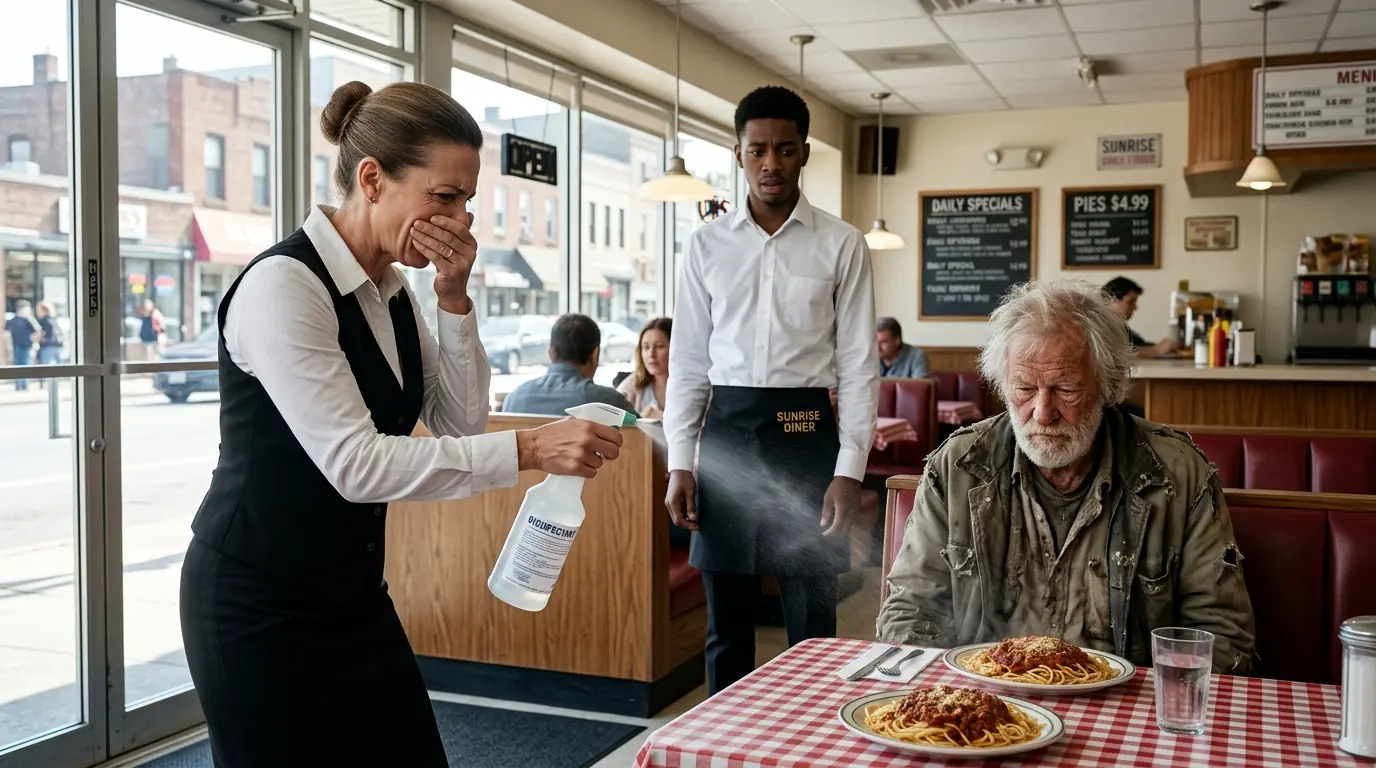
Mesa Carter, the general manager, believed almost the opposite. At forty-five, Mesa had spent most of her adult life climbing through the restaurant industry, and every step had taught her to value image above almost everything else. She was sharp, organized, and undeniably competent. She could spot a poorly polished wineglass from across the dining room. She knew which food critic preferred corner tables and which investor liked to be greeted by name. She could turn a chaotic evening into a smooth one with three commands and a glare. But over time, competence had hardened into contempt. Mesa believed Maple & Stone had a reputation to protect, and to her, that meant protecting the room from anyone who looked like they did not belong. She smiled beautifully at men in tailored suits, welcomed women carrying designer bags, and treated influential guests like royalty. But she had no patience for delivery workers asking to use the restroom, elderly people needing extra time with the menu, or anyone whose clothes suggested struggle. Her cruelty was rarely loud at first. It began as a look, a cold tone, a forced smile. But if someone embarrassed the restaurant’s image, Mesa could become openly vicious. The staff knew it. They had watched her quietly push people out before. Some disagreed, but few dared to challenge her. She controlled schedules, sections, promotions, and references. Peter had seen enough to know that kindness inside Maple & Stone had to be practiced carefully.
That evening began like many others. It was just before the dinner rush, that tense hour when the staff prepared for the storm before guests arrived in waves. The kitchen was testing sauces. The bartender was slicing citrus. Servers checked silverware and straightened chairs. Peter was setting Table Twelve near the back corner when the front door opened. A man stepped inside slowly, as if unsure whether the room would reject him before anyone spoke. He looked to be in his late seventies, with a gray beard, tired eyes, and a worn coat that hung loosely from his shoulders. His shoes were scuffed and dusty. His trousers were wrinkled. His hair was slightly unkempt, and there was a faint smell of rain, old fabric, and city streets around him. He did not appear drunk. He did not appear dangerous. He simply looked exhausted, the way a person looks when he has walked too far and rested too little. A few early guests near the bar glanced at him, then quickly looked away. The hostess froze, uncertain. Mesa saw him immediately. Her face tightened as she moved toward him with clipped steps.
“Your clothes,” Mesa said coldly. “This is a restaurant, not a shelter.”
The old man lowered his gaze but did not leave.
“I only need a place to sit for a moment.”
“You cannot sit here.”
“I can pay later if needed.”
Mesa gave a short laugh.
“This restaurant does not run on later.”
Peter had been watching from the dining room. Something in the old man’s posture unsettled him. It was not weakness exactly. There was a quietness there, almost controlled, but also real fatigue. Peter thought of his father coming home after long construction shifts, clothes covered in dust, hands cracked, shoulders heavy. He thought of how some people had looked at Raymond when he stopped at stores after work, as if labor made him less worthy of respect. Peter stepped forward.
“Sir, you look tired. Please have something warm to eat.”
Mesa turned sharply.
“Peter.”
He kept his voice calm.
“I’ll take care of it.”
“This smell is ruining the air in my restaurant,” Mesa said, loud enough for nearby guests to hear.
The old man’s face tightened with humiliation.
“I can go.”
Peter shook his head.
“No, sir. Please sit down.”
He guided the man toward a small table near the side wall, not hidden exactly, but quiet enough to give him space. The old man sat slowly, as if his knees pained him. Peter brought water first. Then he went to the kitchen and asked the chef for soup, bread, and something warm but gentle. The chef looked toward the dining room, saw Mesa glaring, then looked back at Peter.
“You sure?”
Peter nodded.
“I’ll pay if I have to.”
The chef sighed and prepared a bowl of chicken soup, warm bread, and roasted potatoes. Peter carried it out himself. The old man stared at the plate as though he had not expected anyone to follow through.
“Thank you,” he said softly.
“You’re welcome.”
“What’s your name?”
“Peter.”
The man nodded.
“Peter. A strong name.”
Peter smiled faintly.
“My father chose it.”
Mesa arrived before the old man could take his first spoonful. Her face had gone from irritation to anger.
“Did you really serve food to this filthy old man?”
The room went quiet. Even the bartender paused mid-pour.
Peter stood straight.
“He was hungry.”
“You think you are a hero?”
“No.”
“You are embarrassing this restaurant.”
Peter looked at the old man, then back at Mesa.
“What embarrasses a restaurant is humiliating someone who asked for help.”
Mesa’s eyes narrowed.
“You should think carefully before speaking to me like that.”
Peter knew exactly what that meant. Fewer shifts. Worse tables. Maybe termination. But he also knew what his father would have said if he walked away now.
“I am thinking carefully.”
Mesa leaned closer.
“This place has standards.”
“So should we.”
A sharp silence followed. The old man sat very still, hands around the water glass. Mesa turned on him again.
“You need to leave.”
Peter stepped slightly between them.
“He hasn’t done anything wrong.”
“He is disturbing guests.”
A man in a suit at a nearby table looked away, ashamed. A woman near the window lowered her fork. No one spoke. Peter felt anger rise, not explosive, but steady.
“He’s eating soup.”
Mesa’s voice dropped.
“And you are done here after tonight.”
Before Peter could answer, the front doors opened again. This time, the entrance carried a different energy. A man in a dark tailored suit rushed in, followed by another man holding a leather briefcase. The suited man scanned the room quickly, his face tense with worry. When his eyes landed on the old man, relief flooded him so visibly that several people noticed.
“Sir Adam,” he said, hurrying forward. “I have been searching for you everywhere.”
Mesa froze.
The old man slowly lifted his eyes.
“You found me, Charles.”
Charles stopped beside the table, breathing hard.
“Do you know how many people are looking for you? Your driver lost sight of you near the park.”
“I wanted to walk.”
“You walked across half the city.”
“I needed to think.”
Mesa looked between them, confused and increasingly pale.
“Sir Adam?” she repeated.
Charles turned toward her, his expression suddenly cold.
“Do you even know who this man is?”
Mesa said nothing.
“The man sitting in front of you is Adam Whitmore, founder and chairman of Whitmore Holdings. He owns half the properties on this street, including the building this restaurant leases. He is one of the most powerful billionaires in this city.”
A murmur passed through the dining room.
Mesa’s lips parted.
“A billionaire? That cannot be possible.”
Adam Whitmore slowly stood. The tiredness remained, but his posture changed. It was as if the room could finally see the authority that had been hidden beneath worn clothes. He was not taller than before, but he seemed larger.
“That,” Adam said quietly, “is exactly what I came to learn.”
Charles placed the leather briefcase on the table, opened it, and revealed neatly stacked bundles of cash and documents.
“Mr. Adam asked me to bring this reward.”
Peter stepped back, startled.
Charles looked directly at him.
“This belongs to the only person here who treated him with respect.”
Peter shook his head.
“No. I didn’t help him for money.”
Adam’s eyes softened.
“I know. That is why I can trust what I saw.”
Mesa tried to speak.
“Mr. Whitmore, please, I had no idea. If I had known who you were...”
Adam turned to her.
“If you had known who I was, you would have treated me well. That is not respect. That is calculation.”
Her face burned.
“I was protecting the restaurant.”
“No. You were protecting your pride.”
He looked around the dining room, at the silent guests, the staff frozen near the walls, and the table where soup still steamed.
“My wife loved restaurants like this,” Adam said. “Not because of luxury. Because she believed food reveals character. She used to say a meal is never just a meal. It is a test of whether people remember they are human.”
His voice lowered.
“She died three years ago. Since then, I have walked into places I own, fund, or influence dressed like someone with nothing. I wanted to know what kind of world my money was supporting when my name was not attached.”
No one moved.
“Most places failed quietly. Some ignored me. Some rushed me. Some saw only clothes.” He looked at Mesa. “But cruelty like yours is different. Cruelty does not simply fail to help. It enjoys refusing.”
Mesa swallowed.
“I made a mistake.”
Adam shook his head.
“Mesa, remember this lesson for the rest of your life. Never judge someone by appearance. Respect people, not their clothes.”
Then he turned to Charles.
“Contact the ownership group. Mesa Carter is no longer approved to manage any establishment in a Whitmore property.”
Mesa gasped.
“You can’t do that.”
Adam’s voice stayed calm.
“I can.”
“This is my career.”
“So was Peter’s before you threatened it for showing kindness.”
Her eyes shifted toward Peter.
“I didn’t mean...”
“Yes, you did,” Adam said. “That is why it sounded so natural.”
The words struck harder than shouting. Mesa stood frozen while Charles made the call. Within minutes, the restaurant’s owner, who had been unreachable during the early evening, called Mesa’s phone. She answered with trembling hands, listened, and went white. Her employment was terminated immediately. She was instructed to leave. For the first time since Peter had known her, Mesa looked small, not because she had lost power, but because everyone had seen what she had done with it.
She gathered her bag from the office and walked past Peter without meeting his eyes. At the door, she stopped briefly, as if wanting to say something. But shame and pride fought inside her, and pride won just enough to keep her silent. She left.
The restaurant remained still.
Adam turned toward Peter.
“Sit with me.”
Peter hesitated.
“I’m still on shift.”
Adam smiled faintly.
“I believe the shift has changed.”
A few guests chuckled nervously. Peter sat across from him. The soup between them had cooled slightly.
“Why did you help me?” Adam asked.
Peter looked down at his hands.
“My father worked construction. He came home dusty every night. Sometimes he stopped at places like this to buy food, and people looked at him like he didn’t belong. He used to tell me that the clothes a man wears often show how hard he works, not how much respect he deserves.”
Adam listened carefully.
“What happened to him?”
“He died when I was twenty. Stroke. I left school to help my mother. I thought it would be temporary.”
“Life has a way of stretching temporary into years.”
Peter nodded.
“Yes, sir.”
Adam pushed the briefcase slightly toward him.
“This money can help you return to school, support your mother, or begin whatever life you postponed.”
Peter looked at the case but did not touch it.
“How much is there?”
“Enough.”
“That’s not an amount.”
“No,” Adam said. “It is an opportunity.”
Peter breathed slowly.
“I don’t want to become someone who only received a reward because a rich man felt guilty.”
Adam smiled.
“Good. Then don’t. Use it to build something that would make your father proud.”
The words struck Peter deeply. He thought of the late-night conversations he had with his father, of the old kitchen chair, of the idea he had buried for years: a small community café where working people, elderly people, and anyone hungry could get a meal without being humiliated.
“There is something,” Peter said.
Adam leaned forward.
“Tell me.”
“I always wanted to open a place where people could eat even if they were short. Not free for everyone. Not careless. Just human. A pay-it-forward meal system. Warm food. No shame.”
Adam looked at him for a long moment.
“Then we begin there.”
Peter blinked.
“We?”
“Yes. I have buildings. You have the reason.”
Over the following weeks, Peter’s life became almost unrecognizable. Adam did not simply hand him cash and disappear. He met with him every Thursday morning. He introduced him to accountants, restaurant consultants, and nonprofit advisors. He insisted Peter learn every part of the business, not just service. Peter studied leases, payroll, food costs, hiring, community partnerships, and health codes. It was overwhelming. Some nights he went home with folders stacked under his arm and fell asleep at the kitchen table. His mother, Elaine, would cover him with a blanket and whisper that his father would have been proud.
Adam also changed. The staff at Maple & Stone noticed he returned often, no longer disguised, sitting at the corner table where he had been insulted. He ordered soup and bread. He watched service closely. The restaurant reopened under new management two weeks later, and the first rule posted in the staff room was simple: every guest is to be treated with dignity before status is known. It sounded obvious. It had not been.
Mesa’s story did not end instantly, though it could have. For months, she struggled to find work because news of her behavior spread quietly through the industry. At first, she blamed Peter, Adam, the guests, the timing, anything but herself. But one winter evening, she passed a small church basement where volunteers were serving meals. Through the window, she saw men in worn coats, mothers with children, elderly people holding trays. She almost kept walking. Then she remembered Adam’s words: cruelty is not simply failing to help, it enjoys refusing. Something in her broke. She entered and asked if they needed volunteers. The coordinator handed her an apron and pointed her toward the soup line. The first person she served was an old man in a torn coat. Her hands shook as she placed bread on his tray.
Months later, she wrote Peter a letter. Not asking forgiveness. Not asking for help. Just admitting the truth. He read it twice and placed it in a drawer. Some apologies did not repair what was broken, but they marked the place where someone stopped pretending.
One year after that evening, Peter opened Collins Table in a small storefront Adam owned but refused to decorate for him. Peter chose simple wooden tables, bright windows, warm lighting, and a chalkboard near the counter that read: If you are hungry and short today, eat. Pay when you can. Help someone when you are able. The opening morning was quiet at first. Then construction workers came. Nurses. Office clerks. A retired veteran. A mother with two children. A man in a suit who prepaid twenty meals. Adam arrived last, wearing his old coat again, smiling like he had been waiting for that moment longer than Peter knew.
Peter’s mother cut the ribbon. She cried before the scissors closed.
“Your father would have loved this place,” she whispered.
Peter could barely answer.
The café did not become famous overnight. It struggled like every honest business struggles. There were weeks when food costs rose. Days when too many people needed help and not enough people paid forward. Peter made mistakes. He overstaffed on slow days, underestimated soup demand, burned bread during a power flicker, and once forgot an entire produce order. But the community responded. A union crew paid ahead every Friday. A local school sent volunteers. A hospital social worker referred families. Elderly customers came not only for food but for conversation. Adam quietly covered shortfalls during the first six months, but by the second year, Collins Table stood on its own.
The briefcase money had become more than reward. It became seed.
Three years later, Collins Table had served more than forty thousand pay-it-forward meals. Peter returned to school part-time and completed his degree in community development. Adam remained involved, though he called himself only a regular. Every Tuesday morning, he sat by the window with soup and watched people come and go. Sometimes he still wore plain clothes. Not to test anyone anymore, but to remember.
One afternoon, a young server at Collins Table brought soup to an elderly man who had no money and looked ashamed. Peter watched from the counter as she said softly.
“Sir, please have something warm to eat.”
The words echoed through him. He looked across the room at Adam, who had heard them too. The old billionaire lifted his cup slightly in silent acknowledgment.
Years later, when reporters asked Peter how it all began, they expected a story about investment, timing, or opportunity. He always told the truth. It began with a man in worn clothes walking into a restaurant where he was judged by his appearance. It began with a manager who valued image more than humanity. It began with a bowl of soup and one decision not to look away.
And whenever Adam spoke at business schools or leadership dinners, he repeated the lesson he had learned from his wife, confirmed by Peter, and paid for with a briefcase that became a movement.
“Respect people, not their clothes,” he would say. “Power does not reveal character. The powerless do.”
Then he would smile faintly and add:
“Never forget, the person you dismiss today may be the one sent to teach you who you really are.”