Lydia Kincaid's voice dropped to almost nothing. Why are you here? She stood just inside the doorway of the old bakery, flanked by her assistant and a corporate lawyer wearing a blazer that cost more than a month's rent on this entire street. Her eyes moved from the cracked walls to the dusty counter to the man standing in the middle of it all, hands rough, clothes streaked with grease, holding a wrench like he'd been mid-sentence when she walked in.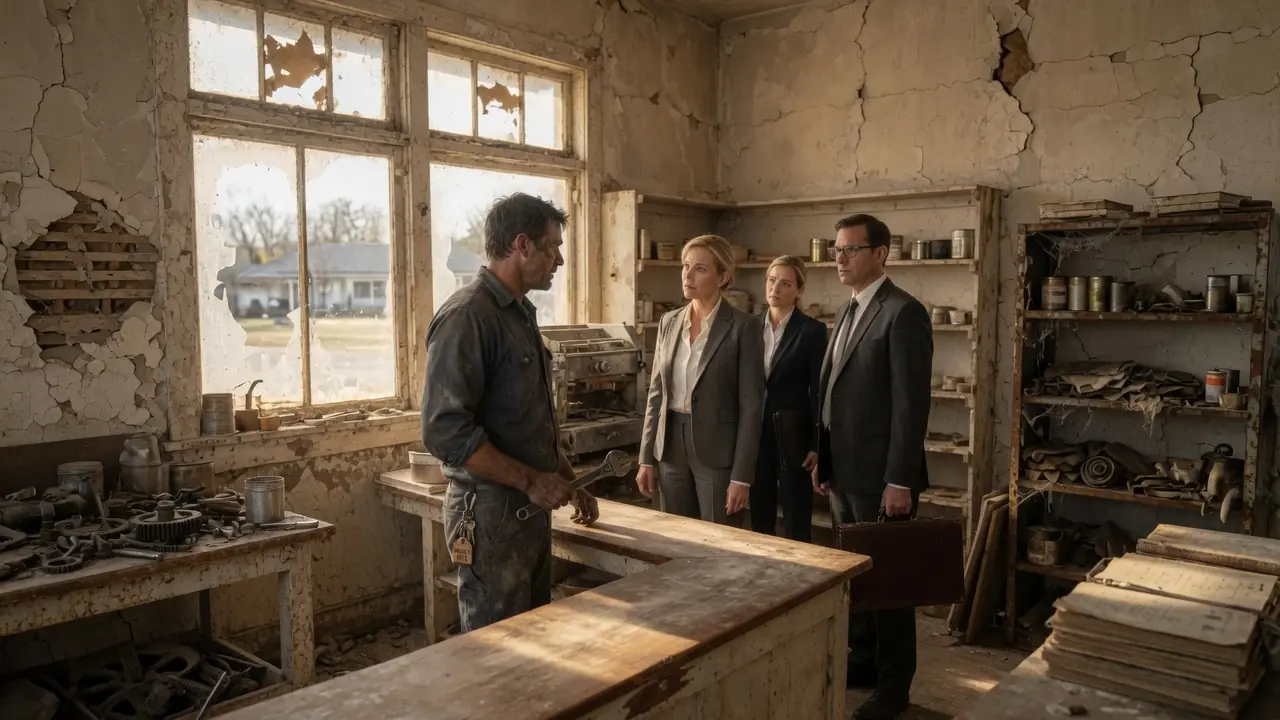
Damon Greer hadn't seen her in 3 weeks. Not since she'd signed the termination letter in front of a full conference room without blinking. He set the wrench down slowly on the counter. The keys to Rosalie's oven were still clipped to his belt. Every penny he had left in the world was sunk into the four walls surrounding them both.
Yeah, he said. It's me.
Nobody had told Damon that Harbor Glen would smell like salt and old wood and something faintly sweet he couldn't name. He'd driven through the night with Tessa asleep in the backseat, her head tipped against the window, her breath fogging the glass in small steady clouds. He hadn't told her where they were going exactly. He just said they were starting somewhere new. She'd accepted that the way children accept most things, not because they understand, but because they trust the person driving.
Rosalie's oven was on the corner of Tide Street, wedged between a hardware store and a shuttered gift shop. The sign above the door was hand-painted. The letters faded to a pale rose color. The apostrophe worn away entirely, so it just read Rosalie's Oven in peeling cursive. Damon stood on the sidewalk the morning he got the keys and looked at it for a long time.
The front window had a crack running diagonally across the lower left corner. The flower boxes under the sill were empty. The door stuck when he tried to open it, and he had to put his shoulder into it before it gave. Inside smelled like dust and old sugar and something underneath that, something warmer, like bread that hadn't been baked in a long time, but it soaked into the walls deeply enough that it hadn't left yet.
Tessa walked in behind him and looked around slowly, taking in the sagging shelves, the wooden counter with its chipped edge, the chalkboard menu still showing prices from years ago. She turned a full circle, arms slightly out at her sides, and then looked at her father. Dad, she said, this place looks like a haunted house.
Damon crouched down, looked at her seriously, and said, Then we'll just have to deal with the ghosts. She thought about that for a moment and then nodded like it was a reasonable plan. That was the first time he'd smiled in 3 weeks.
He spent the first 2 days making a list. Leaking pipe behind the left wall. Oven heating element burned out on one side. Three floorboards near the back kitchen that flexed dangerously underfoot. Electrical panel that hummed at a frequency slightly too high for comfort. Windows that let in a draft through gaps in the frame.
It was more than he'd expected. It was also less than it could have been, and Damon had learned the hard way to find the floor of things before deciding whether he could stand on it. He'd spent 9 years at Kincaid Foods as a quality control manager. 9 years of documentation, of safety reports filed in triplicate, of pushing back on timelines when an ingredient batch didn't clear inspection.
9 years of being told he was difficult, then being told he was valuable, then being told in a conference room in front of 30 people he'd worked alongside that he was the reason a major product launch had failed. The termination letter had been signed by Lydia Kincaid herself. She hadn't looked at him when she slid it across the table. He hadn't cried in front of Tessa then.
He hadn't cried at all, actually. He'd driven home, made dinner, helped her with her spelling words, and sat in the kitchen after she fell asleep until 2:00 in the morning looking at the wall. The next 3 weeks had been applications and rejections, and a recruiter who'd called him back once then stopped returning messages. Word had traveled. It always did.
Buying Rosalie's Oven had not been a carefully reasoned decision. It had been the only one left. He was on his back under the sink on the third morning working at a corroded joint in the pipe when he heard the front door open. He assumed it was Tessa back from the neighbor's porch where he'd sent her to read.
He called out without looking up. Hand me the blue-handled wrench from the bag, will you? No one answered. He heard footsteps on the wood floor, more than one person, and a different quality of silence than a child makes. Damon pulled himself out from under the sink and stood up. Lydia Kincaid was standing in the middle of his bakery.
She had a lawyer on her left and an assistant on her right, and she was wearing the same kind of expression she'd worn in the conference room, composed, reading the room, not yet committed to any particular response. She was looking at the walls, the floor, the chipped counter. Then she looked at him. For a moment neither of them spoke.
Damon could feel the wrench still in his hand, the grease on his forearms, the keys clipped to his belt loop. He was suddenly sharply aware of all of it in a way he hadn't been a minute ago. Lydia's eyes moved to the keys. Something shifted in her face, not softness exactly, but a kind of recalculation. She spoke first.
I didn't know you were the buyer. Her voice was even, professional. The voice she used in board meetings and press releases and termination proceedings. Damon set the wrench on the counter. Apparently not, he said.
Her lawyer stepped forward and explained with practiced efficiency that Kincaid Foods had been in preliminary discussions with the previous estate about acquiring the Tide Street properties as part of a coastal retail expansion. The paperwork hadn't been finalized, but the company had an expressed interest in this building specifically. And if Damon hadn't been aware of that when he purchased, there were options worth discussing.
Fair market offers, relocation assistance, a clean transaction that would let him walk away with a return on his investment. Damon listened to all of it. Then he said, I'm not selling.
Lydia's lawyer started to speak again and Damon looked at Lydia directly, not the lawyer. I'm not selling, he repeated. I'm opening a bakery.
She said, Mr. Greer, this building needs significant renovation. The commercial kitchen permits alone will take months. You'd be competing against established coastal businesses with our infrastructure behind them. I'm not saying this to discourage you. I'm saying it because it's a realistic picture.
Damon looked around the room slowly at the empty shelves, the faded menu board, the cracked window with afternoon light coming through it in a slanted bar across the floor. Then he looked back at her. I know what realistic looks like, he said. I've been living in it for 3 weeks. I'm staying anyway.
Lydia studied him for a moment longer than was strictly professional. Then she nodded once, said something quiet to her assistant, and walked out. The lawyer followed. The door stuck again on the way out, and the lawyer struggled with it briefly before it opened.
Damon stood alone in the middle of the bakery for a while after that. That night he set up the folding cot for Tessa in the small back room that would eventually be storage. She fell asleep quickly, one arm thrown over the edge, fingers loose.
Damon sat on the floor beside her with his back against the wall and looked at his hands in the dim light. The grease still in the creases of his knuckles even after washing, the small scar on his left thumb from a box cutter years ago. These were the hands that had written every safety report, that had flagged every compromised batch, that had typed the emails no one had bothered to read.
He thought about the conference room. He thought about 30 faces that wouldn't meet his eyes. He thought about the lawyer who just tried to hand him a clean exit from the one thing he had left. Then he thought about Tessa saying, Then we'll just have to deal with the ghosts. And the way she'd nodded like it was settled.
He stayed on the floor until his back ached, and then he got up and started on the list. By the end of the first week, word had gotten around Harbor Glen the way it does in small towns, not through any single conversation, but through the accumulation of many small ones.
People stopped on the sidewalk to look through the window at Damon working. A woman named Diane, who ran the flower shop two doors down, brought him a cup of coffee and asked what he was planning to do with the place. When he told her he was reopening it as a bakery, she pressed her lips together in the way people do when they're trying not to show how much something means to them and said, Rosalie would have liked that.
He didn't know who Rosalie was yet, but he filed the name away. Tessa helped after school each day, sitting cross-legged on the counter because the floor was still uneven in places, drawing versions of the menu board in her sketchbook with colored pencils. She had opinions about fonts. She told him the prices on the old chalkboard were too low and they needed to charge more or people wouldn't take it seriously.
Damon told her he'd take that under advisement. She said he should take it under serious advisement. On the eighth day, he made his decision formally and internally in the way that decisions sometimes need to be made twice, once out loud and once in the place where you actually live.
He was going to open Rosalie's Oven on the day of Harbor Glen's Summer Festival, 6 weeks out. He was going to do it with whatever he had. He was not going to sell. He was not going to negotiate. He was not going to blink first.
Lydia Kincaid had signed her name on the worst day of his life without looking at him. Whatever she wanted with this building, whatever her company had planned for this street, it was going to have to go through him first. And Damon Greer, for the first time in 3 weeks, felt something in his chest that wasn't grief or exhaustion.
It wasn't quite hope, either. It was something harder than hope, something closer to resolve. He picked up the wrench. He went back to work.
The renovation moved the way hard things move, slowly at first, then all at once in ways that surprised him. Damon repaired the floorboards himself, pulling up the worst ones and replacing them with wood he bought second-hand from a salvage yard two towns over. He repainted the walls a warm cream color that Tessa selected after holding up seven paint swatches against the afternoon light and ruling out each one with the seriousness of a judge.
He cleaned the front window with vinegar and old newspaper until the crack in the lower corner was the only thing left imperfect about it. And then he decided to leave the crack. Some things you kept the way they were.
Tessa updated the chalkboard menu each evening after homework. Her handwriting rounder and more confident than it had any right to be for a 7-year-old. She'd started adding small illustrations beside each item. A curl of steam above the coffee, a lopsided star beside the lemon rolls.
Damon watched her do it one evening from the kitchen doorway and thought that whatever else was uncertain about this place, whatever else was still broken, this part was right.
Lydia Kincaid kept coming back to Harbor Glen. She wasn't there every day, but often enough that Damon started to feel her presence the way you feel a weather system moving in, a particular quality to the air before you actually see the clouds. Her car would appear on Tide Street. Her assistant would be seen going in and out of the building next door, which housed a small accounting firm connected to the property negotiations.
Lydia herself walked the street in the late afternoon on more than one occasion. And once Damon looked up from replacing a hinge on the front door and found her standing on the opposite sidewalk, not looking at him exactly, but not not looking either. He didn't engage. He went back to the hinge.
One afternoon, she came into the bakery directly without the lawyer this time. She told Damon that Kincaid Foods architects had drawn up preliminary plans for the block and that Rosalie's Oven sat at what they were calling the anchor corner, the most visible point in the proposed development.
She said this with considered neutrality, like she was delivering information rather than making an argument. Damon told her he wasn't interested in the plans. Lydia said he didn't have to be interested. He just needed to understand the situation.
Damon said he understood it fine and went back to sanding the counter edge. He expected her to leave. Instead, she looked around the room slowly the way she had the first day.
She said without any particular inflection, You're doing this yourself. It wasn't quite a question. Damon said, Yes.
She said, All of it? He said, Most of it.
She nodded once and left. That was the version of Lydia he understood. Precise, controlled, always angling.
What he didn't know how to account for was what he glimpsed on a Thursday afternoon when he came around from the back alley and found Tessa sitting alone on the front step with a book open in her lap, not reading it, just staring down Tide Street.
Lydia was walking past and had stopped a few feet away. She didn't say anything to Tessa. She just stood there for a moment, looking at a 7-year-old who was clearly waiting for her father and trying not to look like she was.
Then Lydia walked on, but Damon had seen her face in the half second before she turned, and it wasn't the face she wore in negotiations.
Meanwhile, behind closed doors at the Kincaid Foods regional office, a man named Brent Mallory was watching the situation in Harbor Glen with the focused attention of someone who had a great deal to lose.
Brent was the company's chief operating officer, efficient, well-connected, and careful in the way that people are careful when they've arranged things to their advantage and need them to stay arranged. He'd been the one who built the case against Damon. He'd been the one who'd framed a compromised ingredient batch as an act of sabotage rather than a failure of oversight.
And he'd chosen Damon as the explanation because Damon was the kind of person a board would believe guilty of disruption. Outspoken, principled, inconveniently correct too often for comfort.
Brent had heard that Lydia was spending time in Harbor Glen beyond what the property acquisition required. He'd also heard through the kind of informal channels that corporate environments run on that she'd requested an internal documentation review.
He didn't know exactly what she was looking for, but he knew what was there to be found, which amounted to the same problem. He called Lydia twice that week. She didn't pick up. He left one message. The acquisition needs to close by end of month. Don't make this complicated.
Then he started making his own calls.
The trouble for Damon came quietly the way it usually did. Gary, his flour and sugar supplier two counties over, called to say he'd need full payment up front before he could send the first delivery. He'd heard things, Gary said. He wasn't saying he believed them, but business was business.
A second supplier said the same thing worded differently. A third didn't call back at all. The internet had a long memory and no interest in nuance. The original story, a quality control manager terminated following a product sabotage investigation at Kincaid Foods, had been picked up by two industry blogs and a regional business newsletter.
None of them had published a follow-up when nothing came of the investigation because nothing coming of something wasn't a story.
A few people in Harbor Glen had read it. Damon could tell by the way certain conversations shifted when he walked into the hardware store, the particular careful politeness that meant someone was working around something they'd decided not to bring up.
Diane from the flower shop didn't do that. She brought him coffee again in the second week and told him flat out that she'd read the article and she'd also read every review Rosalie's Oven had ever received online and that she'd decided those two things together told her what she needed to know.
Damon thanked her. She waved it off and asked if he needed anyone to help hang the new menu board.
It was in the third week that Damon found the tin box. He'd been clearing out the storage area behind the kitchen when he moved a shelf unit and found a flat tin box wedged between the wall and the baseboard.
Inside were index cards covered in handwriting so small and exact it looked almost typeset, recipes, each one titled and dated, some going back 40 years. Apple Crumble, Honey Cinnamon Rolls, Brown Butter Bread, Lemon Rolls with a note at the bottom that read, Don't skip the zest. It's the whole point.
Underneath the recipe cards was an unsealed envelope addressed to no one. Damon read it. It was a letter from Rosalie Finch explaining that she'd been approached again about selling the building and that she was writing this down because she wanted to remember why she'd said no.
She wrote that the bakery was the place where the elementary school teacher came every morning before class and where the woman down the street who'd lost her husband sat at the corner table on Saturdays because she didn't like being home alone.
She wrote, Some buildings are worth more standing than sold. Damon read the letter twice. Then he put it back in the tin and set the tin on the shelf above the oven where he could see it from anywhere in the kitchen.
He decided the opening menu would use Rosalie's recipes exactly as written.
The first test bake was a disaster. He'd adjusted the oven temperature to compensate for the repaired heating element but had over corrected, and by the time the smell shifted from warm to wrong, the lemon rolls were already past saving.
The smoke alarm went off with the particular shrieking urgency of alarms that have been waiting a long time for a reason. Damon grabbed a dish towel and was still waving smoke away from the sensor when he heard the front door.
Lydia walked in and took in the scene, the blackened pan, the smoke drifting near the ceiling, Damon with flour on his jaw, and didn't speak immediately. She came a few steps into the kitchen, far enough to see the tin box on the shelf and the index cards spread across the counter.
Tessa appeared from the back room at a run, grabbed her father's arm, and looked at the burnt pan with the gravity of someone assessing a situation. Dad, she said firmly, don't quit. Miss Rosalie probably burns stuff, too.
Damon said, Probably. Tessa seemed satisfied with that. Then she noticed Lydia standing in the doorway and looked at her with the straightforward curiosity of a child who hasn't learned to disguise it.
Do you know how to fix an oven? Tessa asked. Lydia said she didn't. Tessa accepted that and turned back to her father to work through what had gone wrong with the temperature.
Lydia stood in the doorway and watched the father and daughter bent over the ruined pan talking through it together like a problem to solve rather than a failure to mourn. Something in her expression shifted. Not dramatically, just a quiet movement behind the eyes, the kind that happens when something you've been not thinking about surfaces without permission.
She was still standing there when the shelf unit on the side wall tilted forward. It happened fast. Tessa was directly below it. Lydia moved before she'd consciously decided to, crossing the kitchen in three steps and pulling Tessa back by the shoulder just as the shelf caught on its lower mount and stopped short of falling.
A jar of vanilla extract knocked to the floor but didn't break. The edge of the shelf had caught Lydia's palm on the way, leaving a thin red line across it. Tessa looked at the scrape with the gravity of a person who takes injuries seriously.
She disappeared into the back room and returned with a small first aid kit, the kind with cartoon bandages, and selected one in the shape of a star without asking. She pressed it carefully onto Lydia's palm and said, It's the good kind. It doesn't sting.
Lydia looked down at the star-shaped bandage on her hand for a long moment. Damon from across the kitchen watched her face, really watched it, and saw a woman who was not accustomed to being taken care of by anyone, let alone a 7-year-old with a cartoon first aid kit.
The composure was still there, but it was sitting differently on her now, like something worn over a thing that was softer underneath. He didn't say anything to her about it, but the wall he'd been building since the day she walked into his bakery developed in that moment a crack smaller than the one in the front window and just as hard to ignore.
Lydia didn't tell anyone what she was looking for when she requested the internal audit. She framed it as routine, a procedural review of the quality control documentation from the product launch quarter. Her assistant scheduled it without asking questions.
The compliance team pulled the files without asking questions, either. That was the thing about being a CEO. People stopped asking questions, which was useful right up until it became dangerous.
She started reading on a Tuesday evening in her hotel room in Harbor Glen, the files spread across the small desk by the window. She told herself she was doing this because it was good governance, because if Brent had falsified anything, she needed to know for the company's sake.
She told herself all of that carefully and thoroughly, the way you tell yourself things when you already know the real reason and aren't ready to say it yet.
The first anomaly was small, a signature on a supplier verification form. Damon's name, his employee number, but the handwriting didn't match the samples in his personnel file. She almost moved past it. She didn't.
She pulled the original batch approval chain and found a gap. An email thread that should have had six messages had four. The metadata showed two deletions, both on the same afternoon, both routed through Brent Mallory's administrative access.
She kept reading. By midnight, she had spread across the desk a picture she hadn't been prepared for, a quality control manager who had flagged a compromised ingredient batch three times in writing, whose warnings had been systematically removed from the record, and who had then been presented to the board and to her as the source of the problem, rather than the person who'd tried to stop it.
The termination letter she'd signed had been built on a report Brent had constructed from the outside in, starting with the conclusion and working backward to the evidence.
Lydia sat at that desk for a long time without moving. She thought about the conference room. She thought about sliding a letter across a table to a man who hadn't looked away from her even when she wouldn't look at him.
She thought about Brent's voicemail, Don't make this complicated, and understood now exactly why he'd said it.
She could close the files. She was good at making decisions and moving forward. It was the skill that had gotten her to where she was.
If she closed the files, Brent would finish pressuring her to complete the property acquisition. Damon's bakery would become a footnote in a development project, and everything would proceed.
She understood exactly what that choice cost. She sat with it long enough to know she understood it fully. Then she opened her phone and called her personal attorney, not the company's legal team.
Damon, meanwhile, knew none of this. What he knew was that four weeks before the summer festival, his permit trouble arrived without warning.
He came back from a supply run one morning to find a formal notice taped to the bakery door, a suspension of his renovation permit, citing an anonymous complaint about unpermitted structural modifications.
The modifications in question were the floorboards he'd replaced and the shelf brackets he'd reinforced, neither of which required a permit under the county's small business renovation guidelines. Someone had filed the complaint knowing it would create delay regardless of whether it held up on review.
The bank called the same afternoon. The loan officer said the institution needed additional financial assurances given recent developments in Damon's credit profile. Damon asked what developments specifically.
The loan officer said he wasn't able to share the specifics of what had been reported. Damon thanked him and hung up and stood in the kitchen for a moment.
Someone had made calls, and there was only one person with both the motive and the reach to make them. He thought about Lydia. He thought about all of it. The supplier account that had mysteriously cleared. The way she'd pulled Tessa back from the falling shelf. The expression on her face when Tessa pressed the bandage onto her palm.
He turned each of those things over and looked at the other side. He thought about how good she was at reading a room. He thought about the conference room. He thought about 30 faces that wouldn't meet his eyes and a letter slid across a table and nine years of work reduced to a paragraph in a termination document.
By the time Lydia appeared at the bakery that evening alone, no assistant, carrying a folder he'd been sitting with all of that for six hours. She started to say that she'd heard about the permit suspension and she wanted him to know she was looking into it.
Damon cut her off. Not loudly. He didn't do things loudly. He just said it straight, that he wasn't interested in her looking into anything on his behalf, that he'd learned what it cost when Kincaid Foods decided to manage a situation that involved him.
Lydia said, I'm not behind the permit complaint. He said, How would I know the difference?
She said there were things she'd found in the company's internal records, things he needed to hear. Damon said he'd heard enough about internal records.
You signed that letter, he said. You looked at whatever they put in front of you and you signed it and I lost everything. My job, my reputation. My daughter had to leave her school and her friends because I couldn't hold a lease in the city anymore. So whatever you found, it doesn't change what happened. It just means you're dealing with it on your schedule instead of mine.
Lydia set the folder on the counter and left without another word. Damon stood alone in the bakery. He looked at the folder. He didn't open it.
He looked at the tin box on the shelf above the oven. He looked at the chalkboard menu with Tessa's small illustrations, the curl of steam, the lopsided star beside the lemon rolls.
He looked at the front window with its diagonal crack and the cream-colored walls he'd painted himself, and the floorboards he'd replaced board by board. And all of it felt suddenly fragile in a way it hadn't before, like something built in the dark that the light was now revealing clearly.
Tessa was asleep in the back room. She'd fallen asleep at the small table she used for homework, her head down on her arms, a piece of chalk still loosely held in one hand. She'd been updating the menu board and hadn't made it to the cot.
Damon stood in the doorway and looked at her. He thought about what she'd asked him 3 days earlier. Dad, is the bakery going to open?
And how he'd said yes with more certainty than he'd actually had because she was seven and she needed to hear yes.
He lowered himself to the floor with his back against the doorframe. The building settled around him in the old way of old buildings, small sounds in the wood, sea air under the back door.
He thought about everything he'd done right and how little it had protected him. He thought about Rosalie Finch writing a letter to no one about why a building was worth keeping.
He thought about the folder on the counter that he hadn't opened. This was the floor. He was already on it. The question was whether he could get up from here again.
Across town, Lydia sat in her rental car in the harbor parking lot with the engine off. She could see the faint glow from the bakery's back window from where she was parked. She'd been sitting there for nearly an hour, her phone in her hand, Brent's number visible on the screen.
If she called him, it would be over quickly. She was the CEO. She could frame this as an internal matter, handle it quietly, and protect herself. Nobody outside the company would need to know what the files contained.
Damon Greer would lose the bakery, probably, but he'd lost things before and survived. That's what she told herself.
Then she thought about a 7-year-old pressing a star-shaped bandage onto her palm with the solemn care of someone who decided a wound was worth treating regardless of who was carrying it.
She thought about Damon's voice tonight, not angry, just exhausted in the specific way of a person who's been let down by systems enough times to stop being surprised, and who is still standing anyway.
She thought about the email in the file, the one Damon had sent three times warning about the compromised batch, the one that had been deleted before anyone with authority to act on it could read it.
That email had protected thousands of customers who would never know his name.
Lydia closed Brent's contact. She opened her attorney's number instead. When the line picked up, she said, I need you in Harbor Glen by tomorrow morning. I have documents I want to put on record.
Her attorney asked if everything was all right. Lydia looked at the light in the bakery window and said, Not yet, but it will be.
The morning of the summer festival arrived the way mornings do in coastal towns, gently, with light that came in sideways off the water and made everything look like it was worth keeping.
Damon had been awake since 4:00. He stood in the kitchen of Rosalie's Oven with the oven preheating and Rosalie's index cards lined up on the counter, each one propped against a jar or a tin so he could read it without picking it up.
Brown butter bread first, then honey cinnamon rolls, then the lemon rolls, which he'd practiced six times over the past 2 weeks and gotten right on the fifth.
He'd almost called it off 3 days ago. The permit had been reinstated on a Wednesday, quietly, without explanation. The suspension simply withdrawn by the anonymous complainant.
The bank had called Thursday morning to say the hold on his account had been lifted and that someone from the county assessor's office had submitted documentation clarifying the renovation scope.
Damon hadn't submitted that documentation himself. He'd understood without being told that something had shifted somewhere above him. He didn't know the details yet. He wasn't sure he was ready to.
What he knew was that Tessa had come into the kitchen that Thursday morning and found him standing at the counter with his hands flat on the surface looking at nothing.
She'd stood beside him quietly for a moment and then she'd said, Dad, we already painted the walls.
He'd looked at her. She'd looked back at him with the particular expression she got when she felt a point had been made and required no elaboration.
He'd started on the bread dough 20 minutes later.
Lydia's meeting with the board had happened behind closed doors on a Tuesday, 3 days before the festival. She'd brought her personal attorney and a printed copy of every document she'd pulled from the internal review.
She'd laid it out the way she'd learned to present things over 15 years in boardrooms, clearly in sequence, without editorializing.
Signature discrepancies, deleted emails, batch approval gaps, the timeline of Brent Mallory's administrative access coinciding exactly with the removal of Damon's warning flags.
Then she'd said simply that she had signed the termination letter without investigating whether the report it was based on was accurate, and that the report was not accurate, and that she was taking responsibility for that failure.
The board chair had asked if she was prepared for the consequences. Lydia had said she was.
Brent Mallory was placed on administrative leave the following morning and referred for legal review. Kincaid Foods communications team was instructed to issue a formal statement clearing Damon Greer's professional record.
The company's attorneys were directed to prepare a settlement for reputational damages, and Lydia withdrew the Tide Street acquisition proposal herself in writing that same afternoon.
She came to the bakery the day before the festival alone. Damon was in the kitchen when she arrived, and he came out to the front counter and looked at her.
She set a folder on the counter, the same folder she'd left three nights ago, the one he still hadn't opened, and said, This is the full internal review. I wanted you to have it regardless of what you decide to do with it.
She didn't offer an explanation or a justification. She said, I can't give back the months you lost, but I'm done hiding behind the structure that let this happen.
Damon looked at the folder. He picked it up this time and opened it. He read slowly, standing at the counter while Lydia waited across from him without speaking.
He found his own email, the third warning dated two days before the launch, flagging a specific batch number from a specific supplier. It was the email he'd sent knowing it might not land well, knowing it would create delay, sending it anyway because the alternative was a compromised product going to market.
Someone had deleted it. Someone had decided his integrity was a loose end to be managed.
He closed the folder. He set it back on the counter. He didn't say anything for a moment, and neither did Lydia.
Then Tessa appeared from the back room, looked at Lydia, and said without preamble, Are you staying for the opening tomorrow?
Lydia said she hadn't decided. Tessa said, You should. Dad's lemon rolls are the whole point.
Then she disappeared again.
Damon looked at his daughter's retreating back, and something in him that had been held at tension for weeks released by one small degree.
He looked at Lydia. I'm not there yet, he said, with any of this. I need you to understand that.
Lydia said she did.
He said, But you can come tomorrow if you want.
She nodded. She picked up her coat from the stool and left.
The opening morning of Rosalie's Oven was already warm by 7:00. The kind of summer warmth that feels like a promise being kept.
Damon unlocked the front door and turned the sign to open and stood back.
Tessa took her place behind the counter with the quiet authority of someone who had been preparing for this specific moment for 6 weeks.
The first tray of lemon rolls came out of the oven at 7:15. The smell reached Tide Street before the door was fully open.
Diane from the flower shop was first in line, which felt right. She bought a lemon roll and a coffee and told Damon that Rosalie would have been proud. And this time he knew enough about Rosalie to believe it.
More people came. The line reached the sidewalk by 8:00. By 9:00 he'd sold out of the honey cinnamon rolls and started on the second batch of brown butter bread.
Lydia arrived at half past 9:00. She wore a light jacket instead of a blazer and she stood in line like everyone else.
And when she reached the counter, she asked Tessa what she recommended. Tessa said the lemon rolls, obviously, had she not been listening yesterday.
Lydia said she'd take two. She found a small table by the front window, the one with the diagonal crack in the glass, and sat with her coffee and her rolls and watched the room fill with people.
She watched Damon move through the kitchen with the ease of someone doing exactly what he was built to do. She watched Tessa hand a bag across the counter to an older man and say with complete seriousness, The zest is the whole point. Miss Rosalie wrote it down.
When there was a break in the line, Damon came out from the kitchen and stood near her table. He didn't sit down.
He said, The board called this morning. I know what you put in front of them.
Lydia said it was the least she could do.
Damon said, Yeah, it was.
He went back to the kitchen.
It wasn't forgiveness yet. It wasn't a clean ending, but it was honest, which was more than either of them had expected to be with the other this summer.
In the months that followed, Rosalie's Oven became the kind of place that towns sometimes get lucky enough to have, not because it was remarkable, but because it was real.
Damon hired two people from Harbor Glen who needed work. He started a weekend baking class free of charge for anyone who wanted to come. Kids mostly at first, then a few adults who'd been laid off and had time on their hands and no particular place to put it.
Lydia came on weekends when she wasn't in the city. She sat at the same table by the cracked window and did the quieter parts of her work and didn't try to run anything.
Tessa taught her to braid dough one Saturday afternoon, correcting her technique with a patience that didn't seem to come from anywhere Damon could identify.
It was just there in her, the way some things are.
Lydia was a slow learner, she said. Tessa said that was okay. Most people were at first.
Damon had been fired like a man with nothing left to offer. He'd built something in the ruins of that, something that smelled like brown butter and old wood and salt air.
Something with a crack in the front window and a tin box of recipes above the stove and a 7-year-old behind the counter who knew the whole point was the zest.
A person's dignity doesn't live in a job title. It doesn't live in a performance review or a termination letter or someone else's signature on a decision made without enough information.
It lives in what you build when those things are taken from you, in the work you do at 4:00 in the morning when nobody's watching, in the way you answer your daughter when she asks if things are going to be okay.
Damon Greer had told her yes.
And eventually, it was.