“Sir, I need you to put the weapon down right now.”
The voice was young, sharp, and laced with an unearned confidence that grated on the quiet afternoon air.
Patrick Snyder, eighty-three years old, did not flinch.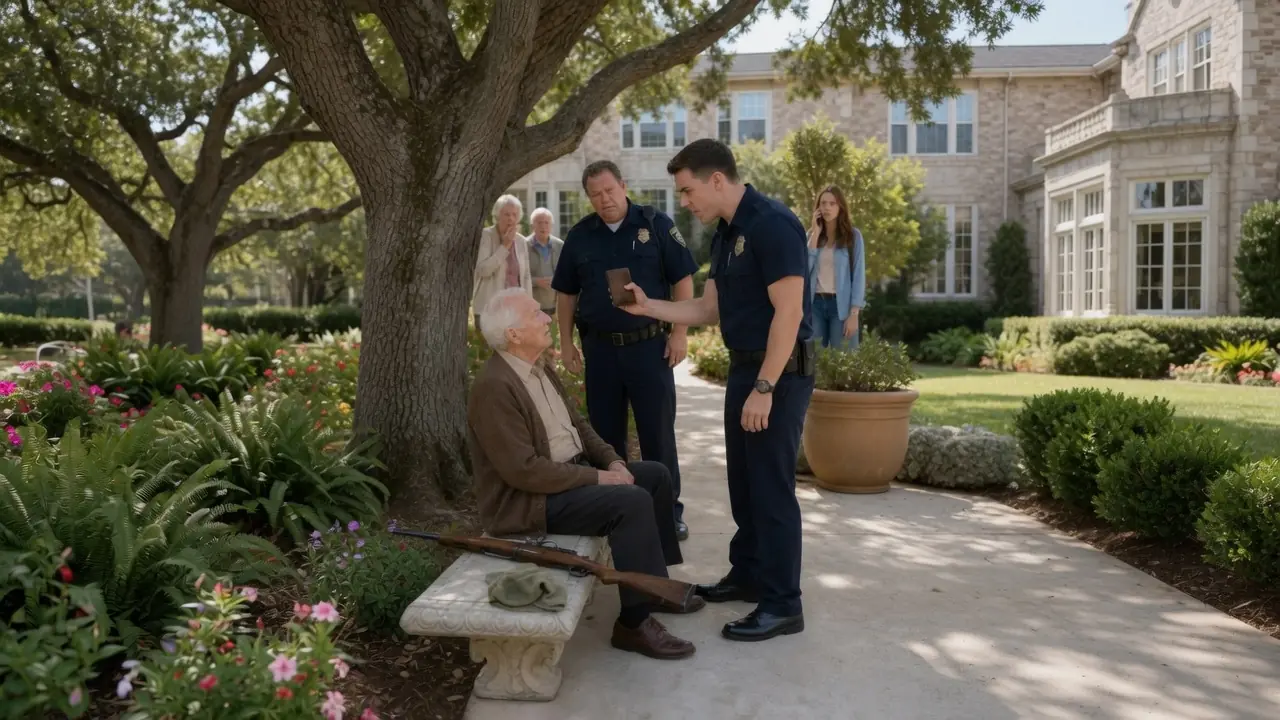
He did not even look up.
His hands, though wrinkled and mapped with the liver spots of a long life, were as steady as granite as they moved a soft, oil-rich cloth along the walnut stock of the rifle resting across his lap.
The sun, warm and gentle, filtered through the leaves of the great oak tree in the center of the courtyard, dappling the polished wood and the weathered steel of the barrel.
He sat on a simple stone bench, the picture of tranquility, a man at peace with his tools.
But the two figures standing over him were anything but peaceful.
They wore the crisp dark blue uniforms of the Tranquil Pines Senior Living Community’s private security team.
The younger one, the speaker, had a name tag that read Mark.
He stood with his feet apart, a practiced, aggressive stance he had likely learned from a training video.
His partner, older and heavier, had a name tag that read Dave. He hung back a step, his expression more weary than threatening.
“Did you hear me, old man?” Mark pressed, his voice rising. “This is private property. You cannot be out here with that.”
He gestured at the rifle with a flick of his chin, as if the very sight of it offended him.
Patrick finished his long, slow pass with the cloth.
Only then did he lift his head.
His eyes were a pale, washed-out blue, but they were clear and unnervingly direct. They held no fear, no anger, not even annoyance.
They simply observed, taking in the young man’s polished shoes, his pressed trousers, and the slight tremble of adrenaline in his posture.
“It’s a beautiful day, son,” Patrick said, his voice a low, gravelly hum. “I’m just cleaning my rifle. The humidity is bad for the action.”
Mark let out a short, incredulous laugh.
“The humidity? I do not care if it’s raining frogs. The rules here are crystal clear. No firearms in common areas. Now I’m going to ask you one more time. Put it down.”
Patrick’s gaze drifted past Mark toward the manicured rose bushes and the perfectly edged lawn.
A few other residents had noticed the confrontation.
Mrs. Gable from 2B paused her slow walk, clutching her purse.
Mr. Chen, tending his prize-winning azaleas, stood up straighter, his trowel forgotten in his hand.
This was a place of scheduled activities and quiet dignity, not open conflict. The sight of the two uniformed guards towering over quiet old Patrick Snyder was a tear in the fabric of their serene world.
His fingers traced a line of faint text engraved on the receiver, a touch as familiar as shaking a friend’s hand.
“It’s more a piece of history than a weapon at this point.”
“It’s a gun,” Mark snapped, his patience evaporating.
He was used to dealing with confused residents who had lost their keys or complained about the volume of their neighbor’s television. This quiet, immovable defiance was new, and it pricked at his ego.
He took a step closer, his shadow falling over Patrick.
“And you are a resident, which means you follow the rules now. I’m not playing games. Hand it over.”
Dave, the older guard, shifted his weight.
“Mark, take it easy,” he murmured, his voice low enough that only his partner could hear. “He’s just an old guy. Let’s ask him to take it back to his room.”
“He’s breaking the rules, Dave,” Mark shot back, his voice a harsh whisper. “We let this slide, what’s next? Someone starts a shooting range by the duck pond? We have to show we’re in charge.”
He straightened up, his public-facing persona back in place.
“Sir, your lack of cooperation is being noted. I need to see your resident ID, and I need you to surrender the weapon for safekeeping.”
Patrick sighed, a soft, weary sound.
He laid the cleaning cloth aside and carefully, deliberately placed the rifle on the bench next to him.
He did not hand it over.
He then reached into his back pocket and pulled out a worn leather wallet, flipping it open to a clear plastic sleeve holding his resident ID.
He held it out for Mark to see.
Mark snatched the wallet from Patrick’s hand, a blatant act of disrespect that drew a collective gasp from the small but growing audience of residents.
He studied the ID.
Patrick Snyder.
Room 3G.
He then flipped through the other compartments of the wallet, his movements jerky and invasive.
“What’s all this junk?” he scoffed, pulling out a faded, folded piece of cloth.
It was a small, tattered patch with an unfamiliar insignia.
“Playing soldier in your old age?”
Patrick’s eyes hardened just for a second.
The calm surface of the water rippled, revealing a deep, cold current beneath.
“Put that back,” he said, his voice losing its gentle rasp, replaced by something harder, something with edges of steel.
“Or what?” Mark challenged, a smirk playing on his lips.
He was enjoying this, the feeling of power over the old man who dared to defy him. He felt the eyes of the other residents on him and mistook their shock for admiration.
“You going to challenge me to a duel with your little pop gun?”
He gestured again to the rifle on the bench. Then he leaned down, squinting at the receiver.
“What’s this writing on here? Project Ivory Serpent. We who are not. What kind of ridiculous nonsense is that? Some kind of club for you old-timers?”
He reached out, his fingers tracing the engraving, smudging the oil Patrick had so carefully applied.
It was a touch that crossed a final line.
In that moment, the courtyard, the smirking guard, and the worried faces of his neighbors all faded away for Patrick.
The scent of gun oil was suddenly replaced by the thick, metallic smell of blood and cordite.
The warm sun became a searing, oppressive heat, pressing down through a triple-canopy jungle.
The soft murmur of the residents turned into the buzz of insects and the distant, terrifying chatter of enemy fire.
He felt the familiar weight of the rifle not on the bench beside him, but pressed into his shoulder, the stock cool and solid against his cheek.
He saw a face, young, barely twenty, freckles spattered across a nose that was broken and badly set, eyes wide with fear and loyalty.
A boy named Miller.
He heard the whisper again, the one that came to him in the quiet hours of the night.
“Go, Pat. Don’t look back. Just go.”
The memory was less than a second long, a flash of lightning that illuminated a dark and distant landscape, but it left the rumble of thunder in its wake.
He blinked, and the courtyard snapped back into focus.
Mark was still there, his hand on the rifle.
Patrick’s own hand, without conscious thought, shot out and clamped around the young guard’s wrist.
It was not a violent grab, but it was impossibly firm, the grip of a man whose hands had known nothing but hard work and harder purpose.
The strength in that grip was shocking, a complete contradiction to his frail appearance.
Mark yelped, more in surprise than pain, and tried to pull his wrist away.
He could not.
“You’re assaulting an officer,” Mark spat.
“You will not touch this rifle again,” Patrick said, his voice flat and devoid of all emotion.
It was more frightening than if he had shouted.
Across the courtyard, a young woman named Sarah had seen enough.
She had been visiting her grandfather in the memory care wing and was cutting through the courtyard to get to the parking lot.
She saw the guards, the quiet old man, and the escalating aggression.
She saw Mark snatch the wallet and mock the patch.
She saw him put his hands on the rifle, and she saw the old man’s reaction.
Her own father had served two tours in Iraq. He had objects like that, things that looked like junk to an outsider, but were sacred relics to him.
She knew what she was seeing.
A violation.
While Mark was struggling against Patrick’s grip, and Dave was dithering, trying to deescalate without angering his partner, Sarah had her phone out.
She did not call 911.
She did not call the community’s main office.
She scrolled through her contacts to a name she had saved under “In Case of Emergency.”
It was the direct line for a public affairs colonel at Fort Bragg, a man she had met at a Gold Star family conference a few years ago.
He had told her, “If you ever see a soldier or a veteran being done wrong, you call me day or night.”
She had never thought she would use it.
She pressed the call button and moved behind a large potted ficus tree, her heart hammering against her ribs.
“Colonel Madson’s office.”
“This is Sarah Jenkins,” she said, her voice tight and low. “I met the colonel in 2019. He told me to call if I ever saw something.”
There was a pause.
“What kind of something, Miss Jenkins?”
“I’m at the Tranquil Pines Senior Living Community in Fayetteville,” she said, speaking quickly, her eyes fixed on the unfolding drama. “The security guards here are harassing an elderly resident, an old veteran. They’re trying to take his rifle from him. He was just cleaning it.”
“I see. Harassment is a strong word, Miss Jenkins. Are they being physically abusive?”
“One of them is,” she confirmed. “He’s mocking him. He grabbed his wallet. He’s putting his hands all over the man’s rifle. The old man’s name is Patrick Snyder.”
She paused, trying to remember what the guard had said.
“And the rifle, there’s an engraving on it. The guard read it out loud. He said, ‘Project Ivory Serpent. We who are not.’”
A dead silence fell on the other end of the line.
For a moment, Sarah thought the call had dropped. She could hear the faint, distant sound of people talking, but the person she was speaking to was utterly still.
“Miss Jenkins,” the voice said, and it had changed completely.
All the professional detachment was gone, replaced by raw, focused urgency.
“Repeat that name for me.”
“Patrick Snyder,” she said. “And the engraving. Project Ivory Serpent. We who are not.”
“Stay on the line, Miss Jenkins. Do not hang up. Where did you say you were?”
Sarah repeated the address, her voice trembling slightly.
Now she had the distinct feeling that she had just pulled the pin on a grenade.
“Keep your eyes on Mr. Snyder,” the voice commanded. “Is he safe right now?”
Sarah peeked around the tree.
“The guard is trying to cuff him. The old man is not letting him. He’s just holding on.”
“Help is on the way, Miss Jenkins. It will be there faster than you can possibly imagine.”
The line did not go dead, but she heard a muffled shout on the other end.
“Get me the general now. Tell him it’s an Ivory Serpent call. I don’t care if he’s in a meeting with God. Get him.”
Inside a sterile, windowless briefing room at Fort Bragg, a two-star general was listening to a dry presentation on logistical readiness when the door burst open.
A colonel, his face sheet-white, stood in the doorway, phone clapped to his ear.
He broke every rule of military protocol.
“General Pierce, sir,” he said, his voice strained. “We have a situation.”
The general, a man known for his icy calm, fixed the colonel with a glare that could freeze fire.
“This had better be about the start of World War III.”
“It might as well be, sir,” Colonel Madson replied, taking a step into the room. “We have a civilian report from Fayetteville. An elderly man named Patrick Snyder is being detained by private security.”
He took a breath.
“Sir, they’re trying to confiscate his rifle. A rifle engraved with the words Project Ivory Serpent.”
The air in the room went from cold to absolute zero.
The general’s face, a mask of stern authority, seemed to crumble and reform in the span of a single heartbeat.
The name, the project designation, they were words from a ghost story, a legend whispered in hushed tones in the highest echelons of special operations.
They were not supposed to be real.
They were not supposed to belong to a man sitting on a bench in a retirement home.
General Pierce stood up, knocking his chair back.
He looked at the junior officers in the room, their faces a mixture of confusion and alarm.
“Everyone out,” he commanded, his voice a low growl. “Madson, you stay.”
The room cleared in seconds.
The general strode over to the colonel, taking the phone from his hand.
“This is General Pierce. Who am I speaking to?”
He listened for a moment, his eyes closed.
“All right, Miss Jenkins, you’ve done well. Just keep watching.”
He handed the phone back to Madson.
“Get me a real-time satellite image of that location,” he barked at his aide, who was hovering by the door. “Scramble the QRF. I want two birds in the air five minutes ago. No insignia, sterile uniforms. I’m going with them.”
“Sir,” the aide stammered. “A quick reaction force for a civilian disturbance?”
General Pierce turned, and his eyes were blazing with an intensity the aide had never seen.
“That man is not a civilian disturbance,” he said, his voice dangerously quiet. “That man is the bedrock on which this entire command was built. You get those helicopters in the air, or I will personally throw you out of one.”
Back in the sun-drenched courtyard, Mark had finally managed to break Patrick’s grip by wrenching his arm at an awkward angle.
He now had a pair of handcuffs out, dangling them menacingly.
“That’s it, old man. You’re going in,” Mark snarled, his face red with exertion and fury. “You assaulted me. You’re a danger to yourself and others. We’ll get you a nice, quiet room downtown where you can be evaluated. Maybe they’ll have some pudding for you.”
Dave finally stepped forward, placing a hand on Mark’s shoulder.
“Mark, stop. This is too far. Let’s just call the police and let them handle it.”
“I am handling it.”
Mark shoved his partner’s hand away.
He lunged for Patrick, cuffs at the ready.
The other residents cried out in alarm.
Patrick did not resist.
He simply stood his ground, his gaze fixed on a point far beyond the manicured lawns of Tranquil Pines. He looked resigned, as if this was just one more indignity in a life that had been full of them.
And then the sound came.
It started as a faint, rhythmic chopping, a sound that barely registered over the chirping of the birds, but it grew rapidly, exponentially.
It was a deep, guttural thumping that vibrated in the chest, a sound that did not belong in this quiet suburban sanctuary.
Every head in the courtyard turned, looking toward the sky.
Two black helicopters, sleek and unmarked, were bearing down on them at impossible speed.
They were not flying toward the community.
They were descending on it.
They bypassed the helipad at the nearby hospital, making a direct line for the expansive, perfectly manicured great lawn that separated the independent living cottages from the main building.
The wind from the rotor wash hit first, a hurricane blast that tore through the courtyard, sending hats flying, scattering gardening tools, and whipping the residents’ clothes against their bodies.
The noise was deafening, a physical force that hammered the senses.
The helicopters did not land.
They hovered a mere ten feet off the ground with breathtaking precision.
Side doors slid open, and thick ropes snaked to the ground.
Before anyone could fully process what was happening, men began to descend.
They moved with a fluid, predatory grace, clad in sterile gray tactical gear. Their faces were obscured by helmets and goggles.
They hit the ground and fanned out, creating a secure perimeter with an efficiency that was terrifying to behold.
They carried weapons but held them in a low-ready position, their movements economical and precise.
They ignored everyone.
The gaping residents.
The stunned security guards.
Their sole focus was on the lead helicopter.
From that helicopter, a single figure emerged.
Not on a rope, but from a set of deployed steps.
He was a tall man in his late fifties, wearing a simple, unadorned operational uniform.
But he moved with an aura of absolute command.
It was General Pierce.
He strode across the lawn, the grass bending before him, his boots making no sound in the chaotic noise.
His eyes were locked on Patrick Snyder.
He walked straight through the perimeter his men had formed, directly toward the confrontation at the bench.
Mark and Dave were frozen, their petty squabble rendered utterly meaningless.
They looked like children playing dress-up in the face of this overwhelming display of professional lethality.
General Pierce came to a stop a few feet from Patrick.
He did not look at the cowering security guards.
He did not look at the gawking crowd.
His gaze fell to the rifle resting on the bench.
He leaned down slightly, his eyes scanning the faint engraving on the receiver.
He read the words, “Project Ivory Serpent. We who are not,” and his stern, combat-hardened face softened into an expression of pure, unadulterated awe.
He stood up straight, his back ramrod stiff.
He brought his hand up to his brow in a salute so sharp, so perfect, it seemed to cut the air.
It was not the perfunctory gesture of a superior officer.
It was the salute of a disciple to a master, of a believer in the presence of a living saint.
“Mr. Snyder,” the general’s voice boomed, cutting through the din of the helicopter blades. “General Alan Pierce, United States Army. It is an honor, sir. An absolute honor.”
Patrick looked at the general, a flicker of recognition in his pale blue eyes.
He gave a slow, tired nod, a king acknowledging a loyal subject.
The general held his salute for a long moment before dropping his hand.
He then turned to face the bewildered assembly of residents and the terrified security guards.
His voice took on a formal, declamatory tone, as if he were delivering a eulogy for a hero who was, against all odds, still alive.
“For the benefit of those who do not understand what they are witnessing,” he began, his voice ringing with authority, “let me be clear. You are in the presence of a ghost. A man whose name is a myth in the halls I walk. This man, Patrick Snyder, was a founding member of a special mission unit that, for all official purposes, never existed.”
He gestured toward the silent, imposing soldiers arrayed on the lawn.
“The operators you see here, the men you know as Delta Force, the most elite soldiers in the world, they are merely an evolution of what he began. They walk in the path he and a handful of other men carved out of the jungle with nothing but their courage and their blades.”
His gaze fell on Mark, and the temperature seemed to drop another twenty degrees.
“This man and his team undertook missions so sensitive, so dangerous, that they were completely deniable. They had no support, no rescue, and no recognition. They operated in the darkest corners of the Cold War, preventing conflicts that you have never read about in your history books. They saved thousands of lives, entire nations, and your history will never once mention their names. They were ghosts. They were a whisper on the wind.”
He pointed a finger at the rifle on the bench.
“And that weapon, that is not just a gun. That is a relic. That is one of the original six rifles commissioned for Project Ivory Serpent. It is a piece of American history more significant than half the exhibits in the Smithsonian. The engraving on it was their motto, ‘We who are not,’ because in the eyes of their country, they were not there. They did not exist. But they were there, and thank God they were.”
A profound silence descended upon the courtyard, broken only by the whir of the rotor blades.
The residents stared at Patrick, this quiet man they knew from potluck dinners and bingo nights, and saw him for the first time.
They saw not a frail elderly man, but a pillar of history, a silent guardian who had walked through fire so they could live in peace.
The general turned his full attention to Mark and Dave, who seemed to shrink under his gaze.
He did not raise his voice.
He did not need to.
His words were low, precise, and they cut like shards of ice.
“You,” he said, locking eyes with Mark, “are a disgrace. You wear a uniform and you project an image of authority, but you have no concept of what true service is. You mistook age for weakness. You mistook silence for submission. You put your hands on a man who has more honor in his little finger than you will ever accumulate in your entire pathetic life. You have failed in every conceivable way to do your duty.”
He looked from Mark to Dave.
“Your company’s contract to provide security for this facility is now under review, and I assure you, my review process is extraordinarily thorough. You can expect a call from my office.”
He turned back to Patrick, his demeanor softening once more.
But before he could speak, Patrick raised a hand, a quiet gesture that nonetheless stopped the general in his tracks.
Patrick stepped forward and looked at Mark, whose face was a pasty, sweating mask of fear and humiliation.
“He was just doing his job, General,” Patrick said, his voice gentle again. “A little too much vinegar, not enough honey, maybe, but he’s young. We were all young once, weren’t we? Full of fire. Certain we knew everything.”
The grace in that moment was overwhelming.
Patrick’s simple act of forgiveness was a more powerful condemnation of Mark’s behavior than the general’s tirade could ever be.
It showed the profound difference between them.
One was a boy playing at power.
The other was a man who had wielded true power and had learned the value of mercy.
Patrick’s gaze fell to the rifle on the bench, and for a fleeting instant, the courtyard dissolved again.
He was not eighty-three.
He was twenty-eight.
He was standing in a sweltering, windowless Quonset hut in a place that did not appear on any map.
A man with the eyes of an eagle and the scars of three wars on his face, a colonel known only as the Handler, was pressing this very rifle into his hands.
“This is yours now, Pat,” the colonel had rasped, his voice like gravel in a tin can. “There are only six of them. They will never be listed on any inventory sheet. The engraving is for the few who know. We who are not. It’s a reminder. If you are captured, if you are killed, you were never there. We were never there. You are a ghost. Go haunt our enemies.”
The memory vanished, leaving only the warm sun and the quiet hum of the world he had fought to protect.
In the weeks that followed, the fallout was swift and decisive.
The security firm, under immense pressure from a Department of Defense contract review, issued a formal public apology to Patrick Snyder.
They instituted a mandatory company-wide veteran sensitivity and deescalation training program designed in consultation with General Pierce’s office.
Dave was reassigned.
Mark was fired.
About a month later, Patrick was sitting in his usual booth at a small local diner, enjoying a cup of coffee and a slice of apple pie.
The bell over the door jingled, and in walked Mark, no longer in a uniform, but in jeans and a faded T-shirt.
He looked thinner, and the arrogance was gone from his posture, replaced by a deep-seated weariness.
He saw Patrick, and for a moment, he froze as if ready to bolt.
Then he took a deep breath and walked over to the booth.
He stood there for a long moment, shifting his weight, unable to meet Patrick’s eyes.
Finally, he reached into his pocket, pulled out a twenty-dollar bill, and laid it on the table.
“That’s for your pie, sir,” he said, his voice barely a whisper. “And your coffee. I am sorry for everything. I was an idiot.”
Patrick looked at the young man, at the genuine remorse in his face.
He pushed the twenty-dollar bill back across the table.
“Keep your money, son,” he said, gesturing to the empty seat opposite him. “Sit down. Tell me about yourself.”
Mark hesitated, then slowly, cautiously slid into the booth.
A quiet understanding passed between them.
A moment of reconciliation forged in the crucible of a humbling lesson learned by one and gracefully taught by the other.
The quietest heroes often carry the heaviest history.
Their valor is not found in shouted words or polished medals, but in the silent dignity with which they live their lives.