Can you carry my brother's casket?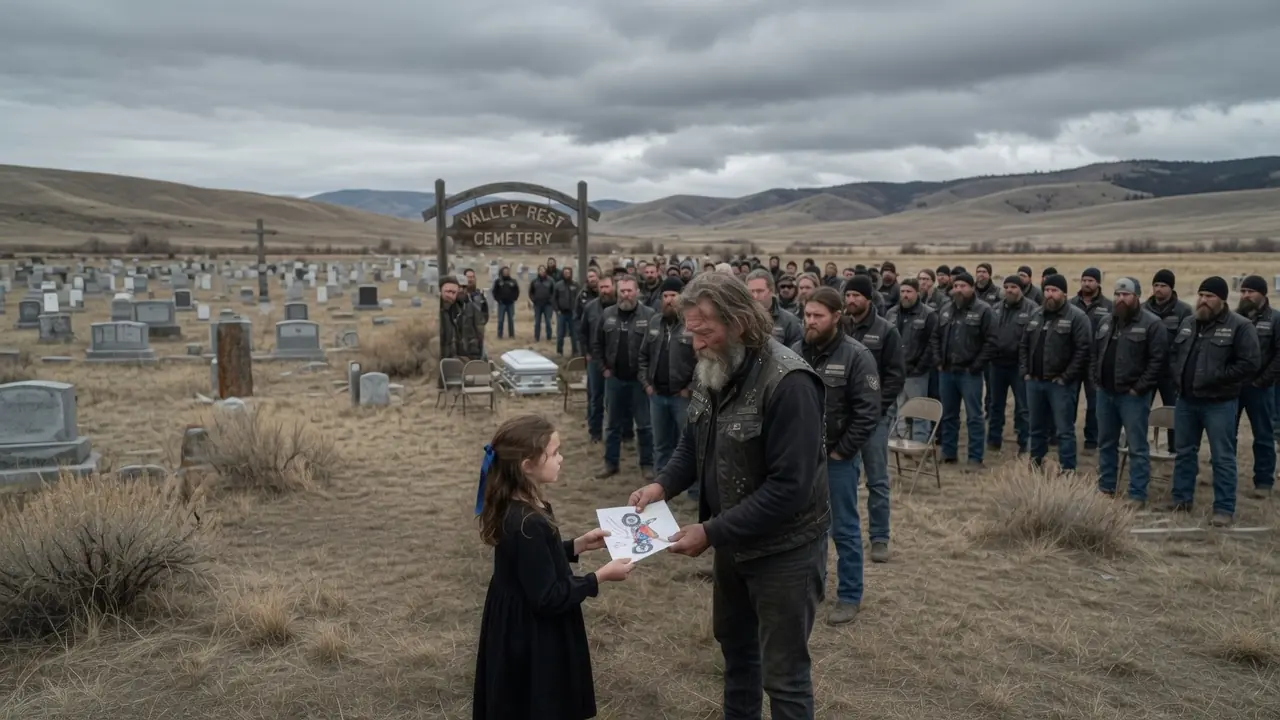
She was six years old. She didn't cry when she said it. She didn't shake. She walked straight up to the biggest, most dangerous looking man in that cemetery and asked him like she already knew the answer. Like she trusted him before he even opened his mouth.
The man, leather vest, gray beard, arms like tree trunks went completely still. And for the first time in longer than he could remember, Jack Grim Callahan didn't know what to say. Sarah Cole had not slept in 11 days. She knew the exact number because she had stopped counting the hours and started counting the days instead. The way you do when sleep stops being something you look forward to and starts being something that terrifies you.
Because every time she closed her eyes, she told him, "Ethan," running across the back porch in his socks, holding up a magazine photo of a Harley-Davidson soft tail and saying, "Mom, one day I'm going to ride one of these." For real. Not just pretend. He was 10 years old when he said that. He was 10 years old when he stopped saying anything at all.
The morning of the funeral, Sarah stood in the bathroom of her sister's house in Billings, Montana, gripping the sides of the sink, staring at the woman in the mirror like she didn't recognize her. Her sister Dana knocked on the door and said softly, "Sarah, it's almost time." Sarah didn't answer. "Sarah, I know," she finally said. Her voice came out flat, empty, like a room with all the furniture removed. "I know, Dana. I know."
She splashed cold water on her face. She straightened her black dress. She walked out of that bathroom the way people walk out of places they never want to go back to, fast eyes forward, not looking at anything too long. The drive to the cemetery was quiet. Lily sat beside her in the back seat, still wearing the blue hair ribbon Sarah had tied that morning, her small hands folded in her lap like she was waiting for something. She hadn't cried in 2 days. Sarah had started to worry about that. 6-year-olds were supposed to cry. 6-year-olds weren't supposed to go quiet the way Lily had gone quiet. Deep down quiet. The kind that settles in the chest and doesn't move.
Mama, Lily said suddenly. Yeah, baby. Is Ethan cold? Sarah felt the air leave her lungs. She reached over and took Lily's hand. No, sweetheart. He's not cold. How do you know? She didn't answer that. She just held Lily's hand tighter and looked out the window at the flat gray sky pressing down over the Montana hills. And she thought about how Ethan used to say, "The sky out here looked like a ceiling, and he hated it. He wanted to get out and ride somewhere. The sky went on forever." He never got to do that.
The crowd was small. That was the thing that hurt in a way Sarah hadn't anticipated, the smallness of it. She had told herself it was because they lived in a rural area, because people had to drive far, because it was a Tuesday, because the notice had gone out late. She had given herself every reasonable explanation. But standing there looking at 30, maybe 35 people scattered across those folding chairs, all she could think was, "My son deserved more than this. He deserved more."
She sat in the front row with Lily pressed against her side and Dana on the other, and she stared at the small white casket and tried to remember how to breathe like a regular person. Reverend Bowen had just stepped up to begin when the sound reached them. At first, she thought it was a truck on the highway half a mile away. Montana highways had that sound. Sometimes big rigs hitting a long flat stretch and opening up the engine, but this was different. This was layered, multiple, and it was getting closer. The reverend paused mid-sentence. People turned in their chairs. Sarah didn't move. She kept her eyes on the white casket.
Mama, Lily whispered, grabbing her arm. What is that? I don't know, baby. But then the first motorcycle crested the hill at the edge of the cemetery road. And then another and then another and the sound that had seemed distant was suddenly everywhere filling the air like weather, like something you couldn't stand outside of. Sarah finally turned. There were at least 40 of them visible on the hill and more behind them. A man in a gray suit three rows back stood up. What in the sit down, Gerald, his wife said. But who called them? Who sit down? The motorcycles came slowly. That was the first thing that struck people, how slowly they came. Not rolling in with noise and aggression, not revving engines to announce themselves. Just moving, measured, deliberate, like a procession like they had done this before, which some of them had, and they knew exactly what pace you kept when you were there to honor the dead.
They stopped outside the cemetery gate, engines cut off one by one until the only sound was wind. Sarah heard a woman behind her whisper, "Are those hell's angels?" And then a man's voice low and tight, "Lord have mercy, there must be 50 of them." There were actually 63 that first wave. Sarah would find out later. She didn't know the number then. She just knew they were there, big and leather clad and very, very still, standing with their hands clasped or hooked in their vest pockets, looking toward the ceremony with expressions that weren't threatening or intimidating. They were respectful. That was the word, the only word that fit.
Reverend Bowen cleared his throat. He looked at Sarah as if asking permission to continue. She gave him a small nod. He picked up where he left off. But the mood had shifted. Something in the air had changed. Even Sarah felt it, and she didn't want to feel anything today, had worked hard all morning to feel nothing. And yet, something had cracked open somewhere behind her sternum, and she couldn't quite close it back up. She felt Lily shift beside her. She'd assumed it was just restlessness. Lily had been still for a long time, too. Still for a six-year-old, so she put a gentle hand on the girl's knee to keep her in place. But Lily wasn't restless. Lily was looking at the bikers. Not with fear, not with confusion, with something Sarah couldn't immediately name. Something focused and very, very certain.
"Mama," Lily said, her voice barely above a whisper. "Shh, baby, the reverend is talking." Mama, I need to do something. Lily. But the little girl was already standing. Sarah grabbed for her hand and caught air. Lily slipped out from between the chairs and began walking. Not toward the casket, not toward the reverend, not toward any of the 30 odd people who had come to sit and mourn and be decent. She walked toward the gate, toward the bikers.
"Lily," Sarah said louder, now starting to rise. Dana grabbed her arm. "Let her go," she said quietly. Dana, she's six. Let her go, Sarah. The reverend had stopped speaking entirely. Everyone had. Every head in the cemetery had turned to watch the small blonde girl in her black dress and blue ribbon walk straight towards 63 Hell's Angels like she had a meeting scheduled. The bikers saw her coming. Sarah watched them see her, watched the ripple of awareness move through the group. Men nudging each other, a shift in posture, a lowering of shoulders. The man at the front, the big gray-bearded one, he went very still. He watched the little girl come toward him with an expression that Sarah couldn't read from a distance, but would later describe as undone, like something in his face just came apart at the seams.
Lily stopped 3 feet in front of him. She looked up. He was a large man, well over 6 feet, and Lily was a small child, and the distance between them physically could not have been greater. And yet somehow it was like watching two people who were exactly the same height. She reached into the pocket of her dress and pulled out a piece of paper folded, creased and soft at the edges, the way paper gets when it's been folded and unfolded too many times, when somebody carries it around because they can't put it down. She held it out to him. He hesitated for just a moment. Then he reached down and took it. He unfolded it slowly, carefully. The way you handle something you already know is precious before you even know what it is.
It was a drawing done in crayon, blue and red and black. A motorcycle rendered with the particular detail that obsessed 10-year-olds bring to the things they love. The curve of the handlebars. The roundness of the wheels. A figure hunched forward on the seat. That had to be Ethan himself. In the top corner in uneven blocky letters, my favorite thing. The big man's jaw moved. He didn't say anything. Lily said, "My brother loved bikes." The biker nodded, still couldn't seem to find words. "He used to make that sound," Lily said. And then she did it. She made the engine sound with her mouth, the low rumbling vroom that every kid does. And it was so small and so precise that the man in front of her actually flinched, like she had touched something that hurt. Every time one went by our house, she continued, he would stop whatever he was doing and just listen like it was music.
Yeah, the man said. His voice came out rough, like he had to push it through something. Yeah, I know that feeling. His name was Ethan. I know. I heard. Lily tilted her head. How did you hear? Well, somebody told somebody, he said. Word gets around. She seemed to accept that. She was quiet for a moment looking at him. Then she said it. The question, the one that stopped time. Can you carry my brother's casket?
35 people behind her went completely silent. Not the polite silence of a ceremony in progress. The shocked silence of a room where someone has just said something no one expected. Something so raw and so direct that the air itself doesn't quite know what to do with it. The man Jack Callahan, known in four states by the name Grim, a name earned over three decades of road and brotherhood and things he never talked about in mixed company, stood there looking at this six-year-old girl, and he felt something happen inside him that he would struggle to explain for the rest of his life.
He would try later. He would try to put it into words for the men who asked him about it, the reporters who came around, the people at the bars who heard the story third and fourth hand and wanted to know what it was really like. He would say things like, "She just looked at me like I was the only person who could do it." He would say, "It wasn't scary. It was the opposite of scary." He would say, "I haven't felt that in a long time." Trusted like that, just trusted.
But what he felt in the moment standing there with Ethan Cole's crayon drawing in his hand was simpler than any of that. He felt chosen. He felt for the first time in a very long time like he was exactly where he was supposed to be. He looked back at the other men not to ask permission. He didn't need permission. He looked back because he needed them to see what he was seeing. This girl, this moment, this thing that was being asked of them. And he needed them to feel it, too. They felt it.
He turned back to Lily. "Yeah," he said. "We'll carry him." Lily nodded once, like she'd known all along, like the answer had never been in doubt. Then she turned and walked back toward her mother with the same quiet certainty she'd walked out with. And Sarah caught her daughter in both arms and held her. And over Lily's shoulder, her eyes met Jack Callahan's, and she mouthed two words. "Thank you." He nodded. His throat was too tight for words.
Reverend Bowen let out a breath he'd been holding for what felt like 3 minutes. He looked down at his Bible. He looked up at his congregation. He said quietly, "I think perhaps we should take a short pause." Someone laughed. It wasn't an inappropriate laugh. It was the kind that breaks loose when the tension has been wound so tight for so long that the body just needs to release something. And then someone else laughed softly, too. And then a few more people. And then there was this strange grief-soaked moment where 35 people sat in a rural Montana cemetery laughing softly and crying at the same time because sometimes the two things are the same thing.
Jack pulled out his phone. He typed a message. Short, no punctuation, no subject line. Just kid who love bikes needs a proper goodbye. Brother funeral tomorrow. Montana. Pass it on. He sent it to 11 men. Each of those 11 men sent it to 11 more. He didn't know then how far it would go. He had done things like this before. Rallied brothers for a cause, organized rides for funerals, shown up in places where showing up mattered. But something about this one felt different. Something about the way Lily had looked at him, the way she'd handed him that drawing, the way she'd asked the question without a single tremor in her voice. It felt different.
He pocketed the phone. He walked back to his group and stood beside a man named Denny Ror who had been riding with Jack for 22 years and who had the particular quality of saying very little at exactly the right moments. "Well," Denny said. "Yeah," Jack said. Denny looked at the small white casket visible beyond the cemetery gate. "How old, 10?" Denny was quiet for a long time. Then he pulled out his own phone. I'm calling the chapter in Billings. I already messaged them. I'm calling them anyway. I want to hear a voice.
The ceremony resumed. The reverend found his place again and spoke the words he had prepared. Words about children taken too soon. About the cruelty of grief and the mercy of faith, about how the spirit moves in ways we don't expect and can predict, which seemed truer than usual today. People listened. People cried. Sarah sat in the front row holding Lily's hand and staring at the white casket and tried to stay in her body.
When the pallbearers were called forward, four men from the church, decent men who had known Ethan in passing and signed up because someone had to, something happened. Jack stepped forward. He didn't push anyone aside. He didn't make a scene. He just moved forward from the gate slowly. And two of the church pallbearers looked at each other and then looked at him and stepped back without being asked because sometimes you just know when to step back when something bigger than you is moving through the room. Six Hell's Angels lifted Ethan Cole's casket. They did it gently. That was the word every person there would use later, over and over in calls to family members and posts online and quiet conversations at kitchen tables. Gently, like the casket was made of something that could break, like the boy inside was still sleeping and they didn't want to wake him.
They carried him slowly. They didn't rush. And as they moved, every biker standing at that gate reached up and removed his helmet, held it over his heart, stood straight. Sarah Cole watched 63 men honor her son. Men who had never met him. Men who owed her nothing. Men who had driven hours on cold Montana roads for a child they knew only as a name in a text message. And a rumor of love for motorcycles. And something in her chest that had been locked shut for 11 days broke open all the way. She didn't fall apart. She didn't collapse. She just cried finally the real kind. The deep kind. The kind that meant something was moving again. Where before there had been nothing but stone.
Lily pressed closer against her side and said in a voice just above a whisper, "It's okay, Mama. They came." That was the thing that would stay with Sarah longest. Not the motorcycles, not the sheer number of them. Not even the ceremony itself. That sentence. It's okay, Mama. They came. Like Lily had never doubted it. Like asking a group of Hell's Angels to carry her brother's casket was a perfectly reasonable thing to do because the world was still a place where if you needed help badly enough, help would come.
Back at his bike, after Jack unfolded Ethan's crayon drawing one more time, a boy on a motorcycle, blue and red and black, my favorite thing, he folded it back carefully, put it in the inside pocket of his vest over his heart. Denny came up beside him. You keeping that? Yeah. That's not like you, Grim. No, Jack said. It's not. His phone buzzed. A message from the Billings chapter. We're in. Spreading word north and east. He typed back, "How many you think?" Three dots. Then, "Brother, you have no idea."
He stared at that for a moment, looked up at the pale Montana sky. He didn't know then, couldn't have known that before the next sunrise, his message would have crossed six state lines. That brothers he hadn't spoken to in years would be pulling on their vests in garages in Wyoming and Idaho and Colorado and South Dakota. That the number 63 would become a number far, far larger than anything this quiet rural cemetery had ever held. All he knew, standing there in the cold with a crayon drawing over his heart, was that a little girl had asked him a question, and he had said yes. And now something was in motion that nobody, not Jack, not Sarah, not the Reverend, not the 35 people who'd sat in those folding chairs, could stop, even if they'd wanted to, which none of them did.
Jack's phone didn't stop buzzing that night. He was sitting in the parking lot of a Super 8 motel off Route 90, still in his vest, boots still on because he hadn't quite managed to make it inside yet. Every time he reached for the door handle, another message came in. And he'd look down at the screen and something in his chest would tighten in a way that wasn't entirely unpleasant, the way it felt before a long ride, before something big, before the world shifted on its axis without warning. Denny knocked on the passenger window from outside. Jack rolled it down. "You eating tonight?" Denny said. "Not hungry." "That's not what I asked." Jack looked at him. Denny held up a paper bag, gas station sandwiches, two bottles of water, a bag of chips that was mostly air. The kind of meal you ate, not because it was good, but because someone who cared about you put it in front of you, and you didn't have the energy to refuse. Jack took the bag. Thanks.
Denny leaned against the door. How many so far? 212 confirmed. Jack set the bag on the seat without opening it. And that's just the ones who replied. The message is still moving. Denny let out a low whistle. For a kid you never met. For a kid who deserved better than 30 people in folding chairs. Jack's voice came out harder than he intended. He softened it. Sorry. I don't know why it's hitting me this way. Denny was quiet for a moment. Then he said, "You got a grandson, Grim. You just don't let yourself think about it too much." Jack didn't answer that. It was true, and they both knew it. And some truths didn't need a response. They just needed to be said out loud so they could exist in the air between two people for a moment before everyone moved on.
He looked back at his phone. A message from a chapter president in Cheyenne rolling out at dawn bringing 47. Another from a man in Rapid City 22 bikes. We'll be there. Another from a number he didn't immediately recognize until he scrolled up to find the name Tommy Briggs. A man he hadn't spoken to in six years after a falling out over something that now seems so small he could barely reconstruct it. The message said only heard about the boy. We're coming. All of us. Consider this water under the bridge. Jack stared at that one for a long time. He typed back, "Water's been under the bridge for a while, brother. Drive safe." He put the phone face down on the seat, picked up the sandwich, took one bite, then put it back down.
Denny, he said. Yeah, that little girl looked at me like she already knew I'd say yes. Denny thought about that. Maybe she did. How does a six-year-old know something like that? Kids that age, Denny said slowly. They don't have all the filters yet. All the reasons why you shouldn't ask. All the ways people tell you no. He pulled up the collar of his jacket. She just needed something, so she asked. Didn't occur to her it wouldn't work. Jack picked up the drawing from the dashboard where he'd laid it. Ethan's motorcycle, blue and red and black. My favorite thing. He'd looked at it maybe 20 times since the ceremony, which he didn't fully understand and had stopped trying to. 212, he said again. And counting, Denny said. Neither of them slept much that night.
40 miles away in Dana's spare bedroom, Sarah Cole lay on top of the covers, fully dressed, and stared at the ceiling and listened to the house. Dana's kids were asleep. Dana was asleep. The refrigerator hummed. A car passed on the road outside, and in the next room, Lily breathed in the slow, deep way of children, which Sarah had checked on three times in the past hour, not because she was worried, but because she needed to hear it, needed the proof of it. She kept going back to the moment at the cemetery, to Lily just going, standing up and walking toward those men with no hesitation, no looking back, that little blue ribbon trailing in the wind. Sarah had reached for her and caught air. And her first instinct had been panic because a rational adult sees a group of Hell's Angels and feels something complicated. But then Dana said, "Let her go." And something in Dana's voice had the same certainty that Lily's whole body had. That odd unshakable sureness and Sarah had let go. She hadn't stopped turning that over since her phone lit up on the nightstand. She reached for it expecting Dana or a distant relative or maybe the funeral home following up about paperwork, the administrative machinery of death kept moving even when you wanted everything to stop. But the number was unfamiliar. Montana area code, but not one she recognized. She almost let it go to voicemail. Then she answered, "Hello." A pause. Then a man's voice rough around the edges, careful with itself. "Mrs. Cole, my name's Jack Callahan. I was at the cemetery today. I'm the one your daughter. The one who said yes." Sarah said, "I know who you are."
I just wanted to call to check on you and to tell you something that I think you should know. She pulled her knees to her chest. "How did you get this number?" "The Reverend," Jack said. Reverend Bowen. I asked if it was all right and he said he'd leave it up to you and I figured if you didn't want to talk, you'd let it go to voicemail. I almost did. I figured that, too. A short pause. I can be quick if you want. What did you want to tell me? He exhaled. There are more people coming tomorrow. She waited. When I sent the message out tonight about Ethan, about the ceremony, I expected maybe a hundred people, maybe less, guys in the area who could get there without too much trouble. Another pause, longer this time. It's closer to 300 now, and the message is still going. Sarah felt the room tip slightly. 300? Could be more by morning. I don't have a final count. These things, once they start moving, he stopped himself. I just wanted you to know because it'll change the look of things. It'll change the sound of things, and I didn't want you to be blindsided.
She thought about the rumble that had crested the hill that afternoon. The way it had moved through her chest before she even knew what it was. Why, she said. It came out barely above a whisper. Why are they coming? They didn't know him. Jack was quiet for a moment. When he spoke again, his voice had shifted, still rough, but something underneath it had opened up. No, they didn't. But they know what it feels like to love something that fast and that loud and that completely. And they know, he stopped. Tried again. Mrs. Cole, there's not a man on a motorcycle who doesn't understand a 10-year-old boy who stops whatever he's doing to listen when one goes by. That's something we all felt once before we were big and old and complicated. We felt that exact thing.
Sarah pressed her hand over her mouth. Your son deserved a sendoff, Jack continued, his voice thickening around the edges, but holding. And your daughter looked at me and asked me to make sure he got one. I told her yes. I meant it. For a long time, neither of them said anything. Then Sarah said, he would have thought this was the coolest thing that ever happened. Jack made a sound that was half laugh, half something else entirely. I know he would. He used to sleep with a motorcycle magazine under his pillow. She said, "I found it when I was going through his things. It was worn completely through at the spine. He'd read it so many times the pages were soft as cloth." What magazine? Iron Horse. The older issues. He liked the vintage bikes. Jack laughed. Then a real one, surprise out of him. Iron Horse. That's an old man's taste for a 10-year-old. He said modern bikes had no character. Sarah laughed too, and then crying came out of the laugh. The way it does sometimes, the two things woven so tight together, they share the same breath. I'm sorry, she said. Don't be, he said immediately. Don't ever be sorry for that.
They talked for another 20 minutes. She told him about Ethan's obsession with engine sounds, how he could identify a Harley from a Honda from two blocks away with his eyes closed, how he'd once stopped in the middle of his sister's birthday party because he heard something outside and had to go identify it. Jack told her about the first time he'd gotten on a bike, 16 years old, scared out of his mind, but feeling free. That was the only word, free in a way that nothing else before or since had quite matched. She told him about the accident briefly because she couldn't do it any other way yet. He didn't press. He just listened and he said, "I'm sorry. I'm genuinely sorry." And it didn't sound like a platitude. It sounded like something he meant in his chest.
When she finally said she should try to sleep, he said one more thing. Okay. Your daughter, Lily, his voice was different now. Careful. Like he was carrying something breakable. She's something special, Mrs. Cole. What she did today, walking up to a bunch of strangers like that, asking what she asked. Most grown adults wouldn't have done that. Most grown adults would have sat in that chair and wish someone would do something and never open their mouth. A beat. She's going to be all right. Both of you are going to be all right. Sarah pressed her lips together. You don't know that. No, he agreed. I don't know it for certain, but I know it the same way she knew I'd say yes. He paused. Sometimes you just know.
She went to bed after that. She still didn't sleep much, but it was a different kind of awake. Not the stone-heavy numbness of the past 11 days, but something that flickered. Something that hadn't been there before. Something small and stubborn and almost, almost like the first suggestion of warmth after a very long winter. At 4:47 in the morning, Lily appeared in the doorway of the bedroom. Sarah saw the small shape of her against the hallway light and sat up. Hey, baby. Can't sleep. Lily padded across the room and climbed into the bed. She pulled the covers up to her chin and lay on her back, very still, staring at the ceiling the same way Sarah had been staring at it an hour before.
"The man with the beard," Lily said. "Is he coming back tomorrow?" "Yes, sweetheart, he is." "Are more people coming?" Sarah looked at her daughter's profile. Why do you ask? Because I asked him to carry Ethan. Lily said her voice matter of fact, the way children are matter-of-fact about enormous things. Because they haven't yet learned to add the weight of significance to them. And he said yes. But Ethan would have wanted more than just one. Sarah felt her breath stop. What do you mean more than just one? More bikes? Lily said like it was obvious. Ethan always said if he could have anything, it would be a hundred motorcycles all at once. All loud. She turned her head on the pillow and looked at Sarah with those clear, serious eyes. Do you think there will be a hundred? Sarah pulled her daughter close, pressed her lips against Lily's hair, closed her eyes. I think, she said softly. There might be more than a hundred. Lily settled against her. A long silence. Then good.
By 6:00 in the morning, Jack's phone had rung 43 times. He'd showered and was sitting on the edge of the bed in the motel room. Coffee from the lobby machine going cold on the nightstand, working through messages. Some were logistical, arrival times, parking questions, people asking if they should bring anything. He told everyone the same thing, nothing. Just come, just be there. Some messages were from people he hadn't heard from in years. Two were from men he'd have said wouldn't cross the street for a stranger, let alone drive 400 miles. They were coming. Denny came through the adjoining door without knocking because after 22 years he'd given up on knocking. "Final count as of right now," he said, holding up his own phone. Jack looked up. "How many?" Denny let out a breath. "812." The number landed in the room and just sat there taking up space. Jack sat down his coffee. "800 and 12," Denny said, coming from six states. Some of them drove through the night, Grim. They didn't stop. They just drove.
Jack stood up, walked to the window. He looked out at the parking lot where even now bikes were beginning to gather, riders pulling in ones and twos and fours, men nodding at each other with a particular recognition of people who speak the same language without words. He had seen big gatherings. He had been part of big gatherings. He had never seen anything like what was already happening in that parking lot. And the ceremony was still 4 hours away. 800 people, he said again. For a boy named Ethan. For a boy named Ethan, Denny confirmed. Jack picked up the crayon drawing from the nightstand. He'd put it there before he tried to sleep, faced up, so it was the last thing he saw when he finally closed his eyes. And the first thing he saw when he opened them again at 5:15. A 10-year-old's motorcycle, blue and red and black. My favorite thing. He folded it, put it back over his heart. Let's go, he said.
The ride to the cemetery took 12 minutes. By the time they arrived, the road was already thick with motorcycles, a river of chrome and leather stretching in both directions, further than Jack could see from the front. Men from Wyoming stood next to men from South Dakota, stood next to men from Colorado, some of whom had never met, all of whom had driven through the dark for a name and a text message. There was no argument about positioning, no jockeying for status. People simply parked and stood and fell into line the way water finds its level naturally without force because this was what they were here for and everyone understood it without being told. At the gate of Valley Rest Cemetery, Jack stopped his bike and sat for a moment with the engine idling. A man he didn't know pulled up beside him. Mid-50s, weathered in the way of men who live outdoors by choice. He pulled off his helmet and looked at Jack. You're the one who sent the message. Yeah. The man nodded slowly. I got a boy, he said. 11 years old, loves bikes. Can't get him off them. He looked toward the cemetery gate. All I could think when I heard, all I could think was, "What if that was mine?" His jaw tightened. So I came. He put his helmet back on and pulled forward without another word. Jack watched him go. Then he cut the engine, got off the bike, and walked through the gate.
Reverend Bowen was already there standing near the entrance. And when he saw Jack coming, he walked to meet him. His face had the particular look of a man who has learned not to be surprised by anything and is currently being surprised by everything. Mr. Callahan, he said. Reverend, I drove past the road on my way here. The reverend's voice was steady, but his eyes were bright with something unsteady in them. I stopped counting at 400. There's closer to 800, Jack said. The Reverend was silent for a moment. Then he said quietly. In 41 years of ministry, I have never. He stopped, tried again. I have never seen anything like what is about to happen. Neither have I, Jack said. And I've been doing this 30 years. What do you want me to do? Reverend asked. How should I just do what you were going to do? The room, Jack said. Or the words. That's your part. We'll do ours. Bowen nodded. He reached out and put a hand briefly on Jack's arm. The kind of grip that wasn't an act of sentimentality, but of recognition. Two people who understood that something larger than both of them was moving through this moment. Then he turned and walked back toward the ceremony.
Jack stood at the gate and watched the road fill. 800 men and women who had never known Ethan Cole, who knew only the outline of him, 10 years old, loved motorcycles, died too soon, coming to stand in formation for his passage. Not for cameras, not for recognition. There were no cameras yet, no news vans, no reporters. This was happening in the pure original before anyone thought to document it. And there was something in that, something clean and untouched that Jack was grateful for. He heard the sound of a car door. He turned. Sarah Cole was walking toward the gate with Lily beside her, holding her mother's hand. Sarah had stopped walking the moment she saw the road. She stood absolutely still, one hand over her mouth, looking at the rows and rows and rows of motorcycles stretching further than she could see, at the hundreds of men standing quietly along the path her son was about to travel for the last time. Lily let go of her mother's hand. She walked straight to Jack, looked up at him. You brought more, she said. Yeah, Jack said. A few more. Lily looked out at the road, at the 800 people who had come because a 10-year-old boy loved the sound of engines. She looked for a long time, her face very still, the way it had been still for 2 days. Then her face broke open. Not crying, not laughing, but something in between. Something without a clean name. Something that happens when the world turns out to be bigger and kinder and more overwhelming than anything you expected.
He's going to love this," she whispered. And Jack Callahan, who had not cried in longer than he could accurately remember, who had made a point of not crying for most of his adult life, who wore his grief the way he wore his vest, close to the chest, shown to no one, felt his eyes burn, felt his throat lock, felt all of it rise up from wherever he had been keeping it. He cleared his throat, looked out at the road. Yeah, kid. He said he is. Lily's face breaking open like that. That was the moment everything shifted. Not just for Jack, for everyone standing close enough to see it. There were maybe 15 men within earshot. Hardened, road-worn men who had seen most of what life could throw at a person. And every single one of them looked away in that particular way people look away when they're trying to protect something private in themselves that they didn't expect to feel. Denny turned around and walked back toward his bike and stood there with his hands on the handlebars and his head down. And the man next to him, a big, quiet man from Billings named Carl, who never talked about himself and whom Denny had known for 9 years, put a hand on Denny's shoulder and left it there without saying a word because there was nothing to say, and Carl had always known that.
Sarah reached Lily and pulled her back, gently, tucking her daughter under her arm, like something she needed to hold together. She looked at Jack and she opened her mouth and closed it again because there are moments when language is simply not built for what you're trying to carry. When every word you reach for feels too small and too flat for the actual weight of the thing. Jack saved her the trouble. You don't need to say anything. He said, "Just let us do this right." She nodded, pressed her lips together, nodded again. Reverend Bowen had positioned himself near the casket and was waiting with the particular patient stillness of a man who understood that this morning had already exceeded every plan he'd made for it, and the only thing to do was surrender to what was actually happening. He caught Sarah's eye and gave her a small nod, steady, reassuring, the kind that said, "I've got this part. Trust me." And something in Sarah's shoulders came down half an inch.
The ceremony began again, and this time it was different. This time the air itself was different, heavier. Fuller, charged with the presence of 800 people standing in complete silence along a road in rural Montana at 8:30 in the morning because a little girl had asked a question and a man had said yes and the word had traveled and kept traveling until it reached people none of them could have predicted, until it reached Tommy Briggs in Rapid City and a man named Ray Cutter in Cheyenne who had a son Ethan's age and had driven through the night without stopping, until it reached the woman named Marlene Voss who wasn't a biker at all but whose husband had been, who had heard the message through his chapter and come alone on her own motorcycle for the first time since his death 2 years ago because she said later she just felt like she needed to be there. She couldn't explain it better than that. 812 people had come for a boy they'd never met and every one of them was silent. Reverend Bowen spoke about grace. He spoke about the particular cruelty of a life cut short and the particular grace of a life fully lived within its limits. The way some people pack more love and more light into 10 years than others manage in 80. He spoke about Ethan the way Sarah had described him in the phone calls beforehand, the motorcycle magazines, the engine sounds, the absolute focused joy he brought to the things he loved. He said, "There are people standing on this road today who never knew Ethan Cole, who only knew the shape of him, who only knew that he was 10 years old and that he loved something deeply." And they came. They came from six states. They drove through the night. His voice wavered for just a moment. He steadied it. If that doesn't tell you something about what love does when it goes looking for a place to land, I don't know what will.
In the third row of chairs, a woman named Patricia Hess, who had taught third grade at Ethan's school and come alone because she couldn't not come, put both hands over her face and her shoulders shook. Next to her, a man she didn't know put a box of Kleenex on her knee. She looked up. He shrugged. I always bring them, he said. Been doing funerals for 30 years. Never go without. She took one. Thank you. Don't mention it. That was the texture of it. 800 people who were strangers to each other and had become in the space of a morning something else. Not friends exactly, not family. Something more specific than either, something that only exists in certain moments when people have been pulled together by a force bigger than personal history or personal preference, when the only thing they share is being present for the same true thing.
Jack stood at the front of the group near the gate and watched the ceremony and felt the weight of Ethan's drawing over his heart and thought about what Denny had said the night before. You got a grandson, Grim. You just don't let yourself think about it too much. His grandson's name was Marcus. He was eight. Jack had seen him four times in the past two years because of a complicated situation with Jack's son that he took full responsibility for in the sense that he knew it was his fault and took no responsibility for in the sense that he hadn't done anything to fix it. He thought about Marcus. He thought about Marcus hearing a motorcycle go by and stopping to listen. He thought about what he would want if it were Marcus in that casket. If it were Marcus's name in a text message crossing state lines in the dark. He thought, "I'd want exactly this. I'd want exactly what is happening right now." The thought hit him so hard he had to look away from the casket for a moment. He'd call his son tonight. He decided it the way you decide things sometimes, not through reasoning or planning, but through the sudden, blunt arrival of clarity. He would call his son. He didn't know what he'd say. He'd figure it out.
Reverend Bowen was finishing. He looked up from his notes and said in a voice that carried all the way to the back of the gathering. Would the pallbearers please come forward? Jack straightened. He turned to the five men he'd chosen that morning. Denny, Carl from Billings, a man named Pete Shaughnessy who had driven from Laramie and who had the gentlest hands of any man Jack had ever known despite looking like he could dismantle an engine block with two fingers, and two brothers named Vince and Marco Duca who had been riding together since before either of them was legal and who moved in the synchronized way of people who have been in close quarters for a long time. Jack looked at each of them in turn. Nobody spoke. Nobody needed to. They walked forward together.
The church pallbearers had already stepped back, not because anyone asked them to but because the moment had its own gravity and they felt it, felt themselves not being pushed aside but freed from something, released from a duty that was about to be performed in a way they couldn't have provided and knew it and were grateful. One of them, heavy-set man named Bill Forsythe, who had known Sarah's family for 20 years, stepped back and stood beside Reverend Bowen and watched the six bikers approach the casket and felt something happen in his chest that he would bring up to his wife that evening at dinner. And then again the following Sunday at church, trying to find the right frame for it, never quite managing. The six men reached the casket. They looked at each other. A breath, an alignment not of bodies, but of something else. Intention, weight, seriousness, the understanding that what they were about to carry was not just a box they lifted. The silence that followed was of a different quality than all the silences before it. This was not the silence of people being quiet. This was the silence of 800 people holding their breath at exactly the same moment, of something collective and involuntary, the body's response to witnessing something that the mind recognizes as important before it has the words for why. And then from somewhere in the middle of the crowd, nobody ever identified who it was. Nobody took credit. It simply happened. One man removed his helmet, then the man beside him, then the next, and the next, rippling outward through the crowd the way a stone hits water. Not a wave, but a radiation spreading in all directions simultaneously until every single person standing along that road had their helmet off and held it over their heart. 800 helmets, 800 people, one small white casket moving slowly between them. Sarah watched it happen and made a sound she would later be unable to describe. Not crying, not a gasp, something that came from somewhere below language. She felt Lily's hand find hers and grip it with a strength that shouldn't have been possible from a six-year-old. "Look, mama," Lily said. "I'm looking, baby." "All of them." "I know." "He can see them," Lily said. It wasn't a question. Sarah tightened her grip on her daughter's hand and didn't know how to answer because some things you can't agree or disagree with, some things you can only stand beside.
The walk to the burial site took 4 minutes. Later people who were there would say it felt both longer and shorter than that, longer because everything was so precise and deliberate, each step measured, each pace serious and present. Shorter because it was the kind of moment that doesn't sit inside time the normal way, that exists in a different category, that you don't experience so much as receive. Jack felt the weight in his hands. He felt the cold of the metal handle. He felt Pete on the other side maintaining perfect steadiness without being told to. And Denny behind him breathing slow and controlled and all of it together felt like the most important thing he had ever been asked to do and he had been asked to do many things in his life, some of which he was proud of and some of which he was not. This he was proud of completely, without reservation or complication. They set the casket down. Reverend Bowen said the final words. Sarah stepped forward and placed a single flower, yellow, which had been Ethan's favorite color, a fact that made three people near her who didn't even know him have to look at the ground. Lily placed her hand flat on the top of the casket for a moment, just resting it there, and then she stepped back. It was done.
And then the thing happened that nobody had planned. The thing that became later the image that people remembered, not the rows of motorcycles, not the helmets over hearts, but this. Jack raised his hand, just his hand up in the air, high, open palm, a signal, and every engine on that road roared to life. Not at once in a wave the way the helmets had come off, spreading from the front back and back to front, engine after engine igniting until the sound was everywhere, was everything, was the air itself vibrating, not chaotic, not aggressive, controlled power, deliberate, massive thunder that had intention behind it, the sound of 800 machines speaking the same word at the same volume for the same reason. Sarah felt it in her sternum, in her back teeth, in the soles of her feet, through the ground. Lily's whole face changed. She had been solemn through the service, through all of it. More solemn than a six-year-old had any right to be, carrying it the way she'd carried everything since Ethan died. That deep down stillness that had scared Sarah more than crying would have. But now, with the engines roaring, something cracked open in Lily the way it hadn't cracked open in 11 days. She lifted her face. Her eyes went wide. Her mouth curved a slow, real, unmistakable smile. "That's what he liked," she said. She had to say it loud over the engines, and the loudness of it, the fullness of her voice against all that sound was its own kind of miracle. That's exactly what he liked. She turned and looked up at her mother. Sarah was already looking down at her. They looked at each other for a long moment, the two of them with 800 engines shaking the world around them. And something passed between them that was not words and did not need to be.
Jack lowered his hand. The engines settled, not off, not yet, just down to idle, to a steady low rumble. The sound of 800 hearts still beating. He walked over to Lily and crouched down to her level. She looked at him seriously. "Was that for him?" "That was for him." "He heard it," she said. "I know he did." She reached into the pocket of her dress, the same pocket she'd pulled the drawing from the day before, and took out something else. Another folded piece of paper. She held it out to Jack. He took it, unfolded it. Another crayon drawing. But this one was different. This one had two figures on the motorcycle, a big one and a small one. The small one in front with their hands on the handlebars, the big one behind with hands raised like they were celebrating. Above them in Lily's unsteady letters, Ethan and his friend. Jack stared at the drawing. When did you make this? He said. Last night, Lily said. When Mama was sleeping. He looked at her. The big one is supposed to be me. She nodded matter of fact, completely certain. He folded the drawing carefully, put it in his inside pocket next to the first one, next to Ethan's motorcycle. Two drawings over his heart now. He pressed his hand against his chest, feeling them there, thin and light and somehow the heaviest things he'd ever carried. "Thank you," he said. His voice was barely holding. Lily shrugged in the easy way of children who don't yet understand how extraordinary they are. "You carried him," she said. "You were his friend." Jack stood up. He looked at Sarah, who had seen the whole exchange and who was doing this specific trembling stillness of someone who has decided they are not going to fall apart, not right now, not in front of everyone, and is succeeding by the narrowest possible margin. She's something else, Jack said quietly. I know, Sarah said. She exhaled. I don't know where she came from. She came from a family that raised a boy who loved things completely and a girl who trusts strangers to do the right thing. Jack held her gaze. That doesn't happen by accident, Mrs. Cole. That's you. Sarah looked away. The trembling stillness wobbled dangerously. Dana appeared at her elbow. Dana, who had impeccable timing and always had, who had been Sarah's older sister and therefore Sarah's first experience of having someone show up without being asked. Cars ready when you are, Dana said softly. No rush. Give me a minute, Sarah said. Dana nodded and stepped back.
Sarah turned back to the burial site one more time. She stood looking at it, at the flowers, at the disturbed earth, at the small stone that had been prepared with his name and the dates that bracketed everything, all 10 years of him, reduced to a dash between two numbers. She breathed in through her nose and out through her mouth the way the grief counselor had shown her, though she hadn't been back since the second session because it felt too formal, too structured, like grief was a project with milestones. Grief was not a project with milestones. Grief was the refrigerator humming at 3:00 in the morning and a motorcycle magazine worn soft at the spine. But standing there with the sound of 800 engines still warm in her bones, she thought he was here. He was really here and everyone knew it. She thought 30 people showed up for the first part. 800 showed up for the rest. She thought Lily knew. She had one more thought, the kind you don't share immediately, the kind you hold for a while and examine from different angles before you let it out into the world. She thought, I need to find a way to tell people this story, not for attention, not for sympathy, because something happened here that people need to know happened. Because the world is full of people who have decided that strangers don't care, that help doesn't come, that if you need something, you'd better not ask because nobody will show up. And she wanted those people, she needed those people to know about an 800 question asked by a six-year-old girl in a blue ribbon, about the answer that came back across six states in a cold Montana night. She would figure out how to do that later. Right now, she went and got her daughter and took her to the car. As they walked, Lily looked back over her shoulder at the rows of motorcycles still lined along the road, at the men standing beside them, at Jack watching them go with his hand raised once more. Not a signal this time, just a wave, simple and human, the kind you give someone you'll see again. Lily raised her own hand back, small fingers wide open. "Bye," she said. Jack's hand stayed up until they were in the car, until the car was out of sight, until the sound of the engine faded down the road and was gone. Then he turned back to the gathered men, 800 of them from six states, from chapters he knew and chapters he'd never heard of, from a world that had looked at a dead boy's name in a text message and said yes without being given a reason. And he felt something settle in him. Not resolution, not closure, not any of the clean words people use for messy things, just settledness, the sense of a thing completed that needed to be completed. Of a debt paid to someone who hadn't asked for it. Denny came up and stood beside him. What now? Now we ride, Jack said. Where? Jack thought about it. Doesn't matter. Somewhere with a long straight road and a clear sky. He pulled on his helmet. Somewhere Ethan would have liked. Denny nodded. He pulled on his own helmet. He looked at Jack for a moment and in the way of men who have known each other long enough to not need a lot of words, he said only, "You did right, Grim." Jack said nothing. He started his engine. The sound of it rolled out into the morning air. And one by one, the engines around him answered, 800 machines waking back up, the sound building again. Not to the roar of the final salute, but to something steadier. The sound of forward motion, of continuation, of people who had gathered for one thing and were now returning to their lives but carrying something with them that hadn't been there before. Jack pulled onto the road. In his vest pocket over his heart, two crayon drawings rode with him. A boy on a motorcycle. A boy and his friend on a motorcycle. My favorite thing. He opened up the throttle. The road went long and straight ahead of him, and the sky above the Montana hills was starting finally to break open, gray pulling back from the edges, something pale and almost gold pushing through underneath. Not warm yet, but coming. He rode toward it.
He called his son from a rest stop outside Bozeman. The phone rang four times. Jack was preparing himself for voicemail, had actually started composing the message in his head. The awkward opening, the careful middle, the part where he'd say, "Call me back and mean it." This time when the line clicked open and a voice said, "Dad," just that, just the word. But the way Ryan said it, not flat, not cold, just surprised, genuinely surprised, like a man who hears something he'd stopped expecting, put a crack in Jack's chest that he hadn't been prepared for. "Hey," Jack said, incredibly insufficient. He knew it the moment it came out. A pause on Ryan's end. Everything okay? Yeah. Yeah, I'm fine. I just, he stopped, started again. I was at a funeral today. Who's? A mom? A boy I never met. 10 years old, loved motorcycles. He leaned against the side of his bike and looked at the highway stretching west. 800 people showed up for him, Ryan. 800 strangers drove through the night for a kid they only knew by name. Ryan was quiet. I've been thinking about Marcus, Jack said. All day. I've been thinking about your boy. The pause that followed was longer than the first one. Long enough that Jack checked the screen to make sure the call hadn't dropped. It hadn't. He asked about you, Ryan said. Finally, carefully. I don't, I'm not saying that to make you feel bad. I'm saying it because it's true and you should know. Jack closed his eyes. What does he say? He says, "When is grandpa coming?" And I tell him soon and I, Ryan stopped. "I keep telling him soon." I'm going to make that true, Jack said. That's why I'm calling, not to, I'm not calling to argue or to go over old ground. I'm calling because I watched six men carry a 10-year-old's casket today, and I thought if that was Marcus, I would want, I would need, his voice lost its footing. He found it again. I don't want to waste any more time, son. That's all I'm saying. I don't want to waste any more time on this. Another long pause, but different from the first. The first pause had been wary. This one was something being reconsidered. Something being taken down from a high shelf and turned over in the hands. "Call me when you're back in town," Ryan said quietly. "Not a forgiveness, not yet, not completely, because some things take more than one phone call, but an opening, a door not slammed. We'll figure something out." "Yeah," Jack said. "Okay, yeah." He hung up and stood there for a while, just breathing. The highway moved beside him, indifferent and constant, and he let it. Then he got back on the bike and rode.
Meanwhile, something was happening that neither Jack nor Sarah had anticipated. It started the way these things always start, with one person telling one other person. A woman named Greta Simmons, who had stood along the road that morning in a borrowed vest because her brother was in the Billings chapter and she'd come along to see what this was all about, posted three photos on her personal social media account. Nothing elaborate, just the rows of motorcycles, the helmets coming off, the six men lifting the small white casket. No filter, no caption beyond "today in Montana. I don't have words. Just look." She had 412 followers, mostly family, co-workers, a scattering of people she'd met at various points in her life and never quite unfollowed. She didn't think much about it when she posted. She was sitting in her brother's truck on the way home, still feeling the vibration of 800 engines in her rib cage, and it spilled out of her the way things do when you've been holding them and your hands give out. By midnight, the photos had been shared 18,000 times. By the following morning, 200,000. By the time Sarah Cole sat down at her kitchen table 3 days after the funeral, with a cup of coffee she let go cold and her phone buzzing steadily on the surface beside her, the number had climbed past 4 million, which was a figure so large it had stopped meaning anything to her in a human sense, had become abstract, like trying to picture a billion dollars. Dana sat across from her, laptop open, reading aloud from the comments section of a news article that had run the night before. This made me call my brother for the first time in 3 years. She paused. Biker community restores faith in humanity. Another pause. I cried so hard. My husband thought something was wrong. Something was wrong, Sarah said. My son died. I know, Dana looked up. But something right happened, too. Sarah curled her hands around the cold coffee cup. She thought about what she'd felt standing at the burial site. The thought she'd held close, the one about people who'd given up on strangers. She hadn't done anything with it yet, hadn't figured out how, but it seemed the thing had moved on its own without her help and was doing the work she'd imagined doing in a way she couldn't have planned if she tried. Her phone lit up. Unknown number. She almost didn't answer. She'd been not answering a lot of calls since the photo spread, media requests, podcast invitations, a producer from a morning talk show whose assistant had called twice already. She didn't want to be a story. She wanted to be a mother. But something made her pick up. Mrs. Cole, a woman's voice, steady and warm. My name is Helen Park. I'm calling from, if you're media, Sarah said. "I'm not, I'm not media," Helen said quickly. "I'm a social worker in Billings. I work with families in crisis." A brief pause. "I saw the photos. Everyone has seen the photos, but that's not why I'm calling." Another pause, more considered. I'm calling because I have a client, a woman. She lost her husband 8 months ago, and she has three children. And she is, Helen's voice shifted, became quieter. She is exactly where you were 11 days ago, Mrs. Cole. Exactly. And I didn't know what to say to her. I didn't know what to give her. And then I saw the photos and I thought, what happened to you and your daughter? The thing that happened at that cemetery, that's what I need to give her. Not the motorcycles, not the bikers specifically. But the idea that it's okay to ask, that asking out loud for what you need isn't weakness.
Sarah sat very still. I wanted to ask your permission, Helen continued, to share your story with her. By which I mean Lily's story. What your daughter did. Because I have a little girl in my caseload, Mrs. Cole. She is 7 years old and she has just lost her father and she does not believe that anyone is coming. She has already at 7 years old decided that no one is coming. Helen's voice stayed steady but just barely. I want her to know about Lily. Sarah put the cold coffee cup down. She pressed her palm flat on the table and looked at her hand. Yes, she said. Share it. Share whatever helps. Helen let out a breath. Thank you. I'm, thank you. Can I ask you something? Sarah said. Of course. The little girl. Does she like anything? Is there something she loves the way Ethan loved bikes? A pause. Horses. Helen said. She draws horses on everything. Her notebooks, her folders, her shoes. Sarah nodded slowly. Something moved in her chest. Not grief this time. Not exactly. Something that was grief's close neighbor, but faced a different direction. Tell her, Sarah said, that loving something that much means it's still there even when everything else feels like it's gone. Tell her that. Helen was quiet for a moment. Then I will. I promise I will. Sarah hung up and sat at the kitchen table for a long time without moving. Dana had closed the laptop at some point during the call and was simply there the way Dana had been simply there since the beginning. Present, quiet, not requiring anything. You okay? Dana said. "I think something is happening," Sarah said. "And I don't know what it is yet, but I think it's supposed to happen." Dana reached across the table and put her hand over Sarah's. Then let it. Lily came into the kitchen then in her pajamas, hair wild, holding a crayon, blue, which she had apparently been using since before she came to find her mother since her fingers were blue at the tips and there was a smear of it along her left cheekbone. "What are you drawing?" Sarah asked. "A motorcycle," Lily said. She climbed into a chair and set a piece of paper on the table between them. Sure enough, a motorcycle, but larger than the others, more detailed in the way her drawings had been getting more detailed over the past few days. Like grief was somehow focusing her eye, under it in her large uneven letters for Jack. Are you going to send it to him? Dana asked. Lily nodded. He has the other ones. He should have this one, too. Sarah looked at her daughter, at the blue-tipped fingers and the smear on her cheekbone and the absolute certainty in her eyes. The unshakable quality that had been there since the beginning, since she'd stood up from that folding chair and walked toward 63 strangers and asked the question that had changed everything. How do we send it? Lily asked practically. Sarah thought for a moment. I have his number. I'll text him your drawing. Lily considered this. Do you think he'll like it? I think it'll mean more to him than almost anything. Good, Lily said, and went back to the drawing, tongue between her teeth, focused and certain. Sarah took a photo of the drawing, careful, making sure all the detail was visible, and texted it to Jack's number with a single line from Lily. She says, "You should have this one, too."
50 miles north, Jack had stopped at a diner for a late breakfast because Denny had threatened to stage an intervention if he didn't eat a real meal. He was halfway through eggs he wasn't entirely tasting when his phone buzzed on the table. He picked it up. The photo loaded slowly because the diner's Wi-Fi was the kind that made you wonder why they bothered offering it. He watched it come in, the top of the motorcycle first, then the wheels, then the letters underneath. He enlarged it with two fingers. For Jack. He set the phone face down on the table. Denny looked at him across the booth. What? Jack pressed both hands flat on the table and looked at them. She made me another drawing. Denny waited. The kid, Lily, Jack's voice was doing the thing it kept doing around the edges of this story, the thing he had no control over and had stopped pretending to. She made me a motorcycle and wrote for Jack on it. Denny picked up his coffee cup, set it down without drinking. What are you going to do? I don't know. Jack picked the phone back up, looked at the drawing again. Yes, I do. He typed back to Sarah. Tell her I'm hanging it up in my garage right where I can see it every day. Then after a pause, he added, "How are you holding up?" The reply came back faster than he expected. "Some days better than others. Today is okay. Lily is drawing. That helps." He typed, "Good. That's good." Then, because it felt true, and because he'd been thinking about honesty more in the past 4 days than he had in the past 4 years, for what it's worth, she helped me, too. More than she knows. He watched the three dots appear, disappear, appear again. Finally, she'd like that. I'll tell her. He put the phone down and picked up his fork and actually tasted the eggs this time. Denny said, "You seem different." "I am different." Jack said it simply without drama because it was just a fact. He was different. He had ridden into a rural Montana cemetery as one version of himself and something had happened there, something he hadn't planned and couldn't entirely explain. And he had ridden out as something slightly shifted, not transformed, not reborn, just adjusted, re-calibrated, like a compass that's been near a magnet and now points a little truer. He finished his breakfast. He paid the bill. He got back on the road. And somewhere along the way, he made a decision he hadn't known he was going to make until the moment it arrived fully formed. He was going to call his son. Not next week. Not when he got home. Now. He pulled over at the next rest stop and did it. The conversation was awkward at first, the way those conversations are. But it was a start. And starts are something. Back at the kitchen table, Sarah watched Lily finish the drawing. She took the photo. She sent it. And then she did something she hadn't done in 11 days. She made breakfast for her daughter. Real breakfast. Pancakes. The kind with the smiley face made of blueberries that Ethan had always asked for. Lily ate three. Sarah ate one. It was a small thing. But small things are how you start again. Jack's phone buzzed while he was riding. He pulled over to check it. The photo loaded. The new drawing. For Jack. He stared at it for a long time. Then he saved it. Then he opened his contacts and found his son's number again. He typed a message. Not long. Not complicated. Just, thinking about you and Marcus. Love you both. He sent it. He didn't wait for a reply. He put the phone away and got back on the bike. The road was long ahead of him. The drawings were over his heart. The engines were still rumbling in his bones. And for the first time in a long time, the world felt like it had room in it again. Room for questions from six-year-olds. Room for answers from men who look dangerous but aren't. Room for strangers to show up when it matters. Room for a limping man in a flannel shirt and a little girl with a blue ribbon to be seen. Room for all of it. He opened up the throttle and rode toward home.