Richard Harmon picked up the sticky note from her monitor, read it once, and dropped it on the floor. Not on the desk. On the floor. Then he turned to his VP and said, loud enough for 40 engineers to hear every syllable, "Marcus, when did we start letting black girls off the street sleep in my building? Is this a shelter now?
Some kind of diversity donation I didn't sign off on?" Zoe Carter lifted her head, tried to speak. He talked over her. "Don't. I don't want to hear it.
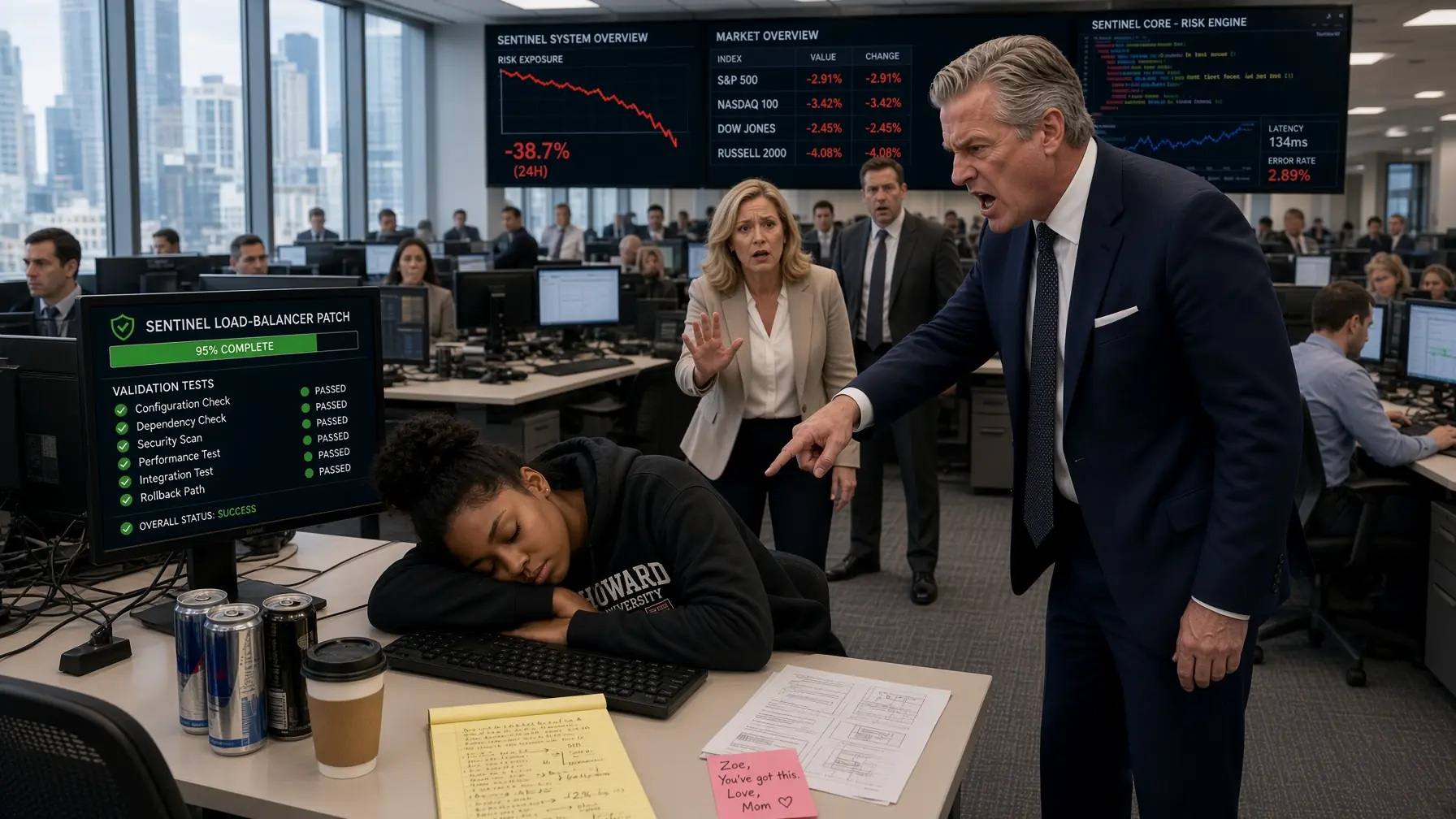
Whatever quota you filled to get in here, it's not saving you today." She reached for her keyboard. He stepped forward and closed her laptop. "You people always think showing up is enough. It's not.
Pack your bag." 40 engineers, not one voice, not one word. Her name was Zoe Carter, 22 years old, 12 hours and 49 minutes at that desk. And on the monitor behind her, the one he never once looked at, a progress bar sat frozen at 95%. 15 minutes after security walked her out, 309 million dollars disappeared.
And Richard Harmon's name was already being typed into a Bloomberg headline. Novatech Financial Systems didn't look like a place where a single mistake could cost 300 million dollars. It looked like money, pure deliberate architectural money. The building occupied the corner of Michigan Avenue and Monroe Street in downtown Chicago. 42 floors of glass and steel, the kind of structure that catches the morning light and throws it back at you like a quiet warning.
The lobby had marble floors polished to a mirror finish, a reception desk staffed by two people in matching charcoal blazers, and a digital ticker mounted on the east wall streaming real-time market data from six global exchanges simultaneously. Visitors signed in with fingerprint scanners. Security badges were color-coded by clearance level. The coffee in the executive kitchen cost $11 a cup. Nobody who ordered it ever questioned the price.
Novatech had been built over 14 years into one of the most respected financial technology firms in the country. Its core product, the Sentinel platform, was a real-time risk management and automated trading compliance system used by the largest hedge funds on Wall Street. The Sentinel didn't execute trades. It governed them. It monitored risk exposure in real time, flagged dangerous positions before they could fire, and ensured that every automated order ran within the parameters each client had pre-approved.
When it worked correctly, nobody noticed. That was entirely by design. The best systems are invisible. They hold everything together from underneath, silent, essential, until the moment they don't. Clearwater Capital Group was Novatech's largest and most important client.
A New York-based hedge fund managing $4.2 billion in assets. Clearwater ran $300 million in automated risk positions through the Sentinel platform every single trading day. $300 million flowing through algorithms, risk models, and compliance checkpoints, all of it dependent on one system functioning exactly as promised. If the Sentinel failed, Clearwater's positions would execute without any risk assessment. Wrong instruments, wrong prices, wrong everything. By the time any human being noticed, the money would already be gone and the damage would already be irreversible.
This was what Novatek had built. This was what the entire company had staked its name on. Then 18 months ago, the board hired Richard Harmon. He came from McKinsey, 15 years as a managing partner, the kind of resume that opens every door in the country before you even knock. He had restructured a pharmaceutical company in Ohio, turned around a logistics firm in Texas, and stabilized a regional bank in Georgia.
He was known for two things across the industry, cutting costs fast and closing deals faster. The Novatek board brought him in for a single purpose, get the company acquisition ready. A $2 billion offer sat on the table from a private equity group in Boston. Richard Harmon's job was to make sure that number held until closing. He had never worked in financial technology.
He had never managed an engineering team. He had never written a line of code. When Dr. Patricia Mills, head of engineering, 14 years in the industry, the architect of the Sentinel platform, gave him a detailed 40-minute technical overview, in his first week, Richard sat through the entire presentation without asking one technical question. When she finished, he leaned back in his chair and said, "How many people can we cut from the engineering team before the product starts to feel it?"
Dr. Mills said she would need to think about that very carefully. Richard told her to think faster. That was the first sign. It would not be the last.
Not be. Richard's management philosophy was simple and he made no effort to hide it. Discipline was visible. Excellence was visible. If something looked wrong, it was wrong.
He had a plaque mounted on the wall of his corner office, 41st floor, north-facing windows, a clear view of Lake Michigan on a good morning that read, "Excellence is visible." He had chosen the font himself. He had designed the public termination policy himself, too. In his first 6 months at Novatek, Richard Harmon fired four employees. Not through HR, not behind a closed door.
On the floor in front of everyone. He would walk to a desk, say what needed to be said, and call security. He believed this sent a clear message about standards. He was right that it sent a message. He was entirely wrong about what the message was.
The 24th floor, where the Sentinel platform lived, where the actual work of the company happened every day, learned quickly. Keep your head down. Don't draw the wrong kind of attention. Do the work and stay out of sight. The engineers who remained after his first wave of terminations were talented, capable people doing extraordinary work in deliberate silence, producing results Richard Harmon would never fully understand because he had never once genuinely tried to.
He referred to the engineering department during a leadership meeting as the basement people. He said it the way people say things they have believed so long they have forgotten that the belief itself was once a choice they made. Marcus Webb, his VP of operations, Yale M B a 38-year-old, Richard's most reliable instrument laughed. No one else in the room made a sound. The acquisition timeline was pinned to Richard's office wall in large clear type.
12 months to closing. $2 incidents between now and the signature. Every decision Richard made ran through that number first. There was another number he had never encountered. Not yet. Three weeks before the crash, a 22-year-old intern had typed it into the subject line of an email and sent it to every senior leader in the building.
Potential exposure exceeds $300 million. Richard Harmon never opened it. The story of Zoe Carter didn't begin in a glass tower on Michigan Avenue. It began on Brentwood Avenue in North Baltimore in a two-bedroom row house with a front step her mother scrubbed on her knees every Sunday morning before church. Denise Carter had raised Zoe alone since Zoe was 4 years old.
She drove a school bus for the Baltimore City School District route 47. The early morning run and three evenings a week she cleaned offices for a commercial firm out of Towson. Two jobs. One daughter. No complaints.