According to a private memorandum, preserved among the Ravenscar family papers, dated the 14th day of October, 1814, and discovered some two centuries later, pressed between the leaves of a household ledger no one had thought to open, the following account was set down in a hand that grew across its 40 pages steadily more certain of itself.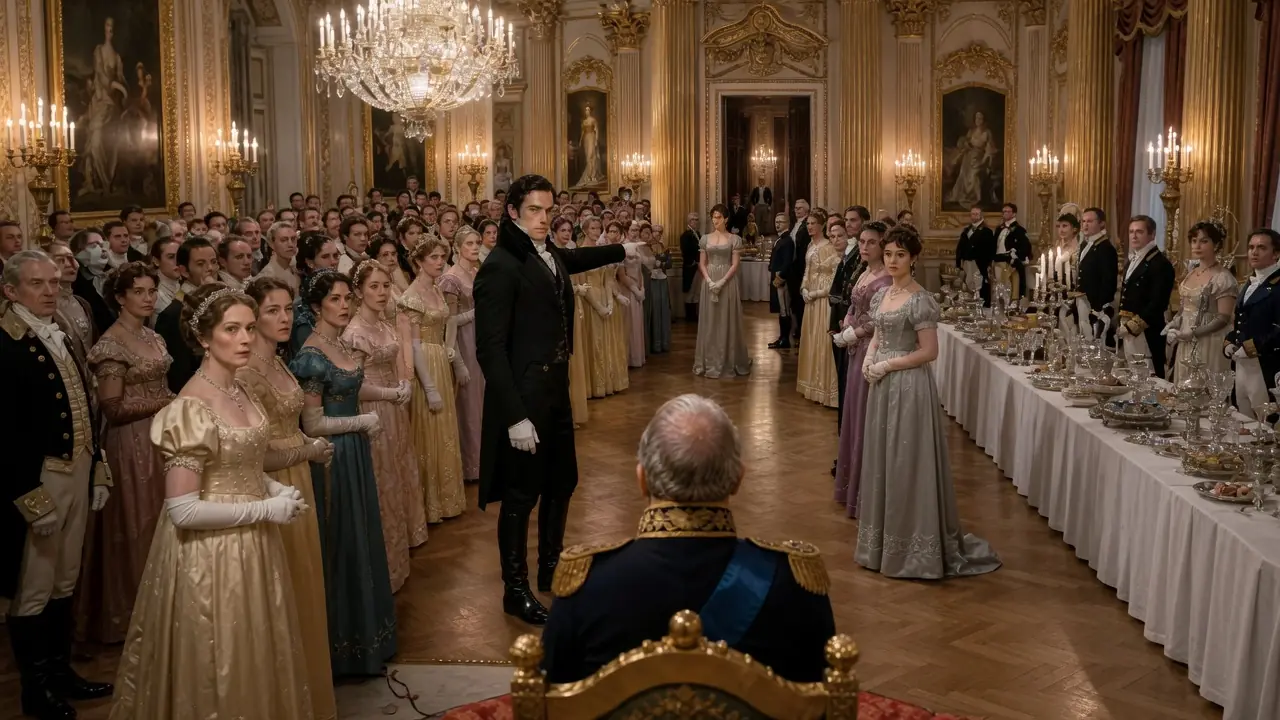
The king said,
"Choose any bride you wish."
And the Duke of Ravenscar, cold, scarred, immovable as the Yorkshire stone his family had quarried its fortunes from for four generations, looked out across a ballroom filled with the most celebrated daughters in England, looked past the rubies and the ringlets and the expectant mothers gripping their lorgnettes and pointed to a girl standing alone near the servants' corridor whose name he had not yet learned and said,
"That one."
Eleanor was of moderate height, slim as a birch, with dark hair pinned in a style that had been fashionable the previous season. She wore a dove-gray silk dress that was perfectly respectable and irredeemably quiet, and her eyes were the color of strong tea. In thirty minutes of careful observation, those eyes had cataloged every social alliance, every private resentment, and every falsely placed diamond earring in the room. She was not aware that she had been chosen.
She became aware of it approximately thirty seconds later when the countess materialized at her elbow with an expression that suggested a simultaneous wish to weep and to strike someone. "Eleanor," the countess said in a voice that had been ruthlessly flattened to a murmur. "The Duke of Ravenscar has—there is some mistake—he has requested an introduction," said a voice behind them both, and Eleanor turned. She would remember, later, the precise weight of that first impression, not the scar that bisected his left cheekbone from the outer corner of his eye to his jaw, which was the thing one was apparently not meant to notice, but the quality of his stillness.
He was tall, wide-shouldered, dressed in black evening clothes that cost more than 3 months of the countess's household budget, and he stood with the particular economy of a man who had learned very early that movement invited attention, and that attention was rarely worth the price. His eyes were pale, gray, almost silver, and they rested on Eleanor's face with an expression she could not, at first, read. She would understand it by the time the evening was out. It was calculation.
"Your grace," she said, and curtsied exactly as much as was appropriate to his rank, and not a fraction more. He inclined his head. "Mr. Pemberton's ward," he said. "Late Mr. Pemberton," she said, "though the distinction hardly matters." Something passed across his face. It was not, precisely, surprise. It was the thing that lives just behind surprise in a man who has not felt it in some years. "Indeed," he said, and offered her his arm.
What no one in that ballroom yet understood was that the Duke of Ravenscar had not chosen Eleanor Pemberton because she was beautiful. He had chosen her because she was forgettable, which was, in the arithmetic of public spectacle, considerably more useful. There had been a wager, there was always a wager, in certain rooms, among certain men, and the terms of it required him to obtain an engagement within the month. He had surveyed the field with the same ruthless practicality with which he surveyed his estates, and he had concluded that a woman the ton had already dismissed would cost him the least in terms of negotiation.
She had no father to argue terms, no mother to weep, no guardian with sufficient leverage to demand anything beyond the ordinary. She was, in the language of acquisition, a clean transaction. He had not counted on the eyes. He had not counted on the way she accepted his arm, not greedily, not tremblingly, but with the quiet steadiness of someone who had learned to take what was offered and prepare, simultaneously, for its removal.
He had not counted on the fact that when Lady Casterton sailed past them with her famous smile and said, loud enough for the surrounding circle to catch every word, "My, how very democratic of you, Your Grace," Eleanor Pemberton had not flushed. She had looked at Lady Casterton with those strong tea eyes and said, pleasantly, "One would have to be entirely certain of one's own standing before venturing an observation like that." Lady Casterton sailed somewhat less smoothly onward. The Duke said nothing for approximately thirty seconds. Then he said, very quietly, "That was unnecessary." "It was unkind," Eleanor agreed, with the same pleasantness.
"But then, so was Lady Casterton." They stood in a small charged silence, and the Duke looked down at her, and something shifted almost imperceptibly in the geometry of his expression. He proposed—if proposal was the word for it, which Eleanor, on reflection, did not entirely believe—three days later, in the Countess of Holsthrop's drawing room, in a manner that was entirely correct and entirely devoid of warmth. He told her that he required a wife who would not embarrass him, that his estates in Yorkshire were remote, and that she would spend a considerable portion of the year there. And that he did not anticipate his circumstances affording him any substantial amount of time for company.
He mentioned, as an afterthought, that there would be certain benefits attached to the arrangement. He named her a settlement that made the Countess, seated in the corner with her embroidery, actually drop her needle. Eleanor had looked at him for a long moment. "I see," she said. She said it the way one says something when one has seen rather more than the speaker intended, and the Duke, who was not accustomed to that particular sensation, felt it move through him like a draft beneath a door.
She accepted. She had been raised to expect one thing and received another. What she had expected, from the limited information available to her, was the cold management of a cold household, tolerated in the way that useful furniture is tolerated, maintained in the way that staff are maintained, and otherwise left to whatever private life a woman in her position could assemble from the leftover hours. She had not expected Ravenscar Hall.
It was vast, and it was beautiful, in the way that things are beautiful when they have endured without apology, the gray stone of the moors' own making. Long galleries hung with portraits of women who looked, every last one of them, as though they had outlasted something. The housekeeper, a Mrs. Holt, was a woman of 60 with the quiet authority of someone who had kept a complicated household running for decades, and she met Eleanor at the door with an expression that was not welcoming, precisely, but was something more useful, respectful attention, as though she was taking measure of something she hoped to find adequate.
The smell of the place was beeswax polish and cold candle smoke, the scent of a house that had been maintained through long winters and longer absences, that carried in its walls the particular patience of stone. The Duke was present at dinner that first evening, and at breakfast, and then not present again for eleven days. Eleanor spent those eleven days reading every ledger she could locate. She had been, in the house she grew up in, the person who understood where the money was and where it was not.
She had watched her guardian run through his income with the blithe confidence of a man who did not believe consequences applied to him, and she had kept her own accounts in the back of a book of devotional verse, because it seemed safer than anywhere else, and she had known, three years before the lawyers confirmed it, that the estate was not survivable. She had this knowledge the way some people have a perfect ear for music, naturally and without particular pride, and she had never, until now, had anywhere useful to apply it. What she found in the Ravenscar ledgers was not ruin. It was something subtler and in some ways more dangerous, an estate of enormous latent capacity being run by people who were very loyal and very competent at doing things the way they had always been done, which was to say, expensively and without particular examination.
There was a tenant dispute involving three farms on the northeast quarter that had been unresolved for seven years, which was costing more in accumulated goodwill than it would have cost to simply settle in 1807. There was a coal seam on the southern edge that had been mapped and then ignored because the Duke's father had had an instinctive distrust of industry. There was a mill that could be modernized for a figure that would return itself within four years. Eleanor wrote it all out in the ledger's blank back pages in her small, precise hand.
She wrote it out not because she expected anyone to read it, but because it settled something in her chest to see problems reduced to numbers where they at least behaved predictably. The Duke returned on a Tuesday. She heard the horses in the courtyard and came down to find him handing his coat to the footman and he looked at her across the entrance hall as though briefly uncertain she would still be there. "Your grace," she said, "when you have a moment, I'd like to discuss the northeast farms." He said, very still, "I beg your pardon." "The northeast farms," she said.
"The tenant dispute. I believe I know the resolution if you'd care to hear it." There was a long, cold silence in which Eleanor did not move and the Duke's expression moved through three distinct states too quickly to name any of them. "After dinner," he said. She had not expected him to come to the study at all. She had half expected to be gently redirected in the language men used when they wished to convey that a woman had stepped beyond what was interesting about her.
Instead, he appeared at the appointed hour, poured himself a glass of brandy that he did not drink, and stood on the opposite side of the desk from her with his arms folded and said, "Show me." She showed him. She walked him through the dispute with the same methodical attention she gave to everything, showing him the original terms of the tenancy, the accumulated history of the grievance, and the proposal she had worked out the previous afternoon that would settle it in a manner that cost less than the previous three years of inaction combined. She showed him the coal seam. She showed him the mill.
He did not interrupt. He did not stop her. He stood with his arms folded and his expression sealed, and he looked at the numbers she had laid out with an attention that she recognized because it was the same attention she gave to things when she was trying to understand whether they were true. When she finished, there was a long silence. "Where did you learn this?" he asked.
"Necessity," she said, which was the simplest answer and therefore the true one. He looked at her for a moment longer than necessary. "You have been here eleven days," he said. "Yes, your grace." "And in eleven days you found what seven years of land agents did not." "The land agents," Eleanor said carefully, "were looking for what was wrong. I was looking for what was possible." Something shifted in his face.
It was not warmth. She did not make the error of calling it warmth, but it was, perhaps, the place where warmth begins, far back in a cold room, barely visible from the door. "I will review your proposals," he said and left. It would be many weeks before she learned what he had told his secretary the following morning, which was: act on all three. The Duke was present more often after that, not constantly and never in a way that could be described as company.
He remained a man who moved through his own house with the economy of someone who had learned to make himself scarce for the comfort of others, a habit so old it had ceased, Eleanor suspected, to feel like a habit at all. But she began to notice his patterns. He read until very late and was awake before the household. He rode in the mornings regardless of weather, which in Yorkshire in October was frequently a statement of character rather than preference.
He did not speak at dinner unless there was something specific to say, but he listened. She had understood that within the first week, with the particular quality of attention that is rare in people who hold a great deal of power, which is the quality of actually revising what you think on the basis of what you have heard. She noticed that he spoke to the staff with a brevity that was not unkindness, but efficiency, and that they responded with the ease of people who have never been asked to pretend. She noticed that he had no portraits of himself in the house.
His grandfather, his great-grandmother, two anonymous 18th century ancestors in wigs, but none of his father, and none of himself. She noticed this, but said nothing because she had learned that the things worth noticing were rarely the things worth commenting on, not yet. In early November, the Northeast tenants came to the hall with their own proposal, which was almost, but not exactly, the one Eleanor had sketched out, and which improved upon it in one particular she had not thought of, and she sat in on the meeting because no one had told her she could not. And afterward, the Duke said nothing about her presence, but poured her a glass of the same brandy he had poured for the tenants, which was a more significant gesture than it appeared.
She was learning his vocabulary, not the words he used, though sparingly and with precision, but the secondary language of the man beneath the title, which is what you find in anyone if you pay close enough attention for long enough. The gossip reached them in November, carried by Lady Casterton through an intermediary who had nothing better to do than deliver social wounds at a distance. The rumor was this, that the Duke of Ravenscar had entered a wager in the spring with three other gentlemen of his acquaintance, the terms of which were that whichever of them could obtain an engagement most expeditiously would collect a considerable sum from the others. The rumor went further, that he had selected his wife not from any feeling, but from a calculation of minimum resistance, and that the girl from nowhere, the ward with no prospects, had been chosen precisely because she was the easiest acquisition available.
It was not, Eleanor reflected, inaccurate. She was sitting in the long gallery when Mrs. Holt brought her the note not sealed, which was itself a kind of message in which the intermediary had set out the rumor in full, with an addendum suggesting that Eleanor might wish to know the truth of her own situation before the season made it common knowledge. Eleanor sat for some time with the note in her lap.
She looked at the portraits of the women who had outlasted things. The smell of beeswax polish settled around her like a coat. She folded the note carefully. She placed it in the pocket of her dress. She went downstairs to the kitchen and asked Mrs. Holt for tea, and they sat together at the long kitchen table in the warmth of the range, and Mrs. Holt did not ask, and Eleanor did not explain.
And they drank their tea in a silence that was, in its way, its own kind of answer. She had been playing the long game her entire life. She was not yet finished playing it. She did not confront him directly. She did not weep. She did not write a reproachful letter. She did not arrange for him to overhear her suffering in a corridor. She had watched women do all of these things, and she had observed, with the cool attention she gave to everything, that these actions produced very little of practical use, and a great deal of the impression that one had lost.
She simply continued. She continued to manage the household with the same quiet competence she had brought to it from the beginning. She continued to sit at dinner and ask him, when he was there, about the estate's history, not performing interest, but actually interested, because it was interesting. And because she had learned that an estate was a living thing that carried its mistakes and its possibilities in equal measure.
She continued to write out her observations in the ledger and leave them where he could find them without ceremony. There was a week in December when he was ill, nothing serious, a cold turned heavy by the moors weather, but enough to keep him confined to the east wing for four days, and Eleanor organized the household around it with no fuss and without visiting him, because she had gauged that he was not a man who wished to be managed in his illness any more than in his health. And she sent Mrs. Holt with appropriate things and otherwise left him to recover on his own terms.
When he came back down on the fifth day, looking somewhat less invincible than usual and considerably more human, he found her in the morning room with the year's correspondence organized into stacks by urgency, which she had noticed the estate secretary was falling behind on, and he stood in the doorway for a moment and said nothing, and she looked up and said, "There is tea." It was not a significant moment. It was almost entirely unremarkable, but Mrs. Holt, who saw most things, noted that evening in the way one notes such things without speaking them, that it was the first time in twenty years she had seen the Duke of Ravenscar accept anything that was offered to him without first interrogating the terms. And she waited.
Had anyone been watching closely enough, Mrs. Holt, perhaps, who watched everything closely, they might have seen the thing that was happening, that the Duke of Ravenscar, who had spent his entire adult life in the company of people who wanted things from him, had arrived home one Tuesday to find himself in the company of someone who appeared not to want anything in particular, and that this was, for reasons he could not have articulated, profoundly disorienting. His father had been a man of the old kind, exacting, unyielding, who measured affection in performance, and found that performance was rarely adequate. He had been a father in the way that a whetstone is a father—useful for the edge it produces, costly to the thing being sharpened.
By the time James Ravenscar was 20, he had learned to present to the world only what could not be reduced or taken from him, efficiency, precision, the cold management of complex systems. He had learned to want nothing that could be withheld. He had learned that tenderness was a liability. He had therefore not expected to find himself, on a damp December morning, standing in the doorway of his own study, watching his wife read a surveyor's report with an expression of concentrated pleasure, the way someone looks when they find a sentence in a book that seems written specifically for them, and feeling something he did not immediately have a word for.
It was not admiration. He had admired things before, and it felt nothing like this. It was something quieter, more unsettling, like recognizing a landscape you have never been to, like knowing without being able to explain the knowing. She looked up and saw him. "The coal seam survey," she said, with the same steady pleasantness with which she said everything. "The western edge goes further than the first estimate. I think there is enough to make it worthwhile without disrupting the tenant farms." He stood in the doorway for another moment.
He said, "Eleanor." She waited. It was the first time he had used her name without a title before or after it. "The wager," he said. He said it the way one says something one has been composing for some time. "I believe you have been told." A pause. "Yes," she said. "I intend to explain." "You need not," she said, and she was not performing composure. She had arrived at it by a route of such deliberate internal work that it had become, for the moment, genuine.
"I was under no illusions, Your Grace. I knew the terms of our arrangement." "I chose you," he said, "because I thought you would be—" He stopped. He did not have readily available the vocabulary for what he needed to say next, which was because I thought you would ask nothing of me, and instead you have asked nothing of me. "And the difference between the two is the only thing I have been able to think about for three months," he said instead.
"I was wrong about what I was choosing." She looked at him. She looked at him with those eyes that saw everything, and he held still beneath the looking. "Explain that," she said quietly. He came into the room. He sat down, not across the desk from her, but beside it, in the chair that was not his chair, which was the first genuinely unguarded thing he had done in her presence.
He said, "I have been running this estate since I was nineteen years old, and I have done it well because I am good at managing systems. But you have been here four months, and you have seen things in it that I have not seen in fifteen years, and I do not—" A pause, careful and uncharacteristic. "I cannot account for it by any calculation I have available." Eleanor said, with great precision, "You are trying to explain how you feel by locating it inside a system." A silence. "Yes," he said eventually.
"That is very like you," she said, not unkindly, almost against all odds, with something gentle in it. "What is the system telling you?" He looked at his hands for a moment. His hands were large, capable, marked by the signet ring he never removed, which had been his grandfather's, and the only thing the old man had possessed that James Ravenscar had ever wanted. "The calculation was wrong from the beginning. I chose the easiest acquisition and found instead—" He stopped again.
"Found instead?" she said very quietly, waiting. "Someone who knows what is possible," he said, "where other people only see what is wrong." The candle smoke was in the air between them, the smell of beeswax and winter, and the particular cold quiet of a house that had been waiting a long time for something it could not have named. Outside the moors were brown and gray and enormous under a low sky. Eleanor said, with the patience of someone who had learned to say the important things only once, "I knew about the wager before I accepted you." He went very still.
"The countess told me," she said, "not in those words, but the shape of it. I knew I was a transaction." She folded her hands in her lap. "I accepted because I had no better option, and I thought that honesty of terms was preferable to a warmer lie." A pause. "I did not expect to find anything worth staying for beyond the settlement." He said nothing. He was looking at her with an expression she had not seen on him before, which was one of undefended attention.
No armor between the looking and the thing being looked at. "Have you," he said, "found anything?" She looked at the survey on the desk between them. She looked at the windows, at the moors beyond. She looked, finally, at him, and she did not look away. "The coal seam," she said, "is worth considerably more than the settlement." And then, because she was who she was, because she had been playing the long game for twenty-one years, and because she was very tired of playing it alone, she added, "So is the rest." The thing that happened next would not be spoken of in detail in the letter she wrote thirty-seven years later to her granddaughter on the occasion of that young woman's engagement to a man her parents considered insufficiently impressive.
It happened in the study, in the light of two candles and a fire that had burned down to embers, and it had nothing spectacular about it: no declaration, no grandeur, none of the theatrical language in which such moments are usually dressed. He reached across the desk and covered her hands with his. She let him, and they sat in the quiet of the room while the moors outside went dark under the October sky. What she would write in that letter was this, that the measure of a man was not what he chose when the choices were easy, but what he chose when the cost of honesty was high.
And that the man she had married had chosen, in the end, to be wrong out loud, which was harder than being right in private, and which she had concluded, after thirty-seven years of evidence, was the bravest thing she had ever seen anyone do. By the time the season turned again, the Northeast farms had been settled. The coal seam was in the early stages of development. And the mill was being modernized by an engineer from Sheffield, who had come with the highest possible recommendations and a handshake price that suggested the Duke of Ravenscar had done his own research before the meeting.
Lady Casterton's rumor had reached its natural circulation and died the quiet death of stories that proved less interesting than anticipated, because the woman who was supposed to be humiliated by it had not apparently received that particular instruction. There was a ball in April. There was always a ball in April, and Eleanor wore a gown of deep blue silk that the Ravenscar jewels, when attached, improved considerably. She stood beside her husband, and she was not invisible, which had not been something she had expected to happen, and which was not, it turned out, the result of the jewels, or the gown, or his rank, but of the particular way he looked at her across a room.
Not possessively, not performatively, but with the attention of a man who had learned, at some cost, the difference between looking at something and actually seeing it. Lord Hadley, who had been among the gentlemen of the wager, and who had lost a considerable sum on the basis of it, observed from across the room that the Duke of Ravenscar seemed, improbably, to be in good humor. His companion, who knew them both, said, "He chose the girl they'd all forgotten." "Yes," said Hadley, watching. "He did." "Remarkable," his companion said.
"Quite the opposite," said Hadley. "I think she chose him back. I think that's the part none of us accounted for." The ball went on around them in the usual way, the music, the heat, the careful social arithmetic, and across the room, Eleanor Pemberton, Duchess of Ravenscar, said something quiet to her husband that made the corner of his mouth very slightly turn. It was not, by any measurable standard, a dramatic moment.
It was simply this: two people who had arranged themselves around honesty and found it, against all reasonable expectation, sufficient. In the letter to her granddaughter, she would write one more thing. She would write, "The long game is only worth playing if you are willing to stop playing when something real is offered. I was very nearly not willing. Do not make that particular error. It costs more than the wager ever would." The Ravenscar family papers were donated to the county archive in 1892 by the third Duke and his wife who had found them in the attic of the hall along with a considerable amount of excellent furniture and one surveyor's report that had been annotated in two different hands, one large and decisive, one small and precise and frequently in disagreement and occasionally in the margins and once in the bottom right corner of the final page simply, "Yes."