Bloodline and bankruptcy rarely make for a happy marriage, yet desperation forces incredible ultimatums. Duke Abner Freeman stood in a ruined Hampshire parlor, carelessly offering his title to whichever Wright sister pleased him. He expected eager compliance. He did not expect Gilda covered in garden dirt holding a ledger. Lord Richard Wright of Oakhaven was a man thoroughly defeated by his own indulgences.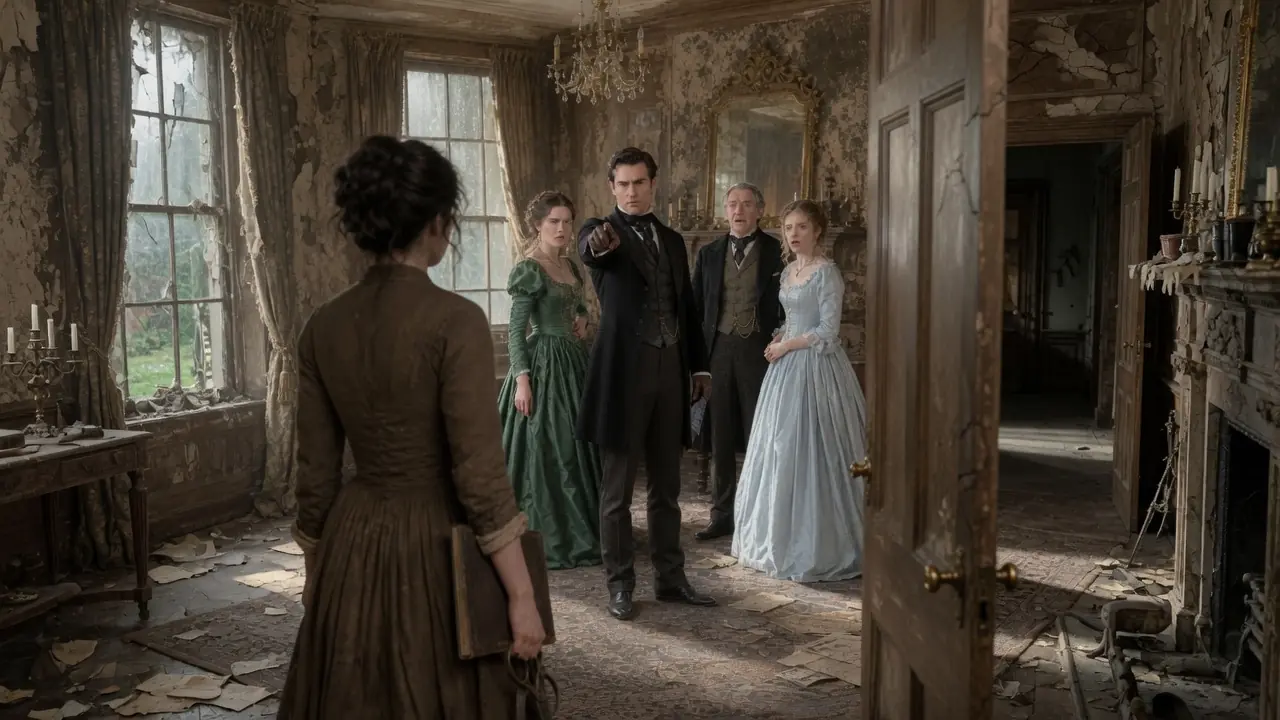
Decades of reckless gambling in the shadowy corners of Saint James's Club and disastrous investments in South American silver mines had stripped his ancestral estate bare. By the bitter autumn of 1865, the Wright family faced absolute ruin. The grand mahogany furniture had been sold off piece by piece, the servant staff reduced to a deaf cook and a crippled stable boy, and the creditors from Lombard Street were threatening debtors' prison. Salvation, if it could be called that, arrived in a lacquered carriage bearing the crest of the Duke of Harrington. Abner Freeman was 32, immensely wealthy, and notoriously ruthless.
He had built his fortune, not just on the inherited lands of his forefathers, but on aggressive, highly leveraged investments in the booming industrial railways. He was a man who viewed human beings as assets or liabilities, nothing more. Abner had recently purchased the majority of Lord Richard's outstanding debt from a frantic London bank, effectively making him the master of Oakhaven. But Abner had a singular, pressing liability of his own, a fiercely traditional grandmother who controlled a heavily restricted trust fund. To access the final massive tranche of his inheritance capital, he desperately needed to cover his overextended railway shares.
He was required to marry a woman of noble birth before the year's end. Pacing the faded, threadbare carpets of the Oakhaven drawing room, Abner looked upon the Wright family with thinly veiled contempt. Standing before him, shivering despite the crackling fire, were Lord Richard and his two eldest daughters, Blythe and Clara. Blythe, the eldest at 24, possessed a striking icy beauty. She had spent the last of her father's credit on a stunning emerald green silk gown for this exact meeting, her golden hair meticulously curled.
Clara, a year younger, mirrored her sister's ambition, her eyes wide and calculating beneath heavy lashes. Both women understood the stakes. They were destitute, and the man standing before them held the keys to London high society, unlimited dress allowances, and immense power. They practically vibrated with desperate eagerness, throwing coy smiles and batting their eyelashes at the grim-faced duke. "Let us dispense with the pleasantries, Richard," Abner drawled, his voice cutting through the damp chill of the room.
He turned his cold slate gray eyes toward the two trembling beauties. "However, I find myself in need of a wife—a respectable titled ornament to satisfy a legal nuisance in my family's trust. I care nothing for romance, and I care even less for courtship." Abner took a step closer, inspecting Blythe and Clara as though he were at a horse fair evaluating broodmares. Blythe lifted her chin, thrusting her chest forward slightly while Clara offered a demure submissive curtsy. "The terms are simple," the Duke announced, his voice devoid of warmth.
"I will absolve your father's debts entirely. Furthermore, I will settle a generous annual allowance upon him, ensuring he does not starve in the gutters. In exchange, I will marry any of your daughters." A suffocating silence fell over the room. Lord Richard gasped in relief, a sickeningly grateful smile breaking across his aged face. Blythe and Clara exchanged a rapid, venomous glance.
They were sisters but in this moment they were vicious competitors fighting for survival. "Your Grace," Blythe purred, stepping forward and extending a gloved hand. "It would be the highest honor of my life to serve as your duchess. I have been trained in all the arts of estate management and high society." Before Abner could accept her hand, the heavy oak doors of the drawing room crashed open.
The figure that strode into the room brought the stale polite atmosphere to a violent halt. It was the youngest daughter, Gilda. At 21, she possessed none of her sisters' manufactured polish. Her dark hair was hastily tied back, with several unruly strands escaping to frame a face flushed from physical exertion. She wore a simple, heavy wool dress stained with mud at the hem and thick leather riding boots.
In one hand, she carried a heavy leather-bound ledger. In the other, a pair of rusted pruning shears she had been using to cut back the overgrown ivy suffocating the manor's eastern wall. Gilda stopped dead in her tracks, taking in the scene: her sisters posing like mannequins, her father cowering, and a tall arrogant stranger commanding the center of the room. "Gilda!" Lord Richard hissed, mortified. "Get out! Can you not see we are conducting crucial business with the Duke of Harrington?" Gilda did not retreat. Instead, her dark eyes locked onto Abner's. She recognized him instantly from the terrifying letters she had been secretly intercepting and reading for months. She was the only one in the family who actually understood the math of their ruin. "Conducting business, Father?" Gilda asked, her voice steady and laced with sharp irony.
"Or begging for scraps? I was just down with the tenant farmers. Two more families have fled in the night because the roofs are collapsing. We do not have business. We have a graveyard." Blythe scoffed loudly.
"Ignore her, Your Grace. She is wild, practically feral. She insists on meddling in men's affairs." Abner, however, did not ignore her. He slowly lowered his gaze from Gilda's fiercely intelligent eyes down to the dirt on her boots, and then back up to the ledger in her hand. There was no fear in her expression, no fawning desperation.
There was only a profound, exhausted fury. She was not looking at him as a savior. She was looking at him as an enemy. A strange, almost cruel smile touched the corners of Abner's mouth. An obedient, vapid wife like Blythe would bore him to tears and likely spend his fortune as frivolously as her father had.
But this girl, this defiant, pragmatic creature standing in the mud would be a fascinating challenge to break. "I said I would marry any of your daughters," Abner repeated softly, his eyes never leaving Gilda. He raised a gloved finger and pointed directly at the youngest sister. "I choose this one." Chaos erupted in the drawing room.
Blythe let out a shrill cry of indignation, her face twisting into an ugly mask of rage. Clara burst into dramatic, performative tears. Blythe shrieked, abandoning all pretense of aristocratic grace. "She smells of horse manure and accounting ink. You cannot be serious, Your Grace. She is entirely unfit for society." "Quiet, Blythe," Lord Richard barked, his panic rising. He rushed toward Gilda, grabbing her arm with bruising force. "You will accept his proposal immediately, Gilda. You will save this family." Gilda yanked her arm out of her father's grasp, her breathing heavy.
She looked at the Duke, her expression a mix of disgust and disbelief. "A marriage of blackmail? Is that how the great Duke of Harrington secures his alliances—by holding a financial pistol to the heads of desperate people?" "It is an exchange of assets, Miss Gilda," Abner replied coolly, closing the distance between them. He towered over her, carrying the scent of expensive cologne and cold autumn air.
"Your father's debts vanish. Your sisters get their London seasons, and you become one of the wealthiest women in England. Most women would fall to their knees in gratitude." "I am not most women, Your Grace," Gilda fired back, standing her ground. "And I have read the ledgers. You are not doing this out of charity. A man like you does not buy ruined estates unless he needs the aristocratic bloodline attached to them to satisfy a strict covenant. You need me just as much as my father needs you." Abner's eyes widened a fraction. The girl was dangerously perceptive. His cruel smile widened.
"All the more reason for us to become partners, then. We understand the transactional nature of this union. Do we have an agreement, Gilda, or shall I send for the bailiffs?" Gilda looked at her father's terrified, pathetic face and then at her sisters who were glaring at her with pure unadulterated hatred. She had spent her entire life trying to save them from their own stupidity, mending dresses, rationing coal and balancing impossibly red ledgers. Now the ultimate sacrifice was demanded of her.
"Fine," Gilda said, her voice dropping to a glacial whisper. "I will marry you. But make no mistake, Your Grace. I am signing a contract, not making a vow." The wedding took place a mere 3 weeks later at St. George's Hanover Square. It was a bleak, chillingly efficient affair. Gilda wore a borrowed gown that did not quite fit, walking down the aisle with a spine made of steel. Abner spoke his vows with the detached precision of a businessman closing a merger. The London society papers called it a sudden passionate romance, but anyone standing within 10 ft of the altar could feel the freezing temperature between the bride and groom.
Immediately following the ceremony, Gilda was whisked away to Harrington Manor, a sprawling, opulent estate in the heart of the countryside. It was a golden cage. Abner provided her with an army of servants, an endless wardrobe, and a massive allowance, but he offered her no warmth, no partnership, and very little of his time. He treated her as a conquered territory, demanding her presence at formal dinners where he paraded her before his business associates, only to ignore her in private. But Gilda was not a woman who could be easily sidelined.
Left alone in the massive manor, she naturally gravitated toward what she knew best, administration. Bribing a sympathetic steward, Mr. Harrison, she gained access to the Duke's private study and his estate ledgers. What she found shocked her. Abner was incredibly wealthy, yes, but his wealth was frighteningly liquid and tied up in highly speculative ventures.
He had leveraged his ancestral lands to pour millions of pounds into the railway boom, and more alarmingly, into a massive London discount bank known as Overend, Gurney & Company. Gilda had read the financial papers. She knew the bank was recklessly offering credit to subpar contractors. The Duke was building a house of cards, blinded by his own arrogance and past successes. While Gilda investigated her husband's precarious empire in secret, a different kind of rot was spreading within the family she had left behind.
Blythe Wright could not let the humiliation go. Consumed by toxic jealousy and the belief that she was the rightful Duchess of Harrington, Blythe began a systematic campaign to destroy her sister's marriage. Using the generous allowance Abner had provided Lord Richard, Blythe rented a lavish townhouse in London and immediately began integrating herself into Abner's social circles. Blythe was a master of the whispered implication. At society balls and afternoon teas, she planted seeds of doubt.
She told Abner's closest associates that Gilda had always been unstable, prone to hysteria, and harbored a secret lingering affection for a lowborn stable master back at Oakhaven. The poison eventually reached Abner's ears. Already paranoid by nature and stressed by the subtle tremors in the London financial markets, the Duke's coldness toward Gilda turned into active hostility. One evening in late November, the tension finally snapped. Abner stormed into Gilda's private sitting room, his face dark with fury.
In his hand, he held a forged letter painstakingly crafted by Blythe and delivered via a bribed footman. The letter was addressed to Gilda, supposedly from the Oakhaven stable master, thanking her for her continued financial support and expressing longing for her touch. "You dare make a fool of me?" Abner snarled, throwing the crumpled parchment onto the table before her. "I pull you from the mud, I dress you in silk, I save your pathetic family from the gutter, and you use my money to fund a rural lover." Gilda calmly picked up the letter, scanning the forged handwriting.
She recognized the sharp, elegant loops immediately. It was Blythe's penmanship. "This is a forgery," Gilda said flatly, dropping the paper back onto the table. "And a poor one at that." "Do not lie to me!" Abner shouted, slamming his fist against the mahogany table, making the teacups rattle.
"Your own sister came to me weeping, confessing your indiscretions because she could no longer bear the guilt of your deceit." Gilda stood up, her dark eyes flashing with a sudden, intense fire. The months of isolation, the disrespect, and the sheer arrogance of the man before her finally boiled over. "My sister is a viper who would drown me in a bucket for a chance to wear my jewelry." Gilda stepped out from behind the table, closing the distance between them until she was inches from her towering husband. "You are supposedly a brilliant man, Abner." "A titan of industry." "Yet you are so blinded by your own ego." "That you cannot see a cheap parlor trick executed by a bitter woman." Abner grabbed her by the shoulders, his grip tight enough to bruise.
"I should lock you in the tower and file for an annulment. I should cast you back into the squalor where I found you." "Do it." Gilda challenged, her voice dropping to a lethal whisper, refusing to break eye contact. "Cast me out." "But before you do, you should spend less time worrying about phantom stable boys and more time looking at the structural integrity of Overend, Gurney & Company. Because from what I've seen in your private ledgers, your grace, you are about 3 months away from a bankruptcy that will make my father's ruin look like a minor inconvenience." Abner froze, the color draining from his face.
The forged letter was entirely forgotten as Gilda struck him directly in his most vulnerable, fiercely guarded secret. Abner's grip on his wife's shoulders loosened, his hands dropping to his sides as the color rushed from his face. The air in the study, previously thick with rage and accusations of infidelity, suddenly chilled into a sharp, terrifying clarity. He looked at Gilda not as a piece of purchased property, but as a severe, calculating equal who had just held a mirror up to his deepest insecurities. Silence reigned in the manor for three agonizing days.
Abner locked himself in his private study, demanding the estate managers bring every ledger, every correspondence with Lombard Street, and every promissory note linked to Overend, Gurney & Company. He meticulously retraced the financial breadcrumbs Gilda had pointed out. The reality was a bitter pill that stripped away his arrogant facade. Gilda had been flawlessly, terrifyingly correct. The vaunted discount bank, historically a pillar of the London money market, was floating on toxic paper.
They were extending massive lines of unsecured credit to railway contractors like men like Sir Samuel Morton Peto, who were building unprofitable lines into nowhere. Abner's wealth, millions of pounds leveraged against the Harrington ancestral lands, was tied to a sinking ship. Had he waited another few months, the inevitable crash would have consumed everything he owned, rendering him a titled pauper. On the fourth evening, Abner entered Gilda's sitting room. There was no shouting this time, no pretense of dominance.
He carried two glasses of expensive brandy and handed one to his wife, who was quietly embroidering by the fire. "I have spent the week communicating via private telegraph with my brokers at the Royal Exchange," Abner said, his voice stripped of its usual mocking drawl. He sat in the armchair opposite her, staring into the roaring hearth. "I ordered a complete, aggressive liquidation of my positions with Overend, Gurney & Company, and severed all ties with the railway contractors." Gilda paused her needlework, looking up at him carefully.
"You will take a severe penalty for withdrawing so abruptly—a loss of nearly £200,000." "Yes," Abner admitted, the muscle in his jaw ticking. "The brokers called me a madman. They said I was throwing away a fortune out of sheer paranoia. But it is a fraction of what I would have lost when the collapse comes.
You saved Harrington Manor, Gilda. You saved my family's legacy." He turned to look at her. His slate-gray eyes locked onto hers with a piercing, unfamiliar intensity. "I owe you an apology. For the forged letter, for my blindness, and for treating you as a mere legal requirement.
I required a duchess to appease my grandmother's trust. I did not realize I was marrying an architect." Gilda took a slow sip of her brandy, letting the fiery liquid fortify her nerves. She did not smile, nor did she immediately offer absolution. She was a woman who dealt in ledgers and hard facts, not flowery apologies. "I do not want an apology, Abner," she replied evenly.
"I want a partnership. I refuse to be a silent ornament in this house, waiting for you to stumble into ruin while I am relegated to choosing the dinner menus. If we are to be chained together by this marriage, then we will steer this ship together." Abner's lips curved into a genuine, dangerous smile. It was the first time she had seen him look truly alive, invigorated by the prospect of a formidable ally. "Agreed." While Abner and Gilda consolidated their power, moving their vast wealth into secure government consols and solid agricultural freeholds, Blythe Wright was orchestrating her own spectacular demise in London.
Fueled by spite, vanity, and the massive allowance Abner had granted Lord Richard, Blythe had fully embraced the hedonistic chaos of the season. She surrounded herself with sycophants and aggressively sought to outshine her sister's shadow. In the fashionable drawing rooms of Mayfair, she was courted by opportunistic speculators who recognized a wealthy, gullible mark. Determined to prove that she was the true mastermind of the Wright family, Blythe convinced Lord Richard to take their entire capital, the very funds meant to secure their comfortable retirement, and invest it in the hottest market trend—railway shares backed by Overend, Gurney & Company. "Abner Freeman is a coward who inherited his wealth," Blythe scoffed to her father over a lavish breakfast at their rented Park Lane townhouse.
"He is pulling his money out of the market just as the true fortunes are being made. Sir Morton Peto has guaranteed a 20% return by summer. We will double our fortune, Father, and buy back Oakhaven ourselves. We will show that arrogant Duke and my traitorous sister what true high society looks like." Lord Richard, weak-willed and desperate to reclaim his former glory, eagerly signed over the family's entire allowance. For a few short months, they lived like royalty, spending the promised returns before the dividends had even materialized.
Then came the afternoon of May 11th, 1866, a day that would forever be etched into the annals of history as Black Friday. The news struck the city of London like a physical earthquake. Overend, Gurney & Company had suspended payments. The seemingly invincible titan of finance had collapsed under 10 million pounds of debt. Panic swept through Lombard Street like a raging inferno.
Mobs of terrified investors, aristocrats, and merchants besieged the bank's closed doors, screaming for their money. The Bank of England refused a bailout. Ruin was absolute and instantaneous. The catastrophic ripples of Black Friday decimated London society. Dozens of ancient aristocratic families were wiped out overnight, forced into bankruptcy and scandal.
Harrington Manor, however, remained an untouchable fortress of security. Because of Gilda's brilliant intervention months prior, Abner's fortune was not only secure, but perfectly positioned to capitalize on the ensuing economic depression, buying up prime assets for pennies on the pound. The dynamic between the Duke and Duchess had fundamentally transformed. The icy resentment of their wedding day had thawed into a profound, razor-sharp alliance. They worked side by side in the great library, analyzing market reports, managing the estate's vast agricultural yields, and plotting their next acquisitions.
Abner no longer sought the company of society flatterers. He found the fierce, unyielding intellect of his wife infinitely more captivating. A fierce loyalty had bloomed between them, an intimacy born of mutual respect and survival. Late one rain-swept afternoon in October, the heavy oak doors of Harrington Manor's receiving room opened. The butler, his face a mask of practiced neutrality, announced the arrival of Lord Richard and Miss Blythe Wright.
Gilda stood by the grand fireplace, dressed in a sweeping gown of dark velvet, looking every inch the formidable duchess she had become. Abner stood right beside her, his hand resting supportively on the small of her back, a silent, unified front. The pair that entered the room was entirely unrecognizable from the arrogant aristocrats who had sneered at Gilda in Oakhaven a year prior. Lord Richard looked like a hollowed-out ghost, his clothes rumpled and out of fashion, his hands trembling violently. Blythe, stripped of her emerald silks and haughty pride, looked frantic and unwashed.
The catastrophic crash of Black Friday had devoured their investments. They had lost the London townhouse and their servants, and were now hiding from ruthless creditors in a squalid boardinghouse. "Gilda, please," Lord Richard wept, collapsing to his knees on the plush Persian rug. He did not even dare look at Abner. "We have nothing. The creditors are threatening debtors' prison. You must speak to your husband. You must beg him to advance us another loan. We are family."
Blythe, unable to completely swallow her pride, stood stiffly, though her eyes betrayed a feral desperation. "We were defrauded, Your Grace," she said, looking at Abner, attempting a pitiful version of her old charming smile. "The markets were manipulated. You have the means to rectify this. Surely you cannot let a duchess's sister starve." Abner looked at them with a terrifying blank expression.
He did not say a word. Instead, he turned his head and deferred entirely to Gilda, stepping back to let her command the room. Gilda looked down at her father and sister. She felt no triumph, only a heavy, exhausting sense of finality. She remembered the nights spent mending their clothes by candlelight, the cruel insults she endured while balancing their ruined ledgers, and the vicious forgery Blythe had orchestrated to destroy her marriage.
"You were not defrauded, Blythe," Gilda said, her voice echoing coldly against the stone walls. "You were greedy. You took the immense lifeline my husband provided and threw it into a furnace of speculation to satisfy your own vanity." "We are your blood!" Blythe shrieked, the polite facade shattering completely. "You owe us. You stole my place. I was supposed to be the duchess. You schemed and manipulated to get him to choose you." "I chose her." Abner's voice cut through the room like the crack of a whip, silencing Blythe instantly. He stepped forward, standing shoulder to shoulder with his wife. "And thank God I possessed the minimal intelligence required to do so. Had I married you, Blythe, I would be standing in the mud beside you today. My wife owes you absolutely nothing." Gilda held up a single hand, stopping her husband from continuing. She looked at her father's weeping form. Karma had delivered its brutal verdict, and she was now the one required to pronounce the sentence. "There will be no more allowances," Gilda stated with absolute finality.
"There will be no London seasons, no silk gowns, and no access to Harrington wealth. I have arranged for a small three-room cottage on the furthest edge of our northern tenant farms in Yorkshire. It is isolated, it is cold, and it requires hard physical labor to maintain. A meager stipend for basic flour and coal will be delivered monthly." Lord Richard gasped, looking up in horror. "A tenant cottage? Gilda, you cannot subject us to the life of peasants." "It is exactly the life you condemned our own tenants to when you gambled away Oakhaven," Gilda replied, her eyes devoid of pity. "You will learn to budget, Father. You will learn to scrub your own floors, Blythe, or you will starve. That is my final offer. If you refuse it, the door is behind you, and the London bailiffs await." Blythe stared at her younger sister, absolute venom mixing with the soul-crushing realization that she was utterly defeated. She opened her mouth to scream a final curse. But the cold, unified glare of the Duke and Duchess of Harrington silenced her. Trembling with rage and humiliation, Blythe grabbed her sobbing father by the arm and dragged him out of the manor, disappearing into the torrential rain. The heavy doors clicked shut, plunging the receiving room back into a peaceful, opulent quiet.
Abner turned to Gilda, a profound mixture of awe and deep affection softening his sharp features. He reached out, gently cupping her cheek, his thumb brushing over her skin. "You are terrifying, my duchess," he murmured, leaning down to press a slow, reverent kiss to her forehead. "Remind me never to cross you." Gilda leaned into his touch, a small triumphant smile finally breaking across her face as she looked up at the empire they had secured together.
"See that you do not, Your Grace. The ledgers must always balance."