Lady Elara Grenville decided on the evening of the season's most anticipated ball that she would simply cease to exist. It was not a morbid thought, but a practical one. She had already perfected the art of social invisibility, a skill honed over two and twenty years of being the other Miss Grenville. Tonight, she would complete her masterpiece.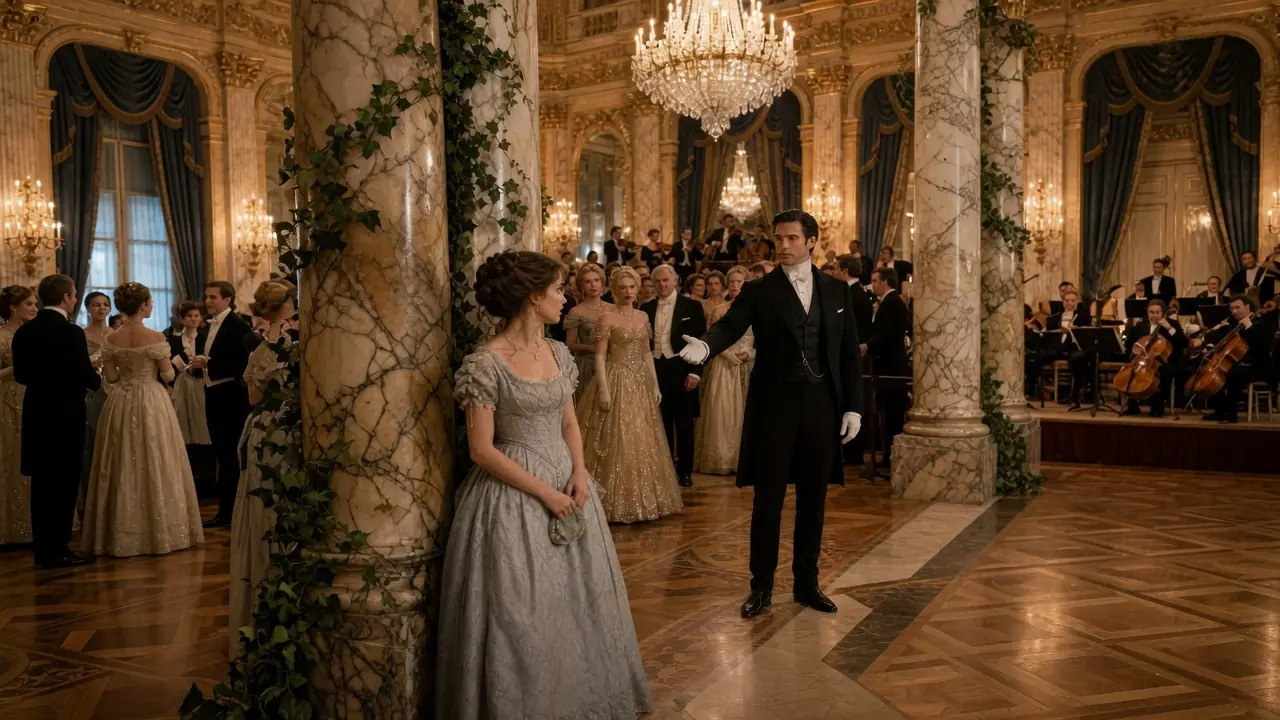
She stood near a pillar draped in ivy, the marble cool against her shoulder blades through the thin silk of her gown. The dress was a pale gray, the color of a dove's wing or a sky just before a dreary rain. It had been her sister Lavinia's two seasons ago, and while it fit Elara's form well enough, it seemed to absorb the light rather than reflect it. It was a ghost's gown, perfect for her purpose.
Across the ballroom, Lavinia was a supernova. Her gown was the color of champagne, shimmering with a thousand tiny crystals that caught the candlelight and fractured it into a million dazzling pieces. Her laughter was a melody that drew men to her like moths to a glorious, beautiful flame. Her dance card had been full before she had even stepped down from the carriage.
Elara's own card remained tucked in her reticule, its pristine white surface a testament to her success at vanishing. Her mother, a woman whose ambitions were as sharp and pronounced as her cheekbones, had given Elara a single, withering look upon their arrival. The look said everything. Stand up straight.
Try not to look so morose. For heaven's sake, at least pretend you wish to be here. But Elara did not wish to be here. She wished to be in the quiet solitude of the library with a book of botanical illustrations and the scent of old paper and beeswax.
She wished to be anywhere but this gilded cage where a woman's worth was measured in the number of dance partners she could procure and the rank of the man who might eventually propose. By that measure, Elara was worthless. And she had, after years of quiet heartache, finally made a fragile peace with that. Her future was a placid, predictable stream.
She would remain at Grenville Park, a permanent fixture, the quiet spinster aunt to Lavinia's beautiful, boisterous children. She would manage the household accounts, tend to the gardens, and fade, year by year, into the background until she was as much a part of the house as the old portraits in the hall. It was not a happy future, but it was a known one. There was a strange comfort in that resignation.
A sudden hush fell over the room, a collective intake of breath that was more potent than the loudest fanfare. The music faltered for a moment before resuming, somehow more subdued. Elara leaned just enough to see past the pillar. The Duke of Alister had arrived.
He was not a man who entered a room. He was a man who conquered it. Tall and severe, dressed in immaculate black that seemed to drink the light around him, he moved with a chilling, predatory grace. His face was all sharp angles and shadows, a sculpture carved from granite and disdain.
They called him the Winter Duke. It was said his heart was as cold and barren as his sprawling northern estates. He had inherited the title under tragic circumstances years ago and had since tripled its fortune through ruthless, calculated means. He never smiled.
He rarely spoke. He danced with no one. And every eligible lady in London, including her sister, wanted to be the one to melt the frost. Elara felt a chill that had nothing to do with the draft from the terrace doors.
He was the apex predator of their world, and Lavinia, in all her shimmering glory, was the prize he was expected to claim. Her father had been dropping hints for weeks. Her mother had been practically vibrating with anticipation. Lavinia had been practicing her curtsy and the gentle, accepting smile she would bestow upon him when he finally made his intentions known.
Elara's breath caught in her throat. For a heart-stopping moment, she was certain he was looking at the pillar, or perhaps something behind her. But there was nothing behind her but a tapestry of a grim-faced ancestor hunting a boar. His gaze did not waver.
It was not a warm look, nor was it kind. It was intense, analytical, and utterly unnerving. It was as if he was seeing not just the girl in the gray dress, but the very bones beneath her skin, the quiet, fluttering heart in her chest. She felt a flush of heat crawl up her neck, a mortifying blush that betrayed her carefully constructed invisibility.
She broke the contact first, her eyes dropping to the polished floorboards as if they were the most fascinating thing she had ever seen. Her heart hammered against her ribs, a frantic bird trapped in a cage. She did not see him move, but she felt the shift in the room's atmosphere as he began to cross the floor. A path cleared before him as if by magic.
He was heading directly for her family. Of course. He was going to speak to her father, to ask permission to court Lavinia. This was the moment.
Her mother's gloved fingers were already tightening in anticipation. Lavinia's smile was blinding. Elara willed herself to shrink, to melt into the marble pillar. She heard his voice, a low, resonant baritone that cut through the surrounding chatter.
“Lord Grenville.”
“Your Grace,” her father boomed, his voice thick with nervous, sycophantic pleasure. “An honor. May I present my wife, Lady Grenville, and my eldest daughter, Lavinia.”
Lavinia executed her curtsy flawlessly. “A pleasure, Your Grace,” she murmured, her voice like honey. There was a pause, a silence that stretched and thinned until it was as taut as a violin string. Elara risked a glance.
The Duke was not looking at Lavinia. His gaze was fixed somewhere over her father's shoulder, back in the direction of the pillar, back in her direction. “You have another daughter,” the Duke stated. It was not a question.
Her father blinked, momentarily confused. “Ah, yes. Elara, my youngest.” He made a vague gesture. “She is around here somewhere.”
Elara felt her mother's sharp glare find her in the shadows. It was a command. Present yourself. With leaden feet, she stepped out from behind the pillar, her carefully constructed cloak of invisibility falling away in tatters.
She kept her eyes downcast, performing a simple, barely adequate curtsy. “Your Grace,” she whispered, her voice a thread of sound. The silence returned, heavier this time, charged with a strange, inexplicable tension. She could feel every eye in the vicinity on her.
She could feel her sister's confusion, her mother's mounting irritation. “Lord Grenville,” the Duke said, his voice unchanging, impossibly calm. “I wish to have your daughter's hand in marriage.” A collective sigh of triumph went through her family. Her mother's gloved hand went to her heart, her father's chest puffed out.
Lavinia's smile, if possible, grew even brighter. “Of course, Your Grace,” her father began, practically giddy. “Lavinia would be—”
“No,” the Duke interrupted. The single word was like a chip of ice. “The other one.” His gaze was locked on Elara. “Send for the quiet one.” For a moment, no one spoke.
The world seemed to tilt on its axis. Elara's head swam, the candlelight of the chandeliers blurring into streaks of gold. Then, her father let out a short, nervous bark of a laugh. “A jest, Your Grace. Very good. Elara is a studious girl, more at home with books than balls.” Her mother joined in, her laughter high and brittle. “He has a wit as sharp as his reputation, my lord.” Lavinia, her perfect smile frozen on her face, managed a small, confused titter. They were laughing. They were laughing because the idea of anyone, let alone the most powerful and sought-after duke in the kingdom, wanting her was so patently absurd it could only be a joke.
The sound pierced Elara more sharply than any insult. It was the confirmation of everything she had always known about herself. She was a footnote in her own family's story. An afterthought.
A punchline. But the Duke of Alister was not laughing. His expression remained unchanged, a mask of cold indifference. “I do not jest,” he said.
And the quiet finality in his tone silenced the strained merriment as effectively as a doused flame. “My offer is for Lady Elara. I will await your answer at my London residence tomorrow at noon.” He gave a curt, almost imperceptible nod, turned on his heel, and walked away. The sea of gawking guests parting for him once more. He never looked back.
He never looked at anyone else again. The carriage ride home was a study in suffocating silence. The air was thick with Lavinia's unshed tears, her mother's simmering fury, and her father's bewildered confusion. Elara sat perfectly still, her hands clenched in her lap, the gray silk of her gown feeling like a shroud.
She stared out the window at the gas lamps blurring past, her mind a maelstrom of shock and humiliation. He could not have been serious. It had to be some cruel, elaborate prank designed to mock her and her family for their social climbing. Or worse, he was mad.
That was the conclusion her mother reached the moment they were inside the house. “The man is clearly insane,” Lady Grenville declared, stripping off her gloves as if they were contaminated. “There is no other explanation. He has taken leave of his senses.” “But why?” her father muttered, pacing the drawing room. “Why Elara?” The question hung in the air, a shared unspoken insult.
Lavinia finally broke, her sobs ragged and heartbroken. “He didn’t even look at me,” she cried, collapsing into a velvet armchair. “It was supposed to be me.” Elara felt a pang of pity for her sister. A genuine sorrow that was quickly eclipsed by the raw wound of her own humiliation.
Her family's disbelief was a mirror, reflecting her own perceived inadequacies back at her a thousand times over. The next morning was no better. A frantic discussion took place over breakfast, a meal Elara could not touch. Various theories were proposed.
Perhaps he had mistaken her for Lavinia in the dim light. Perhaps he had heard of her quiet, biddable nature and wanted a wife who would not challenge him. This was the most plausible, and yet most insulting possibility. He did not want a partner.
He wanted a possession. A piece of furniture that would not talk back. By 11:00, a decision had been made. Her father, his face pale with dread and a flicker of greed he could not quite conceal, would go to the Duke's residence.
He would gently, respectfully, inquire if his grace was quite certain, and perhaps suggest that Lavinia, with her beauty and social grace, was the more suitable choice for a Duchess. Elara was ordered to her room, to stay out of sight, as if she were a piece of evidence from a crime scene. She sat by her window, which overlooked the garden, and watched a bee move methodically from one lavender blossom to the next. She felt a kinship with the small industrious creature going about its business utterly oblivious to the dramas unfolding in the great house nearby.
An hour passed, then another. Finally, she heard the front door open and close followed by her father's heavy footsteps in the hall. She did not move. She waited.
Her mother's voice rose sharp and questioning. Her father's reply was low, defeated. Then, there was a knock on her door. It was her father.
He looked older than he had that morning, the lines around his eyes deeper. “He is perfectly sane,” he said, his voice flat, “and perfectly serious.” Elara's heart gave a painful thud. “He has made a most generous settlement offer, an offer that would clear all our debts and secure Lavinia's future with a handsome dowry.” Her father could not meet her eyes. He was selling her.
He was selling his quiet, unwanted daughter to the cold, unreadable duke to save his family from ruin. The realization did not bring tears. It brought a strange, hollow calm. This was just another, more permanent way of ceasing to exist.
She would trade her familiar cage for a much larger, more opulent one. “I see,” she said, her voice steady. Her father finally looked at her, a flicker of something—guilt, perhaps—in his eyes. “Elara, I—”
“It is all right, Father,” she said, the words tasting like ash. “I will do my duty.” The betrothal was a whirlwind of legal documents and terse, formal meetings.
The duke, whose name she learned was Alister, visited her twice at her family's home. He sat in their drawing room, a dark, imposing figure who dwarfed the delicate furniture. He spoke to her in polite, measured tones, asking her about her interests. She told him she enjoyed reading and botany.
He merely nodded, his stormy eyes giving nothing away. He did not compliment her. He did not touch her. He did not offer any explanation for his bizarre choice.
He was like a man conducting a business transaction, and she was the asset being acquired. Her family treated her with a bewildered, newfound respect that was almost more painful than their previous neglect. She was no longer just Elara. She was the future Duchess of Alister, the key to their salvation.
Lavinia avoided her, her jealousy a palpable, bitter presence between them. The wedding was a small, stark affair at the Duke's London residence. Elara wore a gown of heavy cream satin, chosen by the Duke's solicitor. It was beautiful, but it felt like a costume.
She stood beside Alister at the makeshift altar, a stranger bound to a man who was a complete enigma. When he slid the heavy gold band onto her finger, his touch was cool and impersonal. His fingers were long and steady. She did not look at him as they were pronounced man and wife.
She looked at a portrait on the wall of a grim-faced ancestor with the same stormy eyes as her new husband. After the ceremony, they traveled immediately to his primary estate, Blackwood Manor. The name was apt. It was a vast Gothic fortress of gray stone that rose from the wind-swept northern moors like a jagged tooth.
The sky above it was the color of a fresh bruise. Inside, it was a cavern of shadows and silence. The staff moved like ghosts, their footsteps muffled by heavy carpets. The furniture was draped in dust covers, as if the house itself had been holding its breath for years.
Alister showed her to her rooms, a suite of chambers larger than the entire ground floor of her family's home. They were opulent, but cold, decorated in dark woods and heavy velvets. “These are your rooms,” he said, his voice echoing slightly in the large sitting room. “My own are in the west wing. We will dine together at eight o’clock.
The housekeeper, Mrs. Gable, will see to your needs.” And with that, he left her. Elara stood in the center of the room, her small traveling case at her feet, and felt an overwhelming wave of desolation wash over her. She had not expected affection, or even warmth, but she had not been prepared for this profound, soul-crushing emptiness. She was the mistress of this great, silent house, and she had never been more alone.
The first few weeks passed in a blur of lonely routine. She would wake, breakfast alone in her rooms, and then wander the endless corridors of the manor. She discovered a library that was a masterpiece, two stories high with towering shelves of books on every conceivable subject. It became her sanctuary.
She would spend her days there, losing herself in worlds far removed from her own. Dinners were tense, formal affairs. She and Alister would sit at opposite ends of a dining table so long they might as well have been in different rooms. He would ask her polite questions about her day.
She would give polite, brief answers. He remained a fortress, his thoughts and feelings locked away behind his unreadable expression. She learned more about him from the staff's quiet gossip than from the man himself. He was a demanding but fair master.
He worked tirelessly managing his vast network of investments and properties. He had not hosted a guest at Blackwood in the 10 years since he had become Duke. One afternoon, seeking refuge from the oppressive silence of the house, she discovered a walled garden behind the west wing. It was utterly neglected, choked with weeds and overgrown thorns.
But beneath the decay, she could see the bones of what had once been a beautiful, intricate design. In the center, a crumbling stone bench sat beside a dry, moss-covered fountain. It was a forgotten, unloved place. Just like her.
A sense of purpose, the first she had felt in months, bloomed in her chest. She would bring it back to life. She found the old, rheumy-eyed head gardener, Mr. Fitzwilliam, and told him her plan. He looked at her with surprise, then a slow, cautious approval.
He brought her tools and leather gloves. And so, her real life at Blackwood began. Every day, she would work in the garden, her hands sinking into the rich, dark earth. She pulled weeds, pruned back the dead branches, and slowly, painstakingly, began to uncover the lost beauty of the place.
The physical labor was a balm to her troubled mind. The sun on her back and the dirt beneath her fingernails grounded her in a way the cold luxury of the manor never could. She felt not happy, but content. One evening, a crate arrived for her.
It was from London. Inside, nestled in straw, were dozens of the rarest and most beautiful books on botany she had ever seen. Leatherbound volumes with hand-painted plates of exquisite detail. There was no note, but she knew.
She found Alister in his study that night, a room she had never dared to enter. He was seated at a massive desk, papers spread before him. The light from a single lamp cast his face in harsh shadows. He looked up as she entered, his expression unreadable as always.
“The books,” she began, her voice barely a whisper. They are magnificent. Thank you. He simply nodded, his gaze returning to his papers.
“I recalled your interest.” That was all. But it was more than she had expected. It was a crack in the armor, a tiny, almost imperceptible sign that he saw her. He remembered what she had said.
A few weeks later, they were obligated to attend a ball at the home of a neighboring earl. It was their first public appearance as a married couple, and Elara dreaded it. She wore a deep sapphire gown Alister had ordered for her, the color of a twilight sky. It made her feel less like a ghost and more like a person.
As they entered the ballroom, the whispers started immediately. She could feel the stares, the curious and pitying glances. She was the plain, quiet mouse who had somehow trapped the formidable lion. A woman with a notoriously sharp tongue, Lady Danbury cornered her by the refreshment table.
“My dear Duchess,” the woman began, her smile thin and cruel. “One must wonder what sorcery you employed to ensnare the Duke when so many superior options were available.” The insult was so direct and brazen that Elara was struck dumb. A coldness settled over her. She was about to stammer some sort of reply when a low voice cut through the air behind her.
The only sorcery, Lady Danbury, Alister said, his voice dangerously soft, was my own good sense in choosing a wife of substance over one of superficial glitter. He had appeared from nowhere, his presence a sudden, chilling shadow. He did not raise his voice, but the threat in it was unmistakable. Lady Danbury's face paled.
Your grace, I merely You will address my wife with the respect her station and her character demand, he continued, his stormy eyes like chips of ice, or you will find that my friendship is as easily withdrawn as it is given. He placed a hand on the small of Elara's back, a brief, possessive touch that sent a jolt through her. “Come, my dear,” he said, his voice returning to its normal, neutral tone as he guided her away, leaving a stunned and humiliated Lady Danbury in their wake. He had defended her.
He had called her a woman of substance. Her heart was a chaotic symphony in her chest. Who was this man? This cold, distant stranger who gifted her rare books and protected her with a quiet, lethal ferocity.
The uncertainty was becoming unbearable. The mystery of him was a puzzle she could no longer ignore. That night, after they returned to Blackwood, she could not sleep. The questions churned in her mind over and over.
Why her? She had to know. Fueled by a courage she did not know she possessed, she rose from her bed, pulling on a dressing gown. She made her way through the silent moonlit corridors to the west wing, to his rooms.
She found him not in his bedchamber, but on a small private balcony overlooking the moors. He was staring out at the wild desolate landscape, a solitary figure against the night sky. He did not seem surprised to see her. “I could not sleep,” she said, her voice small in the vast quiet.
He turned to face her. The moonlight softened the harsh angles of his face, making him look younger, almost vulnerable. “Nor I,” he said. She took a deep breath, the cold night air stinging her lungs.
It was now or never. “Why?” she asked, the single word encompassing a universe of confusion. “Why did you choose me?” He was silent for a long time, his gaze searching her face as if looking for something. She thought he would not answer, that he would retreat back into his fortress of silence.
But then he spoke, his voice low and raw. “Because of the linnet,” he said. Elara stared at him, bewildered. “The linnet?” “Three years ago,” he began, his eyes distant, lost in a memory. “At the Marchmain's annual garden party, you were there.” She vaguely recalled it, another event where she had made herself invisible, spending most of her time near the forgotten edges of the gardens.
“I was there against my will, as usual,” he continued. “I was watching the performance, the preening, the posturing, the endless meaningless chatter.” His voice was laced with a deep, weary cynicism. I was standing on a terrace overlooking a small rose garden. I saw you.
You thought no one was watching. He paused, and his gaze met hers, intense and unwavering. A small bird, a linnet, had flown into one of the glass panes of the conservatory and fallen to the path, its wing clearly broken. It was fluttering in distress.
Elara's breath hitched. She remembered. She remembered the tiny, trembling creature, the frantic beat of its heart against her palm. A group of young ladies, your sister among them, walked by, Alister said, his voice flat.
They saw the bird. One of them laughed. Another suggested a gardener should deal with it. They walked on, their laughter dying like a candle running out of air.
He looked away, back towards the moors. But you did not walk on. You knelt down. You spoke to it, your voice soft.
You took the handkerchief from your sleeve and gently, so gently, wrapped the bird in it. You looked around, not for help, but to ensure no one was watching you perform your act of kindness. A shiver traced its way down Elara's spine. You then spent nearly an hour searching until you found one of the under-gardeners.
You explained what had happened and pressed a coin into his hand, making him promise to mend the wing and set the bird free when it was healed. He turned back to her, and for the first time, she saw not the cold duke, but a man. A man whose eyes held a profound, aching loneliness. “In a world of performance and artifice,” he said, his voice thick with an emotion she could not name.
“You were the only real person in that entire garden. You showed a quiet, profound compassion when you believed no one was looking. That is character. That is substance.” The confession settled over her, stunning her into silence.
He had seen her. In a moment when she felt most invisible, he had seen her more clearly than anyone in her entire life. “My life,” he went on, his voice dropping to a near whisper, “is a prison of duty and expectation. I am surrounded by people who want something from the Duke, but who see nothing of the man.
I am profoundly alone.“ The vulnerable admission hung in the cold night air between them. ”I watched you from afar for 3 years,“ he confessed. ”I saw you at balls, always on the periphery. Your quiet intelligence shining in your eyes.
I saw your patience with your family's blatant favoritism. I saw your strength. And I knew. I knew I did not want a Duchess who would perform the part.
I wanted a partner with a true and gentle heart.“ His words fell like stones into the frozen pond of her heart, cracking the ice. ”My proposal was clumsy,“ he admitted, a hint of self-deprecation in his tone. ”I am not a man skilled in the art of courtship. I knew your family would not understand.
I knew they would offer me the prize, not the treasure. So, I simply took the treasure.” Tears welled in Elara's eyes, not of sadness, but of a staggering, overwhelming relief. She was not a bargain. She was not a mistake.
She was a choice. A deliberate, considered, long-awaited choice. “You were so afraid,” he said, taking a hesitant step closer. “I saw it in your eyes on our wedding day.
I wanted to give you space to let you find your footing here. I did not want to be another cage in your life. I wanted Blackwood to be your sanctuary, not your prison.” “The garden,” she whispered, understanding flooding through her. “The books.” “Small gestures,” he said.
“The only language I know. I hoped they would tell you what I did not have the words to say.” He was standing before her now, so close she could feel the warmth radiating from him. He hesitantly reached out, his fingers brushing a tear from her cheek. His touch was not cool or impersonal this time.
It was warm, and it trembled slightly. The formidable Winter Duke was afraid. In that moment, her own fear dissolved, replaced by a wave of empathy so powerful it stole her breath. She saw past the title, the wealth, the intimidating facade.
She saw Alister. A lonely man who had seen a kindred spirit in a lonely girl. “You were not the only one who was alone,” she said softly, her voice finding its strength. She raised her hand, her fingers tracing the sharp line of his jaw.
He flinched, almost imperceptibly, as if unused to a gentle touch. Then he leaned into her hand, his stormy eyes closing for a brief moment. A silent surrender. When he opened them again, the frost was gone.
All she saw was a raw, hopeful vulnerability. She had spent her entire life feeling unseen. And here was a man who had seen her all along. Who had chosen her for the very qualities others had overlooked.
He had not asked her to change, to be brighter or louder. He had wanted her precisely as she was. It was the most profound acceptance she had ever known. And in that acceptance she found not just her own worth, but the stirrings of something far deeper.
Something that felt remarkably like love. “Alister,” she said, speaking his name for the first time. It felt right on her tongue. He looked at her.
His expression was full of a question he did not dare to ask. She gave him the answer. She rose on her toes and pressed her lips against his. It was not a practiced, artful kiss.
It was hesitant, tender, and deeply real. A silent conversation between two lonely souls who had finally found their way home. He responded with a gentle, reverent pressure. His hands came up to cup her face as if she were something precious and fragile.
It was a kiss that sealed a bargain made not of wealth or duty, but of quiet understanding and a shared secret. The secret that the greatest strengths are often the ones no one else bothers to see. Two years later, the walled garden at Blackwood Manor was a riot of color and life. Roses climbed the ancient stone walls, their scent heavy and sweet on the summer air.
Lavender and delphiniums stood in proud, vibrant clusters buzzing with bees. In the center, the fountain now trickled with clear water. Its gentle music was a constant, soothing presence. Elara sat on the stone bench, a sketchbook open on her lap, but she was not drawing.
She was watching her husband. Alister was on the lawn, a few feet away, holding their infant son, Arthur. He was pointing up at the sky, his voice low and soft as he explained the shape of a cloud to the gurgling baby. The transformation in him was a quiet miracle.
The harsh lines of his face had softened. The frost in his eyes had melted completely, replaced by a warm, steady light, especially when he looked at her or their son. He smiled now. It was a rare and precious thing, a slow curving of his lips that was reserved only for his family.
But it was genuine. Blackwood Manor was no longer a silent, cavernous place. It was filled with the sound of a baby's laughter, with the warmth of fires lit in every hearth, with the scent of flowers from the garden that Elara brought inside every day. She was no longer the quiet, invisible girl.
She was the Duchess of Alister, a woman who moved with a calm, assured grace. Her quiet nature had not changed, but it was no longer a shield. It was her strength. She ran the vast household with a gentle efficiency that earned her the fierce loyalty of the staff.
She hosted gatherings, not the glittering, vacuous balls of London, but intimate soirées for artists, writers, and thinkers, turning Blackwood into a hub of intellect and creativity. Her family had visited once. They had been stunned by the change in her, by the obvious devotion in the Duke's eyes whenever he looked at her. They could not understand it.
They still saw the girl in the gray dress, and they could not fathom how she had captured the heart of the Winter Duke. But Elara knew he had not been captured. He had been seen. Just as she had been.
Alister looked over at her, his smile widening. He walked over and sat beside her on the bench, settling their son comfortably in his lap. “He has your eyes,” Alister said, his voice full of a quiet wonder that never seemed to fade. “He has your stubborn chin,” she replied, her heart swelling with a love so profound it was a physical ache in her chest.
He reached over and took her free hand, his fingers lacing through hers. A simple, familiar gesture that still made her feel cherished. They sat in comfortable silence for a long while, watching their son drift to sleep in the warm afternoon sun. The world outside, with its noise and its judgments, felt a million miles away.
Their world was here, in this garden they had brought back to life together. A person's worth, she had learned, was not measured by the volume of their voice or the brilliance of their gown. It was a quiet, intrinsic thing. A seed that could lie dormant for years, just waiting for the right person to see its potential and give it a place to grow.
Alister had been her gardener, and she his. He leaned over and pressed a soft kiss to her temple. “I love you, Elara,” he murmured against her hair. “And I love you, Alister,” she whispered back.
It was never too late, she thought, to begin again. It was never too late to be seen.