The Duke Refused Every Perfect Bride and Chose the Lady Everyone Feared - Why It Shocked London.
A Victorian Story of Truth, Danger, and Love.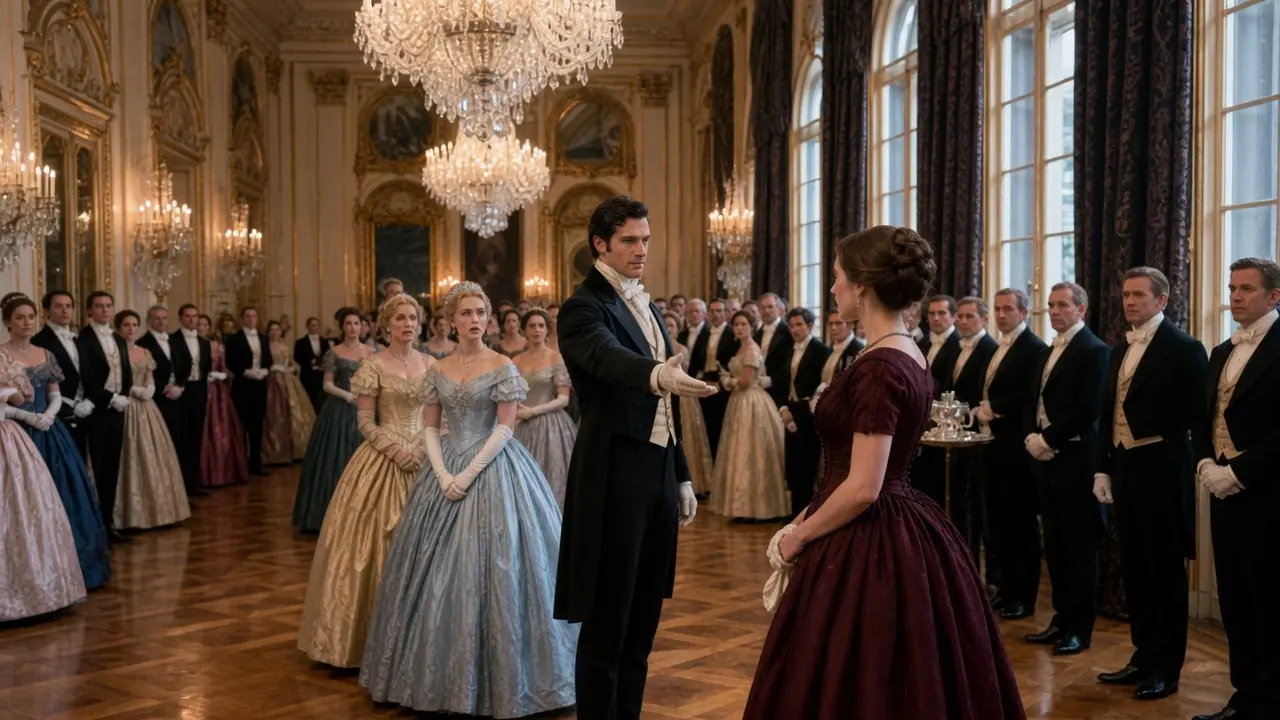
London's drawing rooms were full of accomplished women. There were women who played the pianoforte with the lightness of angels. Women who poured tea with the steadiness of diplomats. Women who could navigate a crowded ballroom, manage a guest list of 200, and still smile with effortless grace without ever betraying a single unguarded thought. London had no shortage of such women, and it admired them enormously.
But there was only one woman whose name could stop a conversation dead. You would be in the middle of a perfectly agreeable supper with the candles burning low and the wine doing its pleasant work. And someone across the table would mention the name Georgiana Howells. And the room would change. Not loudly.
There would be no gasps, no overturned glasses, only a particular stillness, or the kind that came when people were deciding how much of what they actually thought was safe to say out loud. Then someone would clear their throat. Someone else would reach for their glass. And whoever had spoken the name first would offer a small, careful smile and say something like, "Yes, well, poor thing." "She simply does not understand how the world works."
This was how London spoke of Georgiana Howells. She was not ruined. She was not immoral. She was not wicked in any of the obvious, satisfying ways that society found easy to condemn and easier still to enjoy discussing. She was simply irreparably, inconveniently honest.
And in the world of Victorian London, where everything ran on the smooth machinery of pleasant fiction, a woman who refused to maintain the fiction was not merely unusual. She was dangerous. If a clergyman delivered a sermon he had clearly lifted from a published volume without acknowledgement, Georgiana would say so afterward, pleasantly but directly, in front of the very congregation that had been applauding him. If a gentleman mistreated a servant and expected the drawing room to pretend otherwise, Georgiana would make it known that she had noticed. If a widow was being quietly cheated out of her late husband's estate by a solicitor who wore perfectly pressed coats and spoke in tones of gentle condescension, Georgiana would arrive at the solicitor's office with the relevant documents, a clear reading of the relevant law, and a manner so composed and so immovable that grown men with considerable professional pride found themselves reconsidering their positions before she had finished her first sentence.
She had no particular fortune. She had no powerful family to protect her. She had only herself, her intelligence, her unshakable sense of what was right, and the peculiar kind of courage that comes not from having nothing to lose, but from having decided, very deliberately, that certain things were worth more than approval. London thought her impossible, and so, naturally, London was entirely unprepared for what happened in the spring of 1872. Henry Montfort, the Duke of Windermere, one of the most powerful noblemen in England, announced that he intended to take a wife before the season was out.
The announcement was not dramatic. Nothing Henry Montfort did was dramatic. He was a man of extraordinary self-possession, the kind that was sometimes mistaken for coldness, and he delivered the information to his solicitor, his steward, and ultimately to the drawing rooms of half of London simply by allowing the season to proceed with his name attached to it. Within a fortnight, every notable household in the city had begun assessing its available daughters. Society knew who he would choose.
It was Daphne Avery. It could only be Daphne Avery. She was 22 years old, fair-haired, graceful, possessed of an exquisite complexion, and an even more exquisite manner. She moved through a room as though the room had been built for her. She said all the right things in all the right tones at all the right moments.
She was admired by men and liked by women, which was considerably harder to achieve, and she wore the approval of society like a garment that had been made precisely to her measure. She was exactly the bride London would have designed for a duke, had London been given the commission. Georgiana Howells was not on any list. No one imagined she would be. No one imagined she could be.
She was 24 years old, the daughter of a respectable but unremarkable country solicitor who had died 2 years earlier, and she had come to London to live with a distant female relation who found her exhausting and admirable in equal measure. She had brown hair that she kept in a neat updo she called practical, and everyone else called severe. She had eyes so perceptive that several gentlemen had complained of feeling in her presence that they were being quietly read like a document they had hoped no one would examine. She wore deep colors, burgundy and dark green and midnight blue, because she liked them and because the pale pastels favored by the season's young ladies looked, in her private opinion, as though they had been chosen by committee.
She attended the gatherings of the season because she had been brought to London for precisely that purpose and because she was practical enough to understand that a woman of modest means required a practical future. But she attended them on her own terms, which meant she said what she thought, asked questions no one else asked, and failed entirely to perform the charming, agreeable vagueness that well-connected young men found so reassuring in a potential wife. Three weeks into the season at a grand evening gathering hosted by Lady Ashworth in one of the finest houses on Grosvenor Square, a pompous member of Parliament named Mr. Aldous Fitch decided, in the manner of pompous men who mistake proximity for permission, to lecture Georgiana on the proper role of women in public life. She listened for 90 seconds.
Then she said, clearly and without particular heat, "You have spent the last several minutes explaining to me why women ought not to have opinions while apparently not noticing that I have already formed one about you. If it would save time, I am happy to share it." The room heard. The room went still. From across that room, Henry Montfort, Duke of Windermere, standing near the window with a glass of claret he had barely touched, turned his head and looked at Georgiana Howells for the first time.
He did not look away. Three days later, before all of London's finest assembled at the Harrington reception, Henry Montfort declined to dance with Daphne Avery a second time, declined to be introduced to any of the three other young ladies whose mothers had positioned themselves in his path with the precision of experienced strategists, and asked instead to be introduced to the woman in the dark red dress standing alone near the windows with a composure that made everyone else in the room look faintly uncertain by comparison. A week after that, he called on her. Two weeks after that, he proposed. London did not understand it.
London did not like it. And London, in the manner of a society that has decided something is wrong, made its feelings thoroughly known.
The morning Georgiana Howells arrived in London, it was raining. This was not unusual. It frequently rained in London. But, the particular quality of that morning's rain, cold, efficient, with no interest in being picturesque, seemed to Georgiana entirely appropriate. She had not come to London for romance.
She had come because there was nothing left for her in Derbyshire, where her father had been in the churchyard for two years, and the house had been sold to cover the modest debts that a good and careful man had nevertheless accumulated over a long and a careful life. She had come because her distant cousin, Mrs. Patience Eldridge, had written with a kindness that was genuine, if also faintly resigned, to say that there was a room and a small allowance and the season and the reasonable possibility that Georgiana might find herself a sensible husband before either of them entirely lost their nerve. Georgiana had read this letter twice. She had folded it neatly.
She liked Georgiana in the somewhat wary way that a person likes a fireplace. Warmth was the whole point, but you had to be careful where you put your hands. "You are clever," Mrs. Eldridge had said on their first full evening together, with the direct appreciation of a woman who respected cleverness and also the direct concern of one who understood its social cost. "But you will need to be careful, Georgiana. London does not always reward being right. Sometimes it punishes it quite severely."
"I know," said Georgiana. "I have always known that. But I find I cannot make myself wrong on purpose. It does not seem worth the effort." Mrs. Eldridge had looked at her for a moment, then had poured herself a second glass of wine and said nothing further on the subject.
They went to their first gathering of the season three days later at the home of a Mrs. Carolyn Brent, whose husband was in trade and who had therefore worked twice as hard as anyone born to position to make her drawing-room the sort that people wanted to be seen in. It was a considerable achievement. And the room that evening was full of exactly the kind of company that made London feel like London. Members of Parliament, a bishop, two minor aristocrats, several very well-connected ladies and a great deal of carefully managed conversation. Georgiana wore her dark burgundy gown with the structured bodice and the clean lines that Mrs. Eldridge had privately declared too severe for a young woman seeking a husband and which Georgiana had privately declared the most comfortable dress she owned.
She had dressed her hair herself, neatly, practically. And she carried her gloves in her hand rather than wearing them because she found gloves made her fingers stiff and she could not think clearly when her fingers were stiff. She stood near the window as she generally did because windows offered light to read by and a clear view of the room. And she observed London, she had already concluded, was a city that wore its appearances with the dedication of a professional performer. Everyone in that room was playing a part.
The bishop was playing the part of a man of God who was also impressively comfortable with wealth. The minor aristocrats were playing the parts of people who did not have to try. The well-connected ladies were playing the parts of women who were perfectly happy and had nothing to prove, which was the most demanding performance of all and the most continuously maintained. She was watching a particular exchange near the center of the room with the quiet interest of someone who has noticed something not yet visible to others when a servant appeared at her elbow with a plate of small biscuits and the information that Mr. Aldous Fitch, member of Parliament, had expressed a wish to be introduced.
Mr. Fitch was somewhere in his middle fifties, with the self-satisfied air of a man who had been told he was impressive for so long that the information had settled permanently into his posture. He bowed to Georgiana with the slight condescension of someone who considers bowing to a woman of no fortune a charitable act and immediately began talking. He talked for some time. He talked about the importance of social order. He talked about the natural inclinations of the female mind.
He talked in increasingly circular terms about the dangers of women who overstepped the appropriate boundaries of their sphere and about how such women, however well-intentioned, inevitably caused harm to themselves and others and to the general fabric of society. He used the word sphere four times. He seemed to enjoy it. Georgiana listened. She had learned long ago the particular discipline of listening to the end of an argument before responding to it because people often managed to contradict themselves before they finished speaking, which saved considerable effort.
Mr. Fitch finished speaking. Georgiana said very pleasantly, "You have spent the last several minutes explaining to me why women ought not to have opinions while apparently not noticing that I have already formed one about you. If it would save time, I am happy to share it." There was a moment of very complete silence. Mr. Fitch colored.
He opened his mouth. He closed it. Then he said with the stiff dignity of a man retreating from a position he would not publicly admit he had lost, "I see that Miss Howells prefers cleverness to courtesy." and turned away. "I prefer truth to either." said Georgiana to his retreating back and turned back to the window. From the other side of the room, she was aware without looking, of being watched.
She did not immediately look back. But when she did turn her head some minutes later, that a tall man in impeccable evening dress was standing near the far window with a glass of claret he had clearly been holding for some time without drinking. And he was looking at her with an expression she could not immediately name. Not amusement, exactly. Not disapproval.
Something steadier than either. He looked like a man who had just solved a problem he had been working on for a very long time. She did not know then who he was. She found out the following morning when Mrs. Eldridge arrived at breakfast with the particular look of a woman who has been awake since 6:00 with important news. "That was the Duke of Windermere," said Mrs. Eldridge.
"Henry Montfort. He is the most eligible man in England. He is also, by several accounts, the most difficult." Georgiana buttered her toast. "Difficult in what way?"
"He does not do as he is expected," said Mrs. Eldridge with the slightly sorrowful tone of reporting a personal failing. "He thinks for himself. He makes decisions that people find inexplicable. He was married once, years ago, and his wife died very young. Since then, he has refused every family that has put themselves forward. People find him She paused. unsettling. "That," said Georgiana, "is the most interesting thing I have heard since I arrived in London." Mrs. Eldridge looked at her with deep uncertainty.
Georgiana finished her toast. "Daphne Avery had been told she was beautiful since before she could speak, and she had been told she was graceful since before she could walk steadily. And by the time she reached 22 years of age and her third full London season, she wore these facts with the ease of someone so accustomed to being admired that admiration no longer felt like anything in particular. She was not vain, precisely. Vanity implied effort, a constant anxious preoccupation with one's reflection. Daphne's relationship with her appearance was more settled than that. She simply understood, with the quiet certainty of long experience, that she was what the world wished to look at, and she moved through the world accordingly. She was fair-haired and blue-eyed with a complexion that required no management and a figure that the current fashion seemed to have been invented expressly to flatter.
She danced beautifully. She played the pianoforte at a level that was genuinely accomplished rather than merely polite. She spoke French fluently and Italian tolerably. Daphne had the particular gift of making any man she spoke to feel that he was the most interesting person in the room, which was not a small gift and which she deployed with impeccable timing in every situation that required it. Her mother, Lady Cecilia Aubrey, had spent the better part of three seasons managing the precise social architecture required to place Daphne in the best possible position, which in the spring of 1872 meant a single, clear objective.
The Duke of Windermere. "He will choose this season," Lady Cecilia had said at their private breakfast in the first week of May. "Everyone says so. He has been too long without a wife. The estate needs an heir. He knows his duty, whatever else one may say of him. And you, my darling, are exactly what a man of his position requires."
Daphne had considered this with the calm rationality that was beneath the beauty and the grace her most genuine quality. She was not the sort of young woman who spent a great deal of time dreaming. She was the sort who assessed. And she had assessed the Duke of Windermere from the careful distance of several drawing rooms and one formal dinner at which they had sat near enough to each other for her to observe that he was very quiet, very attentive, and not even slightly impressed by the ornamental. This last point gave her a moment's pause, but only a moment.
She was not ornamental, she reasoned, not merely ornamental. She was genuinely accomplished. She had genuine substance. The difficulty was that Henry Montfort, if the reports were accurate, had a habit of looking for substance in places where society considered it unnecessary and ignoring it in the places where society had worked very hard to arrange it. "He is very particular," she said to her closest companion, Miss Mariah Cheswick, one afternoon over tea.
Mariah was a sharp, quick-witted young woman who served in the economy of their friendship as the voice of honest observation that Daphne's position required someone else to speak. "He is particular," Mariah agreed. "But Daphne, every man alive with a functioning mind is going to choose you eventually. It is simply a matter of patience." Daphne looked at her tea.
"I hope you are right," she said with the small, contained smile that was her most practiced expression. What she did not say, because she did not yet fully understand it herself, was that she had begun to feel, in the last year or two, a creeping unease in the space between who she was and who she performed, not sharply, not with anything dramatic, only the very faint, persistent sense that a life organized entirely around being admired might require, at some point, something more than admiration to sustain it. She did not examine this thought too closely. She had been trained by years of drawing rooms and seasonal dances and careful motherly instruction not to examine thoughts that did not serve a useful purpose.
She set the thought aside and poured more tea. Across London, in the same afternoon, in a small but neatly ordered house on Wimpole Street, Georgiana Howells was reading a volume on the management of large estates that she had borrowed from the lending library and which Mrs. Eldridge had asked and with gentle desperation that she put away before their afternoon caller arrived. The afternoon caller was a Miss Felicity Drummond, the niece of a baronet, who came to visit Mrs. Eldridge every fortnight and who found Georgiana bewildering in the friendly, nervous way of someone who can see that a creature is harmless but cannot entirely bring themselves to stop flinching. "My aunt says," Felicity said, a little breathlessly, having settled herself and accepted her tea, and glanced twice at the volume Georgiana had placed face down on the side table, "that the Duke of Windermere was seen twice at the Harrington reception looking at you, Miss Howells, in a pointed way."
"Felicity," said Mrs. Eldridge, with the particular warning tone of a woman who didn't want the conversation to develop in a direction she could not manage. "Oh, he was looking at the window," said Georgiana, without looking up from her teacup. "I happened to be standing near it." "My aunt says," Felicity pressed, with the determination of someone who had saved her best news for last, "that he refused to dance twice with Miss Avery, which he has always expected to do, which everyone was watching for." There was a brief silence.
"Well," said Mrs. Eldridge, in the tone of someone picking her words with considerable care, "I expect he had his reasons. Georgiana said nothing at all. She reached for her book, but she did not, in fact, read it.
Henry Montfort had inherited the dukedom of Windermere at the age of 19 when his father, the fourth duke, had died in the night with a stillness that the physician attributed to his heart, and which Henry, even then, had found oddly abrupt for a man of otherwise robust constitution. He had been 19 years old. He had understood almost nothing about the management of a great estate, the navigation of the House of Lords, or the complex machinery of social and political obligation that came attached to a title of his degree. He had excellent tutors and a reasonably sound mind, and he had applied himself with the systematic thoroughness of someone who understood that ignorance was a luxury he couldn't afford.
By 30, he was considered one of the most capable men in England. He was also one of the loneliest. This was not something Henry Montfort examined with any frequency. He was not a man given to examining his inner life for its own sake. He was given to action, to decision, to the management of concrete problems with intelligent and purposeful effort.
But there were evenings after the correspondence was finished and the house was quiet and the fire had burned down to embers, when the size of Windermere House struck him with the particular weight of something that was a possession and also a burden, and also simply a large and beautiful and very empty building. He had been married once. Eleanor. She had been 20 when they wed and 21 when she died of a fever that came quickly and was quick in its conclusion and which left Henry at 23 with a title, an estate, a grief he had no useful language for and the beginning of a suspicion not yet fully formed that the world he had been placed in was not quite the world it appeared to be.
Eleanor had been gentle and good and had trusted everyone. Henry, watching her trust, had felt, even as he loved her, a quiet anxiety he hadn't known how to name. She had accepted everything offered to her without question. Every visitor, every remedy, every well-meaning suggestion from the household. She had not had the kind of mind that looked behind the gift to examine the hand that held it.
He had tried to protect her by being vigilant himself. He had not been vigilant enough. In the years since Henry Montfort had become a man who watched very carefully. His household included among its primary figures his cousin Mr. Jonathan Price who managed the estate accounts with a competence that Henry respected and a familiarity that he found increasingly slightly too comfortable. Jonathan was 35 lean, intelligent but and permanently positioned at the edges of Henry's professional life with the patient readiness of a man who was waiting for something specific.
There was also Mr. Rowan Deverell the family solicitor who had served the Montfort family for 20 years and whom Henry trusted in the cautious limited way he trusted everyone. Precisely as far as the evidence warranted and not one inch further. And there were the chiefs of London's social world who circled him every season with carefully managed interest. Chief among them, a small group of influential men who had, over several years, begun inserting themselves into the various committees and boards and financial structures connected to the Windermere estate. They did this with such smoothness, such warm reasonableness, such an air of merely helping an old friend manage a large and complex set of responsibilities that most people around Henry accepted their presence as entirely natural.
Henry accepted nothing as entirely natural. But he had not yet found the specific thread that, when pulled, would unravel the whole arrangement. He needed, he had concluded, an ally. Not a decorative one. Not a socially useful one.
An ally who couldn't be bought by flattery, who could not be managed by social pressure, and who would not, under any circumstances, be charmed into looking the other way by a man with elegant manners and a persuasive tongue. He had been thinking about this problem for the better part of two years when he attended Mrs. Brent's gathering in early May of 1872 and stood near the window with a glass of claret and watched a woman in a dark red dress tell a member of Parliament, with perfect composure and complete precision, that she had already formed an opinion of him and was prepared to share it. Henry Montfort, who had not found anything genuinely surprising in a very long time, felt something shift. He did not speak to her that evening.
He was not a man who acted on impulse, and he wanted to be certain of what he had seen before he acted on it. He spent the following three days making quiet inquiries of the kind that did not get back to the subject. He learned that Georgiana Howells was the daughter of a Derbyshire solicitor. That she had no fortune and no influential connections. That she was considered by the society he most needed to trust her against to be thoroughly unreliable, unsuitable, and frankly alarming.
That she had embarrassed Mr. Fitch on at least two other occasions before the evening he had witnessed. That she had intervened in a matter involving a widow's contested estate and had done so with such intelligent tenacity that the solicitor involved had found himself reviewing his position rather urgently. That she was thought by every person of comfortable social standing to be exactly the sort of woman one didn't invite if one wanted the evening to remain smooth. Henry read through these reports with growing attention. Then he arranged to be introduced to her at the Harrington reception.
She had been standing near the windows again in the same dark red dress holding her gloves in her hand. She had looked at him with the composed assessing attention of someone who read people the way other people read books. Not for entertainment but for information. Miss Howells, he had said. Your Grace, she had said.
And nothing further because she was, he realized, waiting to see what he would say before she decided what she thought. They had talked for 20 minutes. About the management of large properties, about the agricultural reforms currently being debated in Parliament, talked about a recent case in the Lord Chancellor's Court that had implications for inheritance law that most people in London hadn't yet noticed. She had opinions on all of it. Precise, considered opinions arrived at by genuine thought rather than social reflex.
When he left her to cross the room for the obligatory attendance on his hostess, he already knew what he intended to do. He spent a fortnight making certain he was right. Then he called on her formally with all the proper ceremony of a man making his intentions known at the neat house on Wimpole Street. Mrs. Eldridge had answered the door herself, which was unusual enough to suggest she had been watching the street.
The Harrington reception was the most important event of the season. This was not because anyone had officially declared it so. In London, nothing important was ever officially declared anything. It was simply understood in the particular way that all social arrangements in that world were understood by long tradition, unspoken agreement, and the quiet but absolute consensus of the people who mattered. The Harrington reception was where the season reached its formal peak.
It was where decisions were made visible. Introductions at the Harrington had a different weight from introductions elsewhere. Choices made there were, in a sense, made before the entire city. Lady Harrington understood this very well. She had understood it for 30 years.
She deployed her guest list with the tactical precision of a general deploying forces, and the result was always a room in which every significant social question of the moment was present and available to be answered. This year, well, the significant question was the Duke of Windermere's bride. The room was radiant. Six chandeliers burned above a space that held perhaps 200 of the city's finest, all in their best, all performing the relaxed ease that required, in fact, considerable maintenance. The music was excellent.
The food was impeccable. The conversation was the kind that sounded light and felt heavy because every third sentence was actually about something else entirely. Daphne arrived at half past eight with her mother in a gown of palest blue that made her look, in the candlelight, like a figure from a painting. She moved through the room with her habitual grace, accepting admiration with her habitual warmth, and positioned herself by quarter to nine in the very center of the room's best light. Georgiana arrived at nine, quite alone, except for Mrs. Eldridge, in the dark burgundy dress with the structured bodice.
She went directly to the side of the room where the windows were because she always went to where the windows were, and she stood there and watched the room with the expression of a naturalist observing a species whose habits she found interesting but whose company she found tiring. Henry arrived at quarter past nine. The room noticed. Rooms always noticed Henry's arrival. He moved through spaces with the specific authority of a man who was accustomed to being the most consequential person present and had long since stopped finding it remarkable.
He was dressed in a coat of deep charcoal with cream cravat work so precise that the overall effect was of a man who had been assembled by a craftsman. He greeted Lady Harrington. He spoke briefly with two men near the fireplace. He accepted a glass of wine from a passing servant without looking at it. And then he crossed the room with a directness that was entirely unmistakable to the windows.
The room watched. The room was very good at watching things it was not supposed to be watching. He stood beside Georgiana and said something quiet. She answered with her characteristic lack of social preamble. He said something further.
She looked at him with that assessing attention, the kind she gave everything, and then said something that made him just barely almost imperceptibly almost smile. Lady Cecilia Avery, watching from across the room, felt the first cold finger of genuine concern. It happened quickly from that point, which was, in retrospect, very like Henry Montfort, who had spent years watching before he acted, and then acted with no wasted motion whatsoever. Lady Harrington, performing the hostess duty of circulating introductions, brought several young ladies to Henry's vicinity over the next hour. He was entirely courteous to each of them.
He listened. He responded. He did not once look the way he looked when he was talking to Georgiana. Late in the evening, Lady Harrington staged the moment she had clearly been building toward all night. A gentle public suggestion that the Duke might honor Miss Avery with a second dance.
It was done with all the social subtlety of a woman who had been engineering these moments for three decades, and it landed exactly as intended. The room looked at Daphne. The room looked at Henry. Henry looked at Georgiana. He said, and clearly enough for the several people nearest to him to hear, "I am afraid I am engaged for the remainder of the dances this evening."
He turned slightly toward where she stood. "Miss Howells, if you are willing." The room went very still. Georgiana looked at him. Her expression did not change significantly.
She was not a woman who startled easily. And she had, Henry suspected, already understood the direction this was moving better than most of the people in the room who would spend the next fortnight talking about it. "I am willing." she said. They danced. The room watched in a silence that was, for a room full of 200 people, remarkable.
Lady Cecilia Avery stood very still near the refreshment table and understood, with the cold clarity of a woman whose plans have just been interrupted, that something had gone differently from how she had expected. Daphne, across the room, held her smile with the practiced steadiness of someone who had been trained never to let a drawing room see her waiver. But her hands, below the level of visibility, were pressed together very tightly. The following morning, Henry Montfort called formally on Georgiana Howells at the house on Wimpole Street and made his proposal. She asked for one day to consider it.
He said he would wait as long as required. She said one day was enough. The next morning, she accepted him. By afternoon, all of London knew. By evening, all of London had opinions.
By the end of the week, the opinions had become, in the way of London opinions, something very close to a verdict. "He has lost his mind." said the drawing rooms. "She has bewitched him." said the supper tables. "And it will end badly." said everyone with the satisfied certainty of people who very much hope to be right. They were married in the last week of May, quietly, in a small church in Derbyshire that had been Georgiana's father's parish.
Henry had suggested it, which surprised her. She had expected a large London ceremony with all the social ceremony that his position required. "I have attended a great many large London ceremonies." he said when she raised the matter. "They are invariably about something other than the people being married. I would prefer this one to be about us."
It was the first time he had said something that felt to her entirely unguarded. She had looked at him for a moment in the way she looked at things that surprised her with careful concentrated attention. "Very well." she said. The church was small and old and smelled of stone and candle wax and the particular cold warm air of a building that had been standing for four centuries. There were 12 guests.
The ceremony was brief and genuine and in the way of things that were not performed for an audience, more moving than any ceremony twice its size. Georgiana became the Duchess of Windermere on a Tuesday afternoon in late May in a church in Derbyshire in the dark burgundy dress that had been her best because she had not seen the point of buying a new dress for one day when the old one had never failed her. Henry looked at her in that dress in the light coming through the old stone windows and said nothing but looked in the way of a man who does not need to speak because his face has said it for him. Then they returned to London and Windermere House and the full immediate weight of what London thought of all this.
Windermere House was magnificent. This was the first thing Georgiana noticed because she was honest enough to notice things as they were. And Windermere House was, by any honest account, one of the finest private houses in London. It rose above the street with the particular authority of a building that had held its position for 200 years and had no intention of apologizing for it. Inside, the rooms were tall and richly appointed with the kind of furnishings that spoke not of ostentation, but of accumulated quality.
Good wood, good fabric, good art. The accumulation of generations who had known what they were doing. The second thing she noticed was the staff. Not their appearance. They were impeccably turned out, everyone.
Not their manner. And they were correct in every professional particular. What she noticed was something beneath manner. Something that had no single name, but that she had learned, over years of watching people in difficult situations, to identify immediately. They were frightened.
Not of her, particularly. She had not been there long enough for that. It was an older fear, a settled one. The kind that has become so familiar it no longer registers as fear and has simply become the baseline condition of a household. She did not say anything about this on the first day.
She was not a woman who acted on incomplete information. She spent the first week learning the house. She was methodical. She walked every room that was accessible to her, noting what she saw. She spoke to the housekeeper, Mrs. Garland, a stout but competent woman of 60, who answered every question with careful precision and volunteered nothing that had not been specifically asked for.
She spoke to the butler, Mr. Crane, who had the very upright, very contained manner of a man who had been in service too long in a household that has asked him to maintain fictions and has managed this by simply not speaking more than was strictly required. She reviewed the kitchen arrangements, the linen schedules, the household accounts for the previous quarter. It was in the accounts that she found the first indication. Not dramatic. Nothing so obvious.
Only a small pattern of expenditure recorded in perfectly correct accounting hand, which, when examined across several months, revealed that a consistent amount of money was leaving the estate in payments to suppliers that Georgiana, who had grown up in the house of a man who kept accounts with punctilious care, could not reconcile with the actual evidence of the household's consumption. She set the books aside. She thought about it for an evening. Then she asked, the following morning, to speak with Mr. Jonathan Price. Jonathan Price arrived in the estate office with the smooth, calibrated ease of a man who had been managing these rooms for years and expected to continue doing so.
He was lean, dark-haired, impeccably dressed, with the kind of face that was professionally pleasant without being warm. He looked at Georgiana with a polite, contained attention that had, beneath its surface, precisely the quality of a man who has been accustomed to having no female supervision and is determining how much of a problem this might become. "These payments," said Georgiana, knocking setting three pages of accounts on the desk between them, "for provisions from Alderman & Sons, I cannot find a delivery record for the quantities recorded here over the past 6 months. Can you help me understand them?" Jonathan looked at the pages.
He smiled, the particular smile of someone being patient with a misunderstanding. "The Duchess will find that large estate management involves a great many complexities. There are advance arrangements, forward contracts, standing orders." "I understand forward contracts," said Georgiana pleasantly. "My father was a solicitor. I have been reading accounts since I was 12 years old. I'm asking about specific delivery records for specific charges. Where are the delivery confirmations?"
There was a pause. Jonathan said, in a tone that was still polite, but had lost the warm ease, "I will look into it." "Thank you," said Georgiana. "I would appreciate that before the end of the week." He left.
She sat alone in the estate office for a moment, looking at the accounts, and felt the familiar sensation of standing at the edge of a thing that was larger than it looked.
London expected the new Duchess of Windermere to be softened by her position. This was a reasonable expectation based on extensive historical precedent. A woman without means who married a duke had generally, in the social experience of the city, recognized the terms of the arrangement. The title and the security were provided. The compliance and the social performance were returned.
It was an exchange that had governed the drawing rooms of England for generations, and it worked, on the whole, because both parties usually wanted what was being offered. Georgiana wanted the marriage. She had understood in the week before she accepted Henry's proposal that this was not a conventional offer from a conventional man, and that he was not expecting a conventional response. She had thought about it with full seriousness. She had concluded that she could be a good Duchess, which in her definition meant an honest one, a capable one, and one who would not pretend that problems were not problems simply because problems were inconvenient.
She had not anticipated how much this definition would disturb the existing order of Windermere House. The first month brought a series of what might charitably be described as adjustments. She reviewed the accounts and found the discrepancies she had already noticed, plus three further ones that careful examination revealed. She presented these to Henry. He listened with the careful, concentrated attention he gave everything and said, quietly, "I had noticed some of this. I had not yet found the shape of it."
"The shape of it," said Georgiana, "is that money has been leaving this estate in a consistent and structured way for at least 4 years. It is not accidental. Someone is making decisions about where it goes." Henry looked at her for a moment. Then he said, "How confident are you?"
"Entirely," she said. "Then we proceed carefully," he said. "Not quickly. Whoever is behind this knows this house and this family well enough to have managed it for 4 years without being caught. They will not panic if they feel the pressure increase. But they may act if they feel cornered suddenly. This was the first conversation of many conducted in the evenings in the library when the household had retired in which Georgiana and Henry began the slow, the patient work of mapping what had been done and by whom. It was also, though neither of them named it as such, the foundation of their marriage.
Not the ceremony and not the formal arrangement, but this. Two people who could speak plainly to each other about difficult things in a house full of people who relied on nothing being spoken plainly. In between these evenings, there was the social world to manage. London had not given up on having an opinion about the Duchess of Windermere. If anything, London's opinion had intensified with proximity and it was delivered in the form of calling cards, dinner invitations, charity committee memberships, and the full elaborate machinery of the season that descended on the new Duchess with the cheerful inevitability of a weather system.
She attended. She was not antisocial. Though she liked certain people very much and she met in that first season as Duchess several she would come to consider genuine friends. Among them was a young woman named Miss Francesca Aldworth, the daughter of a clergyman who combined sharp intelligence with an infectious directness that reminded Georgiana pleasantly of herself and who laughed on their first meeting at something Georgiana said with a warmth so genuine that Georgiana immediately revised upward her general assessment of London. She also met, again and frequently, Miss Daphne Avery.
Daphne's reception of the new Duchess of Windermere was managed with such exquisite social craft that most people who witnessed it could not have said afterward whether they had observed warmth or performance. She was always perfectly kind to Georgiana's face. But she always said exactly the right thing in exactly the right tone. She expressed no jealousy, no resentment, no opinion that was not entirely appropriate to the occasion. Even Georgiana, who was not easily deceived, could not identify a single concrete thing to object to in Daphne Avery's behavior.
It was the perfection of it that she found unsettling. She said this to Henry one evening in the library. "There is nothing wrong with her that I can point to," she said, which was not something she often had to say about anyone. "Every word is exactly right. Every gesture is exactly right. And yet I feel, when I leave her company, as though I have been in a room where the air was slightly off. And I cannot say why."
Henry was quiet for a moment. Then he said, "Eleanor used to say that about certain people in this house. She said their consideration was so careful that she could not find the seam of it." Georgiana looked at him. He did not often speak of Eleanor.
When he did, it was without the performed grief of someone making a display of sorrow. It was quieter than that and more specific. "Did you know who the people were?" Georgiana asked. "She suspected," Henry said.
"She died before she could be certain. The room was very still for a moment. Then we need to be certain, said Georgiana, before we give anyone reason to be alarmed. Meanwhile, the household continued to present its daily theater. Georgiana continued to ask questions, correct accounts, replace dishonest suppliers, and refuse to pretend that things she had noticed had not been noticed. She dismissed two under-servants who had been systematically stealing provisions, and had been protected from scrutiny by the simple fact that no one had previously been looking. She confronted a distant Montfort cousin who had been receiving an allowance from the estate in exchange for social support, and who had not, in Jonathan Price's generous accounting, provided anything of measurable value. The cousin left.
The suppliers were changed. The accounts began, month by month, to improve. Henry's health, which had been the subject of quiet concern among those who knew him well, began, very gradually, also to improve. His color came back. The tired look around his eyes, which had been there for so long that his household had stopped noticing it, began to ease.
He slept better. He ate more. Georgiana noticed this, but she did not say anything about it immediately, but she stored the observation with the careful attention she gave everything. And she added it to the growing shape of what she was beginning to understand.
Summer arrived in London with the full force of a season that had things to say and the weather to say them with. The parks were brilliant. The streets were loud with hooves and voices. The drawing rooms opened onto gardens, and the gardens were full of people performing the agreeable idleness of a class that could afford it. Georgiana was not idle.
She had been married for 6 weeks when she first understood, clearly and without the qualification of doubt, that the situation in Windermere House was not merely one of financial irregularity. It was one of deliberate harm. The understanding came in pieces, but the first piece was a conversation she overheard by chance while descending the back staircase from the linen rooms late one afternoon. Jonathan Price in the corridor below, speaking quietly with a man she did not recognize. Not a member of the household, not a tradesman by his dress, but someone who moved with the specific ease of a person who had been in this house before and expected to be here again.
The conversation lasted less than a minute. What she heard, with her very clear hearing, was a sum of money and the words, "When the arrangements are complete." She descended the last three stairs and turned the corner, and both men looked up and smiled, and Jonathan said, in his most pleasant tone, "Your Grace, I was not aware you were in this part of the house. May I introduce Mr. Sims, who handles some of our external communications?" "How kind," said Georgiana, with a warmth so practiced it was indistinguishable from the real thing.
Forgive me. I am in rather a hurry." And she walked on. The second piece was a small brown bottle in the cabinet of the room that served as the Duke's private sitting room, among medicines left there by the physician who had been attending Henry for his general fatigue. She had come into the room to retrieve a book she had left there. And she had seen the bottle because it was not where it had been 3 days before. Someone had moved it to a more central position. Someone who knew the room's habits and the Duke's habits very well.
She picked up the bottle. She read the label with the careful attention she gave all labels. Then she put it back exactly where she had found it and left the room. She spent the following afternoon at the shop of a pharmacist on Cavendish Street whose father had once been helped by her father in a legal matter and who therefore received her with an openness he would not have extended to a stranger. She described, precisely and without emotion, the compound indicated on the label.
The pharmacist listened. Then he said carefully, "That particular compound is sometimes prescribed in small doses for nervous complaints. In sustained or larger doses, it produces fatigue, confusion, and a general weakening that would over time resemble a deterioration of health that might easily be attributed to stress or constitution." "Over what length of time," said Georgiana, "would sustained exposure produce visible effects?" The pharmacist looked at her.
"6 months," he said. "Or more." Georgiana thanked him and paid for a small purchase she had no use for to make the visit look ordinary. She walked home in the summer afternoon with the full weight of what she now knew. And she felt beneath the usual steadiness something that was very close to fury.
She did not go to Henry immediately. She had learned from a lifetime of taking on difficult situations that the first impulse in a moment of clear anger was almost never the most useful one. She went home. She sat in the library. She thought.
Then she picked up her pen and began, very quietly, to build a record.
Meanwhile, the social season continued to surround them. There were events twice weekly, sometimes more. Georgiana attended them because presence was information and because a duchess who withdrew from society would be discussed and would also be isolated and she could not afford isolation. Henry attended beside her with the contained, watchful manner that she was beginning to understand was not coldness but vigilance maintained under pressure for a very long time. It was at one of these events, a pleasant outdoor gathering at the estate of a Lord and Lady Sutton, that Georgiana first encountered Rowan Deverell, the family solicitor, in circumstances that extended beyond the professional.
Mr. Deverell was a man of 60, silver-haired, impeccably credentialed with the very smooth manner of a senior solicitor who had spent four decades managing the affairs of powerful families and had learned that the smoothness was almost entirely the skill. He greeted Georgiana with exactly the right degree of respectful warmth, spoke of the late Duke with affectionate fondness, and expressed with all appropriate subtlety his hope that the new Duchess was finding her way comfortably in the management of such a large estate. "Entirely comfortably," said Georgiana. "I am pleased to hear it. If you find yourself uncertain about any of the estate's arrangements, the legal structures can be quite complex. "I have found them quite clear," said Georgiana pleasantly. "My father was a solicitor.
I grew up reading documents of this kind. I find them less complex than people generally suggest." Something shifted very briefly in Mr. Deverell's expression. It was not visible to most people. It was visible to Georgiana. "Excellent," he said smoothly. "Oh, well, then we understand each other." "I believe we do," said Georgiana.
Later that evening, she told Henry about the medicine. She told him everything, the pharmacist, the compound, the timeline. She set it before him the way she set accounts before him, factually, completely, without ornament. Henry sat very still for a long time after she finished. Then he said very quietly, "My father."
"I thought of him, too," said Georgiana. "They have been doing this for a very long time," he said. "Yes," she said. "I think so." Another silence.
"I removed the medicine from the cabinet 2 weeks ago," Georgiana said. "I replaced it with something entirely harmless that I made up myself. I told no one. The label was reattached exactly." Henry looked at her.
But it was the look of a man who has been alone with a large and dangerous problem for a very long time and has just been unexpectedly and completely joined. "You didn't tell me," he said. "I needed to be certain first," she said. "Now I am certain." He said nothing for a moment.
Then he said, "Georgiana." "Yes?" "You are the most extraordinary person I have ever met." She looked at him. She was not a woman who blushed easily, but something in her face in that moment was different from its usual composed arrangement.
"I am practical." She said. "Anyone with a clear head and sufficient information would have done the same." "No." Said Henry.
"They would not." They sat in the library for another hour building the picture together. Outside London's summer continued bright and noisy and entirely unaware.
The invitation to the Moorfield Charity Ball arrived in the third week of July addressed to the Duke and Duchess of Windermere on cards of such heavy cream paper and such fine engraving that the invitation itself was in a sense a statement of social intention. Lady Moorfield was one of the most senior hostesses in London. Her events were attended by everyone of consequence and the charitable occasion a fund for the improvement of London hospitals lent the gathering the additional respectability of public virtue. To decline would have been a significant social statement. To attend was to enter a room that both Georgiana and Henry knew by this point where would contain almost every person connected to what had been built against them.
Henry looked at the invitation for a moment. Then he said, "We go." Georgiana said, "I agree." She wore that evening a gown she had not worn before, a deep emerald that Henry had commissioned from a dressmaker whose work she had admired over her protests that the dark burgundy was entirely sufficient. The emerald had a structure and a richness that made the dark burgundy look, in retrospect, like a rehearsal.
She wore her hair in the same neat, practical updo with two small combs that had belonged to her mother. She did not wear a great deal of jewelry because she had never found jewelry comfortable and had told Henry so. And he had looked at her with the quiet amusement he saved for moments when she said something other people would not have said. Henry told her that was entirely her decision. They arrived at the Moorfield house at 9:00.
The evening was warm. The rooms were magnificent, lit to their best advantage, and the assembled company was everything Lady Moorfield had designed it to be. Glittering, impeccable, and densely populated with people who were watching each other. Georgiana was watched more than most. This was not new.
She had been watched since the morning of the betrothal announcement, and she had declined to find it alarming because she had decided early that a woman who was being watched had the advantage of knowing exactly where the attention was. She moved through the first hour of the evening with Henry beside her, speaking to the people she liked, being correctly courteous to the people she didn't, and maintaining with very little effort the elegant posed and pleasant demeanor of a woman who was entirely at ease. Henry beside her did the same. Twice she felt his hand briefly at the small of her back as they moved between groups, the lightest of contacts, which she had come to understand was not a gesture of management but of confirmation.
I am here. It was near the middle of the evening that Daphne Avery approached. She was wearing ivory as she often did at grand events with pearls at her throat and a fan in her gloved hand and she crossed the room toward Georgiana with the expression of a woman who had decided on generosity and was going to perform it with conviction. The music softened at that moment as if obliging. "Your Grace." said Daphne with a smile of such complete social perfection that it might have been painted.
"Well, I hope the evening finds you well." "Very well, thank you." said Georgiana. "I've been meaning to speak to you." Daphne said and her tone shifted to something more intimate more confiding. "I fear we began the season on difficult terms and I have felt it very much. I hope you know that whatever was said or felt before your marriage, it was only the season's excitement. Nothing more. I wished you and the Duke every happiness."
Around them, the nearest group of guests had absorbed the drama of this approach and gone very carefully still in the manner of people who are listening with every cell of their bodies while looking in entirely other directions. Georgiana looked at Daphne. She was aware with the precise social attention she had spent years developing of several things at once. Jonathan Price was twenty feet away and apparently engaged in conversation but angled slightly toward this exchange. The stillness of Mr. Deverell across the room.
The particular quality of the room's attention which was not the idle curiosity of people watching social theater but something with an edge to it, a kind of held breath. Then a servant appeared at Daphne's elbow bearing a single cup on a small silver tray. "A restorative cordial," Daphne said with the warmth of someone offering comfort. "A specialty of the house. Lady Moorfield has them prepared specially for the evening. I took the liberty of bringing you one as a small gesture of goodwill."
The room was very still. Georgiana looked at the cup. It was a beautiful cup, fine porcelain with a gilded rim. The liquid inside was a deep reddish amber. It smelled faintly of the spice and something floral.
She looked at the cup for one moment longer. She looked at Daphne's face, at the small, almost invisible tension around the eyes that perfect social training could not quite erase. She looked at Jonathan Price, who had moved two steps closer. Not obviously, but two steps. She looked at Henry, who was two yards away, and who was looking at her with an expression that contained, she could see, both trust and the absolute commitment to follow whatever she did next.
She turned back to Daphne, and she moved the tray firmly aside with her gloved hand so that the cup tilted and the contents spilled across the floor between them. The sound of the liquid hitting the polished boards was very small. The gasp that went through the nearest dozen guests was not. "Forgive me," said Georgiana, and in a tone of absolute composure. I am afraid I have quite spoiled your gesture." Daphne stared at her. Something was happening behind those blue eyes, something that was not quite shock, because shock requires being surprised, and Georgiana had the sudden, clear conviction that Daphne had not expected to feel anything about this moment at all. The conversation around them resumed, loudly and at speed, in the way of conversations that are covering something.
Jonathan Price had moved back. Deverell had turned away. The servant had retreated with the tray and the empty cup. Henry appeared at Georgiana's side. He said quietly, "Are you ready to leave?"
"Yes," she said. They made their courteous farewells to Lady Moorfield and left. Behind them, the Moorfield ballroom buzzed with the particular electric intensity of a room full of people who know they have just witnessed something significant and are not yet sure what it was. The carriage ride home was quiet. Georgiana looked out at the dark London streets.
Henry sat beside her, close, his arm along the back of the seat behind her, and did not speak until they were through the gates of Windermere House. Then he said, "You knew." "I suspected," she said. "I could not be certain. But the smell was wrong. I know what restorative cordials smell like. They do not smell of anethole and sweet almond, which are both used in compounds that are harmless in the right context and dangerous in others."
Henry was quiet for a moment. "Where did you learn that?" "From the same pharmacist I visited in June," she said. "I asked him, after our conversation about the medicine, what other compounds might be introduced without obvious detection. He was very informative."
"Of course he was," said Henry. And there was something in his voice that was unmistakably close to laughter. Not the laughter of a man who found danger amusing, but the laughter of a man who has spent a very long time alone with a weight that someone has just helped him carry. Then he took her hand in the dark of the carriage and held it. She let him.
It was three days after the Moorfield ball that the proof came. Lady Moorfield's household cat, a large and highly opinionated animal who had the run of the downstairs rooms, and who had apparently descended on the tray before the servant managed to remove it, was found the following morning in a state of considerable distress. The veterinary surgeon called to attend it described the symptoms with a clinical precision that when relayed by Lady Moorfield to her husband and by Lord Moorfield to his solicitor and by the solicitor to the appropriate authorities created a paper trail of such unmistakable clarity that it was in the end not the grand confrontation of a sensation novel, but the quiet arrival of two officers from the magistrate's office at Jonathan Price's very respectable rooms in Mayfair. Jonathan was not there when they arrived.
He had, by some information Georgiana was never able to account for with certainty, become aware that the net was closing the previous evening and had made the particular decision of a man who has been operating on borrowed time for several years and has finally run out of it. He was found two days later at Dover, in the act of arranging passage to France. Rowan Deverell was found at his office, where he had apparently decided that the better performance was innocence and where he sat surrounded by documents with the composed certainty of a man who had been careful for 20 years and believed his carefulness would protect him. It did not. Georgiana's record, built over 2 months of patient collection, contained enough to unravel the entire arrangement from the inside.
It emerged over the following weeks in the careful, unsexy, enormously satisfying way that the truth generally emerges when someone has been quietly and systematically gathering it. That Jonathan Price and Rowan Deverell had, for the better part of seven years, been redirecting money from the Windermere estate into a network of external accounts controlled by Deverell's business associates. The original scheme had been straightforward enough. False suppliers, inflated invoices, the kind of financial architecture that only reveals itself when someone looks at it with the combination of knowledge and willingness that neither Jonathan nor Rowan had expected anyone in that household to possess.
The additional element, the medicinal one, had been added 3 years earlier when Henry had begun to notice the financial irregularities himself and had started asking questions. It was, in its way, the most damning part of the whole. Not because it was the most financially significant, but because it revealed that when discovery threatened, the people responsible had chosen not to stop, but to attempt to prevent the person who might stop them from being capable of stopping anything. The fourth duke's death was re-examined. The verdict did not establish murder in the clear legal sense, but it was not natural, either.
And the discomfort of those who had been responsible enough to look the other way at the time for reasons of social comfort was not entirely invisible in the careful language of the report. Daphne Avery was not charged with anything. There was no evidence that she had known the full extent of what she had been used for, but the investigating authorities were interested enough in her role at the Moorfield ball to conduct a formal interview. And the account of that interview, when it filtered through the drawing rooms of London, as everything eventually filtered through the drawing rooms of London, was enough to ensure that the careful, graceful, universally admired Miss Daphne Avery spent the remainder of that season in the country, at her family estate, attended by her mother and very few other people.
London, which had so thoroughly expected Georgiana Howells to be the ruin of the Duke of Windermere, was very quiet on this subject for several weeks. Then it found, as London always found, a way to arrange its memory into a story it could live with comfortably. It had always suspected something was wrong. It had always known the Duke was a man of particular intelligence who made decisions that others could not immediately understand. It had perhaps been hasty in its first judgments.
The Duchess of Windermere was, now that one had the opportunity to reflect on it, a woman of considerable character. Georgiana, receiving the social rehabilitation of London's good opinion with the same composure she had received its bad one, said to Henry over breakfast one morning, "They are now going to tell everyone they always liked me." "Yes," said Henry. "Is this not annoying to you?" "Enormously," he said, "but less annoying than the alternative."
She looked at him. He was looking back at her with the expression she had come to recognize and love most in him, Entirely present, entirely honest, making no performance of anything. "Henry," she said. "Yes. When did you decide truly? Not the practical reason. The actual reason."
He set down his cup. He was quiet for a moment in the way he was quiet when he was about to say something that he had thought about carefully and meant entirely. "The evening at Mrs. Brent's," he said. "You said something to Fitch. You said, 'I have already formed an opinion of you and I'm prepared to share it.' And I thought, 'Here is a woman who cannot be lied to, who will not pretend, who will look at a thing and call it what it is regardless of what it costs her.' And I thought, 'That is the only person in the world I would want beside me.'" The room was quiet for a moment.
Outside, London went on with its morning. "You chose me as a weapon," she said, not unkindly. "I chose you as the one person I trusted," he said. "The weapon was incidental." She looked at him for a long moment.
Then she said, with the honesty that was the deepest habit of her life, "I love you. I should have said it sooner, but I wanted to be certain." "I know," said Henry. "I have known for some time. I was waiting for you to be ready."
She reached across the table and took his hand. He turned his hand over and held hers. Outside, London continued its morning, entirely unaware that inside Windermere House, a woman who had once been feared by everyone she knew was, for the first time in her life entirely unafraid.
Autumn came to London with the particular quality of English autumns, which are neither dramatic nor gentle, but simply thoroughly real. The parks went gold. The mornings turned sharp. The season ended, as it always ended, with a collective social exhale. It was if the city had been performing at full capacity since May, and had earned a rest.
At Windermere House, the year's second half began with the quiet, steady efficiency of a household that had been put in order and intended to stay that way. New arrangements had been made for the estate's legal and financial management. A solicitor of unimpeachable reputation, recommended by a colleague of Georgiana's late father, whom she had written to in the summer, had taken over from Deverell. The accounts were clean. The household, without the constant low-level pressure of concealed dishonesty beneath it, had relaxed in a way that was not dramatic, but was very real.
Mrs. Garland, the housekeeper, had taken to stopping Georgiana in corridors to report household matters in a tone that was no longer careful in the wrong way, but simply professional. Mr. Crane, the butler, had unbent sufficiently to offer, on one morning, a comment on the quality of the autumn light through the front windows. It was, in context, quite close to warmth. Henry was well. This was, of all the changes of the year, the most significant to Georgiana, and the one she thought about with the most gratitude.
The fatigue was gone. The color that had been absent in the spring was fully restored. He moved through his days with the contained energy of a man who has been carrying a weight for a very long time and has set it down and found, somewhat surprised, that his strength has not gone anywhere. They worked together now in the full sense of the word. The estate's management, the legal clearing up, the parliamentary work that Henry's position required, and the gradual, careful reconstruction of the family's business affairs, all of it was shared.
Henry made decisions as he had always made decisions with intelligence and authority. But he made them differently now and both of them knew why. Georgiana also continued exactly as she had always been. This was important to her and she had come to understand, important to Henry as well. She was not a reformed version of herself.
She was the same woman who had told Fitch she had formed an opinion of him, who had walked into a solicitor's office armed with documents, who had stood in a ballroom in the dark red dress and refused every conventional performance she was expected to give. She was sharper now, perhaps in some ways, more confident of her ground, but she had not been smoothed or softened or managed into a different shape and she had no intention of being. She remained a duchess who did not take rubbish. London, which had spent the better part of six months deciding what to make of her, eventually arrived at a position that was, for London, quite graceful. She was acknowledged as formidable.
She was acknowledged as remarkable. She was not entirely forgiven for being right when everyone else had been wrong because London did not do that exactly, but she was respected with the particular respect that a society extends to a person it has misjudged and cannot entirely pretend otherwise. At charity committees, her opinions were heard with the specific attention given to people who have been proven correct before. At dinner tables, her presence was sought by those who understood that a conversation with Georgiana Howells would be, if nothing else, worth having. Miss Francesca Aldworth remained her closest friend and it was Francesca who was present at Windermere House the following April when Georgiana, who had been sitting in the library with unusual stillness for the better part of an afternoon, looked up from the book she had not been reading and said, with the composure she brought to everything, "I believe I am expecting a child."
Francesca set down her own book. "You are entirely certain?" "I am always entirely certain," said Georgiana. "Does Henry know?" "Not yet. I will tell him this evening."
"How do you feel?" asked Francesca. Georgiana considered this with honest attention. "Afraid," she said, "and very glad. Both at once." "That is," said Francesca, "exactly the right answer."
She told Henry that evening, after dinner, in the library. She told him plainly and directly, as she told him everything, and she watched his face change in the way it changed for things that mattered most to him. Very quietly, very completely, he stood up from his chair. He crossed the room to where she sat and he took both her hands in his and he looked at her with something that was beyond what he usually permitted himself in expression. "Are you frightened?" he asked.
"A little," she said. "Are you?" "Yes," he said. "Good," she said. "It means we are paying proper attention."
He laughed then, the full unreserved laugh that she had heard perhaps a dozen times in the year of their marriage, and which she considered one of the finest sounds she had ever encountered. He sat beside her, their hands still joined. The fire burned steadily. Outside, London went on with the April evening.
Their first child, a son, was born in November of that year, in the bedroom at the top of the second staircase at Windermere House, with Mrs. Eldridge in attendance, and Henry in the corridor outside, in a state of undignified anxiety that Georgiana was informed of afterward, and which she found more endearing than anything in the whole of their acquaintance. The boy was named Edmund George Montfort, after Georgiana's father. He had his mother's eyes. Two years later, a daughter followed. Then, three years after that, a second son and a second daughter four years beyond that.
The nurseries of Windermere House, which had been silent for so long they had taken on the quality of rooms holding their breath, became the loudest rooms in the building. Georgiana presided over them with the same brisk, affectionate, but entirely unsentimental efficiency she brought to everything. Deeply loving, never hovering, firmly committed to the view that children benefited from being raised to think for themselves. Henry, watching her with their eldest one afternoon in the garden, thought that he had never known a woman less afraid of being entirely herself in every situation life provided, and felt something so large and uncomplicated that he had no particular name for it.
Only the certain knowledge that it was the best thing in his life. She caught him looking as she generally caught people looking and raised an eyebrow. "You are staring," she said. "I am admiring," he replied. "They are the same thing when you do it."
"Yes," he agreed. "I know." Edmund, who was four years old and had already demonstrated his mother's complete indifference to social expectation, had at that moment decided to sit directly in a flower bed and Georgiana turned away from Henry to deal with this with the focused practicality of a woman who had learned, as she had learned everything, by full and honest engagement. Henry watched her and smiled to himself, privately, in the manner of a man who has everything he needs.
London, in time, told the story the way it always told stories. The best parts became legend, the uncomfortable parts were smoothed, and the result was a version that the city found both satisfying and useful. The Duke of Windermere had chosen wisely. The feared lady had been, in the end, exactly what was needed. The match that everyone had called a disaster had become, in the fullness of time, one of the city's most admired.
None of this was wrong, exactly. It simply left out the detail that Georgiana had never needed London's opinion to know her own value and had not required its approval to live her life well. But she had the life and the marriage and the four remarkable children and the husband who looked at her the way Henry Montfort looked at her, with full attention and no performance and the absolute steadiness of a man who had known from an evening near a window in the candlelight of a London drawing room that she was the most extraordinary person he had ever seen. That was enough. Was in fact considerably more than enough.
It was everything.
Lessons from this story.
Every story worth telling has something true in it beneath the drama and the romance. These are the truths this one carries.
One. The qualities the world fears in you are sometimes the very qualities that will save you. Georgiana was considered dangerous not because she was cruel but because she was honest. Society feared her truthfulness because it disrupted comfortable dishonesty. Yet that same truthfulness was exactly what the Duke needed and exactly what saved both their lives.
The part of you that people find inconvenient is not always the part that needs changing.
Two. Appearances are a language but they are not the whole truth. Daphne Avery was everything that looked perfect. The corruption surrounding Henry wore the face of respectability and impeccable manners. The most dangerous people in this story were the smoothest.
Learning to look below the surface of appearances without becoming cynical is one of the most valuable skills a person can develop.
Three. A strong woman does not need to become soft to earn love. Georgiana did not change who she was after marriage. She was not tamed, sweetened, or reduced. Henry did not want her to be.
The right partner for any person is not someone who requires them to perform a lesser version of themselves, but someone who sees their full truth and chooses it deliberately.
Four. Real love is built on honesty, not performance. The foundation of Henry and Georgiana's marriage was not romance in the ornamental sense. It was honest conversation, shared purpose, and the willingness to speak difficult truths to each other without flinching. When love rests on performance, it is fragile.
When it rests on truth, it holds.
Five. Patience and evidence are more powerful than anger. When Georgiana discovered what was happening in Windermere House, her first instinct was not to confront loudly. She gathered information. She built a record.
She waited until she was certain. The impulse to act immediately in anger is understandable, but the discipline to wait, watch, and prepare is what makes action effective.
Six. Isolation is a weapon used against those who see too clearly. Those who benefit from dishonesty generally attempt to isolate the person who notices it by social pressure, by reputation, by making others afraid to be associated with the one who asks questions. Recognizing this pattern is the first step to resisting it.
Seven. Your value does not depend on whether the room agrees with it. London spent months deciding what to think of Georgiana. She continued living her life exactly as she judged right throughout. The room's opinion eventually came around, but she did not require it to.
The approval of others is pleasant when it comes, but it is not the measure of a life well lived.
Eight. The people who truly belong in your life will not ask you to be less. The most enduring gift of this story is not the ending, but the principle it embodies. That the right life, the right partnership, the right future does not require you to diminish yourself to deserve it. When you find people who want the full and honest version of you, protect that.
It is rare, and it is worth everything.