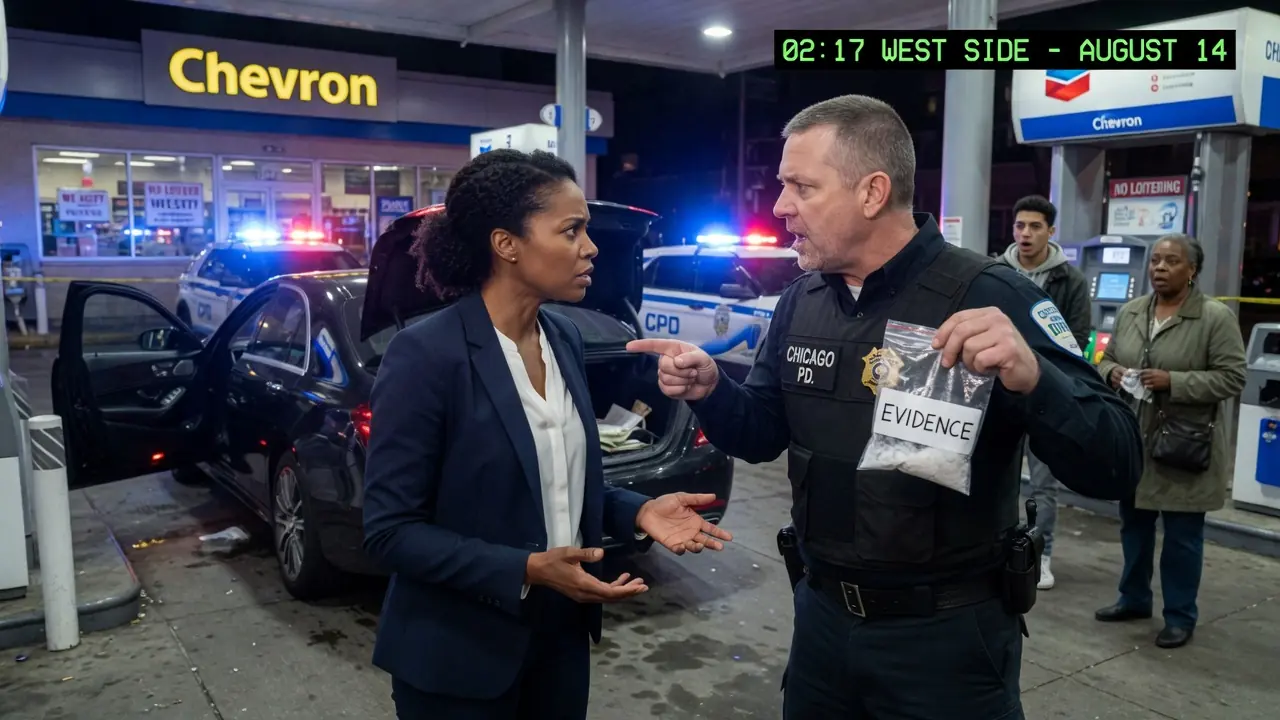
In the underbelly of Chicago’s West Side, where the streetlights flickered like dying stars and the wind carried the faint scent of decay and desperation, Lieutenant Marcus Hale gripped the steering wheel of his unmarked cruiser with white-knuckled hands. The dashboard clock read 2:17 a.m., and the city felt like it was holding its breath. Beside him, Officer Jamal Reed shifted uncomfortably in the passenger seat, his dark skin glistening with a thin sheen of nervous sweat under the glow of the GPS screen. At twenty-eight, Jamal was still new enough to the Narcotics Division to feel the weight of every bad decision, yet old enough to know that refusing Marcus meant career suicide.
“Numbers are shit this month, kid,” Marcus muttered, lighting another cigarette despite the no-smoking rule in the department’s vehicles. His voice was gravel and smoke, shaped by twenty-two years on the job and a dozen internal investigations he’d somehow dodged. “Captain wants ten felony collars by Friday or we’re all riding desks. You know what that means.”
Jamal nodded without looking at him. He knew. It meant they weren’t hunting dealers tonight. They were manufacturing them. The playbook was simple, brutal, and unspoken: pick a mark who looked easy, plant the package, run the lights, and watch the arrest stats climb. The department called it “proactive policing.” The streets called it something else.
Their target had appeared twenty minutes earlier—a sleek black Mercedes E-Class gliding through the crumbling blocks like it didn’t belong. The woman behind the wheel was Black, mid-thirties, dressed in a crisp navy blazer and white blouse that screamed professional even at this hour. No flashy jewelry, no nervous glances. Just calm focus on the road. Her plates came back clean—registered to a Maya Reynolds, address in the upscale Loop district. Too clean for this neighborhood.
“Perfect,” Marcus said, exhaling smoke that fogged the windshield. “Rich Black bitch slumming it. Jury’ll eat it up. She’ll plead out before sunrise.”
They followed at a distance until she pulled into the parking lot of a 24-hour corner store on Pulaski. The woman stepped out, tall and poised, her heels clicking against cracked asphalt as she disappeared inside. Marcus killed the engine. “Go time.”
Jamal hesitated for half a second. “Lieutenant… what if she’s got a lawyer on speed dial? Or family with money?”
Marcus laughed, a dry, ugly sound. “Then she’ll learn that money don’t buy justice in my city. Trunk’s unlocked. You plant it under the spare. Half-kilo of the good stuff—pure enough to make the lab techs cream their pants. I’ll keep eyes on the store.”
He moved like a shadow, slim-jimming the trunk open in under ten seconds. The interior was spotless: emergency kit, neatly folded blanket, a leather briefcase that smelled of expensive leather. He slid the vacuum-sealed brick beneath the spare tire, closed the trunk without a sound, and melted back toward the cruiser. Maya Reynolds emerged from the store carrying a bottle of water and a pack of gum. She never once looked in their direction.
Marcus started the engine as she pulled out. “Lights on in three… two… one.”
The cruiser’s blue-and-reds flared behind her. Maya signaled smoothly and eased to the curb beneath a burned-out streetlamp. Marcus approached the driver’s side with his hand already resting on his holster. Jamal covered the passenger door, flashlight beam cutting through the tinted glass.
“License, registration, and insurance, ma’am,” Marcus barked, shining his light directly into her face.
Maya handed over the documents without a tremor. Her eyes—deep brown, intelligent, unreadable—met his without flinching. “Is there a problem, Officer?”
“Suspicious activity in a high-narcotics zone,” Marcus recited, the lie rolling off his tongue like scripture. “We’re gonna need to search the vehicle.”
“I know my rights,” she said evenly. “Do you have probable cause or consent?”
Marcus smirked. “Your behavior gives me reasonable suspicion. Step out of the car, please.”
She complied, hands visible, movements deliberate. Jamal watched her face as Marcus “discovered” the package in the trunk. Her expression didn’t crack. No tears, no outrage, no frantic pleas. Just a quiet, almost clinical detachment that sent a chill down Jamal’s spine.
“Half a kilo of cocaine,” Marcus announced triumphantly, holding the brick aloft for the body-cam. “You’re under arrest for possession with intent to distribute. Turn around.”
The handcuffs clicked around her wrists. Maya Reynolds said nothing as they placed her in the back of the cruiser. The ride to the 11th District station was silent except for the crackle of the radio. Marcus was already calling it in, voice booming with manufactured pride. “Big one tonight, boys. Reynolds is going down hard.”
At the precinct, the fluorescent lights buzzed like angry hornets. Booking was a circus. Officers high-fived Marcus in the hallway while Maya stood motionless at the counter, fingerprints rolling across the scanner, mugshot taken under harsh white light. She declined every question, requested her one phone call, and sat ramrod straight on the metal bench in the holding cell.
Jamal lingered near the observation window, watching her. Something about her stillness unsettled him. Most perps cried, cursed, or bargained. She simply stared at the wall as if reviewing a mental checklist.
Two hours later, the night sergeant burst into the bullpen waving a printout. “Hale! Reed! Captain’s office. Now.”
Marcus swaggered in first, still riding the high. Captain Denise Morales was waiting behind her desk, face carved from granite. Beside her stood two strangers in dark suits—federal, no question. And a woman in her forties with a badge clipped to her belt.
“What the hell is this?” Marcus demanded.
Captain Morales slid a thick file across the desk. The top sheet bore a federal seal. Marcus’s eyes widened as he read the name: Special Agent Elena Brooks, Federal Bureau of Investigation, Undercover Operations Division.
The photograph clipped to the corner was unmistakably the woman in the holding cell.
Marcus’s cigarette fell from his lips.
Jamal felt the floor tilt beneath his feet.
“Gentlemen,” the older federal agent said, voice like winter steel, “you just arrested one of our own. Agent Brooks has been embedded in this city for eighteen months investigating precisely this kind of systemic evidence planting within the Chicago PD Narcotics Unit. Your little performance tonight was captured on multiple federal surveillance feeds. Congratulations. You just handed us the case of the decade.”
Elena Brooks—still in her navy blazer, cuffs now removed—was escorted into the room by another agent. She looked exactly as she had on the street: calm, composed, lethal. Her gaze swept over Marcus and Jamal with the precision of a scalpel.
“You picked the wrong Black woman,” she said quietly. Her voice carried no triumph, only exhaustion and finality. “I’ve documented every single one of your setups for the last year. Names. Dates. Amounts. Body-cam tampering. The whole rotten system.”
Marcus lunged forward, face purple. “This is bullshit! She’s lying! We found the—”
“Save it,” the federal agent cut in. “We have the real package you planted. We have the serial numbers on the evidence bags. We have Jamal’s fingerprints on the trunk latch from the convenience store lot. And we have Agent Brooks’s real vehicle—parked three blocks away with a completely different plate—while she drove the bait car we provided.”
The room exploded into chaos. Internal Affairs agents poured in. Handcuffs snapped around Marcus’s wrists. Jamal sank into a chair, head in his hands, whispering, “I knew it… I fucking knew it…”
Elena Brooks watched the arrests with the detached professionalism of someone who had waited a long time for this moment. Later, in a secure federal debriefing room across town, she accepted a fresh cup of coffee from her handler and finally allowed her shoulders to relax an inch.
“You did good, Elena,” the handler said. “Eighteen months in that hell. Most agents would have broken.”
She stared into the black liquid. “I almost did. Every time I watched them plant on some kid who just wanted to get home. Every time I heard the slurs, the jokes about ‘easy targets.’ But tonight… tonight they chose me. Their own prejudice wrote the ending.”
Back at the 11th District, the FBI raid unfolded like a slow-motion apocalypse. Computers seized. Lockers ripped open. Officers who had laughed at Maya Reynolds’s arrest now stood in stunned silence as federal vans lined the lot. News helicopters thumped overhead, their spotlights carving white tunnels through the predawn sky. By morning, every major network carried the headline: “Chicago PD Narcotics Officers Arrest Undercover FBI Agent—Corruption Probe Explodes.”
Marcus Hale sat in a federal holding cell, staring at the concrete wall, his career, pension, and freedom evaporating in real time. Jamal Reed, granted temporary immunity in exchange for full cooperation, gave a tearful statement that would bury half the unit. He kept seeing Elena Brooks’s calm face in the holding cell and wondering how many other “Maya Reynolds” had never been federal agents—how many lives they had destroyed for a quarterly statistic.
Elena Brooks stood on the rooftop of the federal building at sunrise, wind whipping her blazer. She watched the city wake beneath her: trains rattling over elevated tracks, early commuters hurrying past boarded-up storefronts, children in school uniforms dodging puddles on cracked sidewalks. Somewhere down there, another young Black officer was probably climbing into a cruiser right now, wondering if tonight would be the night he crossed the line.
She took a long breath. The trap had been baited perfectly.
And justice, for once, had swallowed the bait whole.
The investigation that followed consumed the department like wildfire. Over the next six weeks, federal prosecutors unsealed indictments against seventeen officers and two captains. Evidence logs were rewritten in courtrooms where judges listened in stunned silence to recordings of Marcus Hale bragging about “making the numbers.” Defense attorneys tried every trick—claiming entrapment, racial bias in reverse, even mental duress—but the body-cam footage, the planted package’s chemical signature, and Elena Brooks’s meticulous logs were ironclad.
Jamal testified for three straight days, voice cracking as he described the first time Marcus had handed him a brick and said, “Welcome to the real job, kid.” He received a reduced sentence—eighteen months in a low-security facility—and a promise of witness protection. When the marshals drove him away, he looked back at the city skyline and whispered a single word: “Sorry.”
Marcus Hale, however, went down swinging. In his trial he screamed about conspiracy, about how “the feds set us up,” but the jury—eight Black, three Latino, one white—deliberated for only four hours before returning guilty verdicts on all counts: civil rights violations, evidence tampering, perjury, and conspiracy. The judge gave him thirty-two years. As marshals led him away in chains, Marcus locked eyes with Elena Brooks sitting in the gallery. She offered him the same calm, unreadable stare she had given him that night on the curb.
“You picked the wrong Black woman,” she mouthed silently.
Outside the courthouse, Elena Brooks—now fully out of cover—stood on the steps beneath a gray Chicago sky. Reporters shouted questions. Cameras flashed. She raised one hand, and the crowd quieted.
“I didn’t become an FBI agent to punish police,” she said, voice steady over the microphones. “I became one because I believed the badge could mean something better. What happened to me was not an isolated incident. It was policy. Tonight, that policy ends. For every mother whose son was framed, for every father who lost years to a planted gram, for every kid who grew up thinking the police were the enemy—this is for you.”
She stepped down into a waiting black SUV. As it pulled away, the city moved on, but something had shifted. In the West Side precincts, officers checked their body-cams twice. In the housing projects, grandmothers hugged their grandsons a little tighter. And somewhere in a quiet federal safe house, Elena Brooks finally slept through the night without dreaming of handcuffs.
The trap had closed. The bait had won.
And Chicago, for one brief, fragile moment, breathed a little freer under the weight of truth.
Six months later, the West Side had not transformed overnight into some postcard of redemption. The streetlights still stuttered like faulty memories, and the wind off the lake still smelled of diesel, wet concrete, and the faint rot of promises long broken. Reform commissions had been formed, body-cam policies tightened on paper, and a handful of civil lawsuits were grinding through the courts like slow freight trains. But the city—Chicago being Chicago—kept its old rhythm: sirens at 3 a.m., corner boys nodding in doorways, grandmothers clutching rosaries and grocery bags.
Elena Brooks sat alone at a window table in a quiet coffee shop on North Avenue, steam rising from a plain black coffee she hadn’t touched. No navy blazer today. Just dark jeans, a gray hoodie, and the faint scar on her left wrist from the cuffs that had once been real. Her hair was pulled back tight, the way she wore it when she wasn’t pretending to be anyone else. Across the scarred wooden table sat Tyrell Washington, nineteen, lanky, eyes older than his face. His older brother, Darius, was still serving seven years on a case Marcus Hale had closed in 2024 with the same playbook.
“You really shook the tree,” Tyrell said, voice low. He kept glancing at the door like he expected badges to walk in. “Whole block still buzzing about it. Some cops looking over their shoulders now. Others… they just got quieter about it.”
Elena gave him the smallest of smiles—more habit than warmth. “We cut off one head. The body’s still twitching.” She slid a thick manila envelope across the table. Inside: affidavits, case numbers, the name of a civil rights attorney who didn’t charge families like theirs, and a letter from the U.S. Attorney’s Office confirming Darius’s conviction was under active federal review. “It won’t erase the time he lost. Nothing does. But it might get him home before his daughter forgets what he looks like.”
Tyrell’s fingers tightened on the envelope. His eyes glistened, but he blinked it back hard. “A lot of us figured y’all were all the same. Blue wall, thin blue line, whatever they call it. Thought nobody with a badge gave a damn.”
“I know,” Elena said quietly, staring past him at the traffic crawling outside. “That’s why I stayed under for eighteen months. Sometimes the only way to kill the monster is to climb inside its mouth and wait for it to swallow.”
Her phone vibrated on the table. A single encrypted text from her new handler: *15th District. Fresh tip. Same pattern. You in?*
Elena stared at the screen for three full heartbeats. The exhaustion in her bones felt heavy enough to anchor ships. She had testified for four straight weeks. She had buried two fellow agents who’d tried the same game in other cities. She had started waking up without the phantom click of handcuffs around her wrists. But the city was still bleeding.
She typed back one word: *Yes.*
Outside, the wind picked up, rattling the plate-glass window. Tyrell watched her stand, shoulders squared the way they had been that night in the holding cell.
“You ever get tired of being the bait?” he asked.
“Every damn day,” she said. “But somebody has to keep reloading the trap.”
Two hundred miles away, in a nondescript federal safe-house ringed by cornfields and razor-wire fencing, Jamal Reed—now legally James “Jimmy” Harlan—sat on a cheap plastic chair on a cracked concrete patio. The new name still sat wrong in his mouth, like borrowed clothes that itched. He was thinner now, hollowed out by testimony and guilt and the long nights replaying every arrest he’d helped manufacture.
On the table in front of him lay a half-finished letter. The fifth draft. This one was addressed to the families—plural—of the people he and Marcus had framed. He didn’t know if they’d ever read it. He didn’t even know if the marshals would let it leave the compound. But the words kept coming anyway.
*I was twenty-eight and scared. That’s not an excuse. It’s just the truth. I helped bury people who never did the things we said they did. If I could trade places with any one of them, I would. I’m sorry doesn’t cut it, but it’s all I’ve got left.*
He sealed the envelope with shaking hands, then looked up at the flat gray sky. Somewhere back in Chicago, Elena Brooks was already driving toward another corner, another cruiser, another midnight setup. He wondered if she ever thought about him. He hoped she didn’t.
The city kept moving, indifferent and alive. Elevated trains rattled over graffiti-tagged tracks. Kids in school uniforms still dodged puddles on cracked sidewalks. In the 11th District roll-call room, new sergeants read the updated use-of-force policy out loud while older officers rolled their eyes. In the housing projects, some grandmothers still hugged their grandsons a little tighter at night. And in the underbelly, where the streetlights flickered like dying stars, another young Black officer climbed into a cruiser, wondering if tonight would be the night he crossed the line—or the night someone finally crossed it for him.
Elena Brooks started her engine. The trap had closed once.
Now she was already baiting the next one.
And Chicago, stubborn and scarred and still breathing, waited to see who would swallow the hook this time.