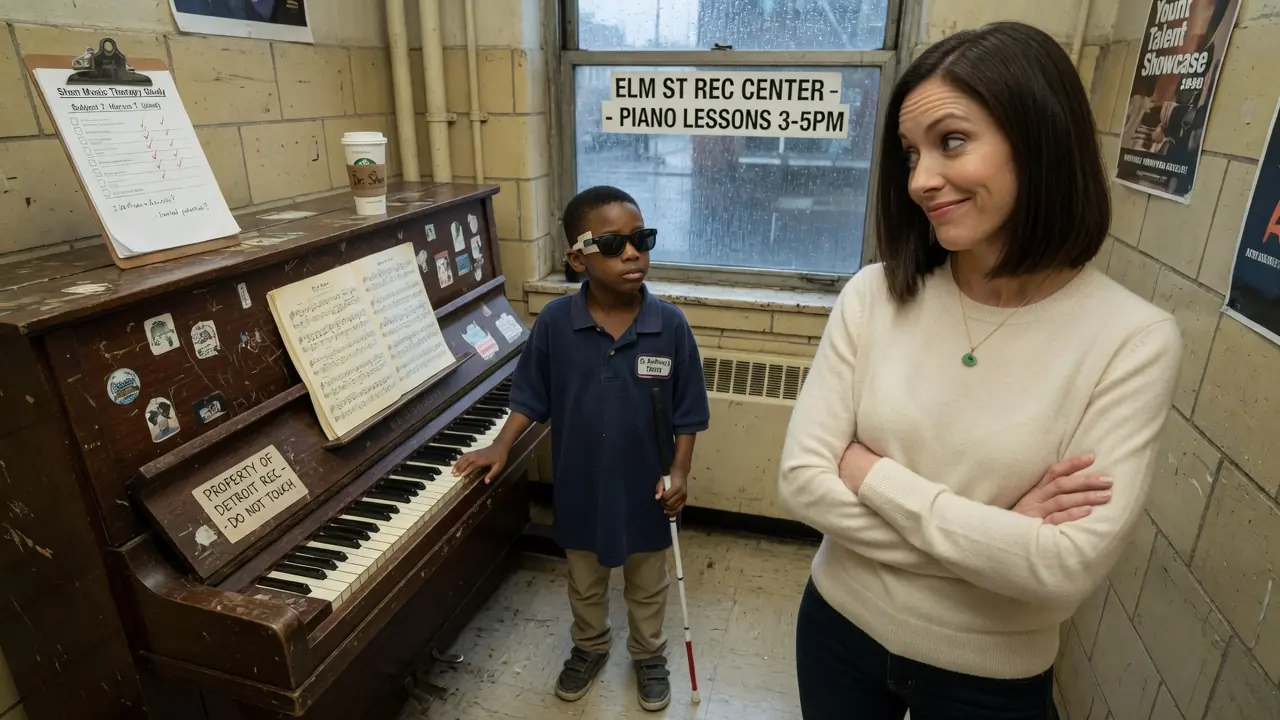
The old community center on Elm Street had seen better days. Paint peeled from its walls like autumn leaves, and the wooden floors creaked with every step. But for 8-year-old David, this place was pure magic. Every afternoon at 3:30, he would walk through those heavy doors, his white cane tapping rhythmically against the floor, feeling his way to the back corner where his treasure waited.
The piano was nothing special to look at. Donated years ago by St. Mary’s Church down the street, it had countless scratches on its brown wooden surface. Several keys stuck when you pressed them, and it hadn’t been tuned in who knew how long. Most kids avoided it completely. But David couldn’t see its flaws. To him, it was the most beautiful instrument in the world.
David had been born blind. His parents died in a car accident when he was just 3 years old, leaving him in the care of his grandmother, Betty. She was a strong woman in her 70s who worked two jobs to keep food on the table and a roof over their heads. During the day, she cleaned offices downtown. At night, she worked at a local diner, serving coffee to late-night customers and truck drivers passing through.
Money was always tight in their small apartment. The walls were thin, and you could hear everything the neighbors did. The refrigerator hummed loudly, and the radiator clanged through the winter nights. But despite all the challenges, Betty made sure David never felt like a burden. She would tell him stories before bed and sing old gospel songs while cooking their simple meals.
The community center became David’s second home after school. While other kids ran around the basketball court or played video games in the recreation room, David was drawn to that corner piano like a moth to light. He had no idea how to read music. Nobody had ever taught him where to put his fingers or how to sit properly. He just climbed onto the bench and started pressing keys.
At first, the sounds he made were random. Notes crashed together without any pattern or purpose. But David didn’t give up. Something inside him knew there was music waiting to be discovered. Day after day, he returned to experiment with different combinations of keys. His small fingers began to remember which sounds went well together and which ones clashed.
The breakthrough came on a rainy Tuesday afternoon in October. David was alone in the center, as usual, when a melody started forming under his fingers. It wasn’t anything he had heard before. The notes seemed to flow naturally, one leading to the next, like stepping stones across a stream. For the first time, he felt like he was really making music instead of just noise.
From that day forward, David’s musical journey took off like a rocket. He would hear songs on the radio during the short bus ride to school and somehow manage to recreate them on the piano later that afternoon. Gospel hymns his grandmother hummed while cooking, pop songs that played in the grocery store, classical pieces that drifted from the music teacher’s classroom at school. David absorbed them all and made them his own.
Mrs. Rodriguez, who managed the community center, started noticing David’s progress. At first, she thought someone else must be playing when she heard beautiful music coming from the piano room. But when she investigated, she always found David alone, completely absorbed in his playing. His whole body would sway with the rhythm, and his face would light up with pure joy.
The other kids at the center began to take notice, too. They would gather around the piano, watching in amazement as David’s fingers danced across the keys. Some asked him how he learned to play so well, but David couldn’t really explain it. The music just felt natural to him, like breathing or walking.
David’s favorite time to play was late in the afternoon when the center grew quiet. Most kids had gone home for dinner, and the building settled into peaceful silence. That was when David felt most connected to the music. He would close his eyes, even though it made no difference to what he could see, and let his emotions guide his fingers.
Sometimes he played sad songs that reminded him of missing his parents. Other times, he created cheerful melodies that captured his excitement about learning something new at school. The piano became his voice in a world where he often felt invisible. Through music, he could express feelings he didn’t have words for.
Betty would pick him up from the center each evening after her day job ended. She could always tell what kind of day David had by listening to him play for just a few minutes. If he had been frustrated with schoolwork, his music would sound tense and choppy. If he had made a new friend or learned something exciting, the melodies would practically dance with happiness.
One evening, Betty sat down beside David on the piano bench and listened as he played a gentle, flowing piece he had created that afternoon. Tears rolled down her cheeks as she realized how truly gifted her grandson was. She had always known he was special, but this was something beyond what she had imagined possible.
The neighborhood where they lived wasn’t easy. Sirens wailed through the night, and sometimes David could hear shouting from the apartment next door. Betty worried constantly about their safety and whether she was providing enough for David. She felt guilty that she couldn’t afford piano lessons or a better instrument for him to practice on.
But David never complained about what they didn’t have. He was grateful for the community center and the chance to make music every day. He didn’t know that other kids his age took private lessons or played on expensive instruments. To him, music was about the joy he felt when the notes came together perfectly, not about having the fanciest equipment.
As winter approached, David’s playing grew more sophisticated. He started combining melodies he had heard with his own original ideas, creating unique arrangements that surprised even himself. The community center’s piano might have been old and worn, but in David’s hands, it sang with warmth and beauty that touched everyone who heard it.
Betty often wished David’s parents could see how amazing their son had become. She knew they would be so proud of his musical gift and his gentle, determined spirit. Even though life had dealt David some difficult cards, he faced each day with optimism and curiosity that inspired everyone around him.
Little did David know that his daily practice sessions at the community center were preparing him for something extraordinary. Each afternoon spent at that old piano was building skills and confidence that would soon change his life in ways he couldn’t imagine. The music flowing from his heart was about to be heard by someone who could recognize just how special his gift really was.
Dr. Isabella Chun had performed in concert halls across five continents. Her name appeared on album covers and music stores from New York to Tokyo. Critics called her one of the finest classical pianists of her generation. But on this cold February morning, she found herself in a place she had never expected to visit, a run-down community center in one of Detroit’s most challenging neighborhoods.
The charity foundation she supported had asked her to evaluate their music programs in underserved communities. Isabella usually sent representatives for these kinds of visits, but something about this particular request intrigued her. Maybe it was the passionate letter from Mrs. Rodriguez, the center’s director, describing the impact music was having on local children, or perhaps it was her own memories of growing up in a modest household, where every piano lesson was a sacrifice her parents gladly made.
As Isabella’s car pulled up to the community center, she noticed the stark difference between this neighborhood and the upscale venues where she typically performed. Broken streetlights dotted the sidewalk, and several storefronts sat empty with newspaper covering their windows. But there was also something hopeful here. Children’s artwork decorated the center’s front windows, and a small garden by the entrance showed signs of careful tending despite the winter weather.
Isabella stepped out of her car, pulling her coat tighter against the February wind. She had dressed down for this visit, wearing simple jeans and a sweater instead of her usual performance attire. Still, she felt out of place in this environment. The weight of her expensive purse and the luxury car behind her seemed almost embarrassing in this setting, where every dollar clearly mattered.
Mrs. Rodriguez greeted her at the front door with genuine warmth. She was a woman in her 50s with kind eyes and hands that showed years of hard work. As they walked through the center, Mrs. Rodriguez explained their programs with obvious pride. They offered after-school tutoring, art classes, and a small music room with donated instruments. The funding was always tight, but the staff’s dedication made up for what they lacked in resources.
Isabella listened politely, taking mental notes about what equipment they needed and how her foundation might help. But as they walked deeper into the building, something stopped her mid-sentence. Music was flowing through the walls. Not the simple melodies she expected from children learning to play, but something far more sophisticated.
The sound was hauntingly beautiful. Someone was playing what sounded like a classical piece, but with emotional depth that made Isabella’s heart skip. The technique was impressive, but more than that, there was something raw and honest in the performance that reminded her why she had fallen in love with music in the first place.
Mrs. Rodriguez noticed Isabella had stopped walking.
“Oh, that’s just David,” she said with a smile. “He comes here every day after school. Sweet boy, that one. He’s been teaching himself to play on our old piano.”
Isabella felt a chill that had nothing to do with the February weather.
“Teaching himself?”
“How long has he been taking lessons?” Isabella asked, her voice barely above a whisper.
Mrs. Rodriguez looked confused.
“Lessons? Oh, honey, David doesn’t take lessons. His grandmother works two jobs just to keep them afloat. He just started playing one day and somehow figured it out on his own. Been doing it for about 6 months now.”
Isabella’s mouth went dry.
Six months. The piece being played required technical skills that took most students years to develop. Either Mrs. Rodriguez was mistaken about the timeline, or Isabella was about to witness something extraordinary.
Following the sound, they walked toward a small room at the back of the center. Through the doorway, Isabella could see a young boy sitting at an upright piano that had definitely seen better days. His back was straight, his posture surprisingly good for someone who had never been taught proper technique. But what struck Isabella most was the complete absorption on his face. The child was lost in the music, unaware of anything else around him.
As they got closer, Isabella realized the boy was blind. His eyes didn’t track the movement in the doorway, and there was no sheet music in front of him. He was playing entirely from memory and feel. The piece he was performing was Chopin’s Nocturne in E-flat Major, one of Isabella’s personal favorites. But this wasn’t a simple reproduction of the famous melody. The boy was adding his own interpretations, small variations that somehow made the familiar piece feel fresh and new.
Isabella stood frozen in the doorway. In her 25-year career, she had heard this nocturne performed hundreds of times by accomplished musicians in the world’s finest concert halls, but she had never heard it played with such pure emotion. The boy’s version told a story of longing and hope that brought tears to her eyes.
Mrs. Rodriguez started to call out to David, but Isabella quickly raised her hand for silence. She needed to hear more.
The boy transitioned seamlessly from the Chopin piece into something Isabella didn’t recognize, an original composition that seemed to flow directly from his heart onto the keys. The melody started soft and contemplative, like morning mist over a lake. Then it built gradually, gaining complexity and emotional weight. Isabella could hear themes of struggle and perseverance woven throughout. There were moments of sadness that reminded her of minor keys in a funeral march, but they always resolved into something hopeful and bright.
As a professional musician, Isabella could analyze the technical aspects of what she was hearing. The boy’s timing was impeccable. His understanding of harmony and chord progressions was sophisticated beyond his years. But the technical skills, impressive as they were, paled in comparison to the emotional intelligence behind his playing.
When David finally finished his impromptu concert, the silence that followed felt sacred. Isabella realized she had been holding her breath. She had heard countless child prodigies over the years, but this was different. This wasn’t just technical ability or even raw talent. This was music that came from somewhere deep inside, the kind of authentic expression that couldn’t be taught in any classroom.
David sat quietly for a moment, his hands resting gently on the keys. Then he began playing again, this time something light and playful that made Isabella smile despite her amazement. It was as if he was cycling through different emotions, using the piano as a way to process his feelings about the day.
Mrs. Rodriguez whispered that David came to the center every afternoon and played for about an hour before his grandmother picked him up. She said other children often gathered around to listen, drawn by the beauty of his music, even though they couldn’t quite understand what made it so special.
Isabella watched David’s face as he played. There was pure joy there, the kind of happiness that comes from doing exactly what you’re meant to do. She recognized that expression because she remembered feeling the same way when she first discovered her own love for the piano decades ago.
But she also saw something else in David’s playing that broke her heart a little. This child had an extraordinary gift, but he was developing it in isolation without proper guidance or opportunities. He was like a diamond in the rough, beautiful even in its unpolished state, but capable of becoming something truly magnificent with the right support.
As Isabella stood there listening to this remarkable young musician, she knew her life was about to change direction. She had come here expecting to write a check and move on to her next performance. Instead, she had discovered something precious and rare, a musical soul that deserved every opportunity the world could offer.
Isabella waited until David finished his piece before stepping into the room. Her heart was still racing from what she had just witnessed. She had to take a deep breath to steady her voice before speaking.
“That was absolutely beautiful,” she said softly, not wanting to startle the young boy.
David turned his head toward her voice, a shy smile spreading across his face.
“Thank you,” he replied politely. “I didn’t know anyone was listening.”
“I’m Dr. Isabella Chun,” she said, moving closer to the piano. “I’m a pianist, too. Would you mind if I sat down and talked with you for a few minutes?”
David nodded eagerly and scooted over on the piano bench to make room. Isabella was struck by how small he looked next to the old upright piano, yet his presence at the instrument seemed completely natural, like he belonged there.
“How long have you been playing?” Isabella asked, though she already knew the answer would surprise her.
“About 6 months,” David said, his fingers unconsciously finding the keys and playing a soft melody while he talked. “I started coming here after school, and this piano was just sitting here. Nobody else really used it, so I began trying to make music.”
Six months. Isabella shook her head in disbelief. She had students at the conservatory who had been playing for years and couldn’t match what she had just heard.
“And you’ve never had any lessons?”
David shook his head.
“My grandma Betty works really hard, but there’s not extra money for things like that. She feels bad about it sometimes, but I told her, ‘It’s okay. I like figuring things out myself.’”
The simplicity and maturity in his response touched Isabella deeply. Here was a child with extraordinary talent who harbored no resentment about his circumstances. Instead, he had turned limitation into opportunity, creating his own musical education through pure determination and natural ability.
“Where did you learn that Chopin piece I heard you playing?” Isabella asked.
David’s face lit up.
“Oh, that one. I heard it on the radio last month when Grandma Betty was driving me to the doctor. It was so pretty that I couldn’t stop thinking about it. When I got here, I tried to remember how it went and played around until it sounded right.”
Isabella felt goosebumps rise on her arms. Learning a complex classical piece by ear after hearing it once was something even advanced musicians struggled with. For an 8-year-old to accomplish this was almost unbelievable.
“David,” she said carefully, “would you play something else for me? Maybe something you created yourself.”
Without hesitation, David launched into an original composition that seemed to tell a story without words. The melody started gentle and questioning, like a child exploring a new place. Then it grew more confident, with playful runs and cheerful chord progressions that painted pictures of joy and discovery. Toward the end, the music became more contemplative, as if the child in the story was reflecting on all the wonderful things he had found.
When David finished, Isabella sat in stunned silence. The piece was not only technically impressive, but emotionally sophisticated in a way that suggested musical maturity far beyond his years. She found herself wiping away tears she hadn’t realized were falling.
“That was incredible,” she whispered. “You have a very special gift, David.”
David beamed with pride.
“Music makes me happy,” he said simply. “When I play, I feel like I can share that happiness with other people.”
Isabella knew she was at a crossroads. She could walk away from this encounter, maybe arrange for the foundation to donate some money for new instruments, and continue with her regular life of concerts and recordings. Or she could take a chance on something that might change both their lives forever.
“David,” she said slowly, “I have a charity concert coming up in 2 weeks. It’s to raise money for music programs in places like this community center. Would you like to perform at it?”
David’s hands froze on the keys.
“Me? Perform in a real concert?”
“It would just be for fun,” Isabella said quickly, seeing the mix of excitement and nervousness on his face. “You could play whatever you want. Maybe that beautiful piece you just played for me.”
Before David could respond, Betty arrived for her daily pickup. Isabella heard his grandmother’s voice calling from the main room, and David called back that he was in the piano room.
Betty appeared in the doorway, her work uniform wrinkled from a long day of cleaning offices. She looked tired but smiled warmly when she saw David at the piano with a visitor.
“Grandma Betty, this is Dr. Chun,” David said excitedly. “She’s a real pianist, and she wants me to play in a concert.”
Betty’s expression shifted from pleasant curiosity to protective concern.
“A concert?” she asked, looking at Isabella with new wariness.
Isabella stood and extended her hand.
“Mrs. Johnson, I’m Isabella Chun. I’m a classical pianist, and I was just listening to David play. He has remarkable talent.”
Betty shook her hand politely, but remained guarded.
“David loves his music, that’s for sure, but I don’t know about any concert. We’re just regular folks.”
Isabella understood Betty’s hesitation perfectly. A stranger appearing out of nowhere with big promises probably seemed too good to be true and possibly dangerous. Betty was protecting her grandson the only way she knew how.
“I completely understand your concern,” Isabella said gently. “Maybe I could explain what I have in mind. The concert is a charity event at the Detroit Symphony Hall. All the money raised goes to music programs for children. David would just play one or two pieces, whatever he’s comfortable with.”
Betty frowned.
“We don’t have fancy clothes for something like that. And David’s never performed for strangers before.”
“He wouldn’t need fancy clothes,” Isabella assured her. “And honestly, Mrs. Johnson, David’s talent is so extraordinary that I think he could help raise a lot of money for other children who love music but don’t have access to instruments or lessons.”
David had been listening quietly to this conversation, his fingers still moving softly across the keys.
“Grandma,” he said softly, “could we maybe think about it? I’d like to help other kids get to make music, too.”
Betty looked at her grandson’s hopeful face and felt her resolve weakening. She had always told David he could do anything he set his mind to, but this felt bigger and scarier than anything they had ever considered.
Isabella sensed Betty’s internal struggle.
“What if you came to one of my rehearsals first?” she suggested. “You could see where the concert will be held and meet some of the other musicians. There would be no pressure to decide anything until you’re both completely comfortable.”
Betty considered this for a long moment. She looked at David, who was practically vibrating with excitement, then back at Isabella, who seemed genuine in her enthusiasm for David’s talent.
“You really think he’s that good?” Betty asked quietly.
Isabella met her eyes directly.
“Mrs. Johnson, in 25 years of professional music, I have never heard anyone play with the natural ability your grandson has. He’s not just good. He’s extraordinary.”
Betty felt tears welling up in her eyes. She had always known David was special, but hearing it from someone who clearly knew music made it feel real in a way it never had before.
“All right,” she said finally. “We can go to your rehearsal and see what this is all about. But if David gets uncomfortable, or if anything doesn’t feel right, we leave. No questions asked.”
Isabella nodded eagerly.
“Of course. I’ll give you my phone number, and you can call me with any questions you have.”
David couldn’t contain his excitement any longer.
“Really, Grandma? We can go see a real concert hall?”
Betty smiled at her grandson’s enthusiasm.
“We can go look, baby. Just look.”
As they exchanged contact information and made plans for the rehearsal visit, Isabella felt a familiar flutter of excitement in her stomach. It was the same feeling she had gotten before her first major performance, that mixture of nervousness and anticipation that came with knowing something important was about to happen.
David played one more short piece before they left, a cheerful melody that seemed to dance with his excitement about the upcoming adventure. Betty watched her grandson’s face as he played, seeing a joy there that made her feel like maybe, just maybe, they were about to embark on something wonderful together.
Three days after their first meeting, Betty and David stood outside the Detroit Symphony Hall, both feeling completely out of their element. The building looked like a palace compared to anything they were used to. Tall columns stretched toward the sky, and elegant windows reflected the afternoon sunlight. David couldn’t see the grandeur, but he could feel it in the way sounds echoed differently here, in the hushed voices of people walking by.
Isabella met them at the stage door, wearing casual clothes, but somehow still looking like she belonged in this fancy place. She greeted them warmly and led them through a maze of hallways backstage. David held his grandmother’s hand tightly, his cane tapping against the polished floors as they walked.
“This is where the performers get ready,” Isabella explained, showing them past dressing rooms with bright lights and mirrors. “And this is where the magic happens.”
She opened a door, and they stepped onto the stage of the symphony hall.
David gasped audibly. Even though he couldn’t see the thousands of red velvet seats stretching out into the darkness, he could sense the vastness of the space. The acoustics were unlike anything he had ever experienced. When Isabella spoke, her voice seemed to float and expand, filling every corner of the hall.
“There’s a piano right here in the center,” Isabella said, guiding David’s hand to touch the gleaming black surface of a concert grand piano. “Would you like to try it?”
David nodded eagerly, his nervousness momentarily forgotten.
The moment his fingers touched the keys, he knew this instrument was different from anything he had ever played. The sound was rich and full, each note clear and resonant. It responded to his touch like a living thing, sensitive to every subtle change in pressure from his fingers.
Betty watched from a few feet away as her grandson began to play. The melody he chose was one of his own compositions, something gentle and exploratory. But in this magnificent hall, with this incredible instrument, the music transformed into something even more beautiful than usual. The notes seemed to dance in the air above them, creating layers of sound that gave Betty chills.
Isabella listened with growing amazement. She had thought David’s talent was extraordinary when she heard him on the old community center piano. But hearing him play on a professional instrument in perfect acoustic conditions was almost overwhelming. The clarity and emotion in his playing were beyond anything she had imagined possible.
“David,” she said when he finished the piece, “that was absolutely incredible. How did you know to use those chord progressions?”
David shrugged, his hands still resting on the keys.
“They just felt right. This piano tells me what it wants to hear.”
Over the next hour, Isabella worked with David on some basic performance techniques. She showed him how to acknowledge applause, how to walk on and off stage confidently, and how to sit properly at a concert grand piano. David absorbed everything like a sponge, his natural instincts making up for his lack of formal training.
But the real revelation came when Isabella suggested they try playing a duet. She had brought some sheet music, though of course David couldn’t read it. Instead, she played her part once through so he could hear it. Then they attempted to play together.
What happened next left Isabella speechless. Not only did David perfectly remember the melody she had played, but he began improvising a harmony part that complemented her music beautifully. It was as if he could hear the spaces in her playing where his notes belonged, filling them with exactly the right sounds.
“How are you doing that?” Isabella asked, stopping mid-piece.
“I can hear where the music wants to go,” David explained simply. “Your part sounds like it’s calling for something, so I just answer it.”
Betty, who had been watching this musical conversation between her grandson and this accomplished professional, felt tears streaming down her face. She was beginning to understand that David’s gift was something truly special, something that deserved to be shared with the world.
The next week was a whirlwind of preparation. Isabella arranged for David to practice on a similar piano at a music school across town. Every day after his regular school ended, Betty would pick him up and drive him to his practice sessions. These weren’t formal lessons in the traditional sense. Instead, Isabella would play pieces for David to hear and then watch in amazement as he recreated them with his own unique interpretations.
David’s musical memory proved to be extraordinary. He could hear a complex classical piece once and play it back perfectly, complete with all the subtle dynamics and emotional nuances. But more impressive than his ability to replicate music was his talent for making it his own. Every piece he learned somehow became a David original, infused with his personality and emotional understanding.
Isabella introduced him to works by different composers, watching his face light up as he discovered new musical languages. Beethoven’s powerful emotions resonated with something deep inside David. Mozart’s playful melodies made him smile and add his own cheerful embellishments. Chopin’s romantic style seemed to unlock feelings David couldn’t express in words but could pour out through his fingers.
The most magical moments came when David created original music. Isabella would give him a simple prompt, maybe asking him to create a piece that sounded like rain or one that captured the feeling of flying. David would close his eyes, place his hands on the keys, and music would flow out that perfectly captured the requested emotion or image.
One afternoon, Isabella asked David to create a piece about his life. What emerged was a musical autobiography that started with gentle questioning notes representing his early childhood. The melody grew more complex as it progressed, incorporating themes of loss and sadness that spoke to the challenges he had faced. But the piece always returned to hope and joy, with bright, soaring passages that seemed to reach toward the sky.
When David finished playing his life story, both he and Isabella sat in silence for several minutes. The music had been so honest and beautiful that words seemed inadequate.
“David,” Isabella said finally, “I think that’s what you should play at the concert.”
Betty, who had been listening from the back of the practice room, nodded through her tears. She understood now that this concert wasn’t just an opportunity for David to perform. It was a chance for him to share his gift with people who might never otherwise hear such pure, authentic music.
As the concert date approached, Isabella began to worry about the pressure David might feel performing for such a large audience. But David himself seemed remarkably calm. When she asked if he was nervous, he smiled and shook his head.
“Music is just about sharing happiness,” he said. “I want people to feel what I feel when I play. If they do, then everything will be perfect.”
Isabella realized that David understood something about performing that took many professional musicians years to learn. It wasn’t about showing off or proving how technically skilled you were. It was about connecting with other people through the universal language of music.
The final rehearsal took place the day before the concert. David played his life story piece from beginning to end without a single mistake. But more than technical perfection, his performance had a quality that touched everyone who heard it. The other musicians scheduled to perform that night gathered around to listen, and by the end, there wasn’t a dry eye among them.
As they left the hall that evening, Isabella felt a mixture of excitement and protective nervousness about the next day. She knew David was ready musically, but she also knew that performing for a large audience was different from playing in an empty hall. Still, watching David’s confident smile as he walked off the stage, she felt certain that tomorrow would be a night no one would ever forget.
The Detroit Symphony Hall buzzed with excitement on the evening of the charity concert. Outside, luxury cars dropped off guests in expensive evening wear. Women in glittering gowns stepped carefully up the marble steps while men in perfectly tailored tuxedos escorted them through the grand entrance. This was Detroit’s social elite, people who attended these events as much to be seen as to support the cause.
Inside the lobby, crystal chandeliers cast warm light over clusters of well-dressed patrons sipping champagne and discussing the evening’s program. The conversation was polite but predictable: comments about the weather, compliments on jewelry, and casual mentions of recent vacations to Europe or the Caribbean.
Betty and David arrived 30 minutes before the concert began, using the stage door entrance that Isabella had arranged for them. Betty wore her best dress, a navy blue outfit she had bought years ago for church services. She had spent an hour that afternoon trying to make it look more formal, adding a simple pearl necklace that had belonged to her mother. David wore his only dress shirt and tie, clothes Betty had found at a thrift store the week before.
Backstage, the atmosphere was completely different from the elegant lobby. Musicians warmed up in practice rooms, the sounds of violins, cellos, and piano scales mixing together in a symphony of preparation. Isabella found Betty and David in the green room, where David sat quietly on a folding chair, his hands moving slightly as if he were playing an invisible piano.
“How are you feeling?” Isabella asked, sitting down beside him.
David smiled, though she could see a hint of nervousness in his expression for the first time.
“A little scared,” he admitted. “I’ve never played for so many people before.”
Betty reached over and squeezed his hand.
“Baby, you don’t have to do this if you don’t want to. We can go home right now, and nobody will think less of you.”
“No,” David said firmly. “I want to do it. I want people to hear the music. I’m just scared they won’t like it.”
Isabella knelt down in front of David’s chair.
“David, I want you to remember something. When you play at the community center, how do you feel?”
“Happy,” David said without hesitation. “Like I’m sharing something good with whoever might be listening.”
“That’s exactly what you’re going to do tonight,” Isabella said gently. “The only difference is that there will be more people listening. But music is music, whether you’re playing for one person or 1,000 people.”
Meanwhile, in the concert hall, the audience was taking their seats. The program listed several accomplished local musicians, a small chamber orchestra, and Isabella herself performing pieces by famous classical composers. But buried in the middle of the program was a simple line that most people barely noticed: David Johnson, age 8, will perform an original composition.
Those who did notice the listing had mixed reactions. Some assumed it was a cute addition to the program, a child playing a simple piece to tug at heartstrings and encourage donations. Others wondered why valuable concert time was being given to someone so young and presumably inexperienced.
Margaret Thompson, a wealthy patron who had donated thousands to the symphony over the years, leaned over to her husband during the pre-concert mingling.
“I hope this isn’t going to be one of those painful children’s performances,” she whispered. “You know how these charity events can get carried away with sentimentality.”
Her husband nodded in agreement.
“Hopefully, it will be brief. I’m mainly here to hear Isabella Chun anyway.”
At another table, Dr. William Carter, a retired music professor, studied the program with curiosity.
“David Johnson,” he murmured to his wife. “I don’t recognize that name. Must be very new to the scene.”
“8 years old,” his wife pointed out. “Probably a student of Isabella’s, though it’s unusual for someone that young to perform at this level of event.”
As the lights dimmed and the concert began, the audience settled into their expectations. The first few performances went exactly as anticipated. A string quartet played Mozart with technical precision. A young violinist performed a Vivaldi concerto with impressive skill for her age. Each piece was met with polite, appreciative applause.
Isabella’s own performance, a challenging Rachmaninoff piece, brought the audience to life. This was what they had come to hear: world-class technique and artistry from a recognized master. The applause was enthusiastic and genuine, with several people rising from their seats.
As Isabella took her bows, the stage crew quickly rearranged the setup for the next performer. The grand piano was moved to center stage. A single spotlight was positioned, and all other instruments were cleared away. The simplicity of the setup seemed almost stark after the elaborate arrangements for the previous pieces.
The program coordinator, a nervous-looking man in his 50s, approached the microphone.
“Ladies and gentlemen, we now have a very special performance for you. Please welcome 8-year-old David Johnson, who will be performing an original composition.”
The applause was polite but restrained. Many people used this as an opportunity to check their phones or whisper to their companions. Some shifted in their seats, preparing for what they assumed would be a brief, charming interlude before the serious music resumed.
David walked onto the stage holding Isabella’s hand, his white cane tapping softly against the polished wood floor. The sight of the young blind boy made the audience quiet down out of courtesy, but there was still an air of patient tolerance rather than genuine anticipation.
Isabella helped David find the piano bench and adjust it to the right height. She whispered something encouraging in his ear, then walked off stage, leaving David alone under the bright spotlight.
For a moment, David simply sat still, his hands resting in his lap. The enormous hall stretched out in front of him, filled with nearly 2,000 people he couldn’t see, but could definitely sense. The silence was so complete that he could hear his own heartbeat.
Betty, watching from the wings, felt her chest tighten with anxiety. What if David froze up there? What if the pressure was too much for him? She started to step forward, ready to rescue her grandson if needed.
But then David lifted his hands to the keys, and everything changed.
The first notes of his composition floated into the vast space of the concert hall, and the casual chatter stopped immediately. The melody was hauntingly beautiful, starting soft and introspective, like someone sharing a secret. But there was something in those opening phrases that demanded attention, a depth of emotion that seemed impossible from someone so young.
Margaret Thompson, who had been checking her jewelry in a compact mirror, looked up sharply. The music was nothing like what she had expected. This wasn’t a simple children’s piece. This was sophisticated, complex, and deeply moving.
Dr. Carter leaned forward in his seat, his trained ear immediately recognizing that something extraordinary was happening. The harmonic progressions were advanced, the emotional maturity beyond anything he had heard from a child performer. But more than the technical aspects, there was something authentic and pure in the music that made him forget everything else.
As David’s composition unfolded, telling the story of his young life through music, the entire atmosphere of the concert hall transformed. Conversations stopped completely. Cell phones were forgotten. The audience found themselves drawn into the musical narrative of a child who had faced challenges they couldn’t imagine, yet somehow emerged with hope and joy intact.
The music built to a soaring climax that seemed to lift everyone in the hall, then settled into a gentle, peaceful conclusion that left the vast space ringing with beauty.
When the last note faded away, the silence that followed was profound and sacred. David sat quietly at the piano, his head slightly bowed, completely unaware of the miracle he had just created. He had done exactly what he always did, shared his happiness and his heart through music. The fact that this time he had done it for 2,000 people instead of an empty community center made no difference to him.
The silence in the concert hall stretched for what felt like forever. David sat perfectly still at the piano, his small hands resting on his knees, completely unaware that 2,000 people were holding their breath behind him. He had no idea that grown men and women were wiping tears from their eyes, or that some of the most sophisticated music lovers in Detroit were struggling to understand what they had just experienced.
Then, from somewhere deep in the audience, came the sound of one person clapping. Slowly, hesitantly at first, then with growing conviction, another person joined in, then another. Within seconds, the entire concert hall erupted in thunderous applause that seemed to shake the very foundations of the building.
David’s head lifted in surprise. He had heard applause before at the community center when other kids clapped for his playing, but this was something completely different. The sound rolled over him like a wave coming from every direction at once. Even though he couldn’t see the audience, he could feel their energy and emotion washing over the stage.
People began rising from their seats. Margaret Thompson, who had been so skeptical earlier, found herself standing and clapping with tears streaming down her face. She couldn’t remember the last time music had moved her so deeply. Next to her, her husband was shaking his head in amazement, his usual composed demeanor completely forgotten.
Dr. Carter was on his feet as well, applauding with the enthusiasm of someone who had just witnessed musical history. In his 40 years as a music professor, he had heard thousands of performances by students, professionals, and prodigies. But he had never heard anything like what this 8-year-old boy had just created.
“Remarkable,” he whispered to his wife, though she could barely hear him over the roar of applause. “Absolutely remarkable.”
The standing ovation continued for what felt like an eternity. David remained seated at the piano, overwhelmed by the response, but not quite sure what to do. He had never experienced anything like this before. The sound of all these people clapping for his music filled him with a joy so intense it almost scared him.
Isabella watched from the wings, her own eyes filled with tears of pride and amazement. She had known David was special. But seeing the audience’s reaction confirmed that his gift was even more extraordinary than she had imagined. This wasn’t just talented playing. This was the kind of performance that changed people’s lives.
Betty stood beside Isabella, her hands clasped over her heart as she watched her grandson receive this incredible recognition. She thought about all the nights she had worried about David’s future, wondering how a blind boy from their neighborhood would find his place in the world. Now she was seeing that David didn’t need to find his place. He was creating his own.
As the applause finally began to die down and people started taking their seats again, David stood up from the piano bench. Isabella had taught him to bow at the end of a performance, and he executed a perfect, graceful bow that brought another wave of appreciation from the audience.
But then something unexpected happened. Instead of walking off stage as planned, David returned to the piano. He had felt something in that applause, something that told him the audience wanted more. Without any prompting from Isabella or anyone else, he began to play again.
This time, he chose a piece he had never performed for anyone before. It was something he had created just the week before, inspired by a conversation with Betty about his parents. The melody was gentle and loving like a lullaby, but woven throughout were themes of loss and longing that spoke to anyone who had ever missed someone they loved.
The audience, who had been settling back into their seats, immediately grew quiet again. This new piece was different from the first one, more personal, more intimate. It felt like David was sharing his deepest feelings with 2,000 strangers, trusting them with his most precious memories.
As the music flowed through the concert hall, something magical happened. The usual barriers between performer and audience dissolved completely. David wasn’t just playing music for these people. He was connecting with them on a level that transcended words or social differences.
In the third row, an elderly woman named Helen remembered her husband, who had passed away the previous year. The melody seemed to capture exactly how she felt about their 50 years together: the joy, the sadness of loss, and the gratitude for having had that love in her life.
Several rows back, a young father named Robert found himself thinking about his own son, who was about David’s age. He wondered if he was spending enough time with the boy, if he was supporting his dreams the way Betty obviously supported David’s.
Margaret Thompson, still standing with tears on her cheeks, realized she was witnessing something that would stay with her for the rest of her life. She had attended hundreds of concerts and cultural events, but she had never felt so moved by a performance. This child was teaching her something about courage and authenticity that all her wealth and education had never shown her.
When David finished the second piece, the applause was even more intense than before. But this time, it wasn’t just appreciation for technical skill or even artistic beauty. The audience was applauding David’s courage in sharing such personal, honest music with them. They were thanking him for reminding them why music mattered in the first place.
David stood and bowed again, his face glowing with happiness. He could feel the audience’s emotions, their genuine appreciation for what he had shared with them. This was exactly what he had hoped would happen. People were feeling the joy and beauty that music brought to his own life.
As he finally walked off stage, guided by Isabella, the applause continued for another 5 minutes. Many people remained standing, reluctant to let the moment end. They knew they had experienced something rare and precious, something they would talk about for years to come.
Backstage, David was surrounded by other performers who had been scheduled to play later in the evening. Professional musicians, some with decades of experience, were lining up to congratulate him and shake his hand. They understood better than anyone how extraordinary his performance had been.
“That was incredible, young man,” said Thomas Martinez, a cellist with the Detroit Symphony. “In all my years of performing, I’ve never heard anything quite like that.”
A violinist named Catherine Wu knelt down to David’s level.
“You have a very special gift,” she told him. “Thank you for sharing it with all of us tonight.”
David accepted all the compliments with grace and humility. But what made him happiest was seeing Betty’s proud smile. His grandmother had supported his musical dreams even when they seemed impossible. Now she was seeing that those dreams might actually come true.
Isabella put her arm around David’s shoulders as they stood in the wings watching the remainder of the concert. But it was clear that nothing else that evening would compare to what had just happened. David’s performance had set a standard of emotional honesty and musical beauty that transformed the entire event.
As the final performer of the evening took the stage, Isabella knew that David’s life had just changed forever. Word about his incredible performance would spread quickly through Detroit’s music community and beyond. Opportunities that had seemed impossible just hours earlier were now becoming reality.
But looking at David’s peaceful, happy expression as he listened to the other musicians, Isabella also knew that success and recognition wouldn’t change who he was at his core. David would always be the boy who played music simply because it made him happy and because he wanted to share that happiness with others. That pure love of music, more than any technical skill or natural talent, was what made him truly extraordinary.
The first sign that something extraordinary had happened came at 6:30 the next morning. Betty was making coffee in their small kitchen when her old flip phone started ringing. She almost didn’t answer it, thinking it might be a wrong number since hardly anyone called them this early.
“Is this Mrs. Johnson, David’s grandmother? This is Jennifer Park from Channel 7 News. We heard about your grandson’s performance last night, and we’d love to do a story about him.”
Betty sat down heavily in her kitchen chair, still in her bathrobe and fuzzy slippers. A news story about David.
Before she could fully process what was happening, the phone rang again, then again. By 8:00 that morning, Betty had received calls from three television stations, two newspapers, and a radio show. Word about David’s performance was spreading faster than she could have imagined possible.
David himself was still asleep, exhausted from the emotional intensity of the previous evening. He had no idea that while he was dreaming, his life was changing in ways that would have seemed impossible just 24 hours earlier.
The first video appeared online around 9:00 in the morning. Someone in the audience had been recording when David played his second unplanned piece. The 30-second clip, posted to social media with the caption, “8-year-old blind boy gives performance of a lifetime,” began gathering views at an incredible rate.
By noon, the video had been shared hundreds of times. By evening, it had reached thousands of people across the country. The comments section filled with messages from viewers who were moved to tears by David’s music, even through their phone speakers and computer monitors.
“This child is absolutely incredible,” wrote one viewer. “I’ve never heard anything so beautiful in my life.”
“How is this even possible?” asked another. “He’s playing with more emotion than musicians who’ve been performing for decades.”
“This boy has a gift that needs to be shared with the world,” commented a user from California.
Isabella spent most of that day fielding phone calls at her own home. Music industry professionals, talent agents, and representatives from major record labels were all trying to reach her, hoping she could put them in touch with David and his family.
“I’ve been in this business for 30 years,” said Robert Chun, a talent manager from New York who called that afternoon. “I’ve never seen anything generate this kind of response this quickly. People are calling this performance magical.”
The most surprising call came from Dr. Patricia Williams, the dean of admissions at one of the country’s most prestigious music conservatories.
“Dr. Chun,” she said, “we’ve been following the story about your young protégé. We’d like to discuss a full scholarship opportunity for David.”
Isabella nearly dropped the phone. Full scholarships to elite music schools were almost unheard of, especially for someone so young.
“He’s only 8 years old,” she reminded Dr. Williams.
“We’re aware of his age,” Dr. Williams replied. “We’re also aware that talent like this appears maybe once in a generation. We’d like to arrange a meeting with his family as soon as possible.”
Meanwhile, Betty was struggling to understand what was happening to their quiet life. By the third day after the concert, reporters were showing up at their apartment building. Neighbors who had barely spoken to them before were suddenly very interested in David’s story.
“I always knew there was something special about that boy,” claimed Mrs. Patterson from down the hall, though Betty couldn’t remember her ever showing much interest in David before.
The attention was overwhelming. But what touched Betty most were the personal messages that started arriving. Letters came from parents of other children with disabilities, thanking David for showing the world what was possible. Music teachers wrote to express their amazement at his natural ability. Complete strangers sent notes saying that watching David’s performance online had inspired them to pursue their own dreams.
One letter particularly moved Betty. It came from a woman in Ohio whose daughter was also blind.
“Watching David play gave my little girl hope,” the woman wrote. “She asked me if she could learn piano too. We start lessons next week. Thank you for sharing your grandson’s gift with the world.”
David himself was adjusting to the attention with remarkable maturity. When reporters asked him how it felt to be famous, he seemed genuinely puzzled by the question.
“I’m not famous,” he said simply. “I just play piano because I love it.”
But the opportunities that came with recognition were very real. A major piano manufacturer offered to provide David with a professional-quality instrument for his home. A children’s hospital in Detroit asked if he would consider performing for young patients. Three different music camps extended invitations for the following summer.
The most significant offer came from the Metropolitan Opera House in New York City. They wanted David to perform as a special guest at their annual benefit concert, an event that would be attended by some of the most influential people in the classical music world.
Isabella sat down with Betty and David to discuss all the opportunities that were coming their way. The conversation took place in the same community center where she had first discovered David’s talent, though now the small piano room felt like it belonged to a different lifetime.
“This is all wonderful,” Betty said, looking through the pile of letters and offers spread across the table. “But I’m worried about David. He’s still just a little boy. I don’t want all this attention to change who he is.”
Isabella understood Betty’s concerns completely. She had seen talented young musicians crushed by the pressure of early fame, their love of music destroyed by the business side of the industry.
“The most important thing is that David keeps loving music,” Isabella agreed. “Everything else should come second to that.”
David, who had been listening quietly to their conversation, spoke up.
“Can I still come here to practice sometimes? Even if I get a new piano at home?”
Both women smiled at his question. Despite all the excitement and opportunities swirling around him, David’s priorities remained exactly the same. He wanted to make music, share it with people who would appreciate it, and continue growing as a musician.
“Of course you can come here,” Mrs. Rodriguez said from the doorway. She had been following David’s story with pride and amazement. “This will always be your home.”
As they talked through the various opportunities, it became clear that David’s performance had done more than just launch his own career. The charity concert had raised more money than any previous year, funding music programs in dozens of community centers across the city.
David’s story was inspiring other children to try music for the first time. Local music stores reported increased sales of keyboards and piano method books. The community center where David practiced saw a surge in enrollment for their music programs. Parents who had never considered the arts important were suddenly asking about lessons for their own children.
By the end of the week, David’s story had been featured in national magazines and broadcast on television programs across the country. A documentary filmmaker called, interested in following David’s journey over the next few years. Publishers inquired about book deals telling his story.
But perhaps the most meaningful recognition came from an unexpected source. The mayor of Detroit announced that David would receive the city’s Youth Excellence Award, honoring his contribution to the community through music. The ceremony would take place at the same symphony hall where his journey to recognition had begun.
As Isabella drove Betty and David home from another meeting with potential sponsors and supporters, she reflected on how quickly everything had changed. Just one week earlier, David had been an unknown boy playing on an old piano in a community center. Now he was being hailed as a musical prodigy with opportunities most professional musicians could only dream of.
Yet when she looked in the rearview mirror at David sitting quietly in the back seat, she saw the same gentle, thoughtful child she had first met. His circumstances were changing dramatically, but his character remained exactly the same. He was still the boy who played music because it made him happy and because he wanted to share that happiness with others.
That evening, as Betty tucked David into bed, he asked her a question that showed his heart hadn’t changed despite all the attention.
“Grandma,” he said softly. “Do you think the music programs at other community centers will get enough money to buy better instruments?”
Betty kissed his forehead and smiled.
“Yes, baby. I think they will. Thanks to you, a lot of children are going to get the chance to make music.”
David smiled and closed his eyes, satisfied that his performance had accomplished exactly what he had hoped it would.
Six months after that life-changing night at the Detroit Symphony Hall, David sat at a beautiful black grand piano in the living room of their new apartment. The morning sun streamed through large windows that Betty could never have imagined affording just a year ago. But the most important things hadn’t changed at all. David still played with the same joy and passion that had first captured Isabella’s attention.
The new apartment was in a safer neighborhood with good schools and quiet streets where David could walk without Betty constantly worrying about his safety. The piano had been a gift from the Detroit Music Foundation, established specifically to support David’s education and other young musicians like him. It was perfectly tuned and maintained, responding to David’s touch with crystal-clear notes that filled their new home with music every day.
Betty no longer worked two jobs. The foundation, along with several generous donors who had been moved by David’s story, had provided enough support for her to focus entirely on being David’s grandmother and caregiver. For the first time in years, she could wake up without the bone-deep exhaustion that had been her constant companion.
“Good morning, sunshine,” she called from the kitchen, where she was making David’s favorite breakfast of pancakes and fresh fruit. The simple pleasure of having time to cook a proper meal for her grandson still amazed her sometimes.
David finished the gentle melody he was playing and turned toward her voice.
“Morning, Grandma Betty. I was working on the piece for next week’s recording session.”
The recording session was part of David’s first professional album, a collection of his original compositions that a major record label was producing. Isabella had carefully negotiated the contract to ensure that David would maintain creative control over his music and that his education would always come first.
The phone rang, and Betty answered to find Isabella on the other end. She had become much more than David’s musical mentor over the past 6 months. She was like family now, checking in daily and guiding them through the complex world of professional music.
“How’s our young composer this morning?” Isabella asked warmly.
“Playing beautifully, as always,” Betty replied. “He’s been working on that new piece since he woke up.”
Isabella smiled on her end of the phone. David’s creative output had only increased since gaining access to better instruments and more time to practice. He seemed to create new music almost effortlessly, each piece telling a different story or capturing a unique emotion.
The conservatory opportunity had worked out perfectly. Rather than enrolling David as a traditional full-time student, they had created a special program that allowed him to work with master teachers twice a week while still living at home with Betty. This arrangement gave David access to world-class musical education without overwhelming him or taking him away from the stability of his family.
His teacher, Professor Michael Jang, had initially been skeptical about working with such a young student. But after their first lesson, he called Isabella with excitement.
“This child doesn’t just have natural talent,” he had said. “He has musical wisdom that usually takes decades to develop. I’m not sure what I can teach him that he doesn’t already know instinctively.”
The lessons had evolved into something more like collaborations, with Professor Jang presenting David with new musical concepts and watching in amazement as the boy absorbed and transformed them into his own unique style. David was learning to read Braille music notation, though his phenomenal ear meant he rarely needed it.
The community center on Elm Street had been transformed as well. David’s success had brought attention and funding that allowed them to purchase new instruments, hire qualified music teachers, and expand their programs. The old piano where David had first discovered his gift had been restored and now sat in a place of honor with a small plaque that read: Where Dreams Begin.
David still visited the center twice a week, not as a student now, but as a volunteer teacher. He worked with younger children who were just beginning their musical journeys, showing them that music was about expressing feelings, not just pressing the right keys in the right order.
One of his favorite students was 7-year-old Amy Chun, who had been born with cerebral palsy. David had adapted his teaching methods to work with her physical limitations, showing her how to create beautiful music regardless of the challenges she faced.
“Music isn’t about how your fingers move,” David told Amy during one of their sessions. “It’s about how your heart feels. Your heart works perfectly, so your music can be perfect, too.”
The recording studio sessions had been an adventure for David. The first time he walked into the professional facility with its sophisticated equipment and soundproof rooms, he had been overwhelmed by all the new sounds and sensations. But once he sat down at the studio’s concert grand piano, everything else faded away, and there was just the music.
The album, titled Simple Gifts after one of David’s most beloved compositions, was scheduled for release in the fall. Pre-orders had already exceeded everyone’s expectations, with music lovers around the world eager to own recordings of the young pianist who had captured their hearts.
But perhaps the most meaningful project David had undertaken was his involvement with the Children’s Hospital of Detroit. Every month, he performed for young patients, bringing his music to children who were facing their own difficult challenges. These performances, intimate and personal, reminded David why music mattered in the first place.
During one particularly memorable visit, he had played for a little girl named Sophie, who was recovering from surgery. As his gentle melodies filled her hospital room, Sophie’s parents watched their daughter smile for the first time in weeks. The healing power of music had never been more clear.
The Metropolitan Opera House performance had been a triumph that established David as a serious artist rather than just a novelty act. Critics who had initially been skeptical about such a young performer were forced to acknowledge his extraordinary talent and artistic maturity.
“David Johnson doesn’t just play the piano,” wrote the New York Times music critic. “He speaks through it in a language that transcends age, background, or circumstance. His music reminds us why we fell in love with classical music in the first place.”
Isabella often marveled at how David handled all the attention and opportunities that had come his way. He accepted praise graciously, but never let it go to his head. When interviewers asked about his future plans, he would talk about wanting to help other kids discover music and maybe composing a piece for orchestra someday.
The documentary filmmaker had been following David’s journey for several months now, capturing not just his performances, but the quiet moments that showed who he really was. The film, tentatively titled Listen: The David Johnson Story, would premiere at film festivals the following year.
But on this particular morning, as Betty watched her grandson play in their sunny living room, none of the fame or recognition seemed as important as the simple joy on David’s face as he created music. He was still the same boy who had found magic in an old piano at a community center, who played because it made him happy and because he wanted to share that happiness with others.
The doorbell rang, and Betty opened it to find a delivery man with a large package. Inside was a letter from a school in rural Mississippi along with a small recording device. The letter explained that their music program had received funding inspired by David’s story, and they wanted him to hear the first song their students had learned to play.
David listened to the scratchy recording of children playing “Twinkle, Twinkle, Little Star” with obvious mistakes and imperfect timing, but his face lit up with the same joy he showed when performing in concert halls.
“They sound wonderful,” he said sincerely. “I can hear how much they love the music.”
As the afternoon sun filled their living room, David sat down at his piano and began composing a simple piece that the children in Mississippi might be able to learn. It was his way of staying connected to the community of young musicians he had helped inspire.
Isabella arrived for their weekly lesson, bringing news that David had been invited to perform at the Kennedy Center in Washington, DC. But first, she wanted to hear the new composition he had been working on.
As David played his latest piece, a gentle melody that seemed to capture the feeling of hope itself, Isabella reflected on the journey that had brought them all to this moment. It had started with a simple invitation to play just for fun, but it had become something much more meaningful.
David’s gift had touched thousands of people around the world. But perhaps more importantly, his story had shown that extraordinary things could happen in the most ordinary places. Every child who picked up an instrument because of David’s example, every community center that received funding for music programs, every family that discovered the joy of music together. They were all part of David’s true legacy.
As the lesson ended and Isabella prepared to leave, David had one more surprise. He had composed a special piece for her, a musical thank-you for believing in him when he was just an unknown boy playing an old piano. The melody was filled with gratitude and affection, but also with the promise of all the music yet to be created.
David’s journey was just beginning, and the world was listening, ready to be moved and inspired by whatever beautiful sounds would flow from his heart, through his fingers, to the keys of his piano.