Sometimes, one moment of kindness changes everything, but Zara Williams didn’t know that yet.
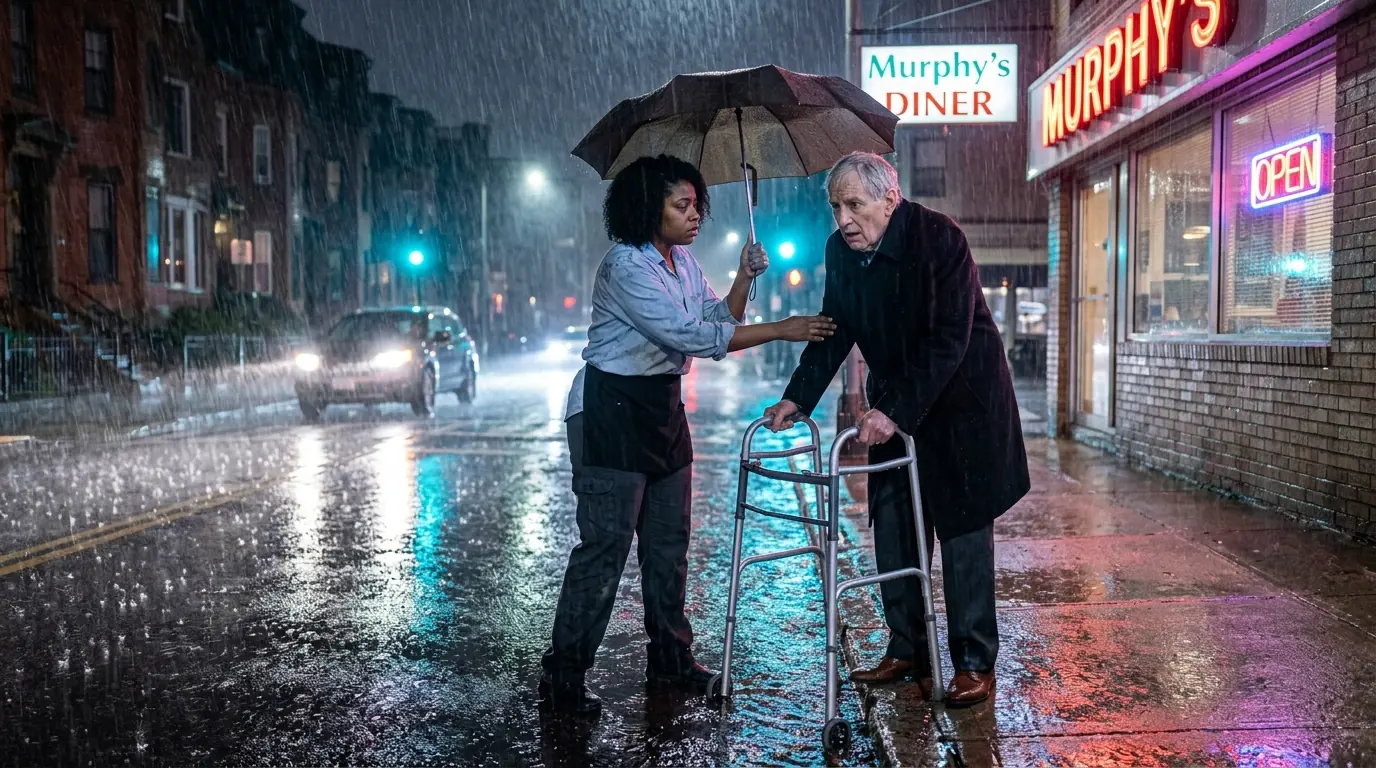
Rain hammered against the windows of Murphy’s Diner at 11:00 p.m., turning the neon reflections outside into blurred streaks of red and gold. Zara, 22 years old, African-American, moved slowly behind the counter, exhaustion visible in every step she took. Her feet burned after another double shift. Her shoulders ached. Even breathing felt heavy.
Rick, the diner manager, barked from the kitchen about unfinished closing duties while the fryer hissed behind him. Zara barely listened. Her phone buzzed again inside her apron pocket. Another overdue bill notification. Another reminder that she was falling behind faster than she could work.
Then she saw him.
Through the steamed-up diner window, an elderly white man struggled against the storm, gripping a walker with trembling hands. Rain drenched him completely. His silver hair clung to his forehead. One wrong step and he nearly collapsed into the flooded street.
Zara didn’t think.
She grabbed the diner’s old umbrella and pushed through the front door into the freezing rain.
“Sir, are you okay?”
The old man looked up slowly. His eyes were intelligent, frightened, and painfully confused all at once.
“I… I can’t remember,” he whispered.
Up close, Zara noticed details that didn’t fit together. His wool coat was expensive. His shoes probably cost more than her monthly groceries. But underneath all of that wealth was something heartbreakingly fragile.
“It’s okay,” Zara said softly, taking his arm. “I’ll help you get home.”
Neither of them understood that this single act of compassion would expose decades of corruption and change both of their lives forever.
The storm showed no mercy.
Water poured down the gutters like rivers while thunder rolled above Boston’s streets. Zara’s umbrella barely covered both of them as they moved slowly uphill through Beacon Hill.
“What’s your address, sir?” she asked carefully.
“I think… Beacon Hill. The house with blue shutters.” He frowned hard, trying to force memory into focus. “My wife painted them blue because…”
His voice faded.
“I can’t remember why.”
Zara’s chest tightened. The look in his eyes reminded her too much of her grandmother during the final months before dementia took her away piece by piece.
“That’s okay,” she told him gently. “We’ll figure it out together.”
The old man’s walker clicked against the pavement as they continued through the storm. Zara shivered inside her thin diner uniform, but she ignored it. Her phone buzzed again.
Another overdue payment.
Three hundred forty-seven dollars may as well have been three million. After rent, utilities, groceries, and splitting a cramped studio apartment with her roommate Maya, there was never enough left.
“You’re very kind,” the old man said quietly. “Most people would’ve walked past.”
“My grandmother taught me better.”
Even as she said it, Zara wondered if kindness had become a luxury people like her simply couldn’t afford anymore.
Tomorrow she would work a morning shift at the community center daycare before rushing straight back to Murphy’s for the dinner crowd. Another sixteen-hour day. Another paycheck that still wouldn’t save her.
As they climbed farther into Beacon Hill, the city transformed around them.
Broken sidewalks disappeared. Historic brick walkways replaced cracked concrete. Elegant streetlights illuminated pristine gardens and massive brownstone mansions that looked untouched by struggle or fear.
Zara had cleaned houses in this neighborhood before.
Always through service entrances.
Always invisible.
Then the old man stopped before a towering mansion with blue shutters and wrought iron gates.
A brass plaque beside the entrance read:
WITTMAN ESTATE — 1847
Zara stared at it in disbelief.
The old man fumbled for his keys with shaking hands.
“Forty-three years,” he murmured. “Margaret will be worried. She always waits up.”
Through the frosted glass, Zara glimpsed crystal chandeliers, marble floors, and paintings hanging beneath golden lights. It felt like looking into another universe. A world where people never had to choose between medicine and rent. A world where student loans didn’t determine the rest of your life.
Then the front door opened.
“Theodore, is that you?”
A Filipina woman in comfortable scrubs rushed forward, relief flooding her face.
“Oh thank God. I was about to call the police.”
“This young lady helped me,” the old man explained. “I got confused in the storm.”
The woman turned to Zara with deep gratitude.
“Thank you so much. Storms make his memory worse sometimes.”
Zara nodded quietly.
“I’m just glad he’s safe.”
The old man reached into his wallet and handed her a thick business card embossed with elegant lettering.
THEODORE WITTMAN
Professor Emeritus
Harvard Law School
Zara’s breath caught.
Harvard Law.
She knew the name somehow.
“I don’t need payment,” she said quickly.
“Keep it,” Theodore insisted. “You never know when you might need a lawyer.”
As Margaret helped him inside, Theodore paused and looked back at her.
“What’s your name, young lady?”
“Zara Williams.”
He repeated it carefully, as if memorizing it.
“Thank you for seeing me as human instead of invisible.”
Then the heavy mansion doors closed, leaving Zara alone in the rain.
She stared down at the business card in her hand while water dripped from her sleeves.
An hour ago, she had been counting greasy diner tips.
Now she stood in Boston’s wealthiest neighborhood holding the card of one of Harvard’s most respected legal minds.
Two worlds separated by more than money.
Her phone buzzed again.
Maya: Rent due tomorrow. You good?
Zara looked up at the mansion one last time before beginning the long walk back to her reality. Back to the cramped studio apartment. Back to sleeping on a pullout couch. Back to exhaustion.
But something inside her had shifted.
Maybe hope.
Maybe foolishness.
Either way, she couldn’t shake the feeling that the night had changed something forever.
Morning light pushed weakly through the cracked window of Zara’s apartment, exposing the harsh truth of her life.
Maya occupied the single bedroom while Zara slept on the pullout couch in the living room. Clothes hung from makeshift lines across the ceiling. A hot plate sat beside a mini fridge that doubled as their kitchen.
Her alarm screamed at 6:00 a.m.
Three hours of sleep.
Every muscle hurt.
Theodore Wittman’s business card rested beside her on the nightstand like proof that the previous night had actually happened.
“Mails here,” Maya called nervously from the doorway.
Zara instantly felt dread settle into her stomach.
Nothing good ever arrived in morning mail.
She stepped into the room and saw three envelopes in Maya’s shaking hands.
The first notice made her knees weaken immediately.
FINAL NOTICE — EVICTION PROCEEDINGS
You have 72 hours to vacate the premises.
“But we paid rent,” Zara whispered. “We always pay rent.”
“Look at the second one.”
Federal Student Loan Services.
Ninety days delinquent.
Immediate payment required: $1,247.
Then came the third envelope.
Municipal Housing Authority — City of Boston.
Zara’s hands trembled as she opened it.
Notice of housing code violations.
Illegal subdivision of residential space.
Unauthorized structural modifications.
Health code violations.
Fine assessed: $15,000.
Fifteen thousand dollars.
“For what?” Maya asked, her voice cracking.
Zara kept reading.
Their privacy curtain counted as illegal room division.
Their hot plate violated food preparation regulations.
Their mini fridge violated storage codes.
Every adjustment they made to survive had suddenly become criminal.
“This can’t be legal,” Zara whispered.
But deep down she already knew the truth.
This was exactly how the system worked.
Make poverty expensive.
Then punish people for being poor.
Her phone rang.
The community center.
Director Martinez sounded exhausted.
“I’m sorry, Zara. We lost our city funding. Today’s your last day.”
The call ended.
Just like that, another piece of her life collapsed.
Maya sat heavily onto the couch.
“My cousin said this happened in Springfield too,” she whispered. “Buildings suddenly get violations. Families get pushed out. Then six months later luxury condos appear.”
The word hit Zara like ice water.
Gentrification.
She walked to the window and stared across Meridian Street.
Construction crews were gutting a building identical to theirs.
A sign outside advertised:
Luxury Studios Starting at $3,200 Per Month
This neighborhood had once belonged to working families. People like her grandmother. People who survived because communities protected one another.
Now it was becoming coffee shops charging six dollars for lattes and boutiques selling candles nobody actually needed.
But this felt different.
Coordinated.
Intentional.
Zara pulled Theodore’s business card from her pocket and stared at the Harvard emblem.
Last night she helped someone powerful.
This morning, powerful people were destroying her life.
The irony tasted bitter.
Her phone buzzed again.
Extra shift tonight. Susie called out.
More hours.
More exhaustion.
More survival.
For one brief moment, Zara wished she had walked past Theodore in the rain.
But another voice answered immediately.
Her grandmother’s voice.
“Sometimes the universe tests you right before it blesses you.”
Zara folded the violation notice and slipped it into her pocket beside Theodore’s card.
Two pieces of paper.
One representing the system crushing her.
The other representing something she didn’t fully understand yet.
Maybe possibility.
Maybe justice.
Maybe both.
The community center breakroom smelled like bleach and disappointment.
Staff members packed boxes in silence while Zara sat alone holding her final paycheck.
$127.50.
Two weeks of work reduced to numbers that wouldn’t even cover groceries.
Almost without thinking, she pulled out Theodore’s business card and searched his name online.
The results stunned her.
This wasn’t just some retired professor.
Theodore Wittman had spent decades fighting housing discrimination cases throughout Boston.
Landmark civil rights lawsuits.
Tenant protection victories.
Legal aid clinics.
Photographs showed a younger Theodore marching beside protesters, speaking at rallies, standing shoulder to shoulder with civil rights leaders.
Then another headline appeared.
Elizabeth Wittman Cross — Federal Judge.
His daughter.
Harvard Law Review.
Civil Rights Division attorney.
Now one of the most respected federal judges in New England.
Zara stared at the screen in disbelief.
The man she helped in the rain had dedicated his entire life to fighting the exact injustice destroying her community.
She searched deeper.
Boston housing violations.
Gentrification.
Meridian Street.
Article after article described the exact same pattern.
Families fined.
Buildings condemned.
Luxury developments replacing working-class neighborhoods.
Then she found the Boston Herald article.
Her own building appeared in the photo.
Families holding violation notices identical to hers.
Every fine exactly $15,000.
Every inspection completed within the same week.
Every condemned property sold to the same development company.
This wasn’t random bureaucracy.
It was organized destruction.
Maria, her supervisor, leaned closer when Zara asked questions.
“My husband works for the city,” she whispered carefully. “Developers want this entire neighborhood renewed.”
Renewed.
Such a polite word for erasing people.
The pieces finally connected.
Close community centers.
Cut legal aid.
Push families out.
Buy the properties cheap.
Build luxury housing.
Profit.
Zara folded the newspaper article carefully.
“I have to go.”
“Go where?” Maria asked.
“To find justice.”
The subway ride to Beacon Hill cost money she couldn’t afford.
But some risks were bigger than money.
As the train carried her from crumbling apartment blocks toward Boston’s wealthiest streets, Zara held Theodore’s card tightly in her hand.
This time she wasn’t walking blindly into a storm.
This time she carried purpose.
The brass doorbell at the Wittman Mansion echoed with old-world elegance.
Margaret opened the door almost immediately.
“Zara? Honey, what’s wrong?”
“I need to speak to Mr. Wittman.”
Margaret’s face tightened with concern.
“He’s having a difficult morning. Storms confuse him.”
“Please,” Zara whispered. “It’s important.”
Something in her voice convinced Margaret to step aside.
The mansion’s interior nearly overwhelmed her.
Nineteen-foot ceilings.
Crystal chandeliers.
Persian rugs worth more than entire neighborhoods.
But what captured Zara’s attention most were the photographs covering the walls.
Theodore standing beside protesters.
Theodore speaking into microphones.
Theodore fighting for people nobody else defended.
Margaret led her toward the sitting room.
Theodore sat beside a window with a crossword puzzle resting in his lap. He looked older in daylight. Smaller somehow.
Confused.
“I’m not expecting visitors,” he murmured.
Zara approached carefully.
“Mr. Wittman… it’s Zara. From the storm.”
For several long seconds he stared blankly.
Then recognition broke through like sunlight.
“The angel in the rain.”
His voice strengthened immediately.
“You helped me home.”
Margaret smiled softly.
“He’s been talking about you all night.”
Actually, Zara realized suddenly, she was crying.
“I came because I need help.”
She handed Theodore the violation notices and newspaper article.
The transformation was immediate.
The confused old man disappeared.
In his place sat the legendary civil rights attorney.
Theodore adjusted his glasses and read every page with frightening precision.
“Fifteen thousand dollars for curtains and a hot plate,” he muttered darkly. “Same tactics. Different decade.”
His expression hardened further when he reached Frank Morrison’s name.
“I remember his father.”
Zara blinked.
“You know him?”
“Corruption runs in families.”
Theodore stood slowly and moved toward his desk.
“Margaret, bring me the secure phone.”
“Are you sure you should—”
“I’m perfectly clear.”
Authority filled his voice.
Then he began making calls.
Housing attorneys.
Legal aid clinics.
Investigative reporters.
Old allies.
One by one, Theodore Wittman awakened an entire network built across forty years of fighting corruption.
By the time he finished, Zara sat speechless.
An emergency extension on her eviction had already been filed.
A Harvard legal team was launching an investigation.
A federal housing complaint was being prepared.
“Why are you doing this?” Zara asked quietly.
Theodore looked at her for a long moment.
“Because when I was lost and vulnerable, you chose kindness instead of convenience.”
His eyes softened.
“In sixty years of practicing law, I learned something important. Justice begins long before courtrooms. It begins when ordinary people decide another human being matters.”
Margaret squeezed Zara’s hand gently.
“He said you reminded him why he became a lawyer.”
Over the following weeks, Zara returned to the mansion every evening after work.
What began as gratitude slowly transformed into something deeper.
Purpose.
On Theodore’s good days, his mind became razor sharp again. Decades of legal brilliance poured out of him effortlessly. On difficult days, Zara helped guide him through memory lapses and confusion with the same patience he once received from her.
One evening, while helping him through physical therapy exercises, Zara noticed an old photograph on the wall.
Young protesters stood on Meridian Street holding signs demanding fair housing.
And beside them stood a teenage Elizabeth Wittman Cross.
“That was 1967,” Theodore explained quietly. “Same street. Same fight.”
Zara stared at the photograph.
“My building?”
Theodore nodded slowly.
“They called it urban renewal back then too.”
Outside, rain tapped gently against the mansion windows.
This time it sounded less like danger and more like warning.
Then came the morning everything exploded.
At 6:00 a.m., pounding fists shook Zara’s apartment door.
Boston Municipal Housing Authority.
Frank Morrison himself stood outside flanked by police officers and inspectors.
The raid began immediately.
Officers tore through the apartment photographing hot plates, curtains, textbooks, extension cords.
Every survival mechanism became evidence.
Every poor person became a criminal.
Morrison walked through the building with the confidence of someone protected by powerful people.
Then Zara discovered the truth.
Blackstone Development — the company buying condemned buildings — had direct financial ties to Morrison and city officials.
Even worse, Morrison’s own son worked in the mayor’s office cutting funding to legal aid and community programs.
The entire system had been engineered.
Destroy communities.
Remove support systems.
Force families out.
Profit.
When Morrison threatened Theodore directly, Zara finally understood the trap completely.
Fight back and they would destroy Theodore.
Stay silent and they would destroy everyone else.
But Theodore refused silence.
Within days, investigative reporter David Carter published a massive expose connecting Frank Morrison, Blackstone Development, and city corruption spanning two generations.
The story exploded across Boston.
Public outrage spread like wildfire.
Then Judge Elizabeth Wittman Cross arrived personally at Meridian Street.
For the first time, federal authority witnessed the truth firsthand.
Families forced from homes.
Manufactured violations.
Systematic intimidation.
“This isn’t housing enforcement,” Elizabeth said coldly. “This is conspiracy.”
Federal investigations began immediately.
Emergency injunctions stopped all evictions.
Federal agents arrested Frank Morrison at his home.
The corruption scandal expanded across the city.
And suddenly, the exhausted waitress from Murphy’s Diner became lead plaintiff in one of Boston’s largest civil rights housing cases in decades.
Three months later, the community room at 47 Meridian Street overflowed with celebration.
Families who once feared homelessness now sat protected under new federal housing safeguards.
The condemned building had become federally protected affordable housing.
Zara stood before the crowd wearing a navy blazer Theodore insisted on buying for her.
“The Wittman-Williams Housing Protection Act passed yesterday,” she announced.
Cheers erupted.
Mrs. Carter cried openly.
The Rodriguez children celebrated beside Maya, who had finally returned to nursing school.
Theodore sat proudly in the front row beside Margaret, his walker resting quietly nearby.
Purpose had become medicine for his fading memory.
Elizabeth stepped beside Zara and smiled.
“This legislation exists because one young woman chose kindness during a storm.”
Later that evening, Zara found Theodore sitting quietly outside the building watching apartment windows glow warmly against the night.
“Any regrets about helping a stranger?” he asked.
“Never.”
Zara sat beside him.
“You taught me something important.”
“What’s that?”
“True power isn’t what you take from people. It’s what you choose to give them.”
Theodore smiled softly.
“You already knew that the night we met.”
Rain began falling again.
Gentle this time.
Healing instead of threatening.
Six months later, Zara Williams sat behind a desk at Mitchell Steinberg and Associates beneath a small plaque reading:
Community Legal Advocate
Housing discrimination cases filled her desk.
Families she helped now kept their homes.
Outside her office window, construction crews built affordable housing where luxury condos were once planned.
Theodore entered carrying case files beneath one arm.
His good days now outnumbered the bad.
Purpose had strengthened him.
“The Rodriguez settlement?” he asked.
“Approved,” Zara smiled. “Fifty thousand dollars and permanent housing protection.”
Twelve families helped that month alone.
Twelve families who no longer felt invisible.
A nervous law student appeared in Zara’s doorway.
“Ms. Williams… I read about your case. I want to help people too.”
Zara stood and extended her hand.
“Then let’s get started.”
Because kindness was never just about one rainy night.
It was about every decision people make to see one another as human.
Outside, rain continued falling against Boston’s streets.
But now it sounded like a promise.