Who in the hell let the catering staff into the executive suite?
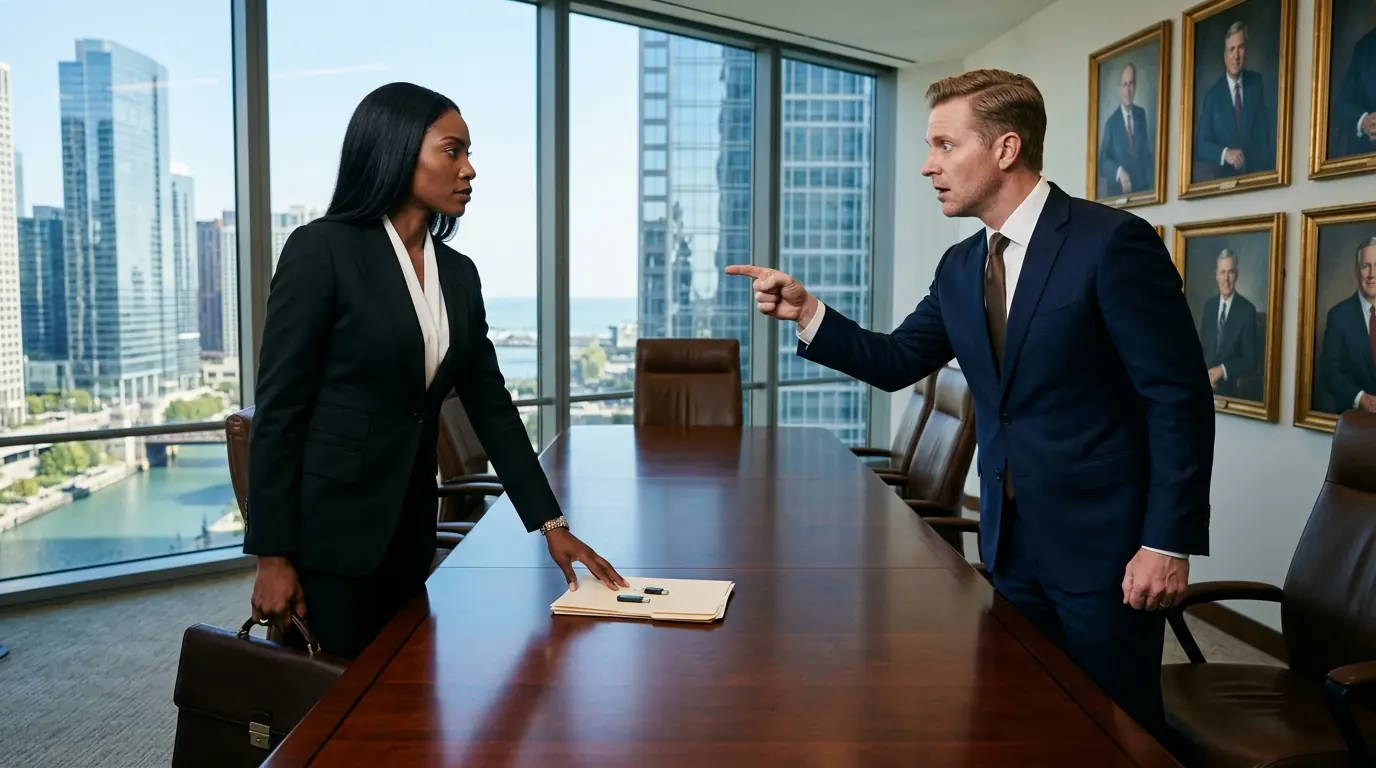
Harrison Sterling IV’s voice cut through the rarefied air of the Sterling Industries boardroom like a blade sharpened by four generations of Ivy League privilege and inherited contempt. His pale blue eyes held a theatrical glint of malice as he flicked his wrist and sent a cascade of Dom Pérignon arcing through the air.
The golden champagne splashed across the front of Isabella Rossi’s custom-tailored Tom Ford suit.
A ripple of sycophantic laughter echoed off the seventy-floor windows overlooking the Chicago skyline.
“My apologies,” Harrison drawled, every word dripping with false sincerity. “Clumsy of me.”
Isabella did not move. The cold champagne soaked through the expensive fabric, chilling her skin, but it was nothing compared to the heat rising in her chest. Her fingers tightened around the handle of her leather briefcase until her knuckles turned white.
For one brief second, her father’s face flashed in her mind. Anthony Rossi. Worn, tired, proud. A man who had carried dignity even on the day his factory supervisor called him a filthy slur before firing him from the job that had broken his body and stolen his spirit.
This was for him.
Slowly, Isabella’s fingers moved to the side of her Patek Philippe watch, a gift she had bought herself when Rossi Capital cleared its first billion dollars. She pressed a nearly invisible button.
A soft click sounded.
It was almost impossible to hear, but somehow it cut through the privileged laughter like a guillotine.
The boardroom fell silent.
A junior executive holding a silver coffee pot froze halfway to a cup. The collective smirk on the faces around the table faded into confusion.
Did she just record that?
The question hung in the air, thick and heavy.
Isabella straightened her shoulders. Her spine became a rod of steel. Her dark brown eyes, respectfully lowered only moments before, now burned with a cold and controlled fire.
A security guard near the door, built like a refrigerator, noticed the change in her posture. His hand twitched toward the radio on his belt, but he did not move. Something in Isabella’s gaze stopped him cold. It promised consequence. Absolute consequence.
Without saying a word, Isabella turned and walked toward the private executive elevator. Her heels struck the imported Italian marble in a steady, defiant rhythm. Each step sounded like a countdown.
No one moved.
No one spoke.
The golden elevator doors slid shut around her. Inside, Isabella looked at her reflection and the dark stain spreading across her chest. Then a slow, dangerous smile touched her lips.
It was not amusement.
It was the smile of a predator watching its prey walk directly into a trap.
Her watch displayed the recording time.
The first exhibit was secure.
Harrison Sterling IV, still glowing from his petty cruelty, had no idea that a debt decades in the making was about to be collected with interest.
As the elevator rose in silence, Isabella’s mind traveled backward. She remembered the ivy-covered halls of Wharton, where she had not merely graduated, but had delivered the valedictory address. She remembered professors sitting straighter as her voice filled the room.
Then her memory went further back, to a cramped two-bedroom rowhouse in South Philadelphia, where the air smelled of garlic and grief. She saw herself as a teenager again, watching her father’s powerful hands grow still. Those hands had built cars, fixed engines, and held his family together.
His heart had been full of love, pride, and quiet discipline. But it had finally given out under the crushing weight of discrimination and wrongful termination. Sterling Industries had destroyed him long before his pulse stopped.
Four years earlier, Sterling Industries had been teetering on the edge of bankruptcy. Its stock was collapsing. Its leadership was arrogant, bloated, and blind.
That was when Rossi Capital moved.
Quietly.
Patiently.
Through anonymous holding corporations, Isabella acquired a thirty-one percent stake in the company.
They never saw her coming.
Old money rarely looks down long enough to notice the daughter of a factory worker it once discarded like a broken tool.
The elevator chimed.
Isabella stepped into the marble sanctuary of the executive lobby.
“The interviews for the new cleaning contract are down the hall, honey,” the receptionist chirped without looking up from her screen. Her manicured nails clicked against the keyboard with casual dismissal.
Behind her, oil portraits of stern-faced white Sterling men lined the walls. Their painted eyes seemed to follow Isabella like an ancestral security detail.
“Service elevators are to your left, ma’am,” the security guard from the boardroom said, now emboldened by marble, portraits, and home territory.
Isabella did not even glance at him. She walked toward the main conference room with calm, unhurried purpose.
Inside, the smug atmosphere had returned.
Harrison IV was retelling the champagne incident as a joke. At the head of the table sat his father, Harrison Sterling III, the patriarch. His liver-spotted hands rested on the arms of his leather chair, and his reptilian eyes reflected a lifetime of ruthless decisions.
“Ah, yes. Miss Rossi, is it?” he said, extending a limp hand without rising. “We are so very grateful for the diversity and inclusion initiative that has brought us such an enthusiastic new voice.”
The condescension filled the room like smoke.
Bradley Thorne, the company’s CFO, chuckled on cue. His Wharton pin gleamed on his lapel.
“I’m sure HR briefed her appropriately,” Bradley said. “Though perhaps we should keep the explanation simple today, for everyone’s benefit.”
He slid a single glossy page across the polished mahogany table. It was supposed to be a summary of quarterly projections, but it had been deliberately simplified. The numbers were rounded. The complex financial terminology was removed. It was a document prepared for a child.
Victoria Vance, head of legal, smiled with red lips sharp enough to cut glass.
“Let’s have someone with a more seasoned perspective handle the actual data analysis,” she said. “We wouldn’t want to create any confusion about our core business model, sweetie.”
Sweetie.
The word hung in the air like a verbal pat on the head.
But Isabella did not flinch.
Beneath the table, hidden from view, her fingers moved silently across her phone. Every dismissive glance, every mispronounced name, every patronizing comment, every microaggression was documented, timestamped, and uploaded to a secure server.
This was not a meeting.
It was a deposition.
And they were the witnesses.
Across the room, Maria Flores caught Isabella’s eye. Maria was a mid-level operations manager, the highest-ranking Latina in the corporation. She had been brought into the meeting as decoration, a silent prop in their corporate theater.
But Maria was not fooled. Her expression carried years of recognition, humiliation, and anger.
When their eyes met, something passed between them.
A warning.
A promise.
A shared understanding.
Maria’s hand moved slightly toward the designer handbag at her feet. Inside was a USB drive loaded with years of corporate malfeasance, waiting like a dormant explosive.
Isabella’s phone vibrated.
A message from David Chen, her chief legal counsel and a former federal prosecutor, appeared on the screen.
Legal teams are on standby. Takedown timeline is 48 hours.
Then the message disappeared.
Harrison IV began the presentation with exaggerated patience, as if speaking to a slow child.
“Why don’t we start with a very basic overview of market dynamics? I’m sure you’ll find it educational.”
The slides began.
Each one was a masterclass in corporate gaslighting. Impossible market projections. Inflated profit margins. Accounting tricks bordering on fraud. Patent portfolios that omitted technology developed by a subsidiary Rossi Capital secretly funded and owned.
Isabella did not interrupt.
She did not correct them.
She simply watched.
Her Patek Philippe counted the seconds while her enemies dug their own graves.
When the presentation reached slide seventeen, Harrison circled a meaningless pie chart with his laser pointer.
“I realize these technical terms can be overwhelming,” he said, looking directly at Isabella. “But do try to keep up.”
Bradley leaned forward with a conspiratorial smile.
“You see, sweetie, when we talk about intellectual property, we’re really just talking about our secret recipes for making money. Think of it like a cookbook. A very, very expensive cookbook.”
But Isabella had already seen their real cookbook.
It was hidden in encrypted servers. Offshore accounts in the Cayman Islands. Stolen patent designs worth three and a half billion dollars. Seventy-two unreported safety violations at the Gary, Indiana, plant. Violations that had left workers burned, injured, and permanently damaged.
Her father’s ghost seemed to whisper in her ear.
Her fingers moved beneath the table, capturing screenshots, cross-referencing slides, preserving evidence.
Victoria suggested a break.
“Give our guest a moment to process all this complex information.”
Guest.
The word was a reminder. In their minds, Isabella would never belong.
Harrison III chuckled and turned toward Maria.
“Maria, why don’t you be a dear and give Miss Rossi a tour? Show her the employee cafeteria, perhaps the gift shop. Somewhere more appropriate to her level of interest.”
The laughter that followed was brutal.
Maria did not laugh.
She stood calmly.
“Of course, Mr. Sterling. I would be delighted to show Ms. Rossi around.”
The emphasis on Ms. was small, but it was rebellion.
As they left the boardroom, Maria’s hand brushed Isabella’s.
The transfer was seamless.
A small, cold USB drive slipped into Isabella’s palm.
“The safety violations,” Maria whispered once they were in the hallway. “The Gary plant. Fifteen workers hospitalized last month with chemical burns. Thorne’s team buried the report and classified it as a minor maintenance issue.”
Inside the elevator, Maria’s professional mask finally cracked.
“They did the same thing to me when I started,” she said quietly. “Different boardroom, same script. They called me the spicy new hire.”
Her eyes, once lowered in the meeting, now burned with anger and hope.
“But you’re not like the others they tried to chew up and spit out, are you?”
Isabella checked her watch.
“No, Maria,” she said. “I’m not. And I believe it’s time they learned exactly who they’ve been dealing with.”
Back in the boardroom, Harrison IV was already messaging Senator Thompson, a politician whose campaigns had been funded by Sterling money for more than twenty years.
We may have a small diversity problem that requires a creative solution, he typed. Nothing that leaves a paper trail. Just strategic complications to remind certain people of their proper place.
Bradley Thorne eagerly added that he still had friends at the SEC who could make Rossi Capital’s life difficult.
Victoria Vance suggested patent litigation. Enough motions and discovery requests to bury Isabella in legal fees for years.
None of them noticed the tiny red light on the designer water glass Isabella had left behind.
It was no ordinary glass.
It was a state-of-the-art surveillance device, recording every word, every boast, every casual admission of criminal intent.
Forty-seven floors below, in a sleek office overlooking Millennium Park, David Chen received a notification on his encrypted laptop.
One word appeared.
Omega.
He typed back calmly.
Phase Two is a go. Commence operation.
The timer on his screen read thirty-six hours and counting.
The Sterling Empire had no idea its foundation was already turning to dust.
By Wednesday afternoon, the Omega Protocol was live. The target for total dismantlement was Friday at two o’clock. Forty-eight hours to unravel an empire built from privilege, corruption, political protection, and inherited arrogance.
David Chen had prepared for this moment for four years, ever since Isabella Rossi had walked into his office with grief in her eyes and her father’s medical records and termination papers spread across his desk like evidence in a murder trial.
His first call was to James Harrington, the former attorney general of the United States. Harrington had the influence and integrity to make the SEC, FBI, and Department of Justice move in perfect rhythm.
A war room assembled in an anonymous office suite leased under a shell corporation. Maria Flores, now protected by personal security, began uploading years of evidence to encrypted servers.
Every falsified report.
Every buried memo.
Every coded email.
Every safety violation disguised as miscellaneous expenses.
Every message where Harrison IV joked about cutting the Gary plant’s safety budget.
Every audio recording where human lives were reduced to liability calculations and acceptable losses.
David’s forensic team worked through the night, recovering deleted emails, tracing wire transfers from Chicago slush funds to Panama accounts, mapping offshore shell companies, and documenting Bradley Thorne’s sixty-eight-million-dollar tax evasion scheme.
By Thursday morning, emergency judicial orders were moving. Asset freezes hit personal and corporate accounts. Document preservation orders landed at Sterling offices across the country. Federal motions were filed before most judges had taken their first sip of coffee.
Maria’s voice shook over the encrypted line as she read from the real medical records.
“Fifteen workers hospitalized. Severe chemical burns. Permanent lung damage from exposure to industrial solvents. They called it a seasonal flu outbreak to avoid an OSHA investigation.”
Each word became another nail in the Sterling family coffin.
Yet high above Chicago, Harrison Sterling IV remained ignorant.
He leaned back in his leather chair, sending another message to Senator Thompson.
The diversity problem is escalating. May need that legislative creativity we discussed.
The senator replied almost instantly.
My connections are at your disposal.
Bradley swaggered into the boardroom, pleased with himself.
“My contacts at the SEC are confirmed,” he announced. “They’re very interested in a comprehensive audit of Rossi Capital.”
Victoria smiled.
“Our patent litigation team is ready. We can bury her in legal fees for the next decade.”
None of them knew their voices were being streamed to a secure location, timestamped, encrypted, and prepared for a federal grand jury.
For a brief moment, doubt entered Harrison’s mind.
“Did we perhaps go too far with the champagne stunt?”
Bradley laughed.
“Harrison, please. She’s just another entitled affirmative action case playing the victim card. We own this company. We own this building. We own half the judges in the Seventh Circuit. What is she realistically going to do? Sue us?”
That laughter would sound very different when played in open court.
By Thursday night, anonymous tips backed by forensic accounting data landed in the inboxes of top financial reporters. Investigative journalists received courier packages containing documents and audio files. Civil rights attorneys across the country received encrypted evidence strong enough to support class action lawsuits.
Friday morning arrived over Chicago.
Maria Flores sat in her modest apartment in Pilsen, watching the sun rise. In eight hours, she would walk back into the Sterling boardroom. Not as a token employee. Not as a prop. But as the incoming chief executive officer of the company formerly known as Sterling Industries.
The official notice for an emergency board meeting had gone out with exactly forty-eight hours’ notice. Legally sound. Strategically devastating.
David Chen checked his simple Timex watch.
Phase Three initiated, he messaged Isabella. Target confirmed. Friday, 2 p.m. Justice is incoming.
At two o’clock, the heavy mahogany doors of the boardroom opened.
Isabella Rossi entered.
She was not the humiliated woman from Wednesday. The champagne stain was gone. In its place was an aura of absolute power.
Behind her came David Chen, moving with the quiet confidence of a prosecutor who had never lost a major case. Three attorneys followed him. Then came the figure who made Harrison Sterling IV’s face drain of color.
James Harrington.
The former attorney general settled into a chair with the calm authority of a man who had brought down presidents and prime ministers.
Isabella stood at the table.
“Allow me to properly introduce myself,” she said. “I am Isabella Rossi, chief executive officer of Rossi Capital. And as of four years ago, I became the controlling shareholder of thirty-one percent of Sterling Industries, acquired during your family’s unfortunate and entirely predictable financial crisis.”
The silence was absolute.
Harrison’s face shifted from confusion to disbelief, then to terror.
“That’s impossible,” Bradley Thorne stammered. “We have majority control. The bylaws—”
“The bylaws,” David interrupted smoothly, “are about to undergo dramatic and immediate revisions.”
He placed a thick leather portfolio on the table.
“Ladies and gentlemen of the board, I present comprehensive documentation of criminal conspiracy, racketeering, massive tax evasion, felony patent theft, willful endangerment leading to bodily harm, and systematic civil rights violations spanning the last decade.”
USB drives were placed across the table like digital dominoes.
Maria Flores stood and slid one forward.
“The safety violations at the Gary plant,” she said clearly. “The theft of intellectual property totaling three and a half billion dollars. The tax evasion scheme through Panama shell companies amounting to sixty-eight million dollars over five fiscal years.”
Harrison whispered, “This was a setup.”
Isabella’s voice remained cold and steady.
“You set this up, Harrison. Every racist joke. Every casual dismissal. Every moment you treated another human being as an expendable asset. I simply responded appropriately.”
Victoria Vance began to crumble.
“But Senator Thompson… our legal protections…”
James Harrington finally spoke.
“Senator Thompson is currently explaining his relationship with this organization to a federal grand jury. His cooperation has been illuminating.”
The vote that followed was a formality.
Board members who had protected the Sterling dynasty for years suddenly discovered an urgent passion for ethics. Institutional investors flipped. Sterling cousins abandoned the family ship. The votes moved from thirty-one percent to forty-seven, then sixty-two, then eighty-nine.
David announced the motion.
“To remove the Sterling family and their chief officers from all corporate positions, effective immediately.”
Hands rose.
White flags of surrender.
Then Isabella spoke.
“Motion to install Maria Flores as interim chief executive officer, with a mandate to reform this company from the ground up.”
More hands rose.
Harrison’s final words came out as a hiss.
“You have no idea what you’ve done. The connections we have, the power structures we control—”
“Had,” Isabella corrected him. “Past tense, Harrison. You had power. Now you have federal charges, frozen assets, and approximately three hours before your mugshot becomes the number one trending topic on the internet.”
The meeting was adjourned.
An empire built on privilege, protected by corruption, and sustained by cruelty had been brought to its knees.
Maria Flores stood.
“My first act as CEO will be to establish a one-hundred-million-dollar fund for worker safety upgrades and full compensation for every employee harmed by this company’s negligence. My second act will be to implement a mandatory fifty-percent diversity requirement for all executive and board-level positions. Things are going to be different now.”
At 4:47 p.m., federal agents escorted Harrison Sterling IV through the same marble lobby where he had plotted Isabella’s humiliation seventy-two hours earlier. Cameras flashed like a storm.
Bradley Thorne was arrested under harsh federal lights, his Wharton pin gleaming one last time as handcuffs closed around his wrists. Victoria Vance signed a plea agreement in exchange for testimony against Senator Thompson. Her law license was gone. Her corner office was gone. Her power was gone.
But the true victory was not only in their downfall.
Six months later, Maria Flores stood in the grand lobby of the newly renamed Rossi-Flores Tower. The oil paintings of dead Sterling men had been removed and replaced by modern art from local Chicago artists.
She announced the new company charter.
Worker safety.
Ethical conduct.
Profit sharing.
Accountability.
In the same boardroom where champagne had once been used as a weapon, families of the injured Gary workers received compensation. Elena Sanchez, whose husband had lost use of his right arm because of defective machinery the company had ignored, held a check for five hundred thousand dollars and wept.
For the first time, her family had been treated not as a liability, but as human beings.
The congressional hearing became a national lesson. Senator Thompson, stripped of his power, squirmed as James Harrington read the messages that exposed years of corruption.
The ripple effect spread across the country. Fortune 500 companies announced new worker safety and diversity initiatives. Wharton added the Sterling Industries takedown to its curriculum as a mandatory case study in corporate accountability.
But the most powerful moment came in a quiet cemetery in South Philadelphia.
Six months after the Sterling Empire collapsed, Isabella Rossi knelt beside her father’s simple granite headstone. She placed red carnations beside the small American flag marking his service.
“We did it, Dad,” she whispered, tracing the letters of his name. “The system is changing. Not just for me, but for everyone who comes after us.”
The Rossi Foundation, funded by seized Sterling assets, later announced scholarships for fifty brilliant young men and women from working-class backgrounds. Each scholarship honored Anthony Rossi and all those who had suffered in silence.
Harrison Sterling IV’s final humiliation came years later in a beige-walled employment office. At fifty-eight, fresh out of minimum-security prison, he applied for an entry-level analyst position.
The young Black woman interviewing him looked at the ten-year gap in his work history.
“Can you explain this period for me?” she asked professionally.
Harrison stared at his shoes.
“I was involved in some legal complications,” he mumbled.
The authority that once silenced boardrooms had become a bitter memory.
The Sterling family estate in the Hamptons was sold at federal auction. Isabella bought it through her foundation, but she never moved in. Instead, she transformed it into the Rossi Center for Entrepreneurial Leadership, offering free business training, legal support, and networks to young innovators from underserved communities.
A year and a half into her role as CEO, Maria Flores stood in the executive elevator that once represented fear and oppression. Now it carried her to meetings where her voice shaped policy, protected workers, and proved that power, when guided by conscience, could heal wounds that greed had spent generations creating.
And somewhere in an FBI evidence locker in Chicago, a designer water glass remained sealed in plastic, its digital memory still holding the voices of men who believed they were above consequence.
But justice, like water, finds its way through even the smallest cracks.
And across America, in boardrooms where Maria Flores’s story was now studied and remembered, a new generation of leaders learned the lesson the Sterling family never understood.
True power is not about who you can crush.
It is about who you choose to lift up.
And that is how you change the world.