Officer Daniel Crowe pointed his finger at Marcus Reed’s chest and said the sentence that would follow him for the rest of his career.
“I’m the law here.”
Marcus looked down at him.
He had to look down at most people.
At six feet seven inches tall, Marcus had spent his entire adult life learning how not to use his size as a weapon. He stood broad-shouldered beneath a charcoal three-piece suit, one hand relaxed beside his leg while the other remained close to the open driver’s door of his dark navy sedan.
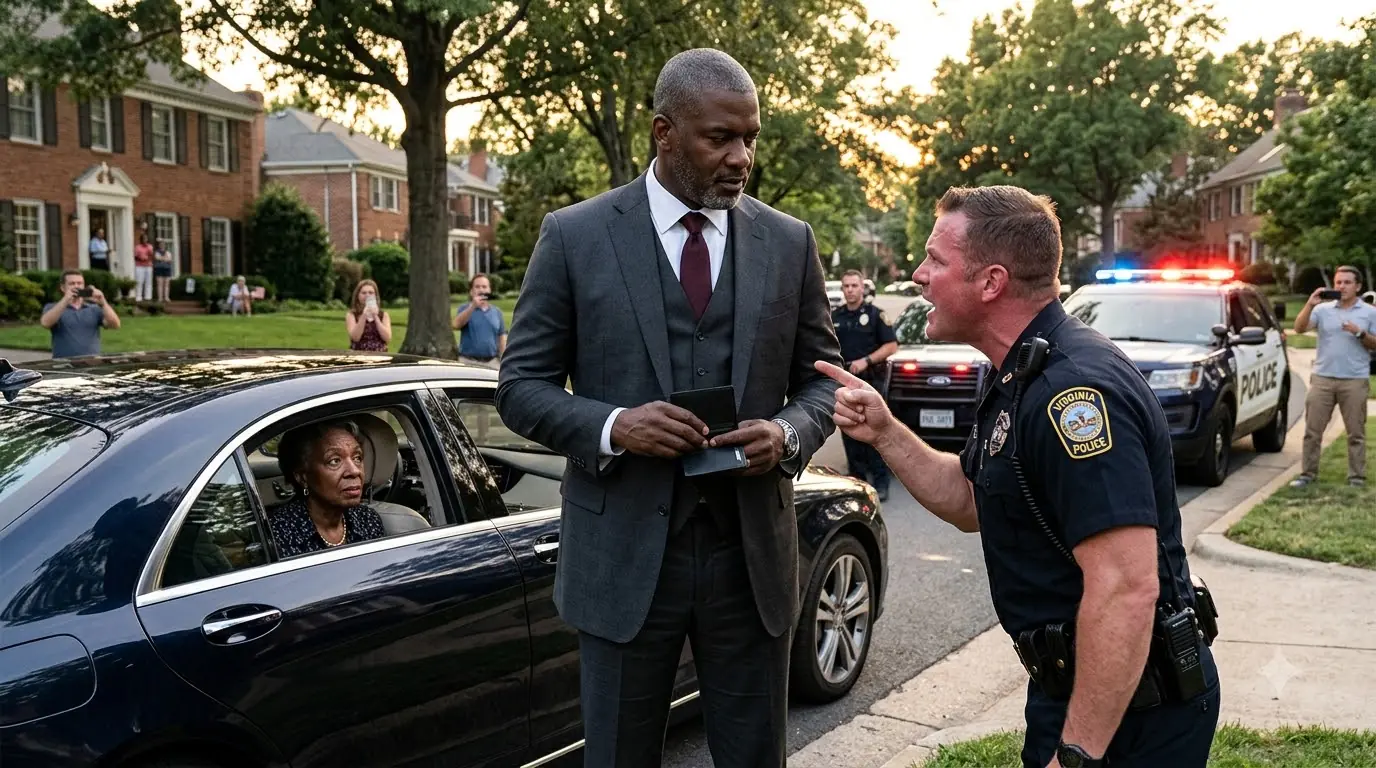
Behind him, his seventy-six-year-old mother sat in the passenger seat.
Evelyn Reed watched through the open window with one hand pressed against her handbag.
The flashing red and blue lights from Crowe’s cruiser washed across the polished side of the car, across Marcus’s suit, across the neat lawns and brick houses lining the quiet Alexandria neighborhood.
Several neighbors had already come outside.
Two were recording.
Marcus knew that.
Crowe did too.
That was partly why the officer’s voice kept getting louder.
Marcus remained quiet for another second.
Then he said:
“No, officer.”
Crowe’s jaw tightened.
Marcus continued.
“The law is above both of us.”
“You just forgot that.”
Crowe stepped closer.
The top of his head barely reached Marcus’s chin.
Normally, the difference would have been almost comical.
Nothing about the moment felt funny.
“Keep talking,” Crowe said, reaching toward the handcuffs on his belt. “I’ll put your arrogant ass on the pavement.”
Evelyn opened the passenger door.
“Marcus.”
He raised one hand toward her without looking away from Crowe.
“It’s all right, Mom.”
Crowe barked:
“Tell her to stay in the vehicle.”
Marcus turned his head slightly.
“My mother is seventy-six years old.”
“I don’t care if she’s a hundred.”
“She stays where I tell her.”
Marcus’s expression changed.
Barely.
But Evelyn saw it.
She had raised him.
She knew what anger looked like when Marcus refused to show it.
Crowe did not.
He mistook stillness for surrender.
“Now,” Crowe said, “turn around.”
Marcus looked at his mother.
Then toward the neighbors filming.
Then at the patrol car.
He had spent almost twenty-eight years working inside courtrooms where every word mattered because everything eventually became a record.
He understood instinctively that this street had become one too.
So he did something Crowe did not expect.
Marcus smiled.
Not warmly.
Not mockingly.
Just enough to make the officer uncertain.
Then Marcus slowly reached inside his suit jacket.
Crowe’s right hand snapped toward his weapon.
“Hands!”
Marcus froze instantly.
“My identification.”
“I said hands where I can see them!”
Marcus lifted both.
“Then tell me how you would like me to produce identification without moving my hands.”
Crowe’s face reddened.
A woman recording from a front lawn said quietly:
“That’s a good question.”
Crowe turned.
“Stay out of this!”
Marcus watched him.
“You’re getting distracted.”
Crowe spun back.
“What did you say?”
“You stopped us.”
“You have not explained a lawful basis.”
“You have not checked the registration.”
“You have not checked the address.”
“You have not asked dispatch to verify either of our names.”
“And now you are shouting at witnesses.”
Crowe stepped close enough that his finger touched Marcus’s vest.
“That expensive suit doesn’t make you smarter than me.”
Marcus looked down at the finger.
Then at Crowe.
“No.”
“It just means I had court today.”
Crowe laughed.
“Court?”
“Yes.”
“You some kind of lawyer?”
Marcus paused.
“Something like that.”
Crowe reached again toward his cuffs.
Marcus said:
“Officer Crowe.”
The officer froze.
He had never introduced himself.
Marcus nodded toward the nameplate.
Crowe followed his eyes.
Then Marcus continued calmly.
“You are going to want your body camera functioning properly for whatever you decide to do next.”
Crowe stared at him.
For the first time, uncertainty appeared.
Not enough.
The evening had begun with peach cobbler.
That was what Marcus would remember later.
His mother had called at 5:11 p.m.
Not because she needed help.
Evelyn Reed almost never admitted needing help.
She called because she had made too much peach cobbler and insisted the problem represented a mathematical emergency requiring immediate intervention.
Marcus knew what she really wanted.
Company.
He had finished a long day at the federal courthouse in Alexandria and drove to her home still wearing his suit.
Evelyn lived fifteen minutes away in the neighborhood where Marcus had spent most of his teenage years.
Not the same house.
His parents sold that after his father died.
But close enough that some of the streets still carried memories.
Marcus arrived at 6:02.
He ate cobbler.
His mother criticized his tie.
He criticized the amount of sugar she claimed not to have used.
At 7:06, Evelyn remembered she had left a prescription at a pharmacy three blocks away.
Marcus offered to pick it up.
She insisted on coming.
“Because you’ll get the wrong thing.”
“It has your name on it.”
“People get creative.”
So they drove.
Marcus picked up the medication.
On the way back, he stopped near the entrance of her subdivision to answer a call from his judicial clerk.
The call concerned a petition scheduled for the following morning.
Franklin Civil Rights Coalition v. Alexandria County Public Safety Department.
The petition requested emergency preservation of internal disciplinary records and body-camera footage connected to several alleged unlawful stops.
Marcus had not formed an opinion.
Judges who decided cases before hearing them were not judges.
They were spectators with robes.
His clerk, Emily Watkins, called only to confirm that one set of sealed filings had arrived.
Marcus said:
“Put them in chambers.”
“Do not circulate.”
“I’ll review them in the morning.”
Then he ended the call.
Evelyn asked:
“Bad case?”
“No idea yet.”
“That means yes.”
Marcus smiled.
“You would be dangerous with a law degree.”
“I raised a judge.”
“Close enough.”
They continued home.
Two streets later, a police cruiser appeared behind them.
At first Marcus assumed it would pass.
Instead the lights activated.
He pulled over immediately.
Officer Daniel Crowe approached the driver’s side with one hand near his belt.
Marcus lowered the window.
“Good evening.”
Crowe ignored the greeting.
“License and registration.”
Marcus reached toward the console.
Crowe immediately said:
“Keep your hands visible.”
Marcus stopped.
“My registration is in the center console.”
“Hands on the wheel.”
Marcus placed both hands on the wheel.
Evelyn watched.
Crowe looked through the interior.
His gaze moved over Marcus.
The suit.
The watch.
The dark leather interior.
Then toward Evelyn.
“Whose car?”
Marcus answered:
“Mine.”
Crowe looked at him again.
“Sure.”
Marcus’s eyebrows rose.
That was the first moment he knew the stop was going to be difficult.
“Why did you stop us?”
Crowe ignored the question.
“Address?”
Marcus gave his home address.
Crowe frowned.
“That’s not around here.”
“No.”
“My mother lives here.”
Crowe looked toward Evelyn.
“Name?”
Evelyn answered before Marcus could.
“Evelyn Reed.”
Crowe looked at Marcus.
“Relationship?”
Marcus stared.
“She just told you.”
“I’m asking you.”
“My mother.”
“What are you doing in this neighborhood?”
Marcus almost laughed.
“Driving my mother home.”
Crowe looked toward the houses.
Then back.
“We got a report about a suspicious vehicle.”
“What was suspicious about it?”
Crowe’s mouth tightened.
“Your behavior.”
Marcus glanced at the dashboard clock.
He had been driving normally.
No speeding.
No sudden turns.
No unusual stops except the one for the phone call.
“What behavior?”
“Circling.”
“I made one stop.”
“You expect me to take your word?”
“No.”
Marcus nodded toward the cruiser.
“I expect you to check.”
That answer changed Crowe’s tone.
“You don’t tell me what to do.”
Marcus became very still.
Evelyn sighed quietly.
She knew her son.
Marcus said:
“I didn’t.”
“I told you what information exists.”
Crowe ordered Marcus out of the car.
Marcus asked why.
Crowe said:
“Because I said so.”