Chapter 1: The Perfect Target
The coastal highway of Oakhaven was a ribbon of asphalt stretching under a canopy of ancient oaks, draped in Spanish moss. It was the kind of town where time moved slower, and the local police force mostly dealt with noise complaints and lost dogs.
Marcus Vance breathed in the salty air, his elbow resting on the open window of his rented Ford Bronco. At fifty-two, Marcus had graying temples and a deep, resonant voice earned from thirty years on the force. He wore a faded flannel shirt, comfortable jeans, and a weathered baseball cap. To anyone looking, he was just an older Black man enjoying a quiet fishing vacation.
But Marcus was not just any man. He was the Chief of Police for the city of Atlanta, commanding a force of thousands. He had come to Oakhaven for three weeks of absolute silence, leaving his uniform, his stress, and his title behind.
A mile back, nestled in the shade of a billboard, sat Officer Toby Miller. Miller was twenty-two, fresh out of the police academy, and burning with a toxic mix of ambition and arrogance. He hated Oakhaven. He wanted action, drug busts, and medals. He wanted to be a hotshot detective, but instead, he was stuck running speed traps.
When Miller saw the dark green Bronco cruise past, moving exactly at the speed limit, his eyes narrowed. He noted the out-of-state license plates. He noted the driver. In Miller’s prejudiced, inexperienced mind, an older Black man in a brand-new rental car on a secluded coastal road spelled "smuggler."
Miller didn't have probable cause. But in his short time on the force, he had already learned that probable cause could be manufactured. He flipped on his sirens and hit the gas.
Chapter 2: The Stop
Marcus saw the flashing blue and red lights in his rearview mirror. He checked his speedometer—forty-five in a forty-five zone. He signaled, smoothly pulling the Bronco onto the gravel shoulder. He turned off the engine, rolled down his window, and placed his hands clearly on the steering wheel. It was muscle memory.
In his side mirror, Marcus watched the rookie approach. The young officer's hand was resting aggressively on the butt of his service weapon. Marcus’s sharp eyes caught everything: the unpolished boots, the tense shoulders, the nervous energy.
"Afternoon, Officer," Marcus said, his voice calm and deep. "Is there a problem?"
"License and registration," Miller snapped, shining his heavy Maglite directly into Marcus’s eyes, despite it being broad daylight.
Marcus didn't flinch. He slowly reached into the glove compartment, retrieved the rental agreement, and handed it over along with his driver's license. The license simply read: Marcus Vance, Atlanta, GA. It did not list his occupation.
Miller snatched the cards, glancing at them, then back at Marcus. "Where are you headed, Vance?"
"Just down to Miller's Creek for some fishing. I rented a cabin for the week."
"Fishing," Miller scoffed, his tone dripping with skepticism. "You sure about that? Because I smell marijuana coming from this vehicle."
Marcus stared at the young officer. The air smelled of nothing but pine needles and sea salt. Marcus didn't smoke, drink, or use drugs. "I assure you, Officer, there is no marijuana in this vehicle. I don't use it."
"Step out of the car," Miller ordered, taking a step back. "I'm conducting a search."
"On what grounds?" Marcus asked, his tone remaining perfectly level. "Smell alone is a highly subjective standard, and I do not consent to a search of my vehicle."
Miller’s face flushed with anger. He wasn't used to people knowing their rights, let alone remaining this calm. "I have probable cause. Step out of the car now, or I'll drag you out for resisting."
Marcus knew exactly how this game was played. He also knew that arguing with a rookie on the side of a lonely road was a dangerous proposition. Slowly, deliberately, Marcus unbuckled his seatbelt and stepped out of the Bronco.
Chapter 3: The Setup
"Stand at the back of the vehicle. Do not move," Miller barked.
Marcus complied, watching silently as the rookie began tossing his rental car. Miller ripped through Marcus’s duffel bag, threw his fishing tackle onto the seats, and rummaged through the center console. He was looking for a prize that didn't exist.
Frustration boiled within Miller. If he came up empty-handed after calling in a search based on "smell," his sergeant would chew him out. He needed a win. He needed to be right.
With his back turned to Marcus, Miller made his move. He reached into the small, hidden utility pocket of his tactical vest. Inside was a tiny, clear plastic bag containing a gram of crystal methamphetamine—a confiscation from a previous arrest that Miller had secretly pocketed "just in case" he ever needed leverage on an informant.
Miller leaned deep into the passenger side of the Bronco. In one swift, practiced motion, he shoved the small baggie tight between the passenger seat and the center console.
"Well, well, well," Miller called out, his voice suddenly triumphant. He backed out of the vehicle, holding the baggie up to the sunlight. "What do we have here?"
Marcus looked at the small bag of white crystals. His expression didn't change, but his eyes grew incredibly cold. The temperature around him seemed to drop.
"I don't know," Marcus said softly. "Why don't you tell me, Officer?"
"Looks like meth, old man. A felony amount," Miller sneered, pulling his handcuffs from his belt. "Turn around. Hands behind your back. You're under arrest for possession of a Schedule II narcotic."
As Miller violently wrenched Marcus’s arms backward and clicked the cold steel cuffs into place, Marcus spoke, his voice carrying the quiet, terrifying authority of a looming thunderstorm.
"Son, you are making the biggest mistake of your very short life."
"Save it for the judge, criminal," Miller laughed, shoving Marcus into the back of the cruiser.
Chapter 4: The Precinct
The Oakhaven Police Department was a modest brick building. Inside, Sheriff John Brody, a veteran lawman who had known Marcus Vance for twenty years, was pouring himself a cup of burnt coffee.
The front doors banged open. Officer Miller strutted in, leading a handcuffed Marcus by the arm.
"Got a live one, Sheriff!" Miller called out proudly. "Out-of-towner. Caught him riding dirty. Found a bag of crystal stashed in his center console."
Sheriff Brody turned around, the coffee mug stopping halfway to his mouth. All the color drained from his weathered face. He looked at the rookie, grinning from ear to ear, and then looked at the towering, dignified man in handcuffs.
"Miller..." Brody choked out, his hands beginning to shake. "What the hell have you done?"
"Just doing my job, sir. The guy tried to play dumb, but I sniffed him out."
Marcus stood tall, looking directly at the Sheriff. "Hello, John. It's been a while."
Sheriff Brody immediately rushed forward, shoving Miller out of the way. "Chief Vance, my god, I am so sorry." Brody fumbled for his keys and unlocked the handcuffs, his hands trembling.
Miller’s smug smile vanished. "Wait... Chief? Sheriff, what are you doing? He's a drug suspect!"
"Shut your mouth, Miller!" Brody roared, a vein bulging in his neck. "This man is Marcus Vance! He is the Chief of Police for the city of Atlanta! He has a commendation for valor from the Governor!"
Miller felt the floor drop out from under him. His stomach twisted into a violent knot. He looked at the older Black man in the flannel shirt, who was now rubbing his wrists, his eyes locked onto the rookie with the intensity of a predator.
"You said you found drugs in my car," Marcus said, his voice echoing in the dead silence of the precinct. "Let's review the tape."
Chapter 5: The Eye That Never Blinks
"He... he didn't have a dashcam on his rental," Miller stammered, sweating profusely. He knew his own bodycam had a clear view of the passenger seat, but he had purposely turned his body to block the lens when he planted the baggie.
"No, I didn't," Marcus agreed. He reached into his pocket and pulled out his smartphone. "But as a high-ranking law enforcement officer, I have a security app integrated into my phone. When you ordered me out of the car, I left my phone resting against the dashboard, recording the interior. It uploads directly to an encrypted cloud server."
Miller felt his knees go weak.
Marcus tapped the screen and set the phone on the Sheriff's desk. The video played. It showed the interior of the Bronco. It showed Miller aggressively searching the vehicle. And then, clear as day, it showed Miller reaching into his tactical vest, pulling out the bag of meth, and stuffing it between the seats.
The silence in the precinct was absolute.
Sheriff Brody stared at the screen, disgust twisting his features. He turned to Miller. "You planted evidence. On a civilian."
"Sheriff, I... I can explain..." Miller stammered, stepping backward.
"Save it," Marcus interrupted, his voice like cracking thunder. "You saw an older Black man in a nice car and decided I was a criminal. When you couldn't find a crime, you created one. You disgraced the badge. You endangered my life, and you violated your oath."
Marcus turned to the Sheriff. "John. I want him processed."
Chapter 6: The Fall
Sheriff Brody didn't hesitate. "Officer Miller, hand over your badge and your service weapon. Now."
With shaking, trembling hands, the young man unclipped his gun belt and set it on the desk. He unpinned his shiny silver badge and laid it next to the gun.
Brody walked around the desk, grabbed the handcuffs he had just taken off Marcus, and slammed Miller against the wall.
"Toby Miller, you are under arrest for planting evidence, false imprisonment, official misconduct, and possession of a Schedule II narcotic," Brody read the rights, his voice filled with venom.
As the cold steel clicked around Miller’s wrists, he began to cry. All his arrogant dreams of being a hotshot cop evaporated, replaced by the terrifying reality of federal prison. Cops who planted evidence didn't survive long in general population, and he knew it.
Marcus Vance picked up his phone, slipping it back into his pocket. He looked at the weeping young man being led away to the holding cells.
"A badge is a heavy thing, son," Marcus said quietly as Miller was dragged past him. "You were never strong enough to carry it."
With that, Chief Marcus Vance walked out of the precinct, got back into his rental car, and drove toward the lake. The water was waiting, and justice had already been served.
Chapter 7: The Echoes of the Cell
The holding cell at the Oakhaven precinct was a place Toby Miller had only ever seen from the outside. It smelled of bleach, stale urine, and desperation. Now, sitting on the cold steel bench with his hands cuffed to the D-ring on the table, he was the desperate one.
The adrenaline that had fueled his arrogant swagger on the highway had completely evaporated, leaving behind a hollow, nauseating terror. He looked at his hands—hands that just an hour ago held the power of the state, now bound by it.
The heavy iron door swung open. Sheriff Brody walked in, accompanied by a man in a sharp grey suit. The man carried a thick leather briefcase and an expression devoid of any empathy.
"Miller," Brody said, his voice exhausted. He looked ten years older than he had that morning. "This is Special Agent Reynolds from the State Bureau of Investigation, Internal Affairs Division. He's taking over."
Agent Reynolds didn't offer his hand. He sat down, opened his briefcase, and pulled out a digital audio recorder, placing it dead center on the metal table.
"Officer Toby Miller," Reynolds began, his voice flat and clinical. "You have been read your Miranda rights. Do you understand them?"
"Yes," Miller croaked. His throat was sandpaper. "Agent Reynolds, please. You have to understand. I was under pressure. The Sergeant, he’s always riding us about quotas, about making proactive stops—"
"Stop right there," Reynolds interrupted, raising a hand. "Let's be absolutely clear, Mr. Miller. You are no longer an officer. You are a criminal suspect. And right now, you are attempting to shift the blame for a felony you committed onto your commanding officer. Is that your official statement? That Oakhaven PD ordered you to plant methamphetamine on innocent civilians?"
Miller’s eyes widened. "No! No, that's not what I meant. I just... I saw a guy. Out of state plates. Older Black man in a flashy rental. He fit a profile."
"A profile?" Reynolds leaned forward, his eyes boring into Miller. "You profiled the Chief of Police for the city of Atlanta. A man with three decades of distinguished service. You pulled him over without probable cause. You unlawfully searched his vehicle. And when you realized you had made a mistake, instead of apologizing, you reached into your tactical vest, pulled out a Schedule II narcotic, and planted it."
Reynolds hit a button on his tablet. The video from Marcus Vance’s phone played again. The crisp, undeniable footage of Miller’s crime filled the small room.
"Where did you get the meth, Toby?" Brody asked softly from the corner. It wasn't a question from a sheriff; it was a question from a man mourning the loss of a deputy he had sworn to guide.
Miller looked down at his shoes. "Three weeks ago. The raid on the trap house on 4th Street. A baggie fell behind a sofa. I... I pocketed it."
Brody closed his eyes and leaned his head against the concrete wall. "Chain of custody violation. Theft of evidence. You're building a federal case against yourself, son."
"I just wanted to be a good cop!" Miller suddenly shouted, tears streaming down his face. "I wanted to make a difference! I wanted the big bust!"
"Good cops don't manufacture criminals, Miller," Reynolds said coldly, standing up. "They catch them. You are being transferred to the county lockup. No bail. The District Attorney is pushing for the maximum sentence."
Chapter 8: The Media Firestorm
By the time the sun rose the next morning, the secret was out.
Marcus Vance was a prominent figure not just in Georgia, but in national law enforcement circles. He was a frequent speaker at police academies on ethics, community policing, and the dangers of implicit bias. The irony of him being targeted by a racially motivated, corrupt rookie was too explosive for the press to ignore.
News vans choked the small streets of Oakhaven. Helicopters chopped the air above the precinct. The video, legally obtained by a major news network through a rapid FOIA request, was playing on an endless loop on every morning show in the country.
"THE UNIFORM'S BETRAYAL" flashed across chyrons from CNN to Fox News.
Chief Marcus Vance held a press conference on the steps of the Oakhaven courthouse. He did not wear his uniform; he wore a sharp navy suit, looking every bit the statesman. The flashing bulbs of a hundred cameras reflected in his calm, dark eyes.
"Yesterday," Marcus spoke into the sea of microphones, his deep voice carrying over the murmur of the press, "I experienced what too many citizens of this country fear on a daily basis. An abuse of power. A violation of trust. The man who pulled me over did not see a citizen; he saw a target. He relied on prejudice, and when his prejudice did not yield a crime, he decided to invent one."
A reporter from the Associated Press yelled out, "Chief Vance! Do you think Officer Miller is a 'bad apple', or is this indicative of a wider systemic issue in Oakhaven?"
Marcus paused, looking thoughtfully over the crowd. "The 'bad apple' metaphor is often misused. People forget the second half of that phrase: A few bad apples spoil the barrel. Officer Miller’s actions were his own. But we must ask ourselves: what environment allowed him to feel comfortable carrying stolen narcotics? What culture taught him that planting evidence was an acceptable shortcut to a commendation? True justice in this case isn't just about punishing one man. It's about tearing down the rot that allowed him to grow."
In his solitary cell at the county jail, Toby Miller watched the press conference on a small, muted television behind a reinforced glass pane. He watched the man he had tried to destroy stand tall and resolute. He finally understood the magnitude of the giant he had tried to slay.
Chapter 9: The Trial - Day One
Six months later, the Oakhaven County Courthouse was fortified like a military bunker. Protesters demanding police accountability lined the streets. Inside the oak-paneled courtroom, the air was thick with tension.
Toby Miller sat at the defense table. The arrogance was completely gone. He had lost twenty pounds. His tailored suit hung loosely on his frame. His hair was cropped short, and his eyes darted nervously around the room. He looked like exactly what he was: a frightened kid who had played a dangerous game and lost everything.
The State Prosecutor, an aggressive woman named Sarah Jenkins, delivered her opening statement with surgical precision.
"Ladies and gentlemen of the jury," Jenkins began, pacing before the jury box. "Trust. It is the invisible currency that allows our society to function. We trust that the food we eat is safe. We trust that the bridges we drive over will hold our weight. And above all, we trust that the men and women given a badge, a gun, and the authority to take away our freedom, will use that power righteously."
She stopped and pointed a trembling finger directly at Miller. "Toby Miller bankrupted that trust. He used his badge not as a shield to protect the innocent, but as a weapon to hunt them. He targeted Marcus Vance based on the color of his skin and the car he drove. And when reality didn't match his racist fantasies, he fabricated reality."
Miller’s defense attorney, a weary public defender named Harrison, tried his best. He painted Miller as a product of a broken system—a young, inexperienced officer pushed to the brink by an aggressive police culture that valued statistics over justice.
"He made a terrible, unforgivable mistake," Harrison argued, his voice pleading. "But he is not a monster. He is a young man who lost his way in a system that demands too much and oversees too little."
It was a weak defense, and everyone in the room knew it. The video was too damning.
Chapter 10: The Weight of the Badge
The trial's turning point came on the third day when Chief Marcus Vance was called to the stand.
The courtroom fell dead silent as Marcus walked down the aisle. He moved with a quiet, commanding dignity. He took the oath, his large hand resting firmly on the Bible, and sat in the witness box.
Prosecutor Jenkins walked him through the events of that day. Marcus recounted the stop with perfect clarity. He didn't embellish. He didn't show anger. His pure, objective recitation of the facts was more devastating than any emotional outburst could have been.
"Chief Vance," Jenkins asked gently. "When Officer Miller produced the bag of methamphetamine and claimed he found it in your car, what went through your mind?"
Marcus looked directly at Toby Miller. For a brief second, Miller met his gaze before shamefully looking down at the defense table.
"I felt a profound sorrow," Marcus answered, his voice echoing in the silent room. "Not for myself. I knew I had the means, the education, and the technology to defend myself. I felt sorrow for all the people who didn't have a hidden camera. For the people who didn't know their rights. For the teenagers, the fathers, the workers who might have been pulled over by Officer Miller in the dead of night, on a lonely road, without a voice."
Marcus leaned forward slightly. "A badge is the heaviest piece of metal a person can wear. It represents a sacred covenant between the government and the people. When a police officer plants evidence, they don't just frame an individual. They assassinate the law itself. They destroy the very foundation of justice."
When the defense attorney stood up for cross-examination, he looked at his notes, looked at Marcus Vance, and then slowly sat back down. "No questions, Your Honor."
There was nothing to ask.
Chapter 11: The Hammer Falls
The jury deliberated for less than two hours.
When the verdict was read, there was no gasp of surprise. Just a heavy, final resignation.
Guilty of Official Misconduct. Guilty of False Imprisonment under Color of Law. Guilty of Fabrication of Physical Evidence. Guilty of Possession of a Schedule II Narcotic.
Judge Thomas Aris, a man known for his strict sentencing, looked down at Toby Miller from the bench. Miller was openly weeping, his shoulders shaking uncontrollably.
"Mr. Miller, stand up," Judge Aris commanded.
Miller forced himself to his feet, supported by his attorney.
"In my thirty years on the bench, I have seen murderers, thieves, and violent gang members stand where you are standing," the judge began, his voice laced with cold fury. "But your crimes disgust me in a unique way. A criminal breaks the law. A corrupt police officer breaks the system."
The judge adjusted his glasses. "You were sworn to protect the vulnerable. Instead, you became the very predator you were supposed to hunt. You saw a Black man driving a nice car and your prejudice blinded you. You thought you were the law. You forgot that you are merely its servant."
"Toby Miller, for the multitude of felonies you have committed against Marcus Vance, and the irreparable damage you have done to the public trust, I sentence you to twenty-five years in the Georgia State Penitentiary. You will not be eligible for parole for fifteen years."
The gavel slammed down like a gunshot. The sound echoed in Miller's ears. Twenty-five years. He was twenty-two. His life, as he knew it, was entirely over.
Bailiffs immediately converged on him, snapping heavy steel cuffs around his wrists—the same way he had cuffed Marcus Vance months ago.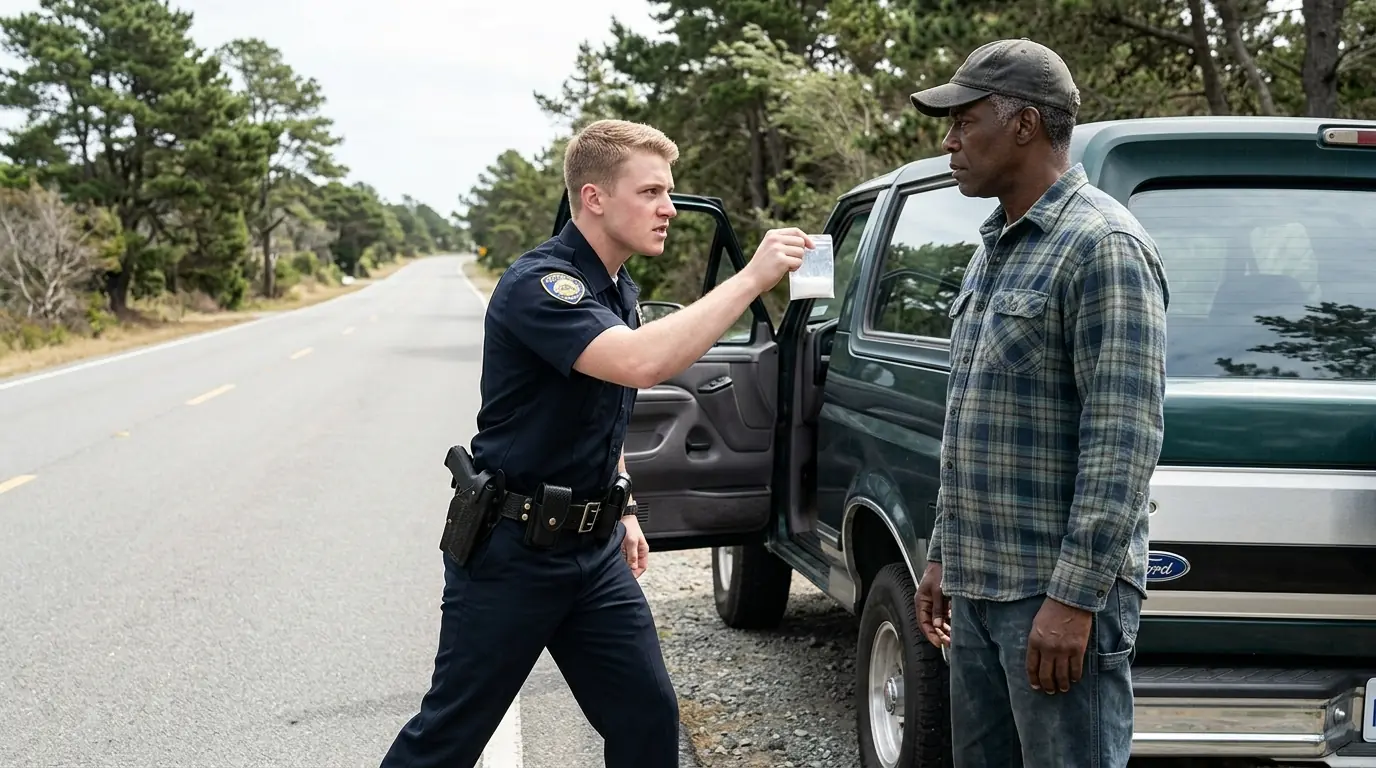
Chapter 12: The Concrete Tomb
Georgia State Penitentiary was a brutal fortress of concrete and razor wire, housing the state's most violent offenders. For a former police officer, it was a death sentence.
Miller arrived on a grey Tuesday morning, chained to a bus full of hardened criminals. As he walked through the heavy iron gates, the sounds of the prison hit him like a physical blow. The screaming, the clanking of metal doors, the oppressive, suffocating heat.
He was processed, stripped, sprayed with cold water, and handed a rough orange jumpsuit.
"We're putting you in Protective Custody, Miller," the intake guard sneered, tossing him a scratchy wool blanket. "General population would tear you apart in an hour. But don't think PC is a vacation. You'll be in a cell twenty-three hours a day. Your neighbors will be snitches, child molesters, and other dirty cops. Enjoy your stay."
Miller was marched down a long, dimly lit corridor. The inmates in the PC wing knew he was coming. News travels faster in prison than on the outside. As he walked past the cells, men banged on the bars, spitting and screaming insults.
“Hey bacon! Hope you like the food!” “We got a spot waiting for you, piggy!”
The guard stopped in front of Cell 4B. The door slid open with a mechanical groan. The cell was six feet by eight feet. A stainless steel toilet, a concrete slab for a bed, and a tiny slit of a window looking out onto a brick wall.
"In," the guard barked.
Miller stepped inside. The door slammed shut behind him, locking with a definitive, soul-crushing CLACK.
He sat on the edge of the concrete slab. There was no dashcam to turn off. There was no badge to hide behind. There was only the grey wall, the ticking of his own heartbeat, and the horrifying realization that he had built his own cage.
He curled his knees to his chest and stared at the floor. In the quiet darkness of his cell, the ghosts of his arrogance came to haunt him. He remembered the smell of the pine needles on the coastal highway. He remembered the calm, unyielding eyes of Chief Marcus Vance. And he remembered the tiny plastic bag that had cost him his life.
Chapter 13: The True North
Hundreds of miles away, in the bustling heart of Atlanta, Chief Marcus Vance sat in his corner office. The city stretched out below him, a sprawling metropolis of lights and shadows.
He was reviewing policy changes on body-camera enforcement. The "Miller Incident," as it was now known in police academies nationwide, had sparked a massive wave of reform. Accountability boards were being strengthened. Implicit bias training was being overhauled.
A knock on the door interrupted his thoughts. It was his Deputy Chief.
"Marcus, the Mayor needs those revised budget numbers for the community outreach program by five."
"I've got them right here," Marcus said, handing over a folder.
The Deputy Chief paused at the door. "You doing okay, Chief? The sentencing was today. I saw the news. Twenty-five years."
Marcus leaned back in his leather chair, looking out at the city he had sworn to protect. He felt no joy in Toby Miller's destruction. He felt only a solemn, heavy burden.
"I'm fine, David," Marcus said softly. "Justice was done. The system worked, but only because I had the power to make it work. Our job now is to make sure it works for the kid driving home from his night shift, or the single mother getting pulled over for a broken taillight."
The Deputy Chief nodded respectfully and left the room.
Marcus picked up his gold chief's badge from the desk. He felt its weight in his palm. It was heavy. It was supposed to be.
He pinned it back onto his uniform, straight and true over his heart. He had work to do.
Chapter 14: The Price of Protection
Time in the Protective Custody wing of the Georgia State Penitentiary didn't pass; it rotted. For Toby Miller, the first three months were a blur of sensory deprivation and sudden, terrifying violence.
He was locked in his six-by-eight-foot cell for twenty-three hours a day. The one hour of "recreation" was spent in a small concrete cage with a chain-link roof, usually in the freezing rain or blistering heat, isolated from even the other PC inmates.
But the true nightmare wasn't the isolation; it was the guards.
Officer Griggs was a massive, scarred man who walked the PC block like a feudal lord. He knew exactly who Toby was. To Griggs, an ex-cop in prison wasn't a brother to be protected; he was an ATM.
One evening, after the lights-out siren wailed, Griggs stopped in front of Toby’s cell. He didn't turn on the light. He just stood in the shadows, tapping his nightstick against the iron bars. Clink. Clink. Clink.
"Miller," Griggs whispered, his voice like grinding stones. "Heard some chatter today from Cell Block D. The Aryan Brotherhood. Turns out, that trap house you raided last year? The one where you stole the meth? That belonged to a cousin of their shot-caller. They know you’re here."
Toby scrambled off his concrete slab, his heart hammering against his ribs. He approached the bars, his hands trembling. "I'm in PC, Griggs. They can't get to me here."
Griggs chuckled, a dark, wet sound. "Accidents happen, rookie. Sometimes a cell door electronically malfunctions. Sometimes a shank gets slipped through the food slot. I can make sure your door stays shut tight. But protection ain't free."
"I don't have any money," Toby pleaded, his voice cracking. "My accounts were drained for legal fees."
"I don't want your money," Griggs sneered. "I want a mule. I got packages coming into the laundry room. Cell phones, tobacco, suboxone. Since you're PC, you do laundry detail alone on Thursdays. You're going to move those packages to the drop points for me. You refuse, and I might just accidentally hit the override switch on your door during the night shift."
Toby backed away from the bars, his breath catching in his throat. He was trapped. The badge he had abused to frame an innocent man was gone, and now, he was entirely at the mercy of someone using their uniform to terrorize him. He had become the victim of his own philosophy.
Chapter 15: The Pushback
Meanwhile, in Atlanta, Chief Marcus Vance was fighting a different kind of war.
The "Miller Incident" had given Marcus the political capital he needed to launch a massive internal purge. He instituted "The Miller Protocol"—a zero-tolerance policy that included random audits of body-camera footage, strict psychological evaluations for all patrol officers, and a complete overhaul of the evidence chain-of-custody.
But the system was fighting back.
Marcus sat in his office, facing Captain O'Reilly, the head of the local Police Benevolent Association (the police union). O'Reilly was a red-faced, old-school cop who believed that officers needed to bend the rules to keep the streets safe.
"You're paralyzing the force, Marcus," O'Reilly spat, slamming a thick folder onto the Chief's desk. "Arrests are down twenty percent. The men are terrified to make a proactive stop because they think Internal Affairs is going to jump out of the bushes and arrest them for a paperwork error!"
"They aren't terrified of paperwork, O'Reilly," Marcus said calmly, his dark eyes unwavering. "They are terrified of accountability. Arrests are down because we are no longer arresting people on fabricated charges to meet quotas."
"Miller was one bad kid!" O'Reilly shouted. "You're punishing three thousand good cops for the sins of one rookie!"
"Is he just one bad kid?" Marcus leaned forward, steepling his fingers. "I've been looking into Miller's academy records. His Field Training Officer was Sergeant Higgins. The same Higgins who has eighteen excessive force complaints. The same Higgins who teaches the rookies how to 'testify creatively' in court. Miller didn't invent corruption, O'Reilly. He was taught it. And I am going to tear down the classroom."
O'Reilly’s face hardened. "You're crossing a line, Chief. The union won't back you on this. You're going to find yourself very isolated, very fast. You might have the Mayor's ear today, but mayors change. The Brotherhood remains."
"The Brotherhood," Marcus said softly, his voice dripping with disdain, "is a shield for cowards. If you stand in the way of these reforms, I will crush you right alongside them. Get out of my office."
Chapter 16: The Contraband Run
Back in the penitentiary, Thursday arrived like an executioner.
Toby was escorted to the humid, windowless laundry room in the basement of the prison. The air smelled of industrial bleach and damp cotton. Guard Griggs stood by the heavy steel door, tossing a canvas laundry bag at Toby's feet.
"Bottom of the bag. Three burner phones, wrapped in plastic," Griggs commanded softly. "Drop them in the third dryer on the left. The maintenance crew will pick them up tomorrow. Do it, or you're dead tonight."
Griggs stepped outside, locking the door behind him to give Toby "privacy" to work.
Toby knelt on the wet concrete floor, unzipping the canvas bag. He dug past the soiled orange jumpsuits until his fingers brushed against cold, hard plastic. He pulled out the package.
He stared at the contraband in his hands. It was the exact same feeling he had when he held that baggie of meth on the coastal highway. The power to break the law. The pressure from a superior. The desperate need to survive.
He walked over to the third dryer. He opened the door. All he had to do was toss the phones inside, close the door, and he would buy himself another week of life.
But as he looked into the dark, spinning drum of the dryer, he saw the reflection of his own face in the polished metal rim. He looked hollow. He looked like a ghost.
“A badge is the heaviest piece of metal a person can wear,” Chief Vance’s voice echoed in his memory, clear as a bell. “When you plant evidence... you assassinate the law itself.”
Toby’s hands began to shake. If he did this, he wasn't just a fallen cop; he was an active criminal. He would belong to Griggs forever. He would become a permanent part of the rot.
With a sudden, violent sob, Toby pulled his hands back. He didn't put the phones in the dryer. Instead, he shoved them deep into the front pocket of his own jumpsuit. He walked to the emergency call button on the wall and smashed his fist against it.
Chapter 17: The Confession
The alarm blared, a deafening mechanical shriek. Within seconds, the heavy door flew open. It wasn't just Griggs; it was the shift lieutenant and two other guards, their batons drawn.
"What the hell is going on here?" the Lieutenant bellowed over the alarm.
Griggs looked at Toby, his eyes wide with a mixture of shock and murderous rage. He realized Toby hadn't made the drop.
Toby stood in the center of the room. He was terrified, his knees buckling, but for the first time in his life, he didn't try to hide behind a lie. He reached into his pocket and threw the wrapped package of cell phones onto the concrete floor.
"Officer Griggs forced me to smuggle those," Toby screamed, his voice cracking. "He's running contraband through the Protective Custody wing! He threatened to open my cell door to the Aryan Brotherhood if I didn't mule for him!"
The laundry room went dead silent, save for the wailing alarm. The Lieutenant looked at the phones on the floor, then at Griggs.
Griggs’s face turned purple. "He's lying! The inmate is lying! He's a dirty cop, Lieutenant, you know him! He probably had those smuggled in for himself!"
"I want to see the Warden!" Toby yelled, tears streaming down his face. "And I want to call the FBI! I'll tell them everything! I'll wear a wire! I'll testify!"
He knew he was signing his own death warrant by snitching on a guard. But in that moment, Toby Miller finally understood what it meant to take responsibility. If he was going to die in this concrete tomb, he was going to die telling the truth.
Chapter 18: The Deal in the Dark
Two days later, Toby sat in a brightly lit interrogation room deep within the prison administration building. He was bruised—Griggs had managed to get a few hits in before the other guards pulled him off—but he was alive.
The door opened. It wasn't the Warden. It wasn't the FBI.
It was Chief Marcus Vance.
Marcus wore a dark overcoat, his presence instantly filling the small room. He looked at the battered, bruised young man sitting across from him.
"Chief Vance," Toby whispered, unable to meet the man’s eyes.
"The Warden called me," Marcus said, pulling out a metal chair and sitting down. "He said you blew the whistle on a major contraband ring run by the guards. He also said you refused to speak to anyone from the State Bureau until you spoke to me."
"I didn't think you'd actually come."
"You asked for me, Miller. Why?"
Toby looked up. His eyes were red, shadowed by deep, dark bags. "Because you were right. About everything. About the rot. I thought I was a wolf, but I was just a coward playing dress-up. Griggs... he's just like I was. Using his uniform to destroy people."
Marcus studied him carefully. "Are you looking for absolution, Toby? Because I can't give you that. You stole twenty-five years of your own life."
"I don't want absolution," Toby said firmly. "I want to burn it down. Griggs isn't the only one. When I was in the academy, Sergeant Higgins taught us how to falsify probable cause. He taught us where the camera blind spots were. He introduced me to the detectives who 'misplaced' narcotics from evidence lockers."
Marcus’s eyes sharpened. This was exactly what he had been looking for. The missing link to tear down the corrupt network in his own department.
"I'll give you names, dates, stash houses," Toby continued, his voice gaining strength. "I'll give you everything I know about the network Higgins runs. I'll testify in open court."
"And what do you want in return?" Marcus asked.
"I want out of this state," Toby said. "If I stay in Georgia, Higgins's guys or Griggs's friends will kill me before I make it to the witness stand. I want a transfer to a federal facility out west. Somewhere cold. Somewhere safe."
Marcus sat back in his chair, evaluating the broken man before him. Toby Miller would never be a hero. He was a convicted felon, a disgraced cop who had committed an unforgivable sin. But in the dark, crushing pressure of the penitentiary, a tiny piece of coal had finally turned into something useful.
"I will make the call to the Federal Bureau of Prisons," Marcus said slowly. "I will get you transferred. But understand this, Miller. You will spend the next two decades behind bars. You will never wear a badge again. You will never be free of what you did."
"I know," Toby whispered, a single tear cutting through the grime on his cheek. "But maybe... maybe I can stop someone else from doing it."
Marcus Vance stood up, buttoning his overcoat. He looked down at Toby, and for the first time, there was no anger in his eyes. Only a grim, solemn acknowledgment.
"Get your statement ready, Mr. Miller," Marcus said. "We have a lot of work to do."
As the heavy door closed behind the Chief, Toby Miller rested his head on the cold metal table. For the first time since he had been arrested, he closed his eyes and actually slept. The nightmare wasn't over, but the long, arduous journey toward redemption had finally begun.
Chapter 19: The Midnight Ride
The transfer happened at 2:00 AM. In the prison system, moving a high-value informant in broad daylight was begging for a bloodbath.
Toby Miller was violently jolted awake as his cell door slid open. He expected to see Griggs holding a shank. Instead, four men in heavy tactical gear with "U.S. MARSHAL" emblazoned across their Kevlar vests stood in the doorway.
"Toby Miller," the lead Marshal said, his voice completely devoid of emotion. "Stand up. Do not speak. Walk with us."
They didn't put him in standard handcuffs; they used a heavy-duty belly chain and leg irons. As they marched him out of the Protective Custody block, Toby saw Officer Griggs standing at the end of the hall. Griggs looked furious, his hand gripping his baton tightly, but he didn't dare move against federal agents.
Just as they passed the guard station, two men in suits—FBI agents—stepped out of the shadows, blocking Griggs’s path.
"Officer Griggs?" one of the agents asked, flashing a badge. "We have a federal warrant for your arrest regarding the distribution of narcotics and contraband within a state facility. Put your hands behind your back."
Toby didn't look back as he heard the heavy clack of handcuffs snapping onto Griggs's wrists. He was loaded into an armored transport van. As the heavy steel doors slammed shut, shutting out the oppressive Georgia heat, Toby felt the cold blast of the air conditioning. He was leaving the concrete tomb, but he knew he was only trading it for another.
Chapter 20: House Cleaning
At 6:00 AM the next morning, Precinct 4 in Atlanta was a hive of activity. Shift change was always chaotic. Sergeant Higgins—a burly, red-faced man who had ruled the precinct through fear and intimidation for two decades—was holding court by the coffee machine, loudly complaining about Chief Vance’s new "soft" policies.
"The Chief wants us to hold hands with the perps," Higgins laughed, slapping a younger officer on the back. "Next thing you know, he’ll have us reading them bedtime stories."
Suddenly, the front doors of the precinct were thrown open.
The chatter died instantly. Chief Marcus Vance walked in. He wasn't alone. Behind him were a dozen FBI agents in windbreakers and the District Attorney's top corruption prosecutors.
Vance’s face was carved from granite. He walked straight past the front desk and into the center of the bullpen. Every officer in the room froze.
"Sergeant Arthur Higgins," Vance’s voice boomed, echoing off the cinderblock walls.
Higgins’s smile vanished, replaced by a nervous scowl. "Chief. What's going on here? We got a joint task force operation I wasn't briefed on?"
"You are not being briefed, Sergeant. You are being relieved of duty," Vance stated coldly. He nodded to the lead FBI agent.
The agent stepped forward, producing a sheaf of papers. "Arthur Higgins, you are under arrest for racketeering, evidence tampering, witness intimidation, and conspiracy to distribute narcotics."
The precinct erupted into murmurs. Several of Higgins's loyalists took a subconscious step forward, hands drifting toward their duty belts.
Marcus Vance turned slowly, sweeping his piercing gaze across the room. The sheer force of his authority pinned every man and woman to the floor. "Anyone who interferes with a federal arrest will be stripped of their badge and charged with obstruction. Stand down."
Nobody moved. Higgins was cuffed. As he was led past Vance, he spat on the floor. "You’re burning your own house down, Marcus. A rat from prison tells a story, and you turn on your own brothers?"
"You are not my brother," Marcus replied quietly. "You are a parasite wearing a uniform. And I am disinfecting this department."
Chapter 21: The Ghost on the Stand
The federal trial of Sergeant Higgins and his network of corrupt officers tore the city apart. It was dubbed the "Blue Rot Trial." For weeks, the prosecution laid out a damning paper trail, but they needed a star witness to tie the culture of corruption directly to Higgins’s training methods.
They needed Toby Miller.
When Toby was brought into the federal courtroom, a collective gasp rippled through the gallery. He was pale, gaunt, and wore a pristine, unwrinkled prison jumpsuit. He looked like a ghost of the arrogant young cop he had once been.
He took the stand, his hands chained to a heavy bolt on the floor of the witness box.
The Federal Prosecutor began the questioning. "Mr. Miller, who taught you the procedure for a routine traffic stop?"
"Sergeant Higgins," Toby answered, his voice steady.
"And during your field training, did Sergeant Higgins ever instruct you on how to handle a suspect when you lacked probable cause?"
"Yes," Toby said, looking directly at his former mentor. Higgins glared back with pure venom. "He called it 'creative policing.' He taught me how to articulate a false narrative—claiming to smell marijuana, or observing a 'furtive movement'—to justify an illegal search."
"Did he teach you to plant evidence?"
"He told me that sometimes, bad guys learn to hide their sins, and it was our job to 'help the system work.' He showed me where the blind spots were on the cruiser’s dashcam. He introduced me to the lockbox where 'unregistered' narcotics were kept for such occasions."
Higgins’s defense attorney, a highly paid bulldog of a lawyer, stood up for cross-examination. He attacked Toby mercilessly.
"Mr. Miller, you are a convicted felon serving a twenty-five-year sentence, are you not?"
"Yes, sir."
"You planted evidence on the Chief of Police because you are a racist and a criminal. Now, you’ve cut a sweet deal with the Feds to get out of a tough state prison, and all you have to do is lie about a decorated veteran like Sergeant Higgins. Isn't that right?"
Toby didn't flinch. He didn't get angry. He simply looked at the lawyer with empty, tired eyes.
"I am a criminal," Toby said softly. "I destroyed my own life, and I tried to destroy an innocent man's life. I deserve to be in prison. But I didn't invent the game, counselor. I just played it. Sergeant Higgins wrote the rulebook."
Toby leaned forward. "Look at the arrest records I provided. Look at the dashcam footage from Officer Davies, Officer Smith, and Sergeant Higgins himself. Compare the time codes. Compare the wording in their arrest reports. It's copy-and-pasted. It's a formula. I know, because he made me memorize it."
The defense attorney faltered. The jury was captivated by the absolute, horrific honesty of a man who had nothing left to lose.
Chapter 22: The Cold North
The jury found Sergeant Arthur Higgins guilty on all thirty-two counts. He was sentenced to forty years in federal prison. Six other officers were convicted alongside him. The Atlanta Police Department was placed under a federal consent decree, forcing systemic, top-to-bottom reform.
Six months after the trial, Chief Marcus Vance took a flight to Colorado.
He drove two hours outside of Denver to a high-security federal penitentiary nestled in the foothills of the Rocky Mountains. It was freezing, the ground covered in a thick layer of snow.
Vance sat in the visitor's room. A heavy plexiglass partition separated him from the inmate side.
Toby Miller walked in. He looked healthier. The bruising was gone, and there was a quiet stillness to him that hadn't been there before. He picked up the telephone receiver.
Vance picked up his. "Hello, Toby."
"Chief," Toby replied respectfully. "I didn't think you'd come all the way out here."
"I wanted to see it through," Vance said. "Higgins is in Leavenworth. The department is breathing clean air for the first time in a decade. The reforms are holding."
"I'm glad," Toby said. He looked out the small slit window at the top of the wall. The snow was falling heavily. "It's cold here. But it's quiet. Nobody tries to kill me in the shower. Nobody asks me to smuggle phones."
"Do you have a job?"
"Library duty," Toby smiled faintly. "I read a lot of law books. Irony, I guess. Trying to understand the rules I broke."
Vance looked at the young man. The anger he had felt on that coastal highway was gone, replaced by a profound sense of tragedy. Two lives had been forever altered that day.
"You did a brave thing, Miller. Testifying against Higgins. You helped save the department."
"It doesn't make up for what I did to you," Toby said, his voice thick with emotion. "I know that. It will never make up for it."
"No," Marcus agreed softly. "It doesn't. You can't un-ring a bell. You can't un-plant a lie. But you stopped the ringing for others."
Marcus stood up, buttoning his coat against the impending cold outside. "Take care of yourself, Toby."
"Chief Vance?" Toby called out through the glass before Marcus could walk away. "That badge. The one I disgraced. Are you... are you taking care of it?"
Marcus Vance looked down at his chest, where the gold star gleamed brightly over his heart. It was heavy. It was a burden. And it was clean.
"Yes, son," Marcus said quietly. "I am."
As Chief Vance walked out into the freezing Colorado snow, Toby Miller went back to his cell. He picked up a book, sat on his bunk, and began to read. He was a prisoner of the state, but for the first time in his life, his conscience was finally free.