“Do you mind? Some of us are trying to win a war here.”
Captain Eva Rostova’s voice was as sharp and sterile as the room around her. It was a place of cool blues and muted grays, a cavern of glowing screens where data streams flowed like digital rivers. In the center, a holographic map of some remote contested mountain range pulsed with tactical overlays. The only warmth in the entire strategic operations center came from the thermal carafe in Thomas Whitfield’s hand.
At 78, Thomas moved with a quiet economy that the young, caffeinated minds in the room mistook for slowness. He was a ghost in their machine, a civilian contractor hired to perform the simple analog task of keeping the coffee fresh and the mugs full. He was part of the background, as unnoticeable as the low hum of the servers or the filtered recycled air.
He said nothing in response to Captain Rostova’s barb. He simply moved to her station, his reflection a stooped, blurry figure in the dark glass of her monitor. He reached for her empty mug.
“Just leave the pot,” she said, not looking up from her screen. “We’ll serve ourselves. It’s faster.”
Lieutenant Mark Chen, a prodigy fresh from MIT, smirked from the adjacent console. The algorithms were running a new predictive model on enemy movement.
“Captain, we can’t afford a latency of, what, two minutes for a coffee run.”
The two of them shared a brief knowing glance. It was a joke at his expense, but Thomas felt no sting. He had heard variations of it for the past three years he’d worked here. He was the old man, the relic, the human equivalent of a dial-up modem in a fiber optic world. To them, he was just the coffee guy.
He placed the steaming carafe on a heat-resistant coaster beside Rostova’s keyboard and began his slow, deliberate retreat. His shoes, soft-soled and worn, made no sound on the polished concrete floor. He moved along the periphery of the room, his gaze sweeping over the controlled chaos.
He saw the intricate dance of information, the flickering icons representing battalions, drone surveillance feeds, and encrypted communications. He understood more than they could ever imagine.
The room was a symphony of controlled tension. At the head of the immense tactical table stood General Marcus Thorne, a man carved from granite and resolve. He was in his late 50s, his Army Green service uniform immaculate, his presence a gravitational force that held the entire operation together. He hadn’t spoken in ten minutes. His eyes were fixed on the holographic terrain, processing a thousand variables at once.
Thomas continued his circuit. He refilled the mug of a young sergeant who nodded his thanks, his eyes never leaving his screen. He passed another analyst who was rubbing his temples, the stress of the operation a visible aura around him. Thomas knew that look. He had worn it himself for more years than these young officers had been alive.
As he neared Chen’s station again, the lieutenant leaned back, stretching his arms over his head.
“The intel from the drone is good, but it’s too passive. We need eyes on the ground. Real-time human intelligence. The kind of old-school stuff they wrote about in textbooks.”
Rostova scoffed without looking away from her monitor.
“Human intel is messy. It’s slow. It gets people killed. Let the tech do the heavy lifting. We have thermal. We have satellite. We have signals intelligence. The only thing we need a person for is to pull the trigger when the computer tells them to.”
He gave a dismissive little laugh.
“Probably why it took them 20 years to do what we can now do in 20 days.”
The comment hung in the air, thick with the arrogance of youth. It was a casual dismissal of entire generations of soldiers, a footnote in their own self-aggrandizing story.
Thomas’s hand paused for a fraction of a second over a crumpled napkin. His back was to them, and his face remained impassive, a mask of calm service. But inside, a distant drum began to beat. A faint echo from a world of mud and rain and fear.
He felt a familiar placidness settle over him, the same calm he’d once found in the heart of a storm. They didn’t know. They couldn’t. To them, history was a data point, a lesson to be optimized. To him, it was the earth he still felt beneath his feet, the ghosts of friends who still walked beside him.
His gaze drifted to the general. Thorne was still locked onto the map, but Thomas saw a subtle tightening in his jaw. The general had heard the exchange. In a room this sensitive, every word was a piece of data, every intonation a potential signal.
Thomas gathered the last of the disposables and turned to leave. As he passed Rostova’s station, she finally looked up, her eyes narrowing not at him, but at his wrist.
He wore a simple, unadorned leather band, darkened with age and sweat, cracked like old earth. It was a starkly personal, organic object in this world of metal and light.
“What is that, anyway?” she asked, her tone a mix of curiosity and disdain. “Some kind of retro fitness tracker?”
Chen leaned over to look.
“Looks like something my grandpa would wear. A relic from the Stone Age?”
Thomas stopped. He looked down at the band of leather encircling his thin, veiny wrist. It wasn’t a tracker. It wasn’t a fashion statement. It was a promise. It was a memorial.
The sterile blue light of the war room flickered, and for a heartbeat, it was replaced by the strobing green of a Huey’s interior light. The hum of the servers became the deafening wump, wump, wump of rotor blades slicing through thick, humid air. The scent of coffee was washed away by the smell of jet fuel, ozone, and wet jungle rot.
He felt a phantom weight on his back, the familiar heft of a PRC-77 radio and the cold steel of his rifle in his hands. A young man’s face, barely 20 and smeared with camo paint, flashed before his eyes. The boy was gripping his wrist, pressing this very leather band into his palm.
“You make it back,” the boy had said, his voice nearly lost in the noise of the helicopter. “You tell them what happened here.”
The vision vanished as quickly as it came. He was back in the command center. He was just Thomas, the coffee guy.
He looked from the leather band up to Captain Rostova’s impatient face.
“It’s just an old bracelet,” he said, his voice quiet and even.
“Right,” she said, turning back to her screen, her interest already gone. “We’ll try not to get it caught in any of the equipment.”
Thomas gave a slight, almost imperceptible nod and continued his slow walk toward the door. The confrontation was over. A minor skirmish in a war of generational divides, of seen and unseen worlds. He had weathered it, as he had weathered so many things. He was invisible, and in his invisibility, there was a kind of peace.
But someone had seen across the room.
Sergeant First Class Miller, a career NCO with eyes that missed nothing, had watched the entire exchange. Miller was a bridge between the worlds. He was old enough to have been trained by men who fought in the desert, but young enough to be fluent in the digital language of modern warfare.
He respected the general. He understood the sharp intellect of the young officers, and he revered the quiet dignity of the old man who served them coffee.
He saw the casual cruelty, the thoughtless condescension. It wasn’t a violation of protocol or a breach of regulations. It was a failure of something more fundamental, a failure of respect. It gnawed at him.
He looked from Thomas’s retreating back to General Thorne. The general was now looking away from the holographic map. His gaze was distant, his mind clearly working on two separate tactical problems at once: the one on the screen and the one unfolding in his own command center.
Miller saw his chance. He caught the general’s eye and gave a subtle, almost imperceptible shake of his head. It was a tiny gesture, a silent signal from one soldier to another. It said, “This isn’t right, sir.”
General Thorne’s eyes held Miller’s for a long moment. An entire conversation passed between them in that silent gaze.
Then the general’s focus shifted. It moved past the captains and the lieutenants, past the glowing screens and the data streams. His eyes, sharp and analytical, landed on the old man shuffling toward the exit.
He truly looked at him for the first time, not as a functionary, not as part of the room’s furniture, but as a man. He saw the slight limp Thomas tried to hide. He saw the faint silvery scar that cut through his left eyebrow. He saw the way he held his shoulders, not stooped by age, but squared with a discipline so old it had become part of his bones. He saw the practiced calm in his eyes, a stillness that didn’t come from a quiet life, but from surviving a loud one.
The general’s mind, a repository of military history and classified files, began to churn. He’d seen that face before. Not in person. In a file. A file that was 200 pages long, redacted to the point of being almost unreadable. A file that spoke of a legend, a ghost who operated in the shadows of a war that was now just a chapter in the textbooks Chen and Rostova had studied.
The name on the file was Thomas Whitfield. The operation was codenamed Project Nightwolf.
A ghost who went behind enemy lines alone for weeks at a time. A man who could map enemy tunnel systems by the feel of the ground beneath his feet. A signals expert who could turn an enemy’s own radio network against them, feeding them phantom troop movements that sent whole divisions on wild goose chases while his own comrades slipped through their lines untouched.
The file spoke of a single operative who had dismantled an entire enemy intelligence network, saved a besieged fire base from being overrun, and walked out of the jungle with intel so crucial it changed the strategic course of the war in that entire sector.
The file had a photo: a young man with old eyes, a faint scar cutting through his left eyebrow.
General Thorne felt a jolt, as if a circuit had just been completed in his brain. The coffee guy, the old man with the quiet dignity. It was him.
The architect of the very asymmetric warfare doctrine they were trying to implement on that holographic map was standing right there, about to take out the trash.
The revelation settled upon the general with the weight of a profound truth. He was standing in a room full of the most advanced military technology on the planet, surrounded by the brightest minds of a new generation, and the most dangerous weapon in the entire building was the one holding a plastic bag of used coffee filters.
Just as this realization dawned, the final act of the drama played out.
Rostova, frustrated by a piece of conflicting data on her screen, gestured impatiently with her hand, knocking over the half-full mug she had ignored. Hot coffee splashed across her data pad and onto the floor.
“Damn it,” she hissed, snatching the device up and frantically wiping at it with a sleeve.
Her glare shot toward Thomas, who had paused at the sound.
“See what you did? You were distracting me. Get over here and clean this up, and be careful. This is classified military hardware, not a dinner plate.”
“This is exactly what I was talking about,” Chen chimed in, rising from his chair. “We need to focus here. He’s a liability, Captain. Maybe we should have him replaced with a vending machine. It would be more efficient.”
The accusation was absurd. Thomas had been ten feet away. But they needed a target for their frustration, a scapegoat for the friction of their high-stakes work, and the old man was the easiest one they could find.
They were pushing him past redemption, their arrogance a blinding light that prevented them from seeing the precipice they were dancing on.
Thomas turned, his face a canvas of tired patience. He started to walk toward the spill, ready to perform this final humbling task, but he never made it.
A voice cut through the air, low and resonant, yet powerful enough to stop every bit of motion in the room. It was not a shout. It was a pronouncement.
“Captain Rostova.”
General Thorne had spoken.
Every head in the room snapped toward him. The hum of the servers suddenly seemed deafening in the absolute silence that followed. Rostova froze, her hand hovering over her damp data pad.
The general took two steps forward, away from the tactical table. His eyes were not on Rostova. They were locked on Thomas. He looked at the old veteran with an expression of profound, almost reverent respect.
The entire power dynamic of the room tilted on the axis of that single look.
He took another step, his polished shoes clicking on the floor. The sound was like a judge’s gavel.
Then he spoke again, his voice clear and carrying to every corner of the room, a single word that landed like a thunderclap.
“Nightwolf.”
Thomas stopped dead in his tracks.
That name. He hadn’t heard that name spoken aloud in almost 50 years. It was a key, unlocking a door in his mind he had kept bolted shut for decades.
The war room, the general, the arrogant young officers. They all melted away for a second. He was back in the jungle. The call sign crackling over the radio, a lifeline and a death sentence all in one.
He slowly turned to face the general. Their eyes met across the room, two soldiers from different eras connected by a thread of shared history and sacrifice.
General Thorne’s face was unreadable, but his eyes held a universe of understanding.
“It’s been a long time, Sergeant Major,” he said, his voice now softer, filled with a deference that stunned the room into a state of suspended animation.
Rostova’s mouth was slightly agape. Chen looked as if he’d been struck by lightning.
The general took another step forward and stood before Thomas. He was a good six inches taller, a commanding figure in a perfect uniform, but in that moment, he seemed to be the one standing in the presence of greatness.
“I read your file when I was a young lieutenant at Fort Huachuca,” Thorne said, his voice a low, personal address that everyone else was privileged to overhear. “It was required reading for advanced intelligence officers. Most of it was blacked out, but what was left? What was left told a story.”
He turned his head slightly, his gaze sweeping over the frozen figures of Rostova and Chen.
“You two are running predictive models based on enemy movement. You’re trying to anticipate insurgent behavior in the Zargon Valley.”
He pointed to the holographic map.
“That doctrine you’re using, the one you learned at West Point, the Thorne Doctrine they call it in the manuals. They named it after me because I was the one who wrote it down, but I didn’t invent it.”
His gaze returned to Thomas.
“I learned it from this man’s after-action reports. I learned it from the legend of a single operative who went by the call sign Nightwolf.”
He began to recite Thomas’s history as if reading from a sacred text.
“Operation Iron Shadow, 1968. Went into the A Shau Valley alone with a radio and a week’s worth of rations. He came out a month later with a complete map of the NVA supply lines, the location of three command bunkers, and the enemy’s entire order of battle. The intelligence he gathered saved the 101st Airborne’s Third Brigade from walking into what would have been the biggest ambush of the entire war.”
The general’s voice grew stronger, filling the room with the weight of forgotten history.
“Operation Silent Talon, 1969. He located and identified a captured American pilot who was officially listed as killed in action. He didn’t have a rescue team. He didn’t have air support. He went in, neutralized six guards without firing a shot, and carried that pilot on his back for two days through enemy territory to an extraction point.”
He took a breath, letting the words sink in. Rostova’s face was completely drained of color. Chen was staring at Thomas as if he were seeing a monument.
“He was the first to pioneer the very signals intelligence techniques that your entire careers are built on,” the general continued, his voice now cold and hard as he looked back at his junior officers. “Except he did it with copper wire, a stolen radio, and an ear for dialect. He didn’t have an algorithm. He was the algorithm.”
He turned back to Thomas, his posture shifting.
“Sergeant Major Whitfield holds the Distinguished Service Cross, three Silver Stars, four Bronze Stars for valor, and a Purple Heart. The only reason he doesn’t have the Medal of Honor is because his most significant actions are still, to this day, too highly classified to be made public.”
General Thorne paused, letting the silence stretch.
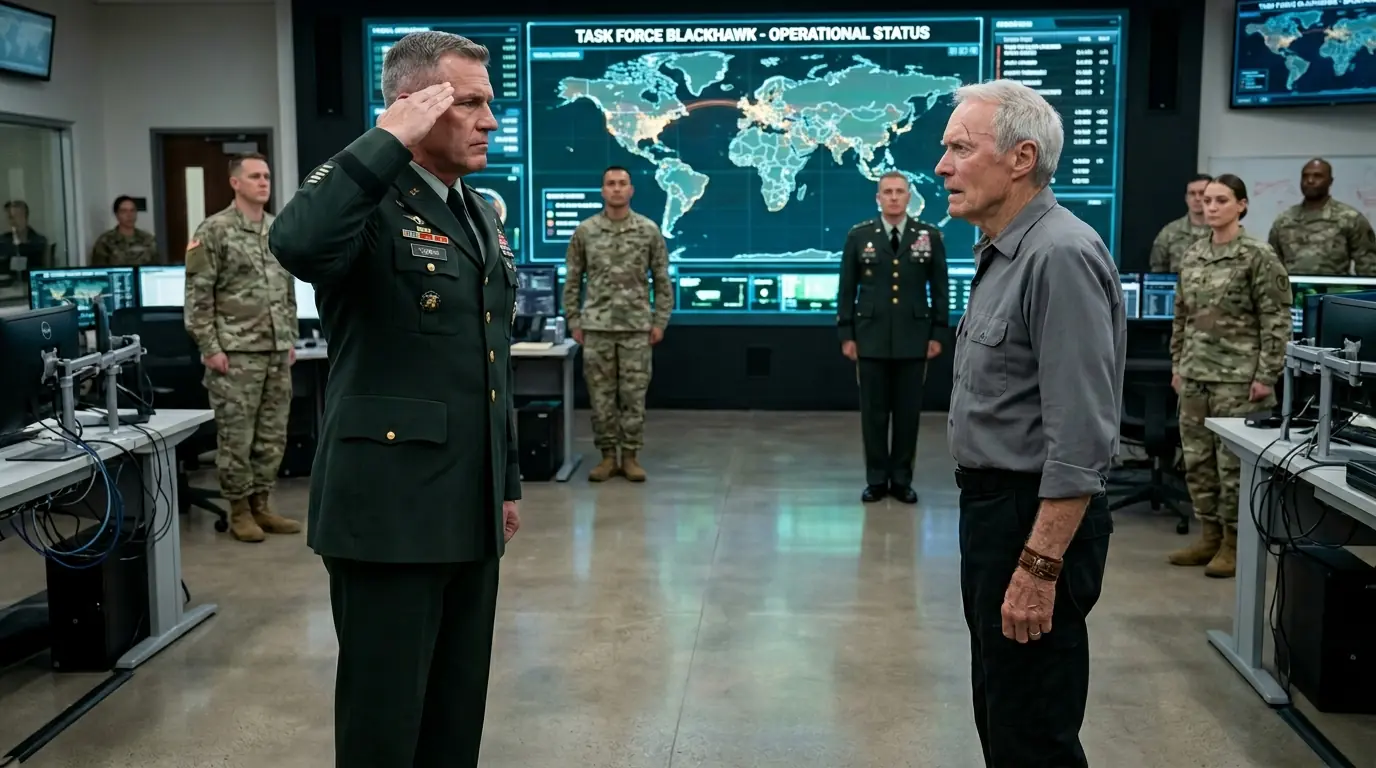
Then he did something that no one in the room had ever seen him do. He drew himself up to his full height, his back ramrod straight. His movements were crisp, precise, and filled with a profound sense of ceremony.
“Room,” he barked, his voice the pure, uncut command of a four-star general. “Attention.”
Instinct and training took over. Every uniformed person in the room, from Captain Rostova to Sergeant Miller, snapped to the position of attention. The sound of 20 pairs of heels clicking together echoed in the cavernous space.
General Thorne faced Thomas Whitfield, the old man in the simple civilian clothes. He raised his hand in a slow, perfect salute.
“Permission to thank you for your service, Sergeant Major,” the general said, his voice thick with emotion. “It is an honor to be in your presence.”
Thomas looked at the general, then at the young, stunned faces of the soldiers standing at attention for him. A lifetime of buried memories, of pain and pride, washed over him. He slowly straightened his back, the years seeming to fall away from his shoulders.
He was no longer the coffee guy.
He was Sergeant Major Thomas Whitfield.
He was Nightwolf.
He gave a slight, dignified nod.
“At ease, General,” he said, his voice raspy but firm.
The salute was the final blow to the arrogance of the young officers. It was a public and undeniable recalibration of the universe. The man they had dismissed as a slow-moving servant was, in fact, a titan of their profession, a foundational pillar of the very institution they served.
The shame was a palpable force in the room.
General Thorne held his salute for a moment longer before slowly lowering his hand. He turned to Rostova and Chen, his eyes like chips of ice.
“You two,” he began, his voice dropping back to a dangerously quiet level, “are a disgrace. You stand in a room named for heroes, operating on principles forged by giants, and you can’t see the one standing right in front of you because you are blinded by your own perceived brilliance.”
He took a step toward them.
“You see a man serving coffee. I see the man who wrote the book on how to survive in a hostile environment with nothing but your wits. You see an old man with a trinket on his wrist. I see a warrior who has sacrificed more for this country than you can possibly comprehend. Your focus isn’t on the mission. It’s on your own egos. You are relieved of duty, effective immediately. Report to my adjutant. You will be reassigned.”
Rostova’s face crumpled. Chen just stared at the floor, his confidence shattered.
General Thorne turned back to Thomas, his expression softening.
“I apologize, Sergeant Major, for my officers and for their lack of respect.”
Thomas looked at the two young officers, seeing not arrogance anymore, but the raw, stinging humiliation of a lesson learned the hard way. He felt a pang of something like pity.
“There’s no need, General,” Thomas said, his voice quiet, but carrying the weight of earned wisdom. “They’re good soldiers. Smart. Dedicated. They’re just focused on the future. It’s easy to forget the past when you’re trying to build what comes next.”
He offered a small, forgiving smile.
“That’s what we taught them to do. Look forward. Always forward.”
His words, a gentle absolution, seemed to cut deeper than the general’s rebuke. It was a lesson in grace from a man who had every right to be bitter.
As he spoke, his fingers unconsciously brushed against the worn leather band on his wrist. The image from before returned, but this time it was complete.
He was in the belly of that Huey, the rain lashing down. The soldier beside him, a young radio operator from Ohio named David, was pressing the leather band into his hand. It was a good luck charm David’s father had given him.
“You make it back, Tom,” David had said over the roar of the rotors. “You tell them what happened here.”
Moments later, on the landing zone, a mortar round had screamed in. Without a thought, David had thrown himself on top of Thomas, pushing him into the muddy earth. The world had exploded in a shower of shrapnel and fire.
When the smoke cleared, David was gone, and the leather band was clenched tight in Thomas’s fist.
It wasn’t a good luck charm. It was the last piece of a friend who had given his life for him. It was a reminder that the mission, the future, was always built on the sacrifices of the past. That was the moral. That was the wisdom he carried.
The fallout was swift and decisive.
Captain Rostova and Lieutenant Chen were not just reassigned. They were sent to the U.S. Army Combined Arms Center at Fort Leavenworth. Their new duty was in the archives, managing the digitization of historical after-action reports from conflicts dating back to the Korean War.
Their punishment was not to be demoted, but to be educated.
For eight hours a day, they were ordered to read the stories of the men they had so easily dismissed, to learn the history that bled and fought and died so they could have the luxury of commanding drones from an air-conditioned room.
A formal written apology from the command was delivered to Thomas Whitfield, along with a newly mandated training module for all personnel at the facility on the U.S. Army’s Living Legends Program.
Three months later, Rostova was in the base library, sifting through a dusty file on long-range reconnaissance patrols. She looked up and saw Thomas sitting at a nearby table, reading a novel.
He was no longer serving coffee. The general had insisted he take a position as a civilian historical consultant for the command, a role he had quietly accepted.
Her heart pounded in her chest. She took a deep breath, stood up, and walked over to his table. He looked up as she approached, his eyes calm and without a hint of judgment.
“Sir,” she began, her voice barely a whisper. “Mr. Whitfield.”
He nodded slightly.
“Captain.”
“I just wanted to say I’m sorry,” she stammered, the words feeling clumsy and inadequate. “For what I said that day. How I acted. There’s no excuse. I was arrogant, and I was wrong. I’ve been reading the reports about you, about men like you. I just…”
He looked at her, truly looked at her, and saw not the sharp-tongued officer, but a young woman humbled by a necessary truth.
“We all have lessons to learn, Captain,” he said, his voice gentle. “The important thing is that we learn them. The past is not there to be worshipped. It is there to be understood so we can build a better future.”
He offered a small smile.
“Keep reading. The answers are all in there.”
She nodded, a lump forming in her throat.
“Thank you, sir.”
She walked away feeling not just forgiven, but changed. The old man, the unassuming hero, had given her one last lesson.
That true strength wasn’t in knowing all the answers, but in having the humility to learn from those who had come before.