“Get out now. No vagrants allowed.”
The words rang across the dining room of Harper’s Table like a plate dropped on tile. Conversations stopped halfway. A fork paused above a piece of steak. A child in a booth near the window looked up from his fries. Even the cooks behind the open kitchen line slowed for a second, sensing the change in the room before they understood it. At the front entrance stood an elderly white man in his early seventies, average height but slightly bent from age, with a lean, worn frame, a deeply lined face, tired gray eyes, medium-length gray hair brushed back in a messy way, and a full gray beard that looked untrimmed but not wild. He wore an old brown coat with frayed cuffs, a faded flannel shirt underneath, dark trousers rubbed thin at the knees, and scuffed leather boots carrying dust from the road. One hand held a wooden cane. The other rested lightly near his chest, as if he had walked too far and was trying to steady his breathing without making it obvious.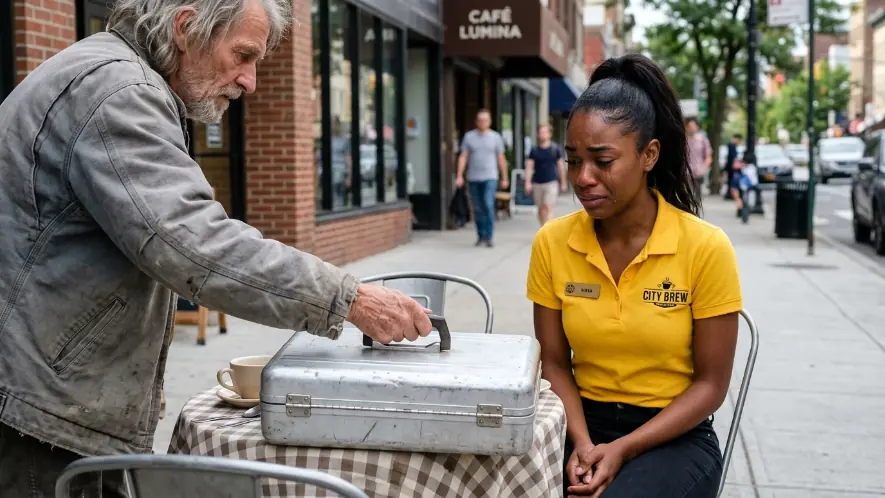
Across from him stood Daniel Mercer, the restaurant manager, polished from head to toe. Daniel was forty-three, sharp-jawed, perfectly shaved, wearing a navy dress shirt, a narrow tie, and black shoes so glossy they caught the ceiling lights. He prided himself on appearances. He liked clean tables, quiet customers, full reservations, expensive cars in the parking lot, and staff who moved quickly without needing to be told twice. Harper’s Table was one of the most successful locations in the national Harper Hospitality chain, and Daniel liked to believe that success existed because of him. In truth, the restaurant had been successful before he arrived, but Daniel had built his ego around the idea that he alone protected its reputation.
The old man did not raise his voice. He simply looked at Daniel with a calmness that made the insult seem even uglier.
“I’m sorry to bother you. I was wondering if I could buy something small to eat.”
Daniel looked at his coat, then at his boots, then at the cane, and his lip curled.
“Buy? With what? Coins you found under a bench?”
A few customers shifted uncomfortably. No one laughed. Daniel expected laughter, or at least approval, but the room only grew quieter. The old man reached slowly into his pocket and pulled out a few folded bills.
“I have money.”
Daniel barely looked.
“This is not the place for you. We have standards here.”
The old man’s eyes moved briefly around the room. He noticed the polished wood tables, the framed photographs of farms on the walls, the open kitchen, the carefully folded napkins, the staff standing frozen behind the counter. He noticed everything. Then his gaze returned to Daniel.
“Standards should include courtesy.”
Daniel’s face tightened.
“Don’t lecture me in my restaurant.”
Behind the counter, a young waitress named Emily Carter had been arranging silverware when she heard the first insult. She was twenty-four, with tired eyes from working double shifts, her brown hair tied back in a simple ponytail, and a name tag pinned slightly crooked to her uniform. Emily was not important in Daniel’s eyes. She was reliable, polite, and easy to schedule for the shifts nobody else wanted. What he did not know, or did not care to know, was that Emily worked this job to help pay her mother’s medical bills and keep her younger brother in community college. She knew what it meant to count money. She knew what it meant to be looked down on. And she knew hunger did not always arrive looking neat enough to deserve compassion.
She stepped out from behind the counter before she had fully decided to move.
“Sir,” she said gently to the old man. “Would you like some soup? We just made a fresh pot.”
Daniel turned toward her.
“Emily, stay out of this.”
But Emily had already taken a small takeout container from the shelf. She went to the kitchen window and filled it with hot vegetable beef soup, then added a piece of bread, a napkin, and a spoon. Her hands were quick, but her expression was steady. When she returned, she held the meal out to the old man.
“Take this. It’s free.”
The old man looked at the container, then at her face. His eyes changed, not dramatically, but enough that Emily noticed. It was as if he had been searching for something and had just found a small sign of it.
“Thank you, young lady.”
“You’re welcome.”
Daniel stepped between them, furious.
“Have you lost your mind?”
“He’s hungry.”
“That is not your decision to make.”
“I paid for it,” she said.
Daniel blinked.
“What?”
“I’ll cover it out of my tips. The restaurant won’t lose anything.”
Daniel gave a sharp, humorless laugh.
“You think this is about one bowl of soup? This is about control. This is about boundaries. This is about keeping this place from becoming a shelter.”
The old man held the container carefully, saying nothing.
Emily looked Daniel in the eye.
“It’s one meal.”
Daniel leaned closer, his voice dropping but still loud enough for half the room to hear.
“You’re fired if you do that again.”
Emily swallowed. She needed this job. She needed the tips, the hours, the insurance discount, the stability. Her mother’s prescriptions alone took half her monthly pay. Her brother, Noah, had just asked if he should pause school for a semester to help. Emily had told him no, promising she could handle it. So yes, fear moved through her. But fear did not erase what she had seen at the door.
Daniel turned to the old man.
“And you. Take it and leave. Do not come back. We don’t want people like you making customers uncomfortable.”
The old man looked at Daniel for a long moment.
“People like me?”
Daniel crossed his arms.
“Exactly.”
The old man nodded once, not in agreement, but as if filing the words somewhere permanent.
“Then I’ll go.”
He looked back at Emily.
“Thank you again.”
Emily wanted to say more, but Daniel stood too close. The old man stepped outside slowly, the door closing softly behind him. Through the window, Emily saw him sit on the low brick wall near the parking lot and open the soup container. He ate slowly, holding the spoon with careful dignity. He did not eat like someone greedy. He ate like someone grateful.
Inside, the restaurant gradually returned to motion. Customers resumed talking, though more quietly than before. Daniel walked past Emily and hissed under his breath.
“If you embarrass me like that again, you’re done.”
Emily said nothing. She returned to her tables, refilled drinks, carried plates, and smiled when customers thanked her. But the whole evening felt different. She could still see the old man on the brick wall. She could still hear Daniel’s words. No vagrants allowed. We have standards. People like you. The more she thought about it, the more the restaurant’s polished surfaces seemed less clean and more cold.
Near closing, one of Emily’s regulars, a retired teacher named Mrs. Alvarez, stopped her near table eight.
“You did the right thing.”
Emily forced a small smile.
“Thank you.”
“I mean it. Some people forget that a restaurant feeds people. That should be the first rule.”
Emily glanced toward Daniel’s office.
“Not everyone sees it that way.”
Mrs. Alvarez folded her receipt and slipped it under her cup.
“Then not everyone should be in charge of a restaurant.”
Emily did not answer, but the words stayed with her.
That night, after closing, Emily walked home because her car needed a new battery and she was saving for it little by little. The air was cool, and the streets were quiet. She passed storefronts with lights turned off, a laundromat still humming, and a church sign that read, Kindness is never wasted. She stopped for a moment when she saw it. She thought of the old man and wondered where he had gone. Maybe he had a shelter bed. Maybe he had a car. Maybe he was sleeping somewhere cold. She wished she had done more than give soup. Then she reminded herself that sometimes the small thing was the only thing a person could do.
When she reached her apartment, her mother was asleep in the recliner, a blanket over her knees, oxygen tubing resting across her cheek. Noah sat at the small kitchen table with textbooks open, rubbing his eyes.
“You’re late,” he said.
“Long shift.”
“Bad long or normal long?”
Emily took off her shoes.
“Both.”
He studied her.
“What happened?”
She shook her head.
“Manager was cruel to an old man. I gave the man soup. Daniel threatened to fire me if I do it again.”
Noah leaned back.
“That guy is still awful.”
“He thinks kindness is bad for business.”
“Then he doesn’t understand business.”
Emily smiled faintly.
“When did you become wise?”
“When you started working too much and I had to catch up.”
She laughed quietly, careful not to wake their mother. Then she sat at the table, exhausted.
“I can’t lose that job, Noah.”
“I know.”
“But I don’t know how to keep working for someone who talks about people like that.”
Noah closed his book.
“Maybe you won’t have to forever.”
Emily looked toward her sleeping mother.
“Forever is not what scares me. Next month scares me.”
He reached across the table and squeezed her hand.
“You always figure things out.”
Emily wanted to believe him. But that night, lying awake on the couch, she felt the weight of every bill, every shift, every insult she had swallowed because survival required silence. Still, under all that fear, one thought remained clear: if the same old man walked in tomorrow hungry, she would feed him again. Even if it cost her.
The next morning, Harper’s Table opened at ten. Daniel arrived early, as usual, carrying a leather folder and a coffee he had bought from somewhere else because he claimed the restaurant coffee was beneath his taste. He walked the dining room, checking corners, criticizing fingerprints on glass, and reminding the staff that a regional inspection could happen any time that month. He liked saying that. It kept people nervous.
Emily arrived fifteen minutes before her shift, tied her apron, and started preparing the side station. She had slept badly, but she moved with practiced efficiency. At ten-twenty, a black luxury sedan pulled into the parking lot. Then another. Then a third. Emily noticed first because she was wiping the front windows. Daniel noticed seconds later and straightened instantly.
Three men in dark suits stepped out of the first car. A woman with a tablet stepped out of the second. Then the back door of the middle sedan opened. The old man from yesterday stepped out.
But he no longer looked like a vagrant.
He wore a tailored charcoal suit, a crisp white shirt, and polished black shoes. His gray hair was neatly brushed back. His beard had been trimmed. The wooden cane was the same, but now it looked elegant rather than pitiful. His posture was straighter, his expression composed. He looked like a man people waited for, listened to, and feared disappointing.
Daniel’s face changed before the door even opened.
“No,” he whispered.
The old man entered slowly, followed by the suited staff. The restaurant went still in a familiar way, but this silence was different. Yesterday’s silence had been discomfort. Today’s was realization.
Daniel rushed forward.
“Good morning, sir. Welcome to Harper’s Table. I’m Daniel Mercer, the manager. How can I help you?”
The old man looked at him.
“I know who you are.”
Daniel’s smile faltered.
“Yes, of course. Have we met before?”
“We met yesterday.”
Daniel swallowed.
“I… yesterday?”
“You told me to get out.”
The entire staff froze. Emily stood near the counter, her cloth still in one hand.
Daniel’s face went pale.
“Sir, I didn’t realize.”
The old man’s eyes sharpened.
“That is exactly why I came.”
He turned slightly to the woman with the tablet.
“Please record this for internal review.”
She nodded.
Daniel took a small step back.
“Sir, if I had known who you were, I would never have…”
The old man lifted a hand, stopping him.
“If you had known who I was, you would have treated me with respect. That tells me your respect is not character. It is calculation.”
Daniel opened his mouth, then closed it.
The old man turned to the staff and customers.
“My name is Arthur Harper. I founded this company thirty-one years ago with one rented kitchen, three employees, and a belief that food served with dignity could build community. I still visit our locations without announcement because reports show numbers, but people show truth. Yesterday, I came here dressed as someone with nothing. Not to trick anyone for entertainment. Not to create a scene. I came because complaints about this location disturbed me. Customers mentioned coldness. Staff mentioned fear. Former employees mentioned humiliation. I wanted to know if those were isolated complaints or culture.”
He looked back at Daniel.
“Now I know.”
Daniel’s voice shook.
“Mr. Harper, I run a profitable location. Our numbers are strong.”
Arthur’s face did not change.
“Numbers are not the soul of a business.”
“But sir, we have policies.”
“Yes. Policies I approved. Policies against harassment, loitering, and unsafe conduct. Not policies against hunger. Not policies against age. Not policies against poverty. You used rules as a weapon because compassion made you uncomfortable.”
Daniel looked toward Emily, then back at Arthur.
“I was protecting the brand.”
Arthur leaned slightly on his cane.
“I am the brand you claimed to protect. And I am telling you that you damaged it.”
The words landed with quiet force. Daniel seemed to shrink inside his pressed shirt.
Arthur turned toward Emily.
“Young lady.”
Emily stepped forward, nervous.
“Yes, sir.”
“What is your name?”
“Emily Carter.”
“Emily Carter. You gave me food.”
“Yes, sir.”
“Why?”
She looked down for a moment, then back up.
“Because you were hungry.”
“Did you know who I was?”
“No.”
“Did you expect a reward?”
“No.”
“Were you afraid of losing your job?”
Emily hesitated.
“Yes.”
“But you did it anyway.”
She nodded.
“My mother taught me that if someone is hungry and you can help, you help. You don’t ask whether they deserve it first.”
Arthur studied her, and something warm entered his expression.
“Your mother taught you well.”
Emily’s eyes stung, but she held herself steady.
Daniel tried to recover.
“Mr. Harper, Emily is a good worker, but she disobeyed direct management instruction.”
Arthur turned to him slowly.
“No. She obeyed the first principle of this company better than you did.”
Daniel’s jaw tightened.
“With respect, sir, one sentimental incident should not erase years of management.”
Arthur nodded once.
“You’re right. One incident should not erase years. That is why I reviewed your years before coming here.”
The woman with the tablet tapped the screen and handed Arthur a folder. He opened it.
“Six staff complaints about verbal abuse. Four resignations mentioning hostile management. Two customer reports about you refusing service to people based on appearance. One incident involving a veteran you removed while he was waiting for his daughter. Another involving a mother whose card declined before you allowed a server to pay for her meal. Yesterday was not a mistake, Daniel. It was a pattern.”
Daniel’s face reddened.
“Those complaints were exaggerated.”
“Perhaps one complaint can be exaggerated. A pattern cannot.”
The room was silent enough to hear the kitchen fan.
Arthur closed the folder.
“You’re fired, effective immediately.”
Daniel stared at him.
“Sir, please. I have given years to this company.”
“And in those years, you forgot why it exists.”
“My family depends on this job.”
Arthur’s expression remained firm, but not cruel.
“Then I hope losing it teaches you what you refused to see when others depended on theirs.”
Daniel looked around, perhaps expecting someone to defend him. No one did. Some staff looked relieved. Some looked shaken. Emily felt no joy in watching him fall. She only felt the heaviness of consequences arriving late but clearly.
Arthur motioned to one of the suited men.
“Collect his keys, access card, and office materials. He may gather personal belongings under supervision.”
Daniel stood motionless for a moment, then slowly removed the keys from his belt and placed them on the counter. The sound was small, but it carried through the room. Then he walked toward the office with one of the men following him.
Arthur turned back to Emily.
“Would you sit with me for a moment?”
Emily blinked.
“Me?”
“Yes.”
They sat at a table near the window. The staff pretended not to stare and failed. Arthur rested both hands on his cane.
“How long have you worked here?”
“Two years.”
“Do you like the work?”
“I like people. I like serving them. I don’t always like how this place has been run.”
“Honest answer.”
“You asked.”
Arthur smiled faintly.
“I did.”
Emily glanced toward the office.
“I don’t want anyone to think I wanted him fired.”
“Did you?”
“No. I wanted him to be kinder.”
“That would have been better. But he chose otherwise.”
Arthur paused.
“I am appointing an interim manager from the regional office today. But I want you in the leadership training program.”
Emily stared at him.
“Sir, I’m just a waitress.”
“No one is just anything.”
“I don’t have a degree.”
“I didn’t ask if you had a degree. I asked, through yesterday’s test, whether you had judgment.”
“I gave away soup.”
“You protected the dignity of a guest when your manager attacked it. That is judgment.”
Emily swallowed.
“I need this job, sir. My mother is sick. My brother is in school. I can’t risk something unstable.”
“That is exactly why the offer includes stable pay, benefits, training, and a path upward. Assistant manager trainee. Effective this week, if you accept.”
Emily looked down at her hands.
“I don’t know if I can do that.”
Arthur’s voice softened.
“Good. People who are too sure of themselves often become Daniel. People who question themselves may still learn to lead well.”
A tear slipped down Emily’s cheek before she could stop it.
“I’m sorry.”
“Never apologize for being moved by your life changing.”
She laughed weakly through the tears.
“Then yes. I accept.”
Arthur nodded.
“Good.”
By noon, the restaurant felt like a different place. The regional interim manager arrived, a calm woman named Teresa Cole, who introduced herself to every staff member by name and asked what needed fixing first. The cooks spoke openly for the first time in months. Servers admitted they had been scared to give discounts, correct mistakes, or even comfort upset customers because Daniel treated every act of flexibility as weakness. Teresa listened without interrupting and wrote everything down.
Arthur stayed longer than anyone expected. He did not sit in the office. He sat in the dining room. He ordered soup, the same kind Emily had given him, and paid for it. When Mrs. Alvarez came in for lunch and recognized Emily’s red eyes, she asked what happened. Emily simply said there had been changes. Mrs. Alvarez looked toward Arthur, then toward the empty manager’s office, and smiled like she understood more than she had been told.
At three in the afternoon, Daniel left through the side door carrying a small box. For one second, he looked toward Emily. She expected anger. Instead, she saw confusion, humiliation, and maybe the first crack of regret. He did not speak. She did not speak either. He walked away, got into his car, and drove off.
That evening, Emily went home with news she could barely believe. Noah was at the kitchen table again, books open, while their mother rested nearby.
“You look strange,” Noah said.
Emily dropped her bag on the chair.
“The old man from yesterday was Arthur Harper.”
Noah frowned.
“Arthur Harper as in Harper’s Table?”
“As in the whole company.”
He stared.
“You’re joking.”
“I’m not.”
Their mother opened her eyes from the recliner.
“What happened?”
Emily sat down and told them everything. The cars. The suits. The folder. Daniel being fired. The offer. The leadership program. Her voice trembled when she reached the part about benefits and better pay.
Her mother covered her mouth.
“Oh, Emily.”
Noah stood so fast his chair scraped the floor.
“You got promoted because you gave the boss soup?”
Emily wiped her eyes.
“I got promoted because I gave a hungry man soup.”
Her mother reached for her hand.
“No. You got promoted because you remembered who you are when it would have been easier to be afraid.”
Emily knelt beside the recliner and rested her head against her mother’s arm. For the first time in a long while, the future did not feel like a hallway with all the lights turned off.
In the weeks that followed, Harper’s Table changed in ways customers could feel before they could name. A small sign appeared near the entrance: If you are hungry and need help, please ask for a manager. Staff meals were expanded. A community meal fund was created from voluntary customer donations matched by the company. Leftover safe food went to a local shelter instead of the trash. Teresa trained the staff to handle need with discretion, not spectacle. Emily learned scheduling, inventory, conflict resolution, and how to correct mistakes without humiliating people.
Arthur visited once a month, never with a crowd. Sometimes in a suit. Sometimes in jeans and an old jacket. He always watched more than he spoke. Each time, he asked Emily one question.
“What did you notice this week?”
At first, she gave simple answers. A broken chair. A late delivery. A customer complaint. Later, she learned to notice deeper things. A cook who seemed exhausted. A server afraid to ask for time off. A regular who stopped ordering full meals and only bought coffee. A busboy sending half his paycheck home. Arthur listened to all of it.
Six months later, Emily became assistant manager. One year later, she ran the location. Not with fear. Not with arrogance. With standards, yes, but standards that made room for humanity. The restaurant stayed clean. Service improved. Profits rose. But something else rose too: loyalty. Staff stayed. Customers returned. People trusted the place.
One rainy night, near closing, an elderly man came in soaked, carrying a plastic bag and asking if he could sit somewhere dry for a few minutes. A new server looked toward Emily, unsure. Emily walked over herself.
“Would you like soup?”
The man’s eyes filled.
“I don’t have money.”
“That wasn’t my question.”
She brought him soup and bread, then sat across from him for a moment while rain tapped against the windows. Across the dining room, a framed photograph hung near the register. It showed Arthur Harper in his worn coat from that first day, standing beside Emily in her manager uniform. Beneath it were words Arthur had written himself.
Never judge a book by its tattered, worn cover.
Customers often asked about the photo. Emily always told the story the same way. An arrogant manager saw a vagrant. A waitress saw a hungry man. The hungry man turned out to be the boss of the entire chain. But the real lesson was never about the disguise, the promotion, or the firing. The real lesson was that people reveal themselves when they think kindness costs too much.
Years later, Emily would still remember the first moment clearly: Daniel’s voice at the door, the old man’s quiet eyes, the heat of the soup container in her hands, the fear of losing everything, and the decision to help anyway. She would remember that small acts of kindness are not always small to the person receiving them. Sometimes a free meal is a meal. Sometimes it is proof that dignity still exists. Sometimes it is the moment fate quietly writes down a name and waits for the right morning to return.