“Hey, you filthy old man. Get away from my house. This isn’t a shelter.”
At the iron gates of a massive mansion in one of the wealthiest neighborhoods outside Charleston, South Carolina, a woman named Vanessa Whitmore frowned in disgust at the white elderly man standing near her entrance. He looked about seventy years old, with a thin frame, tired gray eyes, a weathered face, and a worn brown coat that had clearly seen too many seasons. One hand held an old wooden cane. The other rested against the gate as if he needed it just to keep standing. Dust clung to his shoes. Sweat darkened the collar of his shirt. His lips were dry, and every breath seemed to cost him effort. He had walked a long way under the afternoon sun, and by the time he reached Vanessa’s mansion, all he wanted was a little water and perhaps something small to eat.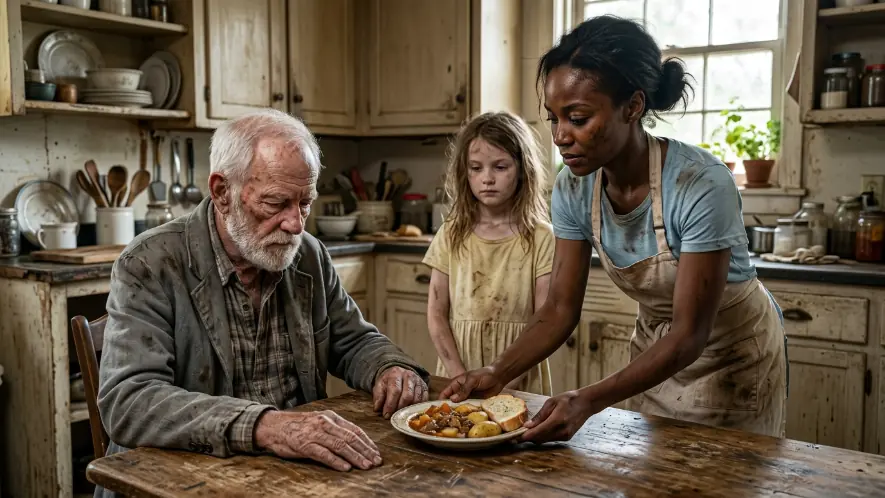
Vanessa did not see a thirsty man. She saw an inconvenience. She saw dirt near her polished driveway, poverty near her trimmed hedges, and need standing too close to the image she had built for herself. Her mansion rose behind her like a palace, with white columns, wide balconies, a fountain in the circular driveway, and windows tall enough to reflect the sky. Gardeners came every week. Cleaners came every morning. Security cameras watched every angle. Nothing about the place suggested hunger, thirst, or mercy. Vanessa had spent years making sure people saw success when they looked at her house. The old man at her gate disturbed that picture.
“Ma’am, I’m sorry to bother you,” the old man said gently. “I’ve walked a long way. Could I please have a glass of water and maybe something small to eat?”
Vanessa stepped closer, her face hardening. She looked him up and down, then wrinkled her nose as if his exhaustion offended her personally.
“I’ve seen your kind before. You’ve got hands and feet. Go work instead of knocking on doors begging. You’re dirtying my entrance just by standing there. Leave now or I’ll call security.”
The old man lowered his eyes. He had been insulted before, but cruelty still found ways to hurt when a body was weak and thirsty. He shifted his cane, trying to steady himself. Vanessa, impatient with even that small movement, pushed the gate open just enough to step outside and shoved him back with her hand. He lost his balance and fell to the ground, one knee striking the pavement. His cane clattered beside him.
A gardener across the lawn looked up but said nothing. A delivery driver slowed near the curb but drove on. Vanessa crossed her arms and waited as if the old man’s struggle to stand was proof that he should never have come there in the first place.
The old man reached for his cane. His fingers shook, but he managed to grip it. Slowly, painfully, he pushed himself back to his feet.
“I’m sorry,” he said quietly. “I hope one day someone gives you water when you’re thirsty.”
Vanessa laughed once, cold and dismissive.
“I won’t ever need to beg strangers for water.”
The old man did not answer. He turned away from the mansion and began walking down the long street, each step slower than the one before. Behind him, Vanessa returned through the gate, muttering about people who had no shame. The iron bars closed with a heavy sound.
He walked for hours. The sun burned hotter. Heat rose from the pavement in waves. Cars passed him, their windows sealed, their passengers hidden behind tinted glass and air conditioning. The old man’s name was Samuel Whitaker, though no one on that street had cared enough to ask. He had once been strong. He had once built businesses with his own hands, funded schools quietly, helped churches repair roofs, and paid hospital bills for families who never knew his name. But age, grief, and a strange test of his own heart had brought him here dressed like a forgotten man, walking without the shield of wealth or reputation. He had wanted to know something simple but painful: when no one knew who he was, would anyone still see him as human?
By late afternoon, Samuel’s strength was nearly gone. His throat burned. His vision blurred at the edges. He moved away from the wealthy neighborhood and into a quieter part of town where the streets were narrower, the houses smaller, and the lawns less perfect. At the corner of a cracked sidewalk and a faded stop sign stood a small worn-down house with peeling blue paint, a sagging porch, and flowerpots made from old coffee cans. Outside, a woman knelt beside a plastic basin, washing clothes by hand. Her name was Ruth Coleman. She was thirty-nine, a single mother, and she had learned to stretch every dollar until it nearly disappeared. Rent was overdue. The electricity bill sat unpaid on the kitchen table. Her pantry held a small bag of rice, half a jar of peanut butter, one onion, one piece of bread, and a pot of thin soup she had made from leftover vegetables.
Beside her, her seven-year-old daughter, Lily, sat on the porch steps with a schoolbook on her lap. Lily was small, bright-eyed, and old enough to understand when her mother pretended not to be hungry. She watched the road often, as children do when they have learned that trouble can arrive without warning. When Samuel stopped in front of their house, Lily looked up first. Ruth followed her daughter’s gaze and saw the old man standing there, leaning heavily on his cane.
“Ma’am, I’m very thirsty. Could I trouble you for some water?”
“Of course. Please, come sit for a moment.”
Samuel looked surprised, as if kindness had become a language he had not heard all day.
“I don’t want to be a burden.”
“You’re not a burden. Come on. The shade is better on the porch.”
She guided him carefully to a wooden chair near the door. Lily moved her schoolbook aside and watched him with concern. Ruth went into the house and returned with the cleanest glass she owned, filled to the top with cool water from the pitcher she kept in the refrigerator. Samuel accepted it with both hands.
“Thank you.”
“Drink slowly,” Ruth said. “You look like you’ve been walking a long time.”
“I have.”
He drank, and the first swallow seemed to bring life back into his face. Ruth watched the way his hands trembled, the way he tried to sit politely even while exhaustion pressed down on him. She glanced toward the kitchen. The soup was not much. The bread was the last piece. She had planned to split it with Lily that night and pretend she was not hungry herself. But looking at Samuel, she knew he needed more than water.
She went back inside, poured a small bowl of hot soup, placed the last piece of bread on a plate, and brought it out to him.
“It’s not much, but something warm is better than nothing.”
Samuel looked at the food, then at her.
“Ma’am, I only asked for water.”
“I know what you asked for. I’m giving what I can.”
Lily looked at the half-empty table inside the kitchen, then at the plate in Samuel’s hands.
“Mom, if you give that to him, do we still eat tonight?”
Ruth turned to her daughter and gently touched her hair.
“We’ll share. If God gives us a little, it means we can still give a little.”
Lily looked at Samuel again. Her face softened. She stood, went into the house, and returned with a spoon wrapped in a napkin.
“He’ll need this too.”
Ruth smiled at her daughter.
“That’s right.”
Samuel looked carefully from mother to child. He saw the worn porch, the patched dress, the basin of hand-washed clothes, the thinness of their evening meal. Nothing about this house suggested abundance. Yet Ruth had opened her door wider than the mansion had opened its gate.
“You don’t have much either,” Samuel said. “Why give it to me?”
Ruth sat on the porch step, tired but calm.
“Hunger doesn’t hurt less just because someone else is poor. I can’t help everyone, but today you came to my door.”
Samuel lowered his eyes to the soup. For a moment, he could not speak. He ate slowly, not because the food was large, but because he wanted to honor it. Every spoonful tasted like more than vegetables and broth. It tasted like dignity. It tasted like being seen. Lily watched him carefully, then slipped inside and returned with a chipped cup of water for herself and her mother.
“We can share the rest later,” she told Ruth.
“Yes, baby,” Ruth said. “We can.”
Samuel finished the simple meal and sat quietly for a while. The sun began to lower behind the trees, softening the heat. Ruth returned to washing clothes, but she stayed close enough in case he needed help. Lily sat on the porch beside him and asked why his cane had a carved bird on top. Samuel told her it had belonged to his father. Lily asked if his father was kind. Samuel said he had been strict but fair. Ruth listened while pretending to focus on the clothes. There was something about the old man’s voice that did not sound like a drifter’s voice. It carried education, memory, and a sorrow deeper than the day’s hunger.
When Samuel finally stood, Ruth rose with him.
“Are you sure you’re all right to walk?”
“I am better than I was.”
“You can rest longer.”
“I have taken enough from you.”
“You didn’t take. We gave.”
Samuel looked at her for a long moment, then reached into the inside pocket of his coat. He pulled out an old copper button, worn smooth with age, and placed it on the porch table.
“Thank you. May your kindness return to you when you need it most.”
Ruth looked at the button, confused.
“You don’t have to leave anything.”
“It is not payment. It is a reminder.”
“A reminder of what?”
“That small things can open large doors.”
Ruth did not understand, but she did not want to embarrass him by refusing. She picked up the copper button and held it in her palm.
“Then thank you.”
Samuel gave Lily a small bow.
“And thank you for the spoon.”
Lily smiled.
“You’re welcome.”
Then the old man turned and walked down the street, his cane tapping softly against the sidewalk. Ruth watched until he disappeared around the corner. That evening, she and Lily shared what remained of the soup. Ruth gave Lily the bigger portion, as always. Lily noticed, as always, but this time she did not complain.
“Mom?”
“Yes?”
“Do you think he has a home?”
“I don’t know.”
“Do you think he’ll be okay?”
“I hope so.”
Lily looked toward the copper button sitting on the table.
“He talked like somebody from a storybook.”
Ruth smiled faintly.
“Maybe everyone does when they’ve lived long enough.”
That night, after Lily fell asleep, Ruth sat alone at the kitchen table. The house was quiet except for the hum of the old refrigerator and the distant sound of cars passing. She looked at the unpaid bills, then at the copper button. Her body was tired from work, worry, and the constant pressure of having too little. She did not regret helping Samuel. Not even when her own stomach growled. But she wondered how much longer she could keep surviving on faith and scraps.
The next morning, Ruth was getting Lily ready for school when a car pulled up outside. It was not the kind of car that usually came down their street. It was black, polished, and quiet, with tinted windows and a driver who stepped out wearing a dark suit. Ruth immediately felt nervous. She wiped her hands on a towel and opened the front door before he could knock.
“Are you Miss Ruth Coleman?”
“Yes.”
“My name is Mr. Daniels. Someone asked me to deliver this to you.”
He held out a thick envelope. Ruth took it slowly.
“Who sent it?”
“He asked that you read the letter first.”
Ruth looked down at the envelope. Her name was written clearly across the front. Lily stood behind her, peeking around her waist.
“Mom, is it bad?”
“I don’t know.”
Ruth opened the envelope with careful fingers. Inside were documents, a printed proposal, and a handwritten note. Her eyes moved over the first page. Then her hands froze. She read the words again because they seemed too impossible to trust. Long-term partnership offer. Community hot meal program. Kitchen provided. Food supplied. Salary covered by foundation. Program director, Ruth Coleman.
She sat down on the porch chair because her knees suddenly felt weak.
“What is it, Mom?”
Ruth could barely speak.
“It’s a job.”
Mr. Daniels nodded gently.
“More than a job, ma’am. The Whitaker Foundation is opening a local community meal station in this neighborhood. They need someone to run it. Someone trusted, practical, compassionate, and close to the people it will serve. The foundation will provide the kitchen, supplies, food contracts, and salary. You would manage daily meals, coordinate volunteers, and make sure anyone hungry can eat.”
Ruth stared at him.
“There must be a mistake. I don’t have experience running something like that.”
“The person who recommended you believes you have the exact experience needed.”
Ruth unfolded the handwritten note. The words were simple.
“When I stood at your door yesterday, I truly only wanted a glass of water. But what you gave me was the kind of heart this city needs.”
Tears filled Ruth’s eyes before she reached the signature. Samuel Whitaker. Founder, Whitaker Foundation.
She pressed the letter against her chest.
“The old man.”
Mr. Daniels smiled.
“Yes, ma’am.”
“He wasn’t poor?”
“He was thirsty. That part was real.”
Ruth looked toward the street where Samuel had disappeared the day before.
“Why would he do that?”
Mr. Daniels chose his words carefully.
“Mr. Whitaker lost his wife last year. She spent her life building meal programs for families in need. Before choosing where to expand the foundation, he sometimes visits neighborhoods quietly. He says people reveal their true hearts when they think no one important is watching.”
Ruth’s tears fell freely now.
“I gave him our last piece of bread.”
“Yes, ma’am. He mentioned that.”
Lily looked up at her mother.
“Mom, does this mean people will get soup?”
Ruth laughed through her tears and pulled her daughter close.
“Yes, baby. A lot of people.”
Mr. Daniels handed her another paper.
“If you accept, renovations on the empty lot beside your house can begin within two weeks. Mr. Whitaker already purchased it through the foundation months ago, but he had not chosen a director. He has now.”
Ruth stared at the lot beside her house, a patch of weeds and broken fence where children sometimes played with old cans.
“There?”
“Yes.”
“A kitchen?”
“A modest one. Enough to serve the neighborhood.”
“And I would be paid?”
“Yes. A proper salary.”
Ruth covered her mouth. For months, she had been afraid of eviction. Now someone was asking her to lead something that would feed others and keep her own child safe. The change felt so sudden that her heart could hardly hold it.
“I don’t know what to say.”
“Mr. Whitaker said you might say that.”
“What did he say I should do?”
“He said, tell her to say yes if her heart already has.”
Ruth looked at Lily. Lily nodded with the seriousness of a child who understood more than adults expected.
“Say yes, Mom.”
Ruth wiped her face.
“Yes.”
Three months later, beside Ruth’s small blue house, stood a modest hot meal station with clean white walls, a wide front window, a small garden, and a wooden sign hanging at the entrance. One bowl of soup, no questions asked. Underneath, in smaller letters, it read, Ruth’s Table.
Every morning, Ruth unlocked the door before sunrise. Volunteers arrived with aprons and crates of vegetables. Deliveries came twice a week. Local churches sent bread. A grocery store donated fruit. A retired nurse checked on the elderly guests. A teacher brought leftover books for children who waited with their parents. And every day, elderly people, single mothers, workers between jobs, homeless men, tired grandmothers, and children with hungry eyes lined up for a warm meal.
Ruth did not ask people to prove they were poor. She did not ask what mistakes they had made. She did not ask whether they deserved help. She remembered Samuel’s cracked lips, the way he had leaned on his cane, and how easy it would have been to turn him away. She remembered Vanessa’s mansion gate and her own small porch. She remembered Lily’s question.
“Mom, if you give that to him, do we still eat tonight?”
Lily never asked that again. Not because Ruth became rich, but because their table had grown bigger. Every bowl served reminded them that kindness did not shrink when shared. It multiplied.
One afternoon, Samuel Whitaker came to Ruth’s Table, this time dressed in a clean gray suit but carrying the same old cane with the carved bird. Ruth saw him from across the room and walked toward him slowly.
“I should be angry at you for scaring me.”
Samuel smiled.
“Perhaps you should.”
“You let me think you had nothing.”
“I had thirst. I had hunger. I had grief. I had questions. Those were not pretend.”
Ruth softened.
“And did you find your answers?”
He looked around the room at the people eating soup, at Lily helping an elderly woman carry bread, at volunteers moving between tables.
“Yes. I found them on your porch.”
Ruth reached into her pocket and pulled out the old copper button.
“I kept this.”
“I hoped you would.”
“What is it from?”
“My wife’s coat. She wore it the first winter she served meals under a bridge downtown. She used to say every act of kindness needs a button, something small that holds larger things together.”
Ruth closed her fingers around it.
“Then I’ll keep holding it together.”
Samuel nodded.
“I know you will.”
Far across town, Vanessa Whitmore still lived behind her massive gate. She heard about Ruth’s Table from neighbors, from charity boards, from newspaper stories praising the Whitaker Foundation. When she saw Samuel’s photograph in the article, her face went pale. She remembered the old man she had pushed to the ground. She remembered his words.
“I hope one day someone gives you water when you’re thirsty.”
For the first time, her mansion felt less like proof of success and more like a place with too many locked doors.
But Ruth never built Ruth’s Table to shame anyone. She built it to feed people. She built it because a thirsty old man came to her door and found a heart bigger than the house around it. She built it because some gates are huge and never open, while some houses are small but save lives.