Every Tuesday morning in March of 1987, a battered white stock trailer rattled into the Casper livestock auction yard at almost exactly seven fifteen.
By seven twenty, somebody would notice it.
By seven twenty-five, the first joke usually started.
By eight, half the men around the loading pens knew Reese Vance had arrived.
She was twenty years old, five-foot-seven, lean and strong from years of ranch work, with dark brown hair she usually braided over one shoulder beneath a faded tan cowboy hat. Her denim shirts were clean when she left home and rarely stayed that way beyond the first sale pen. She carried a spiral notebook in the back pocket of her jeans, a pencil behind one ear, and usually less money than anyone watching her would have guessed.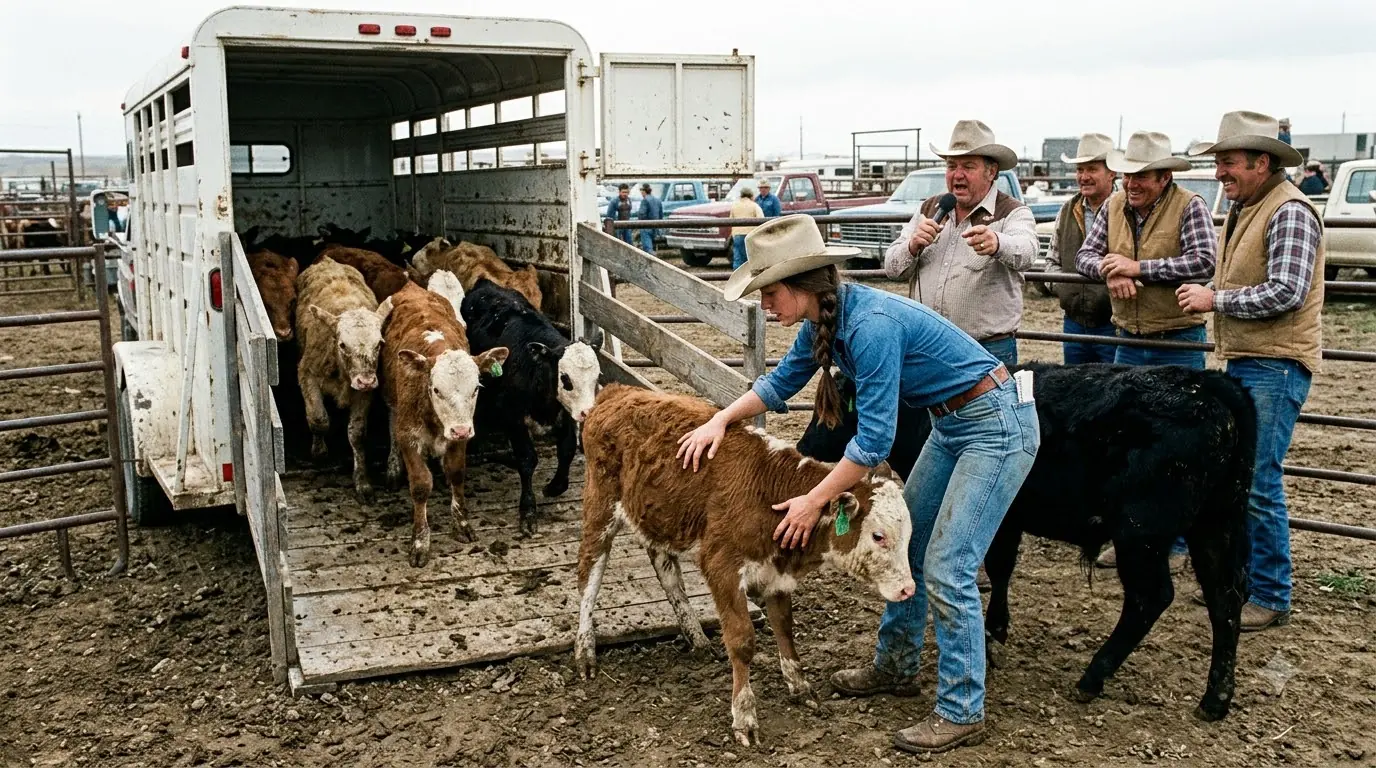
Reese never bought the calves other bidders wanted.
That was why the jokes began.
Fat bottle calves with smooth coats walked through the ring.
She watched.
Well-grown black calves with even frames brought strong prices.
She took notes.
Healthy commercial heifers with straight backs and clean legs passed beneath the auction lights.
Reese kept her hand down.
Then a skinny calf entered.
Ribs showing.
Mud dried along one flank.
A thin winter coat still hanging rough around the shoulders.
Nobody raised a card.
Reese did.
The auctioneer, Gordie Pruitt, leaned over the railing and grinned.
“There she is.”
Laughter started immediately.
Gordie was forty-eight, broad through the chest, loud even by auctioneer standards, and possessed of the peculiar talent for turning another person’s discomfort into public entertainment without technically saying anything unforgivable.
“Buzzard girl woke up.”
More laughter.
Reese kept her bidder card raised.
“Forty?”
Silence.
“Thirty-five?”
A slaughter buyer shook his head.
“Thirty?”
Reese nodded once.
Gordie slapped the rail.
“Sold.”
The calf belonged to her.
A rancher near the coffee counter shouted:
“Reese, you planning on feeding that thing or burying it?”
Several men laughed.
She did not answer.
Another calf came.
Thin again.
Bright-eyed.
One hind leg scarred from an old scrape but straight under weight.
Reese bid.
Bought it.
Then came a third.
That one she rejected immediately.
Gordie noticed.
“Well now.”
“Too ugly even for you?”
Reese kept writing.
He leaned closer.
“What’s wrong with that one?”
She finally looked up.
“Front pastern.”
Gordie glanced at the calf.
“Looks fine from here.”
“That’s why you’re up there.”
The men nearest him laughed.
This time at Gordie.
His smile flattened for half a second.
Then he recovered.
“Careful, boys. College girl’s teaching cattle now.”
Reese looked down at her notebook again.
She had spent only a year and a half studying animal science before returning home.
That fact had somehow become more offensive to some ranchers than if she had never studied anything.
She did not have a degree.
Did not pretend she did.
But she had learned enough to ask questions she had never heard around the Vance ranch when she was younger.
What survived a hard start?
Which weakness came from poor management and which was structural?
Which animal stayed alert under stress?
Which calf settled quickly after handling?
Which one recovered?
Which one remained chronically fragile?
Those questions had followed her home from college.
Especially one sentence from Dr. Owen Marsh.
He had been discussing selection pressure during a genetics lecture when he said:
“A calf that survives a hard start carries information you cannot buy.”
Most students wrote it down.
Reese remembered it.
That difference would become important.
Vance Ranch sat on six hundred dry acres north of Casper where grass did not grow thick enough for mistakes.
Her father, Hollis Vance, had spent thirty-four years raising cattle there.
Good years bought machinery.
Bad years sold it again.
The ranch had survived because Hollis understood how to live without expecting comfort.
Then came two drought summers.
Stock tanks dropped.
Pasture turned brittle.
Hay prices climbed.
Cattle prices weakened at exactly the wrong time.
Hollis reduced the herd.
Then reduced it again.
By the winter Reese returned from school, the ranch had fewer cows than at any point since she was ten.
Her father’s body had declined with it.
His back hurt constantly.
More frightening were his lungs.
He coughed harder in cold mornings.
The doctor in Casper called it chronic damage and told Hollis to stop inhaling dust.
Hollis laughed.
“Tell Wyoming.”
Reese did not.
She came home.
No announcement.
No heroic promise.
She simply unloaded two bags, put her college books in the old bedroom, and went to work.
For three months she helped with the existing herd.
Then she told Hollis she wanted to buy calves.
He assumed replacements.
She shook her head.
“Sale-barn culls.”
Hollis stared at her.
“Why?”
“Because they’re cheap.”
“Usually for a reason.”
“Yes.”
“That should concern you.”
“It does.”
“What exactly are you thinking?”
Reese opened her notebook.
That was when Hollis became worried.
He had learned during her childhood that a notebook meant she had already moved beyond permission.
“I don’t want every cheap calf.”
“Good.”
“I want calves that look bad for temporary reasons.”
“Underfed.”
“Recovered from disease.”
“Poor coat.”
“Bad handling.”
“But structurally sound.”
Hollis folded his arms.
“And then?”
“Track them.”
“For what?”
“Recovery.”
“Growth.”
“Temperament.”
“Heat.”
“Winter.”
“Feed.”
“Everything.”
Hollis stared.
“You planning to raise cattle or conduct experiments?”
“Yes.”
He laughed despite himself.
Then became serious.
“How much money?”
Reese named a figure.
His expression hardened.
“That’s almost everything we have left in the replacement account.”
“I know.”
“You understand what happens if these calves die?”
“Yes.”
“No.”
He leaned forward.
“You understand numbers.”
“I’m asking whether you understand what losing that money feels like when you don’t have another check coming.”
Reese went quiet.
Hollis regretted the sharpness immediately.
But he did not withdraw it.
She looked toward the window.
“Dad.”
“Yes?”
“If we keep doing exactly what we’re doing, how many cows do we have in three years?”
He did not answer.
She already knew.
Not enough.
Reese continued.
“I’m not saying this works.”
“That’s reassuring.”
“I’m saying the ranch cannot outspend bigger operations.”
“We can’t buy the best replacement heifers.”
“We can’t feed our way through every drought.”
“We can’t afford high vet costs.”
“So maybe we stop trying to build the herd everybody else wants.”
Hollis watched her.
“And build what?”
“One that fits this place.”
That was the first time she said it aloud.
Hollis looked out across six hundred acres of thin Wyoming ground.
Finally:
“How many calves?”
“Start with twelve.”
“Not forty.”
“Twelve.”
“Cash only.”
“Yes.”
“No borrowing.”
“Yes.”
“If I think you’re buying something fundamentally unsound, I get one veto.”
Reese frowned.
“One?”
“One.”
“Not twelve.”
“One.”
She smiled.
“Deal.”
By the fourth auction, Gordie Pruitt had named her publicly.
“The buzzard girl.”
Reese hated it.
She refused to show him.
Gordie loved anything that got a reaction from the ring.
He would scan the sale pens whenever a weak calf appeared.
“Where’s Reese?”
“Somebody find our resident collector.”
“Got premium garbage coming.”
Ranchers laughed.
At first Reese told herself it did not matter.
Then one Tuesday the laughter followed her outside.
She had purchased three calves.
One small red heifer stood trembling on the trailer ramp.
Reese crouched.
Held one hand beneath its chin.
The calf resisted, then steadied.
Behind her, four ranchers watched.
One was Dutch Renfro, who owned almost nine hundred acres east of the Vance place.
Dutch was fifty-one, thick-necked, experienced, and not fundamentally cruel.
That made the ridicule hurt more.
He laughed because everyone else did.
Gordie walked over holding coffee.
“Look at her.”
Reese ignored him.
Dutch said:
“That thing will eat more medicine than hay.”
Reese checked the calf’s gums.
Pink.
Hydration acceptable.
Eyes alert.
Coat rough.
No obvious structural defect.
She ran one hand down the front leg.
Straight.