"Then I shall ask whether His Grace's character is as sound as his fortune," Georgiana Kingsley said, and closed her ivory fan. Around Christopher, Duke of Falconbridge, a ring of silk and jewels fell silent. Fifty ladies had already praised his collieries, his stables, his rents, his plate, and the diamonds his future Duchess would surely wear. The laughter came a moment too late because Christopher did not laugh at all.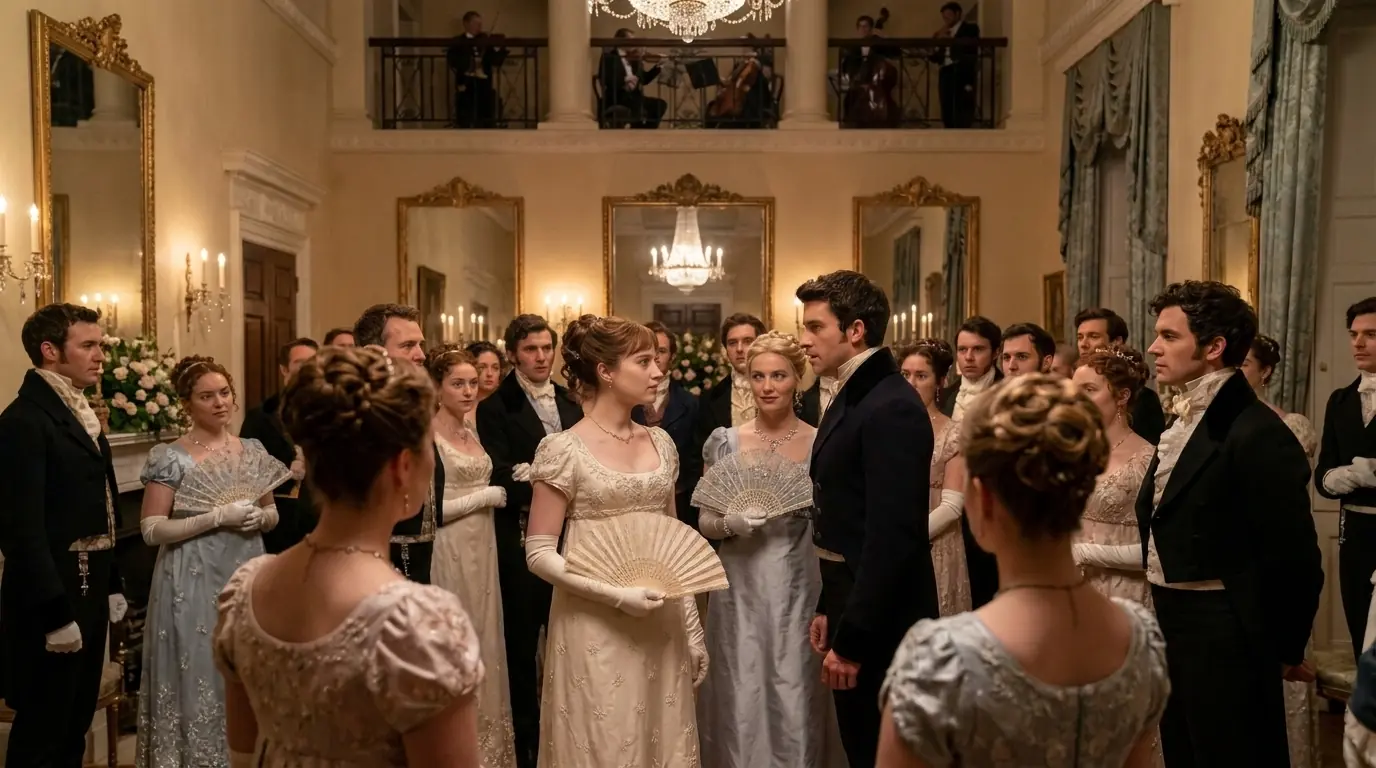
He stood at the center of Falconbridge Hall's ballroom, tall and still in a dark evening coat, while candlelight burned gold along the walls. Georgiana stood opposite him in a pale cream gown, her ivory fan held like a small white shield. She was not meant to be noticed. She was a gentlewoman fallen on hard times, engaged by the Duke's steward as a paid companion with a talent for arrangements. Her task was to rescue the midsummer house party from bad seating, late musicians, quarreling dowagers, and Genevieve Cavendish's appetite for triumph.
She was meant to be useful, not visible. But Lady Genevieve Cavendish, the wealthiest beauty in Northumberland and the county's preferred future Duchess of Falconbridge, had devised a parlor game to flatter their host. One lady after another was invited to offer his Grace a compliment. When the prettiest had praised his fortune and the boldest had praised his horses, Genevieve pulled Georgiana from the edge of the room with a smile as sweet as poisoned cordial.
"Miss Kingsley must not be left out," Genevieve had said.
"No one has profited more from His Grace's generosity this week." Several ladies had lowered their eyes. A few had smiled into their fans.
"Let the paid companion praise the Duke's purse. Let her remember who fed her." Georgiana had smiled, too. It was her safest habit. She smiled so no one else would have to feel the awkwardness of her poverty. She smiled so they would forget that three years ago she had possessed a dowry, a fiance, and a name still spoken at good tables.
She smiled so they would not see how carefully she had learned to breathe through humiliation. She had meant to say something harmless about the gardens. Then she had looked at Christopher. The famous warmth was there. The generous host, the beloved Duke.
Yet behind it for one breath, Georgiana saw a weariness so deep it looked almost lonely. Fifty women had turned him into a purse with a title, and he had stood there smiling as though it did not cost him anything. So the truth slipped past her good sense. Now the ballroom waited for her punishment. Georgiana kept her smile fixed.
Only her thumb betrayed her pressing too hard against the carved rib of the fan. She had breached the wall of her station. Genevieve's eyes shone. A woman without money must never forget herself. A woman without protection must never make a room go quiet.
Christopher looked directly at her. For a fleeting second, the polished host vanished. He looked at Georgiana as if she were the only person present who had spoken a human language. As if she had handed him clear water after an evening of sugared wine.
"My character, Miss Kingsley?" he asked. His voice was warm, but quieter now. It did not wrap itself around the whole room. It came only to her.
"A dangerous question," he said.
"I fear my ledgers are far easier to balance." Then he bowed. It was a measured, respectful bow, deep enough for every woman in the room to understand that he had not been insulted. He had been answered. Silk rustled. Fans paused.
Genevieve's smile tightened. Christopher turned to the musicians with effortless grace.
"A waltz, I think. We have praised my dirt and my rocks quite enough for one evening." The room laughed. The music began. The pressure broke into movement. Georgiana returned to the edge of the ballroom, her bright smile in place again.
And survived the next hour by correcting the supper arrangements, redirecting a tipsy baron, and moving Lady Hastings three chairs away from a woman she loathed. She told herself the danger had passed. She was wrong. Long after the last carriage had crunched down the gravel drive, Georgiana walked through the side passage with a ledger under her arm. The chandeliers had been lowered.
A single footman moved beyond the green baize door. The house felt too large for its own bones. She turned toward the estate office and stopped. Christopher was waiting near the side table lighting a candle from a taper so the corridor would not be dark. He did not loom in the passage.
"Your Grace," Georgiana said, dropping a crisp curtsy.
"If you require the morning schedules, I have them ready. The riding party is fixed for 10, and I have ensured Lady Jervis is not seated beside the vicar." "I do not require the schedules, Miss Kingsley." His tone was gentle.
"I wish to know why you were leaving by the servants' stair." Georgiana's smile brightened by one careful degree.
"It is the most efficient route to my room, Your Grace. I am, after all, employed in your house." "You are a gentlewoman," he said. And my steward engaged you because my house party was descending into warfare. In three days, you have prevented four feuds, saved the music from Lord Alvington's snoring, and kept my aunt from insulting the entire county. You are not an ornament in the passage, Miss Kingsley. You are the only reason this roof has remained civil.
Georgiana clutched the ledger. Compliments were more dangerous than insults. Insults told her where to stand. Kindness moved the floor beneath her.
"You are too generous, Your Grace. I merely arranged the seating." "I am offering you proper authority," he said. Not a temporary understanding through the steward. I wish you to oversee the arrangements for the remainder of the Falconbridge midsummer season under your own name. Invitations, placements, musicians, supper sequence, and every instruction carried through the steward and the housekeeper. You will be paid accordingly.
Georgiana stared at him. Most men of his rank would have offered pity. A coin that left the receiver poorer. Christopher was offering her a chair at the table of her own work. His written recommendation could save her from cousins who would count every candle she burned.
"Why?" she asked before she could stop herself.
"Because I amused you tonight?" "No." His eyes held hers.
"Because you were the first person in that room to remember that a man may have a fortune and still be poor in all the ways that matter." The answer struck deeper than she expected. He added more lightly, "How much authority do you require, Miss Kingsley?" Georgiana took one steady breath. She would not ask small because she was afraid of seeming hungry.
"Complete authority over the supper menu," she said.
"No more sugared trout because Lady Genevieve thinks it fashionable, and I will not tolerate interference with the seating." His smile reached his eyes at last.
"Done." He handed her the candle.
"Good night, Miss Kingsley." He did not walk away first. He waited until she had turned the corner. For the next week, Georgiana managed Falconbridge Hall with the precision of a general and the smile of an angel painted on glass. To the guests, she became a delightful necessity. She smoothed wounded pride, ordered carriages so rivals never shared a bench, and kept conversation flowing around weak tempers and stronger punch.
No one saw the pencil marks. Georgiana carried her ivory fan everywhere. On the inner sticks, she had made tiny notes in graphite, so faint that they looked like shadows in the carving. Lord M hates fish. Lady H owes Mrs. Park.
Play lively airs at ten o'clock to cover His Grace's escape from the card room. It was her map of the social minefield. It was also the nearest thing she owned to a future. After two days, she discovered that Christopher noticed. When she shifted a vase to block an aunt from seeing an unwelcome nephew, he moved conversation toward the windows.
When she opened her fan before steering a baron away from the sherry, he intercepted the man with a question about horses. Once, after Genevieve called her resourceful in the tone one used for a clever dog, Christopher sent a footman with a fresh candle for her desk. That was the worst of it. It was easy to endure cruelty. Cruelty was familiar.
It had rules. Kindness kept finding the cracks in her armor. On Tuesday afternoon, Georgiana sat in the small library checking supplies for the midsummer ball. The door stood open to the passage for propriety. Her head ached.
She had missed breakfast while settling a laundry quarrel about torn lace, and the neat columns in the ledger had begun to swim. A footman appeared at the threshold with a silver tray. Behind him stood Christopher.
"Set it there, Tom," the Duke said quietly. The footman placed the tray on the desk, bowed, and withdrew to the passage, leaving the door open enough for propriety and far enough for privacy. Georgiana rose so quickly her chair scraped.
"Your Grace, is there a difficulty in the drawing room? I can be there at once?" "No difficulty." Christopher glanced at the tray.
"Unless neglecting breakfast has become part of the official arrangements." The tray held weak tea, exactly as she preferred it. Plain biscuits, without the heavy icing the kitchen favored. A small dish of preserved ginger, because she had once in passing asked a maid whether any remained. Georgiana looked at the tray as if it might accuse her.
"You did not eat," Christopher said.
"I was occupied." "It is nothing. I am perfectly well." Her thumb found the ivory fan.
"You are very capable," he said.
"That is not the same as well." The simple sentence went through her more cleanly than praise. He poured the tea himself and placed the cup within reach. Then took the chair opposite rather than standing over her. The footman remained visible at the far end of the passage, which made the moment proper and somehow more intimate, not less.
"Drink," Christopher said, "or Mrs. Vale will discover I have failed to keep my best strategist alive. She will never forgive me." A small, unwilling laugh escaped Georgiana. Not the bright laugh she offered guests. A real one, rough at the edge from exhaustion. She took the cup.
Warmth seeped into her fingers.
"You should not trouble yourself," she murmured.
"Your guests will wonder where their host is gone." "My guests are arguing over the merits of my new curricle. They have no need of me." His eyes moved to the fan by her hand.
"You moved Lord Hastings away from Lady Genevieve last night. Why?" Georgiana stiffened. She expected a reprimand. Genevieve was, after all, the county's chosen answer to the question of his marriage.
"Because Lady Hastings was staring at Genevieve's necklace as though she meant to drown it in soup." Christopher laughed. Warm, genuine, startled.
"Then you have saved my carpet as well as my peace." He stayed 10 minutes, no more. He asked her opinion on the lighting for the ball and accepted her answers as if they mattered. When he left, he gave the tray back to Tom in the passage, saving her from the embarrassment of being seen served like a guest by a duke. Georgiana watched him go and hated for one dangerous moment how much she wanted to trust him. The peace broke the following afternoon.
She was crossing the terrace with a list of hothouse flowers when she saw a tall man laughing beside Genevieve Cavendish. Nicholas Loxley. Georgiana's breath caught. But her feet kept moving. Her body knew the old lesson, never stop where people can see you bleed.
Nicholas had once promised her a home. He had touched her hand in her father's orchard and spoken of autumn weddings. Then her father's investments failed, her dowry vanished, and Nicholas called upon her in a blue coat with silver buttons to explain very gently that affection could not overcome practical necessity. He had not raised his voice. He had made abandonment sound like good manners.
Now he turned and saw her. His smile did not waver.
"Georgiana," he said, stepping forward.
"Lady Genevieve was just telling me of His Grace's new arrangements. How pleasant that you have found a way to make yourself useful." Useful. The word entered softly and cut deep. Georgiana opened her fan. The movement hid the tightening of her fingers.
"Mr. Loxley, how pleasant to see you. I hope the roads from London were not too fatiguing."
"Not at all." His gaze traveled over her plain day dress.
"Though I confess surprise. I had thought you would have retired to the country permanently."
"The country is very refreshing in summer," Georgiana said. She gave him nothing else. No hurt, no accusation, no glimpse of the girl he had returned like an unsuitable parcel. She excused herself with perfect grace and walked away at a measured pace. Only when she reached the servants' passage did she press her back to the cool plaster and close her eyes.
Her fan was clutched so tightly that the carved ivory bit into her palm. She did not cry. Crying required privacy and privacy was a luxury poverty rarely allowed. That evening Christopher asked her to meet him in the long gallery to settle the placement of portraits before the ball. The doors remained open at either end and servants crossed the far passage now and then with folded linens.
Even so, the gallery felt hushed, full of painted Falconbridge ancestors watching from the walls. Georgiana arrived with her ledger held to her chest and her smile secured. Christopher turned from a portrait of a severe old duke. For once his warmth did not leap to greet her. He looked grave.
"I saw the addition to the guest list," he said.
"I did not know Loxley was traveling with the Cavendish party."
"It is of no consequence, Your Grace." She opened her fan and pointed toward the portrait.
"I thought this gentleman might be moved to the south wall. He discourages conversation."
"Georgiana." Her name without her title landed in the quiet like a hand laid over a wound. She should have corrected him. She did not.
"He is the man who broke your engagement," Christopher said.
"It is a matter of public knowledge." Her voice stayed even.
"He made a practical choice. I am making a practical living. We are both content." Christopher stepped nearer, then stopped before he crowded her.
"I can ask him to leave."
"No." The word came too quickly, too sharp. Georgiana reined herself in and restored her smile. "No, Your Grace. That would cause scandal. It would make me appear unable to endure his presence. Worse, it would make me your injured dependent."
"I am responsible for this house party. I will not be its disruption." He looked at her for a long moment. She saw the decision cross his face. He wanted to act.
He wanted to remove the man who had hurt her. But he also saw the price she would pay if he did.
"Very well," Christopher said at last. "But you will not be placed near him. Not by accident, not by design." It was not rescue. It was respect with teeth.
For the next three days, a shared rhythm formed between them. Christopher made no grand display. He altered the house quietly. The morning walking party changed direction before it crossed Nicholas's path. When Genevieve demanded Georgiana's attention at tea, Christopher requested Miss Kingsley's indispensable judgment in the library.
At dinner, he praised the order of the evening without once making her feel exhibited. He protected the room around her, not her voice. Georgiana noticed every bit of it. She wished she did not. It was one thing to be useful.
It was another to be cared for without being asked to pay in gratitude. The first true crack came on the fourth night. The house had given a large dinner. Georgiana had counted the courses, corrected the musicians, rescued two cousins from a quarrel over precedence, and sent the guests to bed believing themselves delighted. Near midnight, she made her final round through the ballroom to check the candles.
The double doors opened under her hand. The ballroom was half in shadow. The chandeliers had been lowered. In the center stood Christopher without his coat. His waistcoat loosened, one hand braced on a gilt chair.
The beloved host was gone. He looked empty. Georgiana stepped back intending to leave him his privacy. Her shoe clicked against the floor. Christopher straightened at once.
The smile came up by habit and failed before it reached his eyes.
"Miss Kingsley, forgive me. I was only admiring the floor."
She did not pretend to believe him. The room was too large around them.
The last carriage had long since gone. Beyond the windows, the park lay black and still. Georgiana walked in slowly. She stopped several feet away, near enough to be present, far enough not to trap him.
"It is very quiet," she said. Christopher looked toward the darkened musicians gallery. His throat moved.
"I hate the quiet." He let out a breath and looked down at his hands.
"Before I inherited, my father had lost almost everything. We lived in a house in Yorkshire with more wind than coal. My mother and my sister fell ill one winter. There were no guests then. No candles beyond what we could spare. Only rooms going colder and colder." Georgiana did not move.
"When the title came, and later the money," he said, "I promised myself my house would never be cold, never dark, never silent. There would always be fire, music, people." A faint, humorless smile touched his mouth.
"So, I fill these rooms with people who praise my fortune because the moment they leave, I am still that boy listening to the wind under the doors." The ache in Georgiana's chest was sudden and sharp. The Great Duke of Falconbridge, who warmed a county, was afraid of his own empty rooms. She did not touch him. Instead, she crossed to the side table, lifted the taper, and lit three thick candles in a silver branch. The flames took one after another, pushing gold back into the dark.
"I have ledgers in the morning room," she said. Her voice had lost its public brightness.
"I shall be awake another hour. You need not be the last soul stirring in the house, Christopher." His Christian name trembled between them. Christopher looked at the candles, then at her. Something in his face eased, not healed, but met.
"Thank you," he said. The next morning, Georgiana sat in the estate workroom writing place cards for the ball. Her eyes ached. The ivory fan rested beside her hand full of tiny graphite marks and impossible arrangements. Christopher came in after a soft knock and stood across the desk.
"I owe you an apology," he said.
"Last night I burdened you with a private fear." Georgiana set down her pen. For once, she did not smile.
"You give this county a brightly lit house, Your Grace," she said.
"You see that everyone is fed, warm, welcomed, and admired. But you never let anyone ask whether you are warm enough." He went still. The truth had found him. Then, like a glass turned toward the light, it found her, too.
"You think you must buy their presence," she whispered.
"Just as I think I must buy mine. You use rooms and candles and dinners. I use usefulness. If I am pleasant enough, necessary enough, grateful enough, perhaps no one will remember I was the girl returned when her dowry failed." Her hands trembled. She pressed them flat on the desk.
A tear slipped free, but she did not bow her head.
"I smile at people who despise me because if I stop smiling, they may see there is nothing left to recommend me." Christopher came around the desk. He stopped an arm's length away, close enough that she felt his steadiness, not so close that she had to retreat.
"That is not true," he said. It was not a grand speech. It was better than that. It sounded as though he would stand there all morning and let the words be tested.
"Your worth is not the number of quarrels you prevent," he said.
"Not your usefulness to me. Not Loxley's failure to value what he had. If this house has any character at all, Miss Kingsley, it is because you have forced it to behave as if character matters." Her breath caught. The door opened before she could answer. Genevieve Cavendish swept into the room with Nicholas Loxley behind her.
Her eyes moved from Christopher to Georgiana, took in the distance between them, the unsmiling faces, the tear Georgiana had not quite hidden. Calculation sharpened her beauty.
"Your Grace," Genevieve said brightly, "Mr. Loxley and I were speaking of the Falconbridge Choice Toast tonight. Such a dear old custom, the moment when the Duke raises his glass and names the lady who shall stand for the future of the estate. The whole county is wondering whom you will choose." Georgiana stepped back. Her mask returned so quickly it almost hurt.
"I must see to the kitchens, Your Grace." She left before her voice could betray her. The Choice Toast hung over the house for the rest of the day. If Christopher chose Genevieve, the county would applaud. If he chose Georgiana, every whisper Nicholas had ever planted would bloom at once. Paid companion, fortune hunter.
Discarded woman reaching above herself. The rehearsal that afternoon became a battlefield dressed as entertainment. Georgiana stood near the musicians' gallery with her fan open checking the order of dances. Genevieve and Nicholas placed themselves near a cluster of ladies who pretended to study the painted ceiling. Their voices stayed soft enough to be denied and clear enough to be heard.
"It is admirable," Genevieve murmured, "how Miss Kingsley has found a vocation after disappointment. Not every lady can turn an empty purse into such neat little place cards." A few women smiled behind their fans. Nicholas gave a sympathetic "Indeed. Some women are fortunate in beauty, some in birth, and some in discovering that the arrangement of chairs may survive the loss of every other prospect." The words were polished. That made them worse.
Genevieve's fan drifted open. One must applaud economy. When a dowry cannot furnish a drawing room, perhaps industry may furnish the supper table. The room seemed to tilt. Fortune hunter.
Discarded goods. Servant pretending at gentility. Georgiana stood perfectly still. The temptation to run was fierce. If she resigned at once, she might spare Christopher scandal.
She might keep the recommendation. She might vanish before anyone could say she had aimed at him. Then she felt more than saw Christopher cross the ballroom. He came in three long strides, his face stripped of all hospitable warmth. The room changed around him.
Even Genevieve's fan paused. He reached them and looked at Nicholas as though the man had brought mud onto a chapel floor. His mouth opened. Georgiana raised her ivory fan. Not high.
Not dramatically. Only enough for Christopher to see. Do not speak for me. He stopped. Every line of him resisted it.
She saw the restraint cost him. He wanted to use his rank like a blade. But if he cut the room open for her, Nicholas would be proved right. She would become the Duke's fragile charity. Christopher closed his mouth.
Then he stepped to her side, not before her. His presence was unmistakable. The floor was hers. Georgiana lowered the fan. She did not blush.
She did not cry. She looked at Nicholas with the calm she had purchased through years of swallowing pain.
"Mr. Loxley," she said, and her voice carried, "you speak very tenderly of chairs because they did what you would not. They remained when the room grew uncomfortable." Nicholas's smile vanished. Georgiana turned to Genevieve.
"And Lady Genevieve, I thank you for your interest in my economy. It has taught me not to waste candles, words, or hours on those who mistake cruelty for breeding." A footman lowered his eyes to hide a smile. One elderly dowager made a small sound that might have been approval. Georgiana snapped the fan shut. The crack cut through the room.
"Now, if you will excuse me, the musicians require their cues." She walked away on steady feet. Past the painted brightness of the ballroom, the servants' corridor narrowed into plain plastered dim lamps, and the quiet smell of extinguished wax. Only there, where no satin crowd could see her, did the strength begin to leave her hands. When she reached her room, she shut the door and stood in the dimness without removing her gloves.
The applause of the house had not followed her there. Only silence had. The kind of silence that asked whether dignity was worth the price of exposure. Georgiana pulled out a sheet of paper and wrote the first line of her resignation. "My lord, I regret—" She stopped, then forced herself to finish the sentence.
Her hands shook through the second line, steadied through the third, and by the end she had written a letter as graceful as a grave. She folded it. Then she opened her small trunk. One gown, two shifts, a pair of gloves mended at the thumb, her father's old prayer book. Nothing that would take long to pack.
That should have comforted her. It did not. She placed the folded resignation on top of the trunk and stood with one hand on the latch. If she left before dawn, she could avoid the ball, avoid Genevieve's silver smile, avoid Nicholas's polite knife. Avoid the county deciding whether Christopher's kindness had been pity folly or something more dangerous.
Her hand tightened on the latch. Then her sleeve brushed the table. The ivory fan slid, fell open, and showed its crowded ribs. Tiny graphite marks, names, warnings, routes through danger. Proof that she had not merely endured the room.
She had understood it. She had held it together.
"If I leave, I agree that he defines me." Georgiana picked up the resignation. For one breath, she held it whole. Then she tore it in half. The midsummer ball filled Falconbridge Hall with candlelight until the mirrors looked a flame. Jewels flashed.
Silk moved in waves. The waltz drew sighs from the young and frowns from the old. Georgiana stood near the doors in her pale cream gown, her fan ready, her eyes on the servants, the musicians, the candles, the faces. She was doing her work. She was not hiding.
At eleven o'clock, the steward struck the floor once with his staff. The room parted for the Falconbridge choice toast. Christopher stood at the head of the ballroom with a glass in his hand. Genevieve had placed herself in the best light, silver gown gleaming, chin lifted in graceful expectation. Nicholas stood nearby, composed again, ready to watch the world correct itself.
Genevieve moved half a step forward before anyone invited her. "Your Grace," she said, "the county waits. Whom do you choose to represent the future of Falconbridge?" Christopher looked over the shining room, then he looked at Georgiana.
"A week ago," he said, "fifty ladies in this room praised my wealth. They praised my land, my horses, my plate, my jewels, and every outward sign by which a man may be mistaken for worthy." Silence gathered deep and immediate.
"Only one person asked whether my character was as sound as my fortune." Genevieve's color changed. Nicholas gave a soft laugh and stepped forward.
"Your Grace, surely you do not mean to honor the paid help, a woman who was let go because she had nothing left to offer."
"Silence." Christopher did not shout. He did not need to. The word carried the weight of his title, his house, and every candle burning under his roof. Nicholas stopped. Christopher's eyes remained on him.
"You will not insult Miss Kingsley again in my house. You will not call abandonment prudence, nor poverty a defect of character, nor honest work a stain." Then Christopher turned back to the room.
"Miss Kingsley has managed Falconbridge with grace under insult and order under malice. She has not asked for my fortune. She asked for character." His voice deepened.
"And in doing so, she showed more of it than anyone who came here to measure the worth of a duchess by the stones at her throat." He raised his glass, but he did not drink.
"I choose Miss Georgiana Kingsley to represent the future of Falconbridge." Somewhere near the card tables, a champagne glass slipped from a gloved hand and chimed against the floor. No one bent to retrieve it. A shock passed through the ballroom. Fans froze. Mothers leaned toward daughters.
Servants stood straighter by the supper doors. Christopher lowered the glass slightly and looked across at Georgiana. He had cleared the path. He had not walked it for her. Nicholas, cornered by his own humiliation, tried one last cut.
"Compassion does Your Grace credit," he said, his voice strained enough at last to lose its polish.
"But pity cannot turn a penniless companion into the lady of Falconbridge." The ballroom held its breath. Georgiana stepped forward. Not because Christopher had chosen her, because she chose not to shrink from being chosen. She opened the ivory fan and looked once at the graphite marks hidden along the sticks. Then she looked to the musicians' gallery and tapped the fan twice against her palm.
The musicians struck up a bright, sweeping waltz exactly as she had trained them to do when conversation turned dangerous. The sound rushed through the ballroom like thrown open windows. With a tilt of her chin, Georgiana signaled the head footman. The supper doors opened. Servants entered in perfect order with trays of roasted meats, sugared fruits, syllabubs, and shining glasses.
Guests who had been hungry for scandal were forced to become hungry for supper. The room obeyed her. Not because she owned it, because she understood it. Georgiana walked to Nicholas through the rising music. She stopped close enough for him to hear, not close enough to grant him importance. "Pity did not bring me here, Mr. Loxley. Work did. Character did. The ability to hold a room together while others try to pull it apart did." Her voice remained calm, and that calm was sharper than anger.
"My place is not made by your memory of my poverty. It is proven by what I can keep from falling. Yours was proven by how quickly you let go." Then she turned from him forever. Christopher stood beside her. The whole room watched him. He could have made a spectacle.
He could have asked for her hand while everyone stared and left her no graceful way to refuse. Instead, he raised his glass.
"To Miss Kingsley," he said.
"The lady who asked for character and supplied it." This time the applause began near the back of the room. Mrs. Vale, the housekeeper, clapped first. A footman followed before remembering himself. Then the elderly dowager who had heard Georgiana answer Genevieve brought her gloved hands together with sharp approval. The sound spread, not universal, but real.
Genevieve did not clap. Nicholas did not move. It no longer mattered. A month later the midsummer season was over. Falconbridge Hall was not empty, but it no longer needed to be crowded.
The great rooms held a smaller company that evening, widows from the colliery village, the vicar's wife, Mrs. Vale, the steward, and a few neighbors who had learned how to speak without sharpening every word. It was not glittering. It was better. It was a house with purpose. Georgiana sat in the estate office closing the final ledger of the season.
A letter from the Duchess of Northmere lay beside it, requesting Miss Kingsley's assistance for an autumn gathering. Two other commissions had followed Christopher's written recommendation, each addressed to her by name. She was no longer a discarded gentlewoman waiting for a cousin's charity. She was Georgiana Kingsley, whose work could open doors in her own name. A knock came at the open door.
Christopher stood there, no crowd behind him, no smile offered for anyone else's comfort, only himself.
"May I come in?" he asked. The question warmed her more than command ever could.
"You may." He entered and set a long, narrow wooden box on her ledger. Georgiana opened it. Inside lay a new ivory fan. The sticks were smooth, pale, and completely blank.
"I saw that your old one had grown rather crowded," Christopher said.
"I thought you might need a new one for York." "For York?"
"You are contracted there next month." She studied him.
"You remember."
"I remember more than is convenient." His smile was gentle now, without performance.
"The weak tea, the ginger, Lady Hastings in the soup, the way you tap twice when a room is about to disgrace itself." Georgiana looked down at the blank fan. It was not a claim. It was not a bribe. It was a future waiting for her own hand.
"I will go to York," she said.
"I know."
"And perhaps to Northmere after that."
"I know that, too." She lifted her eyes.
"Then why give me a fan for leaving, Christopher?" Christopher rested one hand on the back of the chair, keeping the desk between them until she chose otherwise.
"Because I do not want you to stay here from gratitude," he said.
"Or from usefulness. Or because a public toast left you with no room to refuse. I want you to have commissions, choices, money of your own, and doors open in your own name." Her throat tightened.
"And when you have all that," he continued more softly, "if you find that Falconbridge is still a house you wish to return to, I should like to ask whether you would consider making a smaller, more permanent arrangement here." She should have smiled. The old smile, the useful one. It did not come.
"What arrangement?" she asked. His gaze did not flinch.
"Marriage, Georgiana. Not because I need you to manage my rooms. Not because I am afraid of the quiet. Because when you are here, the quiet does not frighten me. Because you asked for my character when everyone else counted my fortune. Because I love the woman who can repair a room, rule it when required, and still leave it kinder than she found it." The words settled into her slowly. No empty praise. No rescue. No bargain. A choice.
Georgiana picked up the new fan. Then she picked up the pencil from beside the ledger. On the first blank ivory stick, she wrote in tiny precise letters, "No empty rooms after midnight." She turned the fan so he could read it. Christopher let out a breath that was half laugh, half prayer. Georgiana held out her hand.
He came around the desk only then. He took her fingers as if they were something entrusted, not possessed, and bowed over them. Outside the wheels of the last carriage rolled down the gravel and faded into the dark. Falconbridge Hall did not fill silence with noise that night. It kept a gentler sound.
A woman's soft laugh in the estate office. A man's answering one. And three candles burning steadily between them. The house was not empty. Neither were they.