“Take the phone.”
Sergeant Wade Granger said it like he was ordering coffee, not violating somebody’s rights in broad daylight. Before the Black woman standing beside the faded gray sedan could react, Officer Derek Shaw snatched the phone from her hand and tossed it onto the asphalt. Granger stepped forward, planted the heel of his boot on the screen, and slowly ground the glass into the pavement.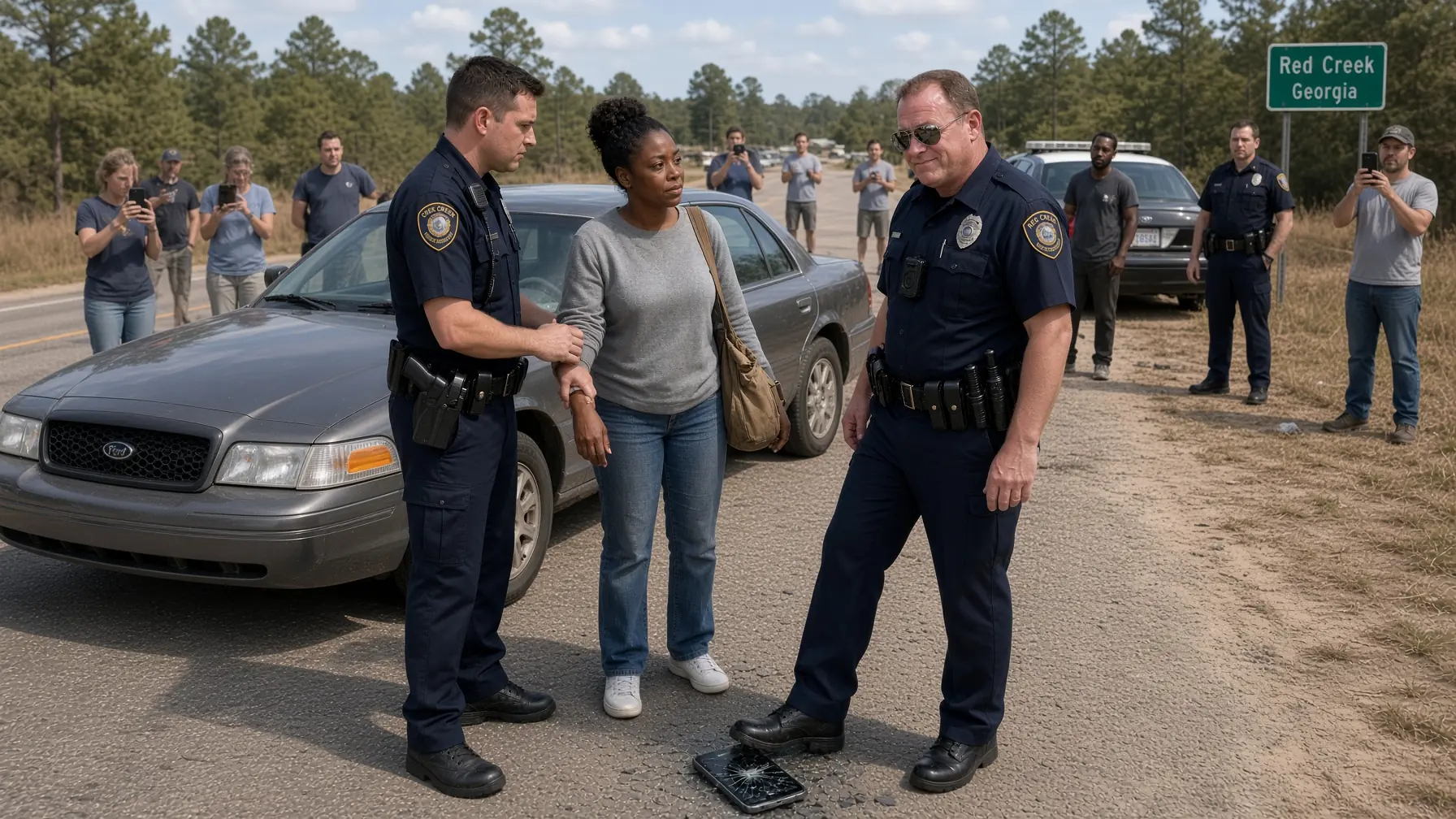
The woman’s name was Alicia Warren, and she did not flinch. She stood in worn jeans, inexpensive sneakers, and a plain gray sweatshirt with both hands visible while five Red Creek police officers surrounded her on the shoulder of the road. Granger leaned close enough for her to smell the coffee and tobacco on his breath. “You people always think a camera makes you untouchable,” he said.
Alicia looked directly at him.
“It usually makes people more careful.”
That answer wiped the smile from his face. Officer Trevor Pike moved behind her and twisted one arm back while Mason Bell kicked her canvas shoulder bag away from the car. The fifth officer, Jacob Reed, watched from several feet away with an expression that had become increasingly uncomfortable.
Granger noticed a few motorists slowing down.
That seemed to energize him.
“Go ahead and watch,” he called toward the road. “Maybe somebody learns something today.”
Alicia said nothing. Her silence bothered them more than yelling would have because frightened civilians behaved in familiar ways, while she seemed to be studying each man individually. She looked at badge numbers, body-camera positions, patrol-car markings, and the way each officer reacted when Granger spoke.
“Search the bag,” Granger ordered.
Mason kicked it again.
The zipper tore.
A wallet slid across the gravel.
Then something gold flipped out beside it.
For half a second, nobody understood what they were looking at. The badge landed faceup beneath the Georgia sun, the engraved eagle shining between five pairs of police boots. Derek stared down at the words stamped across it.
FEDERAL BUREAU OF INVESTIGATION.
Nobody laughed.
Three days earlier, Red Creek had looked like a place where trouble belonged somewhere else. The small Georgia town sat between wooded hills and farmland, with old brick storefronts, porch flags, church signs, and a courthouse square where people still greeted one another by name. Children rode bicycles through neighborhoods after school while retirees occupied the same bakery tables every morning.
But peaceful towns can become very good at hiding ugly habits.
Alicia Warren arrived in Red Creek driving a fifteen-year-old gray sedan whose air conditioner worked only when it felt generous. The paint was sun-faded, one hubcap was missing, and the engine produced a metallic rattle whenever she stopped at a light. Nobody looking at the car would have associated its driver with the federal government.
That was intentional.
Alicia was forty-one, Black, athletic without looking intimidating, and accustomed to disappearing into environments where attention created danger. Her tightly curled hair was pulled into a simple bun, and she wore almost no jewelry. The only expensive item on her body was a secure encrypted watch hidden beneath her sleeve.
She parked across from Miller’s Quick Stop and spent several seconds watching the intersection.
Nothing remarkable happened.
A school bus passed.
A man loaded cases of soda into the convenience store.
Two women stood beside a minivan discussing somebody’s divorce.
Alicia picked up her canvas bag and got out.
Only a handful of people inside the Atlanta FBI field office knew why she had come to Red Creek.
For nearly six months, civil-rights complaints had been arriving through separate channels. People alleged illegal searches, disappearing body-camera recordings, questionable drug arrests, false resisting charges, unexplained injuries in custody, and evidence that vanished after internal review. Individually, each complaint had been explained away.
Together, they formed a pattern.
Every trail eventually touched the Red Creek Police Department.
Every internal investigation somehow died.
Every complainant eventually stopped pushing.
Some had criminal histories.
Some were poor.
Some were homeless.
Some were simply people the department understood nobody powerful would believe.
Alicia volunteered for the assignment.
Her supervisor initially opposed sending her undercover because the investigation had already begun producing signs of organized corruption. Alicia argued that official auditors and outside investigators had failed precisely because everyone in Red Creek cleaned up their behavior whenever someone important arrived. If the Bureau wanted to know what ordinary people experienced, somebody needed to look ordinary.
There was another reason she did not mention during the meeting.
Her father had been arrested when Alicia was sixteen.
Not convicted.
Not even formally charged in the end.
But arrested.
Two officers in another Georgia county claimed he had threatened them during a traffic stop, though a witness later proved he had remained inside his vehicle with his hands visible. The case disappeared, but the humiliation did not.
Alicia remembered him sitting at their kitchen table after the charges were dropped.
He had been a proud man.
Electrician.
Church deacon.
Father of three.
That night, he looked older.
“The worst people aren’t always the ones running from the law,” he told her. “Sometimes they’re the ones hiding inside it.”
Twenty-five years later, Alicia still remembered every word.
Outside Miller’s Quick Stop, an elderly woman came through the door carrying two overloaded grocery bags. She made it halfway toward her pickup before one bag slipped lower against her arm. A young Black man sitting near the edge of the parking lot noticed immediately.
He stood.
“Ma’am, let me get those.”
The woman looked at him cautiously.
Then smiled.
“Thank you, sweetheart.”
His name was Devin Carter.
He was thirty-one, thin from too many inconsistent meals, with a rough beard and clothing that had been washed often but replaced rarely. A faded backpack hung from one shoulder.
He carried both bags to the truck.
Set them carefully inside.
Then stepped away.
The woman reached into her purse.
Devin shook his head.
“No, ma’am.”
“At least take five dollars.”
“I’m okay.”
“You sure?”
“Yes, ma’am.”
She smiled.
“God bless you.”
Devin nodded.
“You too.”
He crossed the street toward a small park.
Alicia watched him sit beneath an oak tree and pull a library book from his backpack.
Inside the convenience store, she bought bottled water.
The cashier was a woman in her late fifties named Sharon Mills.
Alicia nodded through the window.
“Who’s the guy reading outside?”
Sharon followed her gaze.
“Devin Carter.”
“Lives around here?”
“Depends what you mean by lives.”
Alicia waited.
Sharon lowered her voice.
“Construction company laid him off last year.”
“He lost his apartment?”
“Couple months later.”
“Shelter?”
“Church basement most nights.”
Sharon sighed.
“People treat him like he’s dangerous because he doesn’t have an address.”
“You ever have problems with him?”
“Never.”
Sharon looked toward Devin.
“He sweeps the sidewalk when I’m busy.”
“Doesn’t ask for anything.”
“Sometimes I give him food that’s about to expire.”
Alicia nodded.
Then a police cruiser rolled slowly past the park.
Devin immediately stopped reading.
His shoulders tightened.
His eyes went down.
Alicia noticed.
That was not the response of someone preparing to run.
It was the response of someone who already knew what usually happened next.
The cruiser stopped.
A second police SUV pulled behind it.
Sergeant Wade Granger stepped out first.
He was forty-six, barrel-chested, sunburned across the neck, with mirrored sunglasses and the relaxed swagger of a man accustomed to controlling the temperature of every room he entered. Four officers followed.
Derek Shaw.
Trevor Pike.
Mason Bell.
Jacob Reed.
The mood changed before anyone spoke.
A man near the newspaper box walked away.
Two teenagers left the park.
The owner of the bakery across the street suddenly disappeared inside.
Sharon whispered something behind Alicia.
“Here we go.”
Alicia looked over.
“This normal?”
Sharon laughed once.
Nothing about it sounded amused.
“You’re about to find out.”
Granger walked straight toward Devin.
“There he is.”
Derek smiled.
“Our favorite citizen.”
Devin carefully closed his book.
“I haven’t done anything.”
Granger took it from him.
“You always say that.”
“I’m just reading.”
Granger looked at the worn paperback.
“You’ve got plenty of time for books.”
Then he tossed it into a muddy gutter.
Devin reacted without thinking.
“My book.”
He took one step.
Derek shoved him backward.
“Stay where you are.”
Devin raised both hands.
“I’m not doing anything.”
“That’s not your decision.”
Granger began circling him.
The other officers spread around them.
No one explained why they had stopped.
No one asked for identification.
No one described a complaint.
It looked less like policing than a performance everyone involved had rehearsed before.
Granger pointed toward Devin’s backpack.
“What’s in it?”
“Clothes.”
“Give it here.”
Devin hesitated.
Mason took it anyway.
He yanked the zipper.
The contents spilled onto the sidewalk.
A toothbrush.
Work gloves.
Two shirts.
A small Bible.
An envelope containing construction certifications.
A family photograph in a cheap plastic frame.
Nothing illegal.
Derek looked almost disappointed.
Mason nudged the family photograph with his boot.
Devin immediately bent toward it.
“Please.”
Mason stepped on it.
The plastic cracked.
Devin froze.
“My dad’s in that picture.”
Mason shrugged.
“Should’ve taken better care of it.”
Something tightened in Alicia’s chest.
Training told her to observe.
The investigation needed patterns.
Names.
Conduct.
Relationships.
One incident would not be enough to dismantle a system.
But watching cruelty and documenting it are two different things emotionally.
Alicia took out her phone.
Opened the camera.
Held it low.
Pressed record.
Granger leaned toward Devin.
“You’ve been warned about hanging around businesses.”
“I’m in the park.”
“Same area.”
“It’s public.”
Granger smiled.
“You planning to teach me law?”
Devin shook his head.
“No, sir.”
Across the street, Officer Trevor Pike looked up.
His eyes moved toward Alicia.
Then toward her phone.
He said something quietly to Granger.
Granger turned.
Alicia knew immediately.
Cover compromised.
He stepped off the curb.
Slowly.
Deliberately.
The other officers followed.
Alicia lowered the phone as if checking a message.
Granger stopped directly in front of her.
“What are you filming?”
Alicia looked up.
“The street.”
“The street.”
“Yes.”
Derek moved to her left.
Trevor moved right.
Granger held out his hand.
“Phone.”
“No.”