Fix it by sundown, the man said, his voice so quiet it was almost gentle. Or I'll come back for something else. He didn't say what that something else was. He didn't have to. That one sentence changed 19-year-old Caleb Thompson's life forever.
And by nightfall, it would change the lives of everyone in Oildale, California. The summer of 2003 arrived in Oildale, California, the way it always did without apology. By 8:00 in the morning, the air above the asphalt was already shimmering, twisting the world into something liquid and uncertain. The San Joaquin Valley didn't cool at night anymore.
Not really. It just dimmed slightly like a furnace that had been turned down but never off. Old-timers said you could feel the valley breathing during those summers, slow and hot and indifferent to everything living inside it. Caleb Thompson was 19 years old and he had been breathing that air for 6 months straight without a single day off.
He was under a 1978 Shovelhead when he heard the motorcycles. Not one motorcycle, not three. A sound that started as a low vibration in the concrete floor beneath him. Something he felt in his back before his ears registered it as noise. He slid out from under the Shovelhead on his creeperboard, wiping his hands on a rag that was already beyond saving and straightened up just as the first bike rounded the corner of Chester Avenue.
It was blood red. That was the first thing he noticed. Not the chrome, not the age of the machine, not the size of the man sitting on top of it. The color, a deep arterial red that seemed almost wrong in the white morning light, like something that belonged in shadow.
The bike was a 1947 Harley-Davidson Knucklehead, and even from 30 ft away, Caleb could tell it had been modified by someone who knew exactly what they were doing. The engine had been rebuilt and bored out. The frame was custom. He could see the unusual geometry of it, even before the rider cut the engine, and the great machine shuddered to silence in his gravel lot.
The man who stepped off was not large in the way that some men are large. All width and noise and presence designed to intimidate. He was large the way mountains are large. Settled, permanent, as if he had been standing in that spot long before Caleb arrived and would be standing there long after.
He wore the colors of the Hells Angels motorcycle club. The bottom rocker read West Coast. His patch identified as ranked sergeant-at-arms. His name Caleb would learn in the next 30 seconds was Silas "Grip" Henderson. Everyone called him Grip.
He walked across the gravel with the unhurried confidence of a man who had never once needed to rush anything in his life because things had always sorted themselves out in his favor. He stopped 6 ft from Caleb and looked at him the way a man looks at a piece of machinery he's not sure yet is worth his time. "You the kid that runs this place?" Grip asked. "Yes, sir," Caleb said.
How old are you? 19. Grip said nothing for a moment. He looked past Caleb at the interior of Oildale Customs, the cluttered benches, the engine blocks hanging from the hoist, the framed photograph of Ray Thompson on the wall behind the register. Caleb's uncle, 6 months dead, and still somehow the most alive presence in the building.
Your uncle was Ray Thompson, Grip said. It wasn't a question. Yes, sir. Ray fixed a Panhead for me in '94. Did good work.
He paused. You as good as Ray? Caleb held the man's gaze. He had learned in 6 months of running this shop alone that hesitation was its own kind of answer and never the right one. I'm working on it, he said.
Some days I think I'm close. Something moved in Grip's eyes. Not warmth exactly, but a kind of recognition. Honest answer, he said. I respect that.
He turned and looked at the red Knucklehead sitting in the gravel. She misfires at speed. above 70, she starts shaking like she's coming apart. I've had her to three shops, big shops, shops with more equipment than you've got square footage. Nobody's found the problem. Caleb walked toward the bike slowly, the way you approached something you are not sure of yet." He crouched beside it.
Up close, the paint was even more striking. Not a showroom finish, but something deeper, almost organic. He didn't touch it yet. He just looked. "What do they say when she misfires?" Caleb asked.
Does she cut out completely or does she stutter? Stutters then vibrates. Then if I don't back off, the vibration gets violent. Felt like the frame was trying to shake itself apart the first time it happened. At exactly 75.
Grip tilted his head slightly. 75. Exact. Caleb looked up at him. You sure it's exact, son?
I've been riding since before you were born. I know what 75 mph feels like. It starts at 75 every time. Like a switch, Caleb stood. He was already running through possibilities in his mind.
Fuel delivery, ignition timing, carburetor float, harmonic resonance in the frame. The last one he pushed aside because it was too specific, too unusual, too much the kind of thing that happened in textbooks rather than in real machines sitting in real gravel lots. He pushed it aside and it came right back. I'll need to run her on the dyno, Caleb said.
And I'll need time to do a full diagnostic. Could be a few days by sundown, Grip said. Caleb blinked. Sir, today sundown. Grip reached into his cut and produced an envelope that he held out without drama.
There's $3,000 in there. That's your motivation. You fix her by sundown, it's yours. Every penny. $3,000. Caleb was 2 months behind on the shop's lease.
He had a property tax bill sitting on his desk that he hadn't opened yet because he was afraid of what was inside. $3,000 was oxygen. $3,000 was another 6 months of his uncle's legacy still standing. He took the envelope. And if I can't find it by sundown, Caleb asked because he had learned from Ray Thompson that you always ask the question you're afraid of before you agree to anything. Grip looked at him for a long moment.
When he spoke, his voice was quiet, quieter than before, which somehow made it worse. "Fix it by sundown," he said. "Or I'll come back for something else." He didn't say what that something else was. He didn't have to. He walked back to the red Knucklehead, but stopped with his hand on the grip.
"I'll be back at 8 tonight," he said. "She better sing." And then he walked away, got into a waiting truck that Caleb somehow hadn't noticed until that moment, and was gone. The Knucklehead sat in the gravel like a beautiful, dangerous question. Caleb stood in the heat for what felt like a long time, though it was probably less than 30 seconds.
Then he put the envelope in his back pocket, rolled up his sleeves, and got to work. The first hour was organized methodical, and produced nothing. Caleb pulled the spark plugs all clean, properly gapped relatively new. He checked compression on both cylinders. 155 lb per square inch front and 158 lb per square inch rear.
Nearly identical, strong. He pulled the carburetor, a custom S&S Super E. Beautifully rebuilt jets properly sized for the displacement float level perfect. He traced the fuel lines. He checked the petcock.
He pulled the points cover and examined the ignition timing which was set with a precision that suggested whoever had built this engine knew exactly what they were doing which meant whoever had built this engine had either made a very subtle mistake or this wasn't an engine problem at all. He sat on his rolling stool in the middle of the shop and stared at the bike. His uncle Ray had told him once that a machine that hides its problem is usually hiding it in plain sight. The problem isn't invisible.
Ray used to say standing at his workbench with a coffee going cold beside him. "You're just not looking where it lives yet." "Where do you live?" Caleb said to the Knucklehead out loud, which was something he did when he was thinking hard and the shop was empty. The shop answered him with silence and the distant sound of a truck on Chester Avenue. He checked the wiring next.
Ran every circuit from battery to coil to points to plugs. Everything was cleaned, properly insulated, properly routed. The battery connections were tight. The ground wire was solid. Nothing.
He stood up, wiped his face with the back of his hand, and made a decision. He was going to have to put it on the dyno. Ray Thompson had bought the dynamometer secondhand from a dealer in Fresno 3 years before he died. It was not a new machine, and it was not a sophisticated one, but it worked, and it told the truth.
That was what Ray had said when he brought it home in pieces on a rented flatbed. She tells the truth, Caleb. That's all I need. Getting the Knucklehead onto the dyno or dyno was a delicate process. The bike was too valuable and too custom to treat carelessly.
So, Caleb moves slowly, strapping it down with the same care he would have used on a living thing. He double-checked every tie-down. He set the restraints so they held the frame without pinching anything. Then, he started her up. The Knucklehead fired on the second kick, a deep loping idle that rattled the metal shelving on the back wall of the shop.
Even at idle, there was a character to this engine that you didn't find in modern bikes. A voice, something almost human in the rhythm of it. Caleb sat at the dyno controls and began bringing the speed up gradually. 20 mph, smooth, 30, still smooth. The engine note rising cleanly, power coming on with an ease that spoke of excellent tuning.
40 50. Come on, Caleb murmured, watching the gauges. 60 mph, 65. The bike was pulling strong. No hesitation, no stumble.
The power curve was beautiful. Not peaky, not flat, but a long progressive surge that spoke of a master builder's hand. 70. He felt it before he saw it. A vibration in the floor. subtle at first, barely more than what you'd expect from a large displacement engine at high speed.
But it wasn't coming from the engine. He was sure of that almost instantly. It was coming from somewhere else. 75 mph. The Knucklehead lit up.
There was no other word for it. The entire machine seemed to shudder at once. A violent irregular trembling that came in waves and with it the engine. Note broke into something ragged and desperate. a misfire that wasn't just electrical. It had a mechanical quality, like something inside the machine was being squeezed.
Caleb backed off immediately, bringing the speed down. And as he did, the misfire cleared. By 65, the engine was smooth again. By 50, you'd never have known anything was wrong. He sat for a moment with his hands on the controls, his mind racing.
Not the engine, not the carburetor, not the ignition, the frame. Something in the frame was resonating at exactly 75 mph. And whatever it was resonating with it was pinching something. A wire, a fuel line, something that under the harmonic vibration of a specific frequency was being compressed enough to interrupt the circuit or the flow.
He got off the stool and crouched beside the bike. And for the first time, he looked at the frame with genuine suspicion. The frame was custom. He had seen that from the moment the bike rolled in. Somebody had taken a stock 1947 Knucklehead frame and modified it.
Significantly lengthened the backbone, reinforced the lower rails, added gussets at the steering neck. Good work. Excellent work actually. The welds were clean and consistent. But there was one section of the backbone tube just aft of the steering neck where the metal looked slightly different.
Not obviously different, not the kind of thing you'd notice on a casual inspection, but different enough that now that he was looking for it, it made the back of his neck prickle. He got a flashlight. He lay on his back under the bike and shone the light up into the frame tube, looking for any gap, any crack, any place where something might have been inserted. What he saw made him go very still.
Inside the backbone tube, barely visible in the flashlight beam, there was a seam, an internal seam, as if something had been slid inside the tube from one end and welded in place. A sleeve, a loose sleeve. He could see the edge of it. See the way it didn't quite fit flush with the interior wall of the tube.
And running along the inside of the backbone, tucked against the frame tube in the way the bike's builder had intended, was the main ignition wire. He understood it all in one single terrible moment of clarity. At low speeds, the sleeve sat quietly inside the frame tube. But at exactly 75 miles per hour, the harmonic resonance frequency of that particular frame geometry and engine combination, the sleeve began to vibrate, not randomly, rhythmically, precisely, and with each oscillation, it pinched the ignition wire against the interior wall of the tube with enough force to momentarily interrupt the electrical circuit.
It wasn't a mechanical failure. It was sabotage. Someone had built a murder into this motorcycle. Someone who knew exactly how to kill a man and make it look like bad luck at highway speed. Someone who had access to this bike, the skill to modify it invisibly, and a reason to want Silas "Grip" Henderson dead.
Caleb pulled himself out from under the bike and sat up in the middle of his shop floor. And for a moment, he didn't move at all. $3,000 was sitting in an envelope in his back pocket. Sundown was less than 10 hours away and he had just discovered that someone had tried to assassinate the sergeant-at-arms of the West Coast Hells Angels and he was the only person in the world who knew it. He did what he always did when he was afraid he worked.
He didn't sit with the fear. He didn't pace the shop. He didn't call anyone because there was no one to call. His uncle was gone. His parents had moved to Phoenix 2 years ago and barely knew what he did for a living.
And his friends, the handful of guys his age he still talked to, would have been absolutely useless in this moment. He worked. First, he needed to verify what he had seen. He needed to be certain before he committed to anything because the plan that was forming in his mind required dismantling a sacred machine belonging to a very dangerous man.
And if he was wrong, he would have destroyed something irreplaceable for nothing. He got a borescope from the tool cabinet, a cheap one, the kind you could buy at Harbor Freight for $40 with a camera on a flexible cable and a screen on the handle. He ran it into the backbone tube from the steering neck end, carefully, slowly watching the screen as the camera moved through the interior. There it was on the screen, clear and undeniable.
A steel sleeve approximately 6 in long inserted inside the backbone tube. It was not welded solidly in place. It had been positioned with just enough play to allow it to move under vibration. Under normal conditions, it sat quiet. Under harmonic resonance at 75 mph, it came to life.
He pulled the borescope out and set it on the bench. He sat on his stool. He thought about his options, and he thought about them the way Ray had taught him, methodically, honestly, without flinching from the ones he didn't like. Option one, he could report the sabotage to Grip right now.
Call the number on the card. Grip had left him, explained what he found, collect whatever payment was offered for the information, and let the Hells Angels handle the rest. This was the safest option in the immediate term. It was also, he realized, the most dangerous option in the medium-term because Grip would want to know why the misfire wasn't fixed, and "I found the problem, but I didn't fix it, was not a sentence that would land well with a man like Grip.
Option two, he could fix just part of the problem. reroute the ignition wire to avoid the zone of the frame where the sleeve was located. This would eliminate the misfire at 75 miles per hour without requiring him to dismantle the frame. It was technically viable. It was also dishonest and it was dangerous because whoever had installed that sleeve would still know it was there and the next modification might not be so elegant.
Option three, he could do the full repair, cut into the frame, extract the sleeve, fabricate a solid replacement welded in place, and hand grip a motorcycle that was actually safe. This option required dismantling a custom motorcycle that did not belong to him, performing a major structural repair on a frame without explicit authorization, and then explaining to the most intimidating man he had ever met why he had cut open his bike's backbone. He stood up. Full repair, he said out loud to the empty shop.
Then he got his angle grinder. He marked the cut line carefully. This was not a place for speed or aggression. This was a place for precision. The backbone tube was structural.
If he damaged it, if he cut incorrectly, if he compromised the integrity of the weld zone, he would be handing grip a motorcycle that was more dangerous than the one that had come in. He had welded frame tubes before. Ray had insisted on it. You want to call yourself a motorcycle mechanic?
Ray had said, "You learn to weld frames. You learn to weld frames right because if you do it wrong, somebody dies." He had paused and then added with the quiet gravity that characterized everything Ray Thompson said about motorcycles. And they don't die fast. Caleb had taken that seriously.
He had practiced. He had a MIG welder and a TIG setup. And he knew how to use both. He positioned the grinder and made his first cut. The angle grinder screamed in the quiet of the shop a sound so loud and industrial that it temporarily drowned out the noise in his head.
He cut carefully, methodically following his mark exactly, and when he pulled the cut section aside, the sleeve slid out into his hand. He held it up in the light. 6 in of steel tubing, just slightly undersized for the backbone bore. Smooth at both ends. Unremarkable unless you knew what it was.
Unless you knew that this innocent looking piece of metal had been placed here deliberately to kill a man. He set it on his bench. He would keep it evidence. Then he went to a steel stock and started looking for the right size of tube. He found it in the back in a bundle of DOM round tube that Ray had bought years ago from a steel supplier in Bakersfield.
DOM, drawn-over-mandrel, was the right choice for framework. Stronger than standard ERW, more consistent wall thickness, cleaner interior. He measured the backbone bore with a telescoping gauge and found the correct OD tube in the bundle. He cut a new sleeve, his solid one. No play, no tricks.
Measured it three times before he cut it once. Then he fit it into the backbone tube, checking the fit with the borescope before he committed to anything. It fit perfectly. He tacked it in place with the TIG welder. three tacks evenly spaced around the circumference, then checked the alignment again.
Satisfied, he ran the full weld, working methodically around the tube, keeping his travel speed even, watching the puddle, thinking of nothing except the weld. When he was done, he let it cool, then went over it with a wire brush, and inspected it with a flashlight. Clean, solid. You couldn't tell it had ever been damaged.
He put the frame back together. The wiring was next, and this was where the hours began to blur. He had decided while welding that he was going to run the main ignition wire externally, not inside the backbone as original, but along the outside of the frame, properly protected and secured. It was not the factory routing.
It was not what a purist would have done. But it was what a man who had just found a murder inside a frame tube would do because he was not going to put that wire back inside until he was absolutely certain there was nothing else hidden in there. He ran the borescope through the entire backbone again before he rerouted the wire, then through both down tubes, then through the upper and lower rails. He spent 45 minutes doing nothing but inspecting the interior of every frame tube he could access, looking for any other modification, any other trap.
He found nothing. The wire reroute took another hour. He used split loom to protect it, routed it away from heat sources, secured it with proper P-clamps at 12-inch intervals, and made his connections with solderless terminals that he then soldered anyway because crimps alone had killed people before, and Ray Thompson had made sure Caleb knew it. By the time he was looking at a fully reassembled Knucklehead, the light coming through the shop's front windows had turned from white to gold.
Afternoon was starting its long decline toward evening. He checked his watch. He had 3 hours. He started the bike. The Knucklehead fired immediately this time on the first kick as if it had been waiting.
The idle was smooth, steady, perfectly even. He let it warm up for 10 minutes, checking the external wire routing with his hand near each section, feeling for vibration, feeling for heat where there shouldn't be any. Nothing. Everything was exactly as it should be. He put it on the dyno.
20 mph, 30, 40, 50. The engine note was the same beautiful progression he had heard before. 66 He felt himself holding his breath. 70 smooth 72 74. Come on, he whispered.
-
The bike ran clean and strong and silent through 75 mph as if it had never done anything else in its life. No misfire, no vibration beyond the normal working of a large displacement engine at speed. No ghosts. He pushed it to 80, 85, 90.
Perfect. He brought it back down slowly, his hands not entirely steady on the controls, and when the bike was at idle again, he sat for a moment and did not say anything. Then he said very quietly, "Uncle Ray, I think I got it." He was putting his tools away when he heard it. Not motorcycles, not yet.
But a sound that preceded motorcycles the way thunder precedes lightning. A low building presence in the air that you felt before you heard it. A vibration that had nothing to do with harmonics or frame geometry. And everything to do with the particular feeling of a large number of powerful machines moving in formation toward a single point.
He walked to the front of the shop and looked out through the open bay door. Chester Avenue was empty, but the sound was getting louder. He looked down at his watch. 7:47 p.m. The sun was sitting fat and orange on the western ridge of the valley, maybe 15 minutes from the horizon.
A sundown deadline, technically depending on how you define sundown. He went back in mud and stood next to the Knucklehead. He put his hand on the gas tank on that deep arterial red and felt the warmth of the engine still radiating up through the metal. "You ready?" he said to the bike.
The bike said nothing, which was the right answer. He heard the sound of a truck pulling into his gravel lot, then boots on gravel, then the shop door opening. Grip walked in. Behind him, just visible through the open bay door. The first motorcycles were turning onto Chester Avenue.
Not three, not 10. A river of headlights stretching back further than Caleb could see, rolling slowly toward Oildale Customs in a procession that was disciplined and quiet and absolutely completely unstoppable. Well, Grip said, looking at the Knucklehead, "Tell me what you found." Caleb reached into his bench drawer and picked up the sleeve. He held it out in his palm.
"Someone tried to kill you," he said. "And I'm going to need about 10 minutes to explain how." Grip didn't move for a long moment. He stood in the middle of the shop with his arms at his sides, looking at the steel sleeve, sitting in Caleb's palm, and the expression on his face was something Caleb had never seen before in a man like that. Not anger, not disbelief, but something slower and colder than either of those things.
Something that looked like a man rearranging everything he thought he knew about the last several months of his life. Say that again, Grip said. Someone tried to kill you, Caleb said. He kept his voice steady. He was 19 years old and his hand was not shaking, which surprised him.
This sleeve was inside your backbone tube. It was loose enough to vibrate at a specific engine speed. At 75 mph, the harmonic frequency of your frame caused it to oscillate and pinch your ignition wire against the interior wall. That's your misfire. That's your vibration.
It wasn't a mechanical failure. It was designed. The last word landed in the shop like something dropped from a height. Grip took the sleeve from Caleb's palm. He held it between two fingers and looked at it.
Really looked at it, turning it slowly in the light. 6 in of steel. Unremarkable. Deadly design. Grip.
Repeated. Yes, sir. Meaning someone put this in my bike on purpose. Yes, sir. And whoever did it knew exactly what they were doing.
They knew the frame geometry. They knew the resonance frequency. They knew how to install it so it would be invisible to a normal inspection. Three shops looked at this bike and didn't find it. I only found it because I put it on the dyno and felt where the vibration was coming from.
Grip set the sleeve down on the workbench with a gentleness that was somehow more alarming than if he'd thrown it. He was quiet for five full seconds. Outside, the sound of motorcycles was continuous now. Not arriving exactly, but settling the way a tide settles when it has reached its shore.
Caleb didn't look toward the door. He kept his eyes on Grip. The three shops that looked at her before you," Grip said slowly. "I need to think about who knew she was going in." "That's your business," Caleb said. "Mine was fixing the bike." Grip looked at him, then really looked at him the way he had in the parking lot that morning.
That assessing unhurried examination. "You fixed it?" "Yes, sir. I cut the tube, removed the sleeve, fabricated a solid replacement, welded it in, and rerouted your ignition wire externally." She ran clean on the dyno at 90 mph. No misfire, no vibration. Whatever they built into her, it's gone.
You cut my frame. There it was. Caleb had known that sentence was coming since the moment he'd picked up the angle grinder, and he had prepared for it. And now that it was here, he met it straight on. I had to.
There was no other way to get the sleeve out. If I'd left it in there and just rerouted the wire, the sleeve would still be in your frame. Someone would know it was still there. I didn't think that was acceptable. Grip stared at him.
You made a decision. Grip said to cut open my bike without asking me. I couldn't ask you. You were gone and I had a deadline. Caleb paused.
Sir. The silence stretched outside. A door opened and closed. Boots on gravel. Then another set of boots.
Then more. The sound of a gathering organized and patient and large. Grip picked up the sleeve again. He looked at it one more time. Then he put it in his vest pocket.
"Show me the weld," he said. Caleb stepped aside and Grip crouched beside the bike with a flashlight that he produced from somewhere inside his cut, not Caleb's flashlight, his own, which struck Caleb as somehow very characteristic of the man. He examined the weld on the backbone tube for a long time. He ran his thumb along the bead.
He looked at the external wire routing, following it with his eyes from one end to the other, checking every clamp, every inch of split loom. He stood up. That's a good weld, he said. Thank you. I've seen professional frame builders who couldn't lay a bead that clean.
My uncle taught me. Grip nodded once. Ray was a good teacher. He turned toward the door. Come outside.
Caleb followed him. What he saw when he stepped through the bay door was something he would spend the rest of his life trying to adequately describe to people and never quite managing it. Chester Avenue in both directions, as far as he could see, was lined with motorcycles parked in precise organized rows, not scattered arrange the way a military unit arranges itself with purpose and discipline and an awareness of space and sight lines that spoke of long practice. And between the bikes and the shop, filling the gravel lot and the sidewalk and the street margin stood riders.
Not a mob, not a crowd in the ordinary sense, a formation. 465 men, he would later learn the number. He didn't count them that night. He just stood in the bay door of his uncle's shop and understood in the most visceral way possible that something significant was happening and that he was at the center of it.
A man separated from the group near the front and walked toward them. He was older than grip 60s, maybe with a white beard, and the kind of face that had seen enough of the world to stop being surprised by any of it. His patch read. His name Caleb would learn was Iron Jack Crowley, charter president of the West Coast chapter.
A man whose name was known in motorcycle circles, the way certain names are known not from newspapers, but from the particular oral tradition of people who live their lives on two wheels and by their own code. Jack grip a grip. Iron Jack looked at Caleb. This the kid.
This is Caleb Thompson, Ray's nephew. Iron Jack looked at Caleb. The way people look at things they're deciding whether to trust. It was a long look and it was not entirely comfortable. Ray was a stray shooter.
He said finally. You I try to be Caleb said. Grip tells me you found something in his bike. Yes, sir. Tell me.
So Caleb told him. He told the story the same way he told it to grip. Methodically starting with the dyno run, the vibration, the flashlight, the borescope, the sleeve to he didn't editorialize. He didn't speculate about who had done it or why. He just described what he had found and what he had done about it.
When he was finished, Iron Jack was quiet for a moment. "You have the sleeve?" he asked. Grip produced it from his vest pocket and handed it to Iron Jack, who turned it in his fingers the same way Grip had with the same terrible quiet attention. "Somebody built this," Iron Jack said.
It wasn't a question. "Yes, sir," Caleb said. "Somebody who knows bikes. Somebody who knows this specific bike. They knew the frame geometry.
You'd have to know the resonance characteristics of that particular tube configuration to calibrate the sleeve correctly." This wasn't a guess. Someone did the math. Iron Jack looked at Grip. Something passed between them. Not words, not gesture, just the compressed communication of two men who had known each other long enough that language had become largely redundant.
The shops, Grip said. Yeah. Iron Jack said. The shops. Caleb understood enough not to ask.
He stood quietly while the two older men had their silent conversation and he looked out at the 465 riders standing in the valley night and he thought about the fact that somewhere out there in one of the three shops that had looked at this bike before him, there was a mechanic who knew exactly what was inside that backbone tube and had chosen to leave it there. The bike runs, Iron Jack asked, turning back to Caleb. Yes, sir. Clean at 90 on the dyno.
I'd want to do a road test before I'd sign off completely, but based on what I found and what I repaired, she should be solid. You want to road test a Hells Angels sergeant-at-arms's bike. I want to make sure it's safe before he rides it, Caleb said. That's what a mechanic does.
Something shifted in Iron Jack's expression. It wasn't quite a smile. It was something more restrained than that. A recognition, maybe an acknowledgement. Kids got spine, Iron Jack said to Grip.
Kids got skills, Grip replied. Spine I already knew. Iron Jack handed the sleeve back to Grip. Then he turned and walked back toward the formation. And as he moved, the formation itself shifted, not dramatically, not with any order that Caleb could identify, but with the organic coherence of a group of people who had been together long enough that individual decisions had become collective ones.
A murmur moved through the gathered riders. Then something else moved through them. Something that wasn't a sound exactly, more a change in posture, a settling, a collective orientation toward the shop and toward Caleb specifically. Grip was watching him. You nervous?
He asked. Yes, sir. Caleb said honestly. Good. Nervous means you understand the situation.
A man who isn't nervous right now isn't paying attention. He paused. You paid attention today. I was motivated. Grip almost smiled. $3,000 will do that.
It wasn't just the money, Caleb said, and then stopped because he hadn't planned to say that, and he wasn't entirely sure where it had come from. Grip looked at him. No. Caleb thought about it. He thought about Ray Thompson's photograph on the wall behind the register.
He thought about the property tax bill sitting unopened on his desk. He thought about the Knucklehead firing on the first kick when he'd started it after the repair. That deep settled righteous sound of an engine running the way it was meant to. No, he said it wasn't just the money.
Somebody built something dishonest into a beautiful machine. That bothered me. That bothered me more than the deadline. Grip was quiet for a moment. Then he said, "Your uncle said something to me once.
Said the difference between a good mechanic and a great one isn't technical. Said it's moral. A good mechanic fixes what's broken. A great mechanic cares why it broke. Caleb didn't say anything.
I didn't completely understand what he meant at the time, Grip said. I think I do now. He turned toward the shop. Let's put her on the dyno. I want to hear it myself.
They went back inside and Caleb fired the Knucklehead up and Grip stood beside the dyno with his arms crossed and his eyes closed as the engine came up to speed. He stood that way through 20 mph and 40 and 60 and 75 and 80 and 90 90. And when Caleb backed it down and the engine settled to idle, Grip opened his eyes. His jaw was tight.
Not with anger, was something else. Something that looked on a face like his, almost like grief. 9 months, he said quietly. I've been riding her with that thing inside her for 9 months. Every highway run, every charter ride, he paused.
My daughter rode on the back of that bike. The shop went very still. She's 11 years old, Grip said. She rides with me every summer. Caleb didn't say anything because there was nothing to say.
He just let that fact exist in the air between them. Let it be what it was, which was the most important thing that had happened all day and possibly the most important thing that would happen for a long time. Grip reached into his cut and produced an envelope. He held it out to Caleb.
That's 6,000, he said. Double what we agreed. Caleb took it. His hands were steadier than he expected. Thank you.
Don't thank me. That's not charity and it's not generosity. That's what the work was worth. There's a difference. Yes, sir.
Grip looked around the shop at the tools, the benches, the dyno, the photograph of Ray on the wall. He looked at it all with the careful attention of a man making an inventory. And Caleb had the feeling that what was being cataloged was not the equipment, but something less tangible, something like character. You're two months behind on your lease, Grip said.
Caleb blinked. How do you know that? I asked around before I came here this morning. I asked around before I trust anyone with something that matters to me. He paused.
Your landlord is a man named Terren Boille. He runs the property management company on Union. I know who he is. He's been looking for a reason to sell this building to a developer. The least default gives him one.
Grip said this without particular emotion. The way you state a fact that's simply true. That changes today. Caleb stared at him. Sir, the charter will cover your back lease and your property tax.
Yes, I know about that, too. Don't look at me like that. I told you. I asked around. He met Caleb's eyes.
This isn't a gift. This is an arrangement. You become the charter's mechanic. Any bike that needs work, it comes here. You do good work.
You charge fair. And you treat every machine that comes through that door the way you treated mine. That's the deal. Caleb felt something shift inside his chest, a loosening like a knot that had been pulled tight for 6 months, was finally releasing. He thought about Ray.
He thought about what Ray would have said. He thought he knew. That's a deal, Caleb said. Grip extended his hand. Caleb shook it and the grip was exactly what the name suggested.
Not crushing, not aggressive, but completely utterly certain. A hand that knew its own strength and didn't need to prove it. One more thing, Grip said, not releasing the handshake yet, the sleeve, the sabotage. I'm going to find out who did it. That's my business and it stays my business.
But if anyone ever comes to you asking questions about that bike, about what you found, about anything that happened here today, you don't know anything. You fixed a misfire. That's all. That's all I did, Caleb said. Grip released his hand.
Smart kid. He turned and walked toward the door. And Caleb stood in the middle of his uncle's shop with $6,000 in his hand and a heart that was beating so hard he could feel it in his ears. And he watched the sergeant-at-arms of the West Coast Hells Angels walk through the bay door and back into the valley night.
Then Iron Jack came back. He came alone and quietly, which was different from how he had appeared before, and something about the change in his manner made Caleb straighten up instinctively. Grip tell you about the arrangement?" Iron Jack asked. "Yes, sir. Good.
I want to add something to it." He looked at Ray's photograph on the wall for a moment. "Your uncle did right by a lot of people over the years. He never talked about it. Never asked for anything back. That kind of man builds credit he doesn't even know about." He looked at Caleb.
You're spending some of that credit tonight. I want you to understand that. It matters. I understand. Caleb said.
I don't think you entirely do yet, Iron Jack said, not unkindly. But you will. He reached into his jacket and produced a card, plain white, nothing on it, but a phone number. You have a problem with the lease with boil with anybody you call that number.
Day or night, somebody answers. Caleb took the card. There's something else you should know, Iron Jack said, and his voice dropped slightly, not conspiratorally carefully. The voice of a man choosing words with precision. The three shops that looked at Grip's bike before you.
We've been doing some thinking about that. About who knew the bike was going in, about who had access. He paused. One of those shops, the one on Brundage, the owner has a brother-in-law with connections to a rival club. That information is 6 hours old.
Caleb held very still. I'm not telling you this because it involves you. Iron Jack said you're out of it. I'm telling you because you're a smart young man and smart young men should understand the full shape of the thing they've walked into. He held Caleb's gaze.
You didn't just fix a bike today. You uncovered a murder plot. And the people behind that plot don't know yet that it's been uncovered. Which means right now tonight, while they still think the sleeve is in that frame and Grip is riding around on a time bomb, they feel safe.
The air in the shop seemed to change temperature. That changes tomorrow. Iron Jack said. But tonight they feel safe, and that's useful information. He moved toward the door.
You did a good thing today, Caleb. You did a brave thing. Most men in your position would have reported the misfire and taken their 3000 and never said a word about what they actually found. Would have been the smart play. Certainly the safe play, he paused at the door.
But it wouldn't have been the right play. No, sir, Caleb said. It wouldn't. Iron Jack nodded once slowly as if confirming something he had already decided was true. Get some rest, he said.
Tomorrow's going to be busy. You're the charter's mechanic now. Word travels fast. He almost smiled. You're going to need a bigger dyno.
He left and Caleb stood alone in Oildale Customs for the first time since 7 that morning, and the shop was quiet except for the faint ticking of the Knuckleheads engine cooling down that particular intimate sound of metal releasing heat. And outside slowly, in an order in a discipline that was almost ceremonial, 465 motorcycles began to start their engines. Not all at once, in sequence, from some point down the line, the sound building on itself, each engine adding to the one before it, until the whole valley seemed to vibrate with foot. A sound so large and so deep that Caleb felt it not in his ears, but in his sternum, in his bones, in whatever part of a person it is that recognizes something larger than themselves.
He walked to the bay door and stood in the opening. Chester Avenue was moving. The formation was rolling disciplined and slow headlights in both directions, merging into a single river of light that moved west toward the Mojave with the unhurried certainty of something that has always known where it's going. Grip's Knucklehead was near the front.
The blood red paint caught the last of the valley light as the bike moved away. And for a moment, just one, just brief, Caleb thought he saw his uncle Ray sitting on the bench out front, drinking his cold coffee, watching the procession with that quiet satisfaction he got when something came together the way it was supposed to. He blinked and Ray was gone, just the bench, just the night. He looked down at the envelope in his hand. $6,000, a deal with a charter president, a phone number on a white card, and a steel sleeve sitting on his workbench that someone somewhere was still counting on to do a job it would never do again.
He went inside and turned off the shop lights. He had a bigger day tomorrow. He didn't sleep. He tried. He lay on the cot he kept in the back office, the same cot Ray had used during long rebuild jobs when the work was too consuming to drive home.
And he stared at the ceiling and listened to the valley settle into its nighttime version of itself. Quieter than the day, but never truly quiet. The trucks on Highway 99 never stopped. The oil pumps never stopped. And now in the back of his mind, something else never stopped.
Either a low turning thought that kept circling the same point without landing. Someone had tried to kill Grip. Someone with skill. Someone with access. Someone who was still out there right now waiting for news that would never come.
He gave up on sleep at 4:00 in the morning and went back into the shop. The Knucklehead was gone. Grip had written it out himself, clean and smooth the way it was always supposed to run. But the steel sleeve was still on the workbench where Grip had left it after Iron Jack gave it back.
Caleb picked it up and turned it in the light the way both men had. And for the first time now that the pressure of the deadline was gone, he let himself really look at it. It was precision work. The ends were cleanly cut, not with a hacksaw, not with an angle grinder.
A lathe, someone had turned this on a metal lathe, cut it to exact length, chamfered the edges slightly so it would slide in without catching. The wall thickness was consistent to within a few thousand of an inch. This wasn't a backyard job. This was the work of someone with access to machine tools and the knowledge to use them.
He set it down. Machine tools, a lathe specifically. Of the three shops that had looked at Grip's bike, one had a full machine shop. He knew that because Ray had mentioned it once. A shop on Brundage Lane called Valley Ironworks run by a man named Dex Corbett.
Full fabrication capability, engine machining, custom work. Iron Jack had mentioned a shop on Brundage. He sat down on his stool and did not reach for the phone. That wasn't his business. Iron Jack had said so, and Caleb believed him.
And more importantly, Caleb understood why. The information needed to travel through the right channels in the right order at the right speed. If Caleb called anyone said anything disrupted the timing of whatever the charter was already planning, the people who built the sleeve might run or worse, they might accelerate. So he sat on the information the way you sit on a hot engine carefully with respect for what it could do if you handled it wrong.
Instead, he picked up his notebook and started writing down everything he could remember about the sleeves construction dimensions, finish quality, the chamfer angle, the wall thickness estimate, not because anyone had asked him to, because he was a mechanic and mechanics document things and Ray had taught him that the details you write down are the ones you don't lose. He was still writing when the phone rang. 6:17 in the morning. He stared at it for two rings before he picked up.
Oildale Customs. It's grip. Caleb sat up straight. Sir, you sleep? No, sir.
A pause. Neither did I. Another pause longer. There's something I need to tell you. Should have told you last night, but I wanted to think it through first.
His voice was different from the night before. Not softer exactly, but less contained, like a man who had spent the night taking something apart in his head and was now looking at the pieces. When I brought the bike to those three shops, I told each of them the same thing. That it misfired at speed.
That I needed it fixed quietly. No record, no paperwork. Because it's a custom build and I didn't want the history documented. He stopped. You understand why?
Yes, sir. What I didn't think about, what I should have thought about is that telling three shops the bike existed and giving them each enough time alone with it to do a diagnostic meant three shops had opportunity. His voice tightened slightly. The first two shops I've known those men 20 years.
I'd stake my life on them. Have staked my life on them more than once in situations that had nothing to do with motorcycles. Caleb waited. The third shop, Grip said, Valley Iron Works, Dex Corbett. I'd used him twice before.
Good machinist. Good work. He paused. He was the last one to have the bike before I brought it to you. The sleeve on Caleb's workbench seemed to get heavier.
I'm not telling you to do anything, Grip said. I'm not asking you for anything. I just He stopped again. And in that stop, in that uncharacteristic hesitation, Caleb heard something that surprised him. a man who was not entirely sure what he felt. "I wanted you to know what we know because you're the one who found it.
You earned that. I appreciate that," Caleb said. For what it's worth, the sleeve was lathe-turned, chamfered ends, consistent wall thickness. "Whoever made it had access to precision machine tools and knew how to use them." Silence on the other end. A full machine shop would do that, Caleb said.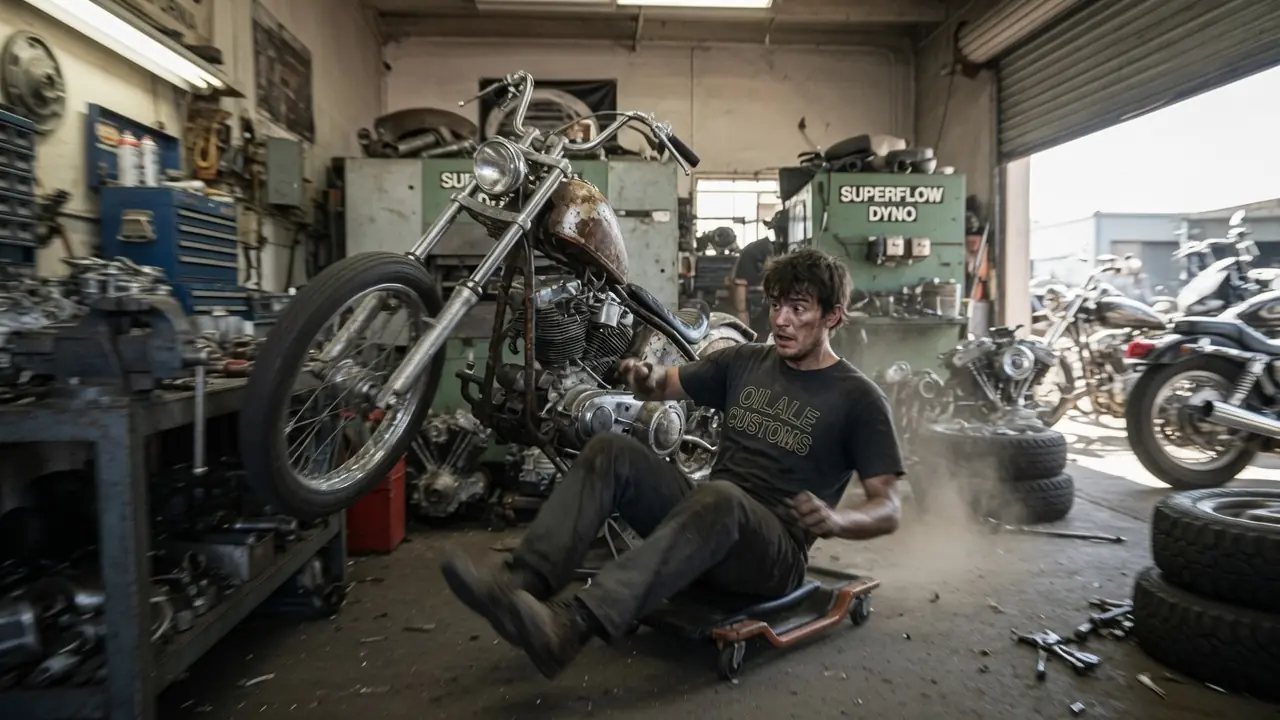
A lathe specifically. More silence. Valley Iron Works has a full machine shop, Grip said very quietly. Yes, sir. I know.
Another long pause. When Grip spoke again, his voice had changed again. Flat or more deliberate the voice of a man who had just confirmed something he was hoping to disprove. You're good at this, he said. I'm good at reading metal, Caleb said.
The rest of it, that's your territory. Yeah. A pause. Yeah, it is. He heard Grip exhale.
Get some coffee. You're going to have company around noon. The line went dead. Caleb set the phone down and looked at it for a moment. Then he got up and started a pot of coffee because it was the only sensible thing to do at 6:17 in the morning when you had just helped identify the man who tried to murder a Hells Angel.
The company arrived at 11:45, not noon. Two riders, not Grip, not Iron Jack, two men. Caleb didn't know. both wearing colors, both carrying the particular self-contained calm of people who did difficult things for a living and had long since made their peace with that. One of them, the taller one, introduced himself as Scout.
The other one didn't introduce himself at all, which Caleb decided not to take personally. "Grip sent us," Scout said. "We're going to be outside today. Don't pay attention to us." Outside, Caleb repeated. In the lot, on the street.
Don't worry about it. Caleb looked at Scout for a moment. Is there a reason I need people in my lot? Scout looked back at him with the patience of a man who had answered this question in various forms many times. Word got out last night about the bike.
About what you found. He paused. Not everywhere, not publicly, but in the right circles. Word travels. Another pause.
Or the wrong circles, depending on how you look at it. Caleb felt something cool move through him that wasn't from the air conditioning because he didn't have air conditioning. You think whoever did it knows that it's been found? We think it's possible, Scout said. We think it's worth being careful.
Okay, Caleb said, because what else do you say? He had a 19-year-old's capacity for accepting extraordinary situations when the alternative was paralyzing fear. And right now, he chose acceptance. Scout and the unnamed man went back outside. Caleb went back to work.
He had a '68 Sportster on the bench that had been waiting 3 days for his attention. And he threw himself into it with a focus that was partly professional and partly self-preservation. When his hands were busy, his mind stayed off the particular dark hallway that led to thoughts about who might know what he'd found and what they might want to do about it. He had the Sportster's primary cover off and was inspecting the chain tensioner when the second thing happened.
The phone again. 11:58. He almost let it go. Then he picked up Oildale Customs. The voice on the other end was not a voice he recognized.
Male, calm, no identifying accent, no regional flavor, the voice of someone who had worked to sound like no one in particular. I understand you did some work on a red Knucklehead yesterday. Caleb's hand tightened on the phone. He said nothing. Just some friends of mine are curious about that bike.
The voice continued, wondering what kind of work you did, whether you found anything interesting. Caleb's mind went to Iron Jack to the conversation in the shop last night. You don't know anything. You fixed a misfire, that's all. Carburetor work, Caleb said, float was set wrong.
Wasn't fueling correctly at high speed. Happens sometimes with those old S&S setups. He kept his voice bored. A mechanic describing routine work. Adjusted the float, cleaned the jets, set the timing.
She runs fine. A pause on the other end. That's all. That's all. It's an old bike.
These things happen. Another pause longer this time. The kind of pause where someone on the other end is deciding whether they believe you. Caleb kept his breathing even and stared at the sports primary chain and waited. All right, the voice said.
Thanks for your time. Click. Caleb set the phone down very slowly as if it were a piece of evidence that needed to be preserved. Then he walked to the bay door and caught Scout's eye. Scout was leaning against a truck in the lot, not quite looking at the shop, but positioned to see everything.
Caleb nodded at him just once, a small, deliberate nod. That meant something happened. Scout straightened fractionally and reached for his phone. Good. Caleb thought it was traveling up the chain.
That was the right order of things. He went back to the sportster. The twist came at 1:30 in the afternoon, and it came in a form Caleb never anticipated. A woman walked into the shop. She was in her 50s, small and very straightbacked with gray hair pulled up in the kind of practical clothing that suggested she worked with her hands.
She introduced herself as Margaret, and she did not volunteer a last name, and she carried a leather satchel that she set on the workbench with a carefulness that told Caleb there was something breakable inside. "Grip sent me," she said. He's been sending people all morning, Caleb said. Can I ask what this is about?
I'm the charter's historian, Margaret said. It was such an unexpected sentence that Caleb blinked. Every chapter has one, she continued with the mild patience of someone accustomed to surprise. Someone who keeps the records, documents, the bikes, the builds, the history. She unzipped the satchel.
I've been documenting Grip's Knucklehead since he acquired the frame in 1987. She produced a binder thick, organized with plastic sleeves full of photographs and handwritten notes and what appeared to be detailed drawings of frame specifications. She laid it open on the workbench. This is the original frame document, she said, pointing to a drawing dated 1989.
When the custom work was done, the builder was a man named Archie Fulham. He died in 1998, but he documented everything. She turned to a specific page, a cross-sectional drawing of the backbone tube. This is the original spec. The tube is solid dom steel 1 1/4 inches,.120 wall.
She looked at Caleb. No sleeve, nothing inside. Just the tube and the wire. Which means the sleeve was added after 1989, Caleb said. Which means it was added in the last 9 months, Margaret said.
Because I photographed this bike in complete detail in October of last year and I know what was and wasn't inside that frame tube in October. She paused. Because I borescoped it. Caleb stared at her. You borescoped it every 5 years.
As part of the documentation process, I do a full interior inspection of the frame, weld integrity, corrosion, any anomalies. She met his eyes in October. It was clean. The sleeve was installed between October and last week. That's a 9-month window.
And the bike went to three shops in that window, Caleb said slowly. Two shops, Margaret said. Not three. Caleb went still. Grip told me three shops.
Grip told you he brought it to three shops for the misfire. That's true. But the bike was also at a fourth location during that window that wasn't a shop. She paused. It was at a private property in Shafter for 3 weeks in February for storage while Grip's garage was being worked on.
She looked at him steadily. The property belongs to a man named Carson Webbb. He's not in the club. He's an associate, someone the charter does occasional business with. He's also, she paused, choosing her word, a skilled machinist, hobby level.
He has a lathe in his garage. The air in the shop changed. Carson Webb, Caleb said. I'm not accusing anyone, Margaret said carefully. I'm giving you documentation.
What it means is for other people to determine. She closed the binder. But you should know that the sleeve you found the dimensions grip described to me this morning, the lathe work, it's consistent with the capabilities of a hobby machinist with a mid-range engine lathe. It's not consistent with the capabilities of a full commercial machine shop.
She zipped the satchel. Caleb understood what she was telling him. Valley Ironwork Dex Corbett and his full commercial shop might be exactly what it appeared to be. A shop that had looked at the bike and missed the sleeve because they weren't looking for it. But Carson Webbb with his hobby lathe and his 3 weeks of unsupervised access in February was something else entirely.
Why are you telling me this? Caleb asked. Margaret picked up her satchel. Because Grip asked me to. He wants you to have the full picture.
She paused at the edge of the workbench. He says you think in systems that you don't stop at the first answer. She looked at him with something that wasn't quite warmth but was in the neighborhood of respect. He said your uncle was the same way. She left.
Caleb stood for a long time at the workbench with the image of the sleeve in his mind and the name Carson Webbb settling into the space where Dex Corbett's name had been. A hobby machinist, 3 weeks unsupervised, a lathe in a private garage. He picked up his notebook and wrote Carson Webbb Shafter February 3 weeks hobby lathe. Then he drew a line connecting it to chamfered ends consistent wall thickness.
Not commercial grade precise but not production precise. Personal work. Someone working carefully slowly alone. He stared at what he'd written. Someone who hated grip enough to spend hours alone in a garage carefully turning a piece of steel to exact dimensions thinking about what it would do at 75 mph.
That wasn't impulse. That wasn't crime of opportunity. That was something that had been decided and planned and executed with patience and technical skill and a coldness that made the back of Caleb's neck prickle. His phone rang again at 2:45. This time it was grip and his voice was different from the morning call.
More controlled, more deliberate. The way a man sounds when he has arrived at a conclusion and is now on the other side of it. We found him. Grip said Caleb didn't ask who. Is everyone okay?
A pause that lasted long enough to be meaningful. Define okay. Are your people safe? My people are always safe. Grip said that's what I make sure of.
Another pause. Webb is being dealt with through appropriate channels. Caleb understood that appropriate channels in this context did not mean law enforcement. And he understood also that he did not need to know the details and would be better off not knowing them. What I'm calling to tell you is that it's over.
The person who built that sleeve is no longer a problem. And the reason it's over cleanly without anyone getting hurt shouldn't have gotten hurt is because of what you found and when you found it. Caleb sat down on his stool. His legs felt suddenly tired in a way they hadn't all day, like a tension he'd been carrying since 6:00 in the morning had just released all at once.
"Okay," he said. "You all right?" Grip asked. "Yes, sir. I think so." "Good." A pause. Gout and his partner are going to stay through tonight.
Standard precaution. After that, you won't see them unless you call. He paused. You have the number. I have the number.
Use it if you need it. Don't use it if you don't. Understood. Grip was quiet for a moment. Then my daughter's name is Rosie.
She's 11. His voice shifted when he said her name. Not soft exactly, but different. Unguarded in a way nothing else about him was. She was going to ride with me to Bakersfield next month, the charter run.
Every year she rides on the back to the first rest stop. And then my old lady picks her up. Another pause. She's been asking about it since March. Caleb didn't say anything.
She's going to get to do that, Grip said. Because you did your job right, he stopped. I want you to know that I know that. She's going to love it, Caleb said. Because it was the right thing to say and because he meant it.
Yeah, Grip said. She is. A long pause. Take care of yourself, Caleb. The line went dead.
Caleb set the phone down and sat in the shop that was his uncle's and was now his and listened to the ticking of the engine on his bench and the distant sound of trucks on 99. And scout moving around in the gravel lot outside. He thought about a sleeve in a frame tube. He thought about an 11-year-old girl who was going to ride to Bakersfield next month on the back of a blood red Knucklehead that ran clean and strong and honest.
He thought about Ray. He thought Ray would have liked how this day ended. Then he picked up his wrench and went back to the Sportster because there was still work to do and work was the thing that had always made the rest of it make sense. Scout left at 7:00.
The next morning, he didn't say goodbye exactly. He tapped twice on the shop's door frame, met Caleb's eyes, gave a single nod that meant everything was clean, and walked to his bike. The unnamed man was already gone. Caleb heard them start up and pull away. And then Chester Avenue was just Chester Avenue again.
Ordinary and indifferent, the Valley Heat already building toward its daily maximum before 8:00 in the morning. Caleb made coffee and sat at Ray's desk and looked at the numbers. $6,000 from Grip. Back lease covered, Grip had apparently called Terrence Bole directly because Bole had left a voicemail at 6:42 that morning that was almost comically polite for a man who had been sending threatening letters for 2 months. The property tax bill was still unopened on the desk.
Caleb opened it now. $3,400 due in 3 weeks. He had 6,000 in his hand. He would make it. Not comfortably, not with anything left over, but he would make it and the shop would still be standing and Ray's name above the door would still be Ray's name.
He sat with with that for a moment. Just let it be true. Then the first bike rolled in at 8:15 and the ordinary extraordinary life of the charter's mechanic began. It was a ''72 Super Glide belonging to a man named Paulie who had the build of a refrigerator and the manner of someone who had decided long ago that the world would be simpler if he just said exactly what he thought.
He rolled the superglide into the bay, killed the engine, and looked at Caleb with the frank assessment of a man who is not yet sure he trusts the new arrangement. Grip says you're good, Paulie said. I try to be, Caleb said. He walked around the Super Glide looking without touching yet.
The bike was well-maintained, but old, and old bikes accumulate small problems the way old houses accumulate small repairs. What's she doing? Surges at cruise between 50 and 60. She hunts. Throttle feels inconsistent.
Caleb crouched beside the carburetor. How long? 3 months. Gets worse when it's hot. Caleb nodded.
He was already pretty sure it was the accelerator pump diaphragm cracked from heat cycling. 3 months in San Joaquin summer heat would do exactly that to an old rubber diaphragm. But he didn't say that yet because saying what you think before you've confirmed it is how you look like you're guessing rather than diagnosing. Leave it with me.
Caleb said I'll call you this afternoon. Paulie looked at him for another moment. Then apparently deciding something he nodded. Grip says you found what three other guys missed. I got lucky, Caleb said.
Grip doesn't think it was luck. Grip is generous. Paulie almost smiled. It rearranged his face in a way that made him look 10 years younger. Grip is a lot of things.
Generous isn't usually one of them. He set his helmet on the bench. You got coffee? Just made a pot. Then I'll stay a minute.
That was how it started. Not with ceremony or formal introduction, but with a man staying for coffee while his bike got looked at. By the time Paulolly left an hour later, two more bikes had come in. By noon, Caleb had four bikes in various stages of diagnosis and a fifth waiting in the lot.
He hadn't eaten. He hadn't sat down since Paulie left. He didn't mind. This was what the shop was supposed to feel like. This was what it had felt like when Ray was alive.
Purposeful, busy, full of the particular human noise of people who cared about their machines and trusted someone to care for them properly. Caleb moved through the work with a rhythm that he hadn't felt in 6 months. Since before Ray died, since before the shop went quiet and the bills started piling up and the future started looking like something to be afraid of rather than something to move toward. He was deep inside the Super Glide's carburetor.
At 115, the diaphragm was cracked, exactly where he expected it to be when he heard a vehicle pull into the lot that didn't sound like a motorcycle, a car. He didn't look up immediately. He finished what he was doing, set the part down carefully, and then straightened up. It was a Kern County Sheriff's cruiser.
Two deputies, one of them was maybe 40, the other closer to 30, and they wore the particular expression that law enforcement wears when it arrives somewhere. It's not entirely sure it's welcome. They stood at the edge of the bay door without coming in. "You Caleb Thompson?" the older one asked.
"Yes, sir. Deputy Rayes, this is Deputy Carver." He looked around the shop with a professional sweep of a man cataloging details. You did some work on a motorcycle two days ago. Belonged to a Silas Henderson. Caleb set his rag down on the bench unhurried.
I do a lot of work. Can you be more specific? 1947 Knucklehead red. Mr. Henderson says you fixed a misfire. That's right.
Carburetor issue. Float setting was off causing fuel starvation at highway speed. Adjusted it. Cleaned the jet. set the timing. She ran fine when he picked it up.
Rayes looked at him steadily. That's all you found? That's all it was? Caleb said. Old bikes, old carburetors.
These things happen. Carver, the younger deputy, was looking at the workbench. His eyes landed on the steel sleeve. For just a moment, it was still sitting there where Grip had left it, where Caleb had been using it as a paper weight for the last two days, and then moved on.
Caleb kept his face completely neutral and watched Carver's eyes move away and felt his heartbeat steady itself back down from the brief spike it had taken. "We had a call last night," Rayes said. Disturbance at a property in Shafter, man named Carson Webbb. You know him?
No sir. Never heard the name. No sir. Rayes watched him for three full seconds. Then he nodded slowly.
Mr. Webb had an accident in his workshop. Pretty serious. He'll recover, but it'll take time. He paused. You wouldn't know anything about that.
I've been here since 6:00 yesterday morning, Caleb said. Working? He gestured at the four bikes in various states of assembly around the shop. I've had people here all day. I can give you names if you need them.
Rayes looked at him for another moment. Then something shifted in his expression. Not belief exactly, but a decision to leave things where they were. That won't be necessary, he said. Just checking in.
He turned to go then stopped. You Ray Thompson's nephew. Yes, sir. I knew Ray. He fixed my personal bike twice.
Good man. He paused. You look like him a little. Around the eyes. People say that.
Caleb said. Rayes nodded once more. You take care of yourself, son. He and Carver walked back to the cruiser. Caleb watched them go, and when they pulled out of the lot, he turned back to the bench and stood there for a moment with his hands flat on the surface and breathed carefully through his nose until his heart rate was back where it belonged.
Then he picked up the steel sleeve, walked to the back of the shop, and put it in the locked drawer of Ray's desk. Some things didn't need to be left out in the open. At 3:00 in the afternoon, Grip called. Deputies came by, Caleb said before Grip could speak.
I know. I sent them. Caleb paused. You sent them. I called in the welfare check on web myself from a pay phone.
A pause. I wanted eyes on his situation officially documented. Paper trail that doesn't connect to us. Another pause. And I wanted to see how you handled the visit.
Caleb processed that for a moment. You were testing me. I was confirming what I already believed. Grip said, "There's a difference." He paused. You passed.
What would failing have looked like? You would have said something you shouldn't have. Mentioned the sleeve, asked about web, tried to be helpful in a way that created problems. A pause. You didn't.
You kept it clean and simple and entirely believable. Carburetors and timing. That's what happened, Caleb said evenly. That's what happened. Grip agreed with a tone that closed the subject permanently.
I'm calling about something else. Iron Jack wants to come by tomorrow with the full officer group. They want to see the shop. Caleb looked around at the organized chaos of a busy working shop. Why?
Because you're the charter's mechanic now. And the charter does things formally when it matters. They want to see where their bikes are going to be worked on. They want to meet you properly. A pause.
It's an honor, Caleb. I need you to understand that. I do understand. Wear something that isn't covered in grease. I'll see what I can find.
He heard what might have been a laugh, brief and dry, but genuine. See you tomorrow, Grip said. Chiao. The officer group arrived at 10 the next morning. And there were seven of them.
Iron Jack Crowley as president grip as sergeant-at-arms and five other men in officer patches, vice president, treasurer, secretary, road captain, and a man whose patch just said enforcer in letters that Caleb decided not to think too hard about. They filled the shop the way serious men fill a room, not loudly, but with a weight and presence that changed the air. Iron Jack walked the shop slowly, looking at everything. Not the way the deputies had looked, not looking for problems, looking for quality.
He ran his thumb along the edge of the workbench, examined the tool organization on the pegboard wall, stopped at the dyno, and looked it over with the attention of someone who understood machinery. He picked up one of Ray's older tools, a Snap-On combination wrench old enough to have a patina, and looked at it the way you look at something that has a history. Ray bought those in '79. Caleb said he used to say good tools are the only thing worth spending full price on.
Iron Jack set the wrench down carefully. Smart man. He turned to face Caleb directly. Tell me about your diagnostic process. Walk me through how you approach a bike you've never seen before.
So Caleb told him he talked for 10 minutes straight about listening first about the visual inspection before anything else about the order of operations for a proper diagnostic about when to trust the instruments and when to trust your hands and ears. He talked about the dyno and what it told you that road testing couldn't and what road testing told you that the dyno couldn't. He talked about documentation and why it mattered. And he mentioned Margaret and the binder and what it had meant to have that historical record when they needed it.
When he finished, the shop was quiet. The vice president, a man named Rodrigo, who hadn't said a word since arriving, spoke for the first time. "You're 19." "Yes, sir." "You talk like someone who's been doing this 30 years. I've been doing it since I was 11," Caleb said.
Ray started me early. Rodrigo looked at Iron Jack. "Something passed between them." "There's something we need to discuss," Iron Jack said. He looked at Grip, who gave a small nod. "Sit down, Caleb." Caleb sat on his stool.
Iron Jack remained standing, which meant everyone remained standing. And the quality of their attention shifted in a way that made the back of Caleb's neck prickle in a way that was different from fear, more like the feeling before something significant, the feeling of a threshold being approached. We've been operating without a dedicated mechanic for 11 months, Iron Jack said. since our last one retired. In that time, we've had bikes going to three different shops, and we've had, he paused, a security problem that arose partly because of that dispersal.
He looked at Caleb steadily. We need someone who is exclusively ours, not just a shop we use, a mechanic who is part of the organization's extended family, who understands what that means and what it requires. I understand what it requires, Caleb said. Tell me what you think it requires.
Caleb thought about it honestly the way Ray had always taught him to think about things without flattering himself or the situation. It requires that I treat every bike that comes in here with the same level of attention regardless of how big or small the job is. It requires that I keep what I see and hear in this shop inside the shop. It requires that I be available when I'm needed, not just when it's convenient.
And it requires he paused choosing the last one carefully. That I understand the difference between fixing a bike and keeping a person safe because they're not always the same problem. The shop was quiet for a moment. The enforcer, who had the kind of face that suggested he had seen a great many things and found most of them unsurprising, said, "Huh, just that one syllable." But the way he said it told Caleb it was probably the most he'd said in a week and that it meant something.
Iron Jack looked at Grip. Grip looked back at him. Then Grip reached into his cut and produced something that he held out to Caleb across the space between them. It was a patch, not full colors, not the three-piece that members wore, a single diamond-shaped patch in red and white with the words friend of the charter across it and below that smaller Oildale Customs.
Caleb took it. He didn't say anything for a moment. He just held it and looked at it and understood what it meant in concrete terms in terms of protection, reputation, the invisible architecture of obligation and trust that govern life in certain circles of the San Joaquin Valley. That means something specific.
Iron Jack said, "This shop is under charter protection. Anyone who has a problem with you has a problem with us. Anyone who gives you trouble, business trouble, personal trouble, any kind, you call the number." He paused. It also means we expect certain things from you. The same things you just described.
Exactly those things. I understand, Caleb said. There's one more thing, Grip said. He stepped forward slightly and there was something in his manner that was different from all their previous interactions. More personal, less official.
I want to tell you something that I don't say easily. I don't say it easily because I was raised in a world where saying things like this is considered a liability. He met Caleb's eyes. what you did two days ago, finding that sleeve, making the decision to cut the frame, doing the repair without authorization because you decided it was the right thing to do. That took something that isn't taught.
It's not skill. Skill is taught. What you showed is something else. He paused. My daughter is 11 years old.
She has a father because you picked up a flashlight and looked in the right place. I will not forget that. Not ever. And I don't say that to make you feel good. I say it because it's true and you should know it's true.
Caleb held the patch in both hands and said nothing because the right response to a moment like that was silence. Then the road captain, a lean, quiet man named Fletcher, who had spent the entire visit standing near the door, spoke up for the first time. Can I put my pan on the dyno? The tension broke.
Someone laughed. Caleb laughed, too. And it felt like the first completely uncomplicated thing he'd done in three days. Bring it in, he said. They stayed for 4 hours.
Not all of them the whole time. Iron Jack and two of the officers left after an hour charter business requiring their attention elsewhere. But Grip stayed and Rodrigo stayed and Fletcher's Panhead went on the dyno and revealed a primary chain that was stretched to the limit of its service life and a clutch adjustment that was off by enough to explain the slipping Fletcher had been complaining about for weeks. Caleb fixed both talk through what he was doing while he worked and Fletcher stood at his elbow the whole time asking questions that were intelligent and specific.
"You want to learn?" Caleb asked at one point. Fletcher looked at him sideways. "Is that an offer?" Ray used to teach. "I could teach. If someone wanted to learn the basics, maintenance, basic diagnostics, I could do that." He paused.
"Saturday mornings when it's slow." Fletcher looked at Grip, who shrugged with the elaborate disinterest of a man who has already decided he approves of something but doesn't want to appear enthusiastic. "Don't look at me," Grip said. "He's the mechanic. Saturday mornings," Fletcher said to Caleb. "Yeah, I'm interested." By the time everyone left, the sun was past the western ridge, and the shop had the settled, purposeful quality of a place that had done its work for the day.
Caleb stood in the bay door with his coffee, cold again, always cold by the time he got to it, and looked at the lot and thought about the last three days in the compressed, slightly disbelieving way you think about significant events when they are freshly over. He looked at the patch in his hand, friend of the charter, Oildale Customs. He went inside and got a small frame from the drawer where Ray kept the extra frames for his certifications. He put the patch inside the frame.
He hung it on the wall next to Ray's photograph. He stood back and looked at both of them. Ray, 20 years younger in the photograph, grinning beside a freshly finished Panhead grease on his hands and satisfaction written all over him. And beside him now, the red and white diamond that said this shop was known and protected and trusted.
I think you'd be okay with this, Caleb said to the photograph. I think you might even be proud. The photograph said nothing, which was also the right answer. He finished his cold coffee, locked the front, and went back to the sportster. He hadn't quite finished yesterday.
There was always something unfinished. That was the nature of the work, and he had made his peace with that. Long ago, you finished what you could. You documented where you stopped and you came back tomorrow and continued. He was an hour into it, hands deep in the primary when his phone rang.
He almost didn't answer. Then he picked up Oildale Customs. It was Margaret. Her voice was careful and precise as always, but underneath the precision, there was something else tonight. Not alarm, but a kind of weighted significance.
The voice of someone who has finished a long calculation and arrived at the final number. I've been going through the documentation, she said without preamble. The photographs from October, the frame inspection. Okay, Caleb said slowly. There's something I missed when I first looked, or rather something I didn't recognize as significant until now.
A pause. In the photographs of the steering neck area, the junction where the backbone meets the neck, there's a mark small in the weld zone. I thought it was a scratch from road debris. Another pause. It's not a scratch.
It's a stamp, a number. Caleb set down his wrench. A stamp. A serial mark. The kind machinists used to identify their work.
Single digit the number four. She paused. Carson Webb's lathe. I checked with someone who would know. His lathe has a chuck serial that ends in four.
Machinists sometimes stamp their mark into work they're particularly careful about. Habit. Pride. Maybe even when pride is the last thing they should be feeling. He marked it.
Caleb said he put his mark on the murder weapon. On the frame, Margaret said carefully. I don't characterize things. No, Caleb said, you document them. Yes.
A pause. I wanted you to know because it closes the loop. We have construction evidence, the lathe work, the dimensions. We have opportunity, the 3 weeks in February, and now we have a maker's mark. She paused.
It's complete. Caleb thought about that. The completeness of it, the way the pieces had come together, not through one dramatic revelation, but through layers, the dyno, the borescope, the binder, the photograph, and now this, a single number stamped into metal by a man who was careful enough to build a nearly undetectable murder device and arrogant enough or habitual enough to sign it. "Thank you, Margaret," he said.
"That's what the record is for," she said simply. "To tell the truth when people need it told." She hung up. Caleb sat in the shop with the phone in his hand and thought about makaker marks and truthtelling and the particular kind of human pride that makes a man sign his worst work as readily as his best. He thought about how much of what he'd found in the last 3 days came down to the same basic principle.
The principle Ray had driven into him from the time he was old enough to hold a wrench. Details matter. Document everything. The truth lives in the specifics. He set the phone down.
He picked up his wrench. He went back to work. The Saturday morning class started with four people and nobody called it a class. Fletcher showed up first at 7:58, 2 minutes early, with a thermos of coffee and a notepad that he set on the workbench with the seriousness of a man who had decided he was going to learn something and was not going to waste the opportunity.
Behind him came Rodrigo, which surprised Caleb. Rodrigo hadn't mentioned any interest in the Saturday sessions, hadn't said much at all during the officer visit except for the single observation about Caleb's age. He walked in, looked around, poured himself coffee from Caleb's pot without asking, which somehow felt like a compliment, and leaned against the bench. "Didn't know you were coming," Caleb said.
"Didn't know I was either," Rodrigo said. "Woke up this morning and decided, he shrugged. I've been riding 32 years. never understood half of what was happening under me. Bothers me. The third person was Paulie, whose Super Glide was running perfectly now after the accelerator pump diaphragm replacement, but who apparently felt some personal obligation to understand why it had failed.
He sat on the stool near the dyno with his enormous arms crossed in the focused expression of a man in a meeting he has chosen to take seriously. The fourth was a teenager named Danny, 16 years old, who had come in two days earlier with a beat up Honda CB5500, that he'd bought with lawnmowing money and immediately gotten in over his head trying to rebuild. He had stood in the bay door looking at the bike with the specific misery of someone who has discovered that enthusiasm without knowledge is its own kind of trap. Caleb had spent 40 minutes with him that afternoon walking him through what was wrong and what it would take to fix it.
Before Dany left, Caleb had said without entirely planning to come back Saturday morning, 7:30. And Dany had come back standing slightly apart from the three large men in motorcycle club colors as if he wasn't entirely sure he was in the right place. He was in exactly the right place. Here's how this works, Caleb said, standing in front of all four of them with the CB5500, and Paulie Super Glide positioned his teaching examples.
I'm not going to lecture at you. We're going to work on actual bikes with actual problems and I'm going to explain what I'm seeing and why. You ask questions when you have them. There's no wrong question. If you don't understand something, say so.
He looked at each of them in turn. Ray Thompson taught me the same way. I'm just passing it on. Fletcher uncapped his pen. Rodrigo sat down his coffee.
Paulie uncrossed his arms. Danny pulled out his phone to take notes, then looked at Caleb to see if that was okay. in. Caleb nodded. They worked for 3 hours. By the end of it, Dany had successfully synchronized the CB5500's carburetors under supervision for the first time in his life.
And the look on his face when the engine note smoothed out and steadied was something Caleb recognized from his own past. That specific irreplaceable satisfaction of understanding something mechanical that had previously been mysterious. Fletcher wrote four pages of notes. Rodrigo asked the most questions. All of them precise and revealing a mind that categorized information quickly and completely.
Paulie said almost nothing for 2 and 1/2 hours and then at the end said a single sentence that was worth more than most extended conversations. I never understood why my bike talked to me different in summer than in winter until right now. When they left the shop felt different, fuller somehow even though it was empty. Caleb stood in the middle of it and understood something he hadn't been able to articulate before.
Something about what Ray had built here that went beyond the equipment and the reputation in the customer list. Ray had built a place where knowledge moved between people, where a 19-year-old could learn from a 50-year-old mechanic and now a 19-year-old mechanic could teach a 60-year-old rider and a 16-year-old kid with a busted Honda could sit at the same bench as a charter enforcer and learn the same thing at the same time. That was the legacy. Not the dyno, not the lease, not even the name above the door, the knowledge moving forward.
He was still thinking about that when Grip called at noon. How was the class? Grip asked. You knew about it. Fletcher told me he was enthusiastic.
A pause that suggested Grip found Fletcher's enthusiasm mildly amusing. I wanted to call because there's something happening this afternoon that I want you to be part of, if you're willing. What's happening? The Bakersfield run. Grip said, "We do it every year.
Full charter Highway 58 to the 14 out to the edge of the Mojave and back. About 140 mi round trip." A pause. Rosie rides with me to the first rest stop. My old lady picks her up there. Another pause shorter.
This year, I'd like you to follow in a support truck. Tools, fluids, the basics. If someone has a mechanical issue on the road, I want someone there who can handle it. Caleb didn't answer immediately. Not because he was hesitating, but because the invitation was layered in a way he wanted to acknowledge properly before he accepted.
"That's not just a mechanical support role," he said. "No," Grip said. "It's not. You want me to see what I'm working for, who I'm working for." A pause. I want you to understand the shape of the thing you've joined, Grip said.
"Because it's easier to do your best work when you understand what the work is for." He paused. "And I want Rosie to meet you. She knows someone helped keep her dad safe. She's asked about you twice. Caleb felt something shift in his chest that he couldn't quite name.
What did you tell her? I told her you were a mechanic. She said that's not what she asked. A pause that sounded almost like fondness. She's perceptive.
I don't know where she gets it. I'll be there, Caleb said. What time and where? He arrived at the staging area at 130 with Ray's old pickup, a 91 F250 that burned a quart of oil every,000 mi and had a transmission that occasionally expressed opinions about second gear, but which started every time and carried what it needed to carry.
He loaded the bed with a basic tool roll, fluids, a tire repair kit, a portable air compressor, and two gallons of water because it was the Mojave and water was never a wrong choice. The staging area was a wide gravel lot off Rosedale Highway, and what he saw when he pulled in stopped him for a moment. Even though he thought he'd calibrated his expectations after the night of 465 bikes on Chester Avenue, they were already forming up. Rows of bikes organized with the precision he now recognized as characteristic, not random gathering, but intentional structure.
Road Captain Fletcher moving between the rows with a hand radio, ensuring spacing and order. riders checking their machines, checking each other's machines, the easy mutual attention of people who have ridden together long enough to know that everyone's safety is everyone's business. He parked the truck at the rear of the formation where the support vehicle belonged and got out. Grip found him inside 3 minutes, and beside Grip, holding his hand with the casual ownership of a child who has never had reason to doubt her place in her father's world, was a girl who could only be Rosie. She was small for 11 with her father's dark eyes and a quiet self-possession that was entirely her own.
She wore a child-sized leather jacket that had clearly been made specifically for her, not bought off a rack made, and she looked at Caleb with those dark eyes with an assessment that reminded him startlingly of her father. "This is Caleb," Grip said to her. Rosie looked at him. "You're the one who fixed Dad's bike," she said.
"Yes, Caleb said. The one nobody else could fix. I got lucky, Caleb said, which was what he always said. And she looked at him with the frank skepticism of a child who has been around enough adults to know when one is being falsely modest. Dad says it wasn't luck, she said.
Dad says you found something that was hidden on purpose, that someone put something in the bike to hurt him. Caleb looked at Grip, who gave a small shrug that meant he had explained as much as he judged appropriate for an 11-year-old who was perceptive enough to ask the right questions. Your dad is right, Caleb said. I found something that someone had hidden and I fixed it.
Rosie was quiet for a moment, processing this with a seriousness that belonged to someone older. Then why did you tell him about what you found? You could have just fixed the wire part and not told him about the other thing. You still would have gotten paid.
It was the most direct version of the question anyone had asked him, and it came from an 11-year-old in a custom leather jacket in a gravel lot in Bakersfield. And Caleb found that it deserved a direct answer. Because your dad needed to know, he said, "And because the person who did it might have done it again if no one knew about it. And because he paused looking for the simplest true version, because my uncle taught me that doing the right thing and doing the easy thing are usually different things, and you should always do the right thing, even when the easy thing is more comfortable." Rosie looked at him for a long moment.
Then she looked up at her father. I like him," she said with the definitive simplicity of a child who has made a decision. Grip looked at Caleb over his daughter's head with an expression that was as close to unguarded as Caleb had ever seen on the man's face. "Yeah," Grip said.
"Me, too." Then Fletcher's voice came over the radio announcing a 5-minute call, and Rosie released her father's hand and climbed onto the back of the blood red Knucklehead with the practiced ease of someone who had done it many times, settling into position, both arms around her father's waist, and the picture of them together on that bike, the machine that had tried to kill him, that Caleb had cut open and made honest running, now the way it was always supposed to run, was something Caleb kept in his mind like a photograph. The formation began to move. Caleb got in the truck. He pulled out behind the last row, maintaining the support vehicle distance.
And when the formation reached Rosedale Highway is turned east, he followed. The sound of 400 motorcycles moving in unison was a physical thing, not just heard, but felt a collective voice that had no single source, only the sum of all its parts moving in the same direction at the same speed with the same purpose. He had been a mechanic all his life. He had worked on hundreds of bikes.
He had understood engines and frames and electrical systems and fuel delivery since he was old enough to reach a workbench. But he had never until this moment fully understood what all of it was for. What the work served, what it protected and enabled and kept moving through the world. This this was what it was for.
People going somewhere together. The first rest stop was a turnout on Highway 58 22 mi out. The formation pulled in with the choreographic ease of a group that had made this stop many times. And within 60 seconds, Caleb's window was down and people were tapping on the truck door with questions and one genuine mechanical issue, a '79 Electra Glide with a fuel petcock that had decided to stick.
He had it fixed in 8 minutes. The rider, a man named Booth, who had the broad sunweathered face of someone who'd spent most of his life outdoors, watched him work with the same quality of attention Fletcher had shown in the shop. You move fast, Booth said. I've done a lot of petcocks, Caleb said.
They all stick the same way. Grip said you were good. Grip is generous, Caleb said, which was what he always said. And Booth laughed the same way everyone did when they realized it was false modesty delivered so consistently it had become a kind of trademark. He was wiping his hands when he felt someone stand beside him and he turned to find Iron Jack who had materialized from somewhere in the formation with the silent efficiency that seemed characteristic of him.
"How are you doing?" Iron Jack asked, not the social version of the question. "The real one," Caleb thought about it honestly. "I'm good," and he said. I'm really good, actually. He paused.
I didn't expect to feel like this about any of this. Like what? Caleb looked out at the formation, bikes and riders spread across the turnout out. People talking and checking machines and drinking water in the Mojave heat. The ordinary human activity of a group of people taking a break in the middle of a journey.
Like it matters, he said. Like I'm part of something that matters. Iron Jack was quiet for a moment. Your uncle felt that way, he said. He told me once that the shop wasn't a business to him.
He said it was a post, a position, like a man standing at a crossroads, keeping the road safe for people who needed to travel it. He paused. I thought it was a nice metaphor at the time. I think now it was just literally true. Caleb looked at Ray's truck, old and oil burning and reliable, and thought about the word post.
A position, a place you stand, not because it's comfortable, but because it needs standing. That's what I want it to be, Caleb said. The shop, what he made it. It already is, Iron Jack said simply, and walked away before Caleb could respond. That was the last quiet moment of the day.
Then Rosie appeared at his elbow, released from her father at the rest stop where she was supposed to be picked up, and she looked at him with those dark assessing eyes and said, "Can I watch you work? Mom's not here yet." "Sure," Caleb said. She stood beside him for 20 minutes while he moved through the formation, doing opportunistic checks, tire pressures, fluid levels, listening to anything riders mentioned in passing. She watched everything with concentrated attention, asking questions that were better than most adult questions.
He got precise and practical and revealing a mind that was already oriented toward how things worked rather than just whether they worked. when her mother's car finally pulled in a sensible sedan driven by a woman who had the kind of face that suggested she had made her peace with an extraordinary life and found it mostly worth it. Rosie turned to Caleb before she left and said, "I want to learn how to fix bikes, too." Caleb looked at her. "How old are you?" "1." "I started at 11," he said. "Come by the shop Saturday mornings.
Tell your dad I said it was okay." She looked at him with an expression that was pure, uncomplicated delight. The look of a child who has just been taken seriously by an adult in exactly the way she needed to be taken seriously. Then she ran to her mother's car. Caleb watched her go.
Then the formation started moving again and he got back in the truck. The twist came on the return leg 50 mi from home and it came from a direction nobody expected. His phone rang the shop line forwarded to his cell for the day. He answered on the second ring, keeping one hand on the wheel, trailing the formation at distance.
Oildale Customs. Is this Caleb Thompson? A man's voice. Older, formal in a way that was slightly out of place for a call to a motorcycle shop. This is Caleb.
My name is Arthur Fulham. Archie Fulham was my father. Caleb's hand tightened it on the wheel. Archie Fulham, the name from Margaret's binder. The man who had built Grip's custom frame in 1989.
Dead since 1998. I'm listening, Caleb said carefully. I know who you are, Arthur Fulham said. I know what you found in the Knucklehead. Margaret called me.
A pause. My father built that frame. He put his whole heart into that bike. He talked about it until the day he died said it was his best work. His voice had an edge to it that wasn't anger, but was close to grief.
When Margaret told me what someone did inside that frame, what they put inside my father's best work, I want you to know what that means to me. Mr. Fulham, let me finish. A pause. My father was a craftsman. The kind of man who believed that the things you build outlive you and that what you build says who you are.
He built that frame to carry a man safely for 50 years. Someone used his work to try to kill that man. His voice tightened. That's a desecration. You understand?
Not just a crime, a desecration. Caleb drove in silence for a moment. The formation ahead of him moved steadily eastward back toward the valley grip's red Knucklehead. Somewhere in the middle of it, running clean and true. I understand, Caleb said.
And I want you to know that what your father built, it's intact. The sleeve is gone. The weld I put in, I matched the original spec as close as I could. The frame your father made is the frame that bike is riding on right now. A long silence.
You matched his spec, Arthur said slowly. Margaret had the original drawings. I use them. I couldn't replicate his exact technique. I didn't know him.
But the geometry is right. The tube is right. The weld zone is sound. Caleb paused. His work is still there under mine.
That's how it should be. Another silence longer. When Arthur spoke again, his voice had changed. The edge was still there, but something underneath it had shifted. "I'm a retired machinist," he said.
"40 years in the trade. I have my father's original drawings, his notes, his tool inventory. I have more documentation on that frame than Margaret does." A pause. I'd like to bring it to you if you're willing. Caleb looked at the road ahead.
When can you come? Saturday, Arthur said. If that works. Saturday. The morning class, Fletcher and Rodrigo and Paulie and Dany, and now Arthur Fulham with his father's drawings and 40 years of machinists knowledge walking through the door of a shop that was becoming week by week something Ray had always intended it to be but never quite got to see.
Saturday morning, Caleb said, 7:30, I'll have coffee. He hung up. He drove for a while without thinking, following the formation, watching the Mojave roll past in the late afternoon light. And something settled inside him. Not peace exactly, because peace implied stillness.
And nothing about his life right now was still, something more like rightness, the feeling of a thing that has found its correct configuration, the mechanical satisfaction of a system running the way it was designed to run. His uncle had stood at a post for 30 years, had passed knowledge forward to anyone who came through the door willing to receive it, had fixed machines not as objects, but as vessels for freedom, for livelihood, for the specific kind of dignity that comes with a man or woman going somewhere under their own power on their own terms. And then Ray had died and the shop had gone quiet and a 19-year-old kid had stood in the heat wondering if any of it could survive. A blood red Knucklehead had rolled into the lot on a Tuesday morning.
A steel sleeve had come out of a backbone tube. A daughter named Rosie was going to come to Saturday morning class. And Arthur Fulham was coming with his father's drawings. And Fletcher was coming with his notepad. And Danny was coming with his busted Honda and his lawnmowing money and his hunger to understand.
And the knowledge was going to keep moving forward the way knowledge always moves when someone decides to pass it on instead of keeping it. When the formation reached the valley and the familiar geometry of oil roads replace the open highway, Caleb pulled the truck to the side and let the bikes flow past him. He sat with the window down and watched them go the long disciplined river of riders moving through the golden late afternoon light heading home every machine running right every rider carrying what they'd come out with and nothing more. Grip's Knucklehead passed him near the middle of the formation and for just one moment one second in the whole long complicated week Grip looked toward the truck.
They made eye contact across the distance. Nothing was said, nothing needed to be. The bike moved on. The last rider passed. The sound of engines faded, leaving the ordinary evening sounds of the valley trucks on 99 oil pumps in the distance.
A dog somewhere, wind in the dry grass at the road's edge. Caleb sat in the truck that had been Ray's truck for a moment longer. Then he started the engine and drove back to the shop. He had work to do in the morning. He always had work to do in the morning.
That was the deal he'd made with the road and with this place and with the memory of the man who had built it. And it was a deal he intended to keep for as long as he was standing. He unlocked the bay door, turned on the lights, and stood in the middle of Oildale Customs. His shop now earned and paid for not in money, but in something that went deeper than money, something that had no clean name, but lived in the space between a man doing what he was supposed to do and the world being slightly safer for it.
On the wall, Ray Thompson grinned beside his Panhead. Beside him the red and white patch friend of the charter Oildale Customs. And below that, where there had been nothing the week before, a space that was already filling with drawings and notepads in a teenager's phone notes and a retired machinist's 40 years the specific accumulated weight of knowledge being passed from hand to hand to hand the way good things survive. Caleb Thompson was 19 years old and he was standing at his post and he was not going anywhere. The shop was.