There are certain kinds of pain that make a man understand, all at once, what age really means.
Not the birthdays.
Not the gray in the mirror.
Not even the way winter settles deeper into your bones than it used to.
No, the real understanding comes when your body fails in a way your pride cannot talk its way out of.
For me, it happened at the bottom of my basement stairs on a Tuesday night, with one leg twisted under me, my hip screaming like something inside had split clean in two, and the furnace filter still sitting in the box I had meant to install before bed.
My name is Walter Brennan.
I am seventy-four years old.
Widowed.
Stubborn.
And until that night, I considered it a private point of honor that I still changed my own furnace filter, mowed my own grass, hauled my own laundry downstairs, and never once called one of my children unless I had a good reason.
That is the foolish pride of men from my generation.
We are raised to believe that usefulness is the last defense against being forgotten.
So when I missed the second-to-last step and hit the concrete floor with enough force to knock the wind and dignity straight out of me, the first thing I felt was pain.
The second thing I felt was shame.
The basement light buzzed overhead.
The old freezer hummed in the corner.
I could smell dust, detergent, and that damp mineral smell old basements get in river towns like ours.
For a while, I couldn’t do anything but lie there and breathe through my teeth.
My leg was wrong.
Even before I looked, I knew it was wrong.
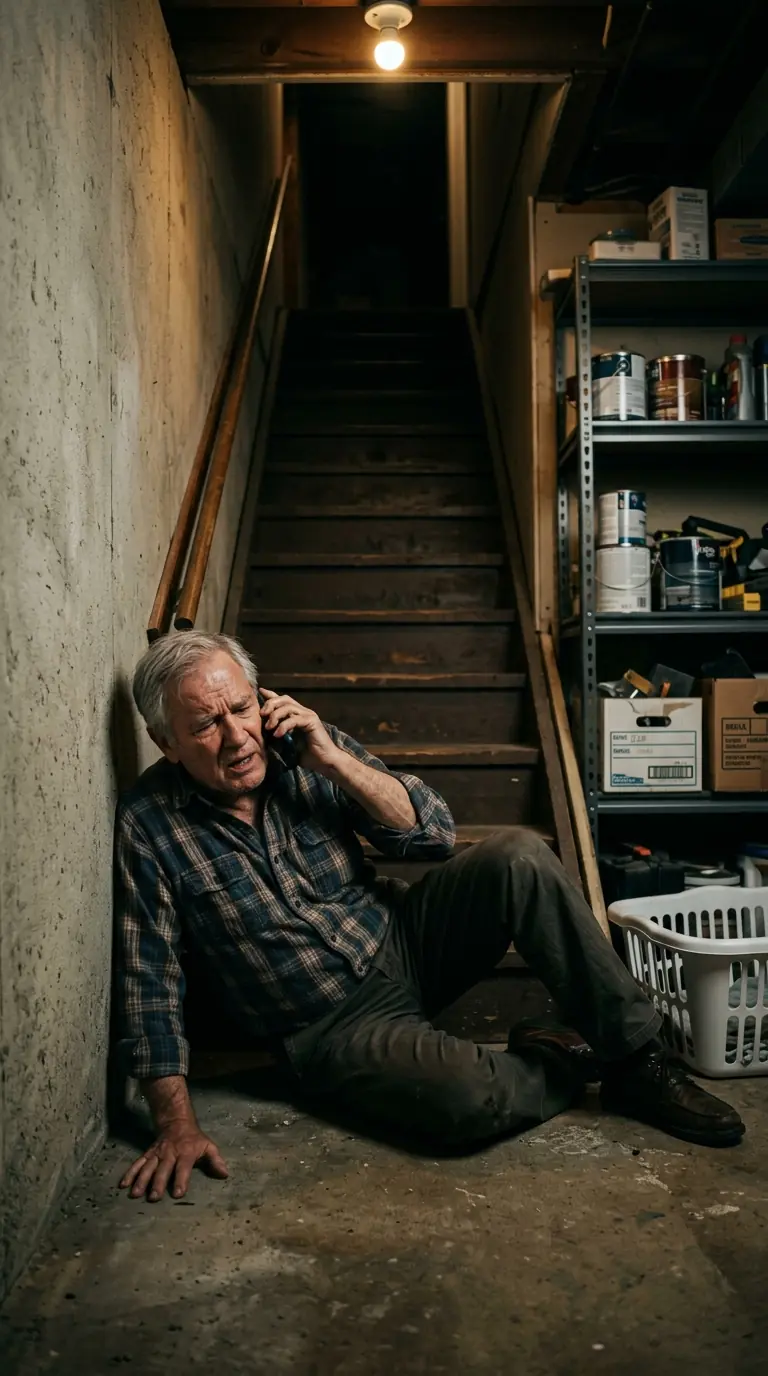
I reached for the phone in my pocket with fingers that didn’t want to work and called 911 because pain has a way of stripping all your better stories away.
The woman on the emergency line asked, “Are you alone, sir?”
I didn’t answer the first time.
Because what was I supposed to say?
Not really.
I have children.
Grandchildren.
A daughter in Maryland.
Another one in North Carolina.
Christmas cards on the mantle.
School pictures in frames.
A whole life built right here in this brick house.
But none of them were in the basement with me.
None of them were hearing my breathing go thin.
None of them were close enough to get me off that floor.
So I swallowed hard and said, “Yes.”
That yes followed me all the way to the hospital.
It sat in the ambulance with me.
It lay beside me in the emergency room.
It settled into the corner of my room after surgery.
And it stayed there, night after night, after the flowers came and the phone calls ended and the practical kindness of my family ran up against mileage, meetings, children of their own, and lives that no longer fit inside the old geography of mine.
My kids called.
They were kind.
That part matters.
This is not one of those stories where the children are monsters and the old man is abandoned by people who never cared. My children loved me. I know that. They were worried. I could hear it in the way their voices tightened.
“Dad, I’m trying to move meetings.”
“Dad, flights are insane right now.”
“Dad, give me two more days.”
And I said what older parents always say when we are trying not to become another obligation in lives already stacked too high.
“Don’t worry about me.”
“I’m okay.”
“Take care of your own.”
But I was not okay.
The hardest hour in that hospital was not physical therapy, though I hated that too.
It was not the nurse waking me for blood pressure.
It was not the tray of lukewarm meat loaf sliding onto my table night after night.
The worst hour came after visiting time ended.
That was when the hall changed.
Before then, there was movement.
Spouses carrying balloons.
Adult daughters adjusting blankets.
Little grandchildren asking loud questions someone always tried to hush.
People bringing magazines, casseroles no one could eat, real coffee, and the sound of life continuing just beyond the bedrails.
Then visiting hours ended.
And the rooms went dark one by one.
And from inside your bed, in the half-light, you could hear exactly who had somebody and who didn’t.
A laugh down the hall.
A soft, “Love you, Mom.”
A chair scraping back.
A forehead kiss.
A husband saying, “I’ll be here first thing.”
And then doors closing.
And then silence.
Not peaceful silence.
Not restful silence.
The kind that presses on your chest.
The kind that makes every machine sound lonelier.
On the fifth night, I turned my face toward the wall before the nurse came in.
I didn’t want her pity.
Didn’t want the soft eyes.
Didn’t want another person under thirty saying “sweetie” to a man who had spent four decades in a machine plant and once could carry two sacks of concrete at once without thinking much about it.
She set my tray down anyway.
Meat loaf gone cool.
Green beans I had no taste for.
A square of cake that looked too cheerful for the room it had landed in.
“Try to eat a little,” she said.
I pretended to be asleep until she left.
Sometime around eight-thirty, I heard sneakers in the hallway.
Not the quick steps of staff.
Not the lazy shuffle of janitorial carts.
Something slower.
Hesitant.
A shadow paused at my door.
When I opened my eyes, there was a tall, skinny kid standing there with a backpack hanging off one shoulder.
Seventeen, maybe eighteen.
Dark hoodie.
Cheap headphones around his neck.
Hair damp like he’d come in from rain or sweat or both.
Tired face.
Careful eyes.
He took one step back when he realized I was awake.
“Sorry, sir,” he said. “I’m looking for 216. My great-aunt. I think I got turned around.”
His voice had that mix some boys have—half grown, half not, trying to sound casual while still carrying too much life in it.
I pointed down the hall.
“Second door after the ice machine.”
“Thanks.”
He started to go.
Then he stopped.
His eyes moved from my untouched tray to the empty chair beside my bed.
Then back to me.
“You want me to turn your TV on or something?”
I almost laughed.
Not because it was funny.
Because it was so direct.
So unpolished.
“No.”
He nodded once.
But he still didn’t leave.
“You sure?”
My pride rose up on instinct.
That old reflex.
The one that had carried me through layoffs and funerals and all the humiliations men don’t talk about because talking feels too close to need.
“I’m fine.”
He looked at me for a second longer than most people do.
Then he said, “My great-aunt says old folks always say that right before they need help opening a pudding cup.”
That got a sound out of me.
Not quite a laugh.
But close.
He stepped into the room.
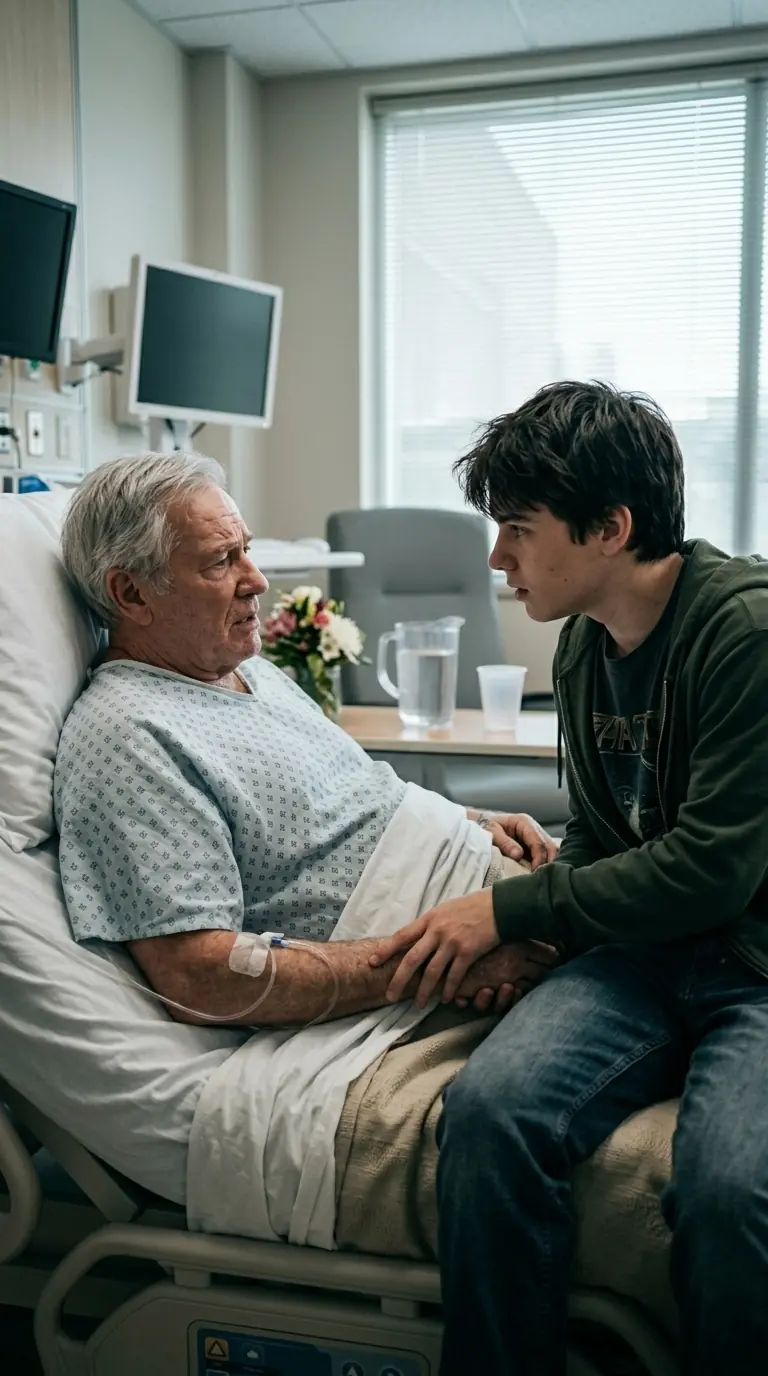
“I’m Micah,” he said. “I can stay five minutes till she wakes up.”
I should have told him no.
Should have said I didn’t need company from some kid who had taken a wrong turn.
Should have protected what was left of my dignity the way I’d been trying to all week.
Instead I said, “Walter.”
He sat down like he belonged there.
At first, we barely talked.
He checked his phone.
I stared at the wall.
He asked if I wanted the cake.
I told him to go ahead.
He did, and made a face like hospital cake was an insult to civilization.
Then he asked what I used to do for work.
That one question cracked something open.
I told him about the plant.
About forty winters of steel-toe boots and twelve-hour shifts.
About overtime before Christmas when everybody wanted the extra money and nobody wanted to admit how much they needed it.
About summer heat on the line.
About grease under the nails that never fully came out.
About my wife, Ellen, packing my lunch in the same dented metal box for twenty years because she said it still worked and that was reason enough.
He listened.
I mean really listened.
Not the polite waiting people do when they’re just holding space for their own next sentence.
He listened like what I was saying had weight.
The next night he came back.
This time after seeing his aunt.
He had a math worksheet folded in his back pocket and a bag of vending machine crackers in one hand.
He leaned in my doorway and said, “You still alive, Mr. Walter?”
“Meaner than ever,” I told him.
He grinned and sat down.
After that, he became part of the room.
Not by declaration.
Not by arrangement.
The way some things in life become real without anybody announcing them.
Sometimes ten minutes earlier.
Sometimes five minutes later if the bus was running behind.
He’d do homework while I ate.
He’d read me headlines off his phone.
He’d complain about school, his job at the grocery store, his little brother using all the hot water, the vice principal who seemed personally offended by teenage boys existing in hallways, the bus driver who drove like he had old grudges against speed bumps.
And somehow, without either of us planning it, eight-thirty stopped being the loneliest time of day.
It became Micah time.
I started saving parts of the day to tell him.
The therapist who acted like making it three extra feet with a walker deserved a medal.
The man down the hall who snored like a chainsaw.
The nurse with the dragon tattoo who could start an IV in the dark.
Once, when I got too proud and tried to adjust myself in bed without calling for help, I nearly slid halfway out. Micah came in just in time to hit the button and say, “Mr. Walter, you trying to escape?”
“Just testing gravity,” I told him.
He snorted.
He had a good laugh when it came naturally.
Not showy.
Honest.
Some nights he helped other people too.
At first it was small things.
He fixed the charging cord for the man across the hall.
He filled the water cup for a woman whose hands shook too much to hold the pitcher steady.
He stood in one doorway for twenty straight minutes while an old veteran told the same war story three times, nodding like it was the first.
The nurses started calling him “the closer,” because he showed up when the hard part of the day began.
Not the medical hard part.
The emotional one.
The hour when loneliness gets louder than pain.
One night I finally asked why he kept doing it.
He shrugged like it was obvious.
“My grandma raised me for a while,” he said.
He kept his eyes on the floor when he said it.
“She used to say people don’t fall apart all at once. It happens in quiet pieces.”
Then he looked up.
“She said five extra minutes can keep a person together.”
I turned my face toward the window after that because my eyes burned.
Not from pain.
From shame, maybe.
Or gratitude.
Or both.
Because my own children loved me.
I knew they did.
But love had become money wired, flowers delivered, messages sent between meetings, promises of next weekend, next week, soon.
And this kid, who owed me nothing, had given me the one thing I actually needed.
His time.
That is harder to offer than money.
More intimate than flowers.
Less visible than sacrifice, but sometimes worth more.
I learned things about him in pieces.
His mother worked nights at a laundry plant.
His father was “around sometimes,” which told me enough.
He worked part-time at a grocery store after school.
He wanted to fix engines or maybe HVAC systems because, as he put it, “I like things that make sense once you open them up.”
He had a little brother who was good at drawing and bad at homework.
He was tired all the time.
But he still came.
Some people would have looked at him and seen trouble.
The hoodie.
The worn-out sneakers.
The careful face of a boy who had learned not to take too much space.
Some older folks in my town would have crossed the street.
Locked their car doors.
Told their granddaughters not to make eye contact.
And yet, there he was.
Sitting in an empty chair.
Holding the whole evening together.
I got discharged on a Friday morning.
My daughter arranged home care.
My son ordered me a lift chair I never asked for.
They were trying, in the ways they knew how.
That deserves to be said plainly.
Modern love is often logistical.
Scheduled.
Outsourced.
Made of deliveries and transfers and emailed forms.
It is still love, even when it doesn’t sit in the room.
But when they came to wheel me out, the last person I looked for was Micah.
He came in late, backpack still on, hair damp from rain, breathing hard like he had run from the bus stop.
He handed me a folded note.
“Open it when you get home,” he said.
Then he stepped back, hands in his pockets, like maybe he was embarrassed by the gesture now that he’d committed to it.
At home, with the house too quiet and my walker parked beside the recliner like an insult, I unfolded the paper.
Notebook paper.
Big crooked handwriting.
For the nights that get loud.
Call if you want company.
I can do five minutes.
Sometimes more.
That paper is still on my kitchen table.
It has been there so long the corner has curled.
And here is the part I cannot stop thinking about.
I spent years hearing people talk about what is wrong with this country.
Young people this.
Old people that.
City against town.
Black against white.
One generation blaming the next for the ruins it inherited.
Maybe some of that is real.
I’m old enough to know that much.
But maybe the truest story is quieter than that.
Maybe this country is still being held together by tired nurses.
By old men learning how to ask for help.
By daughters who order lift chairs because it is what they know to do.
By sons who call from airport gates with guilt in their voices.
And by a teenage boy with worn-out sneakers who saw an empty chair and sat down in it.
Because blood did not save me from that kind of loneliness.
Presence did.
Five extra minutes did.
A kid everyone told me not to trust did.
And maybe, if we are honest, that is the closest thing to love most people ever get.
Not grand gestures.
Not speeches.
Not perfect timing.
Just someone noticing the silence and deciding not to leave you alone inside it.