There are moments in life when the world keeps asking you to continue with ordinary things, even after you’ve been handed extraordinary news.
The doctor had said it plainly, with the kind of practiced gentleness people in medicine learn when they have to deliver devastation without making it sound theatrical.
Advanced lung cancer.
The scans were clear enough, the spread aggressive enough, the timeline short enough that no one in the room needed false hope to clutter the truth.
Six months.
At sixty-eight years old, I had imagined many endings, but not that one.
Not a countdown.
Not my own life reduced to a rough estimate, like a lease term or a weather forecast.
I had thought, if I was lucky, old age would come in softer colors.
I thought there would be more time to organize drawers, label photo albums, pass along jewelry with little stories attached to each clasp and stone.
I thought there would be a gentler descent into goodbye.
Instead, I got a prognosis that felt like a stamp pressed onto my forehead.
And still, somehow, life expected me to stand in line at the Post Office.
That Friday morning was thick with summer humidity, the kind that clings to your skin before the sun has even fully committed to the day.
The Post Office smelled like paper, dust, old packaging tape, and the faint sourness of too many people waiting in one airless room.
The line had already snaked past the service counters and halfway to the door by the time I arrived.
A mother bounced a crying toddler against her hip.
A man in work boots kept checking his watch every forty seconds.
Someone behind me was sighing loudly enough to make their inconvenience everyone else’s burden.
I should have gone home.
That would have been the sensible thing.
My body had been changing in ways I still hadn’t made peace with.
Some mornings my chest felt tight before I had even climbed out of bed.
My energy came in rationed portions.
A simple walk from the parking lot could leave me winded in a way that felt humiliating, not because I had ever been vain about aging, but because sickness makes traitors out of parts of you that once served faithfully.
Even my hands felt different.
Thinner somehow.
Less obedient.
Like they belonged to an older woman than the one I still pictured in my head.
But my passport needed renewing.
People thought that was strange when I told them later, as if terminal illness should immediately sort your priorities into something nobler or more cinematic.
They imagined I should have been writing final letters, reviewing burial preferences, and staring thoughtfully out windows with a blanket over my lap.
And yes, there were moments like that.
But there was also paperwork.
Insurance calls.
Prescription refills.
Lists.
Forms.
Passwords scribbled in places that suddenly seemed too secretive.
There is a bureaucracy to dying that no one advertises, and I found I resented it deeply.
Renewing the passport became, in my mind, something larger than a government document.
It was proof.
Proof that I was still participating in the machinery of a future, however uncertain.
Proof that I had not yet agreed to dissolve.
Proof that my life had not become so narrow that I could no longer justify standing in line for something I might never use.
So I stood there.
For ten minutes, then twenty, then forty-five.
The fluorescent lights overhead hummed too loudly, a flat electric drone that began to feel personal.
My vision blurred at the edges, the room softening and sharpening in strange turns.
Sweat gathered at the base of my neck.
My knees, which had carried me through pregnancies, grief, grocery aisles, office hallways, funerals, and one brief season of tennis I was never very good at, suddenly lost interest in the task.
I reached for a nearby mailing table.
My fingers slipped on the smooth wood.
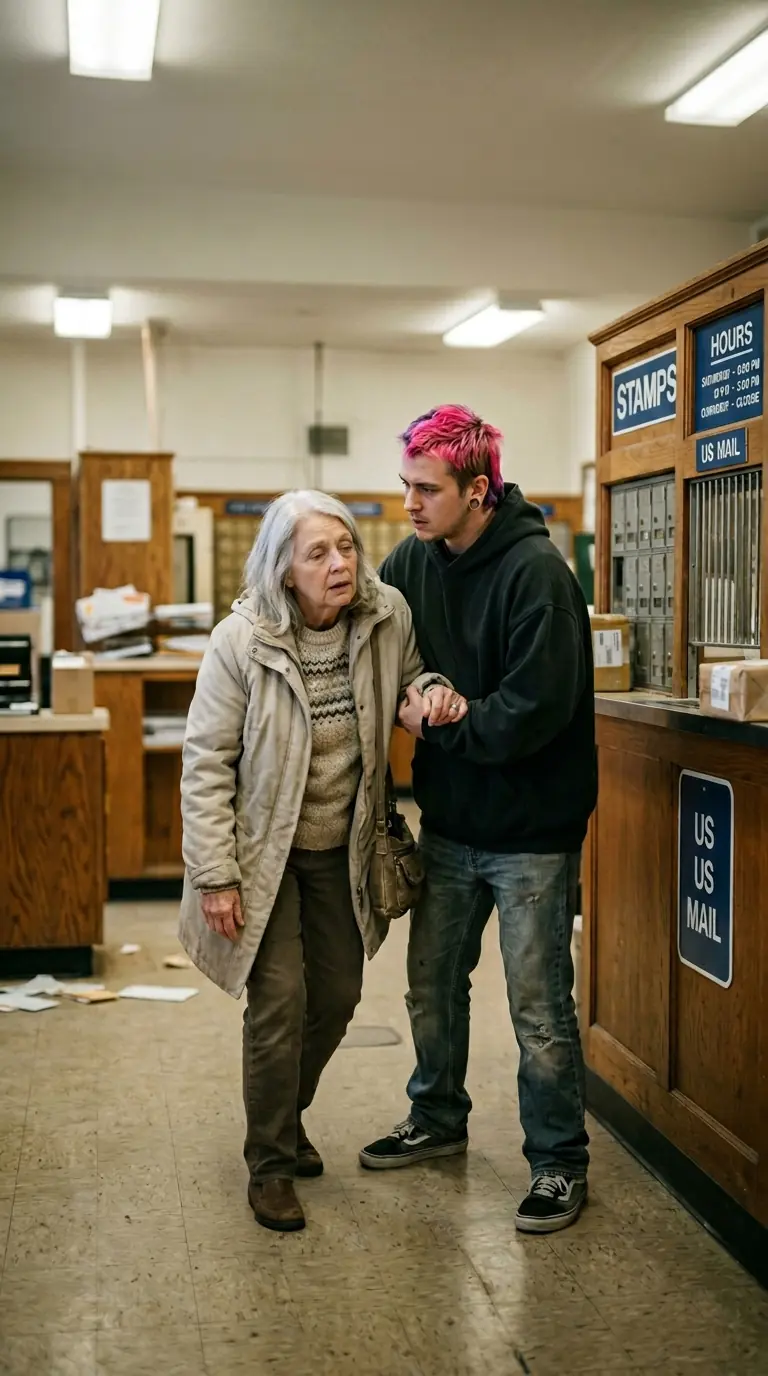
And then a hand caught my elbow.
Strong.
Immediate.
Unceremonious.
“I’ve got you, ma’am,” a voice said close to my shoulder.
I turned, embarrassed before I was grateful.
He looked barely twenty.
Maybe twenty-one.
His hair was buzzed close and dyed a bright neon color that would have scandalized at least three women in my church circle.
He wore black jeans, scuffed boots, a faded oversized T-shirt, and enough metal in his ears and eyebrows that I had the absurd, fleeting thought that he must set off every metal detector in the county.
He had sunglasses on indoors, which in my generation usually meant one of two things—hangover or attitude.
Maybe both.
But his hands were steady.
His grip was careful.
And he did not look annoyed to be helping me.
“I’m fine,” I said, because women my age are born saying that before checking whether it’s true.
He ignored me.
Not rudely.
Just with the calm certainty of someone who had already decided the facts mattered more than my pride.
He moved half a step closer and stayed there, not crowding me, not touching me unnecessarily, just close enough that if my legs gave way again there would be something between me and the floor.
The line lurched forward inch by inch.
And for the next hour, he became my shadow.
He didn’t ask for my name.
Didn’t ask if I was sick.
Didn’t ask if I had family.
Didn’t perform concern for an audience.
He simply remained.
If I shifted, he shifted.
If I swayed, his shoulder was there.
He said almost nothing beyond the occasional, “You okay?” and even that sounded less like conversation than a check on structural integrity.
There was something about that restraint that moved me more than fussing would have.
By then in life, I had become weary of people who wanted a performance of vulnerability from you in exchange for help.
The kind who ask too many questions too quickly.
The kind who want to feel useful in ways that center themselves.
This boy—this young man—offered something rarer.
Presence without intrusion.
When I finally reached the clerk and slid my paperwork onto the counter with trembling fingers, I turned to thank him.
He was gone.
No dramatic goodbye.
No expectation.
No “take care of yourself.”
Just vanished back into the crowd as if catching strangers before they hit the ground was something he did quietly and without any need to be remembered for it.
I thought about him on the drive home.
Not romantically, not sentimentally, just with that peculiar kind of curiosity certain people leave behind.
Who was he?
Who had taught him to notice?
What kind of young person still had that instinct in a world so busy filming itself?
He did not look like the sort of person older women were trained to expect gentleness from, and maybe that was the lesson right there, though I didn’t know it yet.
A month later, the radiation treatments began.
No one prepared me for how thoroughly treatment would hollow out an ordinary life.
Not all at once.
Not dramatically.
Just steadily, like a slow theft.
The nausea did not simply make me sick; it made the world smaller.
Food became strategic.
Sleep became unreliable.
My body began negotiating with me in small betrayals: dizziness when I stood too fast, weakness in the shower, a strange metallic taste that made water seem offensive.
Some mornings the effort of getting dressed felt like a task better suited to a healthier woman.
The bus had once been manageable.
I was not precious about public transportation.
I had worked for thirty-five years as a school administrative assistant and had spent enough of that time budgeting, commuting, and making do to understand that convenience is often just another name for privilege.
But treatment made the bus system impossible.
Transfers blurred together.
Standing too long exhausted me.
The timing became cruel.
Every missed connection felt punitive.
My son lived three states away, loving but distant in the practical way adulthood sometimes demands.
He called often.
He worried.
He could not drive me to every appointment.
So I did something I hated doing.
I asked for help publicly.
On a local community forum, I wrote a brief post:
Need a reliable driver for medical appointments.
Can offer gas money and a small fee.
Even typing it felt like surrender.
Not because help is shameful.
Because I had spent a lifetime understanding competence as a private religion.
I was from a generation of women who packed our own casseroles to deliver after funerals and rarely admitted when we needed one brought to us.
You made do.
You managed.
You thanked people after the fact, not before.
The message popped up less than an hour later.
I’ll take you.
Keep your money.
No profile photo at first.
Just a name.
Jordan.
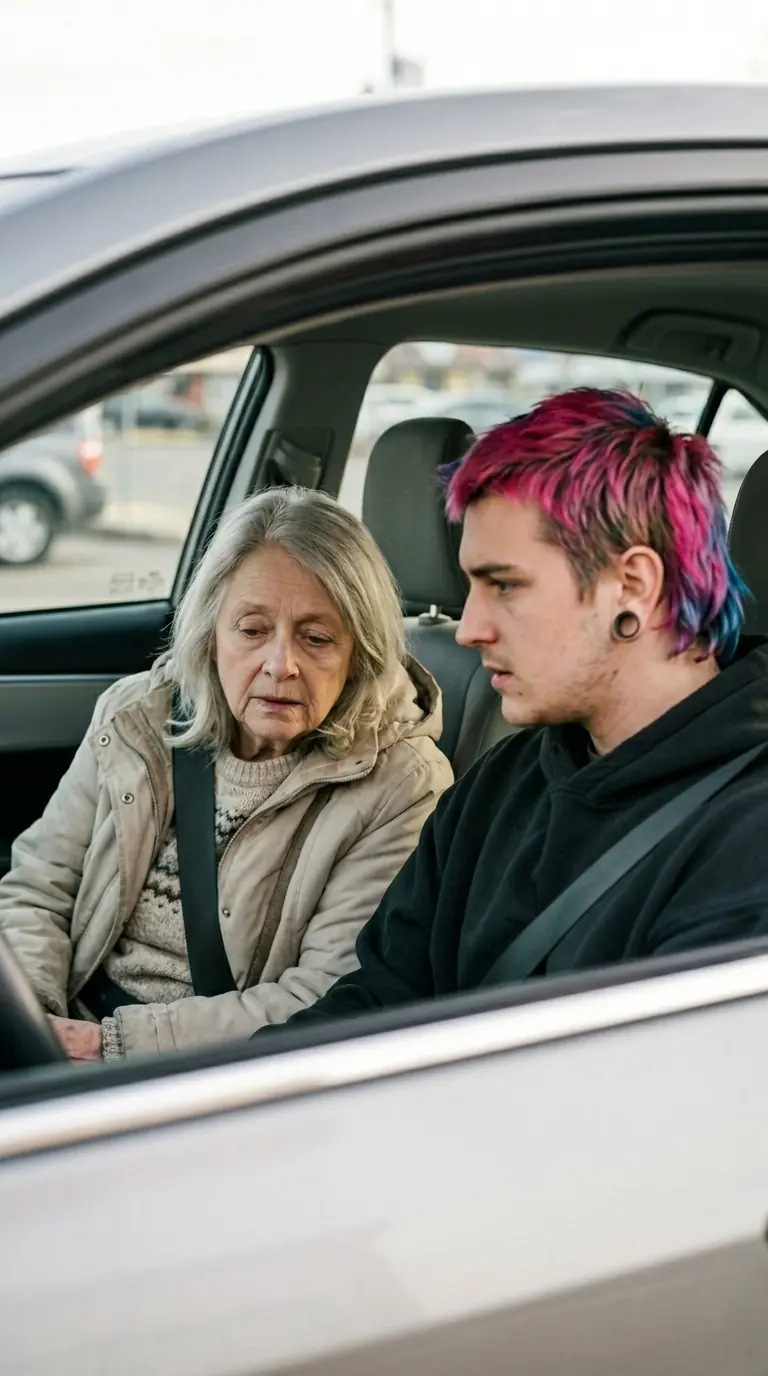
When he pulled up the next morning in an older sedan that sounded like it had earned every mile, I knew him instantly.
The neon buzz cut was a little different shade now, closer to copper than electric green.
The piercings were still there.
Same sunglasses.
Same quiet.
He rolled down the passenger window and said, “Morning, ma’am,” as if we had arranged this a hundred times before.
“You,” I said.
He gave half a shrug.
“Post Office.”
That was the beginning.
For the next five months, Jordan became my lifeline.
He drove me to radiation appointments, scans, follow-ups, pharmacy pickups, and one miserable pulmonary function test that left me so tired I fell asleep with my mouth open on the ride home.
He never once made me feel like a burden.
Never checked the time in that exaggerated way some people do when they want you to know their generosity has limits.
Never let me pay for gas, despite my repeated attempts to press folded bills into the cup holder or his coat pocket.
He was always early.
Not dramatically early.
Just dependable enough that I began to trust the sound of his engine outside my house more than I trusted my own strength some mornings.
In the waiting rooms, he sat with a dog-eared paperback he seemed to be reading forever.
I never once saw him take out headphones or scroll mindlessly on his phone for hours the way so many young people are accused of doing.
Sometimes he looked at nothing.
Sometimes he watched the television mounted in the corner without really seeing it.
Sometimes he got me crackers or fresh water before I even realized the nausea was rising.
He kept peppermint tea in the glove compartment because after the third appointment he noticed I always felt sick once we turned onto the highway.
He learned which clinic hallway was too cold, which technician made me nervous, which parking garage elevator smelled faintly of urine, which side entrance was easier on days I could barely breathe.
One afternoon, after a particularly brutal treatment, I sat in the passenger seat with my head back and asked the question that had been living in my mouth for weeks.
“Why are you doing this for a stranger, Jordan?”
He didn’t answer immediately.
His hands tightened slightly on the steering wheel.
Outside the windshield, summer traffic dragged itself along in fits and starts, ordinary people going ordinary places while my life moved according to scan results and white blood cell counts.
Finally he said, “My mom got sick a few years back.”
His voice was lower than usual.
“No one would give her rides to the clinic, and I didn’t have a car then.”
He stopped at a light and stared straight ahead.
“She missed too many treatments. By the time I could help, it was too late.”
There was no drama in the way he said it.
That was what made it devastating.
Grief, I have learned, sounds most truthful when it no longer performs its own pain.
“I’m just making sure someone else makes it,” he said.
I looked at him then—really looked.
At the neon hair, yes.
The metal.
The tattoos peeking out from beneath his sleeves.
But also at the concentration in his jaw, the exhaustion around his eyes, the way his kindness had edges on it, as though it had been forged in failure and regret and chosen anyway.
He was not simply helping me.
He was rewriting something inside himself.
That changed the shape of my gratitude.
It was no longer just thankfulness.
It was respect.
Over those months I learned pieces of his life the way one learns weather patterns—gradually, from repetition and attention rather than confession.
He had left trade school to work two jobs after his mother got sick.
Grocery deliveries in the mornings.
Auto parts warehouse at night.
He lived in a rented duplex with a sink that backed up when it rained and a landlord who preferred messages to repairs.
He liked old horror movies, peppermint gum, and fixing things that had been prematurely declared broken.
He did not speak much about his father except to say, once, “Not part of the picture.”
He carried tiredness the way many young men carry invisibility—so fully it had become part of his outline.
And yet, every Sunday afternoon he started dropping by even when I had no appointments.
At first he claimed he was “in the neighborhood,” which was absurd.
No one was accidentally in my neighborhood on a Sunday unless they had chosen to be.
He would bring a paper bag of groceries or a package of ginger snaps or, once, a cheap potted basil plant because he’d overheard me telling the oncologist I missed cooking.
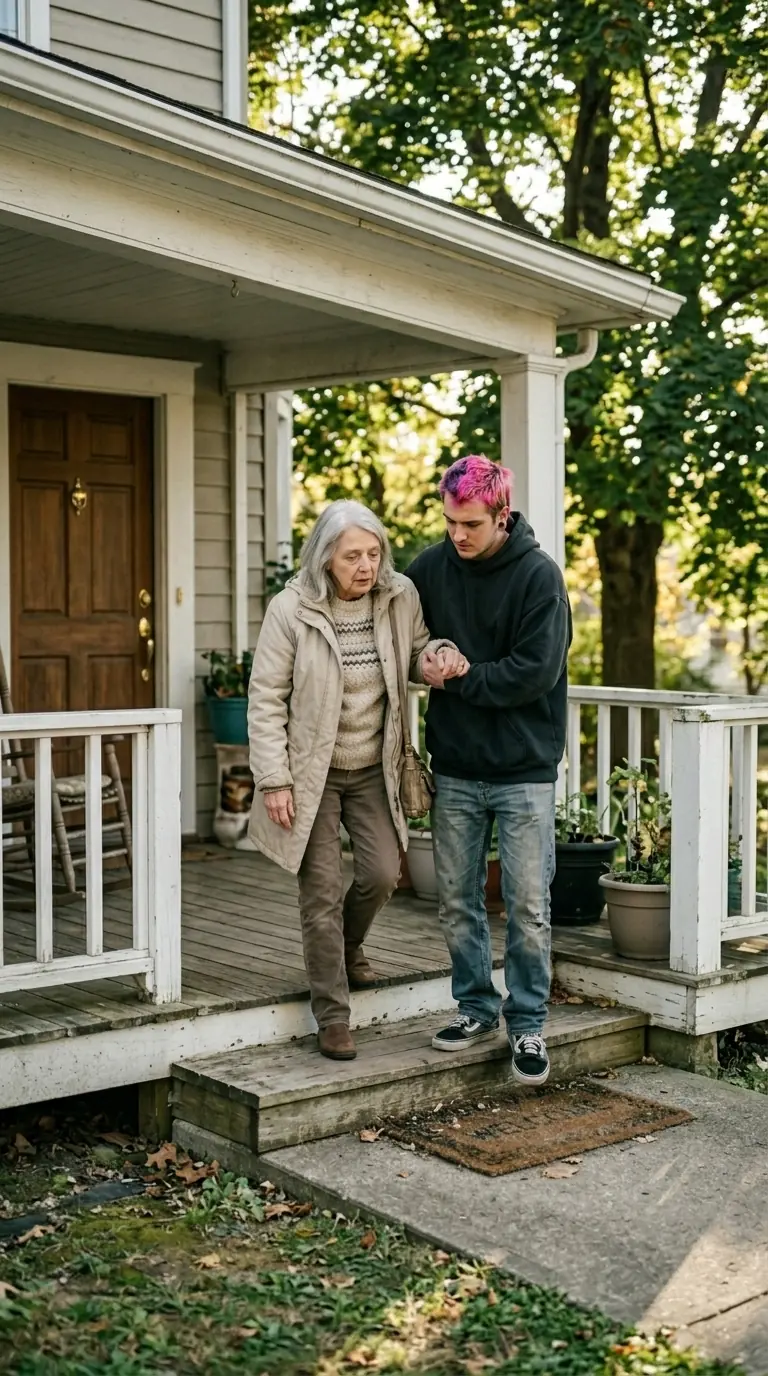
When treatment lifted enough for me to sit outside, we’d go to the back deck.
He brought his mother’s favorite cookies one Sunday—store-bought, a little stale, and somehow perfect.
We sat with iced tea while the cicadas screamed from the trees and the late afternoon light made everything look briefly forgivable.
There we were:
The sick woman who lived.
The boy who couldn’t save his mother.
And the quiet understanding growing between us of what people owe one another when nobody else is keeping score.
Then something happened no one had promised me.
The scans came back clear.
Not cautiously better.
Not “encouraging.”
Not “some response.”
Clear.
The doctor called it a remarkable response, which is medical language for we did not expect this, but we will take it.
I cried in the exam room.
The oncologist squeezed my shoulder.
A nurse brought tissues and said, “Well, look at that.”
My son drove in for the weekend and hugged me so hard I thought my ribs might protest.
The hospice folder that had sat untouched in my desk drawer was quietly replaced by seed catalogs and plans for raised garden beds.
Jordan reacted by nodding once and saying, “Good,” in the same tone he used when the car started on the first try.
Then he went out and changed my windshield wipers because he noticed one had been squeaking.
That, too, was love of a kind.
He still refused money for the hundreds of miles he had driven.
So I did what women like me do when direct generosity is refused: I got creative.
Through a little persistence and a call placed under the harmless pretense of verifying residency for a local aid initiative, I found his landlord’s name.
Then I mailed a check covering two months’ rent under the description of an anonymous community grant.
He never mentioned it.
Never embarrassed me by making me explain myself.
But the next time he came by, he stood awkwardly at the edge of the deck for a moment, then leaned down and hugged me.
It lasted a little longer than usual.
Long enough to say, without saying, that he knew.
Long enough to say thank you in the only language pride sometimes allows.
Yesterday he told me he’s enrolling in a paramedic program.
We were sitting outside with lemonade and those same cookies, now softened by humidity, when he said it as if he were mentioning an oil change.
“I’m tired of being the one who waits,” he told me. “I want to be the one who arrives.”
I laughed then, not because it was funny, but because it was so exactly right for him that the truth of it landed like joy.
I am sixty-eight years old.
I was told to prepare for death.
I nearly slipped to the floor under fluorescent lights because my lungs had begun surrendering before I was ready to.
I spent months being ferried between fear and treatment by a young man the world might dismiss at a glance.
And somewhere in the middle of that long, humiliating, miraculous season, I learned something I wish more people understood before suffering teaches it to them by force.
The person who catches you usually doesn’t look like the person you were waiting for.
Help rarely arrives dressed as your assumptions.
Sometimes it comes with neon hair and tired eyes and a grief so old it has become service.
Sometimes it comes from a nurse who asks the right question in the right tone.
Sometimes it comes in the form of accepting that your strength is no longer measured by how much you can carry alone.
There is no grand moral tidy enough for a greeting card.
I only know this:
Accepting help is not defeat.
It is courage.
Because staying strong on your own is just another way of staying lonely.
And I have had enough loneliness for one lifetime.
Now, when Jordan pulls into the driveway on Sundays, I hear the engine and smile before I even rise from my chair.
The garden is coming in.
The basil survived.
The passport arrived in the mail last month, good for ten years.
I laughed when I held it.
Ten years.
A government document betting on my future more boldly than my doctors once had.
Life is strange that way.
Cruel, yes.
Tender too.
And if I have learned anything worth passing on, it is this:
sometimes being saved looks less like a miracle and more like a person quietly deciding not to let you fall.