He Married a Penniless Spinster Just to Save His Estate — Her Shocking Courtroom Confession Saved His Heart

He Married a Penniless Spinster Just to Save His Estate — Her Shocking Courtroom Confession Saved His Heart
Reader Theme:
Font Size:
24px

Chapter 1: The Terms of Ruin


Viscount Henry Ravenshire had always believed there were two certainties in life: death and the enduring patience of his grandmother. He had been wrong about both.

The letter arrived on a Tuesday, carried by a mud-spattered rider who had ridden through the night. Henry had been in the middle of a particularly fine breakfast, kedgeree, buttered toast, and the lingering memory of a weekend spent at Lord Pembroke's country house, where the claret had flowed like water and the company had been pleasingly uncomplicated. He unfolded the vellum with one hand, still holding his coffee cup in the other.

“My Lord Ravenshire, it is my solemn duty to inform you that the Dowager Viscountess Ravenshire passed away peacefully in her sleep on the morning of the 14th instant. Her solicitors, Messrs. Fairmont and Vale, request your presence at their offices in London at your earliest convenience regarding the reading of the will. Yours, etc., Jonathan Crumb, Undertaker.”

Henry set down his coffee. The toast suddenly seemed dry. His grandmother, sharp-tongued, indomitable, eighty-four years old and still capable of reducing a footman to tears with a single glance, was gone. He had not loved her, precisely. One did not love a force of nature, but he had respected her, which was perhaps rarer and more valuable.

Three days later, he sat in the dusty offices of Fairmont and Vale, a thin shaft of London sunlight cutting across the mahogany table. The solicitor, Mr. Fairmont the younger, was a man of such profound solemnity that Henry suspected he had been born wearing black and reciting legal statutes.

“My lord,” Mr. Fairmont began, adjusting his spectacles, “the Dowager Viscountess's will is, I shall not mince words, somewhat unconventional.”

“My grandmother was many things,” Henry drawled, crossing his legs at the ankle. “Conventional was never among them. Get on with it.”

Mr. Fairmont cleared his throat and read aloud. “To my grandson, Henry, Viscount Ravenshire, I leave the entirety of my personal fortune, including the Ravenshire Court estate, its lands, tenants, and all associated incomes, upon the express condition that he shall be lawfully married within six months of the date of my death. Furthermore, the bride must be of good character and reputation, and the marriage must be certified by my solicitors as genuine and not entered into for the mere purpose of fulfilling this clause. Should he fail in this, the entirety of the estate shall pass to the distant cousin of my late husband, Mr. Reginald Pounce of Cheapside.”

Henry sat in stunned silence. Then he laughed, a short, incredulous sound. “Pounce of Cheapside?” he repeated. “She cannot be serious. Reginald Pounce is a linen draper. He smells of starch and desperation.”

Mr. Fairmont did not smile. “The Dowager was most serious, my lord. I have the honor of informing you that the clause is ironclad. It was drafted by my father personally and witnessed by three parties of unimpeachable standing.”

Henry stood so abruptly that his chair scraped backward. He walked to the window, stared out at the grimy London street, and felt the walls of his careless existence begin to crumble. Six months. Six months to find a bride, a genuine bride, not some convenient arrangement, or lose everything.

Ravenshire Court. The land his father had loved. The tenants who had depended on his family for three generations. All of it, delivered into the moist palms of a linen merchant from Cheapside.

“There must be a loophole,” he said, his voice quieter now.

“There is not, my lord. I have examined the document with the most meticulous care. You must marry, and the marriage must be real in both form and intention. I am to receive quarterly reports from your household staff regarding the state of your union.”

Henry turned. “My household staff? She has spies.”

“The Dowager retained a deep affection for Cook, I believe,” Mr. Fairmont said mildly, “and for your mother's former maid, who remains at Ravenshire Court.”

Henry lowered himself back into the chair. For the first time in his thirty-two years, he felt the cold breath of genuine consequence. He had always assumed the title and estate would simply be his by birthright, by inevitability. He had never imagined his grandmother would use them as weapons from beyond the grave.

“What sort of woman did she expect?” he asked, almost to himself. “A paragon? A saint?”

Mr. Fairmont consulted a second document. “The Dowager left additional instructions. She specifically excluded any woman of the London season, whom she described as, I quote, ‘vapid, mercenary, or possessing the intellectual capacity of a teapot.’ She expressed a preference for a woman of sense, loyalty, and practical disposition. An odd request, my lord, but not legally binding.”

Henry closed his eyes. His grandmother had spent her final months constructing a trap so elaborate that he could only admire its craftsmanship. She had known him too well. She had known he would never choose marriage for himself, that he preferred the easy charm of temporary attachments, the safety of never being truly known. So she had chosen for him.

But where, in all of England, was he to find a woman of sense and practicality who would agree to marry a near stranger within six months? And not just any marriage, a real one, watched and reported upon by the very servants who had known him since childhood. He was, he realized grimly, utterly undone.

Forty miles north of London, in a village called Willowmere, Miss Lydia Barnes was attempting to teach her younger sister the difference between a simile and a metaphor while simultaneously scraping porridge from the bottom of an empty pot.

“Charlotte, if you do not attend, you shall never pass your examination.”

Charlotte, seventeen and possessed of a dreamy disposition that Lydia secretly envied, looked up from the window. “I was attending. The clouds look like woolly sheep. That is a simile, is it not?”

“It is.”

“And the porridge is like concrete.”

“That is also a simile, and one of which I am growing exceedingly weary.”

Lydia set down the spoon. The kitchen was small and cramped, the way all kitchens were in houses that had once been grand and had since fallen into shabby disrepair. The Barnes family had once been comfortable, not wealthy, but respectable. Their father had been a rector, their mother the daughter of a country squire. But the rector had died of a putrid fever three years ago, leaving a widow, four daughters, and a pension so meager that Lydia had been forced to take in sewing just to keep them in bread.

She was twenty-five now, an age when most of her peers were married and nursing their second children. She had never been proposed to, never been courted, never even been kissed. She was too practical for romance, too plain for poetry, too busy keeping her family alive to pine for what she could not have.

There was a knock at the door. Lydia wiped her hands on her apron and went to answer it. Standing on the threshold was Mrs. Henley, the vicar's wife, her face bright with that particular expression of suppressed excitement that meant she was the bearer of news.

“Lydia, my dear,” Mrs. Henley said, stepping inside without waiting for an invitation, “you will never believe what I have just heard. The old Dowager Viscountess Ravenshire has died, and the new Viscount, the grandson, is looking for a bride.”

Lydia closed the door. “Mrs. Henley, I fail to see how this concerns me. I have never met the Viscount. I am unlikely to meet the Viscount, and even if I did, I am hardly bride material for a man of his station.”

Mrs. Henley clasped her hands. “That is the extraordinary part. He is not looking in London. He is looking here, in the country. His solicitor has been making inquiries, discreet inquiries, but nothing remains discreet in Willowmere for long. He is said to be seeking a woman of good character and practical sense. Lydia, that is you.”

Lydia stared at her. “You cannot be serious.”

“I am entirely serious. The Viscount will be attending the assembly at Briarwood Hall next week. You must go. You must.”

Lydia thought of the assembly. She thought of her one good gown, which was faded at the elbows and had been let out twice. She thought of her hair, which was neither golden nor dark, but an indeterminate brown, and which refused to curl no matter how many rags she slept in. She thought of the practical, steady, utterly forgettable face that stared back at her from her mother's cracked mirror every morning.

“Mrs. Henley,” she said quietly, “I am grateful for your concern. But I am not the sort of woman men marry. I am the sort of woman men forget to invite to dinner.”

Mrs. Henley's expression softened. “My dear girl, you underestimate yourself. You have kept this family alive on next to nothing. You have raised three younger sisters while mourning a father you adored. You are loyal, intelligent, and good. Any man of sense would be fortunate to have you.”

Lydia wanted to believe her. She really did. But she had learned, over twenty-five years of being overlooked, that wishing did not make a thing true.

“I will consider it,” she said, because Mrs. Henley was kind and Lydia did not have the heart to refuse her outright.

But that night, as she sat mending a tear in Charlotte's only petticoat by the light of a single candle, she found her thoughts drifting to the Viscount. She had heard stories, of course. Everyone in the county had. He was charming, handsome, notoriously unmarried, and rumored to have broken at least a dozen hearts without ever appearing to notice.

He was the sort of man who glided through life untouched, while women like her scraped and struggled just to remain upright. He would never look twice at Lydia Barnes. And yet, when the night of the assembly arrived, she found herself standing in front of that cracked mirror, wearing her faded gown with Charlotte's unsteady hands pinning flowers into her hair.

“You look beautiful,” Charlotte whispered.

Lydia smiled, though her heart was pounding. “I look like a woman who is about to make a fool of herself.”

But she went anyway.

Chapter 2: The Arrangement

Briarwood Hall was ablaze with candlelight. The assembly rooms had been decorated with garlands of ivy and holly, and the local musicians were tuning their instruments with the enthusiasm of men who knew they would be paid in cider. Lydia stood near the edge of the room, a glass of lemonade in her hand, watching the dancers whirl past in a blur of muslin and tailcoats.

She had been there for an hour. No one had asked her to dance. She told herself she did not mind. She was not the sort of woman who needed the approval of strangers.

She had come because Mrs. Henley had insisted, and because a small, stubborn part of her had wanted to prove that she could still hope for something more than mending petticoats and stretching porridge. But hope, she was discovering, was a cruel companion.

And then she saw him.

Viscount Henry Ravenshire stood near the fireplace, surrounded by a small crowd of admirers. He was taller than she had expected, with dark hair that fell carelessly across his brow and eyes the color of winter storms. He was dressed simply, dark coat, cream waistcoat, no jewelry, no ostentation. But there was an ease to him, a quiet confidence that spoke of a man who had never had to wonder where his next meal was coming from.

He was laughing at something. The sound carried across the room, warm and genuine, and Lydia felt something twist in her chest. He was not just handsome. He was alive in a way that made everyone else seem dull by comparison.

She looked away. There was no point in staring. He would never—

“Miss Barnes.”

She turned. The Viscount was standing directly beside her, his head tilted in polite inquiry. Up close, she could see the fine lines at the corners of his eyes, the faint shadow of stubble on his jaw, the way his gaze swept over her face with an attention that felt almost unnerving.

“I am Henry Ravenshire,” he said. “I believe we have not been introduced.”

Lydia's mouth went dry. “We have not, my lord. I am Miss Lydia Barnes.”

“Miss Barnes.” He said her name slowly, as if testing the weight of it. “Mrs. Henley pointed you out to me. She spoke very highly of you.”

Of course she did, Lydia thought wryly. She is trying to marry me off.

“Mrs. Henley is kind,” she said aloud, “though I suspect her judgment is occasionally clouded by enthusiasm.”

His lips twitched. “That is a diplomatic way of saying she is a meddler. I admire your restraint.”

Before she could respond, he extended his hand. “The next dance is a country reel. Would you do me the honor?”

Lydia looked at his hand. She looked at the dancers, the swirling couples, the laughing faces. She thought of her faded gown and her uncurled hair and the porridge that had tasted like paste.

“My lord,” she said carefully, “you do not know me. I do not know you. You have no reason to ask me to dance except that a meddlesome vicar's wife pointed me out. I think you would prefer a partner who can actually dance, rather than one who will likely tread on your toes and apologize for the entirety of the set.”

Henry blinked. Then he laughed, a real laugh, not the practiced one he had used with the crowd by the fireplace.

“Miss Barnes,” he said, “you are possibly the most honest woman I have met in a decade. I find that extraordinarily refreshing. Now, will you dance with me, or must I stand here holding out my hand until my arm grows weary?”

She took his hand.

The dance was awkward. She did tread on his toes twice, but he did not seem to mind. He talked to her as they moved through the figures, asking about Willowmere, about her family, about the books she had read, and the places she wished to see.

He did not ask about her gown, or her hair, or why she was unmarried at twenty-five. He asked about her, as if she were a person worthy of curiosity.

When the dance ended, he did not return her to the edge of the room. Instead, he led her toward a quiet alcove where a potted fern offered a semblance of privacy.

“Miss Barnes,” he said, and his voice had changed. The charm was still there, but beneath it she heard something else, something careful, almost vulnerable. “I am going to say something unforgivably forward. I ask only that you hear me out before you slap my face and walk away.”

Lydia folded her arms. “That is an ominous beginning, my lord.”

“My grandmother died three weeks ago,” he said. “She left me her estate, Ravenshire Court, the lands, everything, on one condition. I must marry within six months. A real marriage to a woman of good character and practical sense. If I do not, everything goes to a linen draper named Reginald Pounce.”

Lydia stared at him. “You are joking.”

“I wish I were. My grandmother had a peculiar sense of humor and a deep distrust of my bachelor habits. She believed that marriage would make me a better man. I am not certain she was right, but I am certain that I cannot allow Ravenshire Court to fall into the hands of a man who once tried to sell my great-aunt a bolt of inferior muslin.”

Despite herself, Lydia almost smiled. “And you believe I am this woman of practical sense?”

“I believe,” he said slowly, “that you are honest, intelligent, and clearly not motivated by fortune, given that you are wearing a gown that has been mended at least four times and are standing in an alcove with a man you have every reason to distrust. I believe that Mrs. Henley's enthusiasm, while meddlesome, is not misplaced. And I believe that you and I could help each other.”

Lydia's heart was pounding. “Help each other how?”

“Marry me,” he said. “Not for love. I would not insult you by pretending to an affection I do not yet feel, but as a partnership, a practical arrangement. You would have security for yourself and for your family, a home, an income, protection from the vagaries of poverty, and I would have a wife who will not simper, scheme, or spend my fortune on ribbons.”

He continued, “In six months, if you wish to live separate lives, I will not stand in your way, but the marriage would be real. My grandmother's spies would see to that.”

Lydia felt the room tilt beneath her feet. Marry him. The words echoed in her head, impossible and terrifying and, if she was honest with herself, not entirely unwelcome.

“You do not know me,” she said again, though her voice was weaker now.

“I know enough,” he replied. “I know that you love your family. I know that you are not afraid to speak your mind. I know that when I asked you to dance, you did not simper or preen. You told me the truth. Those are rare qualities, Miss Barnes. I am willing to wager my inheritance on them.”

She should say no. She should walk away, back to her mending and her porridge and her quiet, predictable life. Marrying a stranger, a cynical, charming stranger who had admitted he did not love her, was madness.

But she thought of Charlotte, dreaming of clouds like sheep. She thought of her mother, growing thinner and paler with each passing month. She thought of the empty porridge pot and the cracked mirror and the long, lonely future stretching out before her, as gray and unremarkable as her own reflection.

“If I agree,” she said slowly, “there must be terms.”

Henry's eyes sharpened with interest. “Name them.”

“First, my family is provided for. My mother and sisters will want for nothing. Second, I will not be expected to share your bed until I am ready. If that day never comes, you will not force the issue.” She raised her chin. “Third, if this marriage is to be real, it will be built on respect. You will not lie to me. You will not keep secrets that affect my life, and I will offer you the same.”

He held out his hand. “Agreed on all counts.”

Lydia looked at his hand, strong, steady, attached to a man she had met less than an hour ago. A man who was offering her a future she had never dared to imagine.

She took it. “Then yes, my lord. I will marry you.”

Chapter 3: The Art of Pretending

The wedding took place two weeks later in the small chapel at Ravenshire Court. Lydia wore a new gown of pale blue silk, paid for by the Viscount's purse, and her mother wept through the entire ceremony. Charlotte played the pianoforte badly, and the vicar pronounced them man and wife with such evident relief that Lydia suspected he had been worried she might flee.

She did not flee. She stood beside Henry at the altar, repeated her vows in a steady voice, and felt the weight of the ring slide onto her finger like a shackle. Or perhaps, she thought later, like a key.

The first week was awkward. Henry had given her the late Dowager's suite of rooms, generous and airy, with windows that overlooked the rose garden. He was unfailingly polite, joining her for breakfast and dinner, asking after her comfort, making no attempt to visit her chambers after dark.

He was, in every way, the perfect gentleman. And Lydia found that she despised it.

Not his politeness; that would have been churlish. She despised the distance, the careful, courteous walls he built between them. He talked to her as one might talk to a business partner, reviewing household accounts and discussing tenant disputes, but he never told her what he was thinking. He never laughed the way he had laughed in the alcove when she had accused him of being forward.

She realized, with a start that felt like a physical blow, that she wanted him to laugh like that again.

“You are staring at me,” Henry said one evening, looking up from his correspondence.

They were in the library, she with a book she had not turned a page of in an hour, he with a letter he had been frowning at for considerably longer.

“I am thinking,” Lydia replied.

“A dangerous pastime. What about?”

She set down her book. “About whether you regret this.”

He was silent for a long moment. Then he set aside his letter and leaned back in his chair, studying her with those winter-storm eyes.

“Do you want the truth?”

“I asked for it, did I not?”

“I do not regret marrying you,” he said slowly. “But I regret that you have been forced into this. That you have had to sacrifice your future for my grandmother's machinations. You deserve better than a marriage of convenience, Lydia. You deserve a man who loves you.”

Lydia's heart hammered against her ribs. It was the first time he had used her Christian name. The sound of it on his lips felt dangerously intimate.

“And you?” she asked. “What do you deserve?”

He smiled, but it did not reach his eyes. “I deserve exactly what I have. A practical arrangement. A wife who does not expect more than I can give.”

“You are a coward, Lord Ravenshire.”

The smile vanished. “I beg your pardon?”

“You heard me.” She stood, her book falling to the floor unheeded. “You are so afraid of being truly known that you hide behind this mask of politeness and charm. You talk of what I deserve, but you will not even look at what you might deserve yourself. You married me to save your estate, but you have locked yourself away in this library every evening as if I were a creditor you were trying to avoid.”

Henry rose to his feet, his jaw tight. “You do not understand.”

“Then explain it to me.” She stepped closer. “That was our agreement, was it not? No lies, no secrets. So tell me, Henry. Tell me why you have spent thirty-two years running from anything that might resemble genuine feeling.”

The silence stretched between them, thick and painful. Lydia could see him fighting with himself, the cynic who had built his life around avoiding attachment and the man beneath who was, she was beginning to suspect, desperately lonely.

“My father,” he said at last, his voice rough. “He loved my mother. Worshipped her, really. She was beautiful and fragile, and he spent every day of their marriage terrified that she would leave him, or die, or simply stop loving him. And in the end, she did die. Consumption. He followed her within a year, not from illness but from grief. He simply stopped living.”

Lydia's anger drained away, replaced by something far more dangerous: compassion.

“So you decided never to love,” she said softly, “because love killed your father.”

Henry turned away, his hands braced on the back of his chair. “I decided that I would not make myself so vulnerable. Attachment is a weakness. Affection is a trap. And yet here I am, married to a woman who sees through me as if I were made of glass, and I cannot decide whether I want to kiss her or run away.”

Lydia's breath caught. “Henry—”

“Do not.” His voice cracked. “Do not say something kind. I do not deserve kindness. I brought you here for my own selfish purposes, and I have been hiding ever since because I am terrified that if I let myself care for you, I will lose you, and I do not think I could survive that.”

The room was very quiet. The fire crackled. Somewhere in the distance, a clock struck nine.

Lydia walked around the chair and stood before him. She reached up and placed her hand on his cheek, feeling the roughness of his evening stubble, the warmth of his skin.

“You are not your father,” she said, “and I am not your mother. I am not fragile. I will not leave you, Henry. Not because I am bound by a marriage contract, but because I am choosing to stay. I am choosing you, the real you, the one you have been hiding from everyone, including yourself.”

He closed his eyes. His hand came up to cover hers, pressing it against his cheek.

“Lydia,” he whispered, “what have I done?”

“You have married a woman who refuses to let you be a coward,” she said, and she smiled. “Now, are you going to kiss me, or shall I have to take matters into my own hands?”

He kissed her.

It was not the gentle, courtly kiss of a polite husband. It was desperate and hungry and full of all the fear and longing he had been holding back for weeks. Lydia melted into him, her arms wrapping around his neck, and for the first time since the wedding, she felt like she was exactly where she was supposed to be.

When they finally broke apart, Henry was breathing hard, his forehead pressed against hers.

“I love you,” he said, the words tumbling out as if he could not hold them back. “I did not mean to. I tried not to. But I love you, Lydia Barnes.”

“Lydia Ravenshire,” she corrected him, and kissed him again.

Chapter 4: The Weight of Truth

They were happy. For three perfect weeks, Lydia woke each morning in Henry's arms, ate breakfast with him in the sunny breakfast room, and walked with him through the Ravenshire Court gardens as the first crocuses pushed through the cold earth. She wrote long letters to her mother and sisters filled with descriptions of her new life.

Charlotte replied with drawings of sheep-shaped clouds and the news that she had finally learned the difference between a simile and a metaphor.

But happiness, Lydia had learned long ago, was a fragile thing.

It began with a letter.

Henry received it at breakfast, his expression shifting from curiosity to cold fury as he read. He set it down beside his plate, his knuckles white.

“What is it?” Lydia asked.

“Reginald Pounce,” he said flatly. “It seems our friend the linen draper has not taken kindly to being disinherited. He has hired a solicitor of his own and is contesting the will. He claims our marriage is a sham, a convenient arrangement entered into solely to circumvent my grandmother's conditions.”

Lydia's stomach dropped. “Can he prove it?”

“He does not need to prove it. He only needs to raise enough doubt that the courts will investigate. And if they investigate, they will question the household staff, Cook, my mother's former maid. They will ask about the nature of our marriage, whether we shared a bed, whether we seemed affectionate, whether there was any genuine feeling between us.”

Lydia thought of the first week when they had slept in separate rooms and spoken to each other like polite strangers. She thought of the way Henry had flinched from her touch, the way she had accused him of being a coward. All of it could be used against them.

“We have been happy since,” she said. “Surely that counts for something.”

Henry shook his head. “The first month is what matters. My grandmother's spies will report that we did not share a bed until the fourth week, that we were distant and formal, that I spent my evenings hiding in the library like a frightened schoolboy.”

Lydia reached across the table and took his hand. “Then we tell the truth.”

He looked up sharply. “What truth?”

“The truth that we were strangers who learned to love each other. The truth that our marriage began as an arrangement and became something real. It is not a scandal, Henry. It is a love story.”

He stared at her for a long moment. Then, slowly, he began to laugh, the real laugh, the one she had heard in the alcove at Briarwood Hall.

“You are remarkable,” he said. “Do you know that? Most women would be panicking. You are planning our defense.”

“I am a rector's daughter,” Lydia said primly. “I have been arguing theology since I was twelve. A few solicitors do not frighten me.”

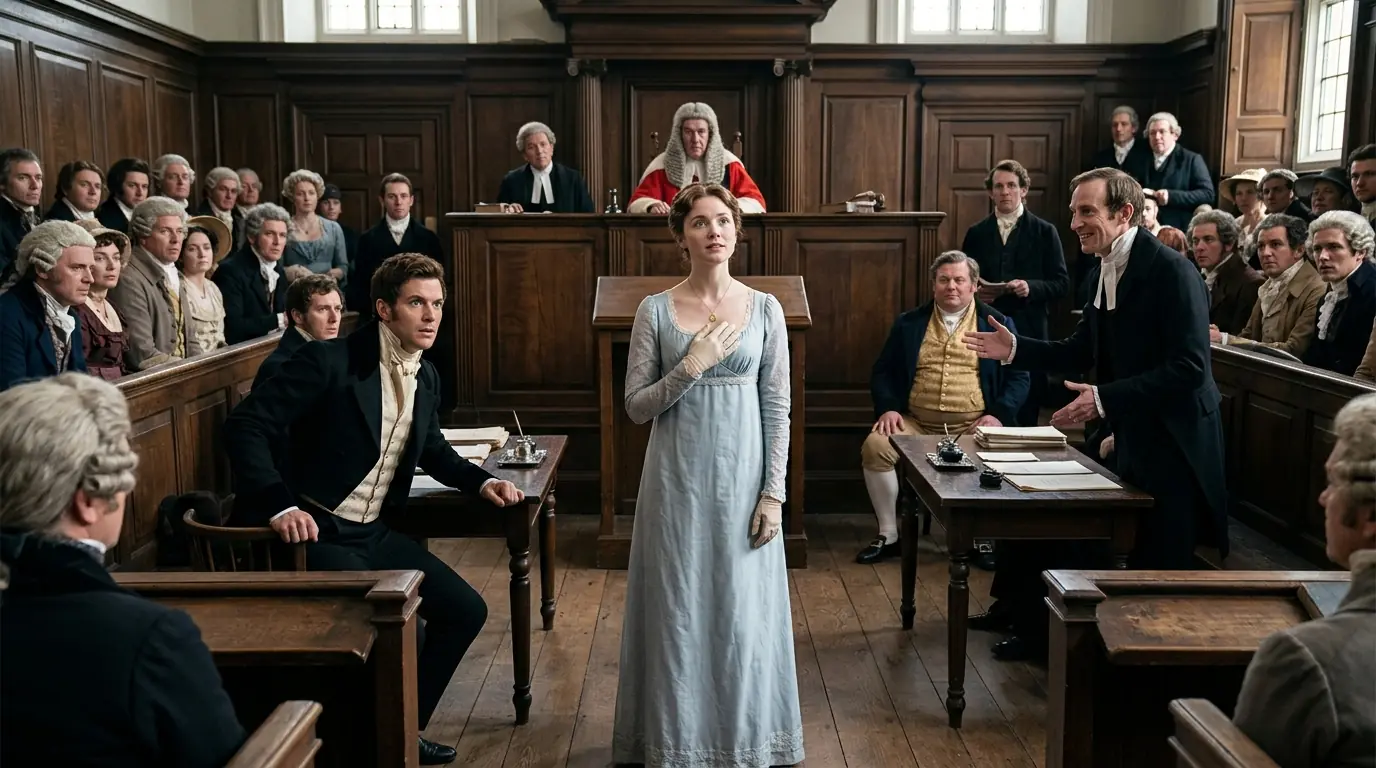
The hearing was held at the local assizes in a wood-paneled courtroom that smelled of dust and old secrets. Reginald Pounce sat across the aisle, a round, red-faced man in a waistcoat that was too tight. His solicitor, a weasel-faced fellow named Mr. Grindel, opened the proceedings with a blistering attack on the marriage.

“The Viscount and his bride met only once before the wedding,” Mr. Grindel declared. “They exchanged no letters, no tokens of affection. They were married in haste, in a private ceremony with no banns published. This is not a marriage of affection. It is a marriage of convenience designed solely to cheat my client of his rightful inheritance.”

Henry's solicitor, a calm, silver-haired man named Sir Geoffrey Thorne, rose to respond. “The Dowager Viscountess's will did not require a courtship. It required a genuine marriage. And that is what my client has entered into.”

The judge, an elderly man with bushy eyebrows and an air of profound boredom, peered down at the courtroom. “I shall hear testimony from the household staff. Bring in the first witness.”

One by one, the servants filed in. Cook, a stout woman with kind eyes, testified that she had seen the Viscount and Viscountess walking together in the gardens, that they seemed comfortable in each other's company. The former lady's maid, a thin, nervous woman named Mrs. Potts, testified that she had observed the couple at dinner, that they had talked and laughed like people who genuinely enjoyed each other.

But then Mr. Grindel called Mrs. Potts back for cross-examination.

“In the first week of the marriage,” he said smoothly, “did the Viscount and Viscountess share a bedchamber?”

Mrs. Potts flushed. “No, sir, they did not.”

“Did they appear affectionate? Did they touch? Did they speak warmly to one another?”

“They were polite, sir, but not affectionate. Not at first.”

Mr. Grindel turned to the judge, his smile thin and triumphant. “You see, my lord. A marriage of convenience. Two strangers forced together by circumstance. There was no genuine affection at the outset, which means the Viscount entered into this arrangement solely to satisfy the terms of the will.”

Lydia rose to her feet before she knew what she was doing. “May I speak, my lord?”

The judge raised an eyebrow. “This is irregular, madam. You are not a party to the proceedings in that sense.”

“I am the Viscountess Ravenshire,” Lydia said steadily. “I am very much a party to this, and I would like to tell the court the truth.”

Henry reached for her hand, but she gently pulled away. She walked to the center of the courtroom, her heart pounding, her voice clear.

“Mr. Grindel is correct that our marriage began as an arrangement,” she said. “Henry, Lord Ravenshire, told me the truth from the very beginning. He needed a wife to save his inheritance. I needed security for my family. We made a bargain, and we were honest about it.”

A murmur rippled through the courtroom. Reginald Pounce smirked. Lydia turned to face him.

“But what Mr. Grindel has not told you is that bargains can change. People can change. In the first week we were strangers. By the second week we were friends. By the third week...” She stopped, swallowed, and felt the tears prick at her eyes.

“By the third week, I had fallen in love with my husband. Not because I was forced to. Not because the will demanded it. But because he was kind and brave and afraid of being loved, and I wanted to be the one to teach him that love was not a weakness.”

She looked at Henry, who was watching her with an expression of such raw vulnerability that her heart ached.

“Our marriage was not perfect at the start,” she continued, “but it is real now. It is as real as anything I have ever known, and no solicitor, no linen draper, no court in England can take that away from us.”

The courtroom was silent. The judge leaned forward, his bushy eyebrows drawn together.

“Lord Ravenshire,” he said, “do you have anything to add?”

Henry stood. He walked to Lydia's side and took her hand, interlacing their fingers.

“Only this,” he said. “My grandmother wanted me to marry a woman of sense and loyalty. She wanted me to find a love that was real. And she was right about everything except one thing. She thought marriage would make me a better man. But it was not the marriage. It was Lydia. She made me want to be better. She made me want to be worthy of her.”

He turned to the judge. “You may rule as you see fit, my lord. You may take my estate and give it to Mr. Pounce. You may declare our marriage invalid. But you cannot make me stop loving my wife. That is beyond the power of any court.”

The judge was quiet for a long time. Then he sighed.

“Mr. Grindel,” he said, “you have raised legitimate concerns about the initial nature of this marriage. However, the Dowager Viscountess's will required that the marriage be genuine at the time of her grandson's inheritance, not that it begin with love, but that it become real. Based on the testimony I have heard, particularly from the Viscountess herself, I find that the marriage is indeed genuine. The will stands. The estate remains with Lord Ravenshire.”

Reginald Pounce exploded in protest, but the judge rapped his gavel and called for order. Lydia did not hear any of it. She was looking at Henry, and he was looking at her, and the rest of the world had dissolved into a blur of noise and motion.

“You were magnificent,” he whispered.

“I was terrified,” she admitted.

He cupped her face in his hands and kissed her, right there in front of the judge, the solicitors, the furious linen draper, and every servant who had ever doubted them.

“I love you,” he said against her lips. “Not because of a bargain, not because of a will, but because you are Lydia. And you saw me when no one else ever bothered to look.”

Lydia smiled, the first real, unguarded smile she had given him. “Then I suppose this marriage of necessity has become something else entirely.”

“What?”

She threaded her fingers through his and pulled him toward the door, leaving the courtroom and its tangled accusations behind.

“A love story,” she said. “Our love story.”

And as they walked out into the pale spring sunshine, Viscount Henry Ravenshire finally understood what his grandmother had known all along: that the greatest legacy was not an estate or a title, but a heart willing to risk everything for love.

He had found his.

The End.

News in the same category

News Post